The President, Nigeria Meteorological Society (NMetS), Prof.
Clement Akoshile, said on Monday, March 18, 2019 that the extreme hot weather
being experienced now would continue until the soil absorbs enough rain water.
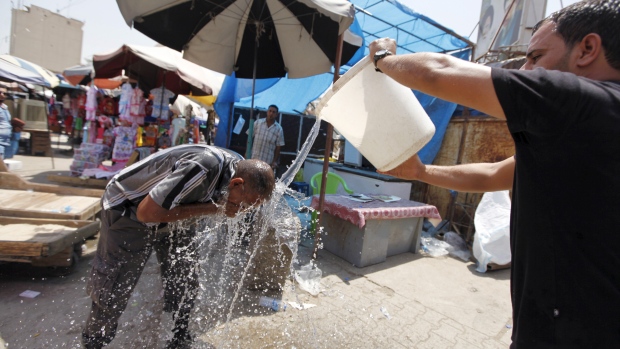
Hot weather: Cooling off amid searing heat wave
Akoshile, who said this in an interview with the News Agency
of Nigeria (NAN) in Lagos, noted that more or less moisture in the atmosphere
would affect the temperature and determine whether it would be cool or hot.
“Hot air constantly takes its energy from the earth’s
surface and is cooling it. If there is more evaporation, the temperature will
drop. If there is less evaporation, the temperature will rise.
“Then, when it rains, it pulls it back because the situation
has changed. The rain that falls on the earth’s surface will still want to
evaporate and cause heat.
“What happens is that when there is a hot blanket of cloud,
it can result into heat and there will be higher temperatures,’’ he said.
Akoshile said that the sun was constantly sending its
radiation into the earth’s surface, adding that if much of the radiation got
through, there would be more heat on the ground, the same way, if less got
through, there would be less heat on the ground.
The NMetS president said that what was happening at present
was that the weather was hot and many people are feeling the heat as a result
of the cloud cover. There might be spontaneous relief when some rain falls.
Akoshile said, however, that if the hot cloud cover was not
allowing the air to move freely on its own, the weather would continue to be
hot.
“Once the earth’s surface becomes dry, it will be difficult
for more evaporation to take place. As a result of this, whatever heat that is
coming will be heating the surface and end in the air.
“If the moisture were to be retained on the surface of the
earth for a long time, then the weather will be cool,’’ he explained.
Akoshile said that since there were limited amounts of rain
at this time, after the rain has been sucked by the earth, the surface, after a
little while, becomes dry.
He said that the radiation coming from the sun would then
heat up the earth’s surface again, causing heat everywhere and the weather
would become hot.
Director-General, Nigeria Hydrological Services Agency
(NIHSA), Mr Clement Nze, on Monday, March 18, 2019 attributed recurring
flash flood along Mararaba, Masaka area in Nasarawa State to failure to
enforce town planning regulations.
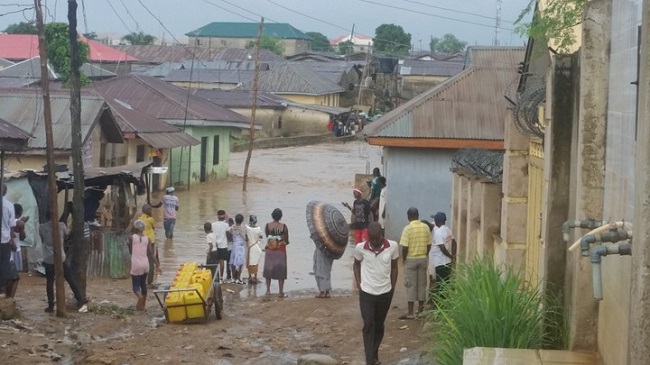
Flooding in Maraba
Nze made this known in an interview with the News
Agency of Nigeria (NAN) in Abuja.
According to him, prohibiting erection of building on
drainage channels, adequate drainage system and abstinence from dumping
refuse in waterways will reduce the incidence of flash floods in Mararaba.
Mararaba and its environs have witnessed heavy rainfall
three times since the beginning of the year which caused flash flood in the
area.
According to him, flash flood comes unannounced and
depending on intensity or how heavy the rain is and its duration.
The NIHS boss said that such rain could wreak a lot of
havoc if there were not enough drainage channels to guide the
volume of water.
He, therefore, advised the residents at flood plain areas to
desist from dumping of rubbish into the water channels as this could also
contribute to such development.
“Like what happened in Lugbe in FCT, Mararaba in Nasarawa
State, is either there is inadequate drainage system, or the drains are
blocked by human beings, what we called ‘’anthropogenic activities of
man”.
Nze stressed the need for governments at all levels to
enforce town planning regulations to prohibit building on flood plains
and forestall flood whenever it rained.
“Governments at all levels have role to play, don’t allow
the high and the mighty in the society to go and acquire lands at the places we
called flood plains.
“These are the natural passage of water, don’t go and
acquire land there to avoid blocking the water channel.
“If you recall the action by the current Governor of Kaduna
State Malam Nasir El-Rufai, when he was the Minister of Federal Capital
Territory (FCT) around 2003.
“His action by pulling down so many structures have saved
the FCT environment from flooding and I think this is what other government
officials should also do, ‘’ he advised.By Okon Okon
The Federal Government says it is committed to enhancing
Nigeria’s development through the implementation of the Sustainable
development Goals (SDGs), calling for support from relevant stakeholders.
Senior Special Assistant to the President on Sustainable Development Goals, Princess Adejoke Orelope-Adefulire
Mrs Adejoke Adefulire, the Senior Special Assistant to the
President Muhammadu Buhari on SDGs, who said this on Monday, March 18, 2019 in
Lagos, called for support from relevant stakeholders.
She spoke at the Community Agenda for Peace, a SDGs Media
Forum. The event had its theme as: “Becoming Agent of Sustainability”.
Adefulire, represented by Dr Bala Yunusa, her Technical
Adviser, said the key mandate of the office was to provide, coordinate and
ensure inclusive implementation of the SDGs, leaving no one behind.
According to her, the SDGs are integrated into the national
polices with a view to providing frameworks for its accomplishment.
She said the office was partnering with Ministries,
Departments and Agencies (MDAs) and the National Bureau of Statistics (NBS) for
reliable data on progress of the SDGs.
“We cannot continue to rely on international statistics
about SDGs, so we are partnering NBS for periodical/annual statistical reports
on achievements of Goals.
“The Millennium Development Goals (MDGs) might not have made
remarkable achievements because it kicked off late in 2016, without a baseline
and amid economic recession.
“For the 2030 agenda and the 17 SDGs, we have strategic
plans to achieve success by holding the leaders accountable.
“We believe that before 2030, which is the deadline for the
SDGs, remarkable achievements would have been attained,” Adefulire said.
Mrs Adenike Olufade, Chief Executive Officer, Digimage
Consult Ltd., called on Nigerians to promote gender equality by recognising
women’s participation in economic development of the country.
Olufade stressed the need to give equal opportunities to
both men and women in economic decisions that would develop the nation and
urged the media to protect the rights of women using the media handles.
Earlier, Mr Obuesi Phillips, President, SDG Media Forum, emphasised
the need to strengthen capacity of the media to monitor, fast track and present
balanced report on SDGs.
Phillips said it was the responsibility of the media to set
agenda towards achievement of the goals, saying that the media is a vital
mechanism to achieve SDGs.
“Considering our commitment to the full implementation of
the SDGs in Nigeria particularly, we have been concerned about the
possibilities of the SDGs going ‘off-track’ like the MDGs.
“We must note that when MDGs went off-track, a whole lot of
expectations also went off-track with it.
“The result was increased and widespread hunger, increasing
poverty, unemployment and youth restiveness across the states of the
federation.
“The question therefore will be, what can we as a people do to ensure that the SDGs, unlike the MDGs, do not go off-track?” he asked.
A 17-year-old and founder of U-Recycling Initiative Nigeria,
Oluwaseyi Moejo, has called on government at all levels to promote policies
that will support and promote recycling system in schools.
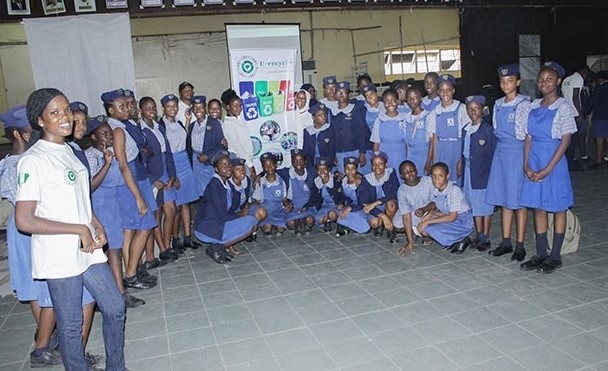
Oluwaseyi Moejo (left) has called on governments to promote policies that will promote recycling system in schools
Moejo made the call in an interview with the News Agency of
Nigeria (NAN) during the celebration of the Global Recycling Day in Lagos
on Monday, March 18, 2019 with the theme: “Save the planet, support recycling”.
The founder, who is a law student of the University of
Lagos, said that such policies would ensure the reduction of the amount of
waste generated, especially in schools, which would encourage students to learn
how to recycle their wastes from the source.
“In Nigeria, various non-governmental organisations,
companies and business are into promoting awareness and leading recyclable
waste collection systems.
“However, this is more prevalent in a commercial state like
Lagos.
“One recycling issue we face is that in most states and
rural areas, there is little or no activity going on to promote recycling
education and sustainable practices as the people in these rural areas are
still oblivious to this.
“A vast majority are ignorant of the need to work together
to solve issues like climate change, poor waste management as government works
to promote proper awareness in schools and communities.
“U-Recycle Initiative Nigeria is a team of over 40 young people aimed at promoting a sustainable and eco-friendly recycling culture in Nigeria through schools and community’s engagement,” she said.
Moejo said that recycling played a role in protecting the
environment, promoting good public health and preserving the planet.
According to her, recycling will inspire the younger
generation to make positive commitment toward protecting the environment.
“I strongly believe that a lot of work needs to be done to
promote recycling and sustainable practices in Nigeria.
“Therefore, U-Recycle is ready to synergise with various
other environmental organisations and put in our best to promote recycling and
environmental consciousness in Nigeria and beyond.’’
NAN reports that no fewer than 200 guests including 10
schools, and other environmental organisations were present at the one-day
event.
The event also featured Up-cycle fashion Show, recycle games
and recycle art exhibition contest.
The multi-purpose recycling plant at the Ilokun dump site in Ado-Ekiti, Ekiti State, needs the urgent attention of the state and federal governments.
Governor Kayode Fayemi of Ekiti State
A News Agency of Nigeria (NAN) correspondent who visited the
site on Monday, March 18, 2019 reports that the plant is at the verge of
collapse if there is no urgent attention to restore it.
The multipurpose recycling plant is among the 26 others
inaugurated by the Federal Government in 2012 under the Waste to Wealth
Initiative.
The initiative, it was gathered, was aimed at ensuring the
recycling of plastic materials for industrial use toward generating income for
government and create employment opportunities.
The NAN visit to the plant, however, showed that majority of
the machines have packed up as confirmed from an interaction with a casual
plant operator who claimed that he was paid N10,000 monthly.
According to him, at the inauguration of the plant, several
modern machines worth millions of Naira were installed among which are the
melting machine, granulator, crusher, cooler, power plant, compressor among
others.
He said that it had been awhile that they operated due to
the state of the facilities which he claimed had gone bad for some years
without intervention by government.
Director of Operations with the Ekiti State Waste Management
Board, Mr Osalusi Ayoola, and the main plant operator, Mr Olu Ajayi, confirmed
that the plant had been underutilised, but blamed the development on lack of
power and poor funding by government.
The officers affirmed that what the immediate past
government under former Gov. Ayo Fayose was offering the board for waste
management was not even enough to cater for clearing of refuse, let alone
maintenance of the plant.
The plant operators also confirmed that the plant was
currently lacking the necessary facilities that could ensure smooth operations,
saying those available had gone bad and unattended to.
The director and the plant operator both agreed that the
plant if well managed, would boost the economy of the state but wondered over
the poor attention of government.
“It is under the supervision of Ekiti State Waste Management
Agency, but the plant is not on the priority list of the state government.
“Since September 2012 that the plant was handed over to the
state government for operation, there has been no budgetary allocation to run
it efficiently, but we have the hope that the present administration of Dr
Kayode Fayemi will do something.
The Permanent Secretary, the Ministry of Environment, Mr
Ibitoye Adeyiola, said that he was recently posted to the ministry.
“Aside that, I have no authority to speak with any
journalist on any matter as a civil servant but will implore you exercise some
patience until a commissioner is appointed for any clarifications,” he said.
An environmental cleaning company, Chanja Datti Ltd, on
Monday, March 18, 2019 sensitised students of Local Education Authority Primary
School, Gwarinpa and traders in Gwarinpa Fruits Market to the importance of
recyclable waste.
Traders
The sensitisation was to ensure that youths engaged in
recyclable waste for their empowerment and environmental cleanliness.
Managing Director of the company, Mrs Olufunto Boroffice,
led the Sensitisation and Awareness Walk team to the school and market to commemorate
the 2019 World Recycling Day.
The 2019 Global Recycling Day, which has “Youth and
Innovation” as its theme, is being celebrated on every March 18.
Boroffice said that the the sensitisation campaign was to
raise the consciousness of people toward recycling of wastes to protect and
preserve the environment.
“We take sensitisation campaign to school and market because
students and traders are generators of recyclable and non recyclable wastes,”
the managing director said.
She urged them to sort out recyclable waste from the
generated waste to earn money to sustain their livelihood and promote healthy
environment.
According to her, looking out for recyclable waste will also
reduce volume of waste in various damping sites drastically.
Boroffice said that her company in collaboration with United
Nations Development Programme (UNDP), Jaiz Bank Plc and Abuja Environmental
Protection Board (AEPB) operated “Trash to Cash Recycling Hubs Project’’ in
five locations in Abuja.
She listed the locations to include Garki Old Market, Wuse
Market, Gwarinpa, Kado and Lugbe.
According to her, the project is aimed at buying and
collecting recyclable waste at the sum of N20 per kg.
“Recyclable wastes include cans, papers, cartons, batteries,
pet bottles, hard plastics and pure water sachet.
“This is a waste to wealth project because it empowers
people and helps in cleaning our environment,’’ Boroffice said.By Deji Abdulwahab
The Nigeria Institution of Environmental Engineers (NIEE) on
Monday, March 18, 2019 said it would intensify campaign on proper waste
management particularly, the electronic waste (e-waste) for a greener and safer
environment.
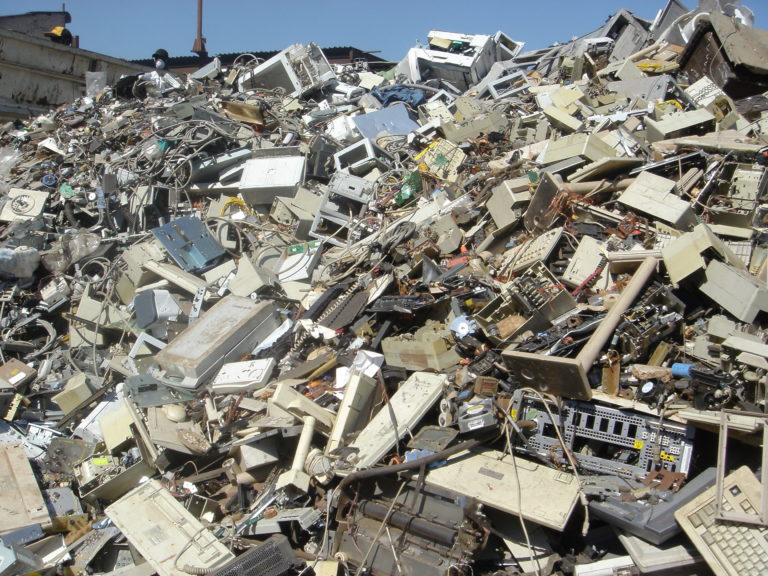
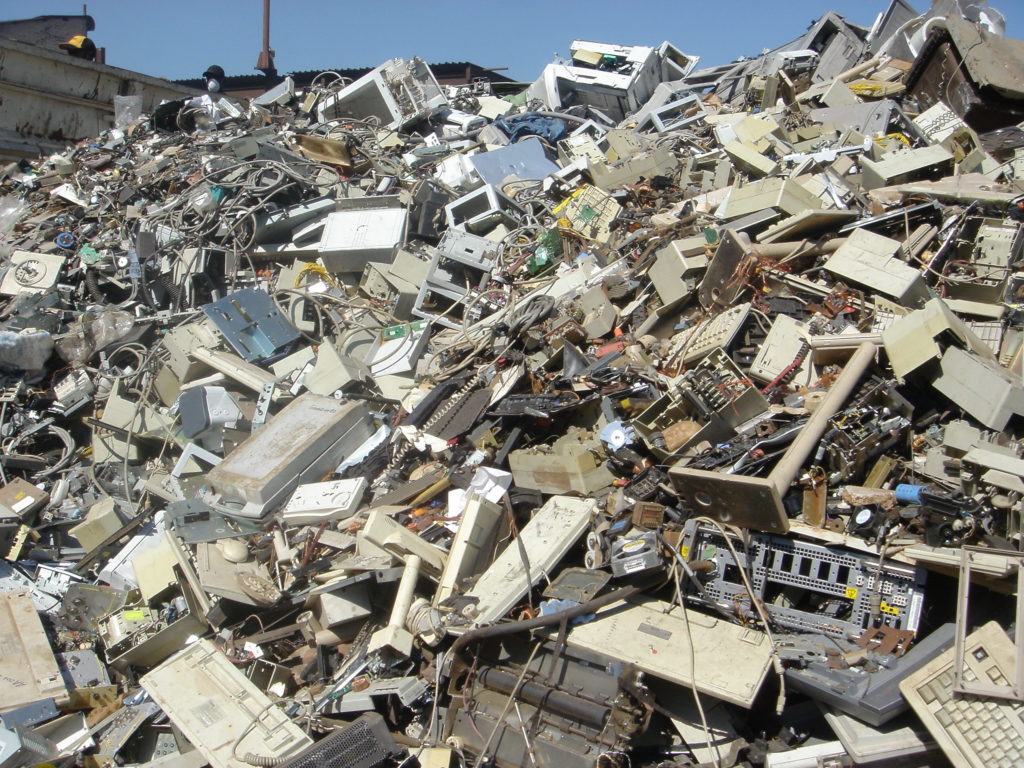
E-waste
Chairperson of NIEE, Mrs Abiola Kosegbe, made this known in an interview with the News Agency of Nigeria (NAN) in Lagos at the sideline of the facility tour of Eterra on e-waste management.
NIEE is an institution that caters for the development of
professionals interested in the development of the environment.
E-waste describes discarded electrical or electronic devices. Used electronics which are destined for reuse, resale, salvage, recycling, or disposal are also considered e-waste.
Kosegbe said that, as professional engineers on environment,
there was need to promote greener and cleaner environment and bring to lime
light, facilities that would promote such, hence the visit.
She said that the institution became interested and
initiated the visit when having heard about the facility.
She added that NIEE was interested in partnering with Eterra
to assist it in promoting cleaner and safer environment.
Kosegbe commended the company for a first-class work on
management of e-waste, saying e-waste was one of the very difficult wastes to
manage.
According to her, there is mismanagement of e-waste in this
part of the world where people import and use lots of used electronic waste,
only to mismanage them.
“So, as it is now, our interest is to bring Eterra to the
limelight, so that people are aware that these facilities are available to
manage the e-waste.
This is in accordance to the internationally accepted
standard.
“The issue of waste has been ongoing for a long time; the
Lagos state government has developed and put in place policies toward the
management of e-waste.
“Even the management of the normal waste is still an issue
but with such facility and awareness, there will be proper management of
e-waste.
“So, as an institution, we will continue to create awareness and enlighten the people on proper management of e-waste,” she said.
According to Kosegbe, the campaign and enlightenment are necessary because e-waste is monstrous in nature and hazardous to human health.
“Hence, the campaign of proper management of waste in general and e-waste in particular for a cleaner, safer and eco friendly environment is encouraged, “she said.
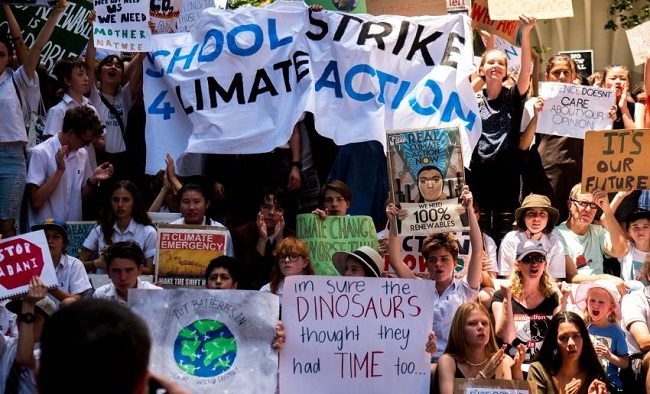
Hundreds of thousands of young people left their classrooms
and filled the streets on Friday, March 15, 2019 to demand real climate
action, only two days after the release of new research by UN Environment warning that devastating
temperature rises in the Arctic might now be inevitable.
A school climate strike
The students engaged in an inspirational wave of activism
across the world, striking for action on climate change in more than 2050
places in 123 countries across the world including South Africa, Namibia, Madagascar,
Kenya, Tanzania, Senegal, Ghana, Nigeria, and even Antarctica.
As dramatic climate change impacts hit communities all over
the world – from tropical cyclones and floods in Africa to typhoons in the Pacific and violent wildfires caused by hotter winter days taking
over Britain – the School Strikes for Climate posed adults a crucial question:
will you use your power to address the climate crisis now?
In response, Greenpeace Africa said: “As an environmental
campaigning organisation, Greenpeace Africa is humbled and inspired by the
thousands upon thousands of school children coming out today to demand action
on the climate crisis. The global climate movement is reaching new heights
today, with youth at the centre. They clearly understand that climate change is
a threat to their opportunities and future. Our youth are sick and tired of
excuses and want to see bold action to avoid catastrophic climate change. The
question is: how can governments possibly ignore their call?
“Greenpeace Africa fully supports the school strikes
for the climate and asks governments across Africa to come up with climate
actions that are clearly in line with the Paris climate agreement. We do not
have any time to waste.”
May Boeve, 350.org Executive Director, said: “Young
people from all corners of the globe are laying bare a truth that many of
us have been too scared to tell ourselves: that the climate crisis is so urgent
that half-measures will no-longer abide. And that this crisis is being
driven by some of us adults – those who want to continue profiting from fossil
fuel extraction and business as usual.”
“Where the authorities fail, people have only one
choice: to lead. We are seeing that today in over 2000 strikes for the climate
in more than 120 countries across the world.”
The UN Environment report, released in Nairobi on Wednesday,
estimates that winter temperatures at the North Pole are likely to rise by at
least 3oC above pre-industrial levels by 2050, and that even if global
emissions were to halt overnight, winter temperatures in the Arctic would still
increase 4°C to 5°C by 2100 compared to the late 20th century.
Boeve stated: “This latest report solidifies the
evidence of what we already know: only concrete actions to shift off coal,
oil, and gas immediately can keep us safe from the worst effects of global
warming.
“We have very little time to act to free our world from
fossil fuels, and build a more equitable and safe future for all. Young people
have already realized this. But what about us adults? We must listen to
their demands and use our power, as the grown-ups in the room, to change
things.”
The world on Friday, March 15, 2019 laid the groundwork for
a radical shift to a more sustainable future, where innovation will be
harnessed to tackle environmental challenges, the use of throwaway plastics
will be significantly reduced, and development will no longer cost the earth.
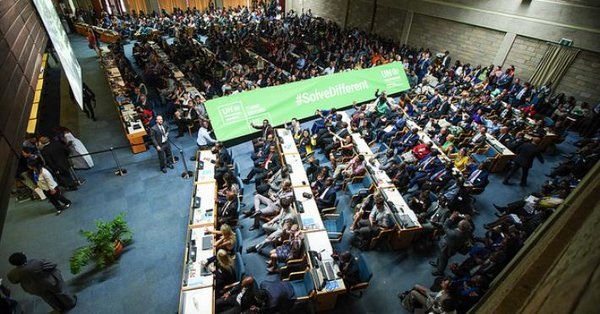
A UNEA-4 plenary
After five days of talks at the Fourth UN Environment
Assembly in Nairobi, ministers from more than 170 United Nations Member States
delivered a bold blueprint for change, saying the world needed to speed up
moves towards a new model of development in order to respect the vision laid
out in the Sustainable Development Goals for 2030.
Noting that they were deeply concerned by mounting evidence
that the planet is increasingly polluted, rapidly warming and dangerously
depleted, the ministers pledged to address environmental challenges through
advancing innovative solutions and adopting sustainable consumption and
production patterns.
“We reaffirm that poverty eradication, changing
unsustainable and promoting sustainable patterns of consumption and production
and protecting and managing the natural resource base of economic and social
development are the overarching objectives of, and essential requirements for,
sustainable development,” the ministers said in a final declaration.
“We will improve national resource management strategies
with integrated full lifecycle approaches and analysis to achieve
resource-efficient and low-carbon economies,” they said.
More than 4,700 delegates, including environment ministers,
scientists, academics, business leaders and civil society representatives, met
in Nairobi for the Assembly, the world’s top environmental body whose decisions
will set the global agenda, notably ahead of the UN Climate Action Summit in September.
As well as pledging to promote sustainable food systems by
encouraging resilient agricultural practices, tackle poverty through
sustainable management of natural resources, and promote the use and sharing of
environmental data, ministers said they would significantly reduce single-use
plastic products.
“We will address the damage to our ecosystems caused by the
unsustainable use and disposal of plastic products, including by significantly
reducing single-use plastic products by 2030, and we will work with the private
sector to find affordable and environmentally friendly products,” they said.
To address critical knowledge gaps, ministers promised to
work towards producing comparable international environmental data while
improving national monitoring systems and technologies. They also expressed
support for UN Environment’s efforts to develop a global environmental data
strategy by 2025.
“The world is at a crossroads but today we have chosen the
way forward,” said Siim Kiisler, President of the Fourth UN Environment
Assembly and Estonia’s environment minister. “We have decided to do things
differently. From reducing our dependence on single-use plastics to placing
sustainability at the heart of all future development, we will transform the
way we live. We have the innovative solutions we need. Now we must adopt the
policies that allow us to implement them.”
The Assembly started on a sombre note after the crash of an
Ethiopian Airlines flight from Addis Ababa to Nairobi, which claimed the lives
of all 157 people on board, including UN officials and other delegates who were
travelling to the meeting. A minute’s silence was held for the victims at the
opening ceremony, where officials also paid tribute to their colleagues’ work.
At the close of the Assembly, delegates adopted a
series of non-binding resolutions, covering the logistics of shifting to a
business-unusual model of development.
These included a recognition that a more circular global
economy, in which goods can be reused or repurposed and kept in circulation for
as long as possible, can significantly contribute to sustainable consumption
and production.
Other resolutions said Member States could transform their
economies through sustainable public procurement and urged countries to support
measures to address food waste and develop and share best practices on
energy-efficient and safe cold chain solutions.
Resolutions also addressed using incentives, including
financial measures, to promote sustainable consumption while encouraging Member
States to end incentives for unsustainable consumption and production where
appropriate.
“Our planet has reached its limits and we need to act now.
We are delighted that the world has responded here in Nairobi with firm
commitments to build a future where sustainability will be the overarching
objective in everything we do,” said UN Environment’s Acting Executive Director,
Joyce Msuya.
“If countries deliver on all that was agreed here and
implement the resolutions, we could take a big step towards a new world order
where we no longer grow at the expense of nature but instead see people and
planet thrive together.”
A key focus of the meeting was the need to protect oceans
and fragile ecosystems. Ministers adopted a number of resolutions on marine
plastic litter and microplastics, including a commitment to establish a
multi-stakeholder platform within UN Environment to take immediate action
towards the long-term elimination of litter and microplastics.
Another resolution called on Member States and other actors
to address the problem of marine litter by looking at the full life-cycle of
products and increasing resource-efficiency.
UN Deputy Secretary-General Amina Mohammed, who attended the
summit on Thursday, said action on unsustainable resource use was no longer a
choice, but a necessity.
“As Member States have stated during vibrant debates,
alongside civil society, businesses, the science community and other
stakeholders here in Nairobi, it is yet possible to increase our well-being,
and at the same time maintain economic growth through a clever mix of climate
mitigation, resource efficiency and biodiversity protection policies,” she
said.
As evidence mounts of the devastating effects of human
activity on the health of the planet, a global clamour for swift action is
rising. As delegates prepared to leave Nairobi on Friday, hundreds of thousands
of students in around 100 countries took to the streets as part of a global
protest movement inspired by Swedish student Greta Thunberg.
Speaking during the Environment Assembly on Thursday, French
President Emmanuel Macron said young people were right to protest and that the
world needed their anger to drive faster, more forceful action.
“We believe that what we need, given the situation we live
in, are real laws, rules that are binding and adopted internationally. Our
biosphere faces total devastation. Humanity itself is threatened. We cannot
simply respond with some nice-sounding principles without any real impact,”
President Macron said.
President Kenyatta also said that the world needed to act
now to address record levels of environmental degradation, food insecurity,
poverty and unemployment.
“Current global statistics are indeed quite
sobering and projections for the future generations are dire and demand urgent
action from governments, communities, businesses and individuals,” he said.
THE Federal Government has disagreed with
those who describe the Paris Agreement Rule Book as a wild goose chase and a
complication of the climate improvement programme.
Participants at the Roundtable on “Legal Preparedness for the Implementation of the Paris Agreement Rule Book” in Lagos on Thursday, March 14, 2019
Director, Department of Climate Change in
the Federal Ministry of Environment (FMOE), Dr Peter Tarfa, defended the Federal
Government at the Roundtable on “Legal Preparedness for the Implementation of
the Paris Agreement Rule Book” in Lagos on Thursday, March 14, 2019.
He made a presentation titled: “Overview of
Nigeria’s National Climate Response Measures: Policies and Strategies” at the daylong
forum.
The Paris Agreement is a pact within the
United Nations Framework Convention on Climate Change (UNFCCC), dealing with
greenhouse-gas-emissions mitigation, adaptation and finance, starting in the
year 2020.
Organised by Environmental Resource Centre
(ERC) and Rule of Law Expertise of the United Kingdom (ROLE UK), the event had representatives
of the Lagos State Government, civil society, private sector and international
community as participants.
After the coordinator of Nigeria Climate
Action Network (CCN Nigeria), Mr. Huzi Mshelia, had presented his “Climate
Change Governance in Nigeria: Legal Framework for Climate Change
Decision-making”, some of the participants expressed cynicism that the Rule Book
“has come to complicate issues in the Paris Agreement.”
Those in this school of thought include the
president of Green Alliance Nigeria and Head of Legal Services, Environmental
rights Action (ERA), Chima Williams.
The cynicism is fuelled by the attitude of
industrialised countries like the United States and China towards the Paris
Agreement.
Another issue is that the nationally
determined contributions (NDCs) of the pact have different timelines.
Tarfa described promotion of environmental
issues in Nigeria as herculean, adding that even to defend the ministry’s
budget before the National Assembly is difficult, as the lawmakers prefer
physical projects.
He, however, noted that government had been
recording achievements as regards environment protection.
“We have succeeded in establishing climate
change desks in the Federal Ministry of Environment and across the states. Even
Cross River State has a ministry of climate change,” he said.
On the different timelines of the NDCs, he
said that a lot of them were put together by foreign consultants.
The director listed government’s efforts to
reach the Paris Agreement goal, which is to keep global average temperature
increase well below two degrees centigrade.
He referred to emerging rail transport,
eco-friendly filling stations initiated by Total, and new buildings with solar
panel roofs as proof of government’s efforts to meet its 2030 NDC timeline.
“It pains us when people sit down and tout
that government is doing nothing,” he said, adding that subsequent efforts
would be more ambitious.
Other papers presented at the event include
“International Climate Regime: Paris Climate agreement and Emerging Issues” by
Christoph Schwarte of Role UK.