National Oil Spills Detection and Response Agency (NOSDRA)
says it has commenced investigations into the explosion at Nembe Creek
Oilfields within OML 29 operated by Aiteo Eastern Exploration.
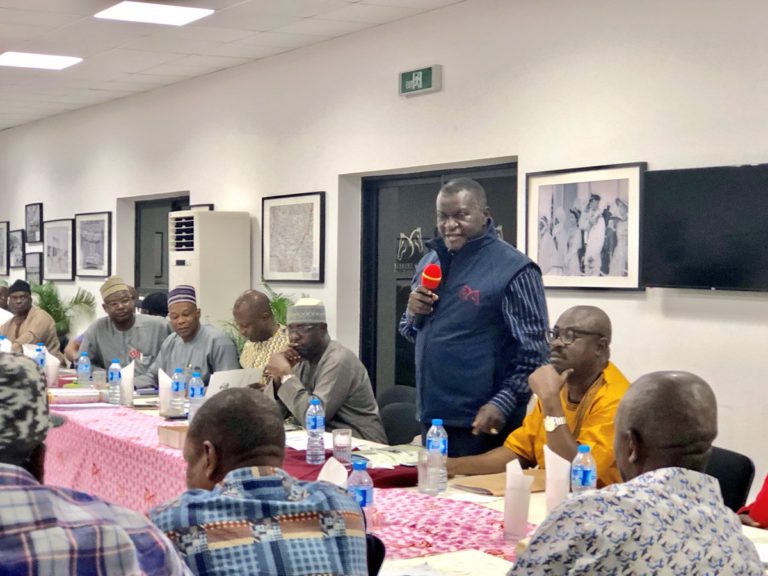
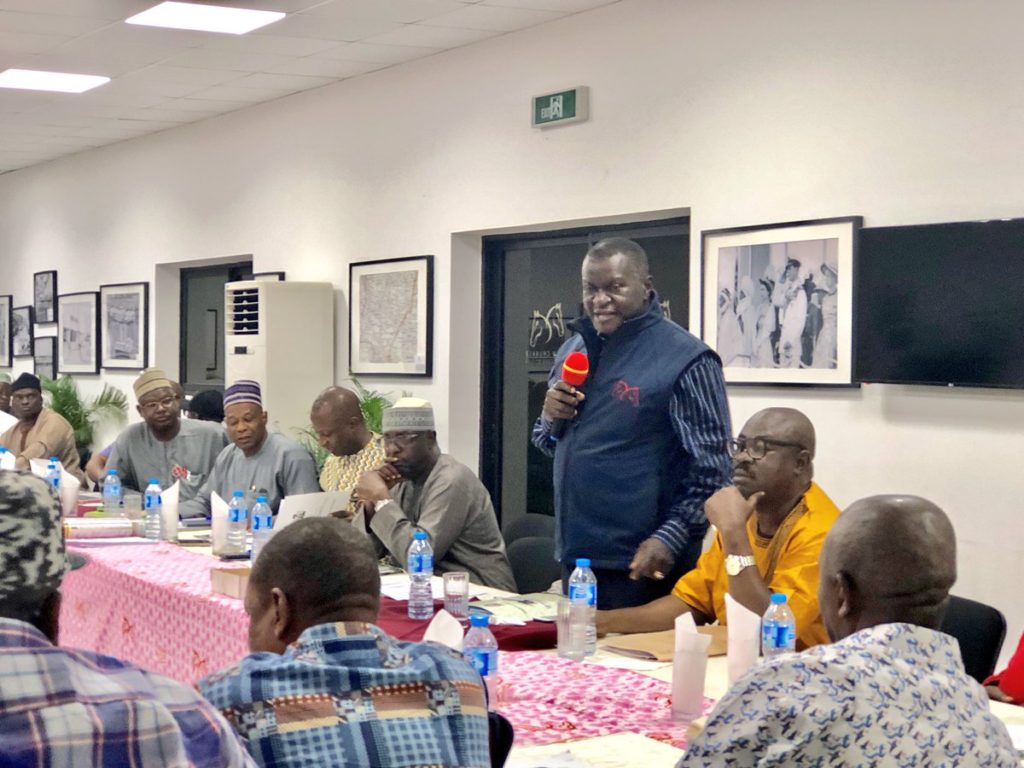
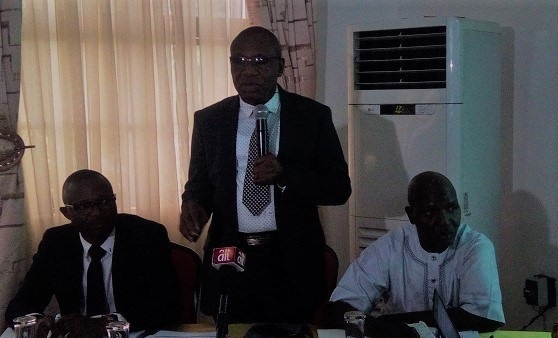
Director-General, National Oil Spill Detection and Response Agency (NOSDRA), Peter Idabor
An explosion from an oil well within the oil block on March
1, 2019 ignited a fire which Aiteo officials said was put off on March 2.
An official of NOSDRA, Bayelsa Ministry of Environment and
11 others in 2016, died from a pipeline explosion at Agip’s oilfield in
Southern Ijaw Local Government of Bayelsa State.
NOSDRA Director-General, Dr Peter Idabor, told NAN in a
telephone interview on Wednesday, March 6, 2019 that a Joint Investigative
Visit (JIV) had been scheduled for Tuesday to ascertain the possible cause of
the incident.
The volume of crude and gas discharged into the
surrounding environment arising from the explosion is yet to be ascertained
But Idabor explained that the JIV, a statutory probe of leak
incidents in the oil and gas sector, would determine the cause of the
explosion, volume of oil leakage as well as assess damage to the environment.
He said that a JIV report signed by representatives of the
community, NOSDRA, Bayelsa State Government and the oil firm who participated
in the investigation was expected at the end of the probe.
The D-G explained that NOSDRA was monitoring the situation
to ensure that the site was safe ahead of commencement of investigations.
“Safety is a top priority in the sector; we were monitoring
developments to ensure that another explosion doesn’t go off; so, we have got
assurances from the oil company that the place is safe.
“A JIV has been scheduled for today and our intention is to
assess the situation and find out what happened,” Idabor said.
Shell Petroleum Development Company (SPDC), in 2015, divested its equity in OML 29 and transferred its interest for $1.7 billion to Aiteo, an indigenous Oil and Gas Exploration and Production firm.
However, a statement signed by Management of the oil firm
made available by its Public Relations Manager, Mr Ndiana-Abasi Mathew on March
2, confirmed that there was no human casualty.
Aiteo pledged that investigation into the incident was a
priority.
“On March 2, 2019, a suspected explosion occurred within the
vicinity of Nembe Creek Well 7, behind Mile 1 Community in Bayelsa State, which
is not too far from Nembe field logistics base
“Despite initial challenges, our operations team was able to
access the well head area when the fire had completely died down on early hours
of March 2.
“Preliminary investigations confirm that there were no
fatalities; human incidents or damage to community property. All the wells and
facilities in the immediate vicinity have been inspected and secured.
“Full investigations to determine the cause of the fire and
in particular, to determine whether this may have been caused by a third-party
infraction remain ongoing.
“These investigations are being pursued with the utmost
urgency and are have been given the highest priority.
“We are continuing to work with all the relevant
authorities to restore full functionality to all the relevant installations and
affected areas,” Aiteo stated.
With a 95% share of renewables in its electricity matrix and
solid achievements to prevent deforestation – 52% of the national territory is
covered by forests – the Central American nation of Costa Rica is already a
world leader in terms of environmental sustainability. However, Costa Rica wants
to go further and be an international example of climate action and ambition.
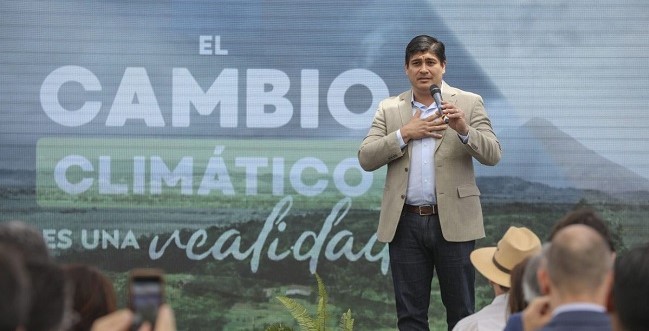
Costa Rican President, Carlos Alvarado Quesada, during the presentation of the 2018-2050 National Decarbonisation Plan
Costa Rica has adopted a plan to achieve a zero net
emissions economy by 2050, in line with the objectives of the Paris Climate
Change Agreement.
“Decarbonisation is the great challenge of our
generation and Costa Rica must be among the first countries to achieve it, if
not the first,” said Costa Rican President, Carlos Alvarado Quesada, on
February 24, 2019 during the presentation of the 2018-2050 National Decarbonisation
Plan in the capital, San José.
With the goal of reducing greenhouse gas emissions, the plan
includes significant measures in basic infrastructure and economic sectors such
as the public and private transport, energy, industry, agriculture, waste
management and soil and forest management.
In addition, the plan establishes a roadmap for modernizing
the economy, generating jobs and boosting sustainable growth.
Costa Rica will incorporate these measures in its new
national climate action plan to be presented to UN Climate Change (also known
as the United Nations Framework Convention on Climate Change, or UNFCCC), by
2020.
In 2020, the signatories of the Paris Agreement are to
present a new round of their climate action plans, formally know as nationally
determined contributions (NDC). The first round of NDCs was submitted ahead of
the approval of the agreement in 2015.
These contributions describe each country’s plans to help
achieve the ultimate goal of the agreement, which is to limit the increase of
the global average temperature as close as possible to 1.5 degrees Celsius,
thereby preventing the worst impacts of climate change.
Costa Rica’s plan includes concrete goals in strategic
sectors such as transport, which is currently one of the country’s major
sources of greenhouse gas emissions. By 2035, 70% of all buses and taxis are
expected be electric, with the goal of full electrification by 2050. As for
private transportation, measures will be taken so that users gradually abandon
fossil-fueled cars and opt for zero-emission vehicles and car-sharing.
As for electricity production, which currently comes to 95%
from renewable sources (mainly hydroelectric power), the country wants that
percentage to reach 100% by 2030. In addition, measures will be taken to ensure
that, by 2050, electricity will be a primary energy source for the transport
sector, residential, commercial and industrial usages.
The plan envisages measures to reduce the carbon
footprint of the national agriculture sector and to increase the forest area
from the current 52% to 60% by 2030.
The presentation of Costa Rica’s Decarbonisation Plan was
attended by Mexican diplomat Luis Alfonso de Alba, special envoy of the UN
Secretary-General for the Climate Action Summit to be held in New York on September
23. This was very fitting, given that the objective of the Summit is for
nations to increase the levels of ambition of their climate action plans.
Ambassador De Alba thanked Costa Rica for the leadership it
is demonstrating with these long-term climate goals. De Alba invited President
Alvarado to use that leadership in the region to encourage other Latin American
leaders to present equally ambitious targets when they meet in September in New
York.
Costa Rica has meanwhile received numerous congratulatory
messages from international leaders from around the world, including from UN
Secretary-General, António Guterres, transmitted by Ambassador De Alda during
the event; that of former US Vice President Al Gore; Spanish President, Pedro
Sánchez; the UN High Commissioner for Human Rights, Michelle Bachelet; and the
UN Executive Secretary for Climate Change, Patricia Espinosa.
Kenyan manufacturers on Wednesday, March 6, 2019 pledged
support for a global initiative to manage plastic waste that had worsened
pollution of marine life and other biodiversity hotspots in rapidly developing
economies.
Sachen Gudka, Chairperson of Kenya Association of Manufacturers
Sachen Gudka, Chairperson of Kenya Association of Manufacturers,
said endorsement of the Ocean Plastics Charter by local industries would
stimulate growth of circular economy that has been a source of jobs for the
youth.
“We support the Ocean Plastics Charter that seeks to address
environmental pollution while unleashing new jobs in waste recycling and
re-use,” Gudka said in Nairobi.
“Sustainable management of plastics has resonated with the
local private sector that is keen to offer innovative and business friendly
solutions to solid waste pollution,” he added.
Major industrial powers and multinational firms in 2018
endorsed the charter that aims to reduce production and use of
non-biodegradable packaging materials responsible for rampant pollution of
large water bodies.
Gudka said that Kenyan manufacturing entities were keen to
adopt global best practices that could provide durable solution to plastic
waste that is a threat to human health.
“Local manufacturers have been implementing plastics
extended producer responsibility (EPR) schemes as part of our response to the
pollution menace.
“Waste management has a direct bearing on our bottom lines and reputation,” said Gudka.
Kenya has prioritised robust public private partnerships to boost management of plastic waste in the fast-growing cities.
Geoffrey Wahungu, Director-General, National Environment
Management Authority, said the government had rolled out incentives to boost
private sector investments in plastic waste recycling.
“There are predictable policies in place to facilitate
greater participation of industry in recycling of plastic waste,’’ said
Wahungu.
He said the government would increase budgetary allocation
towards research and innovations that could promote sustainable waste
management.
Kenya’s ministry of environment in August 2017
enforced a ban on production and use of single use plastic bags in a bid to
reduce pollution that was taking a heavy toll on fragile ecosystems.
The United Nations Population Fund (UNFPA) has inaugurated
the Progress Report on 2018 Demographic Dividend in West and Central Africa
with a call for multiplying strategic partnership and scaling up successful
demographic dividend capture initiatives.
Mr Mabingué Ngom, Regional Director of UNFPA for West and Central Africa
The agency has also renewed its call for West and Central
African countries to take advantage of its population growth, to derive maximum
benefits of demographic dividends in the region.
Ms Kori Habib, Media Specialist UNFPA Nigeria and Habibou
Dia, Media Specialist UNFPA West and Central Africa Regional Office, announced
this in a statement on Wednesday, March 6, 2019 in Abuja.
It said Mr Mabingué Ngom, Regional Director of UNFPA for
West and Central Africa and Mr. Auguste Pareina, Dean of the Diplomatic Corps,
unveiled the report in Dakar, Senegal.
It reported the regional director as saying that available
record puts population growth rate of sub-Saharan Africa at 2.7 per cent,
stressing that the record strongly militated against the continent’s
development.
Ngom had also said, in parallel with the rapid
population growth, there was a drastic reduction in resources in sub-saharan
Africa, stressing that Lake Chad lost 90 per cent of its area between 1970 and
now.
“Thus, UNFPA in a bid to address the negative effect it
poses on the continent, renewed its call for countries in the region to take
advantage of Demographic Dividend to reverse the trend.
“It is worthy to note that the mandate of UNFPA is to end unmet needs for family planning; end preventable maternal deaths and end gender-based violence and harmful practices,’’ it said.
The European Union (EU) says it will launch a €30 million sustainable
energy investment fund in Nigeria.
Minister of Power, Works and Housing, Babatunde Raji Fashola (SAN)
Mr Adekunle Makinde, a former National Chairman,
Nigerian Institute of Electrical and Electronics Engineers (NIEEE) and
co-Chairman of the forum, made this known on Wednesday, March 6, 2019 in Lagos.
Malinda said in a statement that the launch was part of the
activities to mark the upcoming Nigeria Energy Forum (NEF) 2019.
He said that Ms Carla Montesi, Director of West and Central
Africa, European Commission Department for International Cooperation and
Development, would launch the EU-funded Electrification Financing Initiative’s
(ElectriFI) Nigeria Funding Window.
Makinde also said that Montesi was expected to make a
keynote presentation at the conference.
“The forum will provide up to €30 million investment for off-grid and captive power projects in Nigeria.
“NEF 2019 will also focus on achieving the Sustainable Development Goal 7 and how to facilitate investments in sustainable electrification, grid modernisation and digital energy technologies.
“The Forum, which will hold from April 9 to April 10 at the
Admiralty Centre, Naval Dockyards, Victoria Island, Lagos, will have as keynote
speakers, Prof. James Momoh, Chairman, Nigerian Electricity Regulatory
Commission (NERC).
“Others are Dr Weibe Boer, Chief Executive Officer (CEO) All
On; and Engr. John Funso-Adebayo, NIEEE National Chairman,” he said.
The forum Chairman, Dr Oluwole Adeuyi, said that NEF
2019 would address key themes pertinent to mobilising local and foreign
investments for sustainable energy development in Nigeria.
According to Adeuyi, the forum will feature over three
top-class hands-on capacity building workshops on Making Bankable Energy
Projects, by the Sterling Bank.
“Others are Electrification Finance Initiative (ElectriFI)
Nigeria Window Launch, an EU-funded project; and Ghana-Nigeria Climate
Innovation Exchange, by GhCIC, Ghana.
“Over 250 participants are expected to attend seven different technical, investment and training sessions, acquiring new skills through practical exposure to modern energy technologies, engage with expert speakers, exhibitors and training providers,” he said.
Gov. Okezie Ikpeazu of Abia State on Tuesday, March 5, 2019
inaugurated a gully erosion remediation in Umuagu-Ibeku and the
5.8km-Umuada-Isingwu/Amafor/Ossah-Ibeku Road.
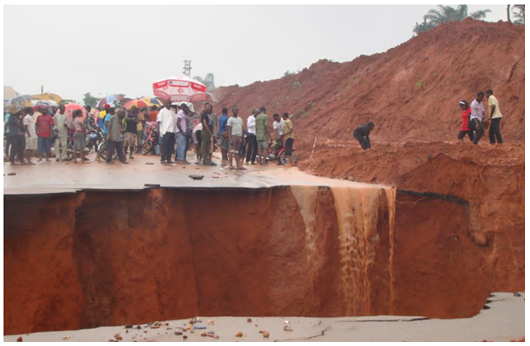
Gully erosion in southeast Nigeria
In his speech, Ikpeazu commended the state Ministry of
Environment and Nigerian Environmental Watershed Management Project (NEWMAP)
for completing the projects within a record time of ten months.
He said that the execution of the two projects would not
only give the people a sense of belonging but improve economic activities in
the area.
The governor said that the completion of the project indicated
state government’s commitment to deliver the dividend of democracy to the
people of Abia.
He described erosion as an environmental menace which ought
to be given urgent attention because of its threat to life and property.
Also, Dr. Aham Uko, the Commissioner for Environment, said
that the two projects were executed through counterpart funding between the
World Bank and state government at the cost of N3.45 billion.
He said: “The place was very well devastated by gully
erosion, resulting from several environmental degradation activities taking
place around the area.
“This is a major feeder road linking the entire Ohuhu
community and Bende Community to the express road of Ossah.
“The state government thought it will be necessary to link
the people of Ohuhu and Bende to the express road.”
In his address, Mr Izuchukwu Onwughara, the Project Manager
of NEWMAP in Abia, said that the road traversed Umuda-Isingwu, Amafor and
Ossah-Ibeku communities.
Onwughara also said that the state government contributed N350
million counterpart fund to the project.
Mr Ezeocha Ezeagbara, the representative of the
Umuda-Isingwu community, thanked the World Bank and state government for their
prompt response to the need of the community.
Ezeagbara said that the community was delighted with Abia government’s commitment to the infrastructure development of the area.
Another 120 youth entrepreneurs from seven states of the Niger Delta have been given Shell Nigeria LiveWIRE business training and N48 million by The Shell Petroleum Development Company (SPDC) Joint Venture to begin small-scale businesses in their respective states in the expectation that they will become models for alternative livelihoods as part of the programme to deter involvement of youths in vices.
A cross section of the graduating Regional LiveWIRE Nigeria beneficiaries
The 120 beneficiaries received their certificates at a Regional LiveWIRE graduation ceremony in Port Harcourt, Rivers State on Tuesday, March 5, 2019.
SPDC General Manager External Relations, Mr. Igo Weli,
described the company’s flagship youth enterprise development programme, Shell
Nigeria LiveWIRE, as a potent initiative that has produced over 7,000 Niger
Delta entrepreneurs since inception in 2003 with most of them now employers of
labour.
He said, “Some of the beneficiaries have also been given the
opportunity to participate in SPDC’s supply chain as vendors and have been
linked to growth capital from other agencies.”
Speaking at the graduation ceremony, the Director of
Secondary Education, Rivers State Ministry of Education, Mrs. Sokari Davies,
commended SPDC and its joint venture partners for the consistent sponsorship of
the Shell Nigeria LiveWIRE programme.
Mrs. Davies said, “Irrespective of the challenges in the
operating environment, SPDC still deemed it necessary to empower and develop
the youths. Other multinational oil companies should copy SPDC and channel
resources towards the development of the youths. That way, restiveness will
greatly reduce. Government will continue to partner with SPDC because of this.
“It is indeed a remarkable day for the 120 beneficiaries,
and we are pleased to see this group of young entrepreneur’s start-up
businesses that will contribute to the economic development of our
communities.”
A previous LiveWIRE beneficiary and now Managing Director of
De-Rabacon Plastics, Yolo Bakumor Smith, told the Regional LiveWIRE graduates
how he also won the maiden Shell Outstanding Achievement Prize in the 2018
Shell LiveWIRE Top Ten Innovators Global Awards.
Yolo said, “I owe my gratitude to Shell because no other
multinational operating in our region has given back the way and manner that
they have. I am my own boss now and I have been privileged to assist a lot of
people courtesy of Shell.”
The Shell LiveWIRE Nigeria programme, a part of the global
Shell LiveWIRE social investment programme, enables young people to start their
own business and create employment. In 16 years of operation in Nigeria, the
Shell LiveWIRE has received local and international recognitions. For example,
in 2011, the programme received the African Leadership Magazine award for Youth
Development, Social Enterprise and Reports Award (SERA) 2010.
Two Nigerian beneficiaries emerged winners in the 2017 and
2018 editions of the Global Shell LiveWIRE Top Ten Innovators Award. Three
others won the 2017 pitching contest in LiveWIRE #Makethefuture Accelerator event
held in Port Harcourt and, between 2010 and now, five beneficiaries have won
the international ‘’GO and Trade Enterprise Linkage Award’’ (which enabled them
to make international trade visits to London, Dubai in United Arab Emirates and
Neighbouring Ghana).
At the national level, five beneficiaries have won the
Federal Government ‘YOU WIN’ awards in 2014 and 2015. Two of them won the
Central Bank of Nigeria Entrepreneurship award, while 10 others won the Tony
Elumelu Foundation Award.’’
The Regional LiveWIRE programme operates in the Niger Delta
region and aims to inspire, encourage and support young people aged 18-30 to
start up their own businesses in the Nigerian states of Edo, Delta, Bayelsa,
Rivers, Abia, Imo, Cross River and Akwa Ibom.
The Wise Administration of Terrestrial
Environment and Resources (WATER), an NGO, has trained over 800 indigenous
peoples consisting of farmers and forest gatherers in Ekuri community in Cross
River State. The workshop, which took place in Ekuri community, was attended by
the National Coordinator of the Nigeria REDD+ Programme, Dr. Moses Ama; State
Coordinator of REDD+, Mr. Patrick Coco Bassey; and Management and Engagement
Specialist, Mr. Tony Attah.
National Coordinator of the Nigeria REDD+ Programme, Dr. Moses Ama
In his opening remark, the Programme
Coordinator of WATER, Chief Edwin Ogar, said that the workshop is critical for
a wider segment of the indigenous peoples of Ekuri to participate, learn,
improve and strengthen their knowledge on REDD+ as a mechanism for climate
change mitigation and for sustainable development.
The workshop which was participatory,
highlighted the global climate change as the main reason for the establishment
of REDD+ as a part solution to this problem.
In a feedback after the training, the
indigenous people participants thanked the organisers of the workshop and noted
that their commitments to forest conservation has been strengthened as the
training has offered them the opportunity to know that REDD+ focus is
conservation, sustainable forest management and regeneration particularly
analog forestry and other accompanying benefits – ecosystems services.
The participants also said that they are
better off than before in understanding REDD+ processes and stages which
include Free, Prior and Informed Consent (FPIC), Preparedness, Investment and
Performance Based Payment, among others.
Earlier, the Clan Head of Ekuri, Chief Abel
Egbe, asked a question, wondering if ‘conservation is a sin’? He said this
question is necessary because supports from government and conservation bodies
to the undying commitments of Ekuri community to conservation of her forest and
livelihoods is lacking and is worried also over the delay in the payment of
carbon credit.
In his response, Dr. Ama thanked the Ekuri
community for her passion and commitments in the conservation of Ekuri
community forest as history of forest conservation in Nigeria cannot be
completed if Ekuri community is not mentioned. He sued for patience and assured
the participants that ‘’if there is low hanging fruit opportunity, Ekuri
community will benefit” while waiting for the payment of carbon credit.
In February of
this year 2019, bulldozers returned to the superhighway construction site in
Cross River State, in an apparent defiance of the 23 conditions laid down by
Nigeria’s Federal Ministry of Environment for the Cross River State Government
to meet before further work on the site.
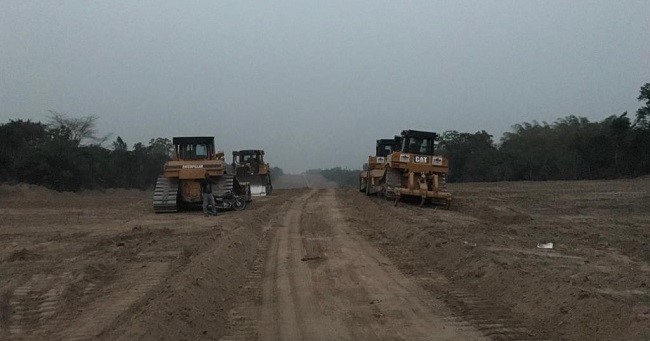
Bulldozers clearing forests for the Cross River superhighway
It will be recalled that the superhighway is one of the ambiguous and the most controversial “signature projects” of Governor Ben Ayade since his assumption of office in 2015, defying EIA requirements, threatening the critical and fragile ecosystems including protected areas and rich community forests, and destroying farms and other livelihoods sources of forest-dependent communities.
Early this year, communities along the superhighway route, especially Okuni and route close to Etara and Ekuri-Eyeyen, woke up to the sound of bulldozers even when the Cross River State Government has met none of the 23 conditions laid down by the Federal Government.
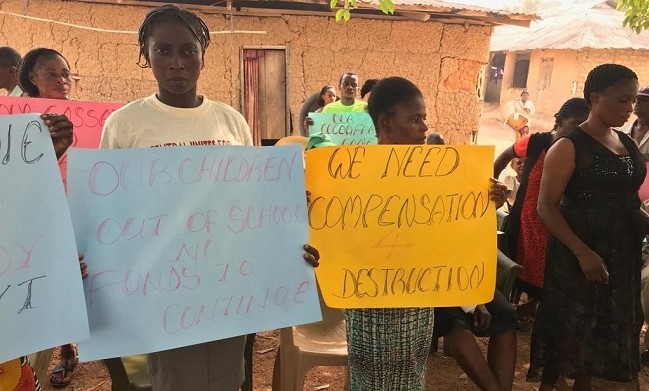
At the heels of the new commencement of work on the superhighway, the communities of Etara and Ekuri-Eyeyen staged a protest demanding for compensation of crops and farmlands that were destroyed the first time, and complete valuation of the impact of the project on their community with attendant safeguards.
Protesting members of affected communities
Speaking during
the protest, Mr. Hart Akpama, one of the community leaders, said: “We have
cocoa farms, yam farms, we also have bush mangoes. The bush mangoes we have in
our forests, these are the ones we were harvesting to get money for ourselves.
Most of these trees have been bulldozed. So we were taken by surprise.”
Mr. Michael
Odora is a farmer in Etara, submitted: “I farmed cocoa and plantain, but the
farm was destroyed. It has affected by life very negatively. I find it
difficult to feed my family. My children are in school. I find it difficult to
pay their fees and, even as we speak, they are disturbing them up and down. We
are crying to the government to see how they can help our people because our
people are suffering as a result of that.”
According to
observers, the superhighway construction that cleared their forests and
farmlands was without recourse to their wellbeing.
This appears to be the reality in many homes of communities where the Cross River State Government’s superhighway project passes. With the Ben Ayade led government’s seeming failing to adhere to Federal Government regulations and standards, and an apparent indifference to the sufferings of communities caused by the project, Etara and Ekuri-Eyeyen have finally joined the league of several communities and groups to file a lawsuit against the state government.
The article titled “A case for Prudent Regulation of the
Tobacco Industry” written by one Akeem Ogunlade of the Centre for Promotion of
Enterprise and Business Best Practices is a fascinating read for followers of
the public discourse about getting Nigeria to implement effective measures
towards reducing tobacco addiction and its associated public health impacts.
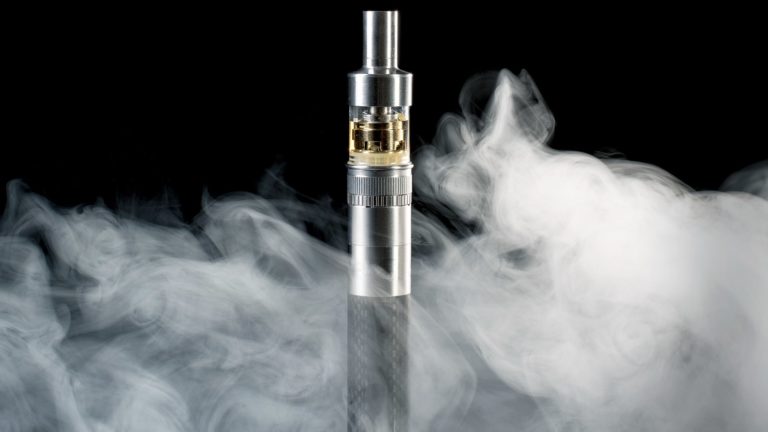
Alternatives to cigarette smoking can create a big impact on health in society
In his article, Ogunlade simply powdered trite arguments of
the tobacco industry that an effective tobacco control policy will harm
the economy and, as such, what Nigeria really needs is the industry promoted –
“Sensible Regulation,” “Balanced Regulation” which he colorfully explains away
as “Prudent Regulation”.
He goes on to describe tobacco control as controversial.
Ironically, it is not. It is in fact, the tobacco industry that creates this
perception so that it can manipulate issues and stay in business.
Tobacco is lethal. It kills. It harms public health and
ruins a nation’s efforts towards Sustainable Development. Tobacco currently kills
more than seven million people each year. More than six million of these deaths
are those who use tobacco directly while another 890,000 die from exposure to
second-hand smoke.
Worried by the rising deaths from tobacco use, the World
Health Organisation (WHO) initiated the Framework Convention on Tobacco
Control (FCTC) which was adopted by the 56th World Health Assembly in May
2003 as the first global public health treaty. Nigeria became party to this
treaty in 2005.
Nigeria domesticated the treaty through the National Tobacco
Control Act, 2015 but the journey was a tortuous one which took almost ten
years. Those years were fraught with scare-mongering by the tobacco industry
and their many front groups hired to hype an alternate reality: that tobacco control
would lead to job losses, shutdown of tobacco companies and a cutback on
government revenue.
But public health experts know that those faulty arguments
only reinforce the WHO caution in Article 5.3 of the FCTC that there exists an
irreconcilable conflict between tobacco industry interests and public health
policies. Article 5. 3 of the FCTC, which Ogunlade referenced in a deliberately skewed
manner, says that “in setting and implementing their public health
policies with respect to tobacco control, Parties shall act to protect these
policies from commercial and other vested interests of the tobacco industry in
accordance with national law”.
The goal of tobacco control is to save lives from tobacco
addiction while tobacco manufacturing, distribution and retailing seeks only to
profit from harming the lives of consumers. “Balanced Regulation”,
“Sensible Regulation” or so-called “Prudent Regulation” as being promoted by
the tobacco industry is that which diminishes the sanctity of life at the altar
of corporate greed. It’s that kind of Regulation that keeps the tobacco
industry in their comfort zone, maintaining high record profits while our
brothers and sisters wallow in disease and preventable deaths.
Fact is, with the FCTC, nations around the world are
unanimous that in the case of any conflict between the profits of tobacco
companies and public health, public health should take precedence.
The fairy tale argument on a link between high taxes and
increase in tobacco smuggling and counterfeiting was brought to the fore again
in Ogunlade’s piece. If not intended to deliberately confuse the public, the
high tax and smuggling nexus is far from the truth. In fact, investigations
show that on the contrary, the tobacco industry is behind smuggling of tobacco
products. It is established that taxes work to prevent youth initiation,
reduce consumption rates while at the same time raise government revenue.
Since the 1990s, incontrovertible evidence has shown that the tobacco
industry has been actively involved in smuggling of tobacco products as a
business strategy. This strategy is to saturate markets with products far
exceeding what local populations can consume. The excess would ultimately be
sold elsewhere and for the tobacco industry, it gets paid regardless of how and
where the products are sold. In Canada, subsidiaries of Japan Tobacco and
British America Tobacco (BAT), and a company partly owned by Philip Morris
International (PMI) were found guilty of tobacco smuggling and collectively
fined C$1.7 billion (£1 billion) over a 10-year period spanning 2000 to 2010
when the cases went to court.
The Guardian of
London, working with the International Consortium of Investigative Journalists
in January 2000, published an investigation into BAT‘s operations which
included the facilitation of tobacco smuggling. Some 11,000 internal documents
of the tobacco industry sieved through during the investigation exposed
how BAT employees did not partake but condoned tax evasion and exploited the
smuggling of billions of cigarettes in a global effort to boost sales and lure
generations of new smokers. The target markets werein Canada, Latin America and
Asia.
Most disturbing was that the documents revealed that the
smuggling “channels” which the company’s cigarettes travelled along
were always operated and managed by others and it used euphemisms – including
“duty not paid”, “general trade” and “transit” – to
describe smuggling channels.
In 2004, Philip Morris agreed to pay $1.25 billion
(£670 million) to avoid a raft of lawsuits alleging that it is complicit in the
smuggling of billions of cigarettes into the European Union. The company was
said to have been complicit in smuggling Marlboro and other brands into
the EU – where cigarettes are heavily taxed – by deliberately over-supplying
countries with lower duties.
The excess would then be smuggled into EU countries and sold
in the black market thereby depriving governments of tax and customs revenue.
Perhaps the most disturbing recommendation in Ogunlade’s
article is his case for so-called “safe alternatives” to the conventional
cigarettes which he described as products with “lesser risks”. We assume that
he is referring to E-cigarettes and the controversial heat-not-burn products.
He listed Canada, US and UK as countries where the regulatory approach to
tobacco control is “progressive”. Whatever that means, this is far from the
truth. The writer makes no mention of the recent US Food and Drug
Administration (FDA) alarm that the number of teenagers using one of the
suggested alternatives – E-cigarettes – in that country has surged by
75 percent, egged on by a boom in flavoured products.
The FDA described E-cigarettes as a scourge in U.S.
schools, with students often vaping in the bathrooms or between classes.
According to the 2018 federal survey figures, one in five high school students
indulge in vaping. This development preceded an FDA crackdown on
sale of E-cigarettes to minors including making it harder to buy
flavored products online since that is how most young people start the journey
to addiction.
The safety of the E-cigarettes and heat-not-burn products
has generally been called to question by recent researches. For instance, some
researchers who worked with PMI and helped coordinate clinical trials on
its iQOS product questioned the quality of some of the researchers and sites
contracted to carry out experiments. Tamara Koval who worked with PMI between
2012 and 2014 particularly highlighted irregularities in one of the studies on
the product.
A new study published in the Medical Journal of Australia,
reveals that 60 percent of nicotine-free e-cigarettes sold
contain pesticides and this is inhaled by smokers of the product. In Hong
Kong, vapers are threatened with jail terms in the government’s plan to
push ahead with a blanket ban on all e-cigarettes and heat-not-burn products.
Whatever the intent of Ogunlade’s rhetoric is for advocating
for more space for tobacco entities to manipulate tobacco control, it is
anti-public health and anti-public good. What Nigeria needs at this moment is
conscientious and stringent enforcement of provisions of the National Tobacco
Control Act, 2015. The nation should also not lag in introducing additional
Regulations to combat novel products and close the loopholes in the current
Act.
As at today, Nigeria is not even near in ranking with other
African countries like Ghana, Niger, Kenya, Ethiopia, Senegal to mention a few,
who have put in place effective tobacco control measures. Within the sphere of
policy, government at all levels in this country must now act fast in rejecting
the ploy to make our nation a dumping ground for tobacco products that
pre-disposes our citizens, especially our young people, to diseases, disability and ultimately death.
By Oluchi Joy Robert, Environmental Rights Action/Friends of the Earth
Nigeria (ERA/FoEN)