The Nigerian Meteorological Agency (NiMet), has predicted moderate dust haze weather conditions in visibility range of two to three kilometres over the Central States of the country on Thursday, January 4, 2018.
Dust haze weather
NiMet’s Weather Outlook by its Central Forecast Office (CFO), on Wednesday in Abuja, also predicted day and night temperatures in the range of 25 to 34 and 10 to 18 degrees Celsius respectively.
The agency predicted that the Southern States would experience moderate dust haze conditions over the inland cities throughout the forecast period.
It also predicted dust haze with visibility range of about one to three kilometres over the coastal cities with day and night temperatures in the range of 32 to 34 and 17 to 23 degrees Celsius respectively.
According to NiMet, Northern States will experience dust haze condition in visibility range of about one to three kilometres with localised visibility of less than 1000m in few cities throughout the forecast period.
“The northern states will also have day and night temperatures in the range of 25 to 29 and 11 and 16 respectively.
“The particles of dust in suspension around the country are expected to still reduce visibilities across the northern states to about one to three kilometres.
“The inland and the central cities are anticipated to be in moderate dust with visibility of two to three kilometers, while the coastal cities are also expected to be in the range of one to three kilometres in the next 24 hours,’’ NiMet predicted.
The Karu Abattoir in Abuja has been fitted with a Net-zero/Low Carbon Biogas Digester to enable the generation of electricity and heat, as well as the production of organic fertiliser. Promoted by the African Environmental Action Network (EANet-Africa), the ground-breaking ceremony of the facility held on December 14, 2017.
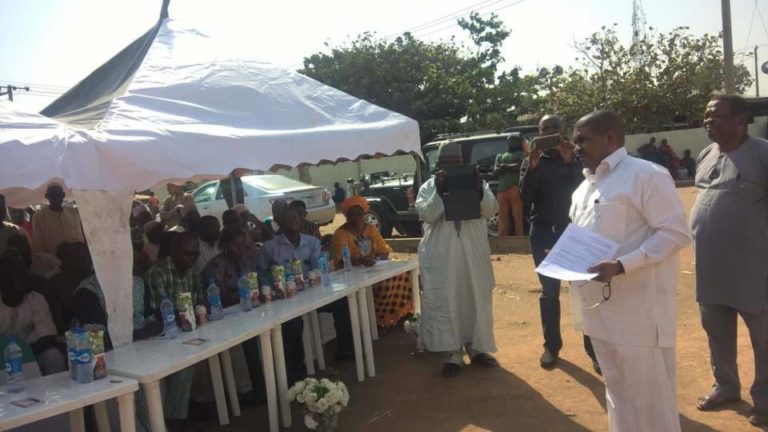
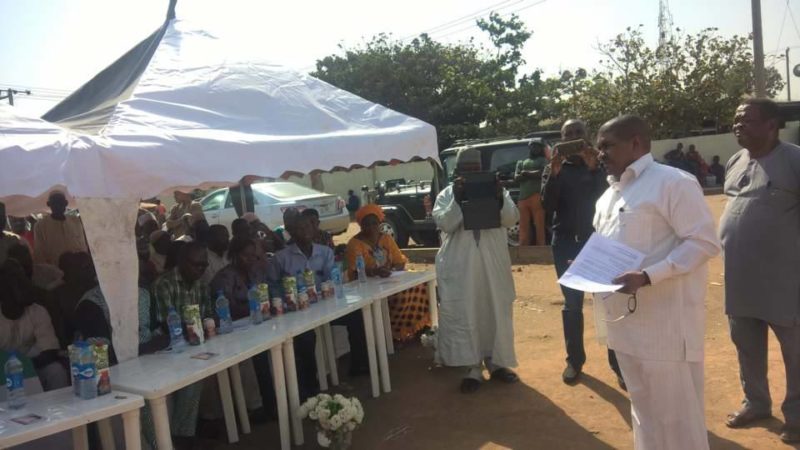
Secretary, Agric & Rural Development, Federal Capital Territory (FCT) Abuja, Nzekwe Stanley Ifeanyichukwu, performing the ground-breaking ceremony
Co-founder of EANet-Africa, Dr Victor Fodeke, described the initiative as an ambitious march towards the decarbonisation of abattoirs in Nigeria, adding that, by generating heat, it reduces fuelwood harvesting and deforestation, generates electricity to power Micro Small and Medium Enterprises (MSMEs), produces organic fertilisers (bio-slurry) for green house farming for food security, and promoting sanitation and reducing volume of wastes.
“We unveil another milestone to conserve our forest resources, and enthrone climate safety and sustainable livelihood. This is a truly mega environmental solution project in compliance with Nigeria’s Nationall Determined Contributions (NDCs) and the historic Paris Agreement. There have been several attempts to popularise biogas technology in Nigeria without a detailed roadmap and sustainable implementation strategies,” he said.
According to him, the EANet-Africa National Strategic Roadmap will bring on board clusters home-based and community-based biogas digestors in each of the 774 Local Government Areas of Nigeria, Primary Health Centres and agriculture communities to produce 2-5mw electricity in five years in a public-private participatory and focused international support strategy, with the co-benefit of national reduction in municipal waste load by 40%, and enhance sanitation; enhancing conservation of forests sink of greenhouse gases (GHG) by eliminating of fuel-wood harvesting; elimination of indoor house pollution implicated in annual mortality of 135, women and children as bio-slurry will power “Women GreenHouse Farming”; take up a waste-to-wealth campaign and a re-orientation of what is wrongly called waste in Nigeria.
“Preliminary discussion in 2016 with Abuja Environmental Protection Board (AEPB) revealed that 47% of municipal wastes in Abuja are biodegradable and we (EANet-Africa) concluded on establishing a biogas digestor to generate about 7mw electricity for FCT,” said Dr Fodeke, who used to be the Director, Department of Climate change in the Federal Ministry of Environment.
He adds: “It is on record that China has over 30 million biogas digestors, while India has 15 million. Biogas technology is popular in East Africa. We are informed that United Kingdom is soon to deploy one million biogas digestors.
“The implementation of these projects with international assistance, and mobilising our innovative internally mobilised public-private partnership (PPP) support strategy can enable Nigeria to reach its Nationally Determined Contributions (NDCs) target of 45% before 2030, enthrone sustainable livelihood, create massive jobs, enhance food security and reduce indoor air pollution and enhance sinks for GHGs in a measurable reportable and verifiable manner.”
Speaker, Benue State House of Assembly, Mr Terkimbi Ikyange (Ushongo/APC), has blamed the recent massacre of Benue people by Fulani herdsmen on the inability of the Federal Government to take threats by the Cattle Breeders Association serious.
Speaker, Benue State House of Assembly, Terkimbi Ikyange
According to a statement signed by the Chief Press Secretary to the Speaker, Mr Bem Abunde and availed EnviroNews, Mr Ikyange stated this while reacting to early Tuesday morning attack on some communities in Guma and Logo Local Government Areas of Benue State by suspected Fulani militia that left many people dead, injured and several properties destroyed.
The Speaker recalled that, when the National leadership of the Cattle Breeders Association under the aegis of Miyetti Allah Kautal Hore, openly threatened to mobilise herdsmen across the country to oppose the implementation of the Open Grazing Prohibition Law, the Assembly in a unanimous resolution, called on President Muhammadu Buhari and the Inspector-General of Police to effect their arrest.
He lamented that inspite of the threats and subsequent reaction by the Assembly and the Benue State Government, no efforts were made by the Presidency and other security operatives to prevent them from carrying out their well planned massacre against the defenseless people of the state.
Mr Ikyange described the attack by the marauders as barbaric and an affront on the Rule of Law, stressing that the resolve of Benue people to stop Open Grazing is unwavering.
The Ushongo representative re-echoed the call for the immediate arrest and prosecution of the National leadership of Miyetti Allah Kautal Hore, as a way of halting the renewed violence against Benue communities.
While commiserating with the deceased families, people of Guma and Logo Local Government Areas and the entire people of the state over the heinous act, Mr Ikyange assured that the Assembly would back every move that will be taken by Governor Samuel Ortom to seek redress.
Storm Eleanor struck Ireland, parts of Britain and northern France overnight into Wednesday, January 3, 2018 bringing with it flooded streets, fallen trees and power cuts.
Floods have already hit in Bantry, Ireland, as a result of Storm Eleanor Photo credit: www.alamy.com
Some 200,000 households were left without power across northern France as of 9 am (0800 GMT), electricity network company Enedis said.
Two thousand of its staff were at work to restore the supply.
Around 55,000 properties were without power in the Republic of Ireland and 20,000 in Northern Ireland, the Press Association reported.
A further 2,500 homes and businesses were cut off from the grid in parts of England.
Winds packing speeds of up to 155 km per hour battered Ireland and caused flooding in the Atlantic seaboard city of Galway.
French railway company SNCF said that regional trains were not working in the Normandy and Alsace regions.
Long-distance trains were running normally.
Air traffic at Strasbourg and Toulouse airports was also interrupted.
French maritime authorities reported that a yachtsman had been rescued in a dangerous helicopter operation in high seas and seven-metre waves off the Normandy coast on Tuesday night.
Shipping was warned of the danger posed by his abandoned sailing yacht, which could not be located.
The Chairman, All Farmers Association of Nigeria (AFAN), Lagos State Chapter, Mr Femi Oke, has called for the introduction of extensive irrigation for farmers to complement seasonal farming in 2018.
Minister of Agriculture, Chief Audu Ogbeh
Oke told the News Agency of Nigeria (NAN) in Lagos on Wednesday, January 3, 2018 that farmers needed government’s encouragement to exploit irrigation and other aspects of agriculture value chain to ensure self-sufficiency in food production.
“Globally, Africa is still far behind the rest of the civilised world in area of agricultural development.
“And the greatest problem causing this on the continent is corruption and Nigeria is affected by this virus.
“For us as a nation to improve our economy, government should encourage practising farmers and provide avenues for them to practice farming in a scientific and commercial way,” he said.
The chairman said that with the right incentives, peasant farmers could also go into commercial farming and even adopt mechanised farming.
He said that agriculture had the potential to boost the nation’s economy.
Oke said that the government should check indiscriminate movements by herdsmen into farmers’ farms to destroy their produce.
He said herdsmen should be encouraged to adopt cattle ranching in line with global best practices.
Oke expressed concern over the effect of frequent clashes between farmers and the herders on agricultural development and food affordability to the populace.
He said that if government provided the right inputs and agricultural activities were properly coordinated Nigerian farmers would always export surplus to other countries.
The Conservator-General, National Parks Service, Alhaji Ibrahim Goni, has urged Nigerians to imbibe the attitude of greening their surroundings so as to boost healthy living.
Alhaji Ibrahim Goni, Conservator-General of the National Parks Service
Goni, who gave the advice in a statement issued in Abuja on Wednesday, January 3, 2018 particularly underscored the need for Nigerians to plant trees to protect their environment.
He said that the greening of the habitat would go a long way in improving the quality of air which the people inhaled.
“Introducing trees in traditional agricultural systems can allow for more efficient nutrient cycling, meaning farm output can be more substantive and reliable,’’ he said.
Besides, Goni urged the citizens to partake in agro-forestry schemes in order to mitigate the effects of climate change.
“We must tap into the potential of agro-forestry, which increases the concentration of various nutrients or enhances nutrient cycling; thereby improving overall soil quality.
“Apart from its potential to mitigate climate impact and improve soil quality, agro-forestry can offer significant economic and social impact, especially for smallholder famers,’’ he said.
The conservator-general also said that planting trees could provide additional resources like fuel from timber, fodder for animals, as well as nuts and fruits or oils which could be used as food or be sold for additional income.
“Not only can timber be used for fuel but biofuels, derived from tree sap, fruit pulps and oils like palm oil or jatropha, could also be advantageous.
“If the production of these trees is expanded, biofuels from tree by-products could still play an interesting role in reducing dependency on fossil fuels and reducing greenhouse gas emissions.
“We also want Nigerians to engage in recreation in the nearest park to them and maintain the culture; as this will go a long way in promoting and improving domestic tourism, better integration and peace in the country,’’ he said.
Goni congratulated Nigerians for witnessing a peaceful Christmas and for crossing over to 2018 in peace and good health, with renewed hope for a better future.
He, however, urged the citizens to reflect on their past and ask for forgiveness for their wrongdoings, while praying for Nigeria’s peace and the success of President Muhammadu Buhari’s administration.
Senator Magnus Abe, representing Rivers South-East Senatorial Zone in the National Assembly, has called on the committee on Ogoni clean up to present it’s report in three weeks.
Senator Magnus Abe
Abe made the call in a statement signed by his Spokesman, Parry Benson, and made available to newsmen in Port Harcourt on Wednesday.
He had met with leaders of the Ogoni ethnic nationality to discuss issues affecting resumption of oil exploration in the area and the ongoing clean-up exercise.
Abe said that the committee on oil exploration, headed by Professor Ben Naanen and other five representatives which included MOSOP and KAGOTE, among others, were mandated to come up with the position of the Ogonis on the issue of oil exploration.
The Senator said that the committee, made up of Ogoni representatives on the Board and Governing Council of Hydrocarbon Pollution Remediation Project (HYPREP), was mandated to meet with the Minister of the Environment and to update the people on the financial releases and progress on the Ogoni clean-up exercise.
“On the issue of the clean-up, the representatives of the Ogoni people who are part of the structure of HYPREP were also mandated to meet with the Minister of the Environmet.”
The committee is “to give us a clear update on the situation of the clean-up, particularly as it relates to the finances that has to do with what has been done as far as the clean-up project is concerned and that also will be reported back in three weeks.
“The Ogoni people are not against discussing the issue that has to do with that, but we are concerned that it be done in an organised peaceful and reasonable manner so that the interest of the community is properly factored in.
“The committee should meet and a report presented to everybody in three weeks,” he said.
Abe said that the committee on the clean-up exercise included two members of the board of trustees, Chief Bebe Okpabe and Dr Peter Medee; three members of the governing council, Legborsi Pygbara, Professor Ben Naanen and Professor Roselyn Konya.
He stressed that their report was being expected in three weeks.
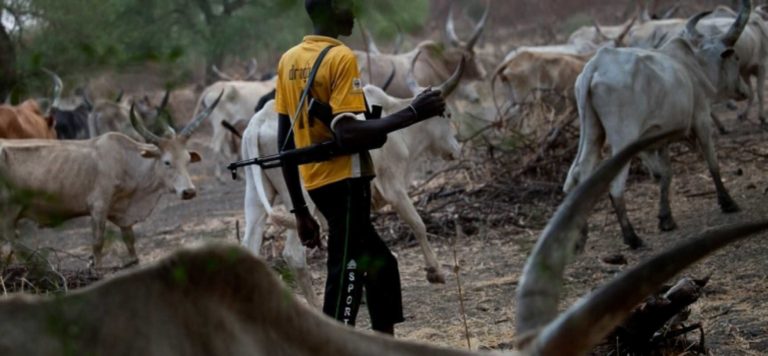
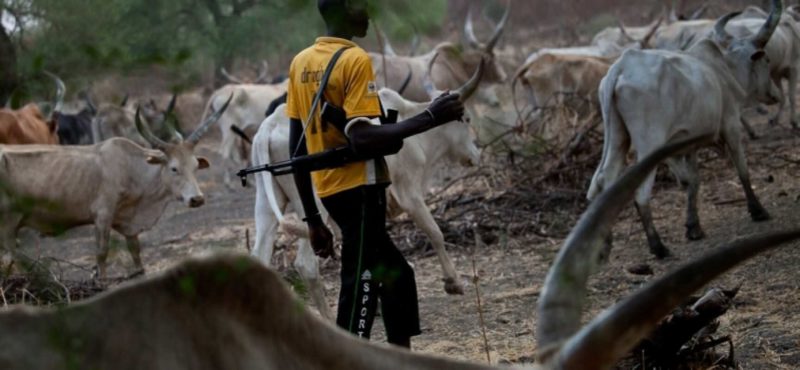
Governor Samuel Ortom of Benue State said herdsmen killed over 20 persons between Monday, January 1 and Tuesday, January 2, 2018 in Guma and Logo local government areas of the state.
A armed herdsman
Ortom disclosed this while briefing journalists on Tuesday in Makurdi, the state capital, after the State Security Meeting.
He said that, out of the number, nine were Livestock Guards who were to ensure the full implementation of the Anti-Open Grazing Law.
He said that the law was not targeted at any ethnic group and wondered why the herdsmen had taken it so personal to the point of unleashing terror on the people.
The governor also lamented the unwarranted wanton destruction of lives and property by the herdsmen.
He said that, no matter the intimidation and killings by the herdsmen, the law would not be reversed or repealed.
He assured that the law must be implemented to the latter and anybody or group of persons that flouted it would be made to face the full wrath of the law.
Ortom called on the Federal Government to wade into the matter so as to avert further destruction of lives and property.
Dr Gajir Tsoho of the Surgical Department, Benue State University Teaching Hospital, said over 30 injured victims of the herdsmen attack were brought to the hospital and were receiving treatment.
Goal 17 of the Sustainable Development Goals (SDGs) advocates for equitable access to science, technology and innovation particularly in Less Developed Countries (LDCs). In this write-up, Coordinator, Journalists for Social Development Initiative (JSDI), Etta Michael Bisong chronicles what his organisation is doing to promote this goal and ensure sustainable living
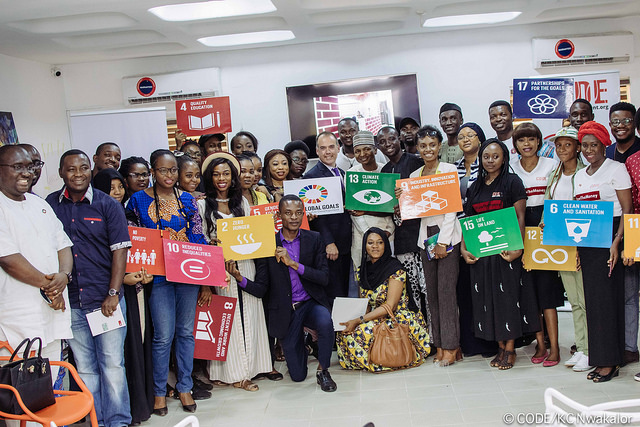
SDGs champions
What motivated the Science Café
Science & technology has become an indispensible component of modern society. Rarely can anything be achieved in today’s world without leveraging or deploying the tools of science & technology.
In Nigeria for example, we are all witnesses to the various massive breakthroughs and how new technologies have transformed human affairs. This transformation is manifest weather in finance management (online banking), education (eLearning); medicine (eHealth) and most recently in agriculture where plants are modified to mitigate ecological challenges. It is a new kind of phenomenon that has redefined human association and relationship.
Sadly, however, science & technology has continued to face public resistance despite these phenomenal milestones. We have seen lots of contradictions raised by scientists and non-scientists alike against some scientific innovations particularly in agriculture where they disagreed vehemently over the health, as well as environmental safety of these technologies.
These contradictions without managing words have in numerous ways bedeviled the rapid penetration and prevented the public from fully accessing the potentials of science & technology to enhance everyday life.
It is for this reason that the Science Café is motivated. Our objective is to create a platform to improve science literacy and help the public access the full benefits associated with modern technologies to promote the concept of decent living as enshrine in goal 17 of the Sustainable Development Goals (SDGs).
How Café will address anomalies
Firstly, I will like to establish that most of these contradictions and arguments raised are not based on scientific evidences; they are driven by sensation while many others are caused by the insufficient public knowledge around the concept of science & technology.
Science as a method is empirical in nature; it is fact driven and explainable. It is worthy to note that science is the single but most effective of all human discoveries including religion that has being accepted based on its ability to prove, explain and even replicated globally.
For this singular reason, the responsibility of delivering mandate of the science café becomes very simple. The café is departmentalised into three components which include a science hangout, and weekly radio/TV talk show, as well as the Science Digest, a monthly publication that captures all the happenings in the science & technology sphere for the purpose of knowledge sharing and public enlightenment.
The science café will through these channels engage and create debates that promote information that are based on scientific methodology. It will serve as a hub for science communication bringing together stakeholders such as scientists, journalists, civil society groups and key industry actors to demystify the myths that have characterised science & technology and prevented it from meaningfully contributing to sustainable growth.
Partnership and sustainability mechanisms
Goal 17 of the SDGs is designed to strengthen the means of implementation and revitalise Global Partnership for sustainable development. One of the primary targets of this goal is to enhance North-South, South-South, and triangular regional and international cooperation on and access to science, technology and innovation and enhance knowledge sharing on mutually agreed terms, including through improved coordination among existing mechanisms and global technology facilitation.
This goal advocates for the development, transfer, dissemination and diffusion of environmentally sound technologies to developing countries on favorable terms, including on concessional and preferential terms, as mutually agreed.
It also canvasses for the full operation of the technology bank and science, technology and innovation capacity-building mechanism for least developed nations by 2017 and enhance the use of enabling technology particularly information and communications technology.
No doubt, this is an ambitious task to deliver. Diverse stakeholders must come together to help use the available resources to achieve this anticipated targets mostly as it relates to less developed countries where the technological divide in unimaginable when compared to developed nations. Today, 2017 is already history and yet there are no visible results to justify this goal as encapsulated under the 15 years development agenda.
Journalists for Social Development Initiative (JSDI) as an organisation established to promote developmental communication is aware that its mandate cannot be achieved without external support. Our partnership with Connected Development (CODE) is an expression of this belief.
Previously, we have worked with several other organisations including the embassy of Ecuador in Nigeria, as well as the Open Forum on Agricultural Biotechnology (OFAB), Nigeria chapter to engage the public and train journalists on science reporting.
We are very happy and proud of CODE for their generosity to work with us. This is the kind of gesture that is required to help direct and deliver our assignment. JSDI, under this agreement, will oversee all the technical operations of the café, while CODE will serve as host and provide other necessary requirements to make sure that this noble initiative transforms from abstract to concrete.
It is important to note that they are huge challenges on this pathway, which is why we conceptualised the science café to help mitigate and provide the right environment for the proper deployment of modern technologies to excel and make the world a better place.
The Café’s projection and future expectations
The science café is expected to be officially unveiled on Thursday, January 18, 2018 in Abuja with special focus on “Science, Technology and Modern Society: Role of Communication in Promoting Sustainable Livelihood”.
Our projection is to create a hub and become a leading agency for the provision of accurate as well as reliable science based information. The primary problem responsible for the public resistance of most scientific innovations in society is caused by insufficient awareness on the principles of science & technology.
We expect to strengthen our partnership with CODE at this pilot stage while seeking for more support from other development partners.
Industry players both at the government and private sector level must understand that we now live in a global village where all human affairs are determine by technology. So, we look forward to engage and work with more development actors, in particular the media and policymakers to promote laws that provide the right atmosphere for the effective deployment of science & technology to deliver goal 17 of the SDGs.
Some prominent residents of Mbakyoondu in Gwer West Local Government Area of Benue State have said that the Anti-Open Grazing Prohibition Law enacted in the state will guarantee security.
Flashback: Governor Ortom signs anti-grazing bill into law as Speaker, Benue State House of Assembly, Terkimbi Ikyange, lends a hand
The residents made the observation when Mr Terver Wever, Group Head, Real Estate and Infrastructure Development of Benue Investment and Property Company, hosted them on Tuesday, January 2, 2018 as part of activities to mark the end of 2017.
According to them, the law, enacted by Gov. Samuel Ortom recently, would prevent further clashes among herdsmen and farmers.
They described the law as the best thing that had happened to the state to stem the wave of insecurity across the state.
Mrs Nancy Yeke, a councilor in the ward, expressed joy, noting that the enactment of the law was a landmark achievement of the Ortom’s administration.
Another resident, Mama Mwarga Chia, a widow, appreciated Wever’s decision to help the needy during the New Year’s celebration, asking the community members to pray for him.
In his comments, Wever highlighted some of the achievements of Ortom’s administration that had direct bearing on the people.
He said the administration had introduced unified sacks as standard of measurement for farm produce to discourage traders from exploiting farmers.
He also urged the youth in the community to acquire skills to be self-reliant and boost the state’s economy.
The high points of the occasion included cash donations, bags of rice, a cow and cloths, among other food items.