The Conservative Environmental Growth and Development Centre (CEGDEC), in collaboration with a group of youths called Estate Youth Parliament (EYP) in the Low-Cost Housing Estate, Oke-Afa, Isolo in Lagos, commemorated the World Environment Day (WED) 2018 by contributing significantly to the cleaning up of the environment.
Members of Conservative Environmental Growth and Development Centre (CEGDEC) and Estate Youth Parliament (EYP) during the exercise
The group, led by Mr. Yusuff Adeyemi, is said to passionate about the state of the environment of the estate, which has been deteriorating. To this effect, members took the bull by the horn and joined force with CEGDEC to actualise positive change in the disorderly residential environment.
Over the years, the campaign for the 3Rs of waste management (reduce, reuse and recycle) had been ongoing in schools and amongst residents by CEGDEC. However, this year’s campaign is marked with the practical demonstration of cleaning up exercise, meant to continue beyond WED 2018, according to CEGDEC officials.
The cleaning up began with the manual fixing of major potholes on the roads with rubbles, especially as the road conditions have become unmotorable. Gutters were cleaned of filth, while wastes including plastics were cleared to give way to grounds for tree planting. Indeed, the wastes were cleared for the propagation of green environment, says CEGDEC.
The host local government, Ejigbo Local Council Development Authority, has also been called upon to sustain the somewhat laudable green initiative by the amiable youths. A courtesy visit was made prior to the exercise to reiterate the need for the local council’s intervention. The host community thanked the untiring hands of the groups that contributed to the cleaning up exercise, while the residents at large were urged to be responsible for the wastes they generate.
The promotion of Reuse, Reduce and Recycle is the best solution by individuals to curb the menace of plastic wastes in our society, Mrs. Maryam Olayeni, CEGDEC’s representative, emphasised.
“All hand must be on deck to continue the race to beat Plastic Pollution, though the bulk control lies with the necessary authority to put in place a policy that discourages the propagation of plastics in our society. Biodegradable materials should replace plastics which are non-degradable, besides plastics disadvantages outweigh its advantages,” Mrs. Olayeni closed on this note.
The Programme Manager, Fight Against Desert Encroachment (FADE) Africa, Bunmi Obanawu, has canvassed good price on plastic materials to discourage Nigerians from using them.
Amb. Ayoola Olukanni of NACCIMA making a presentation at the forum. Founder of FADE Africa, Newton Jibunoh, and others in rapt attention
Speaking in Lagos on Tuesday, June 5, 2018, during an art exhibition tagged “Art Goes Green” to mark the World Environment Day (WED), Obanawu said: “When we are made to pay for plastics, we learn to make less use of them.”
With the theme “Beat Plastic Pollution”, the 2018 WED is urging humanity to refuse any plastic material that cannot be reused, with the slogan “if you can’t reuse it, refuse it”. This is a clever phrase reminding people to be conscious of their plastic usage and to try as much as possible to reuse their plastic.
The United Nations is teaming up with organisations and individuals around the world to raise awareness on the issue of plastic pollution and also promote a reduction in the single use of plastic.
According to Obanawu, we should learn to go shopping with our old bags; that way, we would be saving humanity from danger by reducing the amount of plastic in circulation.
She noted that Nigerians were very dependent on plastics, hence the materials can’t be eliminated completely, but “we can reduce the problem.”
FADE Africa is a non-government organisation founded by Newton Jibunoh, the famed explorer and adventurer. The members pride themselves in environmental activism and have been involved in numerous environmental activities since inception.
“Plastic is everywhere. It is in our homes, offices, parks, cars and natural environment. More than 70 per cent of the plastic used today is used only once and discarded. Plastic materials take more than 100 years to fully decompose, but are used on a daily basis. With all the plastic in circulation, it forces us to ask ‘where is our plastic going?’” she said.
The exhibition is FADE Africa’s bid to answer the question and many more bordering on the future of the environment.
The event was not only to enlighten the guests on other ways of reusing their plastic waste artistically; it was also an avenue for the participants to learn about the increasing danger of plastic pollution with the intention of changing mindsets for the better.
To get the young minds involved in such a positive event, FADE Africa invited students from four secondary schools: Victoria Island Senior Secondary School, Kuramo Senior College, Government Senior Secondary School and Parenthood Foundational International College to be a part of the event. Some of the schools displayed arts and crafts, while others gave short intelligent speeches. Rosemary Adibe spoke on behalf of Victoria Island Senior Secondary School.
Wale Adebiyi, co-founder of Wecyclers, a recycling company, talked about the dangers of plastic pollution, the need to imbibe the culture of recycling and how his company used incentive-based strategy to encourage people to recycle.
Wecyclers says it has over the years worked to raise awareness on the issue of recycling waste.
He urged Nigerians to imbibe the 3Rs of plastic use: reduce usage, reuse or recycle.
Asserting that recycle should be the last resort, he urged the participants to teach others to manage plastic.
The artists who showcased their art made statements with their thought-provoking pieces of art.
Yelloseesee Uwaoma, who makes classic art with regular pens, displayed beautiful pieces created from plastic. The idea behind his work was recreating art from trash.
Odunayo Ajayi, a photographer and concept artist, illustrated how the society is drowning in plastic.
Olusola Ajagbonna, an upcycling professional from My Craft Life In Lagos, also graced the occasion with her incredible artefacts made from recycled plastic.
She engaged the participants in a short session of upcycling plastic. This proved to be very engaging and interesting as people left with light bulb ideas for other uses of their plastics instead of disposing after a single use.
Amb. Ayoola Olukanni, the newly appointed director-general of Nigerian Association of Chambers of Commerce, Industry, Mines and Agriculture (NACCIMA), at the event, stated that going plastic-free was possible, as Kenya, African country, had successfully banned plastic.
The environmentalist canvassed inter-generational trust, where the older generation would save the environment for coming generations. “One generation must treat the environment in such a way that coming generations will find it conducive.”
Jibunoh encouraged everyone present to care a bit more about the environment. He addressed the youth especially because of his belief that the youth were indeed the future.
Olukanni left the audience with the catch sentence: environment is the heart of the matter; let us make it matter of the heart.
The Nigerian Alliance for Clean Cookstoves, in partnership with the International Centre for Energy Environment and Development and Heinrich Boell Foundation, launched the “No Smoke” Music Video on Tuesday, June 5, 2018 in Abuja to commemorate the World Environment Day. The event had in attendance over 100 stakeholders from government, private sector, NGOs/CSOs, the international community as well as the media.
National Coordinator of Nigerian Alliance for Clean Cookstoves, Ewah Eleri
The song in the music video is rendered by the duo, Tai n Kenny, in support of clean cooking solutions especially for the Internally Displaced Persons (IDPs) in the North East Nigeria. It highlights the health hazards and sufferings of millions of people (especially women) cooking with open fire using firewood. About 95% of IDPs, host communities and returnees in the Northeast depends on firewood and charcoal for cooking and 85% of these households face protection risks when collecting firewood. Women and the girl child walk long distances and spend hours a week in search of firewood. This also contributes to deforestation and the effects of climate change.
In Nigeria, more than 120 million cook over an open fire and, according to World Health Organisation (WHO), smoke from open fire causes more than 95,000 deaths annually in Nigeria. After malaria and HIV/Aids, this is the third highest killer, mostly of women and children.
Clean cooking saves lives, empowers women, improves livelihood and combats climate change. It is a priority area in energy access that is central in achieving the goals of the country’s commitment to mitigate as well as adapt to the effects of climate change. Cooking should not kill and clean cooking energy for all is not only possible but a right for our citizens.
The National Coordinator of Nigerian Alliance for Clean Cookstoves, Ewah Eleri, in his welcome address, acknowledged the efforts of various partners and stakeholders from government, private sector, NGOs/CSOs and the international community in moving the clean cooking industry forward. He stated that he is glad the issue of clean cooking is being raised at the policy level. He hopes that the music video will contribute to raising awareness about the need for clean cooking.
Senator Oluremi Tinubu, Chairman, Senate Committee on Environment, in her keynote address recognised the challenges of using firewood for cooking and noted that women and children in rural and urban areas deserve a better life.
She said: “Our mothers can stay healthier and our environment better if we are determined to switch to clean cooking solutions. I am proud to be associated with this event that the Nigerian Alliance for Clean Cookstoves has put together. It is my hope that ‘No Smoke’ will get a lot of airplay and the video being launched will be a feature on our television screens.”
She stated further that the music video would create awareness about the dangers of air pollution and encourage everyone to switch to cleaner methods of cooking.
Her words: “It is my hope that, beyond today’s celebration, the advocacy for cleaner and safer cooking methods will be intensified and the message taken to rural communities that may not see the video.”
She ended her address by reaffirming that the Nigerian Senate remains committed to ensuring that the most vulnerable amongst us are protected. The Senate Committee on Environment will not wane in its commitment towards achieving a healthier environment, she added.
Representative of the Food and Agricultural Organisation (FAO), Jonas Bervoets, commended the efforts of the Nigerian Alliance for Clean Cookstoves and other stakeholders in promoting clean cooking solutions. He underscored the need for safe and environment friendly access to fuels and energy for the Internally Displaced Persons (IDP).
He noted that the FAO, in collaboration with other partners including ICEED, is facilitating a coordinated and effective response to the fuel and energy needs of crisis-affected communities in Northeast Nigeria through the Safe Access to Fuels and Energy (SAFE) workgroup. He further noted that an FAO-ICEED partnership has set up three clean cookstoves production training centres in Maiduguri, the capital of Borno State.
Dr. Yerima Peter Tarfa, Director, Department of Climate Change, Federal Ministry of Environment, noted that the Federal Government is committed to promoting the issue of clean cooking which has the potential to help Nigeria meet its obligations in the National Determined Contributions (NDCs) agreed upon at the Paris climate summit.
He remarked that the music video would play an important role in raising awareness about the need for clean cooking among policy makers and private sector as well as contribute to behavioural change on how we cook.
The Head of Missions Spouses Association (HOMSA) also sent a goodwill message on the occasion.
Vice President Yemi Osinbajo on Tuesday, June 5, 2018 requested foreign consumer goods giants operating in the country to maintain their global recycling policy in the country to eliminate indiscriminate disposal of plastics.
Vice President of Nigeria, Prof Yemi Osinbajo
The Vice President gave the advice during the 2018 World Environment Day with the theme: “Beat Plastic Pollution” in Abuja.
Osinbajo said Coca Cola had committed to collecting and recycling the equivalent of all drink containers and chips every year, amounting to about 110 billion plastic bottles, while other consumer goods giants had begun to utilise more recycled plastics.
“We expect that the consumer giants will make and fulfil the same pledges in Nigeria and also partner governments including states and local governments to ensure that we maintain a critical balance between economic growth and a safe and liveable environment.
“It is my view that for controlling the proliferation of plastic sachets, we must go back to the major producers of fast foods and goods to put in place recycling programmes that could effectively ensure that while we seek environmentally friendly options for packaging, we are keeping the environment as free of plastics as possible.’’
The vice president noted that the country was in a good position to lead Africa and the rest of the world in beating plastic pollution.
He added that there was no need to reinvent the wheel as there were effective initiatives being considered in policy formulation.
According to him, aside from the responsibilities of government, there are also corporate and individual responsibilities.
“We can beat the plastics pollution, we can beat this epidemic but certainly will achieve our objectives much faster if all work together,’’ he said.
He said that the reflection of the day was on what to do with plastic pollution which had become an environmental epidemic created daily and relentlessly by the consumption habits that favour the one-off use of plastics, plastic bags and bottles, sweet wrappers and toys.
He said that scientists had said that such plastics would take between 500 years and 1,000 years to degrade, noting that much of un-recycled plastics were in excess of 4.5 billion tonnes and a lot ended up in the oceans.
He noted that salt and sunlight broke down such plastics into micro plastics eaten by fishes and other marine creatures which could be consumed by humans.
Osinbajo said that the cost to fisheries, tourism and biodiversity was much and that government had tried to remain ahead in planning, policy and reform.
“The Ministry of Environment in collaboration with stakeholders has developed a national strategy for the phasing out of non-biodegradable plastics.
“The ministry is also developing a national plastic waste recycling programme involving the establishment of waste recycling plants across the country in partnership with state governments.
“A total of eight plants have already been completed and handed over to the states while 18 others are at various stages of completion,’’ he said.
Osinbajo added that the Federal Government was partnering state governments to establish waste recycling plant under the community-based waste management programme in the ministry.
He explained that two of such plants were completed in Ilorin, Kwara, one in Lokoja, Kogi, while one was ongoing in Karu, Nasarawa, adding that two privately run programmes also existed in Gombe and Kano states respectively.
The vice president also highlighted the marketing options for cheap packaging of foods and drinks where consumers were relatively poor.
“The micro-marketing methods of fast moving consumer goods such as drinking water in sachets and the retailing of detergents, sugar and milk in sachets have been an effective means of selling these foods and beverages in affordable potions to millions of consumers.
“Sale of items in cellophane bags may be easier to deal with; Uganda, Kenya and Bangladesh amongst others have banned the use of cellophane bags with considerable success,’’ he noted.
Two companies in the business of helping others reduce their climate impact have now taken the Climate Neutral Now pledge, which will help guide and make public their own efforts to go climate neutral.
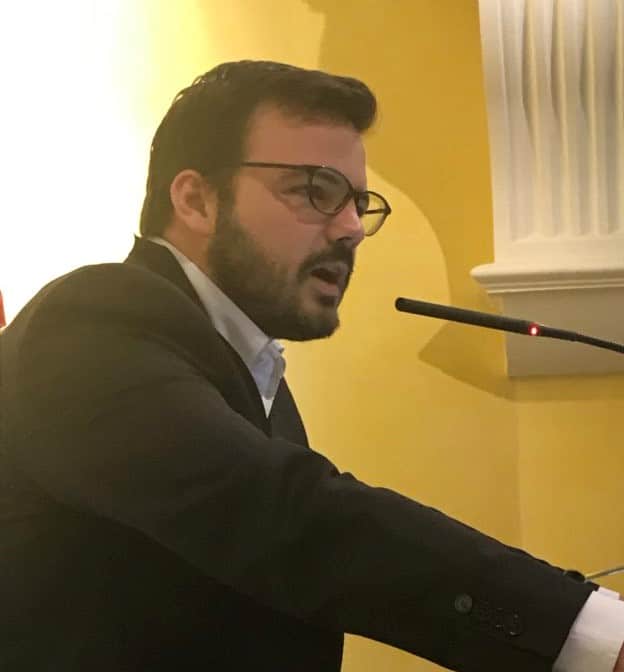
Ecoterrae CEO, Daniel Lazaro
The two companies, MEXICO2, an initiative of the Mexican Stock Exchange, and Ecoterrae Global Solutions, headquartered in Seville, Spain, will measure their emissions, reduce what they can, and offset the rest using Certified Emission Reductions from projects registered under the UN’s Clean Development Mechanism.
The Mexican Stock Exchange and British embassy in Mexico collaborated to form MEXICO2, which supports the transition to a green economy in Latin American countries through offerings on its carbon trading platform and work on green bonds.
“The construction of the Mexican carbon market is an endeavour that requires all parties to commit for a better tomorrow,” said Mariana Ayala, commercial coordinator of MEXICO2.
“There is no way we can achieve the (Paris Agreement) 1.5º (Celsius) target without an emissions trading scheme in Mexico and in several countries in the region,” added MEXICO2’s Eduardo Piquero.
Ecoterrae Global Solutions supports efforts by companies and organisations to reduce greenhouse gas emissions in alignment with the Spain’s climate change objectives. Since 2012, the company has been providing expert technical support, helping companies and organisations identify opportunities, implement projects and locate financing.
“Our commitment to the Climate Neutral Now initiative reflects a forward step in our global strategy as a company dedicated to the fight against climate change by means of the offsetting of our clients’ carbon footprint as well as ours,” said Ecoterrae CEO, Daniel Lazaro.
As part of its work, Ecoterrae has identified, promoted and led the implementation of more than 160 project activities under the Spanish Ministry of Environment’s Climate Projects (Proyectos Clima) initiative, which supports emission reduction projects in the country. The projects generate carbon units that are purchased at a pre-agreed price by the Ministry.
“We are proud to count MEXICO2 and Ecoterrae as signatories of the Climate Neutral Now pledge,” said Niclas Svenningsen, Manager of Global Climate Action at UN Climate Change. “We need companies with expertise in climate action to help us promote and catalyse further action by all organisations.”
The Lagos State Government on Tuesday, June 5, 2018 urged the residents to support its efforts to control plastic pollution in the state.
The Lagos State Commissioner for Environment, Mr Babatunde Durosinmi-Etti
Commissioner for the Environment, Mr Babatunde Durosinmi-Etti, gave the advice during the commemoration of the World Environment Day (WED) in Lagos.
Durosinmi-Etti, who was represented by Mr Babatunde Hunpe, the Special Adviser to Gov. Akinwunmi Ambode on Environment, stressed the need to tackle plastic pollution because of its effects on humans and aquatic life.
He said that plastic pollution created serious environmental and health hazards by threatening the marine life.
”As stakeholders, we all have a role to play in attaining a cleaner and healthier environment.
”We need to encourage bagging of wastes to prevent indiscriminate dumping and cooperate with the government in its efforts to make Lagos a cleaner state,’’ Durosinmi-Etti said.
He urged the residents to exhibit their actions in line with the 2018 WED theme: “Beat Plastic Pollution” aimed at reducing, reusing and recycling.
The commissioner said that WED, which was recommended by the United Nations to propel nations and humanity for the conservation of the environment, was observed in over 100 countries of the world.
He said that the celebration underscored the need in Lagos State to rededicate national efforts for sustainable development by putting environmental concerns at the centre of all developmental plans.
According to him, this year’s WED is a day set aside to address numerous environmental concerns and problems that threaten not just the human race, but planet as a whole.
He said it was a day that simply provided the opportunity to put the environment first and review the existing and emerging environmental problems with a view to creating awareness and proffering solutions.
According to him, the World Economic Forum, in its recent review, puts plastic wastes ending up in the ocean at 80 per cent.
”The World Economic Forum’s review reported the possibility of the ocean containing more plastics than fish by 2050, if problems associated with plastic pollutants are not adequately addressed.
”It is already a well-known fact that marine life is threatened by plastic pollution.
”Aquatic animals are hurt when they get trapped in the web of plastic wastes or feed on these wastes, which often lead to their death.
”Furthermore, degraded bio-products have also been proven to have negative effects on the reproductive capabilities of fishes.
”For the avoidance of doubts, established plastic pollution facts stated that the world uses 500 billion plastic bags in a year,” he said.
According to him, facts have it that eight million tonnes of plastics end up in the oceans.
He said that people had not reused or recycled plastics appropriately and that they bought more plastics than they needed.
The commissioner said that there was need to find alternatives to eradicate the menace caused by these products to help sustain and save our environment.
‘We have only this planet to call our home, let us make it livable for all and for future generations.
”The responsibility to save and sustain our environment begins with us as individuals, communities, governments and industries,” he said.
The Federal Capital Territory Administration (FCTA) has, through its Abuja Environmental Protection Board (AEPB), introduced Blue Bin Project to reduce the quantum of wastes that go to its landfill.
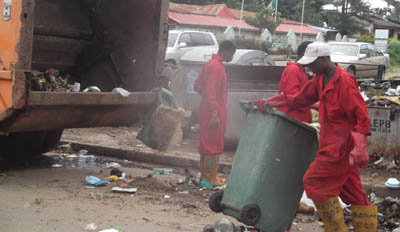
Officials of one of the AEPB waste evacuation contractors, on duty in Garki Area of Abuja
Malam Muhammed Bello, the Minister of Federal Capital Territory (FCT), said this in Abuja on Tuesday, June 5, 2018 at the commemoration of the 2018 World Environment Day (WED).
The News Agency of Nigeria reports that the commemoration has ‘‘Beat Plastic Pollution’’ as its theme.
Bello, who was represented by the Coordinator, Abuja Metropolitan Management Council (AMMC), Mr Umaru Shuaibu, said the project involved recycling of waste materials with a view to reducing waste in the FCT.
‘‘In 2016, based on Memorandum of Understanding (MoU) between the Administration and Japan International Cooperation Agency (JICA), the AEPB introduced an integrated Solid Wastes Management pilot scheme, in life Camp District of FCT.’’
According to him, FCTA promotes the three concepts of waste management which are aimed at reducing, reusing and recycling wastes.
‘‘In the FCT, we shall continue to take very proactive steps towards ameliorating the hazards of plastic pollution.
‘‘We are working to increase general awareness among the populace on the consequences of disposable plastics on the environment.
‘‘One way of doing this, we believe is by sticking with one of the slogans of WED, which is `If you cannot reuse it, refuse it’, the minister said.
AEPB Director, Baba-Shehu Lawan, said that 13 million plastics were being dumped in the world indiscriminately into land, river and ocean yearly.
He described plastics as non-biodegradable which destroyed marine life and the environment.
Lawan said that AEPB joined the world to commemorate WED to raise awareness on people’s actions that led to the blockage of water channels and caused the destruction of the environment.
The Chairman, AEPB Governing Board, Dr Baruwa Yahaya, who said that the environmental management was a collective responsibility, urged residents to assist in controlling plastic pollution in the FCT.
NAN reports that the FCT minister and other stakeholders in the environment sector plant tree seedlings to commemorate the day.
Governor of California State, Edmund G. Brown Jr.; United Nations Climate Change Executive Secretary, Patricia Espinosa; and Mahindra Group CEO, Anand Mahindra, have joined forces to spur more businesses, cities, states and regions to transparently report carbon emissions and progress toward meeting verifiable emissions reduction goals.
Mahindra Group Chairman, Anand Mahindra
“Tracking and reporting carbon pollution keeps governments and businesses accountable,” said Governor Brown. “Governments and businesses must turn their climate goals into bold climate action by honestly and fully reporting their emissions.”
“If we are to keep the target of limiting global temperature rises to 1.5 degrees Celsius within our grasp, we need more governments and corporations than ever before to report on exactly how they are stepping up to address climate change,” said Espinosa, who is also Summit Co-Chair.
“It is only with resource to such information that the world can begin to understand how it can meet the urgent task of implementing the Paris Agreement. Today’s challenge from Governor Brown – which aims to stimulate greater levels of disclosure – is therefore a much welcome ‘call to action’ ahead of the Summit, ahead of COP 24 in Poland,” Espinosa added.
“We can’t manage what we don’t measure, and disclosure is a crucial step for that,” said Summit Co-Chair, Mahindra. “I echo the challenge to companies and governments to enhance disclosures from Summer 2018. The time to step up and act is now.”
Transparently tracking and monitoring greenhouse gases is a key component of holding governments and businesses accountable for meeting emissions reduction targets. The challenge issued today sets a goal of having at least 300 more companies, cities, states and regions publicly disclose their carbon emissions and reduction efforts by the Global Climate Action Summit this September.
More than 570 cities with a combined population of 608 million people, 100 states and regions across 88 countries and 6,300 companies with 55 percent of global market capitalisation have already taken urgent action by measuring and reporting their climate impact through CDP, formerly known as the Carbon Disclosure Project.
The challenge issued today also calls for universal and standardized reporting by all governments and entities worldwide by 2030 as a clear and achievable goal.
“Disclosure works,” said Lance Pierce, President of CDP North America. “Companies, cities, states and regions who have disclosed via CDP for many years – and even those new to the process – are reaping great benefits from public disclosure, and the world is rewarded with collective data, insights and knowledge. They are forging ahead with climate action because it is both in their and their stakeholders’ best interests to do so. I hope that many more are inspired to embrace today’s universal disclosure challenge in time for the Global Climate Action Summit,” he added.
A key purpose of the Summit is to showcase climate action around the world, along with bold new commitments, to give worldwide leaders the confidence they need to go even further by 2020, starting from when they meet at the United Nations COP24 in Poland in November and through to a climate leaders’ Summit scheduled by the UN Secretary-General in late 2019.
Worldwide emissions must start trending down by 2020 in order to keep a global temperature rise well below 2 degrees C and avoid dangerous, rising risks to people and economies world-wide: the Summit will play a key role in galvanizing the support necessary to make that happen. Disclosure is fundamental to tracking individual and collective progress towards global climate goals.
The Summit marks the first time a U.S. state has hosted an international climate change conference with the direct goal of supporting the Paris Agreement.
The Global Climate Action Summit takes place from September 12 to 14, 2018 in San Francisco under the theme “Taking Ambition to the Next Level.”
In line with this year’s World Environment Day theme on beating plastic pollution, Climate and Sustainable Development Network (CSDevNet), in collaboration with partners and other non-state actors, is calling on the Government of the Federal Republic of Nigeria to go beyond rhetoric and mere sloganeering and set in motion the process of banning single-use plastic in Nigeria.
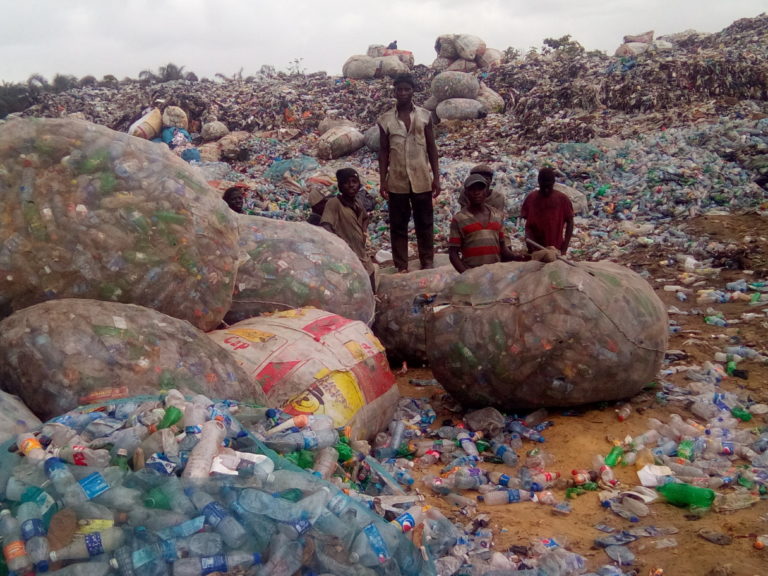
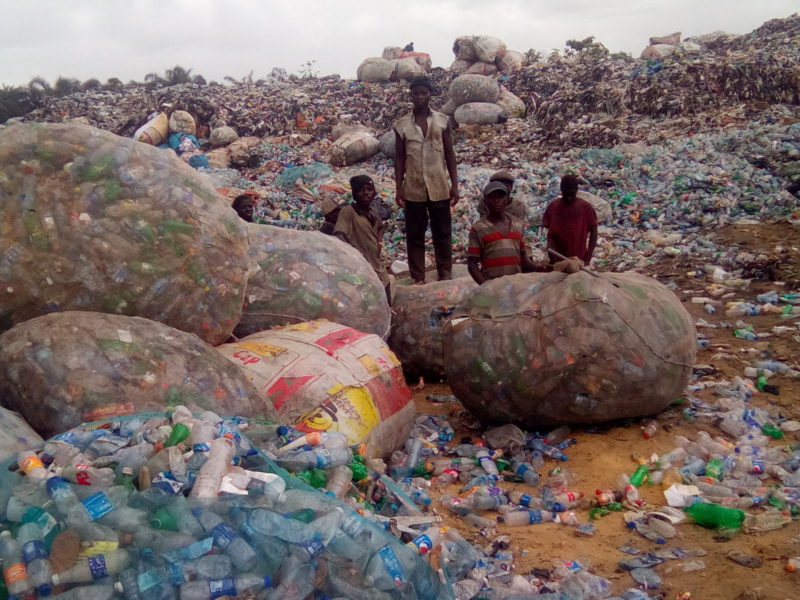
Plastic bottle scavengers and their wares at the Epe Landfill Site/EcoPark in Lagos, Nigeria
The 2018 WED theme represents a veritable opportunity to consider how we can make changes in our everyday lives to reduce the heavy burden of plastic pollution on our natural places, our wildlife – and own health. While plastic has many valuable uses, Nigeria has become over-reliant on single-use or disposable plastic – with severe environmental consequences.
CSDevNet recognises that beating plastic pollution is a huge challenge especially when we consider the perverse culture of current disposable economy. Fifty percent of plastics in use are disposable or single-use type. Globally, we buy one million plastic bottles every minute and use up to five trillion plastic bags every year.
Dumping plastic bottles, bags and cups after a single use is projected to result in our oceans holding more litter than fish by 2050, while an estimated 99 percent of all seabirds will have ingested plastic. There is even evidence that plastic waste threatens soil fertility. Reports by Ocean Conservancy, suggest that there will be more plastics than fish in the oceans by 2050. Already, plastics have been found in over 60 percent of all seabirds and in all sea turtles’ species that mistake plastic for food. We must beat plastics, for our survival and for the survival of other species. We need fish, not plastics.
The Federal Government of Nigeria has a major role to play in beating plastic pollution and particularly addressing the current scourge of plastic waste on urban and rural landscapes across Nigeria. Across Africa, several African countries (including Côte d’Ivoire, Cameroon, Mauritania, Tunisia, Kenya, Uganda Rwanda, Tanzania, Morocco, and South Africa) have enacted laws related to the ban on the use, manufacture and importation of single-use plastic bags.
In view of the fact that outright bans on single-use plastics without viable and affordable alternatives (such as biodegradables or paper-based alternatives, which are often perceived as more expensive and “less durable”) could negatively affect some sections of society and small and medium-size enterprises, we urge Nigerian authorities to introduce the plastic bag levy, which is favoured in several countries across the globe, including the United Kingdom with significant success in relation to behavioural change towards single use plastics.
In some countries, such as South Africa, it has been reported that funds raised from the plastic bag levies are not entirely used in investing in recycling programmes and programmes that will bring about fundamental behavioural changes both at the individual and at the corporate level, towards beating plastic pollution for good. They are also channelled towards creating empowerment opportunities for the teaming young population.
We believe Nigeria can toe this line by providing incentives such as tax breaks for companies to encourage recycling as well as to transform their production processes towards the production of biodegradable alternatives and also strictly enforcing legislation as part of a holistic programme for sustainably transforming their economy and banning all non-biodegradable plastics from the country.
In line with the above, we call on the Presidency of Nigeria through the Federal Ministry of Environment to orchestrate steps aimed at regulating the manufacture, use and disposal of of single-use plastics in Nigeria. CSDevNet hereby commits itself to collaborating with the National Assembly Committees on the Environment, Habitat and Climate Change and other relevant non-state actors in the aggregated efforts at crafting an institutional framework to tackle the plastic menace in the country.
Students of Immaculate Conception Secondary School (ICSS) Bauchi, on Tuesday, June 5, 2018 called for the establishment of “Environmental Conservation Clubs” in all the primary and secondary schools in the country to instil the culture of environmental conservation in the minds of children.
Bauchi State Commissioner for Health, Zuwaira Hassan
The students made the call at a ceremony organised by the institution’s environmental conservation club, the Young Leaders Development Project (YLDP), to mark this year’s World Environment Day.
Speaking through the President of the club, Mr Peter Okafor, the students noted that a lot still needed to be done in area of environmental protection and sanitation.
They said one way of curbing environmental disasters was for the government to encourage environmental conservation practices.
“The government and individuals are not doing enough in the area of environmental protection and sanitation, which is the reason why environmental challenges such as flood, drought and climate change related disasters, are engulfing the Nigeria environment.
“The only way to reverse this ugly trend is for Nigerian government and international organisations to encourage environmental conservation practices across the strata of the society,” they said.
They also called on the Federal and state governments to allocate enough resources for the “greening of cities and town” across the country, adding that this could be done through the encouragement of planting of trees.
Also speaking, the Director of Bauchi State Environment Protection Agency (BASPA), Mr Ibrahim Dalari, said some of the major environmental challenges facing the state were desertification and poor environmental sanitation.
“Our major environmental challenges in Bauchi are desertification, which is in alarming rate, as well as poor environmental sanitation.
“This poor environmental sanitation has triggered diseases, which have claimed lives across the state,” he said.
The News Agency of Nigeria (NAN) reports that other activities that featured to mark the Day included cultural dance, planting of economic and normal trees within the school premises, as well as the recitation of the “green pledge”, among others.