Zambia has signed an agreement with the Sustainable Development Goals (SDGs) Centre for Africa for the establishment of a southern Africa regional office, a senior government official said on Monday, September 24, 2018.
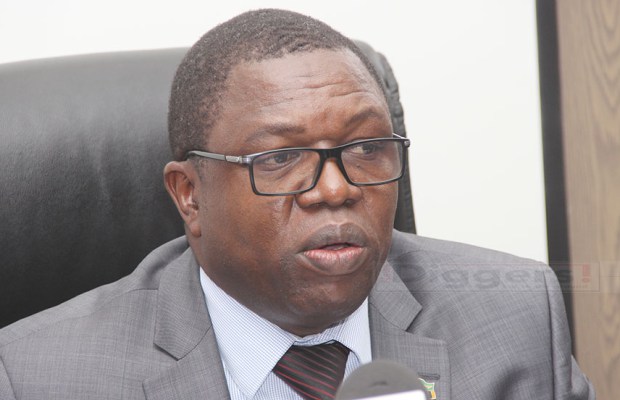
Zambia’s Foreign Affairs Minister, Joseph Malanji
The deal was signed between Zambia’s Foreign Affairs Minister, Joseph Malanji, and SDG Centre for Africa Director-General, Belau Begashaw, in New York.
The agreement will see the country host the office which will be advocating for the implementation of SDGs in the southern African region in line with the principles of the AU Agenda 2063, the Zambian minister said.
The Zambian minister, who is in New York for the UN General Assembly, said the government was committed to the global principles in the fight against poverty.
The minister said that commitment of government enhances its decision to develop the Seventh National Development Plan which has since been aligned to the SDGs.
The government, he said, was implementing several social protection programmes aimed at empowering women and youth as well as other vulnerable people.
He commended the Zambian government for agreeing to host the regional centre and committing itself to fighting poverty.
Similarly, African wild dogs have vanished from a national park in western Zambia in unclear circumstances, authorities said on Monday.
The wild dogs were last spotted in Liuwa National Park in 2013 while operations to establish their whereabouts have proved futile, Gabriel Masaku, Liuwa Area Warden, said.
Masaku, who said this during a meeting with traditional leaders, raised concerns over the disappearance of the wild dogs that it was difficult to trace the animals because they were not fitted with satellite collars.
During the meeting, the traditional leaders said African wild dogs were one of the prides of the national park and wondered how all the parks could have migrated from the ecosystem where they have lived for centuries.
The traditional leaders have since asked the Department of National Parks and Wildlife to expedite the search for the wild dogs.
The official, however, told the traditional leaders that the wild dogs could either have migrated to neighbouring countries or wiped out by rabies.
The traditional leaders also gave the department up to mid-October to issue a compressive report regarding the disappearance of the African wild dogs.
Executive Secretary of UN Climate Change, Patricia Espinosa, has called for more urgency in taking climate action.
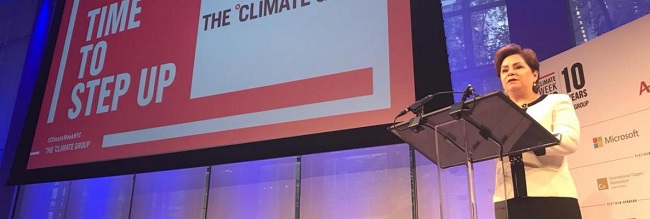
Patricia Espinosa
She made the submission at the opening of the New York Climate Week on Monday, September 24, 2018, even as she stressed the need for leadership and a committed multilateral response.
The last round of formal negotiations took place in Thailand in September, in preparation of the UN Climate Change Conference in Poland (COP24) at the end of the year, with uneven progress.
“Recent negotiations in Bangkok on the Paris Agreement’s implementation guidelines made some progress, but not enough. We must therefore work harder than ever between now and COP24 to complete this work,” she said.
Espinosa received a Call for Action at the Global Climate Action Summit in San Francisco slightly over a week ago, which outlines how states, regions, cities, businesses, investors and communities are stepping up action to put the world on track for a climate-safe world.
In New York City, the UN’s top climate change official stressed the importance of an approach to climate action that empowers bottom-up action, in the form of inclusive multilateralism:
“Listen to the voices of billions who understand that time itself is a dwindling resource when it comes to climate change to those who understand that addressing climate change provides extraordinary opportunity and are acting,” she said.
Her full presentation:
Seventy-three years ago, nations – ravaged by war, weary of its costs – pledged to achieve what had, for the first half of the century, been impossible: a lasting peace.
The signing of the UN Charter in San Francisco was more than an agreement to get along.
It established a rules-based international order, championed multilateralism over self-interest, and clarified that the path forward was not through conflict but collaboration.
We bear the fruit of that work. Today, many are healthier, better educated, and more peaceful than at any point in history.
But humanity faces a new challenge; one that threatens current and future generations.
Climate change is an opponent we shaped with our own hands, but whose power now threatens to overwhelm us.
Throughout the world, extreme heatwaves, wildfires, storms and floods are leaving a trail of devastation and death.
Developing countries suffer the worst, but climate change affects all nations—directly and indirectly.
It’s a challenge that a rules-based international order is custom-designed to address—which led to the Paris Agreement.
Like the UN Charter itself, its signing was an unprecedented multilateral success.
But nations are not living up to what they promised.
Under it, nations agreed to limit climate change to 2-degrees Celsius—ideally 1.5C.
These targets are the bare minimum to avoid the worst impacts of climate change.
But what nations have currently pledged under Paris will bring the global temperature up about 3C by 2100.
Let us be clear: low ambition leads to a future where humanity no longer controls its own fate – runaway climate change does.
Recent negotiations in Bangkok on the Paris Agreement’s implementation guidelines made some progress, but not enough.
We must therefore work harder than ever between now and COP24 to complete this work.
We need to see leadership, we need to recognize the urgency we face, and we need to make a commitment to a decisive multilateral response. We have no other option.
This means that we must:
Listen to the voices of billions who understand that time itself is a dwindling resource when it comes to climate change.
Listen also to those who understand that addressing climate change provides extraordinary opportunity and are acting.
Just as 73 years ago the UN Charter was signed in San Francisco and then moved to New York City…
…we’ve also just arrived from San Francisco and the Global Climate Action Summit.
It was a clear statement from businesses and investors around the world that they have seen the future, and it’s green.
I have with me a call to action from the Summit.
It outlines how states, regions, cities, businesses, investors and communities are stepping up action to put us on track for a climate-safe world.
Let this be a call to nations to not only step up their climate ambition, but chart a clear path to the future, and empower bottom-up climate action.
Let that work continue here in New York, and let multilateralism remain our way forward.
I’m reminded of something by a great supporter of multilateralism, the late Kofi Annan.
In remarks commemorating the first anniversary of the September 11 attacks, he said:
I stand before you today as a multilateralist – by precedent, by principle, by Charter and by duty.
The best way to honour Mr. Annan is to honour his words.
Let us build upon them, by embracing what I call inclusive multilateralism, one that recognizes the need for more voices at the table, not fewer.
I recognise none of this is easy – nothing this transformative or important ever is. But it’s worth it.
It’s worth it because by addressing climate change, we can build a better, more resilient future, both for this generation and all generations to follow…
…a future that is both cleaner and greener, but one where poverty is reduced, rights are shared more equally by all, and that all people can live, love, learn and prosper.
President of Togo, Faure Essozimna Gnassingbe, has commended the Eko Atlantic City project on the technique adopted towards providing what he terms “a permanent solution” to coastal erosion on the Lagos shoreline.
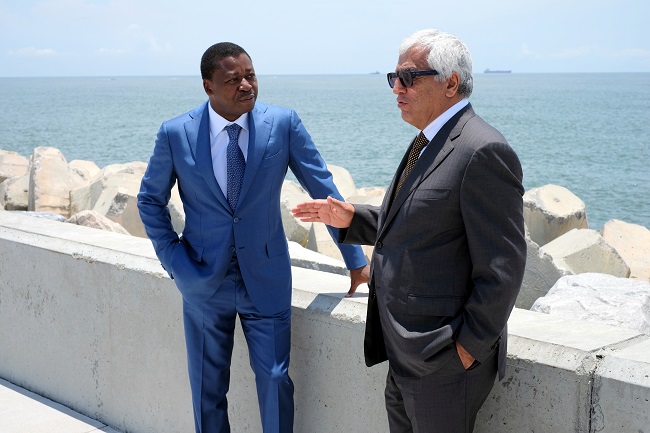
President Faure Essozimna Gnassingbe of Togo (left) with Chairman of South Energyx Nigeria Limited, Ronald Chagoury
He gave the commendation on Friday, September 21, 2018 during a tour of the ongoing project in the company of Mr. Ronald Chagoury, Chairman of South Energyx Nigeria Limited, developers of the estate.
Gnassingbe, who reportedly pays attention to the issues of fight against global warming and protection against coastal degradation in Africa, said: “Like Victoria Island, seaside communities along Togo’s coast and in many African countries have long lived with the consequences of erosion from the Atlantic Ocean. However, with sustainable solutions and innovative partnership with private sector we can tackle coastal erosion and bring an end to this environmental issue.”
Coastal erosion, a menace experienced in West Africa and beyond, including Nigeria and Togo, has been an on-going problem for hundreds of years impacting the lives of millions of Africans, according to observers.
South Energyx Nigeria Limited however claims that Eko Atlantic City “has proven to be a sustainable solution to this threat with the construction of a great sea revetment known as the ‘Great Wall of Lagos’, which was constructed soon after the collapse of Bar Beach in 2005.”
Its construction, adds South Energyx, was said to be an urgent action required to protect the shoreline of Victoria Island and Lekki and the potential loss thousands of lives, homes, businesses and vast areas of developed land.
Speaking during the tour, Chagoury stated: “Eko Atlantic City came up as a solution to address the erosion that was fast destroying the coast of Victoria Island and its environs. We recognised that an urgent step had to be taken to protect the shoreline of Victoria Island and reclaim the land that had been lost.
“As a result, the Eko Atlantic City project came up as a permanent solution to the coastal erosion of Victoria Island and parts of Lekki and we have ensured this through the construction of the ‘Great Wall of Lagos’.
“In fact, this endeavour has not only stopped erosion, it has created a smart city, a financial hub and has united us with our neighbours to come together in the fight against on-going coastal erosion.
“With Eko Atlantic City in place, thousands of lives, homes, businesses and vast areas of developed land in Victoria Island, Lekki and other areas have been saved from the wrath of the Atlantic Ocean. Approximately 6.5 kilometres of a total of 8.5 kilometres of the ‘Great Wall of Lagos’ has been completed. This wall will continue to protect Victoria Island and parts of Lekki from erosion.”
Victoria Adankwa, an Agriculture Officer, is one of the many Ghanaian women fervently looking forward to the uptake of agricultural biotechnology in the country. And she does not hide her passion for the technology.
GMOs
The occasion to bare her thoughts about the technology came at the June 5, 2018 Biotechnology and Biosafety Sensitisation Workshop in Cape Coast, organised by the Ghana Chapter of the Open Forum for Agricultural Biotechnology (OFAB) in Africa, for stakeholders in the Central Region.
Victoria stated: “Since the attempt by man to enhance crop and seed production alters their original composition, it means we have been consuming genetically modified crops all this while, so why the protest against the wholesale uptake of biotechnology in Ghana?”
Her comments bring the discussion on the issue to the point, where the public needs to appreciate that current food crops including staples like corn have gone through some form of evolution even as societies have evolved. “Human civilisation evolved in parallel with crop domestication and breeding,” says Prof. Channa Prakash of University of Tuskegee, Alabama, USA.
He was addressing a gathering of international and national research scientists, policy makers and agricultural officers at a two-day seminar in Accra on Advance Agricultural Biotechnology, Biosafety and Regulatory Approaches. The seminar, which took place on from September 18 to 19, 2018 was organised by the US Department of Agriculture Office of Agricultural Affairs at the US Embassy in Ghana.
Prof. Prakash’s presentation as well as those of the other resource persons, among other things, traced the genesis of biotechnology to thousands of years ago. “Humans have been changing the genetics of crops since the dawn of age… by saving and replanting of seeds collected in the wild.”
He explained that, in the wild state, plants and crops regenerated mainly through seed dispersal system as seeds stayed attached to plants. “The human action of saving and replanting seeds therefore interrupted the natural process of plant regeneration,” Professor Prakash added.
This literary means that most of the crops we have been eating all these years have experienced some form of genetic modification, through deliberate human action. So, while sections of society would want to wish the technology and its products away, as a present day dangerous and unneeded introduction into the food chain, the truth is that humans have been consuming genetically modified foods, since the times people started cultivating crops.
Prof. Naglaa Abdallah of the Faculty of Agriculture, Cairo University, agreed that genetically modified foods have been with man for ages. “Thousands of years ago, farmers were altering the genetic makeup of the crops they grow by selecting the best-looking plants and seeds and saving them to plant for the next season. The selection was for features such as faster growth, higher yields, pest and disease resistance and sweeter fruits,” she said.
Therefore, the corn, water melon, carrot, cabbage, and broccoli among other edibles, which people take for granted are in their normal natural states, have either been altered from their original states or are derivatives from other crop varieties. And, believe or not, if you love strawberries for instance, which is now seen as a fruit for lovers and therefore packaged for Valentine Day celebration, be assured that it was not one of the fruits that were in the Garden of Eden. According to Prof. Abdallah, “modern day strawberries never existed.”
Thus, the process that started as an ancient human activity to access readily available quality seeds for good yields, have been perfected in modern times, to facilitate or fast track the process of acquisition of high-quality seeds with the assurance of better produce in terms of quality and quantity.
Both Prof. Abdallah, who is also the Director of Egypt Biotechnology Information Centre of the International Service for the Acquisition of Agri-biotech Application (EBIC ISAAA) and Prof. Prakash see modern biotechnology crops as making significant contribution to the global food chain. Global cultivation of biotechnology crops includes corn, soybeans, cotton and potato, among others.
For the past 20 years, biotech crops have proved to be highly beneficial to the 28 countries actively cultivating them and the over 18 million farmers engaged in the cultivation. Pesticide use has reduced by 37%, while, crop yields have increased by 22%. Total farm income over the period is estimated at over $150 billion. Moreover, biotech crops and products are some of the safest in the world, because of the rigid regulatory process the development is subjected to.
Profs. Abdallah and Prakash further agree that the major challenge to the fast deployment of the technology is the regulatory costs and length of time involved its development. The latter noted that the development of one event “can take up to 14 years at a cost of $35 million.”
As to how countries like Ghana can adopt the technology at less cost and in short time, Professor Prakash urged the “government to come up with a very strong support for biotechnology, acknowledge that it is one of the most important tools available to enhance agriculture, and assure Ghanaians of the safety of biotechnology, providing the evidence that its products have been used around the world without any problems for over 20 year.
The Deputy Minister for Environment, Science, Technology and Innovation (MESTI), Madam Patricia Appiagyei, earlier at the opening session, said the government recognises the potential benefits that the country can derive from genetically modified organisms and their related products. She added that the necessary biosafety processes and policies have also been developed to address potential adverse effects on health and the environment.
Experts say they are not exactly surprised about the resistance from some sections of society to the acceptance of biotechnology crops and products. This is because most of the world’s scientific breakthroughs over the years, have been initially opposed to by society.
For instance, it took the world 100 years to accept pasteurisation, a process that kills disease causing organisms known as pathogens to render food safe to eat. To date, pasteurisation remains the most important operation in milk processing.
However, some Ghanaian scientists are of the view that it is totally unnecessary for the country to wait any longer to fully embrace biotechnology as the required field trials of the two selected crops – NEWEST Rice and BT Cowpea have successfully been done. They wonder why Ghana should keep waiting, when sister countries including Nigeria have granted approval for commercial releases of biotech crops.
Bothered by the array of threats faced by Nigerian rivers, the Foundation for Conservation of Nigerian Rivers (FCNR) has launched an advocacy campaign for rights of streams in the country.
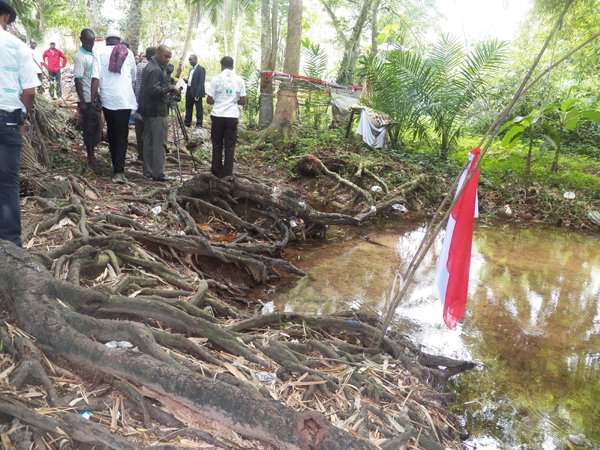
Umuaja, source of Ethiope River
FCNR officials stated that this was undertaken to mark the World Rivers Day (WRD) on Sunday, September 23, 2018. The WRD is a global celebration of the world’s waterways observed on the last Sunday in September of every year.
In a statement endorsed by Prof. Oladapo Afolabi (Co-Founder/Chairman, Board of Trustees) and Irikefe Dafe (Founder/Executive Director), FCNR disclosed: “This year, we are marking the celebration of WRD in Nigeria and Africa by the official launching of an advocacy campaign for rights of rivers in Nigeria using River Ethiope as a case study.”
According to them, Nigeria is one of the countries in the world with rivers in a state of degradation and with no adequate and deliberate effort to reverse the trend.
The statement reads in part: “Every day, the country is losing this precious resource to pollution due to reckless activities of man (industrial and urban development) and climate change, among other factors.
“No river in Nigeria meets the water qualities standard stipulated by the World Health Organisation (WHO) either for swimming, fishing and drinking purposes. In every community in Nigeria today, the rivers that used to be a source of drinking water, swimming and other aquatic activities have ceased to play these vital roles to mankind due to pollution.
“We must redefine our concept of development as a nation, to note that developments that will not accord rivers and waterways their required attention to sustainably support human societies will not only be lopsided but transient.
“It will not be an over statement to say that the state of any river one sees in any community is a practical reflection of the mindset of the people and activities they undertake daily within a river catchment and watershed.
“The River Ethiope in Delta State is probably the only river that has a foundation established to promote its judicious use and conservation in contrast to water bodies in the USA, Australia and most parts of Europe that have all their water bodies under protection.
“Nigeria’s current efforts at economic progress and other developmental aspirations may be frustrated in the near future if deliberate and urgent attention is not given to sustainable management of its streams.”
The Nigeria National Parks Service has appealed to the public to assist the service in facilitating the recapture of wild animals that strayed from parks due to flood incidents across the country.
Alhaji Ibrahim Goni, Conservator-General of the National Parks Service
Alhaji Ibrahim Goni, the Conservator-General of the Parks Service, made the appeal in Abuja via a statement signed by his Media Assistant, Yakubu Zull, on Monday, September 24, 2018.
Goni, who sympathised with the flood victims and affected states, however, urged the general public not to kill any stray wild animal displaced by floods from wildlife parks, saying that they should instead call on experts for quick intervention.
He thanked Gov. Abubakar Bagudu and the people of Kebbi for inviting the officials of the service when they sighted four stray elephants and a calf in Danten swamp in Bagudu Local Government Area of the state.
He urged other citizens to emulate the governor in efforts to protect wildlife regardless of the location of the wild animals because of their value to a balanced and sustainable ecosystem.
“In Nigeria at present, the destruction of natural habitats continues unabated, resulting in the depletion of the country’s wildlife resources.
“Several species of wildlife have been lost, while some are threatened with extinction due to factors such as climate change, human population and pollution,’’ he added.
The conservator-general said that there were over 100 forest and game reserves across the country but noted that the current state of the reserves was quite unsatisfactory.
“This is the reason why the few remaining wild animals maraud with no habitat to protect them.
“The cases of a colony of chimpanzees killed in Enugu, elephants killed in Ondo and Kwara (Jebba), the marauding elephants in Ijebu Ode and the recent case of an elephant killed in Kebbi are fresh in mind,’’ he said.
Goni pushed for the review of the state laws that stipulated highly insignificant punishments for the killing of endangered animal species like elephants, for example.
“The fine is a tap on the wrist for such grievous offences, so the government should review the archaic wildlife laws to come up with effective protection and management policies for wildlife resources.
“The revised laws would avert the indiscriminate and wanton killing of these species,’’ he added.
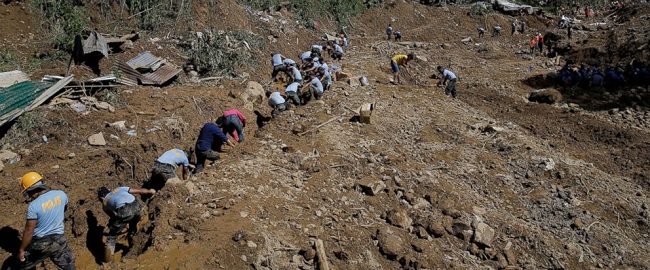
The death toll in two major landslides that struck the Philippines recently has climbed to 95, authorities said on Monday, September 24, 2018.
Rescuers continue to search for victims buried by a landslide after Typhoon Mangkhut lashed Itogon
Officials said as of Sunday a total of 49 bodies have been pulled out of the rubble in the mining town of Itogon, Benguet province in the northern Philippines.
Meanwhile a total of 46 bodies have so far been retrieved from the landslide that also hit a community at the foot of a quarrying site in Naga City in the central Philippine Cebu province.
In Itogon, disaster officials said at least 19 others are still missing after mud boulders crashed on a bunkhouse.
The bunkhouse was where small-scale miners and their families sought refuge as super typhoon Mangkhut barreled the Philippine main Luzon Island on Sept. 15.
Rescuers are continuing their retrieval efforts to locate 40 others still missing in the Naga City landslide that buried some 30 houses around 6 a.m. on Thursday.
Disaster officials counted nearly 200 deaths in typhoon Mangkhut and the twin landslides that struck the Philippines recently.
Almost 1.6 million farmers and fishermen were affected by Mangkhut, the strongest typhoon to hit not only the Philippines but the region this year.
Data showed that 80 to 90 per cent rice and corn crops were destroyed in the affected area, jeopardising food supplies and devastating poor farmers who were counting on their upcoming harvest.
Other livelihoods such as mining are also severely impacted in the typhoon’s aftermath.
Philippines is one of the most disaster-prone countries in the world.
An average of 20 tropical cyclones enter the Philippines each year of which around six to seven cause significant damage.
In 2013, super typhoon Haiyan devastated the central Philippines, killing over 6,000 people.
In 2009, typhoon Ketsana also caused massive flooding in Metro Manila, killing over 700.
Taking place from Monday, September 24 to Sunday, September 30, 2018 in New York City, the New York Climate Week is expected to be another key moment in 2018 to showcase climate action from around the world and to gather political support for a strong outcome at the upcoming UN Climate Change Conference COP24 in December in Katowice, Poland.
New York City
The Climate Week, the 10th in the series, comes shortly after the Global Climate Action Summit in San Francisco, California, where hundreds of new climate action commitments were made by states, regions, cities, civil society and investors.
UN officials welcomed the outcomes of the Global Climate Action Summit, which culminated in a landmark Call to Action presented to the UN’s Envoy on Youth, Jayathma Wickramanayake, and accepted by the UN top climate change official, UN Climate Change Executive Secretary, Patricia Espinosa, in the closing ceremony.
Some of the key events at the New York Climate Week include:
Addresses and statement at the opening ceremony to urge national governments gathered in New York to ramp up their commitments and deliver on the promise of the Paris Agreement.
The OECD, UN Environment and the World Bank Group host a high-level panel discussion on their joint initiative, titled: “Financing Climate Futures: Rethinking Infrastructure”.
The second One Planet Summit, co-hosted by Pres. Emmanuel Macron of France and Special Envoy for Climate Action Michael Bloomberg, which will bring a wide group of actors together for civic leadership on climate issues.
UN Climate Change and The Climate Group will co-organise a special event to announce the 15 winners of the 2018 Momentum for Change Award during Climate Week NYC on Thursday, September 27.
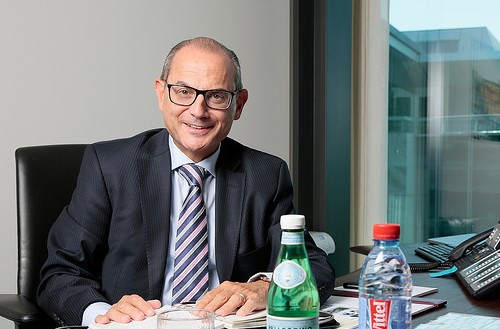
Nestlé has announced new plans to ensure the reduction of deforestation.
Magdi Batato, Executive Vice President and Head of Operations at Nestlé S.A
The Swiss company has set an enhanced plan to ensure that it fulfils its 2020 No Deforestation commitment by being the first global food company to implement Starling, a satellite-based service, to monitor 100 per cent of its global palm oil supply chains.
Magdi Batato, Executive Vice President and Head of Operations at Nestlé S.A, said: “Nestlé has always been committed to source the raw materials we need to make our products in a responsible manner. In 2010, we made a No Deforestation commitment stating that all our products globally will not be associated with deforestation by 2020.”
Starling use cutting-edge technology to provide un-biased year monitoring of land cover charges and forest cover disturbances. The data collected from the process allows companies to manage risks and perform field intervention strategies to drive change.
François Lombard, Head of the Intelligence Business at Airbus Defence and Space, said: “Starling is a fully digital service, offering best-in-class machine learning and cloud technologies to provide very precise and near-real time forest cover change information. Terabytes of satellite images are turned into actionable information, to provide our customers with a reliable service to monitor their supply chains and to early identify potential deforestation events.”
Deforestation is a complex problem and Nestle has urged the entire industry to work together to ensure it is addressed appropriately.
Palm oil is a vegetable oil and is the most widely used of its kind. However, the practices to produce palm oil result in widespread deforestation and loss of habitat for wildlife.
By December 2018, 100 per cent of Nestlé’s palm oil will be monitored for deforestation using satellite imagery.
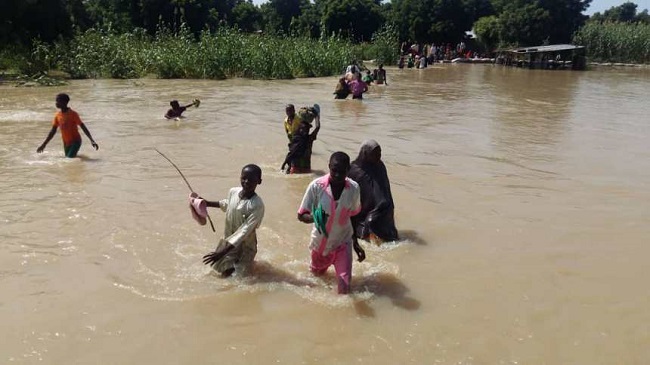
The District Head of Auyo in Jigawa State, Alhaji Umar Baffa, wept openly on Saturday, September 22, 2018 over the devastation caused by flood in Auyo town and other villages in the district.
A flooded Gululu community at Jahun LGA, Jigawa State. Photo credit: premiumtimesng.com
Baffa, who holds the title of Sarkin Auyon Hadejia, said at his palace that the flood, caused by the overflow of the Hadeja-Jamaare River, completely submerged the town and neighbouring communities.
“Three of my people died and properties worth N3.5 billion were lost in the flooding that submerged the town and some villages in my domain.
“For two days, water was overflowing from the Hadejia-Jama’are River to Auyo and, before we could do anything, the water submerged the town and the neighbouring villages.
“The villages included Jura, Rafeji, Uza, Gamakwai, Zabaro and Ayama, among others.
“In the process, three people got missing and we immediately put up a search team and their bodies were later found.
“Many houses, farmlands, animals and other properties were destroyed during the flooding,” the monarch said.
A businessman, Alhaji Isa Auyo, who lost 10 trailer loads of fertiliser, said it was a devastating experience.
“You can see the whole town is submerged; all the people have deserted the town and are now taking refuge in various Internally Displaced Person (IDPs) camps across the state.
“I am really worried about the plight of the people and I appeal to the government, individuals and corporate organisations to rescue us from this catastrophe.
He said that the state government had already undertaken an assessment of the damage and brought food and medicines.
Auyo added: “This is not the first time we are experiencing this episode in Auyo town, we had similar incident in 2001, but the current one is more devastating.
“I am appealing to the Federal Government to look into ways of tacking this recurring phenomenon.
“We were told that the water was from River Congo which overflowed through Cameroon to Lake Chad Basin is causing havoc in many places in Nigeria.
“I urge the federal government to do something to control the water so that that it can pass through our rivers with low velocity without causing any harm to us.
“I also want the Federal Government to include Jigawa among the 11 states where a state of emergency was declared over flooding.”