People worldwide have launched a global coordinated delivery of the recently released IPCC report to decision makers across the globe. The actions demand that all institutions withdraw their support from the fossil fuel industry and stand up to them before it’s too late.
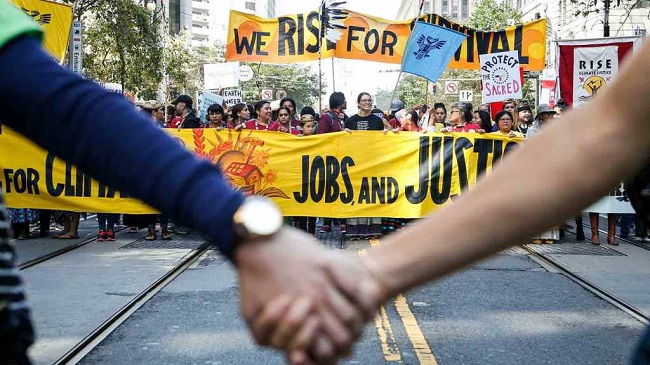
Crowds march up Market Street during the ‘Rise For Climate’ global action in September
Actions will take place in over 100 different locations and include banner drops, hand deliveries and other forms of creative action.
The scientific report confirms the need to keep fossil fuels in the ground to achieve 1.5ºC and demonstrates that it is feasible, if the world takes urgent action. Greenhouse gas emissions need to drop to half their current level by 2030 åand reach net zero by 2050. At the same time, renewable energy needs to progressively provide most of the energy, reaching 70-85% by mid-century.
While the urgency to kickstart a global systemic transition should be now clear, national climate plans are currently setting us on a path to over 3°C of warming by the end of the century. Climate activists, scientists and communities worldwide are advocating for these plans to be dramatically improved at the next UN climate change conference, COP24.
Payal Parekh, 350.org Programme Director, commented: “The fossil fuel industry is knowingly causing the climate crisis. The scientific and economic case for a global transition away from fossil fuels is stronger than ever, yet national governments, financial institutions and other centers of economic and political power keep propping up this polluting industry. The IPCC Special Report on 1.5°C makes it clear that you’re either on the side of science or on the side of the fossil fuel lobby. We’re delivering copies of it worldwide to remind decision-makers that it’s high time they made a choice.”
Communities worldwide are already resisting fossil fuel development and calling for a deep transformation of our energy systems and economies. Some of these stories of resistance can be found in the newly released People’s Dossier on 1.5°C authored by 350.org .
The Dossier puts faces and voices onto the facts and data provided by the IPCC special report. It contains the stories of 13 communities fighting on the frontlines of climate change: from young Pacific Islanders trying to stop the Adani mega-mine to fishermen communities in Africa battling against new coal plants; from the struggle to stop a gigantic gas pipeline among the olive groves of Southern Italy to the landowners and Native Americans putting solar panels on the route of the Keystone XL pipeline.
No fewer than 377,000 people have been vaccinated against cholera in Adamawa State, the News Agency of Nigeria (NAN) reports.
Governor Bindo Umaru Jibrilla of Adamawa State
This was contained in the World Health Organisation (WHO), Nigeria Health Emergencies Programme report, titled “Mid-Year Report 2018”, made available to newsmen on Thursday, October 11, 2018 in Yola, the state capital.
The report indicated that WHO provided the technical and financial support for the immunisation in Mubi North, Mubi South, and Maiha Local Government Areas (LGAs) of the state.
It also said that the organisation established a cholera treatment centre during an outbreak of cholera in the state in May and engaged 35 health workers on ad-hoc arrangement to provide immediate response to the outbreak.
“As a result, we brought case fatality ratio from 17 per cent to 2.2 per cent within two weeks of managing the cholera treatment centre at Mubi General Hospital,” it added.
Other actions taken to contain the outbreak according to the report included the activation of an emergency operation centre for the coordination of rapid decision making of partners involved in the fight against the epidemic and provision of technical supervision for the chlorination of water sources.
“Supplied cholera response materials include ringers lactate, fluid giving sets, cannulas, ORS, antibiotics, and infection prevention and control materials,’’ the report said.
It added that WHO also deployed mobile health teams to disinfect household as well as engaged health workers to conduct geo-coordinate mapping which enabled focused intervention.
Meanwhile, WHO has commenced a two-day Capacity Strengthening Workshop on Health Reporting During Emergencies in Yola for some journalists selected from Adamawa, Borno and Yobe states.
A team of sailors, actors and biologists are on a five-month expedition across the Pacific Ocean to raise awareness on the growing concern of plastic pollution.
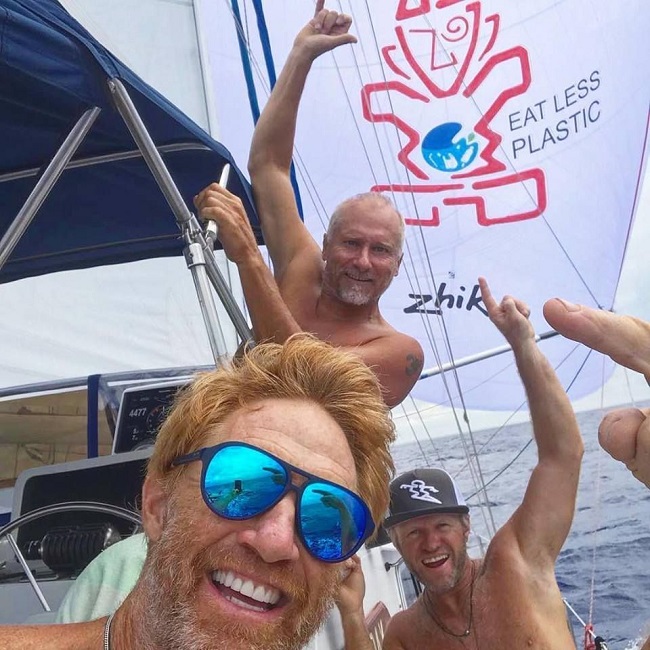
Some members of the Eat Less Plastic voyage
According to Fiji Broadcasting Corporation (FBC) on Thursday, October 11, 2018, the Eat Less Plastic team is currently docked at Port Denarau Marina, Nadi, the third largest city of Fiji and will in the next few days start their campaign in Fiji.
Capt. Phil Somerville, a Hollywood actor (Zero Dark Thirty and stuntmen in Mission Impossible), said they started their campaign from California in May and have sailed to seven island states before reaching Fiji.
Somerville said plastic pollution was a huge problem and they wanted to educate people on this.
“We’ve got a big problem here with plastics.
“It’s a global problem; it affects the world and all the fish in the ocean so that’s why I’m doing something about it.”
Other crew members with him include Grey’s Anatomy actor Martin Henderson, Magen Schifiliti, a marine biologist from Hawaii, and co-skipper Chris Dickson who is also a professional yacht racing skipper including five America’s Cup.
He said they will be going to schools and communities to raise awareness on this growing plague of plastic pollution in oceans and marine life.
The crew will also be holding a clean-up campaign at the Wailoaloa Beach in Nadi on Fiji’s Western side on Saturday.
Eat Less Plastic’s mission is to continue to strengthen the plastic pollution conversation voice to spur change in global policy in a unique way.
As they visit the Pacific islanders, they will learn what they are doing to develop solutions based on their understanding and respect for the ocean.
Their positive practices can be a model for others, helping to bring awareness to plastic pollution in oceans.
The National Space Research and Development Agency (NASRDA) says it is working to improve the living condition of Nigerians through the application of space technology.
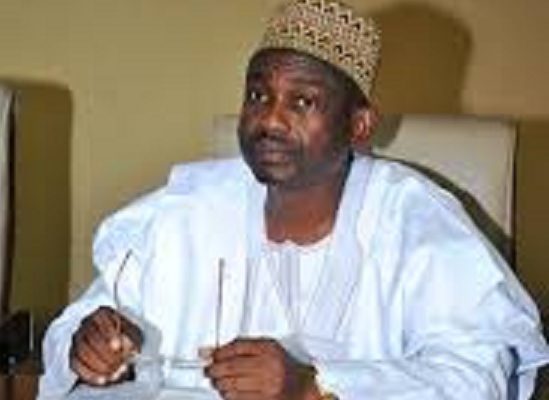
Prof. Seidu Mohammed, Director-General of the National Space Research and Development Agency (NASRDA)
Prof. Seidu Mohammed, the Director General of the agency, disclosed this on Thursday, October 11, 2018 during the commemoration of the World Space Week organised by the agency in Abuja.
The theme for this year’s celebration is “Space Unites the World’’
“We are looking forward to use space technology to improve the living conditions of Nigerians through mechanised agriculture.
“It will encourage the use of infrared to detect crops that are sick in our farms, we can also use satellite images to see how to water farm from distant lands.
“Space technology can also be deployed to predict the water-logged areas and see how we can move people away from flood prone areas,” he said.
The D-G said that the agency was considering collaboration with the National Emergency Management Agency (NEMA) to sensitise people on impending flood situation through foreseen satellite images.
“It is normal we enter into collaboration with NEMA to start campaigns and sensitise people to move out from flood areas.
“It will enable people who periodically go through these problems to avoid such,’’ he said.
Seidu noted that over the past two decades, the agency launched satellites, designed and manufactured Nano-satellite that could acquire images all over the world and had participated in space programmes globally.
“We have acquired images of Nigeria, countries in Africa and consequently made such available to government of nations on the approval of the Federal Government.
“More than 3000 researchers have acquired images on Nigerian satellites and are using it for research all over the world,” he said.
The guest lecturer, Prof. Babatunde Rabiu, Director, Centre for Atmospheric Research (CAR) said space had the inherent ability to unite the world and promote peace.
According to Rabiu, space technology has the capability to engender good governance, inhibit corruption, create job opportunities, ensure public safety and provide platform for sustainable manpower and socio-economic development.
He said virtually all the technological systems of the world were driven by the space entity.
“Space-dependent technologies depends on the use of satellites that are in the orbit and it includes satellite, navigation, information and communication technologies,” he said.
He, however, said that the space environment deserved real time routine monitoring to avoid loss of lives, property and other natural disasters.
The director also recalled that after the launch of the first satellite “Sputnik” into space in 1957, there had been over 40,000 tracked objects and 7,000 satellites launched into space.
“As at today, over 1,000 operating satellites orbit the earth which comprises 59 per cent of communication satellites, 8 per cent navigation satellites and 7 per cent military surveillance satellites”.
He said that space programmes should be adequately funded because it was a global cooperation that required active participation.
Rabiu also urged the education sector to introduce relevant courses that could enhance manpower development in space science and technology in Nigerian universities curriculum.
“The Federal Government should review our existing laws to permit patronage of space dependent products at all levels. They should review the budgetary systems, procurement laws to favour space science and technology,” Rabiu said.
He reiterated that Nigeria has experts that could actively harness space technology and its products to solve the country’s challenges.
Highlights of the event include: Space Ambassadorship Competition for primary and secondary schools’ students in the Federal Capital Territory.
The winners were Joshua Imansuangbon from Pace Setters Academy, Wuse, for primary category, Onuh Favour from NAOWA College for the Junior Secondary category and Osasona Sayo from Capital Science Academy Kuje, for Senior Secondary category.
The Vice-Chairman, E-Waste Relief Foundation (ERF), Prof. Oladele Osibanjo, has called for stringent measures and pragmatic policies to address the management of electronic waste in the country.
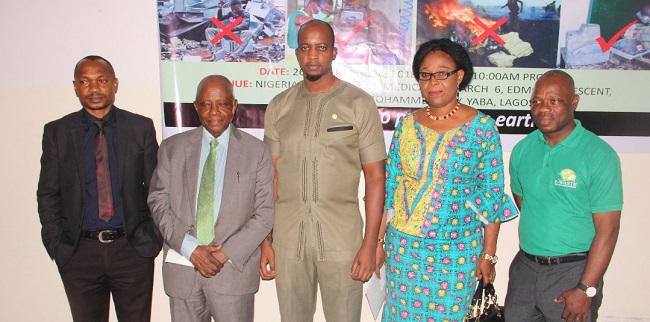
Prof. Oladele Osibanjo (second left) with other dignitaries at the event
Osibanjo made the call on the sidelines of a one-day capacity building workshop organised for the informal sector on the handling and proper disposal of electronic waste (e-waste).
He described the influx of e-waste into the country and its adverse effect as alarming.
Osibanjo said that apart from climate change, e-waste had become one of the biggest environmental challenges facing the world in the 21st Century because of the pervasive influence of Information Communication Technology (ICT).
He listed that that two consequences of improper e-waste disposal as hormone disruption and confusion of the human immune system.
“The circuit board of electronics contains some hazardous contents like Lead, Mercury and Chromium, which are dangerous to humans and the environment. Furthermore, the plastic screen of electronics is impregnated with brominated flame retardants.
“These substances are persistent organic pollutants and they are released into the environment when these electronics are burnt.
“The chemicals are also carcinogenic endocrine disruptors (endocrine disruptors are chemicals that can interfere with endocrine or hormone systems at certain doses, causing cancerous tumours, birth defects, and other developmental disorders).
“This is why you can see an eight-year-old girl menstruating; it is caused by endocrine disruption, which has confused her immune system.
“This information is common knowledge in developed countries, which is why they tend to come and dump their e-waste in Africa,’’ he said.
Osibanjo stressed that e-waste produced globally and annually had reached “a near-Tsunami level’’, adding that in Nigeria, e-waste management was largely handled by the informal sector.
The professor urged governments and stakeholders to take a cue from the ERF by adequately training people in the informal sector on purposeful e-waste management.
“We can do everything on the phone now but the dark side of it is the unlimited production of e-waste.
“The original equipment manufacturers have become smarter and they manufacture their products not to last long. We call it rapid obsolescence.
“Previously, phones can last up to seven years but now after 18 months, it has to be changed and the waste pile grows; the problem now is the waste is so much and there is no space for them; so people resort to burning them,’’ he said.
Also speaking, the President of ERF, Dr Ifeanyi Ochonogor, said that the Foundation had trained 100 e-waste handlers in Lagos to boost their capacity in the management of e-waste.
He said that the objective of the programme was to upgrade the way the people in the informal sector handled e-waste, adding that e-waste had done a lot of harm to the country’s ozone layer and ecosystem in general.
“This training is necessary to forestall misconduct in the disposal of e-waste as they are toxic.
“The toxic waste release poison to the ozone layer, water and the environment; for instance, this happens when the handlers burn cables to get copper, which is poisonous, and the practice should be stopped.
“We are training 100 participants from Alaba market and Computer Village on how to properly handle e-waste.
“They are being trained by top government officials who know the implications of e-waste and are willing to do something about it,’’ he said.
Ochonogor also said that monitoring measures and quarterly programmes would be put in place, adding that the Foundation would network with different agencies to ensure that the training was effective.
He stressed that the monitoring activity would also ensure that the materials given to the handlers were judiciously utilised.
He commended the government for its efforts to streamline waste management and called for its increased participation in the e-waste management programme via the provision of basic tools that were needed to manage e-waste effectively.
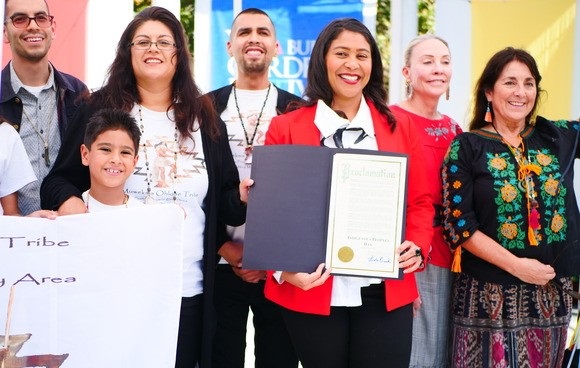
The City of San Francisco in California, USA, has joined several other cities in the country to proclaim October 8th as Indigenous Peoples Day.
San Francisco Mayor London Breed presents the “Indigenous Peoples Day” Proclamation joined by representatives of the Muwekma Ohlone Tribe including Vice Chairwoman Monica Arellano and Council member Vince Medina, Board of Supervisors member Valle Brown and IITC Executive Director Andrea Carmen, Yerba Buena Gardens, San Francisco, October 8th, 2018. Photo credit: Anesti Vega
On Monday, October 8, 2018, during a celebration coordinated by the International Indian Treaty Council (IITC) in Yerba Buena Gardens, Mayor London Breed accompanied by Board of Supervisors Vallie Brown and Malia Cohen delivered a Proclamation stating that the City and County of San Francisco would no longer recognise “Columbus Day” and would instead celebrate Indigenous Peoples Day.
San Francisco joins 93 other US cities, as well as South Dakota, Alaska, Minnesota and Vermont in making this change as called for by Indigenous Peoples to uphold truth in history and recognise the atrocities they have survived because of colonisation.
The Proclamation affirms that “San Francisco is committed to being a city for all people and to standing against discrimination of all kinds. Celebrating Indigenous Peoples Day ensures we acknowledge and honor the original inhabitants of our country who are still here and working to support their communities.”
“As a major International city, the place where the United Nations was founded in 1945 and which also served as the staging ground for the California Gold Rush that decimated the Indigenous Peoples of Northern California, San Francisco’s Proclamation has special importance,” stated Andrea Carmen, IITC Executive Director, who introduced Mayor Breed at the event.
“Together with the removal of the ‘Early Days’ Statue located near San Francisco’s City Hall last month, this is a significant step in recognising the atrocities carried out against California’s First Peoples and moving forward on the basis of respectful relations,” stated Morning Star Gali, member of the Pit River Nation and Community Liaison for the IITC who MC’d the Yerba Buena Gardens event. Staff of the event’s cosponsor Yerba Buena Gardens Festival estimated attendance at more than 3000 participants.
In addition to the presentation of the Proclamation, the event featured statements by Indigenous leaders and San Francisco officials, Indigenous dancing, drumming and special recognitions. Representatives of the Muwekma Ohlone Tribe, one of several Ohlone Tribes that continue to inhabit the San Francisco Bay Area, also spoke on the significance of the Proclamation at the event.
The IITC also sponsored two other San Francisco events to commemorate Indigenous Peoples Day: the annual Sunrise Gathering on Alcatraz, with 1378 participants, and a California Indian Forum, “Taking Action to Heal our Communities” cosponsored by the Friendship House Assn. of American Indians.
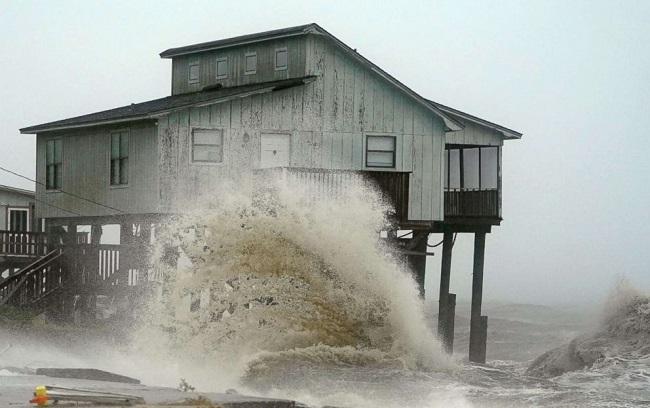
Hurricane Michael made landfall near Mexico Beach, Florida, USA in the afternoon of Wednesday, October 10, 2018 as a Category-4 storm, with “catastrophic” winds reaching 155 mph, according to the National Hurricane Centre.
Waves take over a house as Hurricane Michael comes ashore in Alligator Point
The Associated Press reports that the storm made landfall between Panama City and St. Vincent Island, and some Panama City Beach buildings were torn apart by the devastating winds.
U.S. Federal Emergency Management Agency Administrator, Brock Long, called the powerful storm “a hurricane of the worst kind.”
Earlier Wednesday, meteorologist Dennis Feltgen wrote on Facebook that there is no record of a Category-4 hurricane ever hitting the area and urged people to find a safe place.
“We are in new territory with now Category-4 Hurricane Michael and its 130 mph sustained winds,” he wrote. “The historical record, going back to 1851, finds no Category 4 hurricane ever hitting the Florida Panhandle. Bay County (Panama City) likely to be ground zero for landfall later this afternoon.”
Weather indicators were reported to be clocking maximum sustained winds of 145 mph. Florida Gov. Rick Scott wrote Wednesday: “If you chose to stay in an evacuation zone, you must SEEK REFUGE IMMEDIATELY.”
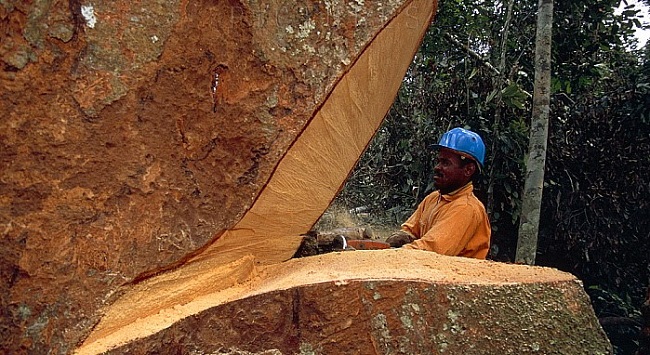
The Standing Committee of the Convention on International Trade in Endangered Species of Wild Fauna and Flora (CITES) has suspended commercial trade in the African Rosewood (Millettia laurentii) from Nigeria.
The African Rosewood tree being cut with chainsaw. Photo credit: Michel Gunther / Biophoto / Minden Pictures
This formed part of measures agreed on by the international conservation organisation to achieve full compliance with international wildlife trade regulations at its 70th meeting that held in Sochi, Russian Federation, from October 1 to 5, 2018.
According to CITES, since the beginning of 2018, Nigeria has authorised over 180,000 m3 of the precious timber to China and Viet Nam, without first making sure that these exports will not threaten the survival of the species.
Apparently miffed by this development, the CITES Committee decided to recommend suspension of commercial trade in the timber species until Nigeria has made a non-detriment finding for the species in the country.
“The CITES Standing Committee dealt with a myriad of wild species and complex issues in the nexus between conservation, trade and development. The seriousness and determination of Parties to bring international wildlife trade rules to their full strength were demonstrated by the frank and constructive debate and decisions made on compliance issues, including the decisions on African rosewood, sei whales, pangolins, elephant ivory and to rectify the mismanagement of trade in CITES-listed species by certain countries,” said David Morgan, Officer-in-Charge of the CITES Secretariat. “This has again shown the real-world impact of CITES when governments around the world are fully committed to respect their obligations under the treaty. The Secretariat commends all Parties on their cooperation and their commitment to implement and enforce the Convention.”
The Standing Committee debated the “introduction from the sea” of sei whales, which is considered as international trade under CITES, from the western North Pacific population by Japan and determined that this activity was for commercial purposes and therefore not in compliance with the Convention. In response to this conclusion, Japan committed to take swift remedial action, and to delay the departure of the concerned research whaling vessels to the western North Pacific and to not authorise any harvest of the sei whales from the high seas in this region until the Standing Committee has assessed Japan’s progress in implementing the remedial actions at its next meeting in May 2019. If not satisfied with the action taken, the Committee may take compliance measures.
The compliance measures that the Committee can take include recommendations to suspend trade in some or all CITES-listed species and represent a unique strength of the Convention. The goal of such measures is to achieve long-term and sustained compliance with the Convention thereby ensuring the survival of the species in the wild. To better achieve the goal and to support countries in achieving full compliance, the Committee agreed that the development of a Compliance Assistance Programme should be considered by the Conference of the Parties in May 2019.
Compliance assistance is already being provided to Lao People’s Democratic Republic, another case of non-compliance considered by the Committee at the meeting. While significant efforts have been deployed by Lao PDR to effectively implement and enforce its CITES obligations, the country continues to be affected by illegal trade and faces challenges to ensure that authorised exports are legal and sustainable. The Committee therefore decided to recommend to all Parties that they suspend commercial trade in the high value Siamese rosewood, including finished products, from Lao PDR until it can be scientifically justified that such exports are sustainable. Lao PDR agreed with the recommendations and committed to report on implementation by February 1, 2019.
The Committee also reviewed compliance issues in the Democratic Republic of the Congo (DRC), where considerable progress had been made since the matter was last discussed late in 2017, to address high levels of illegal trade. However, the DRC is still having difficulties to put the proper mechanism in place to ensure that authorised exports are sustainable and was requested to strengthen its Scientific Authorities by building capacity and allocating sufficient modern resources for making the necessary scientific studies to determine how much can be traded without threatening the survival of the species in the wild. Finally, in view of these persistent challenges, the Committee recommended that Parties suspend trade in grey parrots and in pangolins from the DRC.
The meeting of the Standing Committee also agreed to present new or revised resolutions and decisions on a range of issues to the next gathering of the governing body of the Convention, the Conference of the Parties, which will meet for the 18thtime in Sri Lanka in May-June 2019 (CoP18). The host of CoP18 attended the meeting in Sochi and told participants that “20 million warm hearts are waiting to meet you in Colombo next year”.
The next meeting of the CITES Standing Committee will take place in Colombo, Sri Lanka, on May22, 2019, a day prior to the start of the CoP18.
The Seventh Conference on Climate Change and Development in Africa (CCDA-VII) opened on Wednesday, October 10, 2018 in Nairobi, Kenya with a strong call for Africa to prepare and speak with one voice when it goes to the next UN climate change talks (COP 24) holding in Katowice, Poland in December.
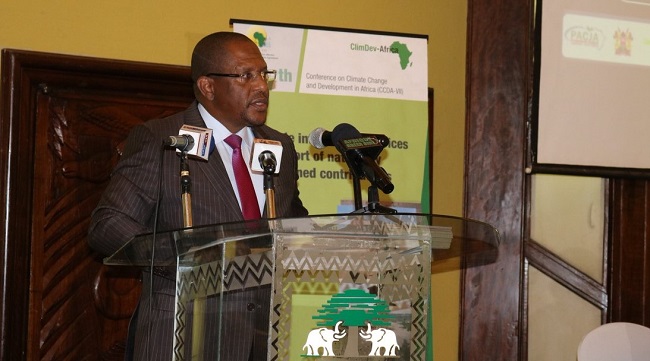
Kenya’s Environment and Forestry Minister, Keriako Tobiko
Kenya’s Environment and Forestry Minister, Keriako Tobiko, speaking on behalf of President Uhuru Kenyatta, said climate change was a matter of life and death for Africa, hence the need for its leaders to speak with a strong unified voice and be heard when participating in multilateral climate negotiations and other global issues.
“We have all experienced the devastating and unprecedented impacts of climate change on our peoples’ lives and livelihoods as well as our national economies. Africa is the most vulnerable continent despite contributing only about 4% to global greenhouse gas emissions but when we go to argue our case we speak in tongues and come back with no deal,” he said.
“We need to make sure that we have a unified voice as we proceed to COP24. We should showcase our own solutions to climate change; solutions that are developed and customised to fit our own situation.”
He said that, given Africa’s shared ecosystems and the fact that natural resources know no boundaries, it was essential that “we continue to speak in one voice to safeguard the basis of our development and seek transformative solutions”.
Commenting on the Intergovernmental Panel on Climate Change’s (IPCC) “Global Warming of 1.5oC special report and its impacts in the context of strengthening the global response to the threat of climate change, sustainable development, and efforts to eradicate poverty”, Mr. Tobiko said limiting global warming to 1.5oC would require rapid, far reaching and unprecedented changes in all aspects of society.
“Operationalisation implies that adequate and predictable resources be mobilised and made available to support adaptation and mitigation action in Africa and other developing world,” he said, adding that it was important that discussions and outcome of CCDA-VII contribute to building momentum towards the upcoming COP24 and implementation of Nationally Determined Contributions (NDCs).
All is not Doom and Gloom
As captured in the IPCC special report on the impacts of global warming of 1.50C, James Murombedzi of the African Climate Policy Centre (ACPC) emphasised that climate change poses undoubtedly the greatest risk to the realisation of the ideals of the AU’s Agenda 2063 and the UN’s Sustainable Development Goals (SDGs).
But the report concluded that “anthropogenic emissions up to the present are unlikely to cause further warming of more than 0.5°C over the next two to three decades (high confidence) or on a century time scale (medium confidence)”.
Murombedzi therefore believes that not all is doom and gloom as “there is a chance for a stable climate system which will allow for sustainable development but only if we do manage to halt emissions in the projected time frame”.
He said there are opportunities to be harnessed by halting emissions and to have an organised transition to a carbon neutral future in the shortest time possible; and restructuring local economies to ensure sustainable development without further emissions.
Tobiko also believes yhat climate change threats present opportunities for innovative and green investments for Africa.
“This is why implementation of the Paris Agreement remains a priority for the continent to adapt to the inevitability of climate variability and change. It is however important to emphasise that achieving the goals of the Agreement require committed leadership from state and non-state actors,” he said.
Local communities, women and the youth, he said, should be engaged in Africa’s efforts to combat the vagaries of climate change.
CCDA-IV Call for Climate Action
The theme for this year’s CCDA forum is “Policies and actions for effective implementation of the Paris Agreement for resilient economies in Africa”, chosen to reflect Africa’s collective engagement and commitment to strengthen climate change actions in the context of its development priorities.
The CCDA is an initiative of the ClimDev-Africa Initiative, a tripartite programme of the African Union Commission (AUC), the African Development Bank (AfDB) and the UN Economic Commission for Africa (ECA).
It was conceived as a physical dialogue place to promote interaction between science and policy on issue related to the climate change-development nexus.
This year’s meeting has attracted over 700 participants from member states, climate researchers, academia, civil society organisations, private sector, youth, women and local government leaders, among others.
“There are numerous practical and innovative solutions at community, sub-national, national and international level that we should never ignore in Africa. Climate change affects all of us but it affects doubly the most vulnerable members of our communities, so we should always engage them because they also have the knowledge and solutions,” said Tobiko.
The Minamata Convention on Mercury has approved five projects in the First Round of its Specific International Programme amounting to $1 million.
Sam Adu-Kumi (right) and Reggie Hernaus
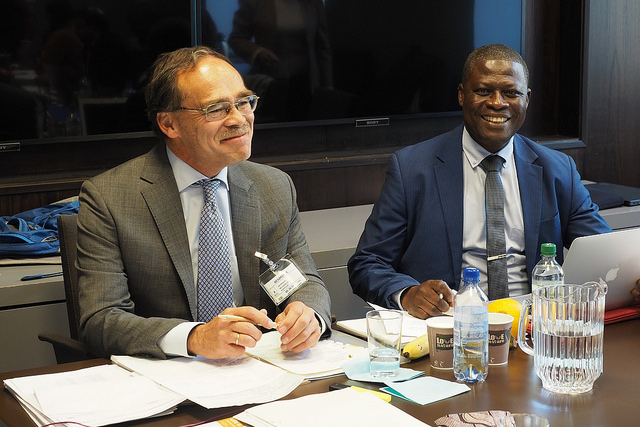
Co-Chairs of the Governing Board of the Specific International Programme of the Convention, Sam Adu-Kumi (Ghana) and Reggie Hernaus (The Netherlands), who made the disclosure in a statement on the Convention’s website on Monday, October 8, 2018, said that the projects were approved on Wednesday, October 3.
The successful projects were submitted by Argentina, Armenia, Benin, Iran and Lesotho.
The Specific International Programme is aimed at improving the capacity of developing-country Parties and Parties with economies in transition to implement their obligations under the Convention.
“On behalf of the Board, we would like to congratulate these applicants,” stated Adu-Kumi and Hernaus, adding: “We noted the high interest in the Specific International Programme, and would like to commend all the applicants, whether successful or not in the First Round, for having prepared high-quality submissions despite the short time frames.”
In total, 19 applications, from 18 Parties, were received by the deadline. According to the Board, it was heartened that applications were received from all regions, including from least developed countries and from small island developing states.
The Co-Chairs added: “The Board would also like to sincerely thank Austria, Denmark, Germany, the Netherlands, Norway, Sweden, the United Kingdom, and the United States for their contributions to the First Round of the Specific International Programme.
“The Board was unfortunately not in a position to satisfy all requests for funding in this round. Given the high interest shown we hope to be able to launch the next round soon and in this regard would like to encourage those in a position to do so to contribute to a robust next round of the Programme.
“The Board will present its full report to the Conference of the Parties at its second meeting.
“On behalf of the Board we would also like to thank the Government of Norway for the gracious invitation to convene this meeting in Oslo.”
The Minamata Convention on Mercury, under Article 13, sets up a Specific International Programme to support capacity building and technical assistance.
The Governing Board of the Specific International Programme met in Oslo, Norway, from October 2 to 3 to review applications to its First Round.
The Members of the Governing Board of the Specific International Programme are:
For Africa: Sam Adu-kumi (Ghana) and Younous Adoum Abdallah (Chad)
For Asia and the Pacific: Prasert Tapaneeynagkul (Thailand) and WTB Dissanayake (Sri Lanka)
For Central and Eastern Europe: Kaupo Heinma (Estonia) and Anahit Aleksandryn (Armenia)
For Latin America and the Caribbean: Florencia Grimalt (Argentina) and Nero Cunha Ferreira (Brazil)
For Western Europe and Others: Reggie Hernaus (The Netherlands) and Atle Fretheim (Norway)