American Scientists have for the first time performed prenatal gene editing to prevent a deadly metabolic disorder in lab animals, offering the potential to treat human congenital diseases before birth.
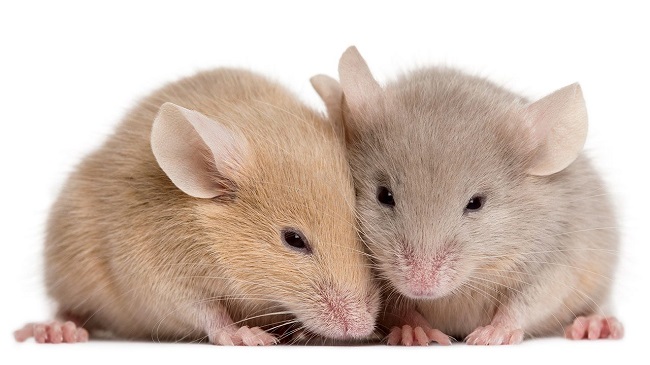
Mice
The study published on Monday, October 8, 2018 in the journal Nature Medicine described the proof-of-concept prenatal use of a low-toxic tool that can efficiently edit DNA building blocks in disease-causing genes.
Scientists from Children’s Hospital of Philadelphia and those at the University of Pennsylvania used two gene-editing tools to reduce cholesterol levels in healthy mice treated in utero.
They also improved liver function and prevented neonatal death in a subgroup of mice that had been engineered with a mutation causing the lethal liver disease called HT1.
HT1 in humans tends to happen during infancy, posing risks of liver failure or liver cancer.
The prenatal treatment could open a door to disease prevention for HT1 and potentially for other congenital disorders, according to the study.
“We used base editing to turn off the effects of a disease-causing genetic mutation,’’ said the study’s co-leader Kiran Musunuru, associate professor of cardiovascular medicine at Penn University.
“We also plan to use the same base-editing technique not just to disrupt a mutation’s effects, but to directly correct the mutation.’’
They used base editor 3 (BE3) and a modified CRISPR-associated protein 9 to form a partially active version of the CRISPR-Cas 9 gene-editing tool and harnessed it as a homing device to carry an enzyme to a highly specific genetic location in the liver cells of fetal mice.
Then the enzyme chemically modified the targeted genetic sequence, changing one type of DNA base to another, according to the study.
BE3 is potentially safer than CRISPR-Cas9, because it does not fully cut the DNA molecule and not leave it vulnerable to unanticipated errors when the cut is repaired.
After birth, the mice in the study carried stable amounts of edited liver cells for up to three months after the prenatal treatment, with no evidence of unwanted, off-target editing at other DNA sites.
In the subgroup of the mice bioengineered to model HT1, BE3 improved liver function and preserved survival.
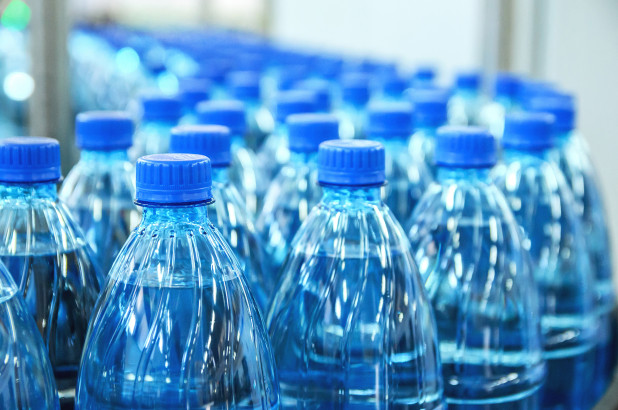
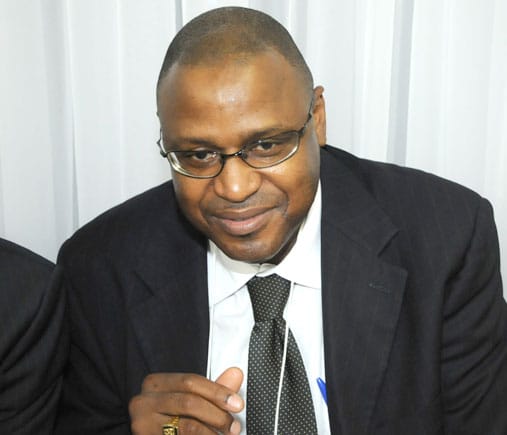
The Chief Medical Director, Living Standard Hospital, Benin City in Edo State, Jide Owolana, said on Tusday, October 9, 2018 that dehydration of the human body could lead to memory loss.
Increased consumption of water increases the brain power and provides energy
Owolana, who spoke in an interview with the News Agency of Nigeria (NAN), also said humans should reduce the amount of soft drinks and alcohol they take.
The medical expert expressedd regret that Nigerians had replaced drinking water with soft drinks and alcohol consumption at every meal they took.
According to him, the need for drinking a lot of water is important, explaining that women are supposed to drink 90 ounces (11 cups) of water per day while men are supposed to take 125 ounces (16 cups) per day.
Dr Jide said the recommended water consumption could vary based on age, weight, sex and the climate.
The Chief Medical Director said that dehydration could cause mood swings, reduce cognitive and motor skills, memory loss and made one more sensitive to pain.
He said the increased consumption of water would increase the brain power and provide energy, promote healthy weight management and weight loss.
Others are flush out toxins, improve complexion, prevent headache, cramps and sprains.
The UN Food and Agriculture Organisation (FAO) has called on the Federal Government to ensure value addition to Nigeria’s agricultural produce to achieve zero hunger by 2030.
Suffyan Koroma, FAO Representative in Nigeria
Mr Suffyan Koroma, the Country Representative of FAO, made the call in Abuja on Tuesday, October 9, 2018 at a walk organised to commemorate the 2018 World Food Day.
Koroma, who stressed that agricultural production would be a waste of time without value addition, appealed to the Federal Government to also consider other complimentary services which agricultural production needed to thrive.
“Nigeria should be free of hunger by 2030 but that does not just rest on agriculture.
“It goes beyond agriculture because the complimentary services that agriculture needs to thrive are also as valuable as the products that we produce.
“For food prices to be lower; it does not just mean production; it means the value-added products, the services, the energy, the effective legislation – all of these should contribute to zero hunger.
“It even involves transportation, knowing what to produce and for what market. If we produce without adding value, it is basically useless; it is a sheer waste of time.
“How do we control animal diseases, pests, conflicts, climate change and issues of flooding? And all these are relevant in efforts to achieve the zero hunger; so, I hope the government will continue to strive in enhancing the drive to achieve zero hunger by 2030,’’ he said.
Also speaking, Chief Audu Ogbeh, the Minister of Agriculture and Rural Development, said that the Federal Government through the ministry was working on how to improve the ease of doing business in the agriculture sector.
The minister, who was represented by Alhaji Nasiru Adamu, the Director of Planning and Policy Coordination in the ministry, said that the move was to ensure the attainment of food security and zero hunger by 2030.
He described the theme of the World Food Day – “Our Actions are our Future: A Zero Hunger World by 2030 is Possible’’ – as apt, particularly at this period when the impact of climate change had been devastating on food production and food security the world over.
Ogbeh said that the government had also identified the key constraints in the agricultural value chain, from the production to the consumption stages, with a view to addressing them.
“This year’s World Food Day marks the 70th Anniversary of the FAO and their 40-year presence in Nigeria.
“FAO is really Nigeria’s partners and we appreciate them very much.
“The theme can be actualised if the government, private sector, development partners work together to fight hunger, extreme poverty and malnutrition.
“This administration is bent on treating agriculture as a business,’’ he said.
The World Food Day is marked on Oct 16 globally every year.
Events lined up to celebrate the 2018 World Food Day include quiz competition, symposium, food fair, national youth summit and the national agriculture show.
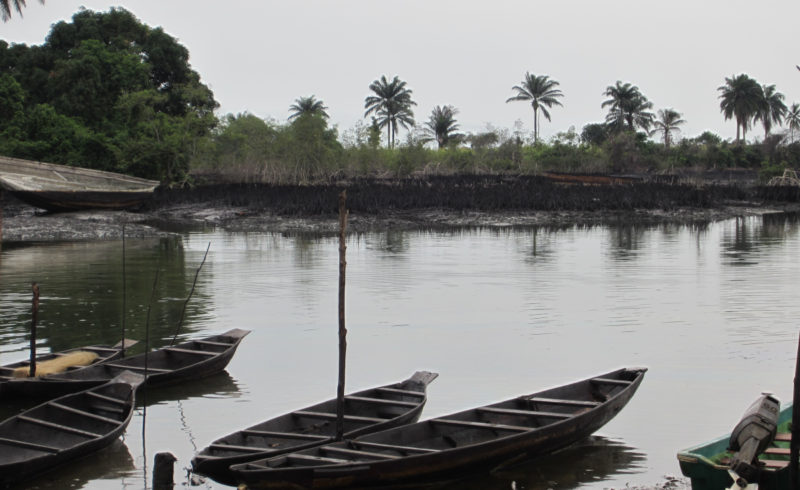
Leakage from an oilfield operated by Shell Petroleum Development Company (SPDC) at Aghoro community in Bayelsa State in Nigeria has discharged some 1,114 barrels of crude oil into the environment.
A water body in the Niger Delta polluted by crude oil
The leakage has adversely affected the fishing vocation of residents who had withdrawn from fishing to pave way for clean up.
The resulting oil spill impacted and polluted an estimated area of 113.03 hectares of land, according to a joint Investigation Visit (JIV) report of the incident obtained by News Agency of Nigeria (NAN) in Yenagoa, the state capital, on Monday, October 8, 2018.
A disagreement among community leaders in the areas affected by the leak stalled the release of the Joint Investigation Visit (JIV) report of the oil spill.
Community leaders, who participated in the JIV to determine the cause of the spill, reportedly refused to sign the report.
The refusal was attributed to wide disparity between the impacted areas claimed by Shell and the community, but Mr Bamidele Odugbesan, the Media Relations Manager at SPDC, said that the grey areas had been sorted out.
The report indicated that only 247.5 out of the 1,114 of SPDC’s crude blend had been recovered at the spill site, while the remaining were yet to be accounted for.
According to the spill incident report, the oil leak was reported on May 17, but the joint visit could not be immediately conducted until June 23.
The report said the spill was caused by equipment failure resulting from weak integrity of the 24-inch Trans Ramos Pipeline giving rise to cracks on the pipeline at Aghoro in Ekeremor Local Government area of Bayelsa.
Representatives of the host community, National Oil Spills Detection and Response Agency (NOSDRA), Bayelsa Ministry of Environment and SPDC, who conducted the investigation agreed on the findings and signed the report.
NAN gathered that repair work on the leaking pipeline is underway, while recovery of spilled oil from the site is still ongoing.
Reacting to the development, Odugbesan expressed regret about incessant spills on the Trans Ramos Pipeline, saying that although the May 17 spill was traced to equipment failure, other leaks were predominantly caused by sabotage.
“The rate of spills on the Trans Ramos Pipeline is very worrisome, for instance between April and May 26, spill incidents were reported on that line and out of these, 18 of them were caused by sabotage, eight were operational,” he said.
The United Kingdom has pledged to partner with the Federal Government in efforts to clean the Ogoni area in the Niger Delta and tackle other environmental challenges across the country.
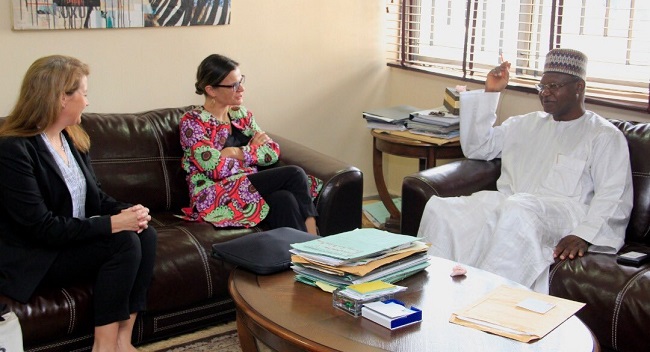
Ms. Lavie Beaufils, the British Deputy High Commissioner to Nigeria (middle), with the Minister of State for Environment, Alhaji Ibrahim Jibril, during the visit
Ms. Lavie Beaufils, the British Deputy High Commissioner to Nigeria, conveyed the pledge on Monday, October 8, 2018 in Abuja when she paid a courtesy visit on the Minister of State for Environment, Alhaji Ibrahim Jibril.
Beaufils said that the British government had resolved to assist Nigeria in Ogoni clean-up efforts, ocean protection and green finances.
She noted that many countries, including Nigeria, were facing some environmental challenges, adding that UK was ready to assist Nigeria in efforts to deal with the challenges.
The envoy said that her visit was aimed at discussing the way forward with the minister and proffer solutions to some of the environmental challenges facing Nigeria.
Beaufils, however, expressed concern over the flooding ravaging parts of the country and underscored the need to find long-term solutions to it.
Responding, Jibril thanked the envoy and the British Government for the intervention, which was aimed at addressing the environmental challenges facing the country.
He noted that Nigeria was a huge country facing the brunt of different climatic elements.
“As we are all aware, climate change is a global challenge and Nigeria is not left out; and our country is mostly affected by the vagaries of its dry and wet seasons.
“The coastal region is mostly affected by the flood, while the northern parts of the country usually experience desert encroachment, particularly during the dry season.
“The country is faced with a lot of environmental challenges which include erosion, desertification, land degradation, among others,’’ he said.
While commending the British Government for the partnership, the minister briefed the high commissioner about the measures which President Muhammadu Buhari’s administration had put in place to facilitate the clean-up of the Ogoni area.
He conceded that the Ogoni clean-up was a major challenge facing the administration, saying that the clean-up might take a longer period of time due to the technical approaches involved in the exercise.
“The Ogoni clean-up is another major issue faced by the present administration because of the level of destructions caused over a long period of time by oil spillage.
“We remain focused and determined to carry out the exercise to ensure that we achieve global best practices,’’ he said.
Jibril said that the Federal Government had put in place measures, which involved the mobilisation of technical experts and foreign experts, to address the environmental issue.
Malaysia has successfully eliminated mother-to-child transmission of HIV and syphilis, the World Health Organisation (WHO) said on Monday, October 8, 2018 in Manila.
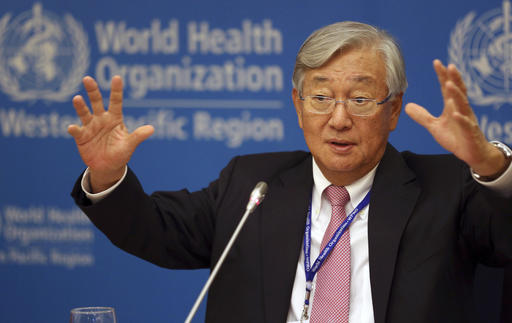
Shin Young-soo, WHO regional director for the Western Pacific. Photo credit: AP/Aaron Favila
“Malaysia today became the first country in the WHO Western Pacific Region to be certified as having eliminated mother-to-child transmission of HIV and syphilis,’’ WHO said in a statement.
Shin Young-soo, WHO regional director for the Western Pacific, lauded Malaysia for its efforts over the past several years to eliminate the transmission.
“Parents can now ensure their babies are born free of HIV and syphilis and have a healthy start to life,’’ Shin said.
He added that “elimination could not have been achieved without Malaysia’s strong commitment to ensuring access to quality and affordable health services for all women, children and families’’.
WHO Director-General, Tedros Adhanom Ghebreyesus, and Shin presented Malaysia’s Minister of Health, Dzulkefly Ahmad, with a certificate of elimination during the session of the WHO Regional Committee for the Western Pacific which opened on Monday in Manila.
As the treatment for prevention of mother-to-child-transmission is not 100 per cent effective, elimination of transmission is defined as a reduction of transmission to such a low level that it no longer constitutes a public health problem.
Malaysia was among the early adopters globally of national prevention of mother-to-child transmission (PMTCT) of HIV and syphilis in maternal and child health services, according to the WHO.
The Southeast Asian country started PMTCT services in 1998.
“Achieving elimination is not the end of our struggle to ensure every Malaysian child starts life healthy and free of HIV and syphilis. It’s the beginning of a never-ending journey to provide exceptional quality of care to prevent all infections that pass from mother to child,’’ Dzulkefly said.
WHO data shows that some 13,000 women, who become pregnant in the WHO Western Pacific region each year, are living with HIV, and one in four does not receive antiretroviral therapy (ART).
Additionally, the WHO said each year an estimated 45,000 pregnant women in the region are infected with syphilis, which can result in early foetal loss and stillbirth, low birth weight, serious neonatal infections and death.
But simple, cost-effective screening and treatment with penicillin during pregnancy can eliminate most of these complications.
“This elimination is a remarkable achievement that puts Malaysia at the forefront of the global effort to ensure that no child is born with HIV or congenital syphilis.
“A combination of political commitment, stronger systems for health, and timely prevention, diagnosis and treatment is the key to success,’’ said Eamonn Murphy, UNAIDS regional director for Asia and the Pacific.
The “Global Warming of 1.5°C” report released by the Intergovernmental Panel on Climate Change (IPCC) on Monday, October 8, 2018 confirms the need to maintain the strongest commitment to the Paris Agreement’s aims of limiting global warming to well below 2°C and pursuing efforts towards 1.5°C, the United Nations Framework Convention on Climate Change (UNFCCC) has said.
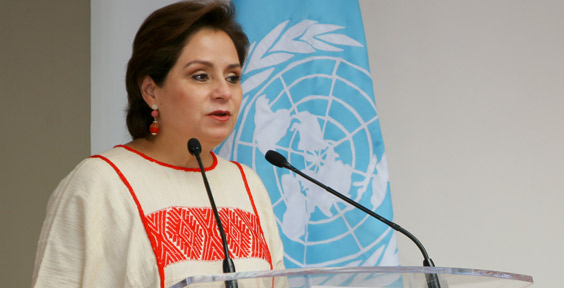
Patricia Espinosa, Executive Secretary of the UNFCCC
The IPCC’s special report clearly states that the world has already warmed by 1°C due to human activity, the UNFCCC Secretariat disclosed in a reaction to the development, pointing out that, as a result, climate change is already affecting people, ecosystems and livelihoods across the globe, with impacts such as floods or droughts disproportionately affecting the poorest and most vulnerable.
Some of the most affected areas are listed to include small islands, megacities, coastal regions and high mountain ranges.
The report, adds the UNFCCC, provides an assessment of the latest science on warming of 1.5°C as opposed to warming of 2ºC.
“The difference between these two numbers, a mere half of a degree, may not sound like much. But the IPCC projects that a 2°C rise in the global average temperature would lead to worse global and regional climate impacts. For example, limiting warming to 1.5°C rather than 2°C could result in 420 million fewer people being exposed to severe heatwaves,” notes the UN climate change body in a statement.
The statement further reads: “Given such impacts, the world needs to keep the Paris Agreement’s goals within its sight.
“According to the IPCC’s report, limiting warming to 1.5°C is possible, but requires unprecedented transitions in all aspects of society. To minimise future global warming, we will need to achieve zero net emissions by mid-century. This in turn will require us to rapidly transition the world’s economy onto such a pathway. Over the next 10 to 20 years we must transform our energy, agricultural, urban and industrial systems, engage non-state actors, and integrate climate action into the broader public policy framework that also addresses jobs, security and technology.
“Tackling climate change can also be consistent with ensuring people around the world are healthy, prosperous, have food, clean air and water. Agriculture, water, energy, biodiversity, public health, cities – every sector addressed by the UN Sustainable Development Goals influences, and is influenced by, the climate. Everything is connected. Climate action towards 1.5°C can be a significant step towards achieving the SDGs.
“In the intergovernmental process under the Paris Agreement, this implies the clear need to work towards speedily implementing countries’ Nationally Determined Contributions (NDCs). In their NDCs, countries detail what they will contribute to the global response to climate change.
“The global response includes emissions reductions and adapting to the impacts of climate change. Many developing countries need technological, financial and capacity building support to make their contribution to the global effort.
“To unlock practical actions and contributions towards the Paris Agreement’s goals, governments have set a deadline for themselves to finalise the agreement’s implementation guidelines at the annual UN Climate Change Conference this December in Katowice, Poland.
“These guidelines will build trust by ensuring transparency. They will enable each country to act and contribute, they will allow all of us to see what each country is doing, and they will allow us to have full clarity on the provision of support, especially climate finance now and in the long-term.
“In this sense, a successful outcome in Katowice will be a first and most crucial step towards achieving the Paris Agreement’s goals of limiting global warming to well below 2ºC and pursuing efforts towards 1.5°C.
“Recognising the need to promote greater international cooperation and more partnerships among local governments, business and civil society, UN Secretary-General Antonio Guterres will host a Climate Summit in September 2019. The Summit will mobilise support for ambitious climate action that will help us to achieve the goals of the Paris Agreement. It will do this by engaging decisions-makers in all key sectors of society and inviting them to join together in building the green economy. Every delay now will only shift the burden to our children and grandchildren.
“Pursuing efforts towards 1.5°C is essential for our future and for future generations’ wellbeing. Accepting and rising to this challenge is the only way that we can ensure that nobody is left behind.”
Civil society groups on Monday, October 8, 2018 have welcomed the Intergovernmental Panel on Climate Change’s (IPCC) latest scientific assessment on global warming, which calls for full decarbonisation latest by 2050. The details will serve as a key input for the Talanoa Dialogue at COP24 in Katowice, Poland in December 2018, as well as influence a political outcome committing to increased Nationally Determined Contributions (NDCs) by 2020.
Limiting warming to 1.50C is necessary possible and urgent
“Science clearly shows our future is incompatible with fossil fuels. With this stark evidence at hand, governments have no excuse but to put climate action at the front and centre of their national agendas,” the activists said.
The unequivocal message from the report, based on more than 6,000 independent research papers, is that every half a degree of warming matters. Limiting warming to 1.50C is necessary possible and urgent, according to the Climate Action International (CAN), saying that it is the only option for a prosperous, just and safe future, especially for those most vulnerable at the frontlines of impacts.
The report, adds CAN, points to a radical shift to decarbonisation by 2050, but preferably earlier by 2040 given rising impacts even at one-degree Celsius warming.
“This assessment must spur the rapid switch to renewables across all sectors in the next decade driven by advances already underway in the real economy. The political will to heed the science and lead this transformational change towards 100% renewables will determine which side of history today’s leaders will stand on.”
Reactions from CAN members and partners
Caroline Kende-Robb, Secretary General, CARE International: “The IPCC report makes it clear: the world must come together now to take serious action to stop global warming. Developing countries are already disproportionately affected by climate change – it deprives the most vulnerable groups, particularly women and girls, from basic universal rights. CARE calls on governments, in particular, from developed countries and emerging economies, to accelerate climate action to reduce emissions now, not in 10 years. Ignoring the necessities for action that the IPCC report spells out is unacceptable.”
Moussa Elimane Sall, Executive Director of Plateforme Mauritanienne du Climat, and Board Member & Regional Coordinator of CAN-ARAB-World: “I fully understand the impressive needs for our countries and leaders to work towards a flourishing future, but to make sure that this future is as flourishing as we expect, we need to bear in mind that the earth has limited resources. Brothers in humanity, the Earth no longer has the time to see us negotiating indefinitely, it’s time to be attentive to its complaints and act accordingly. This Special IPCC report, entitled ‘Global Warming of 1.5ºC’ will provide important information about the current status of climate change, as well as what the future might hold if our governments, businesses, and communities do not start implementing real climate solutions. It’s definitely a reminder or even a distress signal for humankind survival.”
Catherine Abreu, Executive Director, Climate Action Network Canada: “No more excuses, no more delay. That is the message this report has for the world. If we want to continue living on a planet that resembles the paradise we inhabit now, we must act immediately and without relent. Importantly, this report also tells us that we have the time and we have the means. 1.5°C is possible. So, what’s holding us back from taking the action demanded of us? Short-sighted politics and the reckless self-interest of polluting industries. The science is clear, and it has handed us a way forward: all of us must do all we can, all at the same time.”
Raijeli Nicole, Regional Director for Oxfam in the Pacific: “Climate change has set our planet on fire, millions are already feeling the impacts, and the IPCC just showed that things can get much worse. The faster governments embrace the renewable energy revolution and move to protect communities at risk, the more lives and livelihoods will be spared.
“Every tenth of a degree of warming is a choice between life or death. We’re already witnessing the beginnings of massive displacement and a shocking rise in hunger, with women living in poverty suffering the most. It only gets worse from here.”
Peter Frumhoff, Director of science and policy, Union of Concerned Scientists and a Former Lead Author, IPCC: “Many extreme weather events in the U.S. and across the globe have been intensifying after just a one-degree Celsius increase in the global average temperature. As the latest IPCC report shows us, at 1.5 degrees of warming further climate impacts will be devastating and at 2 degrees they would be calamitous. Every fraction of a degree of warming we can avoid matters.”
Wendel Trio, Director of Climate Action Network (CAN) Europe: “Science has given us a message of both urgency and hope. It has made it crystal clear that warming of more than 1.5°C would result in ever wilder extreme weather events. These in turn would expose us to greater drought, food shortages and economic devastation. The silver lining to the report is that we still have a chance to stay below 1.5°C, that solutions are within our reach and that it will help us build a safer, more prosperous Europe.
“The IPCC scientists are sending this message ahead of the all-important COP24 summit in Katowice this year, where governments are expected to commit to step up their climate targets. All eyes are on EU environment ministers now, who need to act on the IPCC warnings and commit to significantly increase the EU’s targets in line with a 1.5°C pathway. Staying below 1.5°C means Europe needs to drastically reduce emissions to reach net-zero by 2040 and this needs to be reflected in the new long-term climate strategy.”
Fiona Armstrong, Founder and Executive Director, Climate and Health Alliance – Australia (CAHA): “This IPCC report makes clear the world’s current trajectory of global warming due to continuously rising greenhouse gas emissions is putting us on track for a rise of 3-4 degrees or more.
“Australia’s health professionals are declaring this report a public health warning. With just one degree of global warming we are already seeing devastating impacts. People are dying in extreme heatwaves, food production is threatened, massive ecosystems are breaking down. Continuing our current pathway will bring further catastrophic impacts for human populations, and dramatic losses of other species.
“Collectively, we need to more than double the efforts being made globally to avoid a ‘hothouse Earth’ that will be incompatible with human civilisation. The stakes could not be higher.
“Limiting global warming is hard, but achievable. The sobering reality however is that even 1.5 degrees is too hot. Every fraction of a degree matter. We must cut emissions to zero and draw down carbon from the atmosphere. This report emphasises this needs to happen now – not in 10, 20 or 30 years – but right now.”
Nouhad Awwad, National Coordinator, Arab Youth Climate Movement-Lebanon and Board Member, Mediterranean Youth Climate Network: “The Special IPCC report, entitled “Global Warming of 1.5ºC” alert us on the importance of keeping the temperature rise below 1.5ºC. The adverse effects of climate change that range from the Arctic ice melt to the natural habitat destruction and the increase of disease burden won’t be confined to a certain country or region; it affects the world as a whole. Natural disasters and health problems severity increase with the temp increase.
“Therefore, the difference between warming of 1.5ºC and 2ºC has devastating effects on coral reefs, water availability, sea level rise and the intensity of extreme weather conditions. World leaders should collaborate with civil society, businesses and scientists to increase intentional cohesiveness, lowering their emission, raising their ambitions, increasing their climate target and reviewing their NDCs.”
Hala Murad, President, Dibeen for Environmental Development, Jordan, Member of Arab CAN-Network: The day may come when the great title is “Save people from extinction” because the whole vital system is going to the abyss, if governments and local authorities all over the world do not do everything, they can for the planet that is our home.
“To this day, in our country, we see great words and plans on paper, but we are not actually doing the role that is imposed on us so that we do not exceed 1.5 degrees Celsius, which is also dangerous, specifically government and supporting agencies they must work with the most vulnerable communities in rural and remote areas, with the poor, women, refugees and others, and should listen to more realistic programs drawn from the harmony between these communities and groups with their environment and climate.
“Talanoa dialogue is an important tool and event to observe and measure the abilities, the capacities and the main challenges that face those people to work with them closely in the future. This is an important for the biosphere to maintain its different characteristics and recover.”
Carol Gribnau, Program Director Green department, Hivos: “0.5 degree seems small but will have a tremendous impact, especially on the lives of vulnerable people in low- and middle-income countries. These countries are already being hit by the consequences of climate change and lack the means to adapt. Whether people there live on an island or in (semi-)arid areas, climate change has already affected their lives severely.
“The report shows it is still doable, but the time to act decisively and together is now. And it will take a joint effort from governments, businesses, financial institutions and citizens to make the transition to a sustainable, low-carbon, and inclusive economy. Therefore we call for an unprecedented shift in these systems by speeding up our adoption of renewable energy solutions and promoting food systems built on diversity, soil health and zero-waste.
“Even if we manage to halt climate change at the 1.5°C threshold, change is already happening. That’s why we need to support local communities to adapt to climate change and to become more resilient. Governments must live up to their commitment to balance climate finance and deliver adaptation support to developing countries. Now is the time to be better safe than sorry!”
Hamzeh Bany Yasin, Climate and Energy Policy Program Manager, Friedrich-Ebert-Stiftung: The IPCC has warned in all its reports that climate change will lead to adverse impacts on natural and human systems. IPCC Special Report “Global Warming of 1.5°C” gives strong insights why the 1.5°C aspirational target of the Paris Agreement should be taken very seriously; as climate threshold concludes that the risks for human well-being and livelihoods, ecosystem, food and water security, which are already serious today, will be critically higher at 1.5°C, and projected for further increase with every level of additional emission.
“For the Arab Countries, despite the variation in climate action, but none of them adequately prepares for 1.5°C-consistent pathways and its associated risks. The key message for now is the urgent need of scaling-up NDC. Yes, there are institutional and procedural challenges, but there is also a hope a close this gap. In our region, climate change agenda hasn’t yet become the priority to bring the country on track of a 1.5°C-consistent pathway, including managing the climate risks. The majority of policy-makers still doesn’t see climate change as a threat, and most of them are not well aware of its consequences. The concept of sectoral interdependence should be mainstreamed when designing policies for mutually interdependent sectors.”
Jagoda Munić, Director of Friends of the Earth Europe: “The fossil fuel age has to end: that’s the message of today’s report. To have any chance of avoiding the chaos, droughts and rising tides of 1.5 degrees or more of global warming, we must massively and speedily transform our society to kick our fossil fuel addiction.
“The EU must do its fair share, beginning with completely stopping funding for fossil fuels and switching to 100% renewables by 2030. Currently Europe is far off track.
“A safer, fairer and cleaner fossil-free Europe is possible, and communities are showing us the way – from resisting dirty energy projects everywhere, to installing community owned renewable energy schemes.
“This is a climate emergency – for many around the world preventing climate catastrophe and temperature rises exceeding 1.5 degrees is a matter of life and death. Only radical system change offers a pathway towards hope and out of despair. We want a just transition to a clean energy system that benefits people, not corporations.”
Manfred Treber, Climate and Transport Adviser, Germanwatch: “Based on the results of excellent scientific work in the last years the IPCC shows in its Special Report on 1.5°C that and how the ambitious 1.5°C-goal of the Paris Agreement can be achieved.
“To arrive at the necessary net zero emissions before 2050, the IPCC scenarios show that strong emission reductions until 2030 are needed. This means that NDCs have to be strengthened and that industrialised countries like Germany must decide soon to phase out coal until 2030.”
Yunus Arikan, Head of Global Policy and Advocacy at ICLEI – Local Governments for Sustainability: “We are living in an urban era, and the 1.5-degree target can only be reached if local and regional leaders work with citizens to adopt sustainable lifestyles and build robust frameworks to ensure city efforts are supported and coordinated across all levels of government.
“The release of the IPCC report coincides with the adoption of the Global Research and Action Agenda on Cities and Climate Change Science and a year in which all levels of government and climate stakeholders are coming together through Talanoa Dialogues to shape climate policy. This moves us in the right direction. With this, urban climate science will play an increasingly important role in shaping climate action, integrating sustainable urban and territorial development into climate policy and supporting a global transformation to achieve the 1.5-degree target.”
Farhana Yamin, CEO, Track 0: “While nations offered plans in Paris to reduce their emissions, current pledges are nowhere near enough to meet the Paris Agreement’s principal goal. Even if nations live up to their commitments, the planet will still be on a path to warm about 3 degrees Celsius. This is unacceptable. If this report doesn’t convince each nation that their prosperity and security require making transformational scientific, technological, political, social and economic changes to reach this monumental goal of staving off some of the worst climate change impacts, then I don’t know what will.
“Nations must now respond to the report by signalling their intention to increase their national emission reduction pledges under the Paris Agreement. At the annual UN climate talks in Poland this December, countries should commit to strengthen policies that cut global warming emissions, invest in measures to limit future climate risks, and do more to help communities cope with the climate impacts that are now unavoidable. In addition, wealthier nations that bear greater responsibility for the global warming problem need to ramp up financial and technology support for actions by developing nations, to help create a better world for all of us.
“The IPCC Report underlines the need for all governments to step up the climate ambition of existing targets, so they align with the Paris Agreement and support the achievement of the SDGs. Every country must put a date on phasing out fossil fuel emissions and subsidies so that we can achieve net zero emissions not later than 2050.”
Anne Stauffer, Director for Strategy and Campaigns at the Health and Environment Alliance (HEAL): “Climate action is all about opportunities for health: decarbonising our lives is entirely possible and will make this world a healthier, more prosperous and sustainable place. Ensuring a limit of 1.5 degree Celsius instead of 2 would mean less health-threatening extreme weather events, chronically ill people, less hospital admissions, less deaths and less financial burden on our societies.”
Kat Kramer, Christian Aid’s Global Lead, Climate Change: “The IPCC report clearly demonstrates that we can still limit temperature increases to 1.5°C and thereby avoid entering a climate era unprecedented in human experience. To do so, we must act with urgency to bring about deep emissions cuts. Governments at this December’s UN climate negotiations must sign up to increasing their climate ambition by 2020: to not do so would be a dereliction of duty towards all humanity, especially the poorest and most vulnerable, and to all life on earth. Not every pathway to achieve the goal is sustainable, however: governments must also choose to avoid false solutions, like geoengineering, to the climate threat and instead promote approaches that safeguard and promote a better quality of life for all.”
Mattias Söderberg, Senior Advocacy Advisor, DanChurchAid (Denmark): “The report highlights the urgent need for support to poor and vulnerable countries. The EU and its member states must live up to the promises about climate finance, and especially scale up the support to adaptation, which until now has not been prioritised. There is no time to waste!”
Giulia Bondi, Climate Justice and Energy Officer, CIDSE: “Limiting global warming to 1.5°C requires a radical change that we must undertake soon. We must completely shift to renewable energies following the principles of equity and sufficiency. The food sector needs to move towards agroecology and guarantee the right to food for all. The whole economy should embrace a post-growth model and Europe should lead the way in this, if wanting to prove climate leadership in meeting its international commitments.”
Sofia Kabbej, Advocacy Director, CliMates (youth network): “The new IPCC report reaffirms the need to step-up climate action if we are to cap the global temperature rise under 1.5°C. The consequences of a 1.5°C warming would still be significant and will impact millions of lives. The successful fulfilment of this commitment relies on us, as a collective, to take the appropriate decisions and translate those into action as soon as we can. Let’s also not forget that effective climate action brings about positive spill-overs to efforts aiming to reduce inequalities worldwide. Youth will be bearing most of the consequences of inaction. Now is the time to act!”
Stephen Cornelius, WWF Chief Adviser on climate change: “Every half-a-degree matter to people and nature – this is the reality of our warming world. The report is a call to action to accelerate the low-carbon transition needed across all sectors such as energy, transport, and food. Without rapid and deep cuts to global carbon emissions we face more severe impacts to ecosystems, from coral reefs to Arctic sea ice, putting more vulnerable communities and wildlife at risk. We expected tough negotiations on this landmark report and we are happy that governments have delivered a good reflection of the underlying science. Current country pledges to cut emissions are insufficient to limit global warming to 1.5°C and you can’t negotiate with science.”
Kelly Stone, Senior Policy Analyst, ActionAid USA: “The Special Report clearly shows the urgency of the Paris Agreement’s goal to limit global warming to 1.5°C. We’re already seeing serious impacts at 1°C. The science is clear that 1.5°C degrees will mean more droughts, floods and other extreme weather, and that the impacts will be even more catastrophic at 2°C degrees.
“The good news is that 1.5°C is still achievable, but only if we acknowledge that business as usual is no longer acceptable.
“Next week ActionAid, along with colleagues in the CLARA network, will release a report showing the huge potential for the right kind of action in the land sector to help meet the 1.5°C goal. Transforming to sustainable production methods, changing diets, protecting forests and safeguarding the rights of indigenous peoples would make a much greater contribution to the 1.5°C goal than has previously been recognised. Addressing harmful consumption patterns must be a key part of the picture.
“The barriers to staying under 1.5°C are not technical, but political. Governments of polluting countries must take home the message that they need to re-order their priorities and take much more action if they are going to keep their citizens and planet safe.
“Relying on large-scale negative emission technologies would be a dangerous gamble we must not take. While some negative emissions are needed, betting on unproven and harmful technologies to remove huge amounts of emissions from the atmosphere in the future. If these technologies do not work at the hoped-for scale, it will be too late to undo the damage. The world will have locked in additional warming and related impacts.
“We strongly oppose the use of Bioenergy with Carbon Capture and Storage, or BECCS. This technology is both unproven to work at scale and relies on the myth that bioenergy is carbon neutral, meaning it won’t offer any real climate benefit.
A climate pathway that puts land needed for food and forests over to BECCS would mean betting on unproven and harmful technologies to remove emissions from the atmosphere in the future, sacrificing the very people the 1.5°C goal was supposed to protect. That BECCS remains one of the main negative emissions technologies considered in climate pathways is unacceptable.
“We’ll have a far better chance of making the 1.5°C goal if we take action to avoid emissions now by pursuing solutions that we already know can work, such as transforming our food systems and diets, and halting deforestation.”
Will McGoldrick, Global Climate Strategy Director, The Nature Conservancy: “The IPCC report is a sobering reminder that we’re still not on track to achieve the goals outlined in the Paris Agreement. If we’re serious about keeping global warming well below 2 degrees and striving for no more than 1.5 degrees, we cannot afford further delay.
“In addition to making deep cuts to global emissions, we need to increase efforts to remove carbon from the atmosphere. The best way to do that is to protect, restore and sustainably manage our forests, grasslands and wetlands.”
Nathaniel Keohane, Senior Vice President for Climate at Environmental Defense Fund: “This new report makes it clearer than ever that we’re in the race of our lives. Our fate – and the fate of our children – is in our hands. We can make decisions that protect our communities, our children, and future generations, or we can pass on a world far different and more damaged than the one we inherited.
“It’s time to cut climate pollution, make clean energy abundant and accessible to all, and protect the world’s tropical forests that store enormous amounts of carbon. As the report makes clear, the stakes could not be higher. Even as President Trump seeks to take the U.S. backward, the rest of America – and the rest of the world – is moving ahead. The clear benefits of limiting global warming laid out in this report should inspire us to double down on our fight to provide a safe planet for our children and future generations.”
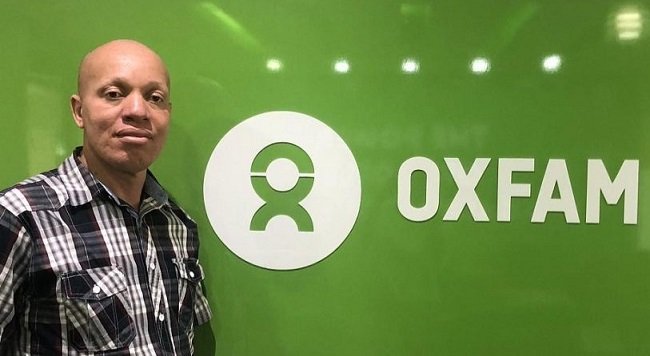
As the Intergovernmental Panel on Climate Change (IPCC) released a report detailing progress and pathways to liming global warming to 1.5 degrees Celsius on Monday, October 8, 2018, Oxfam International has expressed fears that rising temperatures will push millions of people in Africa into poverty and hunger unless governments take swift action.
Apollos Nwafor, Pan Africa Director of Oxfam
Responding to the report, Mr. Apollos Nwafor, Pan Africa Director of Oxfam, said: “Climate change has set our planet on fire, millions are already feeling the impacts, and the IPCC just showed that things can get much worse. Settling for 2 degrees would be a death sentence for people in many parts of Africa. The faster governments embrace the renewable energy revolution and move to protect communities at risk, the more lives and livelihoods that will be spared.
“A hotter Africa is a hungrier Africa. Today at only 1.1 degrees of warming globally, crops and livestock across the region are being hit and hunger is rising, with poor small-scale women farmers, living in rural areas suffering the most. It only gets worse from here.
“To do nothing more and simply follow the commitments made in the Paris Agreement condemns the world to 3 degrees of warming. The damage to our planet and humanity would be exponentially worse and irreparable.
“None of this is inevitable. What gives us hope is that some of the poorest and lowest emitting countries are now leading the climate fight. We’ve moved from an era of ‘you first’ to ‘follow me’ – it’s time for the rich world to do just that.
“Oxfam calls for increased, responsible and accountable climate finance from rich countries that supports small scale farmers, especially women to realize their right to food security and climate justice.
“While time is short, there is still a chance of keeping to 1.5 degrees of warming. We must reject any false solution like Large Scale Land Based Investments that means kicking small scale farmers off their land to make way for carbon farming and focus instead on stopping our use of fossil fuels, starting with an end to building new coal power stations worldwide.”
According to Oxfam, natural disasters such as droughts and floods have been thwarting development on the African continent.
The group adds: “Fluctuations in agricultural production due to climate variations along with inefficient agricultural systems cause food insecurity, one of the most obvious indicators of poverty. The 2016 El Niño phenomenon, which was super charged by the effects of climate change, crippled rain-fed agricultural production and left over 40 million people foods insecure in Africa. Without urgent action to reduce global emissions, the occurrence of climate shocks and stresses in the Africa region are expected to get much worse.”
One month after hundreds of thousands of people took to the streets to demand real climate action as part of the Rise for Climate Mobilisation, the world’s scientists have issued their clearest call for avoiding the worst impacts of a warming world.
Payal Parekh, Programme Director, 350.org
The Intergovernmental Panel on Climate Change (IPCC), UN-backed body of scientists, on Monday, October 8, 2018 released its special report on Global Warming of 1.5 ºC. The study confirms that limiting the rise in global temperatures to 1.5°C would be significantly better than breaching the 2°C threshold, supporting calls for a definitive stop to fossil fuel use and a rapid transition to energy systems based on 100% renewable energy.
Payal Parekh, Programme Director of climate change-focused non-governmental organisation, 350.org, commented: “The science in the IPCC report on 1.5°C speaks for itself. Staying under 1.5ºC is now a matter of political will. Burying our heads in the sand cannot be contemplated as an option any longer. The climate crisis is here and already impacting the most vulnerable and the least responsible for creating it. The only way to achieve it is to stop all fossil fuel extraction and redirect the massive resources currently spent on the fossil fuel economy towards the renewable energy transition.”
According to 350.org, communities worldwide are already resisting fossil fuel development and calling for a deep transformation of our energy systems and economies. Some of these stories of resistance can be found in the newly released People’s Dossier on 1.5°C, it adds, pointing out that the Dossier puts faces and voices onto the facts and data provided by the IPCC special report.
“It contains the stories of 13 communities fighting on the frontlines of climate change: from young Pacific Islanders trying to stop the Adani mega-mine to fishermen communities in Africa battling against new coal plants; from the struggle to stop a gigantic gas pipeline among the olive groves of Southern Italy to the landowners and Native Americans putting solar panels on the route of the Keystone XL pipeline.”
Over the next days, 350.org activists will also launch a globally coordinated delivery of copies of the IPCC report, demanding that all institutions withdraw their support from the fossil fuel industry and stand up to them before it’s too late.
The IPCC report explores in detail the impacts of a world 1.5°C warmer than pre-industrial levels and the feasibility of avoiding greater increases in temperature, while current national plans – if implemented – are only consistent with a world over 3°C warmer.
The key takeaways of the report are that:
Keeping the world from warming over 1.5°C will prevent considerable disruption to all of the Earth’s systems and allow for some ecosystems to partially recover from climate change after 2100, knowing that 20% to 30% of emitted CO2 will remain in the atmosphere for a time ranging from a few hundred to a few thousand years.
The 1.5°C target is feasible, provided enough economic resources are invested early enough to dramatically accelerate the phase-out of fossil fuels and the uptake of renewable energy and energy saving technologies across the board. Within the next decade or so, we will need to radically change the way we build our houses, move from one place to another and grow our food.
Delegates of national governments met in Incheon, Korea, over the course of last week, to negotiate line-by-line the so-called Summary for Policymakers (SPM), the executive summary of the report which is supposed to inform policies. Despite attempts to water down some critical language in the SPM by key countries such as the US, the underlying science in the roughly 1000-page long report doesn’t allow any national government to downplay the magnitude of the document’s findings and the need for a rapid phase-out of fossil fuels.