

Climate movements led by 350.org on Thursday, April 30, 2026, launched globally coordinated actions calling on governments to shift public money from costly fossil fuels towards cheaper renewables, as fossil fuel giants BP and TotalEnergies announce billions of dollars in “scandalous” first quarter profits, with Chevron and Exxon Mobil set to follow.
350.org demanded governments to rein in profiteering by imposing permanent windfall taxes on excess oil and gas profits. Campaigners say that windfall taxes can raise up to $400 billion globally in its first year, which can be used to immediately protect households from price shocks and accelerate the energy transition to bring down household bills for good.
New analysis by 350.org shows that elevated oil and gas prices will impose more than US$600 billion up to $1 trillion in additional costs on the global economy by the end of the year. On top of soaring energy bills, 350.org also says that households shoulder an extra $12 trillion each year in “hidden” fossil fuel costs in the form of fossil fuel subsidies, tax breaks, health impacts, and climate damages.
In its flagship campaign “The Great Power Shift,” 350.org groups and partners in Japan, Indonesia, France, Canada, Türkiye, Brazil, South Africa, East Africa, Pacific and the Caribbean underscored the need to end dependence on fossil fuels and ensure affordable renewable energy for all by ending fossil fuel subsidies and phasing out fossil fuel expansion.
They said that the just concluded landmark conference in Santa Marta, Colombia – participated in by 57 countries representing one-third of global GDP – proved that many countries were ready to advance the economic transformation necessary to transition away from fossil fuels.
Savio Carvalho, 350.org Head of Campaigns and Networks, said: “People are being squeezed by soaring energy costs while oil majors pocket scandalously huge first quarter profits – and that covers just one month of wartime gains. We pay, they profit – until we break free from fossil fuels.
“The lesson is clear: the less reliant we are on fossil fuels, the more protected ordinary people are from price shocks. Renewables have surged ahead as the cheapest option available, while fossil fuels have become a shock-prone liability. It’s time to make Big Oil pay and shift power back to the people.”
In France, 350.org campaigners called on French Parliamentarians to enact a legislative proposal for a fossil fuel windfall tax, and criticised the EU’s decision to leave out windfall taxes in its emergency energy measures announced last week. They held a stunt near a gas station of TotalEnergies, which just announced US$5.8 billion in first quarter profits.
France Petitbon, 350.org France Country Manager, said: “While millions of French people struggle to pay their bills, TotalEnergies is cashing on war. Taxing obscene profits only during price spikes is not enough, we need a permanent windfall tax. The billions this would unlock could deliver urgent support to vulnerable households and fast-track the renewable transition. It’s the only way to break free from economic and political blackmail. The French government, which bears its own responsibility as chair of this year’s G7, has run out of excuses. It is time to listen and put people over profits, not the other way around.”
In Türkiye, in a gathering in Antalya – the host city of the COP31 UN climate talks – 350.org campaigners highlighted analysis that the surge in oil and gas prices during the first 60 days of conflict in West Asia has cost ordinary households and businesses an additional $3 billion.
Efe Baysal, 350.org Türkiye Country Manager, said: “For Türkiye, as the host of COP31, these figures are not just statistics; they are an urgent wake-up call to action. A country preparing to lead on the global climate stage must first complete its own energy transition at home. Freeing our people from the price instability caused by fossil fuels will not only alleviate the financial strain on households but also serve as the most powerful message Türkiye can send to the world in the lead-up to COP31.”
In Indonesia, actions were held in Jogjakarta, Jakarta, Bali, and Lombok calling on the government to tax windfall profits of coal exporting companies, and to redirect fossil subsidies to renewable energy.
Sisilia Nurmala Dewi, 350.org Indonesia Country Manager, said: “Indonesian households just finished honouring their tax obligations this season, while fossil fuel companies pocket record profits and pass the cost of climate disaster to ordinary families. The Indonesian government must act urgently to make windfall tax proposals a reality. Every rupiah collected must be earmarked for the energy transition and climate reparations. Those who wreak damage must pay – not Indonesians already struggling with high costs of living.”
In Japan, campaigners called out the country’s dependence on imported fossil fuels and urged the government to redirect fossil fuel and nuclear subsidies to renewable energy, highlighting 350.org analysis that shows the country has lost up to ¥ 1 trillion in oil and gas spikes in the last two months of war.
Masayoshi Iyoda, 350.org Japan Campaigner, said: “Since Japan relies almost entirely on fossil fuel imports, its energy security is repeatedly jeopardised whenever crises occur. The Takaichi administration’s crisis measures – such as gasoline subsidies and the reuse of inefficient coal-fired power plants – as well as massive oil, gas, and nuclear investments in the US, only feed the world’s fossil fuel addiction that may well lead us to the next crisis. The government should instead embark on energy conservation and rapid renewable energy expansion to ensure affordable energy and protect the livelihoods of the Japanese people.”
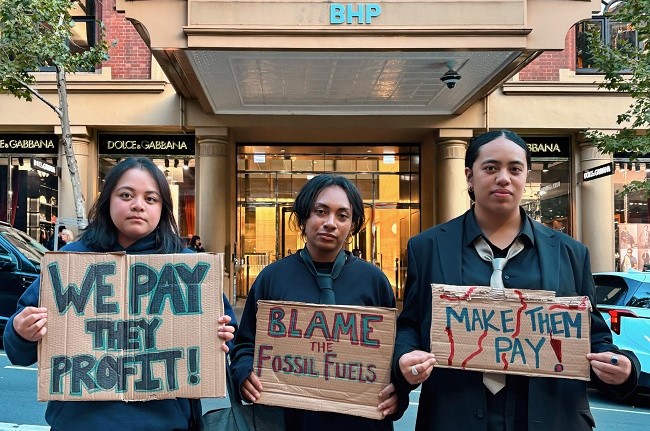
In Australia, 350.org campaigners held an action at the Melbourne headquarters of the country’s largest coal company BMA (BHP & Mitsubishi Alliance), as Pacific island nations face an energy crisis.
Jacynta Fa’amau, 350.org Pacific Campaigner, said: “Fossil fuel companies reap obscene profits even while people in the Pacific and worldwide declare various states of emergency, choked by fossil fuel dependence. The polycrisis of climate change, energy insecurity and skyrocketing cost of living has shown us that the Pacific critically needs to move beyond fossil fuels and embrace renewable energy. Australia can begin by stopping monstrous carbon bombs like BMA’s Peak Downs mine and stepping up to lead the region’s era of renewable energy security.”
In Canada, 350.org campaigners say that Canadian oil and gas companies could make up to CAD $100 billion in excess profits this year – a windfall tax could provide up to CAD $75 billion in direct relief to Canadian consumers and renewable energy investments.
Atiya Jaffar, 350.org Canada Country Manager, said: “While everyday Canadians struggle to make ends meet as the cost of fuel skyrockets, Big OIl is raking in billions they didn’t earn and don’t deserve. They’re not innovating or investing; they are just passively profiting from the global oil price shock. We are calling for an immediate 75% excess profits tax on the oil and gas sector to fund immediate relief for households struggling most during the spiralling cost of living crisis and to massively expand renewable energy, public transportation, and an East-West electricity grid.”
In South Africa, 350.org campaigners are calling for free basic electricity through renewable energy, as the country faces its biggest electricity tariff increase in decades.
Tshepo Peele, 350.org South Africa Country Manager, said: “The energy transition is more urgent than ever as the global energy crisis forces ordinary working-class families to make impossible choices between putting food on the table or keeping the lights on. We need to develop renewable energy infrastructure to address energy poverty for communities hit hardest by rising energy costs. The upcoming local government elections in South Africa offer a vital opportunity for the public to usher in a shift in policy – from a system that favors fossil fuel profiteering to one that benefits the people.”
In Brazil, 350.org campaigners propped up a giant “expensive and dirty” electricity bill in front of the National Congress, and demanded cleaner, cheaper energy from candidates. Brazilian households spend around 12% of their income on energy – the highest share among major economies – with the situation likely to worsen as electricity tariffs are projected to rise further.
João Cerqueira, 350.org Brazil Country Manager, said: “While legislators continue to subsidise fossil fuels and contract new coal and gas plants that lock in higher costs for years to come, families across Brazil are struggling to pay their bills. This is not an accident; it is a political choice. The fossil fuel lobby is winning, and Brazilians are paying the price. This election year, it’s time to change that.”
In East Africa, 350.org campaigners called on local governments to allocate more public money towards affordable, decentralised clean energy.
Rukiya Khamis, 350.org East Africa Programme Manager, said: “The global energy crisis has laid bare a painful truth: while fossil fuel giants enjoy protection, our communities are left vulnerable to every price hike and supply shock. The time for asking nicely has passed. We need to hold big corporations to account for the damage they cause, but we must also look closer to home.
“Local governments must stop pouring public money into the volatile systems of the past and start ring-fencing budgets for affordable, decentralised, clean renewable energy. True resilience isn’t found in a pipeline; it’s built through public investment that prioritises the needs of the many over the profits of the few.”