The Africa civil society organisations under the umbrella of the Pan African Climate Justice Alliance (PACJA) have called on the negotiators at the ongoing United Nations climate conference in Poland to come up with a comprehensive work plan that will help in implementation of the Paris Agreement.
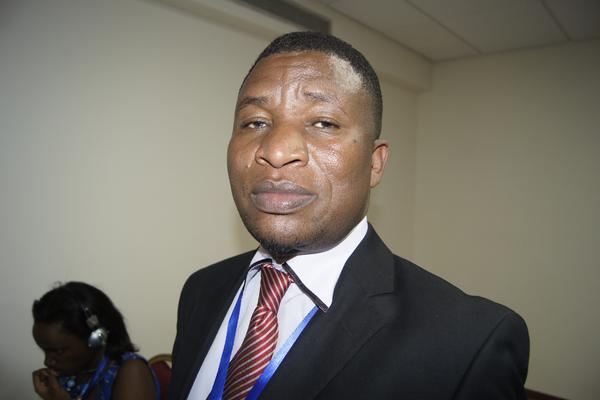
Mithika Mwenda, Secretary General of the Pan African Climate Justice Alliance (PACJA). Photo credit: cloudfront.net
“We join the African Governments and experts in underscoring the vital importance of ambitious outcomes from this conference,” said Mithika Mwenda, the Executive Director at PACJA.
“We need to uphold equity, justice and act as an anchor in the Paris Agreement’s implementation,” he told a press conference at the UNFCCC COP24 in Katowice, Poland, noting that the pre-2020 ambition remains vital to stay within the closing window as indicated by the recently released IPCC report and the Paris Agreement implementation.
Sudanese scientist and climate activist, Dr. Shaddad Mauwa, also said that climate finance should be taken seriously as a critical issue of negotiations for COP 24. “We expect a clear roadmap for fulfilment of climate finance commitment of $100 billion per year by 2020,” he told a team of journalists in Katowice.
Dr Shaddad said that parties should agree to discuss a new post-2025 quantified climate finance goal from the floor of $100 billion and agree on accounting rules for climate finance that are robust and provide full transparency on actual assistance provided and to be provided to the developing countries.
The activists also underlined the need to focus on how Adaptation Fund will serve the Paris Agreement. “Parties should agree on maintaining the current balance of the Fund’s board membership, operational policies and guidelines for developing countries to access the funds when it serves the Paris Agreement,” said Shaddad.
They called on parties to negotiate on the Nationally Determined Contributions timeframe in relation to the Paris Agreement. They noted that a single five-year common timeframe for NDC implementation should be agreed at the ongoing COP24 in order to enhance consistency and comparability of NDCs.
On loss and damages, the civil society representatives pointed out that Africa continues to suffer enormous economic losses in billions of dollars as a result of climate change impacts.
“It is worrying to keep hearing the answer for loss and damage as insurance, this might be possible in developed countries but in developing countries especially in Africa, it is a far-fetched dream,” said Mwenda. “We call for the commitment in the implementation of the Warsaw International Mechanism on Loss and Damage and need a predictable a financing approach for Loss and Damage in Africa,” he added.
Rebecca Muna, the Director of Civil Society Forum on Climate Change (FORUMCC) in Tanzania, noted the importance of gender considerations in policies that supports activities on adaptation, mitigation, finance, technology development and transfer, including capacity building.
“We call for Parties to increase their efforts in ensuring that women are represented in all aspects of the Convention process, and gender mainstreaming is achieved in all processes, and activities of the Convention,” she said.
“We are calling on parties here in Katowice to fresh energy and push the negotiations towards concrete outcomes that will address this grave concern to Africa. The world is watching and the outcome from this COP24 as it will determine whether the Paris Agreement will be a reality or a mere rhetoric,” said Mwenda.
The world Bank has donated $65 million to support Bauchi State urban water rehabilitation scheme.
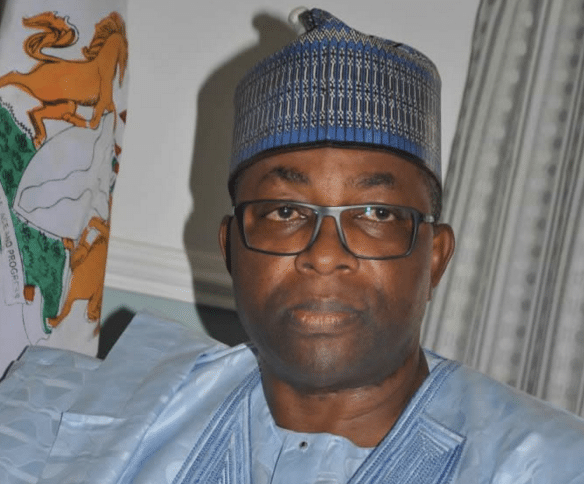
Mohammed Abdullahi Abubakar, Governor of Bauchi State
The Task Team Leader of the Bank in Nigeria, Dr Jamal Alkairy, disclosed this when he led stakeholders in the water sector on a courtesy call to the state’s Deputy Governor, Mr. Audu Katagum, in Bauchi, the state capital, on Tuesday, December 4, 2018.
Jamal said the project was for the rehabilitation and expansion of water supply to the populace in the state.
He explained that the gesture was to improve access to potable water supply, hygiene and sanitation.
According to him, under the project, the World Bank would commit 90 per cent of the amount, while the state government would pay the remaining 10 per sent.
“The project when fully implemented would increase quality and quantity of water supply to the people in the state.
Jamal, however, advised the state government to expedite action towards sustaining the implementation of water reform system in the state.
He then called on the government to ensure accountability and increase its financial efficiency of the water sector.
In his remark, the deputy governor said that the state government had reiterated its commitment towards revamping the water sector for human survival.
Katagum assured the team of the state government’s readiness to release its counterpart funding for the successful implementation of the project.
The Securities and Exchange Commission (SEC) on Tuesday, December 4, 2018 said the nation’s huge infrastructure gap could be addressed with investments in sustainable finance initiatives such as Green Bonds.
Mary Uduk
Ms Mary Uduk, the SEC Acting Director-General, stated this in an interview with the News Agency of Nigeria (NAN) in Lagos on the sidelines of the Green Bond issuance rules launch.
Green bonds were created to fund projects that have positive environmental and/or climate benefits.
Majority of the green bonds issued are green “use of proceeds” or asset-linked bonds. Proceeds from these bonds are earmarked for green projects but are backed by the issuer’s entire balance sheet.
Uduk said there was the urgent need to close the huge infrastructure gap with investments in green bonds.
She said issuance of green bond would provide an avenue to raise capital in the market to finance the country’s infrastructure needs, enhance liquidity and as well help deepen the market.
“Green Bonds is one of such avenues to raise needed capital from investors with a passion for keeping our environment clean and investing the proceeds in environmentally friendly and green infrastructure initiatives,” she said.
On effective utilisation of proceeds, Uduk said the commission had robust monitoring and issue proceeds verification that tracked issuers and proceeds utilisation.
She said the verification process ensured that proceeds from the issue were directed and utilised for the projects they were earmarked for in accordance with the guidelines.
“SEC is engaging with stakeholders and capital market operators on various enlightenment and training programmes on Green Bonds.
“Specifically, since second quarter SEC has collaborated multiple times with the Climate Bonds Initiative (CBI) to provide training for regulators, investors, and intermediaries on Green Bonds,” Uduk stated.
She said SEC had rolled out rules on green bonds and conducted enlightenment programmes as part of its efforts to create an enabling environment for issuers and other stakeholders.
According to her, the commisson will continue to encourage companies to take advantage of this tremendous opportunity.
“It is a new area and we will continue to develop capacity in the green bond market both internally at the SEC and the market as a whole.
“We have organised trainings for regulators and continue to work with experts and organisations like CBI to further strengthen capacity in this area,” Uduk said.
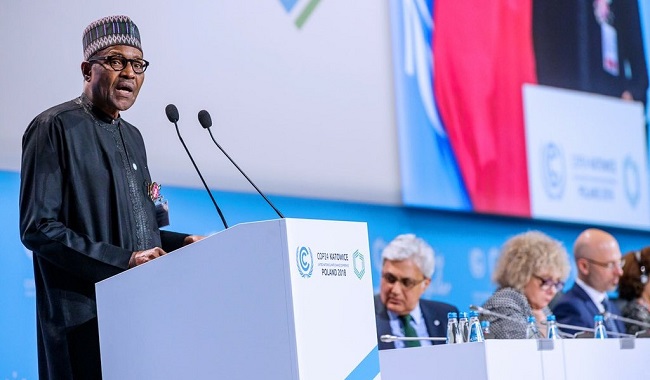
President Muhammadu Buhari on Monday, December 3, 2018 in Katowice, Poland, said no country can confront climate change alone, even as he urged UN-member countries to rededicate themselves to the task of rebuilding and restoring a healthy environment for future generations.
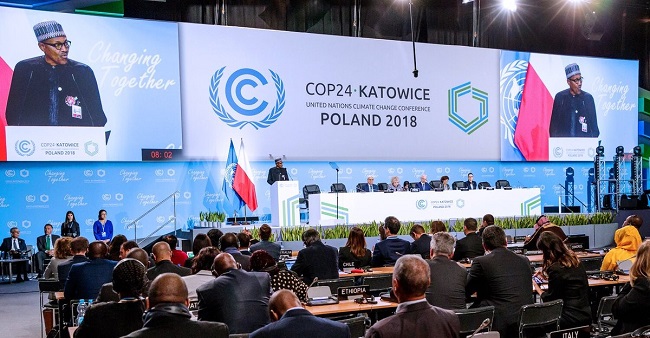
President Muhammadu Buhari delivering an address to the opening session of United Nations Climate Change Conference in Katowice, Poland
In an address to the opening session of United Nations Climate Change Conference (COP24), President Buhari warned that the challenges of climate change, including rising temperatures, desertification, floods, low agricultural yields and drying up of water bodies, are enormous and evident to all.
Citing the receding Lake Chad, the President noted that the effects of climate change are felt more on the vulnerable communities who lacked the capacity and technology to properly address such challenges.
‘‘Obviously, no country can confront the phenomenon alone. In this regard, Nigeria believes in joint and cooperative efforts to tackle the problem.
‘‘We urge that efforts to address the challenges of climate change be pursued within multilateral frameworks. Concerted efforts should be made to strengthen sub-regional and regional organisations, to serve as hubs for Climate Action and partnership,’’ the Nigerian leader said at the International Conference Centre, Katowice.
Speaking specifically on Lake Chad, the President reaffirmed that Nigeria remains committed to saving the lake, which is a source of livelihood to 40 million people, from extinction.
He said Nigeria would build on the success of an International Conference held earlier in February this year in Abuja to create additional awareness globally on the serious environmental and security challenges facing the Lake Chad region.
The President told COP24 Summit, attended by world leaders and UN Secretary-General Antonio Guterres, that a consensus was reached at the Abuja Conference that an inter-basin water transfer from the Congo Basin remains the most sustainable option available to resuscitate and safeguard this precious water body that was once the 6th largest fresh water Lake in the world.
On behalf of the Member Countries of the Lake Chad Basin Commission, the President thanked the Italian Government for donating €1.5 million towards completion of the feasibility studies on the proposed inter-basin water transfer project.
‘‘I once again call on the international community to support this worthy project, for the benefit of nearly 40 million people that depend on the Lake for their livelihood, and to guarantee future security of the region.
‘‘I would like to reiterate Nigeria’s commitment to constructively supporting multilateral action aimed at addressing climate change.
‘‘We must rededicate ourselves to the task of rebuilding and restoring the healthy environment we inherited for future generations,’’ he said.
President Buhari also used the occasion to highlight what Nigeria had done and is doing on climate change after the adoption of the Paris Agreement on Climate Change in 2015.
‘‘We in Nigeria have commenced the implementation of our Nationally Determined Contribution (NDC) to reduce greenhouse gas emissions.
‘‘In the next 15 years, we aim to achieve 20% emissions reduction below Business as Usual (BAU) and 45% emissions reduction with the support of our international partners by 2030.
‘‘Our efforts include the review and introduction of new responsive Legislation/policies, strengthening institutional and manpower capacities, and encouraging gradual transition to low carbon economy.
‘‘Nigeria has also recently ratified the Doha Amendment and will soon deposit the instrument for ratification,’’ he said.
The President urged that efforts to address the challenges of climate change be pursued within multilateral frameworks
The President pledged that Nigeria would continue to pursue industrialisation and economic development, with sound environmental management and best practices.
He added that Nigeria has unlocked the potential of its sovereign green bond to galvanize private capital to finance environmentally sustainable projects.
‘‘In support of our NDC aspiration, we have embraced the issuance of green bond as an innovative and alternative source of funding projects that would reduce emissions and provide robust climate infrastructure like renewable energy, low carbon transport, water infrastructure and sustainable agriculture that our country needs,’’ he said.
Furthermore, the President told the summit Nigeria believes that technology can be a powerful solution for simultaneously addressing climate change and advancing development, stressing the need for developed countries to accelerate the finance for research and development, in addition to promoting access to climate-friendly technologies.
‘‘In addition, there is the need to raise global climate action in the pre-2020 period, in terms of mitigation, adaptation and means of implementation.
‘‘For us in Nigeria, we are promoting technologies and practices such as sustainable land management, climate resilient agriculture, water efficiency and clean energy.
‘‘We have also developed insurance-based initiatives to deal with loss and damage, as well as adaptation to internally acceptable practices,’’ he said.
The President commended the Government and People of Poland for hosting the 24th Session of the Conference of the Parties to the United Nations Framework Convention on Climate Change (UNFCCC) in the ‘‘beautiful city of Katowice.’’
At the formal opening of COP24, President Andrzej Duda of Poland had told delegates that the conference is taking place on the exact location where a coal mine was once operated, adding that Katowice is now one of the greenest cities in Poland.
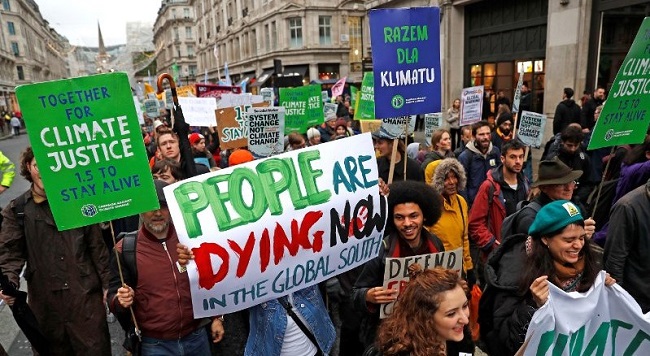
A global coalition of more than 220 organisations has issued a series of demands to world governments as the United Nations Climate Change Conference (COP24) began on Sunday, December 2, 2018 in Katowice, Poland.
Climate change protesters demonstrate, prior to the United Nations climate change conference in Poland, in central London, Britain, December 1, 2018. Photo credit: REUTERS/Peter Nicholls
The demands, endorsed by nearly 200,000 people from 128 countries, is expected to be the bar against which progress is measured in Poland. The coalition demands, among others, that governments should:
Keep fossil fuels in the ground;
Reject false solutions that are displacing real, people-first solutions to the climate crisis;
Advance real solutions that are just, feasible, and essential;
Honour climate finance obligations to developing countries;
End corporate interference in and capture of the climate talks; and,
Ensure developed countries honour their “fair shares” for largely fueling this crisis.
In a statement released by Corporate Accountability, Executive Director Patti Lynn called for world governments to look beyond the obstruction of Global North countries and act with urgency to address climate change.
“When the future of humanity undeniably hangs in the balance, we need serious solutions from serious leaders, not dangerous schemes and political tricks aimed to keep Big Polluters polluting,” Lynn said.
Friends of the Earth International also on Monday, December 3 launched its “People Power Now: An Energy Manifesto” – 10 demands for a just energy transformation which, it said, provided a pathway to a new, clean energy future for all, that contributes to keeping global temperature rise below 1.5 degrees.
The group said inaction by successive governments at the UN and among national governments has left a narrow and shrinking window for action, warning that there is deep frustration with the endless talking shop where polluters freely influence the debate and rich countries block the radical action needed for fossil fuel phase out in the North and finance for the South.
Dipti Bhatnagar, Climate Justice and Energy Programme Coordinator for Friends of the Earth International, said: “This year was supposed to be a major year for the climate – pledges made in Paris three years ago were to be ratcheted up to meet the need for early and steep emission cuts. Thanks to a weakened Talanoa Dialogue, climate ambitions are severely threatened, in addition to the dismantling of equity and the egregious fact that fossil fuel companies are sponsoring the Conference. We need a just transition away from fossil fuels and dirty energy to a just, clean, peoples’ energy system. We need to push for gender justice and for a world free from oppression and inequality.”
Deputy Executive Director, Environmental Rights Action/Friends of the Earth Nigeria (ERA/FoEN), Akinbode Oluwafemi, said: “Big Polluters and their allies must not be allowed to meddle to determine the outcomes of the talks. Now is the time for leaders from Africa and nations already feeling the impacts of climate change to kick the industry out and advance real solutions.”
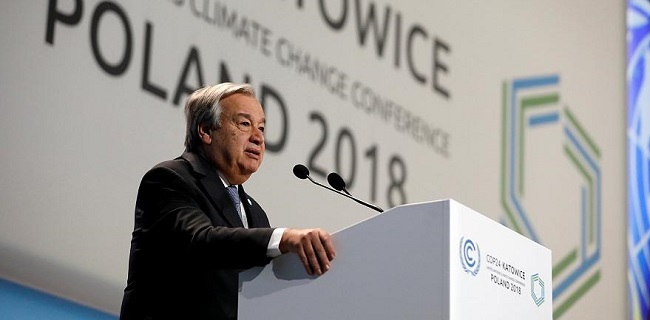
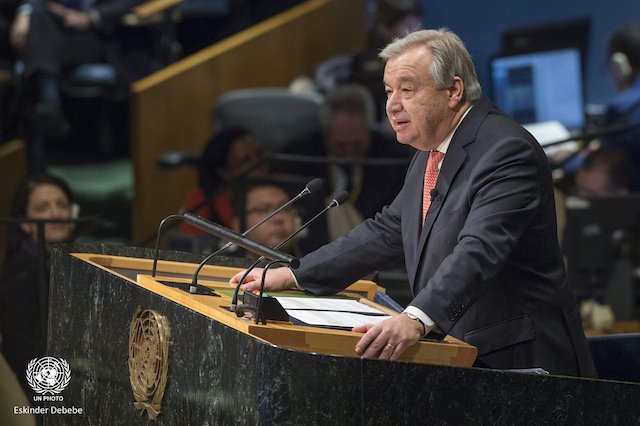
United Nations Secretary-General, António Guterres, in his remarks on Monday, December 3, 2018 at the opening ceremony of the UN Climate Change Conference in Katowice, Poland, says that the job of delegates in the Polish city is to finalise the Paris Agreement Work Programme, and that there is no room for failure. Excerpts:
António Guterres
We are in trouble. We are in deep trouble with climate change.
Climate change is running faster than we are and we must catch up sooner rather than later before it is too late.
For many, people, regions even countries this is already a matter of life and death.
This meeting is the most important gathering on climate change since the Paris Agreement was signed.
It is hard to overstate the urgency of our situation.
Even as we witness devastating climate impacts causing havoc across the world, we are still not doing enough, nor moving fast enough, to prevent irreversible and catastrophic climate disruption.
Nor are we doing enough to capitalise on the enormous social, economic and environmental opportunities of climate action.
And so, I want to deliver four simple messages.
First: science demands a significantly more ambitious response.
Second: the Paris Agreement provides the framework for action, so we must operationalise it.
Third: we have a collective responsibility to invest in averting global climate chaos, to consolidate the financial commitments made in Paris and to assist the most vulnerable communities and nations.
Fourth: climate action offers a compelling path to transform our world for the better.
Let me turn first to science.
According to the World Meteorological Organisation, the 20 warmest years on record have been in the past 22 years, with the top four in the past four years.
The concentration of carbon dioxide is the highest it has been in three million years.
Emissions are now growing again.
The recent special report from the Intergovernmental Panel on Climate Change finds that warming could reach 1.5 degrees as soon as 2030, with devastating impacts.
The latest UN Environment Programme Emissions Gap Report tells us that the current Nationally Determined Contributions under the Paris Agreement will lead to global warming of about 3 degrees by the end of the century.
Furthermore, the majority of countries most responsible for greenhouse gas emissions are behind in their efforts to meet their Paris pledges.
So, it is plain we are way off course.
We need more action and more ambition.
We absolutely must close this emissions gap.
If we fail, the Arctic and Antarctic will continue to melt, corals will bleach and then die, the oceans will rise, more people will die from air pollution, water scarcity will plague a significant proportion of humanity, and the cost of disasters will skyrocket.
Last year I visited Barbuda and Dominica, which were devastated by hurricanes. The destruction and suffering I saw was heart-breaking. That story is repeated almost daily somewhere in the world.
These emergencies are preventable.
Emissions must decline by 45 per cent from 2010 levels by 2030 and be net zero by 2050.
Renewable energy will need to supply half to two-thirds of the world’s primary energy by 2050 with a corresponding reduction in fossil fuels.
In short, we need a complete transformation of our global energy economy, as well as how we manage land and forest resources.
We need to embrace low-carbon, climate-resilient sustainable development.
I am hopeful that the Talanoa Dialogue will provide a very strong impulse for increased ambition in the commitments for climate action.
This brings me to my second point.
The Paris Agreement provides a framework for the transformation we need.
It is our job here in Katowice is to finalise the Paris Agreement Work Programme – the rule book for implementation.
I remind all Parties that this is a deadline you set for yourselves and it is vital you meet it.
We need a unifying implementation vision that sets out clear rules, inspires action and promotes raised ambition, based on the principle of equity and common but differentiated responsibilities and respective capabilities, in light of different national circumstances.
We have no time for limitless negotiations.
A completed Work Programme will unleash the potential of the Paris Agreement.
It will build trust and make clear that countries are serious about addressing climate change.
This brings me to my third point: the central importance of finance.
We need concerted resource mobilisation and investment to successfully combat climate change.
We need transformative climate action in five key economic areas – energy, cities, land use, water and industry.
Some 75 per cent of the infrastructure needed by 2050 remains to be built.
How this is done will either lock us in to a high-emissions future or steer us towards truly sustainable low-emissions development.
Governments and investors need to bet on the green economy, not the grey.
That means embracing carbon pricing, eliminating harmful fossil fuel subsidies and investing in clean technologies.
It also means providing a fair transition for those workers in traditional sectors that face disruption, including through retraining and social safety nets.
We also have a collective responsibility to assist the most vulnerable communities and countries – such as small island nations and the least developed countries – by supporting adaptation and resilience.
Making clear progress to mobilise the pledged $100 billion a year will provide a much-needed positive political signal.
I have appointed the President of France and Prime Minister of Jamaica to lead the mobilisation of the international community, both public and private, to reach that target in the context of preparation of the Climate Summit I have convened in September of next year.
I also urge Member States to swiftly implement the replenishment of the Green Climate Fund.
It is an investment in a safer, less costly future.
All too often, climate action is seen as a burden. My fourth point is this: decisive climate action today is our chance to right our ship and set a course for a better future for all.
We have the knowledge.
Many technological solutions are already viable and affordable.
Cities, regions, civil society and the business community around the world are moving ahead.
What we need is political more will and more far-sighted leadership.
This is the challenge on which this generation’s leaders will be judged.
Climate action is not just the right thing to do – it makes social and economic sense.
Meeting the goals of the Paris Agreement would reduce air pollution – saving more than a million lives each year by 2030, according to the World Health Organisation.
According to the recent New Climate Economy report, ambitious climate action could yield 65 million jobs and a direct economic gain of $26 trillion compared to business as usual over the next 12 years.
We are seeing early signs of this economic transformation, but we are nowhere near where we need to be.
The transition to a low-carbon economy needs political impetus from the highest levels.
And it requires inclusivity, because everyone is affected by climate change.
That is the message of the Talanoa Dialogue.
We need a full-scale mobilisation of young people.
And we need a global commitment to gender equality, because women’s leadership is central to durable climate solutions.
A successful conference here in Katowice can provide the catalyst.
There is now significant global momentum for climate action.
It has galvanised private business and investors around the world, while cities and regional governments are also showing that ambitious climate action is possible and desirable.
Let us build on this momentum.
I am convening a Climate Summit in September next year to raise ambition and mobilise the necessary resources.
But that ambition needs to begin here, right now, in Katowice, driven by governments and leaders who understand that their legacies and the well-being of future generations are at stake.
We cannot afford to fail in Katowice.
Some might say that it will be a difficult negotiation. I know it is not easy. It requires a firm political will for compromise. But, for me, what is really difficult is to be a fisherman in Kiribati seeing his country in risk of disappearing or a farmer or herder in the Sahel losing livelihoods and losing peace. Or being a woman in Dominica or any other Caribbean nation enduring hurricane after hurricane destroying everything in its path.
Climate change is the single most important issue we face.
It affects all our plans for sustainable development and a safe, secure and prosperous world.
So, it is hard to comprehend why we are collectively still moving too slowly – and even in the wrong direction.
The IPCC’s Special Report tells us that we still have time to limit temperature rise.
But that time is running out.
We achieved success in Paris because negotiators were working towards a common goal.
I implore you to maintain the same spirit of urgent collaboration here in Katowice with a dynamic Polish leadership in the negotiations.
Katowice must ensure that the bonds of trust established in Paris will endure.
Incredible opportunity exists if we embrace a low-carbon future and unleash the power of the Paris Agreement.
But we must start today building the tomorrow we want.
Let us rise to the challenge and finish the work the world demands of us.
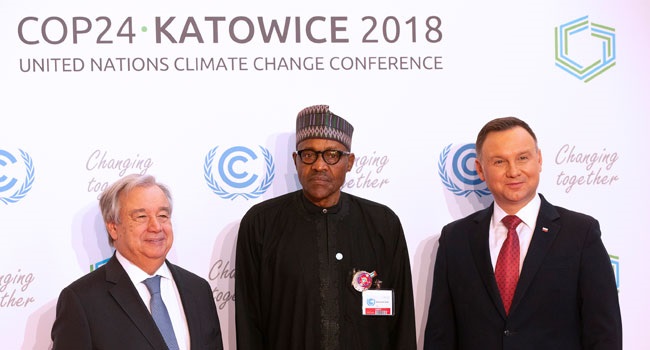
President Muhammadu Buhari on Monday, December 3, 2018 joined other world leaders at the United Nations Climate Change Conference in Katowice, Poland for the ceremonial opening of the summit.
President Muhammadu Buhari with the Secretary-General of the United Nations, António Guterres and the Polish President, H.E Andrzej Duda, at the venue of the COP24 United Nations Climate Change Conference in Katowice, Poland. Photo credit: Sunday Aghaeze/State House
The summit is the 24th session of the Conference of the Parties to the UN Framework Convention on Climate Change, otherwise known as COP24. It also features the 14th session of the Conference of the Parties serving as the meeting of the Parties to the Kyoto Protocol (CMP14), as well as the 3rd session of the Conference of the Parties serving as the meeting of the Parties to the Paris Agreement (CMA1.3).
President Buhari is expected later during the conference to deliver a national statement highlighting Nigeria’s commitment to addressing climate change by implementing the goals set out as part of the nation’s contributions.
The conference is expected to finalise the rule book in the implementation of the Paris agreement on climate change reached in December 2015 in France.
President Buhari is attending the summit with several top government officials including the Minister of Foreign Affairs, Mr Geoffrey Onyeama; the National Security Adviser, Babagana Monguno; and Minister of State for Environment, Usman Jibril.
Governor Yahaya Bello of Kogi State, Governor Abubakar Bello of Niger State and Governor Ifeanyi Ugwuanyi of Enugu State are also in Poland with the President.
Royal Dutch Shell caved in to growing investor pressure over climate change on Monday, December 3, 2018 with plans to set short-term targets for reducing its carbon footprint.
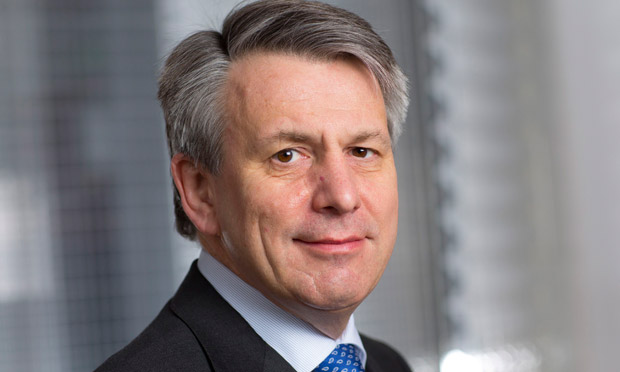
Royal Dutch Shell’s Chief Executive Officer, Ben van Beurden
BP and Total have already set short-term targets, but Shell Chief Executive Officer Ben van Beurden had previously resisted setting hard goals, saying it would be “foolhardy’’ to expose Shell to legal challenges.
But, following discussions with investors, the Anglo-Dutch oil and gas giant said that, from 2020, it would set three- to five-year targets every year which will include specific net carbon footprint targets.
Shareholders had criticised Shell for 2017 setting long-term “ambitions” to halve its emissions of carbon dioxide by 2050, which lacked binding targets for implementation.
Shell, which did not specify any targets on Monday, plans to link these targets and other measures to its executive remuneration policy.
The revised remuneration policy will be put to shareholders for approval at its annual meeting in 2020.
“We are taking important steps toward turning our Net Carbon Footprint ambition into reality by setting shorter-term targets,” Ben van Beurden said in a statement.
The move comes as governments meet in Poland for a conference hosted by the United Nations COP24 which will set out a “rule book’’ to implement a 2015 climate accord.
The Paris agreement set goals to phase out fossil fuel use this century, shift toward cleaner energies and help limit a rise in temperatures.
Shell signed a joint statement with a group of 310 investors with more than 32 trillion dollars of assets under management, dubbed Climate Action 100+, outlining the targets and review process.
“When it comes to meeting the demands of the Paris Agreement on climate change, we believe it is necessary to strengthen partnerships between investors and their investee companies to accelerate progress toward reaching such an ambitious common goal,” Peter Ferket, Chief Investment Officer of Robeco, said in the joint statement.
UN Secretary-General, António Guterres, has welcomed the declaration released on Saturday, December 1, 2018 at the conclusion of the 2018 G20 meeting, which reaffirms a commitment to raise ambition in the fight against climate change.
Antonio Guterres, UN Secretary General
The declaration notes a focus on four pillars at the meeting: the future of work, infrastructure for development, a sustainable food future and a gender mainstreaming strategy across the G20 agenda.
Guterres, in a statement released on Sunday, picked out three key messages from the statement of the world’s leading economies, in Buenos Aires, Argentina.
Support for the Agenda 2030 for Sustainable Development, the UN’s global blueprint for a fair globalisation that leaves no one behind, is reaffirmed in the document, along with a pledge to use all policy tools to achieve strong, sustainable, balanced and inclusive growth.
As well as stressing the need to raise ambition in the fight against climate change, the G20 leaders expressed their very strong support of countries that are signatories to the 2015 Paris Agreement, to implement their commitments set out in their nationally determined contributions.
The G20 declaration states that the leaders look forward to “successful outcomes” of the COP24 climate change conference, which begins in Katowice, Poland from December 3.
The “Work Programme” or rule book of the Paris Agreement – which, for the first time, brought almost all nations into a common cause to undertake ambitious efforts to combat climate change and adapt to its effects – is expected to be agreed at the event.
The UN chief pointed out that agreement on the Work Programme would significantly advance implementation of the Paris accord.
Guterres said in the declaration, G20 leaders recognise the importance of a multilateral approach to trade and of the reform of the World Trade Organisation and renew their commitment to a rules-based international order.
The Secretary-General concluded with a reminder that the G20 comprised the world’s leading emitters of environmentally harmful gases, and that the declaration provides hope for a solution to a global challenge that he has described as a direct existential threat.
“These agreements by the leaders of the world’s 20 largest economies, which also contribute the largest share of global green-house gas emissions, can help rally the international community to make sure that climate change is a race we can win.
“Indeed, it is a race we must win,” the UN chief stressed.
The two-week 24th Conference of the Parties (COP24) of the United Nations Framework Climate Change Convention (UNFCCC), which started on Sunday, December 2, 2018 in Katowice, Poland, will focus on carbon neutrality and gender equality.
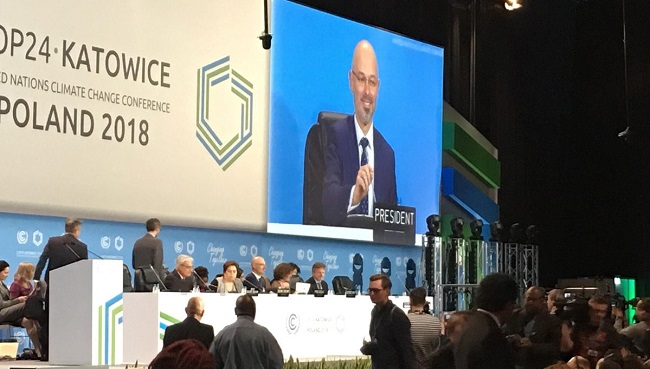
The COP24 opening plenary meeting
The world is gathering to define how the 2015 Paris Agreement would be implemented and moved forward by its 197 parties, days after the UN sounded the alarm on the unprecedented levels of greenhouse gas concentrations in the atmosphere.
Under the agreement, all countries have committed to reduce greenhouse gas emissions in order to limit the global average rise in temperature to well below two degrees centigrade, and as close as possible to 1.5 degrees centigrade.
Kicking off the two-week event in Katowice, a team of cyclists on electric bikes arrived from Vienna, having biked 600 km- to demonstrate the value of renewable energy in reducing emissions.
The expedition was supported by the UN Global Compact, a group of private sector companies committed to sustainable development.
The cycling team, called “Moving for Climate NOW”, made up of about 40 people from different institutions and countries was welcomed by UN Climate Change Deputy Executive Secretary, Ovais Sarmad, and Jakub Gibek, Head of the Climate Policy Unit of the Ministry of Environment of Poland.
Sarmad said: “I commend the cyclists involved in this bike tour for inspiring the world to move in the right direction to fulfil the promise of the Paris Agreement.
“This is the most important COP since the signing of the agreement, and we need initiatives like yours to testify that governments, the private sector and individuals can work together to tackle climate change by committing to multilateralism.”
To limit COP24’s footprint and achieve carbon neutrality, the conference organisers have taken a series of measures.
First, public transportation in the city is free of charge for the duration of the conference, for all participants.
In addition, reusable materials have been used to set up the conference rooms, including carpets and backdrops, while recycled cardboard furniture was installed the main meeting spaces.
The conference will also enforce a strict waste management policy: distinct recycling bins will be available in all meeting rooms; and the packaging of electronic equipment has been saved and would be reused after the conference is over.
Also, the packaging of catering products is environmentally friendly; single-use plastic products are limited across the space; and overall, the conference is paper light, with official documents available only in digital versions.
To limit greenhouse emissions due to transportation, virtual participation is encouraged and supported through live webcasts of the main events.
Unavoidable greenhouse gas emissions due to the event will be tracked through a rigorous calculation by the organisers based on international standards.
It is anticipated that COP24 will generate approximately 55,000 tonnes of carbon dioxide.
To offset this, the Polish Government has committed to planting more than six million trees, capable of absorbing the equivalent of the conference’s emissions in the next 20 years.