Home Blog Page 1721

10 developments that will shape Africa’s energy sector in 2019

0

According to the African Energy Chamber, 2019 will be key for the advancement of new exploration and production development projects from West to East Africa
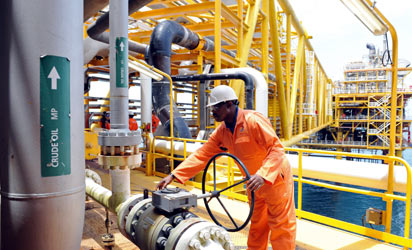
oil installation
Oil installation

After a year of rebound and recovery, Africa’s old and new hydrocarbons markets have an opportunity to further entrench the continent’s position as the world’s hottest oil and gas frontier in 2019. However, the new year also brings a new set of dynamics and challenges set to influence the future of the industry, from presidential elections to megaprojects developments, amidst intensifying international competition.

New African frontiers opening up

Independents are leading the way in exploring and opening new frontiers across Africa. This year will be key for the advancement of new exploration and production development projects from West to East Africa. Developments to watch notably include Senegal’s SNE field development, where FEED works are ongoing and a final investment decision (FID) is expected by Woodside Energy and Cairn Energy this year; Niger’s Amdigh oilfield development, where Savannah Petroleum’s $5m early production scheme is set to start anytime soon; and the opening up of Kenya’s South Lokichar Basin by Tullow Oil, where FID is also expected before year end amidst rising tensions with the Turkana local community.

A year to confirm Africa as a global exploration hotspot

Ongoing bidding rounds in key existing and new African hydrocarbons markets will tell if Africa further confirms its position as the world’s new exploration hotspot and manages to attract necessary investment in its oil and gas acreages.

Amongst well-established African producers, OPEC members Gabon and Congo-Brazzaville each have ongoing bidding rounds. Gabon’s 12th shallow and deep-water licensing round is set to close in April 2019 and Congo-Brazzaville’s License round phase II in June 2019.  With both countries struggling to implement their new Hydrocarbons Codes, the success of these rounds will tell if investors have been convinced by policy reforms developed over the past two years.

Two bigger African producers and also OPEC members, Nigeria and Angola, are set to launch landmark and out-of-the-ordinary bidding rounds this year. Nigeria will auction its gas flare sites under the Nigerian Gas Flare Commercialisation Programme, likely to happen after the February general election, and Angola will hold its Marginal Fields Bidding Round, result of a new May 2018 policy enacted by President Lourenço, and to be launched at the Africa Oil & Power conference in Luanda in June 2019. With the Nigerian Petroleum Industry Bill yet to be signed and the ink still fresh on Angola’s new policy regime, both rounds will also be key in assessing investors’ interest for both countries’ business environments.

Also attracting interest is the newest and arguably one of the upcoming entrants – Ghana – holding its first formal licensing round set to close in May 2019 which has reportedly got the attention of 16 oil companies, including majors ExxonMobil, BP, Total and ENI. As a hopeful new East African offshore frontier, Madagascar is also putting 44 concessions on offer until May 2019, none of which has ever been tendered or explored before. For a country without any major oil discovery to date, the ongoing license round is a wager test.

Africa’s struggling FLNG industry

After the start of commercial operations at Golar LNG’s Hilli Episeyo FLNG vessel in Cameroon in June 2018, hopes were high that Equatorial Guinea would soon move forward with its own Fortuna FLNG project, set to be Africa’s first deep-water FLNG development. While Fortuna was to be game changing for the gas industry of Equatorial Guinea and the rest of the continent, the development of the $2 billion project has stalled due to a lack of financing. And the clock has been ticking since.

The lack of progress on this plan has been so slow that operator Ophir Energy has been denied the extension of its license to operate block R (as of January 2019), which contains the giant Fortuna gas discovery. While Equatorial Guinea’s FLNG aspirations look more uncertain than ever, 2019 will tell if the country can find the right partners to put the project back on Africa’s FLNG map.

Meanwhile, new entrants in Africa’s hydrocarbons stage are making remarkable advances towards the development of their own FLNG industry. On December 21st last year, BP finally announced its FID for phase 1 of the cross-border Greater Tortue Ahmeyim development between Senegal and Mauritania, which involves the installation of a 2.5MTPA FLNG facility. It became the third African FLNG project to reach FID after Cameroon’s 2.4MTPA Hilli Episeyo and Mozambique’s 3.4MTPA Coral South FLNG.

Mega projects on the move

Africa’s come back on the global oil and gas map is not only due to the vast natural resources found in its soil and waters, but also to the continent being home to mega energy projects set to transform the future of the industry.

On the upstream side, the recent inter-governmental cooperation agreement between Senegal and Mauritania, and BP’s FID on its cross-border Greater Tortue Ahmeyim development, bodes well for the future of West Africa’s hydrocarbons industry. The project aims at extracting the 15Tcf of gas estimated to be held in the Tortue gas field, located at a depth of 2,850 metres. However, the ability of both Senegal and Mauritania to work out their differences to ensure a more sustainable development of their offshore reserves and facilities around the MSGBC Basin is a factor to watch out for.

African mega gas projects are not the sole property of the continent’s West coast, with Mozambique moving forward with two landmark projects putting the Southern African nation on the global LNG map. Following the launch of the Coral South FLNG project by ENI in June 2017, a FID is now expected in the coming months for the Anardarko-led Mozambique LNG project, an onshore LNG development initially consisting of two LNG trains totaling 12.88MTPA to export the gas extracted from the offshore Area 1, estimated to contain a whooping 75Tcf.

Sub-Saharan Africa’s biggest petroleum producers, Nigeria, is also moving forward with massive oil development projects in 2019. Last year already saw the launch of Total’s $3.3 billion Egina FPSO in Nigeria, where production officially started in the first days of 2019 and is set to peak at 200,000 bopd. FID is now expected on Shell’s Bonga Southwest offshore field in Nigeria early this year, a multi billion-dollars development whose production is expected to reach 180,000 bopd.

International contenders and pretenders

As Africa strengthens its position at the centre of global transformations, it is increasingly becoming the playground for international actors willing to benefit from the continent’s vast resources.

While China has asserted its position of a contender in the continent, will new continental dynamics lead the Asian giant to change its investment strategy or portfolio? With Russia’s intentions on the continent becoming clearer and clearer, will the first Russia-Africa Summit this year translate into more concrete Russian deals across the continent? At the same time, will the US’ “Prosper Africa” initiative launched in December 2018 be able to counter both rising international competition and declining US influence on the continent?

A complex energy diplomacy dilemma for OPEC in Africa

With a majority of its members made up of African nations since the joining of the Republic of Congo in June 2018, OPEC’s evolving relationship with the continent as it strives to manage the global supply glut will be requiring skillful diplomatic ingenuity.

On one side, Africa’s biggest producers and OPEC members Algeria, Libya, Nigeria, Angola and Congo-Brazzaville, are striving to boost their domestic output, which makes it harder and harder for the Organisation to negotiate its production cuts.

On the other side, the continent is also home to a flurry of upcoming petroleum producers like Senegal, Kenya or Uganda, or old players making a comeback like South Sudan, some of them part of OPEC’s Declaration of Cooperation, whose upcoming or increasing output adds another layer of complexity to the formulation of OPEC’s global oil prices management strategy.

An increasing African output from OPEC and non-OPEC member countries only complicates OPEC’s maneuver capabilities and increases its dilemma of both providing a stable pricing environment conducive to investments, while avoiding a worsening of the supply glut that would push prices further down.

Africa’s biggest petroleum producers casts their ballots

Amongst the series of elections happening in the continent this year, from Senegal to Mozambique, none will be more important for the African oil sector than that of Nigeria this February. The Nigerian presidential election is set to shape the future of the industry, not only because Nigeria is Africa’s biggest oil & gas producer, but because what happens in Nigeria impacts the rest of the subcontinent one way or the other. While both Muhammadu Buhari, seeking re-election, and his ally turned rival Atiku Abubakar have committed to the signing of the Nigerian Petroleum Industry Bill, the ability of the future President to get his office in order and get the bill passed quickly will heavily influence investments within Nigeria’s hydrocarbons sector for years to come.

North, Algeria and Libya are also entering an election year, with the 2019 Libyan general election set for the first half of the year, and Algeria’s for April. Both countries are on a transformation path. Libyan authorities plan to more than double the country’s output to 2.1 million bopd by 2021, providing politics doesn’t tamper hydrocarbons governance and the work of the National Oil Company. With Muammar Gaddafi’s son Saif al-Islam Gaddafi set to stand for election and the country still divided between West and East, maintaining the stability required by investors will prove challenging.

In Algeria, where a wave of reform is shaking the entire hydrocarbons sector, elections are expected to maintain a relative status-quo, at least politically speaking. The country’s national oil company, Sonatrach, has launched an ambitious transformation strategy that will see it investing $56bn over the next four years and internationalising its operations across major global energy markets. 2019 could even see the state-owned giant and Africa’s biggest company further expand south of the Sahara.

Angola’s steady road to reforms

Since taking office in the summer of 2017, Angolan President João Lourenço has been implementing a bullish reformist agenda which is drastically transforming the governance of the country’s oil & gas sector. Angola is reforming fast, but will market forces allow changes to happen at that pace and yield the results that the government is looking for?

While international investors seem to think so, with Total and BP signing major agreements to boost their Angolan operations over the past few months, 2019 will tell if the international oil industry is being convinced of Angola’s return as a competitive African frontier or not.

To showcase the work being done by Sonangol and the Angolan government to generate more investment in the country’s oil & gas industry, Angola is backing up an international conference being organised by Africa Oil & Power in Luanda on June 4-6, 2019, where it will be launching the Angolan Marginal Field Bidding Round. This will be the first official investment roadshow organised in Angola under the current administration, and one that is set to unveil a new set of reforms and investment commitments.

South Sudan’s march to peace

The major progression in South Sudan, and one on which the entire economy relies, is that of the peace accords. The Sudanese and South Sudanese authorities have time and again demonstrated their commitment to the peace process, which has remained peaceful for the most part. However, will peace deals translate into investment promises and money being invested into the South Sudanese economy this year? Some signals point to that direction, with South Africa’s Central Energy Fund committing $1 billion to South Sudan late last year, but markets are still skeptics and observers will remain pragmatics and wait to see how the peaceful transition is managed and how oil production resumes before making any concrete moves.

A year to improve market access for East African producers

With Uganda set to join the club of African petroleum producers by the early 2020s, efforts are on the way to develop adequate infrastructure for the evacuation of oil that will be produced from the Lake Albert Basin. The project seemed to be positively moving forward when Uganda and Tanzania exchanged the inter-governmental agreement for the 1,443km East African Crude Oil Pipeline in May 2017. However, the partners in the pipeline’s construction, French major Total, China’s CNOOC and Tullow Oil, are yet to make a final investment decision on the project. Meanwhile, the Host Government Agreements are to be signed this January, but delays in concluding the pipeline’s financial deal have already pushed back Uganda’s oil production ambitions from 2020 to 2021. The pipeline is crucial for the further integration of the East African community and to set a positive record of joint planning, financing and implementation of landmark energy projects in the region.
NABDA to develop sustainable value chain for gum arabic

0

The National Biotechnology Development Agency (NABDA) says the agency is poised to use biotechnology tools in developing a sustainable value chain for improved productivity of gum arabic in the country.

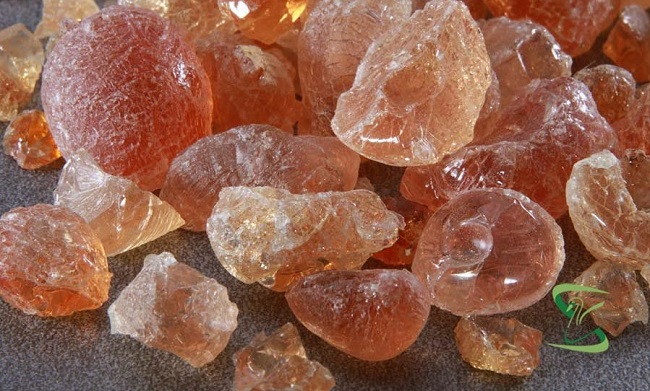
Gum arabic lumps
Gum arabic lumps

Prof. Alex Akpa, the acting Director-General of NABDA, said this at the 1st National Gum Arabic Biosciences and Biotechnology Stakeholders Session on Monday, January 21, 2019 in Abuja.

The theme of the session was “Sustainable Exploitation of Gum Arabic for Socio-economic Development of Nigeria’’ which had in attendance experts from fields such as genomics, phylogeny, agronomy and related areas.

According to him, the goal of the session is to aggregate the perspectives and research results of experts in the fields on the best approach to carry out the exploration and exploitation for gum arabic for socio-economic development.

He said that “potentially, gum Arabic is an export crop that can add value to various sectors of Nigeria’s economy, most especially in the food industry, biomedicine and afforestation, thereby contributing to national Gross Domestic Products (GDP).

“Gum arabic is one of the most important crops in the mitigation of climate, hence the priority needs for its massive cultivation in strategic areas of the country at the time in our history.

“NABDA is positioned to lead the use of biotechnological tools in developing a sustainable value chain of the crop for improved productivity.

“Specifically, shortening the maturity age of the crop, massive production of the seedling using tissue culture, enhancing the quality of the product at molecular level, phylogenetic studies, among others, shall be our priorities.’’

Akpa said that the engagement was expected to lead to the development of actionable work plans on the crop to the benefit of the nation at large.

Dr Nasiru Ibrahim, the acting Director, Agricultural Biotechnology Department, NABDA, said that the meeting was to get all those involved in one way or the other in the field to make impactful inputs that would lead to sustainable research and development of the crop.

He added that gum arabic tree, otherwise known as Desert Gold, was native to Africa and Nigeria was the second largest producer of the crop in the world.

He said: “Gum arabic is used as an additive in beverages, flavour and pharmaceutical companies, textiles, lithography, candy, tannaries, among others.’’

The director, who said that research and development of the crop was only done through traditional improvement methods, noted that successive efforts at harnessing its production and development by the Federal Government went as far back as the times of Late former President Shehu Shagari “with little to show for it.’’

Ibrahim, however, said that NABDA had commenced molecular authentication studies which necessitated the gathering of the experts, both private and in the public sector to make inputs on the way forward.

The National President of Genetics Society of Nigeria, Prof. Kwon Ndong in his paper presentation titled “Beneficial Potential of Biotechnology for gum arabic Seed and Variety Development’’ said all the challenges foreseen in the development of the crop could constitute a research focus.

He added that such focus could be a roadmap for sustainable exploitation of Nigerian gum Arabic for socio-economic development.

Experts who attended the session included Mr Adeleke Ademuyiwa, representive of the Director, Development Finance Department of CBN, Prof. Abubakar Gidado from the North East Technology Centre of Excellence in Maiduguri, Prof. Muhammed Ishiaku from Inistitute of Agricultural Research, ABU, Zaria, and Dr Kenneth Omokhafe from Rubber Research Institute, Benin City.

By Perpetua Onuegbu

Environmentalist wants religious bodies, communities involved in Niger Delta clean-up

0

The Secretary-General, Alliance of Religions and Conservation (ARC) in the UK, Mr Martin Palmer, has said that religious bodies and communities should be involved in cleaning-up of the Niger Delta environment.

Oil spill pollution
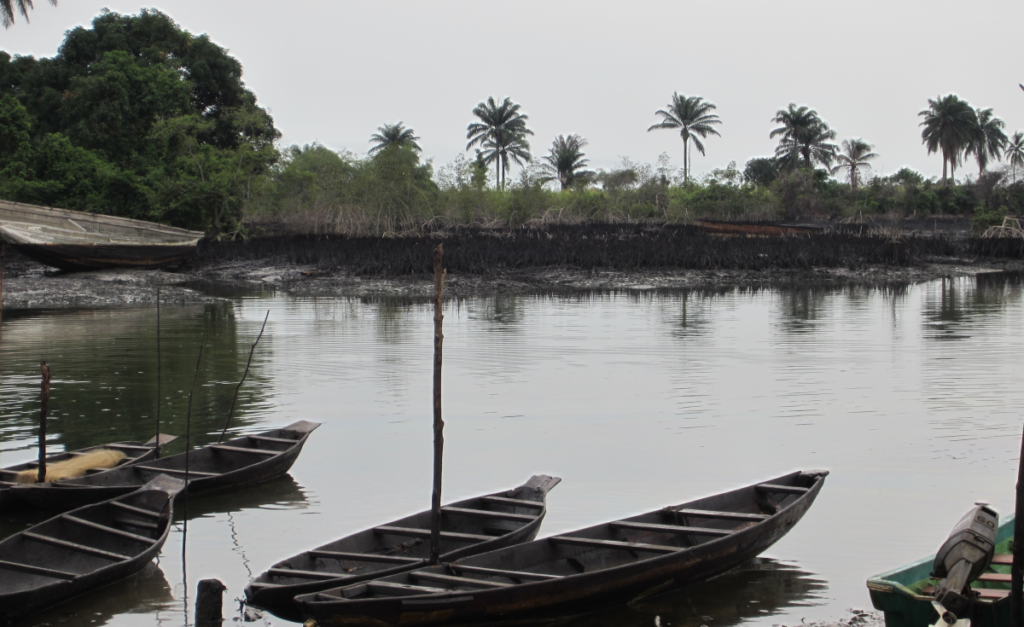
A water body in the Niger Delta polluted by crude oil

Palmer told the News Agency of Nigeria (NAN) in Lagos that it was appropriate for religious bodies and communities to work with the governments and oil companies for lasting solution to the Niger Delta environmental degradation.

According to him, the Niger Delta environmental degradation through oil spillage is a massive problem that has not been experienced anywhere in the world.

“There is a lot of work to be done in restoring the Niger Delta environment where oil spillage has rendered the communities, farm lands and aquatic lives useless.

“It is time the population tackle the problem directly.

“The religious bodies in the area can lead the environmental restoration by holding accountable the oil and chemical companies indicted to clean-up the mess they have created over the years.

“They should also encourage the communities and the companies to invest more in environmentally-friendly developments,’’ the ARC scribe said.

He said that the religious bodies could also encourage investments in fossil fuel than in petrochemicals.

According to Palmer, churches and religious bodies have played a great role in restoring the environment to save human lives, plants and other living creatures over the centuries.

He recalled that during the Roman Empire, the Catholic Church through the Benedictines restored balance in Italy’s degraded environment by reintroducing organic farming and allowing farmlands to rest.

He added that the Moslem unions in Indonesia had used religion to bring balance in their environment, while the Buddhists had also used it to bring order to the Mongolia environment.

The ARC scribe said that religious bodies should not leave the restoration of the Niger Delta to the government alone, adding that their presence would speed up whatever remedial actions that had been put in place.

He stated that the Niger Delta was not just home for humans and the companies but was also home to the various eco and bio diversities, aquatic lives, plants and animals, all depend on the environment.

Palmer said that God had placed the people there to protect and look after all the living creatures, and not just themselves. 

By Chidinma Agu

Hot foods in polythene bags are contaminated by chemicals, says ecologist

0

An ecologist, Mrs Nnenna Didigu, says hot foods packaged in polythene bags are harmful to human health because they are usually contaminated with the chemicals used in producing the bags.

Food in polythene bags
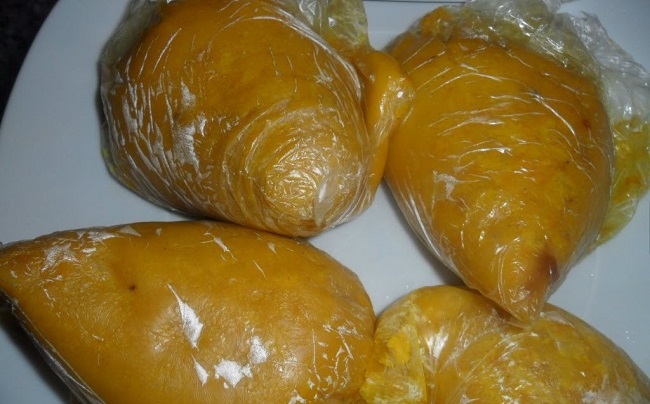
Hot food in polythene bags

Didigu, the Executive Director, Developing Communities for Sustainability Organisation, an NGO, told the News Agency of Nigeria (NAN) in Abuja on Monday, January 21, 2019.

“Prolific use of polythene bags for packaging hot food items is not only harmful to the people but also to our environment.

“There are various chemicals disseminated from plastic bags like polyvinyl chloride.

“Hot foods packaged in polythene bags are contaminated by these chemicals mostly when they are hot or heated.

“Those chemicals include styrene and bisphenol-A which can cause cancer, heart diseases and harm the reproductive problems,’’ she said.

According to her, the number of people suffering from kidney and throat ailments, cancer and infertility is on the increase in the country.

“The rise in such cases is attributed largely to people eating hot food items carried in polythene or plastic bags.

“When hot food is packed in polythene and plastics, chemical exchange between plastic and food is maximised by high temperature and the nature of the food.

“There have been cases of environmental pollution as a result of used non-degradable polythene materials littered over the places, especially in city centres,’’ Didigu said.

Didigu said that some experts in the health sector revealed that beans meal or “moi-moi’’ wrapped in polythene bag is poisonous.

“Because the bag contains large dosage of dioxins that do not naturally exist in the traditional leaves that was hitherto used in wrapping the beans meal.

“Added to this is the consumption of sachet water exposed to sun at over 280C is poisonous and as such has resulted in many cases of kidney and liver failures among Nigerians,’’ she said.

The executive director said that unfortunately, most people consumed foods that were packaged with plastics.

“Plastic plays a part in every phase of food production and preparation.

“Food gets processed on plastic equipment and packaged and shipped in plastic lined boxes and cans.

“At home, we store and reheat leftovers in plastic containers,’’ she said.

According to her, government should intensify efforts to control the problem and conduct awareness programmes against the use of polythene bags for hot food items.

She said that government should adopt best practices of disposal of polythene bags and other plastic materials.

“This can be done through strategic engagements with civil society organisations and non-governmental organisations whose mandate is on sustainable environmental practices and community development,’’ she said. 

By Deji Abdulwahab

Nigeria to generate 30 megawatts from coal in 2020

0

Nigeria is on course to generating 30 megawatts of electricity from coal in 2020, the Ministry of Mines and Steel Development has announced.

coal-plant
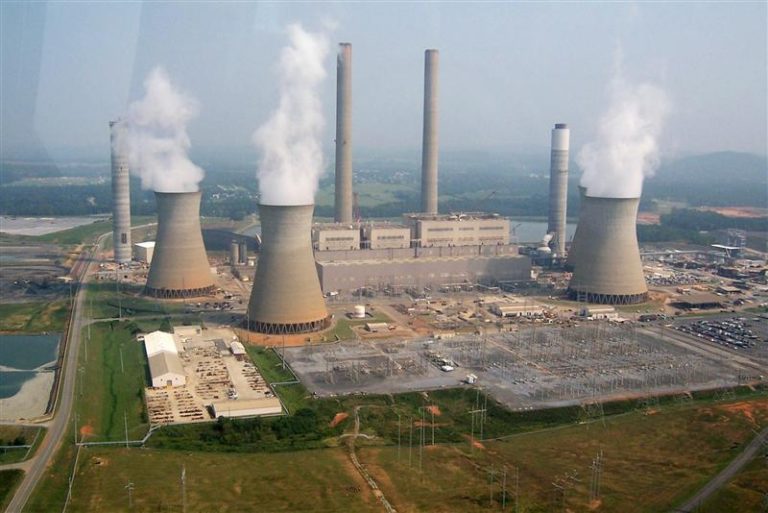
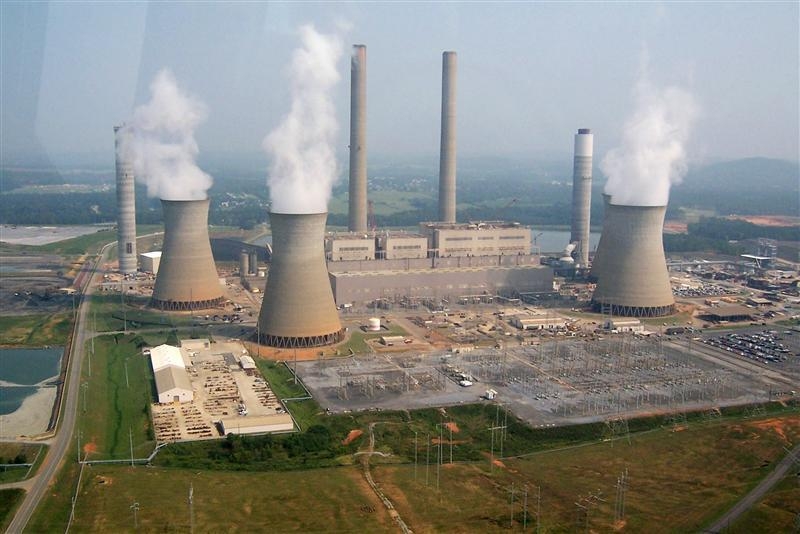
A power plant fired by coal

The ministry made the announcement in a document released by the Minister of State in the ministry, Alhaji Abubakar Bwari, given to reporters in Abuja on Sunday, January 20, 2019.

Bwari said that the power would be generated because Nigeria has more than 2.7 billion tonnes of coal deposits.

“Nigerian coal reserves are estimated at over 2.7 billion tonnes out of which about 650 million tonnes are proven,” he said.

He added that available data suggested that there were coal deposits on more than 22 coal fields in 16 states of the federation.

According to him, a project delivery team has been inaugurated for the concession of the remaining five coal blocks of the Nigerian Coal Corporation, adding that this will be done through a competitive bidding process.

On the Ease of Doing Business in the mining sector, Bwari said that the ministry had taken appropriate steps to improve Nigeria’s ranking in the World Bank Ease-of-Doing-Business Index.

“In line with the Federal Government’s focus on making it easier to do business in the sector, we have continued to address issues towards achieving a decent ranking in the Fraser’s Investment Attractiveness Index,” said Bwari.

By Francisca Oluyole

New €1bn Senegal express train cuts travel time in capital

0

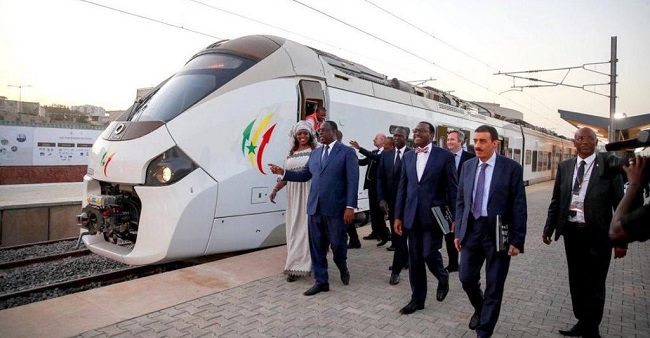
The daily one-hour commute between the densely populated Senegalese capital and the new suburb of Diamniadio will soon be cut in half when the new Regional Express Train (TER) comes into service.

Regional Express Train
Senegalese President Macky Sall, AfDB President Akinwumi Adesina, and other dignitaries during the official ceremony for the handover of the first coaches for the Regional Express Train in Dakar

With a population of approximately three million, Dakar is home to 25% of Senegal’s total population. An efficient, safe and fast mass transit system has been described as a strategic response to the development challenges of the Senegalese capital.

The TER route will link Dakar with the Blaise Diagne International Airport, via the new rapidly developing business centre of Diamniadio. The first phase of the €1 billion project received funding from the African Development Bank, the Islamic Development Bank, the French Agency for Development, the French Treasury and Senegal.

Senegal is the second country in West Africa, after Nigeria, to adopt a dual-mode (electric and diesel) mass rail transit system. When the Regional Express Railway becomes fully operational, it will take just 35 minutes to travel from Dakar to Diamniadio, half the time the 55-kilometre road trip currently takes during peak traffic hours.

Work on the second phase, linking Diamniadio with Blaise Diagne International Airport, will start immediately after completion of the first section in June 2019.

At an official ceremony for the handover of the first coaches for the railway on Monday, January 14, 2019, Senegalese President Macky Sall remarked: “This is the first railway project in an independent Senegal after the Dakar-Rufisque line was built in 1883.”

“We chose to position ourselves at the forefront of progress, right from the invitation to tender for the TER. Every carriage in this dual-mode electro-diesel train has air-conditioning and Wi-Fi. The people of Senegal deserve to travel in comfort and safety, and to save both time and money,” Sall said.

President of the African Development Bank (AfDB), Akinwumi Adesina, said: “This outstanding and transformative railway project makes Senegal a pioneer in the development of modern high-speed urban transport systems in West Africa.”

“This is the largest-ever investment by the Islamic Development Bank in a sub-Saharan Africa project, and it bears witness to our confidence in the country,” said Islamic Development Bank President, Bandar Al Hajjar.

Speaking at the event, French Secretary of State in the Ministry of European and Foreign Affairs, Jean-Baptiste Lemoyne, said: “Senegal is a model of emergence. With this train link, you have shown that ‘impossible’ is not in the Senegalese vocabulary. What the people of Senegal have now, is an advanced Regional Express Train that is on the cutting edge of technology.”

The AfDB says it is committed to strengthening urban connectivity and financing road networks and public transport infrastructure. It adds that since it started operations in Senegal in 1972, it has supported 108 operations with an estimated value of $2.9 billion.

SDGs: Nile University hosts training programme for students

0

Educational institutions are well positioned to communicate the United Nations’ Sustainable Development Goals, especially among young people. Nigerian universities, when they accept this responsibility, can play a central role in promoting the Global Goals to deliver a better, more sustainable future for all.

SDGs4Uni
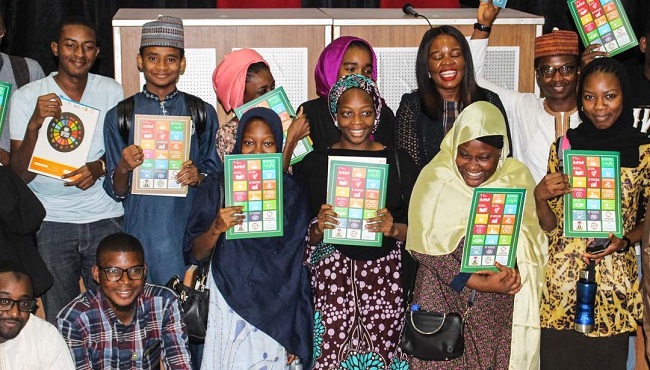
Some of the participants at the training

On Tuesday, January 15, 2019, the International Climate Change Development Initiative through her SDGs4Universities programme trained 70 selected students from the Nile University, Abuja. The programme, which held at the Conference Hall of the university, was targeted to introduce the United Nations’ Sustainable Development Goals (SDGs) framework to young students across African universities and more specifically to engage them to take tailored, innovative actions in their local community that have the potentials to birth global transformation.

According to the Director of Student Affairs, Nile University, Mrs. Aleshinloye, “We believe the Sustainable Development Goals will expose our students to understand how they can make social impacts beyond educational knowledge, as well as, interact with other young people doing amazing things in their communities. Our university will always welcome opportunities like this that helps us to amplify our efforts towards sustainability and sharing best practices to inspire students to implement their own plans.”

Making a presentation at the SDGs4Universities, Semiye Michael, one of 2018 United Nations Goalkeeper and the co-founder of DEAN Initiative, shared with the students present some of his solution-based actions towards driving the SDGs in Nigeria. Another speaker, Rita Idehai, explained how students can identify some social challenges prevalent in Nigerian universities, and what measures the students can take to bring about solutions.

Rose Keffas, a special adviser to Princess Adejoke Adefulire, the Senior Special Assistant to the President, from the Office of the Senior Special Assistant to the President on the SDGs, inaugurated a 20-man SDGs Ambassador group. This group of students will be further trained and equipped on ways of better advancing the Sustainable Development Goals in Nile University, demanding accountability from government and creating solutions to social challenges.

SDGs4University project coordinator, Seyifunmi Adebote, said: “We are taking this project to many other universities across Nigeria to promote knowledge and action about the Global Goals among young people in Universities across Nigeria – private and public.”

By ‘Seyifunmi Adebote, Abuja

Flood, gridlock as Lagos records first rainfall in 2019

0

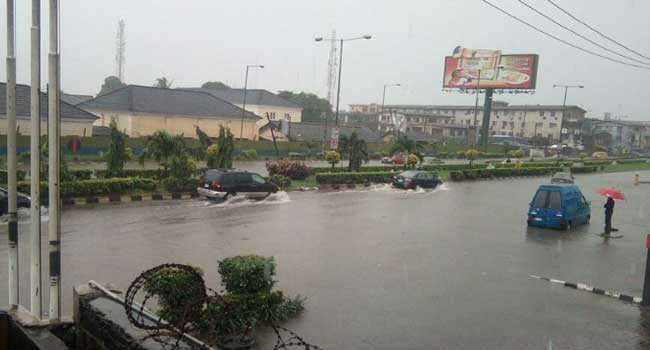
Heavy flash floods and traffic gridlock were the aftermath of the first rain of 2019 in Lagos on Sunday, January 20, 2019. Starting at about 12:30pm, the rain lasted for about an hour and half.

Lagos flood
Flooding in Lagos

It was preceded by a heavy wind and cloudy atmosphere. The rain reportedly touched almost every nook and cranny of the state.

Many residents heaved a sigh of relief due to the harsh weather experienced since the yuletide season. Some described the rain as a sign of good things to come in the year.

Mrs Laide Abayomi, a hair stylist, told NAN that the rain was long overdue.

“We thank God for the rain, though we have been expecting it since last week when other states were experiencing there own.

“The weather pattern has also changed, everything now has changed, even the harmattan started late. We pray the rain brings good increase in our agricultural sector,” Abayomi said.

Mr Akinyemi Badmus, a transporter said the first rain of the year was a sign of blessing.

“I never knew it will come today (Sunday). It has really affected my business as the roads are blocked.

“I want to advice that government should prepare for the rainy season so that we will not be caught unawares when heavy rain comes.

“I ply Yaba route but since the rain started around mid-day, I couldn’t make any fast trip due to the blocked drains along that axis to Ojuelegba.

“Let the Ministry of Environment start work, all the gutters, drainages and roads are blocked,” Badmus said.

Mr Kay Shittu, a resident around Mile 12 area of lkosi/Isheri Local Council Development Area (LCDA), said he was happy to witness the first rain of the year.

“Although there was no sign that it would rain in the morning, I got drenched when it poured and was happy.

“The heat has been too much of recent, especially with the epileptic power supply.

“I know this night would be a bit cool for me to have a sound sleep,” he said.

Mrs Augustina Ekwe, a resident of Ikorodu area, said that the rain was good.

“I was at the Ikorodu Bus stop waiting for vehicle to board to Ketu when I observed that the weather was cloudy.

“Thank God l boarded a vehicle before the rain started.

“I like it. The rain is very good for everybody generally.

“This is January and with such a heavy rain, it shows a sign of good things to happen in the new year,” she said.

Mr Johnson Bola, a trader at Ikosi/Ketu Jakande Fruit Market, said the first rain was okay, but it should have fallen at night.

“Yes, the rain was a downpour. I wished it had fallen in the night.

“Now the market is flooded and full of dirt and muddy water.

“It is good as it fell and stopped. No drizzling, no intermittent falling of the rain.

“As the first rain of the year, l am happy. It had been hot, and at least it will make everywhere cool for a while,” he said.

Efforts to reach the Lagos NiMet Director, Mr Peter Odjugo, proved abortive as his number “was not reachable”.

Places like Akerele, Idi-Araba Road, Lawanson/Itire Road, and Ogulana Drive experienced heavy flood, while some residents were seen clearing the gutters by their houses. 

Agency to disburse N200m to 2018 flood-ravaged communities in Kogi

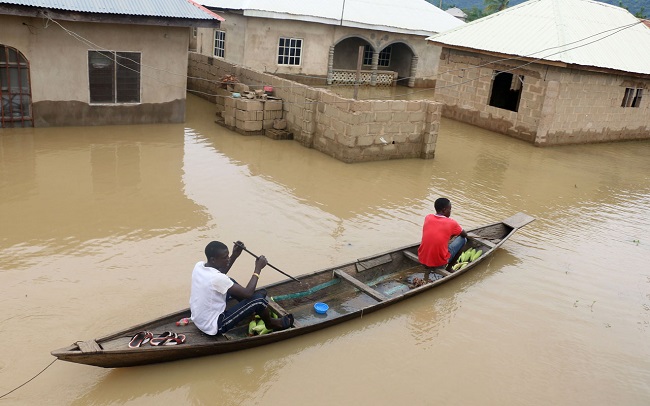
Kogi State Community and Social Development Agency (CSDA) says it will soon disburse about N200 million to support communities in nine Local Government Areas of the state ravaged by flood water in 2018.

Nigeria flood
Residents steer a dugout canoe past flooded houses following heavy rain in the Nigerian town of Lokoja, in Kogi State, on September 14, 2018. Photo credit: AFP / Sodiq Adelakun

Mr Abdulkareem Obaje, National Coordinator, CSDP Nigeria, disclosed this in an interview with the News Agency of Nigeria (NAN) after a “Thematic visit” to the state office of the project on Saturday, January 19, 2019 in Lokoja, the state capital.

Obaje said the fund would be disbursed under the “Flooded Communities Response Plan” to support flooded communities in the nine local governments to get back to their livelihood and continue living their lives.

“There is a special funding this year (2019) called Flooded Communities Response Plan and about N200 million would be disbursed to the Kogi CSDA.

“It is meant to support communities such as Ibaji Local Government and others,” he said.

The national coordinator said after the general lull in activities at the state CSDA over the last two years which he attributed to “procedural issues with the former management”, the agency was fully back on stream.

“We expect that before the middle of this year, the current restriction on approval of new Community Development Projects (CDPs) would be lifted.

“This is necessary so that the agency can go ahead, full blast to start implementing and awarding more projects to poor communities in the state.

“One thing that we expect in the immediate is a fast-track completion of the micro projects that have been approved by the state agency.

“Community Driven Development (CDD) is the way to go to alleviate poverty of poor masses in our communities,” Obaje said.

Malam Momoh Dauda, General Manager of the state CSDA, who also spoke with NAN, said the agency had commenced implementation of Micro Projects.

The general manager said 62 micro projects were rolled over from 2018 for completion this year, adding that the third and last tranche for 26 of the projects had been released.

“The World Bank is ready to fund us, and we are ready to go and hopefully, by the first week of March, all the projects would have attained 70 to 80 per cent completion.

“We are also ready to come up with new CDPs.

“By first week of April, we would have sealed up new CDPs for all the seven focal Local Governments that we are going to intervene this year.

“However, we have a limitation to the number of CDPs that we can do. We are also going to add 17 CDPs making about 42 additional micro projects and by June, we should request for more,” Dauda said.

By Friday Idachaba

Nothing to fear about eclipse – Scientists

0

Astronomy and astrophysics researchers at the University of Nigeria, Nsukka (UNN) in Enugu State said on Saturday, January 19, 2019 that there was nothing to fear over the expected total lunar eclipse on Monday.

Lunar eclipse
Lunar eclipse

The researchers said eclipse is a natural occurrence that helps scientists understand the celestial body.

The scientists made the remarks in separate telephone interviews with the News Agency of Nigeria (NAN) in Abuja.

One of them, Dr Bonaventure Okere, while reacting to the lunar eclipse expected to take place on Monday, said some people still misunderstood the natural occurrence.

Okere, who is also the Acting Director, Centre for Basic Space Science (CBSS) Nsukka, said some people still attach spiritual meanings to eclipse which should not be so.

Lunar eclipse occurs when the moon appears darkened as it passes into the earth’s shadow and occurs only when the sun, earth and moon were exactly aligned with the earth between the two.

It can occur only on the night of a full moon. The type and length of a lunar eclipse depend on the moon’s proximity to either node of its orbit.

The National Space Research and Development Agency (NASRDA) predicted that Nigeria would experience total lunar eclipse on Monday.

Okere said: “For the scientists, eclipse helps them to study and understand the shape of the celestial bodies but for the lay man, it is just to demystify some myths.

“Some people attach some spiritual meanings to it which is not meant to be.

“Some people may see it and think that the world is coming to an end. We create the awareness to sensitise people that it is not something to be frightened about.

“People should understand that a lot of things happen naturally, and it is the scientist who is left to inform people about such occurrence”.

He said that the total lunar eclipse would be the last eclipse to be experienced until 2021.

Prof. Augustine Ubachukwu, leader of the researchers, said unlike solar eclipse, which occurs when the moon completely covers the sun’s disk, lunar eclipse was safe to view.

Ubachukwu said: “People can view the lunar eclipse without any eye protection or special precautions, as they are dimmer than the full moon.”

According to him, the total phase of this total lunar eclipse will be visible from North and South America, and Western parts of Europe and Africa.

“Central and Eastern Africa, Europe, and Asia will see a partial eclipse of the Moon.

“The lunar eclipse begins at 3:36 a.m. early Monday and last until 8:48 a.m., starting and ending as the moon passes through the penumbra (the lighter part) of the earth’s shadow”.

The team leader said the whole duration of the eclipse would be one hour, one minute and 58 seconds.

He further said the whole process would include partial eclipse initially, full eclipse, maximum eclipse, full eclipse again, moon set and ending with a partial eclipse.

Ubachukwu also said people should not be scared, as the eclipse was one of creation’s mysteries. 

By Ijeoma Olorunfemi