Home Blog Page 1717

Nigeria’s wildlife trade and threats to conservation

0

“I am a hunter, I supply fresh wild animals like pangolins, big snakes, antelopes, wild cats, etc.”

This tweet on January 15, 2019, by Onayemi Temitope (@trotsky27), generated a massive online buzz, especially on Twitter where it had over 5,000 engagements. Many called out this young man and labelled his action “wicked” and “punishable”, while others praised him highly for his courage and bravery.
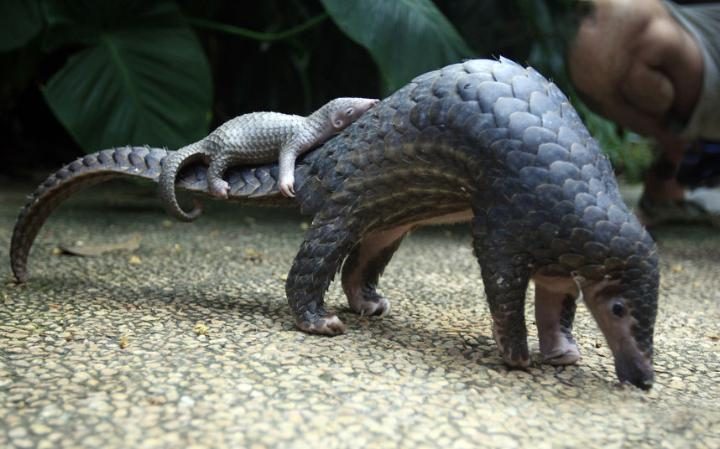
pangolins
The Pangolin

No doubt, wildlife trade remains a very controversial subject on the African continent, perhaps across the world. World Economic Forum asserts that with an annual upper income of $23 billion, wildlife trade is the fourth most lucrative global crime after drugs, humans and arms. While the Convention on International Trade in Endangered Species of Wild Fauna and Flora (CITES) is clear about international trade, with emphasis on sustainability, we must further accept that poaching of wildlife resources in Nigeria is largely unchecked, contributing to Nigeria’s rapid biodiversity loss.

While some very wealthy folks and greedy businessmen are keen on exploiting these resources at the expense of sustainability, the hunters – mostly stack illiterate in local communities – are paid only 3% of the total income, just enough to keep them poor and fuel their thirst to hunt more fauna.

Having carried out numerous wildlife field studies, first-hand interviews with hunters and with a few publications about wildlife – education, trade and conservation in Nigeria, I found Mr. Onayemi Temitope’s case completely different. Onayemi Temitope Timothy is a graduate of Sociology and Anthropology from the University of Benin, with a second degree (Masters) in Sociology (Major – Criminology) from the University of Ibadan. Four years after his graduation, having remained unemployed, Temitope took to wildlife hunting and trading, first as a recreative activity, then as a source of financial stability.

I asked Temitope how often he hunts and what his average kill rate is. “Presently, I don’t really live in Sagamu (the hunting location) but any time I am around, I’ll go hunting with other people. I can’t put a figure to an average kill rate, especially because I don’t hunt every day. The truth is that the recent kill rate has greatly declined and is now typically very low. Sometimes we can get just one snake, sometimes, one Pangolin or just one grass cutter. There are times we don’t even come across any at all,” he replied.

Education is the bedrock of human actions and it snowballs into our actions and inactions. At Wildlife of Africa Conservation Initiative, my team and I have always laid emphasis on Wildlife Education and Conservation using various platforms, formal (schools and universities), informal (communities, social and religious groups) and online advocacy.

My chat with Temitope was very insightful, I was least surprised when Mr. Temitope truthfully confided that, before now, it never felt awkward hunting wild animals – endangered species inclusive.

“Till recently, I never knew most of those animals are endangered, threatened or vulnerable. I used to believe that if humans don’t kill them, higher mammals will or they will just die a natural death and since they procreate more than humans, we cannot exhaust them. It was the Twitter response after my tweet that made me know Pangolins are endangered species. I also got to know some wild animals were of concern to the Federal Ministry of Environment, the Nigerian National Park and State Governments,” he said.

Mr. Felix Abayomi of Wildlife of Africa Conservation Initiative also explained the roles of CITES and IUCN list. His words: “Now, I see things in a different light. Ever since, I have tried to protect Pangolins, as well as other wildlife species. Today, I can tell the difference between conserving and hunting and I am able to create a balance and educate others too.”

In Nigeria, as with other developing countries, the present needs of the people come first and “availability is affordability”. Hence, prioritising the conservation of Nigeria’s wildlife resource would mean a series of inputs.

As a member state, Nigeria would have to revisit and adopt Convention on International Trade in Endangered Species (CITES) guidelines; interest stakeholders, development partners and private sectors will consistently have to lobby and influence the government’s political will at all levels; most importantly, there is a striking need to provide lots of other environmental-friendly economic options/job opportunities that could convert poachers and hunters to conservationists and researchers.

By ‘Seyifunmi Adebote
Biosafety agency reaffirms commitment to safety in regulating GMOs

0

The Director General/CEO, National Biosafety Management Agency (NBMA), Dr. Rufus Ebegba, has reiterated the agency’s commitment to put safety first in the regulation of genetically modified organisms (GMOs) in Nigeria.

NBMA Staff
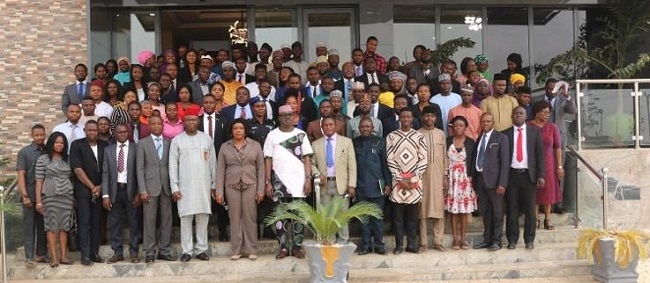
Staff of the National Biosafety Management Agency at the workshop

He stated this while declaring open a one-day training workshop organised for the staff of the NBMA. 

Dr. Ebegba stressed that government deemed it fit to establish NBMA to save Nigeria from becoming a dumping ground for unregulated GMOs and their by-products with the state-of-the-art GMO Detection and Analysis Laboratory of the NBMA ensuring that proper safety analysis is carried on GMOs.

He described the Nigerian biosafety system as the best in Africa as, according to him, government has resolved to exploit the potentials of modern technology with a proper regulatory mechanism in place to safeguard human health, environment and biodiversity from potential adverse impact.

Director, Environmental Biosafety and General Release of the Agency, Ms. Nzeduru Chinyere, in her presentation titled “Biosafety and Biotechnology in Nigeria”, noted that biotechnology is as old as man. She states that, prior to modern biotechnology, humans modified plants traditionally.

“Modern biotechnology is an improvement on the traditional modification of organisms and there is need to regulate this practice,” she stressed, noting that no commercial release can be done without proper risk assessment of the genetically modified product to guarantee its safety.

Head of Planning Research and Statistics, NBMA, Mrs. Bello Scholastica, reaffirmed that Nigeria is ranked high in GM regulation in Africa. She noted that government has put in place the necessary legal framework to regulate modern biotechnology and that, with this, the agency will not condone breach of law by individuals or organisations to trade in GMOs without a Biosafety Permit from NBMA.

Head of the Legal Unit of the agency, Mrs. Onyilofor-Aja Nkiruka, in a paper presentation titled “The Cartagena Protocol and the NBMA Act 2015”, stated that the Cartagena Protocol signed by Nigeria, as well as 194 other countries, aims to safeguard human health and environment from any unintended risks that could result from the practice of modern biotechnology. She also added that Nigeria has made great strides in the domestication of the protocol.

The daylong forum, it was gathered, was organised as part of government’s efforts to strengthen the Nigerian biosafety system to ensure proper regulation in the field of safe transfer, handling and use of GMOs.

AU, AfDB launch scorecard to track nutrition progress

0

The African Union Commission, the African Development Bank and global partners on Monday, February 11, 2019 launched the Continental Nutrition Accountability Scorecard to raise awareness and reinforce commitments by African governments to help end malnutrition.

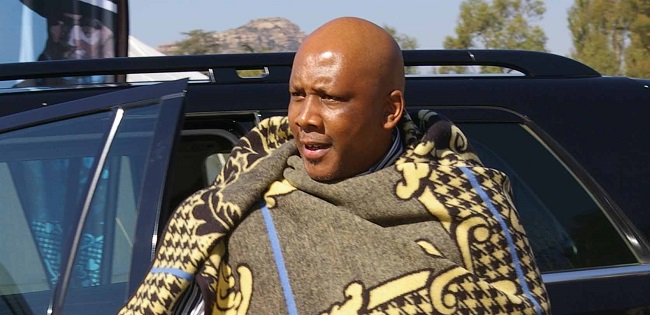
King Letsie III
King Letsie III of the Kingdom of Lesotho

King Letsie III of the Kingdom of Lesotho and African Union Champion for Nutrition, and Dr. Akinwumi A. Adesina, President of the African Development Bank (AfDB) co-hosted the scorecard launch on the sidelines of the 32nd Ordinary Session of the Assembly of Heads of State and Government of the African Union in Addis Ababa, Ethiopia.

“The nutrition accountability scorecard offers an opportunity to lay a solid foundation to aid African leaders to act strategically and deliberately in implementing policies and investing in nutrition programmes that tackle malnutrition in our respective countries,” King Letsie III told attendees.

“As responsible leaders, the onus is on us to take action for the wellbeing of the African people. We need to take appropriate and decisive actions now rather than later,” he added.

In attendance were Dr. Mokgweetsi Eric Keabetswe Masisi, President of the Republic of Botswana, members of the diplomatic corps, health ministers from Malawi, Botswana, Kenya, Senegal, Gambia, Ghana, and development partners including FAO, WHO, UNFPA, UNICEF.

In his remarks, President Masisi commended the bank for the initiative. “I am so proud about the African Development Bank’s involvement… the scorecard is an extremely useful tool. It is important to get a continental picture of the state of our nutrition so that we ask ourselves the right questions to make sure we get our priorities right and fix them,” he noted.

The Continental Nutrition Accountability Scorecard is produced by the African Leaders for Nutrition Initiative (ALN), headquartered at the African Development Bank, in collaboration with ALN’s partners including the Global Panel on Agriculture and Food Systems for Nutrition, and the Bill and Melinda Gates Foundation.

“We must change how we look at the problem of malnutrition. The greatest contributor to economic growth is not physical infrastructure but brainpower, what I refer to as “grey matter infrastructure”. While it is obvious that a road and a port can add to improved trade and economic growth, it is often not recognized that stunting shrinks the size of the brain and therefore compromises the current and future economic growth of nations,” said Adesina.

Africa remains the only continent with high levels of malnutrition and suffers slow progress to reverse the situation in comparison to the rest of the world. United Nations data indicate the number of stunted children in Africa increased sharply from 50.6 million in the year 2000 to 58.7 million in 2017. A growing body of evidence recognizes that malnutrition and economic development are closely interlinked.

Poor nutrition is responsible for stunting children’s growth, harming children’s educational development and future economic prospects.

The scorecard launch presented key findings and recommendations, including calls for governments to increase budgetary allocations for multi-sectoral nutrition plans. The scorecard also calls for the enhanced empowerment of women and adolescent girls and the provision of nutritional support at the most critical time of a child’s life – during pregnancy and early childhood.

The nutrition assessment tool provides a snapshot of the status of key nutrition indicators, including internationally agreed nutrition targets, specific interventions, sensitive interventions, policy and legal provisions, nutrition financing, and socio-economic impacts.

“Over time, the Continental Nutrition Accountability Scorecard will expand in depth, data and usefulness, and will help to identify solutions to mitigate the burden of malnutrition that has impeded the continent for the past few decades,” said Jennifer Blanke, Vice President for Agriculture, Human and Social Development at the African Development Bank.

ALN targets the highest levels of African governments to build advocacy for improving nutrition across the continent. “Let us rise and do the right thing for Africa’s children: secure their future with better nutrition. Let us turn the red colours on these scorecards to green. Let us score goals for nutrition in Africa,” Adesina concluded.

Study says Americans are increasingly ‘alarmed’ about global warming

0

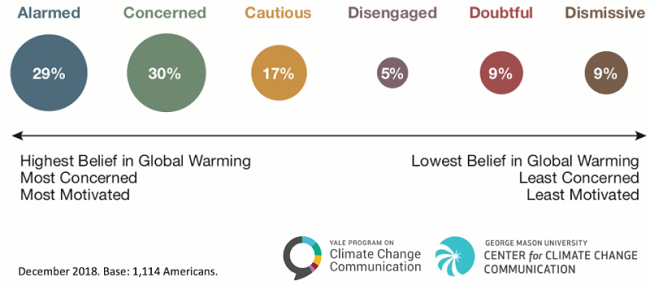
Six in 10 Americans are now either “alarmed” or “concerned” about global warming, a study conducted by the Yale Programme on Climate Change Communication and the George Mason University Centre for Climate Change Communication has found. According to the nationally-representative survey of public opinion conducted from December 2013 to December 2018, the proportion of “alarmed” more than doubled.

Alarmed
The proportion of “alarmed” has more than doubled

A prior research had categorised Americans into six groups – Global Warming’s Six Americas – based on their climate change beliefs, attitudes, and behaviours. The “alarmed” are the most worried about global warming and most supportive of aggressive action to reduce carbon pollution. In contrast, the “dismissive” do not believe global warming is happening or human-caused and strongly oppose climate action.

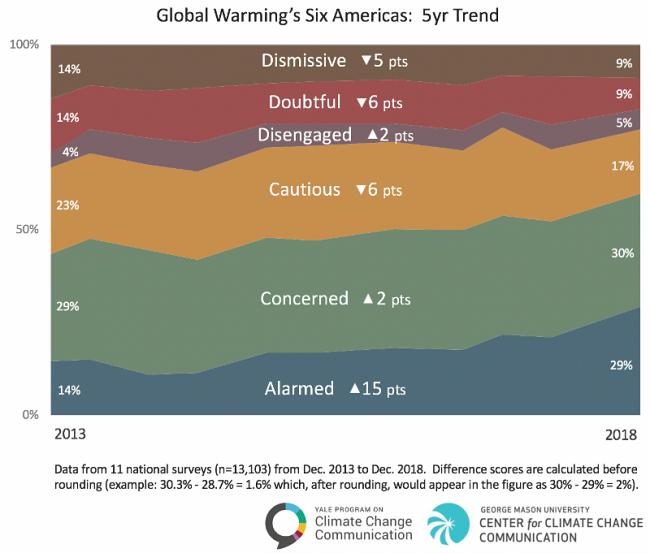
A survey conducted in December 2018 finds that the Alarmed segment is at an all-time high (29%) – which is double that segment’s size in 2013 and an 8-point increase since March 2018. Conversely, the Dismissive (9%) and Doubtful (9%) segments have both decreased over the last five years. The percentage of Americans in these two segments has declined by 12 points since 2013.

Global warming in America
Global warming’s six Americas

Although the size of the Concerned segment has remained relatively consistent since 2013, this doesn’t mean that those who were previously Concerned did not change their minds. Rather, it is likely that many who were previously Concerned became Alarmed, and many who were previously Cautious or Disengaged became Concerned. Over the past five years, the U.S. population as a whole has moved away from the Doubtful and Dismissive segments and toward the Alarmed and Concerned segments.

In 2013, the Alarmed and Dismissive were an equal size at 14% of U.S. adults. As of the end of 2018, however, the Alarmed now outnumber the Dismissive more than 3 to 1 (29% vs. 9%), representing a major shift in these two “issue publics” most engaged in the issue of climate change.

These trends indicate that the political climate of climate change is shifting toward action.

New app supports cookery in climate protection

0

The Government of Germany has endorsed “KlimaTeller”, a new app that enables restaurateurs to estimate the CO2 emissions of their food as well as put together and label climate-friendly menus on this basis.

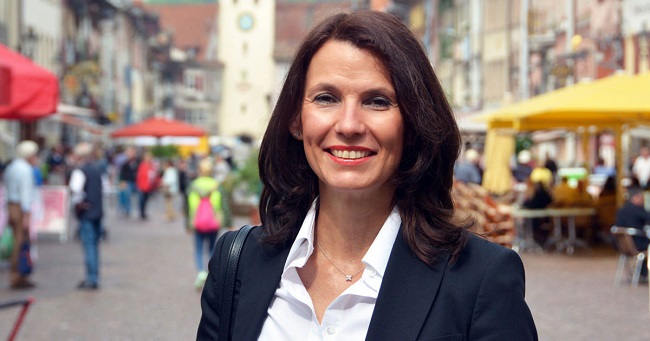
Rita Schwarzelühr-Sutter

The starting signal for the app is given on Tuesday, February 12, 2019 by the Parliamentary State Secretary in the Federal Environment Ministry, Rita Schwarzelühr-Sutter.

The KlimaTeller project, in which the app was developed, is funded by the Federal Ministry for the Environment via the National Climate Initiative (NKI) with around €160,000.

Schwarzelühr-Sutter said: “The KlimaTeller app helps restaurateurs to cook sustainable menus and make this visible to their guests. If you like, you can also cook climate consciously at home. About 15 to 20 percent of all greenhouse gas emissions in Germany can be attributed to our diet. The use of regional and seasonal products is therefore an important building block for climate protection.”

Using the KlimaTeller app, restaurateurs can label their food as a KlimaTeller if the ingredients of a dish in total cause less than 50 percent of the emissions of an average dish. An average dish causes around 1,600 g of CO2 emissions.

With the “KlimaTeller”, every guest knows that with his choice of food, he saves at least 800g CO2 emissions, which is about a five-kilometre drive.

“The KlimaTeller plate helps guests who value seasonal, regional and predominantly vegetarian food to find their way around. This will contribute to the reduction of greenhouse gas emissions,” a source said, adding:

“Around one-fifth of all greenhouse gas emissions in Germany are caused by nutrition. These include, above all, agriculture, processing, trade (including transport) and consumption. With the KlimaTeller we can significantly reduce these emissions and do something actively for climate protection.”

How COP24 helped to close gender gap

0

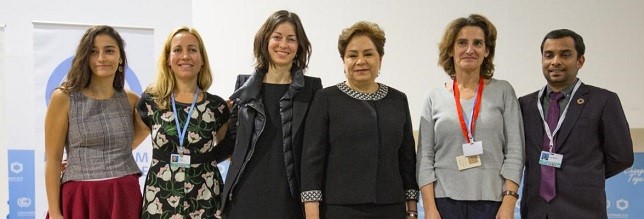
The 24th Session of the Conference of the Parties (COP24) to the UN Framework Convention on Climate Change (UNFCCC) held December 2018 in Katowice, Poland marked the half way point of the two-year UNFCCC Gender Action Plan (GAP) adopted by countries in November 2017. To mark the occasion and to highlight action taken to implement the GAP in 2018, the call to #ActOnTheGAP was launched during COP24 in Katowice.

Gender Action Plan
Momentum is said to be building in support of the Gender Action Plan

From the #ActOnTheGap Action List, which highlighted  side-events that had achieved their commitment to ensuring a gender balanced panel, to the video messages of support and calls for more action – including from incoming COP25 president-designate, Chile’s Environment Minister Carolina Schmidt, Deputy Prime Minister of Ireland Simon Convey, First Minister of Scotland Nicola Sturgeon,  among others – it is clear that momentum is building in support of the Gender Action Plan.

A new format for the annual Gender Day included a dynamic set of events throughout the afternoon in the Action Hub, a Market Place and Exhibition showcasing how countries and organisations are implementing the plan.

High-Level Event explored the issue of access for women in the tech industry, before Momentum for Change Women for Results winners kicked off Gender Day activities at the Action Hub by providing insights into their projects and motivations for their various climate initiatives. Projects ranged from a replantation project in Sri Lanka to a bike project aimed at fighting discrimination against women in Syria.

Discussions continued throughout the afternoon, including a debate on integrating gender into National Adaptation Plans. Gender Day at the Action Hub closed with a poem titled “Rise” by Aka Niviâna and Kathy Jetnil-Kijiner that was a call to action to take environmental responsibility.

A clear message from these activities and exhibits is that when climate solutions are inclusive, women and girls are catalysts of change, delivering more sustainable and effective climate action. A message supported by the Executive Security in her #ActOnTheGAP video “women and girls must be empowered to be agents and leaders of climate action”.

COP24 also saw the first capacity building workshop for National Gender and Climate Change Focal Points, which was held in the inaugural Capacity-Building Hub with over 50 national representatives participating. The capacity building workshop provided delegates with the opportunity to exchange experiences as well as gain knowledge about the policy work that is being carried out on gender and climate change.

The discussions surrounding gender and climate change will not pause after the conference in Katowice, says the UNFCCC, adding that activities at COP24 demonstrated that many countries, organisations and individuals remain committed to achieving gender equality and the empowerment of women and girls through climate action. 

Namibia, others want ban on sale of ivory lifted

0

Namibia on Monday, February 11, 2019 joined South Africa, Zimbabwe and Botswana in calling for the removal of a ban on ivory trade, the country’s Ministry of Environment and Tourism said.

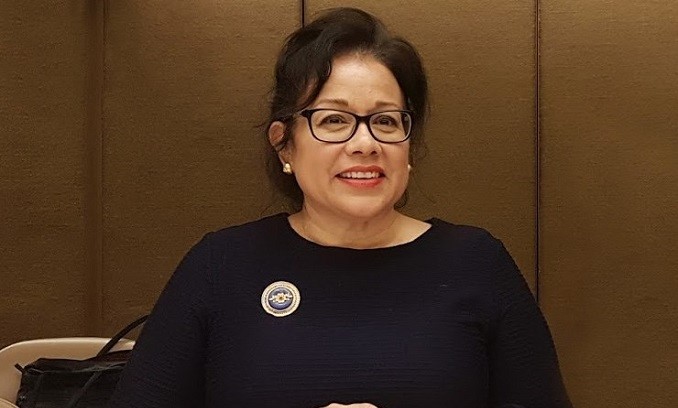
Ms. Ivonne Higuero CITES
CITES Secretary-General, Ivonne Higuero

The three countries that account for 61 per cent of the elephant population in Africa prepared a joint petition to be presented at the forthcoming Convention on International Trade in Endangered Species (CITES) in Sri Lanka in four months.

“CITES has acted as an inhibitor and not an enabler of progress.

“The conference of the parties has repeatedly discounted the importance of the southern African elephant population and its conservation needs against other regions in Africa.

“An end to the ban on ivory sale will give the three countries an opportunity to offload their ivory stockpiles that have been shelved for more than five years,’’ they said.

The countries also argued that they had laid strong modalities through establishment of conservancies that ensure that proceeds of sales from ivory benefit inhabitants in the conservancies financially and also through developmental projects.

“The proponents can no longer accept that their working conservation models are undermined by an international organisation that ostensibly recognises that people and states are.

“They should be the best protectors of their wild life,’’ the petition said. 

Agency says biosafety law can ensure robust food system for nation

0

The Director General/CEO, National Biosafety Management Agency (NBMA), Dr. Rufus Ebegba, has said that the NBMA ACT 2015 is strong enough to ensure a robust biosafety system for Nigeria.

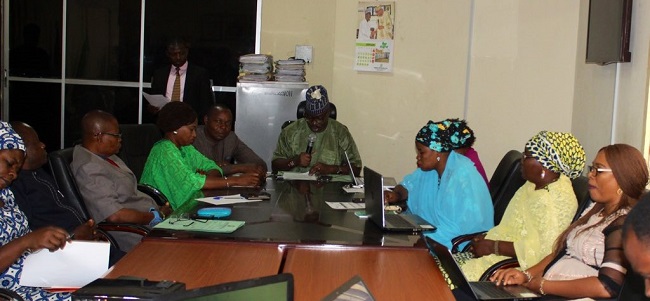
NBMA
Officials of the National Biosafety Management Agency (NBMA) during the meeting with Clerks of the National Assembly

Dr. Ebegba said at an interaction with Clerks of relevant committees of the National Assembly on Monday, February 11, 2019 in Abuja that the Act establishing the agency was not cast in stone, adding that it is a living document that needs to be tested.

The meeting was organised to give Clerks, who are regarded as the engine room of the Assembly, an opportunity to understand the role of NBMA in national development as well as enhance their capacity and understanding on biosafety.

According to him, the sensitisation meeting for the Clerks is an important session which will help to educate them on issues of biosafety because they are permanent staff of National Assembly that advice the legislators.

“This interaction will help them to understand the Laws of Biosafety as well as to help the Agency to initiate amendment of the NBMA Act when necessary,” Ebegba stated.

The DG/CEO appealed to the clerks to continue to exact expedient action on the need to rid the country of unapproved GMOs and ensure that the agency is properly positioned to police any attempt to turn the country into a dumping ground for unregulated GMOs.

In a presentation, Mr. Eric Makwe, Clerk, House of Representatives Committee on Environment and Habitat, narrated the processes of lawmaking in Nigeria and how Acts and other laws of the federation can be amended.

According to him, the Clerks play vital roles in the passage of bills, adding that without vital information and understanding, the clerks will be handicapped when issues of biosafety surface on the floor of the Assembly.

NBMA Director, Environmental Biosafety and General Release, Ms Chinyere Nzeduru, said that the role of the agency is to ensure that the practice of modern biotechnology does not pose any threat to human or the environment.

The interaction, which saw the Clerks visiting the agency’s GMO Detection and Analysis Laboratory, also witnessed the presentation of papers including one on emerging techniques in modern biotechnology and safety techniques by Dr. Mathew Dore, Country Coordinator, Programme for Biosafety Systems (PBS).

Customs gets forensic toolkits to counter illicit wildlife trade

0

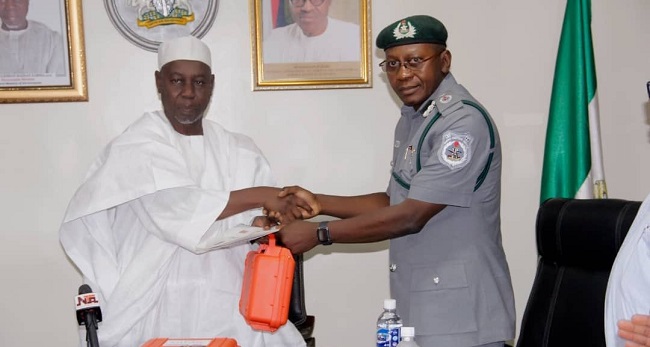
The Minister of Environment, Alhaji Suleiman Zarma, on Monday, February 11, 2019 handed over six forensic toolkits to Nigeria Customs Service (NCS) to detect and identify the source of illegal wildlife trade in the country.

Customs and FME
Minister of Environment, Alhaji Suleiman Zarma (left), handing over the toolkits to the Deputy Comptroller of the Nigeria Customs Service (NCS), Mr Hammi Swomen

Zarma, who gave the toolkits to Deputy Comptroller of NCS, Mr Hammi Swomen, in Abuja, said that the toolkits would also identify the finger prints of those responsible for illegal smuggling of ivory.

He recalled that the International Fund for Animal Welfare (IFAM) presented the toolkits at the International Wildlife Conference on illegal Wildlife Trafficking in October 2018.

“This aims at retrieving finger/palm marks evidence of ivory which has the forensic capability to detect and document finger prints/palms, including source of any person that has come into contact with an ivory illegally traded,’’ he said.

The minister urged Nigeria Customs Service to distribute the toolkits for use at the most susceptible exit points of the nation’s air and sea ports that had been associated with illegal wildlife trade.

He recalled that International trade in ivory was banned in 1989, adding that since then there had been a burgeoning illegal trade which contributed to the depletion of the elephants in the wild.

“I must say that Nigeria has been able to curtail activities of illegal poaching and thus, our elephants in their natural ecosystems are among the most protected in the world.

“Unfortunately, the impact of globalisation has predisposed us to being associated with this illegal trade as the country has become a thriving hub for this illegal export.

“The global community is aware that Nigeria is being used as a transit and it is willing to provide us with all the necessary support to stop these products from transiting through our country,’’ Zarma said.

He, therefore, urged Nigeria Customs Service and other relevant security agencies to plug all loopholes to protect Nigeria from being used as a transit hub.

Responding, Swomen, who said that Nigeria Customs Service would make good use of the toolkits, said that the service would train its staff to know how the toolkits would be handled.

The customs officer, who said that toolkits would be deployed to some nation’s exit points, requested for more toolkits to cover other relevant exits to address illegal wildlife trade and trafficking in the country.

By Deji Abdulwahab

WWF launches effort to halt oil and gas drilling in Greek waters

0

The WWF on Monday, February 11, 2019 published a report on the “Economic impacts of hydrocarbon exploitation in Greece” as part of the launch of its international campaign to halt oil and gas drilling plans in the country. The study, commissioned by WWF and conducted by eftec, finds that a major oil spill in Greece would devastate the country’s tourism and fishing industries, and cost the Greek economy over €7.5 billion.

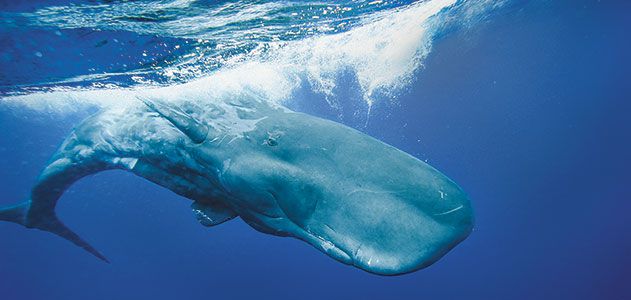
Sperm Whale
The Sperm Whale is a part of the diverse marine life in the Greek waters

The report and international campaign come in response to 25-year concessions being granted for offshore or onshore oil exploration and drilling in a marine and terrestrial area covering almost 75.000 square kilometres, from the North of Corfu to Southern Crete. Oil companies that have agreed concessions include Total, Repsol, Exxon and Eni.

The marine area, which is equal to 30% of the Greek mainland, is characterised by great depths and diverse marine life – including sperm whales, fin whales, Cuvier’s beaked whales, bottlenose dolphins, loggerhead sea turtles and monk seals – while the terrestrial area consists of numerous protected areas of unique ecological importance.

“Not in our worst nightmares would we ever imagine oil and gas rigs just miles off the shores of Crete, Zakynthos, Kefalonia and Corfu, next to loggerhead nesting beaches in the bay of Lagana and Kyparissia or in the pristine landscape of Epirus. Drilling in the very deep waters of Crete and the Ionian Sea poses a lethal threat to this natural paradise and makes no climate or financial sense,” said Dimitris Ibrahim, Marine Officer at WWF-Greece.

WWF’s report is the first ever analysis that forecasts and quantifies the economic impact of a major oil spill in Greece, thus documenting the very real risk of hydrocarbon exploitation. Due to lack of sufficient, available data, the negative impact of an oil spill incident on the environment of Greece, its constituent regions and other vital ecosystem services is not included in the report. However, experience from previous oil spills suggests that including environmental costs could increase the total cost of damage inflicted by 20% – 100%.

Greek tourism, marine ecosystems and local communities are at greatest risk

The report shows tourism is the sector most heavily impacted in the event of an oil spill. In the unfortunate, yet plausible, scenario of a single major oil spill occurring near Crete, the cost could reach €2.2 billion, while up to 45,000 jobs would be lost overnight. A similar event in the Ionian Islands would cost up to €1.78 billion and wipe out up to 25.000 jobs. 

WWF emphasises that the granting of new oil concessions does not align with the fast and deep cuts in greenhouse gas emissions necessary to meet the climate targets of the Paris Agreement and secure a climate safe future. WWF calls on the Greek Government to immediately ban new hydrocarbon exploration and drilling, following the recent examples of Spain, France, Italy, Portugal and New Zealand.

“Drilling in Greek waters places Greece’s marine environment and national economy at risk. An oil spill would have devastating impacts on wildlife, the tourism industry and local communities. The plans also move us further from achieving the climate targets set out under the Paris Agreement. The Greek government needs to immediately withdraw the concessions granted in the area and focus on sustainable development that would be beneficial to Greece and Mediterranean in general,” said Aslihan Tumer, Head of Campaigns at WWF-International.

The WWF also called on Greece’s friends from all over the world to join the campaign and protect the Greek seas, coasts and islands that for decades have been a dream destination for millions of people.