Home Blog Page 1716

Stakeholders call for massive investment in water infrastructure

0

Stakeholders participating in the National Summit on the Human Right to Water in Abuja on Wednesday, January 30, 2019 called for massive investment in water infrastructure by African governments.
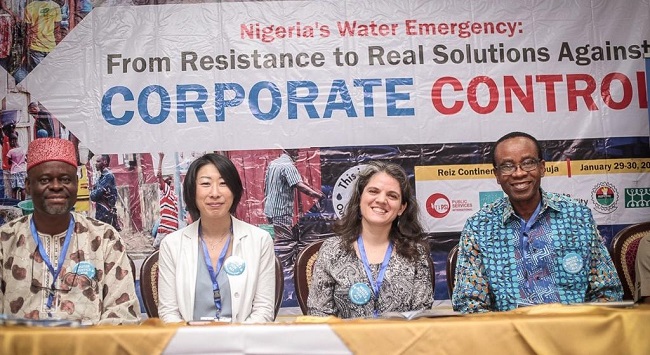
ERA Water Summit
L-R: Dr Otive Igbuzor (keynote speaker), Satoko Kishimoto (Transnational Institute), Shayda Naficy (Corporate Accountability) and Nnimmo Bassey (Chair of the board of ERA) and the summit

The advice, contained in a communiqué issued in Abuja at the end of the summit by the Secretary, Communiqué Committee, Mr Jakpor Philip, disclosed that this would make clean public water available and accessible to the citizens.

The summit was organised by the Environmental Rights Action/Friends of the Earth Nigeria, an NGO, with the theme: “Nigeria’s Water Emergency: From Resistance to Real Solutions against Corporate Control”.

The communiqué said that African governments should invest in public infrastructure and embrace democratic, participatory and transparent management of water investments.

The communiqué underscored the need for comprehensive data on both water infrastructure investment and access to aid planning for now and the future.

It also called for the review of National Water Policy to make it mandatory for all states to collaborate with local governments to ensure adequate funding for water facilities resuscitation.

“The Nigerian government and governments in Africa should reject privatisation projects designed by the World Bank and its corporate partners, including the Public Private Partnership (PPP) success-myth that it is aggressively marketing in developing and poor countries.

“Relevant anti-graft agencies should probe all PPP projects, loans and funding for the existing water system and infrastructure nationwide.

“The Freedom of Information Act (FOI) should be utilised in the public demand of information on funds sourced and approved for public water projects in the last three decades.

“There should be a national agenda for the human right to water, starting with a robust national campaign to demand for a bill that protects against privatisation of water infrastructure.”

The communiqué added that the bill would advance the human right to water.

“Governments in Africa embrace democratic decision-making in addressing water shortages. Women and vulnerable groups should be accorded priority in plans to guarantee access.

“The importance of women’s leadership was shown as vital to the success of this movement.

“Participants agreed wholeheartedly that women’s leadership shall continue to be sustained and bolstered to achieve future victories,” it added.

According to the communiqué, communities at the grassroots level, including Community Development Associations should be fully integrated into campaigns on the human right to water.

By Deji Abdulwahab
We thoroughly scrutinise GMOs before granting permit – Biosafety agency

0

Director-General of the National Biosafety Management Agency (NBMA), Dr Rufus Ebegba, says the agency scrutinises all genetically modified organisms (GMOs) before permission is granted for use.

Dr Rufus Ebegba
Dr Rufus Ebegba

Ebegba said this in a statement on Thursday, July 31, 2019 in Abuja to clarify the process of the recent approval granted for the commercialisation of GMO Cowpea.

He said that the hallmark of the agency’s duties was ensuring safety of genetically modified foods and products to humans and the environment.

“Before any genetically modified product is granted approval status by the agency, two specific committees made up of professionals and experts from the academia, line government agencies, civil society groups and other stakeholders are constituted.

“These committees will painstakingly analyse the application and review the risk management and risk assessment plans before a decision is made.

“When an application either for importation of a GM seed or grain, or for the confined field trial/ commercial release of a crop is made to the agency, it is acknowledged and treated based on the NBMA Act 2015.’’

Ebegba said that public participation in the process of permit granting started with a publication of the application as public notice in three national dailies.

He said that the NBMA website to allowed members of the public to contribute to the discussion which could either be in support or against the application for a period of 21 days.

“The agency finally makes its decision after going through the recommendation of the ad-hoc committees, advising the agency to either grant or deny a permit, considering safety issues to the environment, human health and socio-economic impact.

“The agency does not just process permits but looks critically at the application ensuring that the product does not or will not cause harm before granting approvals.’’

Ebegba said that the permit for the commercial release of the GM cotton was granted in 2016 after due diligence and the product was released under the watchful eyes of the agency.

“And what seemed like a very unpopular decision was applauded by the Ministers of Agriculture and Rural Development, and Science and Technology in a joint press conference two years later.

“The recent approval for the commercial release of GM cowpea went through the same safety procedures, taking into consideration safety of the environment which includes ensuring the conservation and sustainable use of biological diversity.

“And in the area of safety to human health, the agency ensures that GMOs are not toxic to humans and that they do not cause allergies.

He said that the agency would continue to ensure that only safe GMOs would be allowed either for planting, consumption or processing in Nigeria.

“I once more advise super stores that import GM foods without permit to desist from such as we will not hesitate to shut down such stores,’’ he cautioned.

He said that the agency would not hesitate to prosecute any violators of the NBMA Act and advised all those who intended to deal in GMOs to ensure they applied for a biosafety permit first. 

Our children’s planet: What does their education have to do with climate change?

0

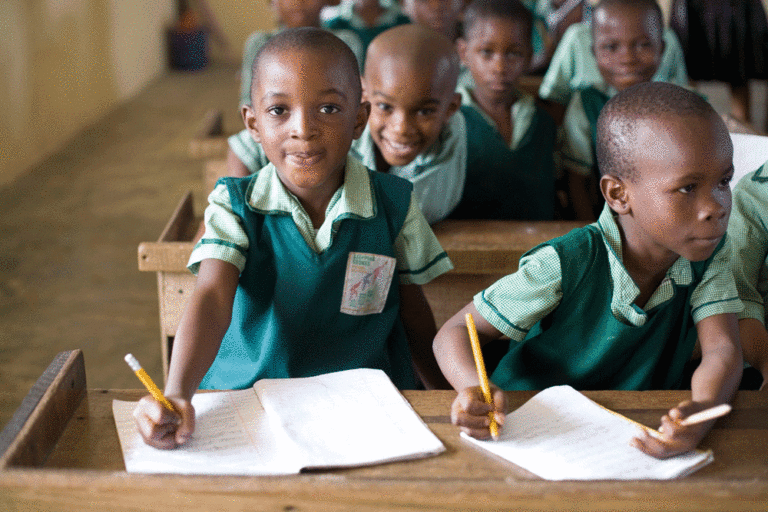
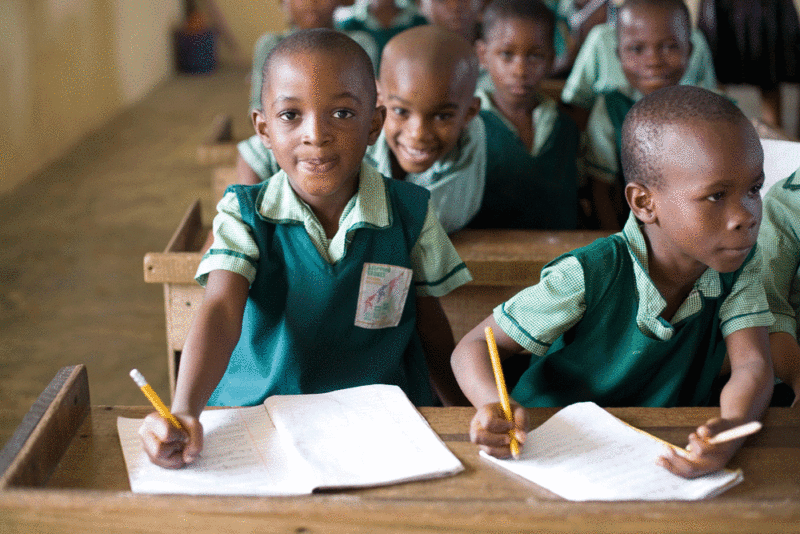
Our world is very different than our grandparent’s. In 1950, there were about 2.5 billion people; today, there are more than 7 billion. Overall, people are healthier, wealthier, and more secure.

School children
School children

But this has come at a cost. The stress on our planet has been immense. Human beings have dramatically altered the climate, changed the chemistry of the oceans, and triggered mass extinctions. The impact has been so great as to define an entirely new geological era – the Anthropocene, turbo charged by a “great acceleration” of population, economic growth and natural resource consumption since the 1950s.

So, what will the world be like for our children? By 2050, the population is projected to top 9 billion. People will probably live better and longer lives. Global GDP will likely triple; natural resource consumption will double. And the effects of climate change – some now inevitable – will be felt more strongly than they are today. Sea levels will be higher, weather more erratic, biodiversity less, and water and natural resources likely scarcer. People who live in poverty will be especially vulnerable to natural disasters, land degradation, water shortages, and shocks in food production.

Can the next generation capture the benefits of growth without the ills? Will technology allow us to decouple growth from natural resource consumption? We can’t say for sure. But we can say that our best bets are human ingenuity, rationality, and values. That comes down to education and the steps we take now to ensure all children are educated and socialised to respect the planet.

Helping with that transition is an especially important challenge for the World Bank because most of the population growth in the coming decades will be in developing countries. By 2050, nearly half of all the world’s youth will live in Africa. And another 40 percent in Asia. Will their education systems prepare the next generation to mitigate and adapt to the changing climate? Can they foster a generation of citizens and policy makers that have the values and skills to manage natural resources sustainably? Will their schools and universities support the science, technology, research and innovation societies will need to cope with climate change?

Climate change is a human-induced problem – in large part a function of the number of people on the planet, their values and skills, and technology. Can education programmes alter the trajectory? Here are some ideas of how:

First, make universal education a matter of urgency. Education change shapes demographic change. Reaching Sustainable Development Goal 4 would likely result in a global population of 8.5 billion in 2050 instead of 9.1 billion. That is because educated women tend to have fewer, healthier, and better educated children themselves. Education also helps people adapt to climate change because it enhances abilities to absorb information, calculate risk, prepare for climate shocks and recover from them.

Second, strengthen STEM education. This will help young people understand physical changes in their environment, and give them the tools they need to invent, innovate, and adopt technology. Let’s aim to cultivate a generation of scientifically literate secondary school graduates. Let’s support technical and vocational education and training systems that train skilled professionals to serve a “green economy”; and universities to produce leaders in the fields of climate science, engineering, natural resource management, and environmental studies.

Third, support environmental education as a standalone subject and/or as a cross-cutting theme in the school curriculum and in teacher training programmes. Cultivate the values and knowledge young people can use to live more sustainable lives – and to live with concern for animals, plants and the world of nature. Stimulate their wonder about the natural world and concern for the health of the planet.

Fourth, build schools that reflect environmental principles – schools that are energy efficient, that spark children’s imagination and use of renewable energy, clean and efficient use of water, and opportunities to interact with the environment. Schools should be strong enough to stand up in extreme weather events, and in high risk areas potentially double as emergency shelters.

In recent decades Korea has emerged as a leading voice on sustainability. It was one of the first countries to embrace a green growth national development strategy. It has been a leading voice on clean power. And today it hosts important institutions such as the Green Climate Fund and a vibrant community of environmental NGOs. All of this while upholding the “economic miracle”. I like to think that Korea’s embrace of sustainability was in part facilitated by World Bank supported environmental education programmes in the 1990s. We can support other countries to succeed too…

By Christopher Thomas, The World Bank

Ogoni clean-up: Stakeholders advocate holistic approach to process

0

Some stakeholders have called for holistic approach that will hasten the clean-up of Ogoni land and the Niger Delta in Nigeria.

Dr Marvin Dekil
Dr Marvin Dekil, National Project Coordinator, Hydrocarbon Pollution Remediation Project (HYPREP)

They made the call in a communique issued on Wednesday, January 30, 2019 in Abuja at the end of a “High Level Advocacy Workshop on the Clean-up of the Niger Delta.”

They also urged government and its organs to promote professionalism and ensure that companies with the requisite capacity, expertise and willingness to work were contracted for the clean-up “to avoid a situation in which jobs were sold out to third parties.

“The Minister of Environment should consider and push for the removal of Hydro Carbon Pollution and Remediation Programme (HYPREP) from the Treasury Single Account (TSA) just as it was when Hajiya Amina Mohammed was Minister of Environment.

“HYPREP should manage the expectations of community members through continuous sensitisation and stakeholders’ engagement to clearly articulate their roles and responsibilities in the clean-up process.

“Civil society organisations (CSOs) should also provide support in this direction by mediating between HYPREP and communities,” the communique quoted the stakeholders as saying.

According to them, HYPREP needs to be more strategic with its sensitisation and stakeholders’ engagement approach in communities.

They also agreed that HYPREP ought to establish the Central Representative Advisory Council (CRAC) to ensure proper sensitisation of communities and a feedback mechanism to get information from the public.

“Government ought to ensure timely release of fund by making approval threshold fluid so that HYPREP would speed up the implementation of its programmes and activities.

“HYPREP should promote peaceful coexistence between it and the community by reverting to Governing Council impacted and unimpacted community engagement ratio 60: 40 rather than the 70:30.

“Global best practice beyond the EGASPIN threshold should be adopted for the Ogoni clean-up exercise.”

By Gabriel Agbeja

Government urged to legislate use of less plastics for manufacturing

0

A don, Prof. Nasiru Idris, on Thursday, January 31, 2019 urged the Federal Government to legislate the use of less plastics by manufacturers for products packaging to curb plastic waste pollution in the country.

Nasiru Idris
Prof Nasiru Idris

Idris, who is Dean, Faculty of Environmental Sciences, Nasarawa State University, Keffi, gave the advice in an interview with the News Agency of Nigeria (NAN) in Abuja.

He said that the industrial revolution brought about technological advancements, which resulted to the emergence of new waste fraction that made waste management a challenge.

“Globally, plastic waste is generated mostly from packaging material for commercial product, thus resulting in its abundance in waste.

“With increasing populations, urbanisation and social status evolving, the consumption of more diversified goods created more diversified waste fractions.

“In developed and developing countries, high quantities of mixed plastic waste are generated but in the developed countries extensive recycling and reuse strategies have been implemented toward minimising its quantity in waste flow.

“If manufacturers are not legally required to use less plastic, it will be difficult for Nigeria to have clean environment since the concept of recycling is coming up and recycling is found mostly informally and carried out by scavengers.

“Plastic is abundantly found littering areas, filling up gutter, waterways and drains all over the city, especially the suburbs thus plastic waste is becoming an environmental and aesthetic nuisance.’’

Idris said that manufacturers should provide affordable and convenient alternatives like woven fabric bags instead of plastic bags and use glass bottles for packaging water and beverages.

“Also, legally pay tax on waste generated from the consumption of their products and reuse used plastic for manufacturing processes where visible.’’

He also suggested “a-no plastic day’’ within shopping malls with fabric bags as alternative for the day and extra charges on plastic bags in shopping malls on those specific days.

Idris, however, said that there was the need for an aggressive enlightenment and education of people on the environmental effects of plastic waste.

“We must create serious awareness on this so that all will work together in keeping the Nigerian environment,’’ he added. 

Zambia calls for closer collaboration to tackle climate change

0

Zambia on Thursday, January 31, 2019 called for closer collaboration among stakeholders to tackle the negative effects of climate change.

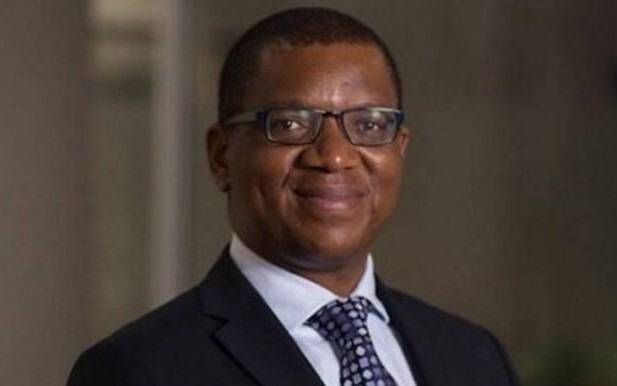
Alexander Chiteme
Alexander Chiteme, Zambia’s Minister for National Development Planning

Zambia’s Minister of National Development Planning, Alexander Chiteme, said at a World Bank-led Climate Investment Fund meeting in Morocco.

“Collaboration between the public and private sectors is vital in tackling the challenges that climate change is posing to humanity, the environment and economies,’’ Chiteme said.

The minister also said that Zambian government has developed a multi-sectoral approach to tackle climate change, adding that challenges remained.

“We have faced challenges in attracting private sector financing and effective participation.

“However, with the additional financing coming on board late last year, we will manage to mobilise private sector investments in economies such as agriculture, natural capital and by providing technical support to relevant beneficiaries.

“It is critical to respond to climate change, using a proactive and strategic approach across all sectors in an integrated manner,’’ he said.

According to the United Nations Development Programme (UNDP), the landlocked sub-Saharan African country has been experiencing the adverse impact of climate change. “The adverse impact of climate change includes an increase in the frequency and severity of seasonal drought, occasional dry spells, increased temperatures in valleys, flash floods and changes in the growing season,’’ UNDP said. 

Environmentalist decries continuous decline in Nigeria’s forest cover

0

An environmentalist, Chief Philip Asiodu, has decried the continuous declining of the Nigeria’s forest cover.

Izoma Asiodu
NCF President, Izoma Philip Asiodu

Asiodu told the News Agency of Nigeria (NAN) in Lagos on Thursday, January 31, 2019 that the country’s forest cover was declining rapidly to at least less than four per cent.

According to him, some things need to be done to reverse the trend.

“In 1988, there is a quest for Nigeria to return to 25 per cent forest cover.

“A lot needs to be done to achieve this 25 per cent which is about covering 250, 000 square km.

“And this requires deliberate efforts by all tiers of governments, corporate bodies and individuals.

“It also calls for a change in the way we do things as individuals, corporate organisations and governments at all levels,” he said.

Asiodu, who is President, Board of Trustees, Nigerian Conservation Foundation (NCF), said that conserving the environment required the efforts of all as damage in the environment was damage to the survival of mankind on earth.

He said that a good environment ensured that human and animals have oxygen to breath and enough trees purifying the air.

Asiodu said that pollution of the air and depletion of Ozone layer would not be an issue.

The environmentalist said that everything on earth revolved around the environment, adding that a clean environment would result to good quality of life on earth.

He said that God had given man charge over the environment to keep and till it for the benefit of all living creatures on earth.

“But what do we see today?

“Man destroying the environment and endangering all the other creatures including their habitat,” he said.

The bureaucrat and former Minister of Petroleum said that human beings had to change the way of living in the environment in order not to endanger themselves and other inhabitants of the environment.

By Chidinma Agu

Cocoa: Group urges end to child labour, deforestation

0

The European Union and Germany have come under intense pressure to put an end to child labour and deforestation – offshoots of growing cocoa plantations in the developing world.

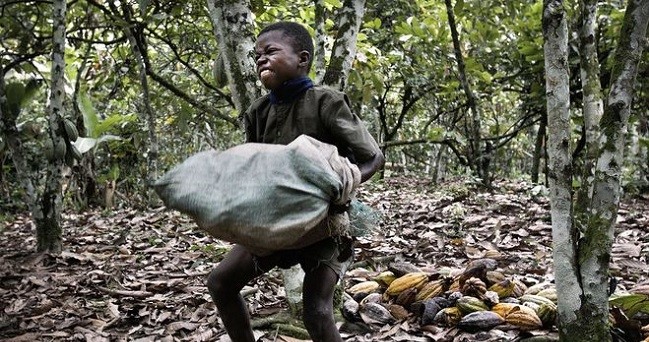
Child labour
A child working in a cocoa plantation

As Germany is expected to reach a decision on the issue soon, the popular desire is for the country to champion the campaign to halt the menace.

Reinhard Behrend of the Rainforest Rescue is bothered by the fact that while rainforests on one hand are cut down for cocoa plantations, children from poor homes are, on the other hand, made to work on the plantations for a living.

“Some 1.2 million children are forced to work on plantations and have no perspective of ever lifting themselves out of poverty. In many places, the expanding plantations are eating their way into protected rainforest areas,” he said, even as he clamoured EU-wide regulations “to put an end to these abuses”.

His words: “Germany is the largest cocoa market within the EU, and regulation with teeth can only be realised if the German government is on board. The German cabinet, however, disagrees over how to deal with the issues of deforestation and child labour: While the Development Ministry is in favour of a proactive approach, the Agriculture Ministry is digging its heels in – as it often does whenever environmental protection is at stake.”

A decision will be reached soon, and observers are hoping that Germany will lead the fight against the abuses rather than turn a blind eye towards them.

Behrend added: “Many of the cocoa plantations were established where rainforests used to grow. Ivory Coast, one of the world’s biggest cocoa suppliers, has lost almost all its forests, including some of the last habitats of the critically endangered chimpanzee. Even national parks are being cut for cocoa production. In Peru’s Amazon region, hundreds of hectares of untouched forests have been destroyed.

“None of this is new. Producers have been promising for two decades to end child labour, human rights violations and environmental destruction, but little has improved. They fear losing customers and profit if they make the first move and raise their prices while their competitors continue to sell cheap. Promises and voluntary initiatives clearly don’t work, so we need legally binding EU regulation.”

As a way out, he stated that cocoa imported to the EU must henceforth be:

  • free of human rights abuses, including child and forced labour
  • provide a living income for farmers so they can feed their families
  • free of deforestation and environmental destruction.

He added: “The EU is the number-one cocoa importer and manufacturer and consumer of chocolate worldwide. If the EU doesn’t deal with this crisis, no one will. The EU needs to take responsibility! A key figure holding the EU back from acting is Germany’s minister for agriculture, Julia Klöckner. Ms. Klöckner should know that children don’t belong on plantations and that intact forests are more important than Europe’s sweet tooth.”

Rainforest Rescue is seeking signatories to a petition apparently aimed at the German government and demanding it to put a stop to the development.

NABDA partners with firm, Cuba to produce bio-fertiliser, vaccines

0

Acting Director-General, National Biotechnology Development Agency (NABDA), Prof. Alex Akpa, says the agency is partnering with Biocrops Nigeria Limited in a research to produce indigenous products suitable for farmers.

Prof. Alex Akpa
Prof. Alex Akpa

Similarly, he disclosed that the agency is collaborating with the Cuban Government to produce vaccines and bio-pharmaceuticals.

Akpa said this in an interview with News Agency of Nigeria (NAN) on Wednesday, January 30, 2019 in Abuja.

Biocrops is an indigenous company devoted to providing tools for farmers at an affordable price by unleashing the powers of biotechnology and economics.

The NADBA boss said that the agency signed a Memorandum of Understanding (MoU) with the tools company in December 2018 to jointly do a research and come up with products for farmers.

He added that “right now, the Federal Ministry of Agriculture has shown interest in one of the products, the Bio-fertiliser.

“The bio-fertiliser is environmentally-friendly and not only that, it is totally harmless to the environment, and it has little or no harm to individuals as it is biologically based.

“There is another important product that we developed with the company called bio-pesticide, which is particularly useful for the preservation of beans.’’

Akpa said that the product came about because of the recent devastating attack on beans, also known as cow pea by a pest called `maroca’.

He explained that “sometime last year, farmers and people who deal in beans were frustrated that they used “snipper’’, a dangerous chemical to preserve beans out of desperation because of the devastating weavels that ate up their crop.

“We, therefore, developed the bio-pesticide to preserve beans, it is safe to the environment, humans and it is biodegradable.’’

The director general added that those were some of the important achievements recorded by the agency in 2018 and expressed optimism that 2019 would be better.

Akpa stated that the collaboration with Cuba came after a visit to the country, led by the Minister of Science and Technology, Dr Ogbonnaya Onu, in 2018 to forge a joint relationship into research to locally produce vaccines and bio-pharmaceuticals.

He said: “The Cuban Government has agreed to collaborate with Federal Government in a research at our centres to produce vaccines and other bio-pharmaceuticals like insulin.”

The NABDA boss explained that the insulin productuin was for the management of diabetes, while another product called interferon would be produced for the management of cancer.

“So hopefully before the end of this year, we should see something tangible in that regard, that is another thing that gives me a lot of happiness and excitement.

“The capacity to produce the vaccines will be there, but since we cannot produce all at the same time, we are going to take them in phases from the simplest technology.

“We will then gradually move to the higher ones and as we do that, we will build the capacity of our people because they will be involved in the production, so we are going to start doing that locally.’’

He added that power as a critical aspect of vaccine production had also been put into consideration, noting that “we are going to have both solar power backup and electric generators in addition to our national grid.

“So, we will make sure that enough is put in place to ensure uninterrupted power supply in the vaccine production.’’

Established under the Federal Ministry of Science and Technology, NABDA’s objective is to implement policies aimed at promoting, coordinating and setting research and development priorities in biotechnology.

Based on the premise, the programmes of the agency are structured in line with international standard, bearing in mind the development of local technology.

By Perpetua Onuegbu and Rukayat Anifowoshe

Africa accused of not investing enough on environment

0

A university teacher, Prof. Victor Ojakorotu, said in Lagos on Wednesday, January 30, 2019 that governments in Africa were not making enough investments to secure the environment to protect people from hazards.

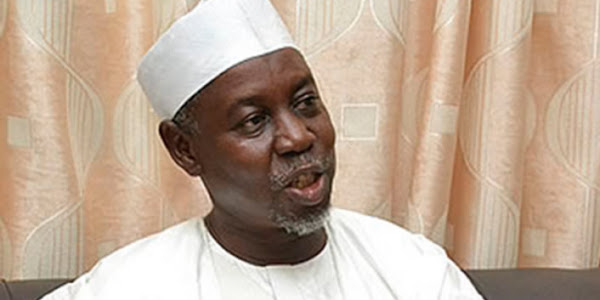
Alhaji Suleiman Hassan Zarma
Alhaji Suleiman Hassan Zarma, Minister of Environment

Ojakorotu, who made the statement in an interview with a correspondent of the News Agency of Nigeria, said the investments being made by many governments in Africa were negligible to mitigate various environmental problems, including climate change and other challenges.

“The reality is that these environmental problems are the root cause of conflicts in Africa.

“Many of the intra and inter-state conflicts have links to squabbles over land, water and other natural resources,” he said.

Ojakorotu, a lecturer at North West University in South Africa, said that environmental problems were among the most pressing developmental challenges plaguing the African continent.

“Our continent’s environmental problems have resulted to a rise in intra and inter-state politics, diplomacy and multi-lateral agreements to curb the negative scale of the socio-economic and political problems brought about by the environment.

“Therefore, the need to ensure environmental sustainability through increased investments to mitigate adverse environment by our political leaders in Africa cannot be under-estimated.’’

The don stressed that African scholars needed to engage more on issues relating to environmental security of African countries.

“A group of African scholars have resolved to engage this problem by calling for well researched papers which shall be complied into a manual to provide guidance towards the continent’s policy direction.

“We are collaborating with a United Kingdom-based university to enable African scholars in the diaspora to contribute to lessening the scourge of climate change and other environment hazards on our people,’’ he said.

North West University is already collaborating with the University of Bradford in the United Kingdom to organise a three-day conference with theme: “Environmental Security, Diplomacy and Conflict in Africa’’ as part of efforts to design a blueprint to address the problem.

The conference is billed to hold from July 25 to 27, 2019 at the University of Bradford.

By Ikemefuna Okudolo