The National Biotechnology Development Agency (NABDA) has
signed a Memorandum of Understanding (MoU) with Biocrops Nigeria Ltd, to
produce bio-pesticides, nematocides and bio-fertilisers.
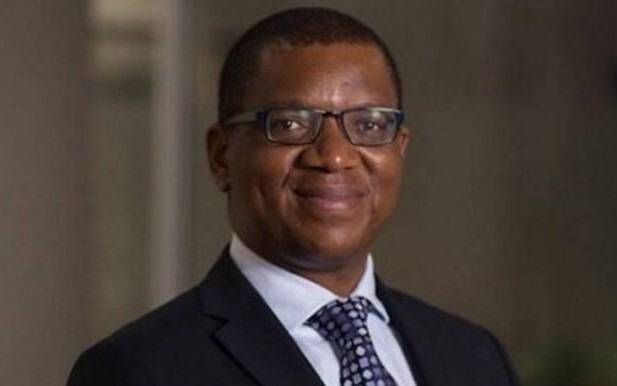
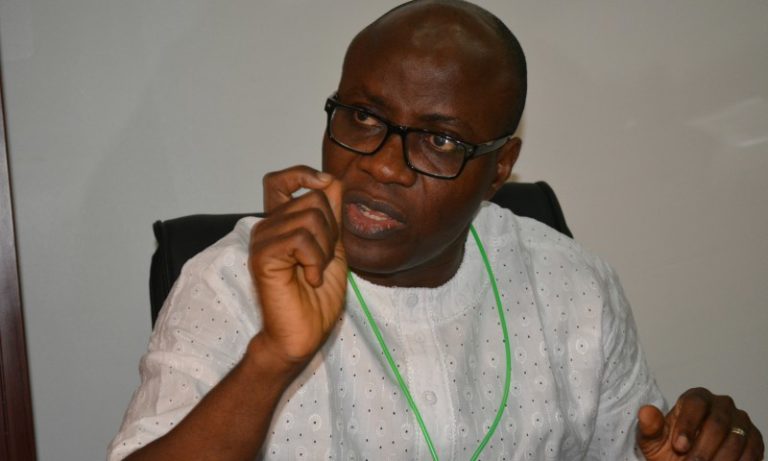
Prof. Alex Akpa
The Director-General of NABDA, Prof. Alex Akpa, who
disclosed this to newsmen in Abuja, said the partnership also focused on
propagation of different biotechnology crops to enhance the nation’s food
security.
“Under the MoU, our scientists and theirs will collaborate
to massively expand our horizon, to produce bio-pesticides, nematicides and
bio-fertilisers.
“With this partnership, we hope to propagate in commercial
level hundreds of thousands and if not millions of plantlets covering cassava,
yam, plantain and banana, among others.
“This is why the Ministry of Budget and National Planning is
interested in this project, which they are part of,’’ Akpa said.
He explained that bio-pesticides and bio-nematicides would
prevent a situation where farmers, out of desperation, use harmful chemicals
like sniper to preserve farm produce.
He also said bio-fertilisers would reduce the effects of chemical fertilisers on the soil, saying: “They are biodegradable and ecosystem-friendly without adverse effects on human health”.
The NABDA boss also commented on the formal presentation of
the BT cowpea by the National Biosafety Management Agency.
He noted that the improvement of the cowpea through
biotechnology was very cogent to food security, as it was a very important
source of protein and also a major staple food.
According to Akpa, the improved BT cowpea is resistant to
Maruka which is a pest that wrecks devastating havocs on cowpea plantation.
He added that it reduces the rate of chemical herbicide and
pesticides from nine times to once through out a farming season.
Reduction in the use of chemical herbicides and pesticides,
he explained further, would reduce environmental degradation, adverse effect of
the chemicals on human and the expenses of farmers during production.
The NABDA DG also disclosed that plans had been concluded to
bring in Cuban scientists to start local production of vaccines and
bio-pharmaceuticals like insulin, among others.
The Vice-President, Nigerian Institute of Quantity Surveyors
(NIQS), Mr Olayemi Shonubi, has appealed to the Federal Government to provide
an enabling environment for the private sector housing to thrive in 2019.
Obafemi Onashile, NIQS President
Shonubi made the appeal while speaking with the News Agency
of Nigeria (NAN) on Friday, December 28, 2018 in Lagos.
He noted that the performance of the sector had been poor
and below expectation in 2018, saying that government should allow the private
sector to drive the housing construction sector.
According to him, such move would ensure maximum provisions
to curb housing deficit in the country.
He said all government needed was to provide the enabling
environment and other necessities, that would aid the operations of the private
housing developers.
Shonubi attributed the country housing deficit to lack of
full participation of the private sector in housing delivery.
“Government alone cannot provide the needed houses for the
country. It needs full participation of the private sector, through a
well-programmed Public-Private Partnership (PPP) scheme.
“This implies leaving housing delivery in the hands of the
private sector while government provides the necessary conducive environment,”
the NIQS chief said.
Shonubi was optimistic that the active participation of the
private sector in housing delivery would have a positive impact on the
country’s housing situation.
He noted that for the PPP programme to yield positive result
in addressing the nation housing needs, the government needed to go beyond the
provision of land and policy frameworks.
According to him, the government needs to grant incentives
to private housing developers.
“Examples of such incentives are import duty waivers on
building materials, provision of infrastructure and credit facilities through
effective mortgage system, tax relief, among others.
“Introduction of realistic building regulations and the
removal of restrictive legislation, such as the Land Use Act of 1978, could
guarantee a conducive atmosphere for the private sector to operate.”
Shonubi noted that some construction works required lucrative
machines too expensive to afford by the local and private operators.
“What makes foreign operators and contractors seem to be
more competent is because they have the financial capacity to secure all kinds
of expensive machinery that facilitate construction works.
“The indigenous private operators need government empowerment to effectively operate.”
Gov. Kayode Fayemi of Ekiti State on Thursday, December 27,
2018 declared emergency in the water sector to ensure water supply to all nooks
and crannies of the state.
Governor of Ekiti State, Dr. Kayode Fayemi
He made the declaration in Ikun Ekiti, Moba Local Government
Area of the state, where he had gone to kick-start the turn around water
rehabilitation project at Ero Dam to supply water to many major towns in the
state.
The governor consequently promised to take legal and
institutional steps to also make the state open defecation free before 2030.
He said it was in a bid to reduce the level of water borne
diseases in Ekiti and make the commodity available to residents that he
declared the emergency in water sector.
According to him, the people must be saved from preventable
Illnesses through provision of potable water.
He clarified that the emergency was in line with the step
taken by President Muhammadu Buhari.
Buhari had initiated similar policy under a programme called Water Supply Sanitation and Hygiene (WASH) in partnership with the World Bank.
The project, which will gulp $55 million, was awarded to
Sagittarius Henan Engineering and is to be completed within 18 months.
The governor said the WASH programme of the Federal
Government and World Bank was initiated to reduce amount being paid by
Nigerians on hospital bills after contacting all forms of diseases from
unhygienic water sources.
Fayemi said statistics had shown that water supply to urban
cities and rural areas in the country had reduced by 15 and four per cent
respectively, despite geometric increase in the population.
The governor added that the state had already paid N700
million counterpart fund to complete the project that was approved by the world
bank in 2014.
“It was because of the safety of the citizens that the
Federal Government declared emergency in WASH. So, Ekiti has keyed into the
programme with this project.
“Ekiti was ranked second in Nigeria as a state that
practised open defecation. We shall put up institutional and legal frameworks
to ensure Ekiti is open defecation free before 2030
“Part of what accounted for this high practice was because
of low water supply to our homes
“We are making our traditional rulers as champions that
would canvass for open defecation-free and if we are going to stop our palaces
from digging boreholes here and there, we as government should provide water to
our people.
“We have done our feasibility studies, 85 per cent of our
water in Ekiti shall be provided by Ero and Egbe dams if they operate at
optimal capacity,” he said.
The governor assured that affordable tariff would be charged
by government and that such would be metred to prevent extortion.
The Permanent Secretary, Ministry of Public Utilities, Mr
Olumide Ajayi, said rehabilitation on Egbe Dam located in Gbonyin Local
Government was also being co-financed by European Union and Ekiti State.
Ajayi said the two projects would supply water to over 66
towns across nine local government areas in the state.
He urged the beneficiaries to be ready to pay affordable
tariffs and maintain the facilities when completed.
The General Manager, Ekiti State Water Corporation, Mr
Olabisi Agbeyo, revealed that this was the first time a major rehabilitation
would be carried out on Ero Dam in 33 years.
“As we speak, Ekiti is not owing a kobo as counterpart
payment; we have paid up and this shows how committed the state was in water
supply,” Agbeyo said.
The Senator representing Enugu North Senatorial District, Chukwuka
Utazi, said on Thursday, December 27, 2018 that N40 million had been proposed
in the 2019 budget for the control of erosion at Onuiyi-Nsukka in Enugu State.
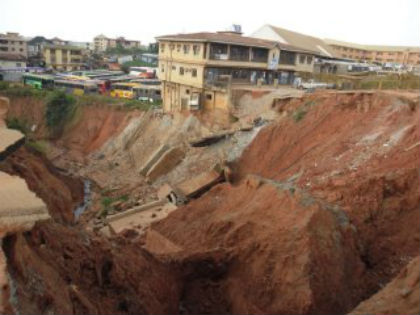
A gully erosion site
Utazi, who disclosed this in an interview with the News
Agency of Nigeria (NAN) at Nsukka, said the proposal was to ensure that the
erosion problem in the community was solved permanently.
The late Dr Nnamdi Azikiwe, first President of Nigeria,
lived in his Onuiyi Haven, few metres to a very deep erosion gully in the area,
until he died in 1994.
“As senator representing Enugu North, I made a case for it
because of the danger posed by the gully erosion in that area. Some buildings
within the area have collapsed, and farmlands washed away.
“The erosion at Onuiyi-Nsukka has caused havoc especially
during rainy season. I am happy money has been budgeted for it,” he said.
He said that N70 million was also proposed in the Federal
Government budget for the take-off of a police station and barracks at
Nkpologu, Uzowani Local Government Area of the state.
The senator noted that the measure was to checkmate series
of robberies and kidnapping that frequently occurred along the Nsukka-Adani
road.
“The N70 million is for the take-off since the amount cannot
be enough to build a station and barracks.
“The money is for clearing of the area, fencing it and doing
some other things the amount can accommodate.
“For some time now, robbers and kidnappers have been
terrorising drivers, passengers and other road users on Nsukka-Adani Road.
“The presence of a police station and barracks in that area will
stop the inhuman acts of these criminals and hoodlums.
“My greatest concern as senator representing the district is
to ensure that lives and property in the area are safe and protected,” he said.
Utazi also said that, at present, the Adani Rice Market and
farms were receiving serious attention as the roads leading to them were under
construction by the federal government.
According to the senator, other infrastructure in the market
and farms were being upgraded for better performance.
Utazi said he sponsored a motion in the senate over the
deplorable state of the 9th Mile Corner-Makurdi road and government
awarded contract for its dualisation at the cost of N5.4 billion.
“That 9th Mile-Makurdi road is very important since
it’s the only link road between the North and the South-East and South-South,”
he added.
He urged politicians to put the interest of the country
first in their campaigns for the 2019 general elections by avoiding actions and
utterances capable of overheating the polity.
“Politicians and political parties in their electioneering
campaigns should go straight and tell Nigerians what they can do if voted to
power rather than blackmailing and assassinating the images of their political
opponents
“We should avoid hate speech as well as tribal and religious
sentiments just to achieve cheap popularity.
“If politicians, INEC officials and security agencies play
according to rules of engagements, the 2019 general elections will be credible,
free and fair,” he said.
The Chairman, Senate Committee on Anti-corruption and other
Financial Crimes, expressed satisfaction with the performance of the Governor
of Enugu state, Ifeanyi Ugwuanyi.
He said the governor had massively developed infrastructure
and ensured regular payment of salaries in the state in spite of lean resources
at his disposal.
“The governor has done well in his first tenure and should
be voted for the second term in 2019,” he said
The National Biosafety Management Agency (NBMA) says it has a state-of-the-art genetic modification detection and analysis laboratory to checkmate any risks associated with the technology.
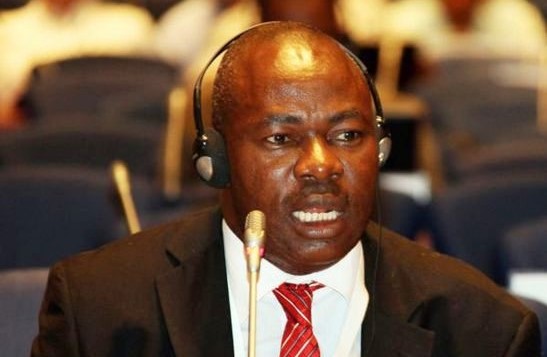
Dr Rufus Ebegba
Dr Rufus Ebegba, the Director-General of the agency, made
this known in an interview with the News Agency of Nigeria (NAN) in Abuja on
Thursday, December 27, 2018.
“Our agency is able to test, analyse and carry out proper
risk assessment on Genetically Modified Organisms (GMOs) before they are
approved for release into the market.
“Biotechnology is basically the use of living systems or
materials from living organisms to modify other organisms, in order to move a
gene of interest from one organism to another one, both related and unrelated,
for you to achieve a particular desire.
“It is not necessarily creating a new organism but altering
it in a way that you achieve a desired interest and there is no technology in
the world that can be said to be 100 per cent safe.
“The proponents of this technology saw the need for an
agreement to ensure that there is holistic bio safety before the product of
genetic engineering can be used for planting, processing, or for any purpose.
“So, it simply means that it needs measures and procedures
to ensure that its activities and the use of genetically modified organisms, do
not have any adverse effects on the environment and human health,” he said.
Ebegba added that the agency also considered the potential
adverse impacts that biosafety should prevent or minimise during risk analysis.
“When we talk about the issue of potential risk in biosafety
or GMO, we are looking at the impact of GMO on the environment.
“Will the super organisms with which these organisms have
been modified become invasive, more dominant, replace the ecosystem, or affect
the ecosystem adversely?
“We look at the issue of genetically modified third party
that is how to resist a particular pest so that it would not affect other
organisms.
“Then we also look at it from the human front. Will these
genetically modified organisms become toxic, affect humans negatively and cause
health problems and allergies?
“These are the things we look out for to ensure that no GMO that
will cause any adverse impacts will be allowed. We only allow those that after
rigorous risk assessment, we considered safe. These we will grant permit for.
“If they are not safe, we won’t grant permit for them,’’ the
NBMA director-general said.
He added that his agency also looked at issues of
socio-economic concern in GMOs.
“We look at the issue of socio-economic concern to know
whether these products are going to be socially compatible with our social
norms.’’
Ebegba urged Nigerians to trust government decisions as government had put measures in place to ensure that human health and the environment were safe.
The Director General of the National Biosafety Management
Agency (NBMA), Dr Rufus Ebegba, has said that Nigeria has been mandated to
lead the West African sub-region on biosafety.
Dr Rufus Ebegba
Dr Ebegba, who made the submission while presenting the agency’s
score card to the public in Abuja on Friday, December 21, 2018 said It is
gratifying to note that, within the short period of the existence of the NBMA
under President Muhammed Buhari’s leadership, the agency has recorded
tremendous growth and progress to be given positions of responsibilities on the
sub-continent.
“NBMA has provided for the first time a haven for the
practice of modern biotechnology, its application and use in Nigeria. Nigeria
can now raise its head among nations as a country ready to appropriately key
into the use of safe modern technology, a critical factor for economic
development.”
The DG said in the last three years the agency has been able
to gevelop and review its operational instruments for effective implementation
of the NBMA Act 2015 and the ease of doing business within related sectors.
“At present, the agency has trained officers through short
Biosafety courses both nationally and internationally and sometimes to masters
degree level. With the establishment of the agency, our universities and
research institutes now have confidence to carry out biotechnology researches
expected to increase agricultural productivity as well as contribute to food
security in Nigeria.
“This is line with the Green Alternative Agenda of the
Federal Government and the Sustainable Development Goals of the UN. Our Food
and Feed Industries are assured of availability and safe raw materials for
their industries, our farmers’ earning ability greatly increases as they
experience reduction in agricultural losses as a result of pest and diseases,
increase productivity as well as reduction in health problems related to use of
chemicals,” he said.
Dr Ebegba said that, in furtherance to the agency’s
collaborative drive, it initiated and signed MoUs with National Agency for Food
and Drug Administration and Control (NAFDAC), National Agricultural Seed
Council (NASC), and National Varietal Release Committee (NVRC), Nigeria
Agricultural Quarantine Service (NAQS), and Standard Organisation of Nigeria
(SON).
He said the agency is in the process of signing an MoU with
Nigeria Customs Service (NCS) Veterinary Pest Control Services Department of
the Federal Ministry of Agriculture and Rural Development.
The DG also noted that the agency has engaged in various
sensitisation efforts via the media and other programmes in other to educate
the public on its activities and mandate. He added that, courtesy of its state-of-the-art
GM detection and analysis laboratory, the agency is able to test, analyse and
carry out proper risk assessment on genetically modified organisms before they
are approved for release into the market.
“Upon meeting the requirements set forth for the
accreditation of Institutions, the NBMA accredited some institutions to carry
out biotechnology activities. These are: Federal University of Technology,
(FUTA), Akure; Institute for Agricultural Research, (IAR), Zaria; International
Institute of Tropical Agriculture (IITA), Ibadan; National Biotechnology
Development Agency (NABDA), Abuja; National Cereals Research Institute (NCRI),
Badeggi; and the National Root Crops Research Institute, (NRCRI), Umudike.
He added that the agency has certified containment
facilities for bio-fortified cassava enhanced with pro-vitamin A (concluded) at
National Root Crops Research Institute, Umudike; bio-fortified cassava enhanced
with Iron (concluded) at the National Root Crops Research Institute,
Umudike; GM Cassava resistant to cassava mosaic virus and brown streak virus
(on going) at National Root Crops Research Institute, Umudike; and GM Cassava
(AMY3 RNAi Transgenic lines) for post-harvest starch reduction, International
Institute of Tropical Agriculture (IITA).
He said the agency has also granted Permit for Commercial
Release and Importation of GM Crops for Feed and Food Processing such as Bt.
Cotton to Monsanto Agriculture Nigeria Ltd. (Commercial Release), Biosafety
Permit to WACOT Nig. Ltd Biosafety Permit for commercial release of Bt Cotton.
Dr Rufus said that Nigeria is benefiting from safe modern
biotechnology under a legal framework for economic growth, improved
agriculture, job and wealth creation, industrial growth and sustainable
environment as operators now have confidence in the sector, risks to human
health from modern biotechnology practice and the use of genetically modified
organisms (GMOs) are at their barest minimum.
He noted that the dumping of unauthorised GMOs into Nigeria
is now at its barest minimum. He stressed that avenue is being provided to
confirm and harness the potentials of modern biotechnology safely, negative socio-economic
consequences of GMOs are being guarded against, even as confidence is being built
in the practice of modern biotechnology, use and handling of GMOs and GM
products.
“Nigeria’s commitment to the principles of international
Agreements and Treaties to Convention on Biological Diversity (CBD) and
Cartagena Protocol on Biosafety (CPB) is reaffirming, Proper regulation for
imported GM products, so that Nigeria will not be a dumping ground for GMOs and
products is assured. Other African countries look up to Nigeria for leadership
in biosafety Issues.”
Ebegba said in the coming year the agency looks to train
more staff and urged Nigerians to trust government decisions as government has
put in place measures to ensure that human health and environment is safe.
After two weeks of intense negotiations, women and gender
groups represented in Katowice, Poland assert that COP24’s failure to deliver
on the 1.5°C goal and refusal to put people at the centre of climate action
exacerbates rather than addresses the challenges facing our planet.
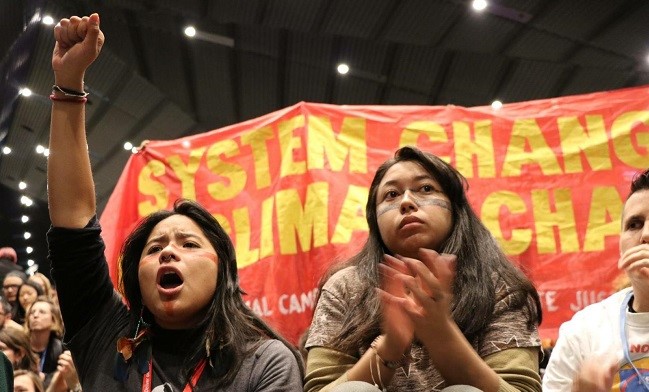
Civil society action at COP24. Photo credit: WWF-New Zealand / David Tong.
The key objective of COP24 was to operationalise the Paris
Agreement, which is said to be premised on a vision for rights-based and
gender-responsive climate action. The Women and Gender Constituency (WGC),
representing people at the frontlines of climate change, says it has constantly
put pressure on countries to craft an appropriately ambitious and
people-centered interpretation of the Paris Agreement. The group adds that it is
“disheartened at the continued and dangerous dismissal and silencing of the
real, system-changing solutions to a just and sustainable world”.
“Prior to these negotiations, the IPCC Report gave the world
a reality check – if we want to reach the goals laid out in the PA, we have to
act fast and ambitiously with the right solutions. The opportunity to put
people at the center of this vital climate action by including the principles
that states already agreed upon, such as protecting human rights and gender
equality, was overlooked. However, communities of concerned persons throughout
the world, including those represented by the WGC, will continue to put into
place real solutions, from the grassroots up, to save our planet and people,”
says WGC, one of the nine stakeholder groups of the United Nations Framework
Convention on Climate Change (UNFCCC).
The lack of ambition revealed an unwillingness to recognise the ongoing
devastation across our landscapes: “Our world is facing brutal
changes in the way we used to know it. The weather, the rivers and the forests
are not the same. Right now, local, traditional and indigenous communities,
intersected by gender, economic status and age, are at the frontline of climate
impacts, but in a short time, everybody will feel it,” says Taily Terena,
ECMIA – Continental Network of Indigenous Women, Americas, as spoken at the
Talanoa Dialogue closing.
Climate science must not be questioned or treated as just another
negotiation item: “The Paris Agreement set an important and
ambitious goal of keeping warming under 1.5°C. The recent IPCC report on
achieving this goal could not be clearer – we have 12 years to avert climate
catastrophe. Instead of heeding the alarm by climate scientists to raise
ambition and action at COP24, some countries shamefully attempted to weaken
recognition of the report and its findings. We are long past attempts to deny
the science of climate change. For the WGC, we know we need to stay below 1.5
to stay alive- and we will not stop our collective action to achieve this.,”
notes Bridget Burns, Women’s Environment & Development Organisation
(WEDO).
The guidelines are not robust enough to solve the climate crisis, nor
do they ensure that the voices and rights of peoples affected are properly considered: “The
PA has firmly recognised that to be effective and truly transformative, climate
action has to respect and promote gender equality and women’s human rights.
Instead we see that large investments, increasingly under the guise of climate
action, are forcing women and indigenous peoples from their lands, forests and
traditional fishing territories. A number of states wanted to delete almost all
references to human rights and gender. Only in a few areas could this egregious
trend be reversed,” states Hwei Mian Lim, Asian-Pacific Resource and
Research Centre for Women (ARROW).
National implementation must integrate gender-responsive approaches: “It
is a success that Parties recognise the need to design NDCs in a gender-responsive
manner. Still other principles that are pivotal for ambitious and effective
action are missing. While planning the NDCs countries should report on how the
guiding principles of the PA, such as food security, public participation, just
transition, ecosystem integrity, gender equality, indigenous peoples’ knowledge
and human rights have been taken into account. This was agreed upon in Paris!”
says Nanna Birk, LIFE – Education, Environment, Equality.
Without strong mechanisms, we cannot correct our course toward the PA
goals: “Because the Global Stocktake has not been designed as a
robust and true accounting of the state of the world’s progress toward the
Paris goals, we fear that the currently disastrously insufficient commitments
by countries will not be improved. This system is failing us now, and it has
now been designed to fail us in the future,” stresses Ndivile Mokoena,
GenderCCSA-Women for Climate Justice Southern Africa.
Ignoring loss and damage is an injustice: “It became quite
obvious during COP24 that few countries tried to avoid discussing loss and
damage entirely, though this should be non-negotiable as the Paris Agreement
recognised the urgency of this topic. 2018 has been a disastrous year especially
in South and South east Asia bearing the brunt of unpredictable monsoons,
cyclonic storms and natural disasters, destroying properties, livelihoods and
lives of the people who continue struggling to recover from these losses. The
needs of those most affected, including women, migrants, people with
disabilities and other discriminated, communities-at-risk, must be taken into
account financially. Instead, climate frontline states are being asked to pay
high premiums for disaster risk insurance to companies from the Global North,
whose governments continue to shirk their historic responsibility for loss and
damage. That implies an irony that we will never accept,” emphasises Shradha
Shreejaya, Asia Pacific Forum on Women, Law and Development/
The development and transfer of technology has to be just: “It
is very distressing that the already scarce resources for the technology
framework will go to the private sector. This is based on a perverse idea that
public funds should be blended with private sector investment that will bring
profit. In this way, climate adaptation technologies and our solutions will
always end up being left behind,” contends Neth Dano, ETC Groups.
Nuclear energy is neither clean nor renewable: “It is
unacceptable that the dirty energy industries, which act clearly against the
Paris Agreement and are responsible for numerous cases of human rights
violations, are given so much visibility at COP24, particularly the nuclear
industry. We want to ask all states in this process: Which side are you on? We
think they must stand with their people, not polluters!” adds Sascha
Gabizon, Women Engage for a Common Future (WECF).
Silencing voices of climate activists must be condemned by the
community of states: “We have warned since early this year that
the Special Bill for COP24 that was passed by the Polish parliament risked
creating a dangerous precedent of silencing activists’ voices and excluding
frontline communities shared experience that is crucial to this process. We had
demanded guarantees that no untoward actions against civil society were taken;
however, people have been arrested, interrogated and even denied entry to
Poland or deported. This unacceptable practice that violates UN principles must
not be repeated at any future climate conference,” states Patricia
Bohland, GenderCC – Women for Climate Justice.
Providing the recognition of Indigenous Peoples’ rights is only the
beginning: “Even though we are celebrating that the Local Communities
and Indigenous Peoples Platform will be brought to life with equal
representation from Parties and indigenous peoples, the WGC will keep following
the Platform’s development to ensure its goals are fully achieved, while also
paying attention to gender equality considerations,” says Isadora Cardoso,
GenderCC – Women for Climate Justice.
True, system-changing solutions are available but require real support:
“The WGC’s Gender Just Climate Solutions showcase how grassroots women invent
and manage community-based and appropriate climate technologies. Their efforts,
however, are not supported by the current mechanisms, which focus on
centralized and very large-scale activities, often to the detriment of human
rights, the rights of women and indigenous peoples, and ecosystem integrity,”
says Anne Barre, Women Engage for a Common Future (WECF).
Established in 2009, the WGC now consists of 28 women’s and
environmental civil society organisations working to ensure that women’s voices
and their rights are embedded in all processes and results of the UNFCCC
framework, for a sustainable and just future, so that gender equality and
women’s human rights are central to the ongoing discussions.
A recent report of the Nigeria Extractive Industries Transparency Initiative (NEITI) reveals that the total financial flows from Nigeria’s oil and gas sector slumped to $17.05 billion in 2016, a 31% decline on the $24.79 billion generated in 2015, and a 75% on the sector’s peak earnings of $68.44 billion generated in 2011. In addition, the 2016 figure is the lowest in 10 years and the fifth lowest in the 18 years covered by NEITI’s audit reports so far (1999 to 2016).
Executive Secretary of NEITI, Waziri Adio
According to the NEITI 2016 Oil and Gas
Industry Audit Report, released to the press on Friday, December 21, 2018, the
plunge in revenue in 2016 resulted from the double whammy of low oil prices in
the global market and reduced oil production in Nigeria, which in turn was
caused by disruption and vandalism of oil assets and spike in crude theft,
among others.
Yearly average price of crude oil per
barrel was $43.73 in 2016 as against $52.5 in 2015. Total oil production in
2016 was 659 million barrels as against 776 million barrels produced in 2015, a
fall of 15%. Losses due to crude oil theft and sabotage rose from 27 million
barrels in 2015 to 101 million barrels in 2016, an increase of 274%. This was
aside losses due to deferment, which in 2016 was put at 144 million barrels
which also went up by 65% when compared to the 87.5 million barrels in 2015.
“The bombing of the under-water 48-inch
Forcados Oil Loading/Export Pipeline was one of many major occurrences that
befell the industry in the year under review,” the NEITI report stated. “This
incident occurred in February 2016 and the line remained in-operational for
seven months. Shell Petroleum Development Company (SPDC) declared force majeure
on lifting from Forcados on 21st February 2016. Companies injecting into the
Forcados Terminal such as SEPLAT, PANOCEAN, MIDWESTERN, ENERGIA, PLATFORM,
PILLAR, WALTERSMITH, and EXCEL shut down production for over 147 days.”
In addition, SPDC declared force majeure on
the Bonny Terminal due to a leak in Nembe Creek Pipeline between May and July
2016 while NAOC declared force majeure on the Brass Terminal between July and
August 2016.
Similarly, Mobil Producing Nigeria
Unlimited declared Force Majeure twice between May/June and July/October 2016.
This was due to a drilling process disruption and damage to the QIT loading
system.
The NEITI report stated: “MPN’s total
production within the four-month period was 4,616,825bbls, which is less than
half of what was produced in each month previously as reflected in DPR
reconciled sign-off records.”
After surviving the slump in the global oil
market in 2008 and 2009, Nigeria’s oil sector rebounded in 2010 with a 49%
increase in total financial flows to $44.94 billion, followed by the peak of
$68.44 billion in 2011. However, flows from the sector have been trending
downward since that peak year with $62.94 billion generated in 2012, $58.08
billion in 2013, $54.56 billion in 2014, and $24.79 billion in 2015. Similarly,
oil production has been on steady decline with 866 million barrels produced in
2012, 800 million barrels in 2013, 798 million barrels in 2014, 776 million
barrels in 2015 and 659 million barrels in 2016.
NEITI’s audit reports independently
reconcile payments by companies against receipts by government agencies and
cover key financial flows such as earnings from sale of Federation’s crude oil
and gas, sector-specific taxes, fees and levies such as royalty, Petroleum
Profit Tax (PPT), signature bonus, gas flared penalty, and other flows such as
NDDC contribution, NCDMB levy, NESS fees, education tax and others. Breakdown
of the payment shows that the major earnings for 2016 came from export and
domestic sale of Federation crude oil and gas with $7.97 billion, PPT with
$4.21 billion, and royalty oil with $1.57 billion.
A major highlight of 2016 was that for the
first time in Nigeria’s history, crude oil produced from Production Sharing
Contracts (PSCs) overtook output from the Joint Ventures (JVs). In 2016, PSCs
accounted for 324 million barrels, while the JVs accounted for 289.1 million
barrels, (as against the 320 million barrels for PSCs and 375.5 million barrels
for JVs in 2015). PSCs, a production arrangement introduced in 1993, thus
became the leading production arrangement in 2016. The PSCs are mostly
offshore, thus insulated from vandalism and sabotage, and are not constrained
by adequacy/availability of equity funding by the Federation. This change in
production structure pushes to the fore the need to renegotiate the terms of
the PSCs as stipulated in the Deep Offshore and Inland Basin Production Sharing
Contracts Act of 1993 so as to increase government’s take.
The NEITI report also reveals that the
total lifting for 2016 was 668.1 million barrels, as against the 780.4 million
barrels lifted in 2015, a drop of 14.35%. Out of the total liftings for 2016,
NNPC lifted 244.6 million barrels (36.61%) on behalf of the Federation while
the companies lifted 423.5 million barrels (63.39%).
Other major highlights of the report are
the following:
Contribution of the oil and gas
sector to GDP dropped from 9.5% in 2015 to 8.3% in 2016.
Total gas produced in 2016 was
3,051,249 mmscf, out of which 288,209 mmscf was flared, representing 9.45% of
production.
A total of 126 million barrels
(valued at $5.48 billion or N1.37 trillion) was earmarked for domestic
consumption, allocated as follows: 23 million barrels (18%) for refineries,
55.9 million barrels (45%) for Direct Sale Direct Purchase (DSDP), 36.6 million
barrels (29%) for PPMC lifting and 10.4 million barrels (8%) for offshore
processing.
From the money for domestic
crude allocation (DCA), NNPC deducted the following upfront: N512 billion for
JV cash call, N126.5 billion for pipeline repairs and maintenance, N99 billion
for under-recovery and N20 billion for crude losses.
A total of 101 million barrels of
crude oil was recorded as losses due to theft and sabotage, valued at $4.4
billion. Breakdown of this shows that SEPLAT and SPDC alone reported 81 million
barrels of crude oil as losses due to sabotage while 20 entities reported 19.8
million barrels as losses due to theft.
NLNG dividend, loan and
interest repayment for 2016 was $390.2 million, as against $1.07 billion of
2015, a decline of 63.5%.
$8.2 billion was budgeted for
cash calls in 2016, $5.5 billion was released, and $4.9 billion was paid.
Non-JV cash call expenses came to $874 million, representing 17.59% of cash
call expenditure.
The 2016 NEITI report covered 84 entities,
comprising the following: ten government agencies, seven power generating
companies, 62 oil and gas companies, three refineries, and the NLNG and
NGC. The report is made public as part
of NEITI’s statutory mandate under the NEITI Act 2007 and in compliance with
the principles and standards of the global Extractive Industries Transparency
Initiative (EITI), which Nigeria voluntarily subscribed to in 2003. The eighth report
to be produced by NEITI on the oil and gas sector, the 2016 audit was conducted
by Haruna Yahaya & Co., an indigenous accounting and auditing firm.
The Ambassadors of Dialogue, Climate and Reintegration, an
NGO, says it has inaugurated environmental project “Chill the Climate” to
support climate action in the country.
Dr Peter Tarfa, Director, Department of Climate Change (DCC) in the Federal Ministry of Environment
Executive Director of the organisation, Mr Richard
Inyamkume, told the News Agency of Nigeria (NAN) in Abuja on Thursday, December
20, 2018 that the project was to train over 100,000 people to support climate
action at the grassroots.
“The Chill the Climate project is a capacity building and
awareness raising programme aimed at raising over 100,000 climate ambassadors
across the federation by 2030 to support climate action at grassroots.
“The project is being implemented in five pilot states –
Adamawa, Benue, Lagos, Rivers and Abia.
“It is hoped that through this project, we will increase
public awareness about climate change, discourage degradation and encourage
green conservation and resources preservation,’’ he said.
The executive director said that the organisation
inaugurated 21 female climate ambassadors who were already working in schools
and communities, setting up “Climate Care Clubs”.
He added that the ambassadors held first Adamawa Climate
Change rally in Dec. 6.
“We are building capacity for 30 climate ambassadors in
Benue state. These people will be inaugurated and inducted into the
organisation’s ‘One Hundred Thousand Network’,’’ Inyamkume said.
He said that the organisation would hold a climate change
rally in January 2019, expressing the organisation’s readiness to reach out to
large number of people.
Kenya on Friday, December 21, 2018 launched a five-year plan
aimed at transforming Arid and Semi-Arid Lands (ASAL) into reliable economic
hubs.
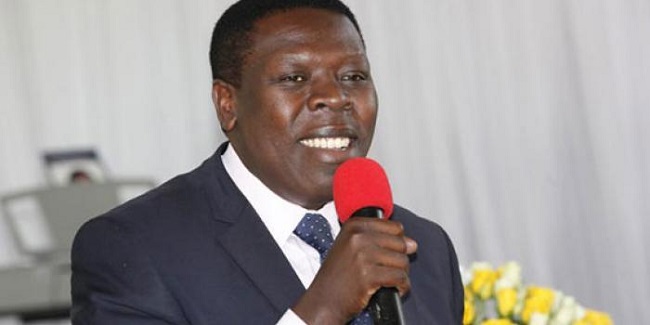
Eugene Wamalwa
Mr Eugene Wamalwa, Cabinet Secretary of the Ministry of
Devolution and ASALS, said that the 2018-2022 strategic plan targeted
livestock, energy, tourism, agriculture, trade and minerals sectors which, he
said, were underexploited.
“We want to address the inequalities and vulnerabilities
that are currently being experienced in the ASALs in a coordinated manner,”
Wamalwa said during the launch.
He said that though the regions faced extreme climatic
conditions, leading to devastating effects on the environment and livelihood of
communities with spiraling vulnerabilities, they had great potential for
development and contributions to national economy.
Wamalwa noted that ASAL regions in Kenya cover 48 million
hectares, which is slightly over 80 per cent of Kenya’s total land surface.
“Out of this land mass, 9.6 million hectares support
marginal agriculture, 15 million are suitable for sedentary livestock
production and 24 million hectares are dry and suitable for nomadic
pastoralism,” he added.
Wamalwa said that the government was looking at finding
long-term solutions to the problems in the regions by mainstreaming investments
as way of finding a lasting sustainable development.