

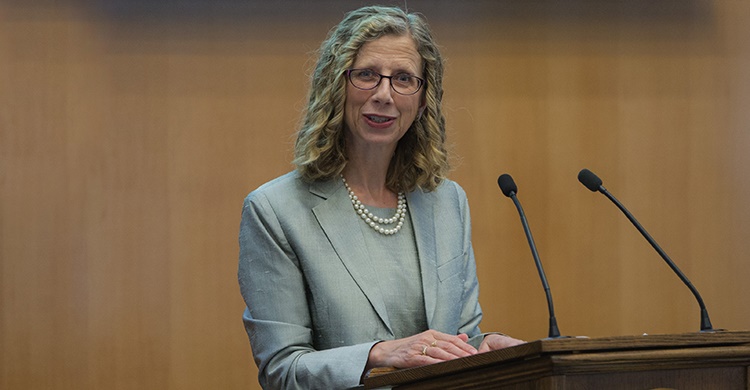
Speech delivered by Inger Andersen, Executive Director, United Nations Environment Programme (UNEP), at the 173rd meeting of the Committee of Permanent Representatives in Nairobi, Kenya, on Monday, April 20, 2026
Please let me begin today by touching on the environmental consequences of the situation in the Middle East.
The destruction of infrastructure – including fuel storage, refining and processing facilities – across the region has polluted the air, soil and water. Fires from damaged oil and gas facilities release heat and air pollutants – creating serious risks to those responding to the fires and to people living in affected areas.
Meanwhile, the destruction and damage of sea-faring vessels have led to significant spills. Oil spills contaminate rivers, lakes, reservoirs, groundwater and marine waters – which pose serious health risks, impact wildlife and exacerbate issues for a region already grappling with water scarcity.
Past conflicts show pollution from conflict-related damage can last many years. So, I continue to echo the UN Secretary-General’s call for the immediate cessation of all hostilities. Ending the destruction is essential to protect human lives and enable the containment and remediation of pollution, which is essential to protect the region’s natural systems and remove serious risks to human health. UNEP is working with the UN system to keep the environmental situation in the affected region under review, and will report on environmental issues of regional significance emerging from the conflict.
This is our first gathering since the seventh session of the United Nations Environment Assembly (UNEA-7), at which Member States adopted UNEP’s Medium-Term Strategy and handed down new mandates through 11 resolutions and three decisions, all of which will strengthen our support for environmental action. UNEA-7 was a success, but of course we can improve. In this regard, I thank you for the discussion on lessons learned and the good reflections provided, which will help to prepare for UNEA-8.
While it is still early days, UNEP is moving forward as quickly as it can to implement these new mandates and the MTS – while still focusing on pre-existing mandates. Right now, we are focusing on three areas.
First, being more efficient and effective in delivery and reducing fragmentation in countries, as we ensure they are advised strongly on low emission, resilient growth. Second, delivering measurable and credible impact. Third, derisking investing in the environment through science, law and finance so that value chains are secure and people are resilient.
UNEP’s overall financial health and increased predictability is key to advancing these efforts and delivering on UNEP’s central mandate as the leading global environmental authority, with clear eyed focus and impact.
I thank Member States for recognising this need, and the importance of the Environment Fund as the financial spine of the organisation, which together with contributions from the Regular Budget pays for the science, the environmental law, the policy coordination, the capacity building, the standards and the convening.
A total of US$85 million against the approved Environment Fund budget of $100 million was received in 2025. Recognising the drop of $5 million in income compared to 2024, we continue operating under a reduced envelope, every dollar counts, every contribution counts, especially in the current landscape. I am proud to share that 108 Member States contributed to the Environment Fund in 2025. No other UN entity can claim the same width of the Member State support. Your consistency, trust and solidarity reflect our collective commitment. I am grateful and encourage Member States to pay their full contributions.
We at UNEP also understand and prioritise the leadership and responsibility of Member States in implementing the mandates you handed to UNEP. For this reason, I have engaged in consultations with partners and Member States over the last few months – including the regional and political groups in Nairobi – and will continue to engage with every Member State and grouping.
I was in New York for a busy week to chair the High-Level Committee on Programmes (HLCP) – which focused on topics such as moving beyond GDP and the UN80 Initiative. To brief Member States on UNEP’s latest work, science and priorities. And to attend the Third Session of the Preparatory Commission for the Agreement on Marine Biological Diversity of Areas Beyond National Jurisdiction (BBNJ).
I reminded delegates at PREPCOM that it is crucial for the BBNJ to pull experience from all other conventions and rely upon a strong, efficient and independent Secretariat. UNEP is, of course, ready and equipped to lend its expertise and serve as the institutional locus of this Secretariat.
I was also pleased to join Member States and the Minister of Environment and COP31 hosting President Designate from Türkiye at a New York event to mark the fourth International Day of Zero Waste, shining a global spotlight on the preventable challenge of food waste. This year’s global campaign demonstrated growing momentum and collective action toward zero-waste societies. Some 20 Zero Waste Cities were announced by the UN Secretary-General’s Advisory Board, over 135 events registered worldwide and 14 major tourism companies serving over 600 million guests annually joined UNEP and UN Tourism’s “Recipe of Change” initiative to reduce food waste.
In March, I engaged with EU partners in Brussels. We discussed – with the European Commission, in the European Parliament and EU Environment and Climate Ministers – how a strong and resilient environment is fundamental to sustainability, resilience, security, and economy with the fundamental role of science. I also travelled to Helsinki for the Nordic Consultations, where we discussed the UN80 Initiative and the importance of maintaining strong environmental science in a time of misinformation.
As our safety, prosperity and future depends on a One Health approach, I joined partners at the One Health Summit in Lyon, hosted by President Emmanuel Macron on World Health Day. The Summit focused on delivering sustainable health across humans, animals, and ecosystems, with discussions addressing zoonotic diseases, antimicrobial resistance and food safety – all to help ensure we prevent the next crisis before it begins.
The Quadripartite – with our partners at FAO, the World Health Organisation, and the World Organisation for Animal Health, the Quadripartite – also gathered for its fourth Executive Annual Meeting. The priorities for the Quadripartite, as I see it, are strengthened science and strengthening integrated evidence and knowledge exchange, advancing coherent, cross-sectoral policy frameworks, and mobilising resources to turn commitments into action.
We were also pleased to host a briefing here in Nairobi on the UN80 Initiative with Under-Secretary-General for Policy, Guy Ryder – giving Member States the opportunity to discuss the latest progress and priorities beyond areas that UNEP is supporting or leading on.
The UN80 Initiative continues to move forward. At the end of March, the United Nations General Assembly adopted Mandate Creation, Implementation and Review for an Efficient and Effective United Nations – a resolution to strengthen how mandates for UN organisations are created, implemented and reviewed. This is something we at UNEP have been advocating for a while. Based on your asks, UNEP has been ahead of the curve by innovating through our end-to-end support to Member States on the management of the lifecycle of UNEA resolutions. This new UNGA resolution will play a critical role, bringing good practice from Nairobi to the rest of the UN system.
UNEP continues to play a key role in the UN80 Initiative, together with the UNFCCC, by leading Work Package 27, which is “undertaking a thorough assessment of current arrangements” and will “make proposals on possible structural changes and programme realignments on environmental issues”.
On April 23, you will have the opportunity to hear more about the progress being made, with a briefing on WP27. As we focus on a UN system shift towards coherence, effectiveness and impact through the interconnected issues of science, governance, coordination and implementation, we look to your guidance at the briefing on how we can make this truly transformational and supportive of the needs of people, planet, peace and prosperity. Let me also highlight that advance materials for this meeting have been made available to delegations over the weekend.
Please let me close with a look at some of the key multilateral environmental milestones this year.
We have already seen the 15th Meeting of the Conference of the Parties to the Convention on the Conservation of Migratory Species in Campo Grande, Brazil, where countries agreed to step up conservation efforts, including new or enhanced treaty protections for 40 species and populations of birds, aquatic wildlife, and terrestrial animals.
I am about to depart to Astana, Kazakhstan for the Central Asia Regional Ecological Summit, where nations are looking to accelerate concrete action for the challenges facing this vibrant region. UNEP is a key partner in the summit, which we hope will strengthen regional cooperation on climate adaptation, sustainable natural resource management, mobilizing green financing and more.
This is, of course, another year of Rio Trio COPs – providing a real opportunity to accelerate action across every aspect of the environmental challenges.
The UN Convention to Combat Desertification (UNCCD) COP17, in Mongolia, will place a strong focus on efforts to sustain livelihoods, strengthen ecosystem resilience and address climate change in drylands.
The Convention on Biological Diversity COP17, in Armenia, will be a chance to accelerate action toward the 2030 targets of the Global Biodiversity Framework. UNEP is supporting 70 countries to finalise their National Biodiversity Strategies and Action Plans (NBSAPs) – including finance and capacity building.
UNEP’s work on climate science strengthens the foundation for impactful policies and implementation through reports such as the Emissions and Adaptation Gap Reports, and actions around cooling, methane and food waste. New work on overshoot of 1.5°C will inform Climate COP31 in Türkiye.
There are, of course, other important gatherings, such as the 2026 UN Water Conference in Abu Dhabi, co-hosted by the UAE and Senegal, and the COPs of the Regional Seas Conventions and Action Plans – with the Nairobi Convention and the Coordinating Body on the Seas of East Asia both gathering, in Tanzania and the Philippines respectively.
UNEP is also working towards advances in chemicals, waste and plastic pollution.
The Global Framework on Chemicals will hold its first International Conference in Geneva this November. This will be a key milestone in meeting its five strategic objectives and 28 targets, many of which are due by 2030.
The full operationalisation of the Intergovernmental Science-Policy Panel on Chemicals, Waste and Pollution (ISP-CWP) is a key priority – and depends on finalising the rules of procedure, establishing the financial architecture and agreeing on intersessional work at a resumed session of the first plenary.
In December, the Meeting of the Parties to the Montreal Protocol will take place in Kigali, Rwanda – marking the 10th anniversary of the Kigali Amendment, with a key topic of discussion being the expected follow up on the HFC-23 emissions, regional atmospheric monitoring and lifecycle management of refrigerants.
Regarding the development of an international legally binding instrument to end plastic pollution, including in the marine environment, progress is being made. Ambassador Julio Cordano of Chile, who was elected in February as the new Chair of the Intergovernmental Negotiating Committee (INC), has made it clear that he is determined to get the treaty over the line. The Chair’s letter of March 16 shared a roadmap outlining work to come, including a series of informal activities leading up to INC-5.4.
This will include a Heads of Delegation Meeting here in Nairobi from June 30 to July 3. UNEP remains unwavering in its support to the Committee and delivering on the mandate of UNEA resolution 5/14. In this context, I am very pleased that Ambassador Cordano was able to meet with regional groups during his visit to Nairobi last week.
We undoubtedly have a busy period ahead of us, with much work to do in complex times. We must ensure that the environment remains high on the UN and multilateral agenda. Because a vibrant and healthy environment, a predictable climate, well-functioning nature, and unpolluted air, soil, and water are critical to undergirding the UN Charter’s pillars of peace and security, human rights and economic development.