

At the opening of a three-day strategic review in Lagos, Nigeria’s flagship climate resilience initiative, the Agro-Climatic Resilience in Semi-Arid Landscapes (ACReSAL) project, delivered a clear message: it is not only on track, but ahead of schedule.
The mid-term review and additional financing mission, which began on Monday, April 20, 2026, at the Lagos Continental Hotel, is scheduled to run till Wednesday, April 22. It has drawn more than 500 delegates from the 19 northern states and the Federal Capital Territory, underscoring the scale and significance of the programme.
Participants include federal and state government officials, commissioners, academics, technical experts and development partners from the World Bank, all convened to assess progress and outline the next phase of implementation.
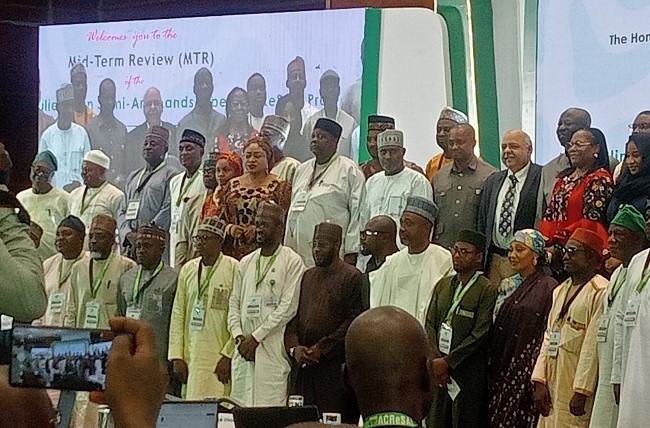
At the centre of discussions is a project increasingly regarded as one of the strongest performers in Nigeria’s climate resilience portfolio with different presentations of data driven impacts.
Setting the tone early, the National Project Coordinator, Abdulhamid Umar, speaking on behalf of the Federal Ministry of Environment, said ACReSAL has already exceeded several of its key performance benchmarks, despite being only midway through its lifecycle.
“The project has actually surpassed its target and we’re just halfway through,” he told journalists on the sidelines of the event.
According to Umar, the initiative has reached approximately 9.3 million beneficiaries, significantly exceeding its initial target of 3.4 million. Women account for nearly half of that number.
Environmental restoration figures are equally notable. Over one million hectares of degraded land have been rehabilitated within three years, effectively achieving a target initially set for six years.
Beyond the data, Umar pointed to tangible changes in communities across the northern region. In Katsina State, he said, improved water management infrastructure has helped avert the kind of devastating floods that previously led to loss of lives and property. In parts of Benue and Gombe states, he added, longstanding tensions between farmers and herders have eased.
“We have impacted heavily on agricultural development and empowerment where our CRF investment has yielded,” he said. “We have also recorded more peaceful coexistence between farmers and herders.”
He further noted that increased agricultural productivity and empowerment initiatives have translated into job creation for young people and expanded income opportunities for women, reshaping livelihoods in vulnerable communities.
“The beneficiaries are the ones who can tell a better story than the implementers,” he added.
That perspective found cautious support among World Bank specialists present at the review, who acknowledged the project’s performance while highlighting areas that require strengthening as it transitions into its next phase.
Nagaraja Rao Harshadeep, a lead environmental specialist, said ACReSAL’s strength lies in its dual focus on land restoration and the development of systems for sustainable resource management. However, he stressed the need for the project to evolve with emerging tools.
“I think what could be done more in the future is to leverage new types of data and analytics that are currently available for planning,” he said, noting that improved data integration could sharpen decision-making and investment targeting.
Angela Armstrong, a senior environmental specialist, pointed to progress made at the macro level, particularly in the development of watershed management plans across multiple states. The next phase, she said, should prioritise deeper community engagement.
“The next steps should really focus on community-led investments, taking the broader watershed work and translating it into micro-level plans with communities,” she said.
For Veronica Jarin, also an environmental specialist with the World Bank, sustaining momentum will depend on scaling up resources.
“Any additional financing will scale up current activities and increase the livelihoods of people,” she said.
Across sessions and side conversations, a consistent narrative has emerged: ACReSAL is evolving beyond a conventional intervention programme into a potential model for climate resilience.
There are already discussions around institutionalising the initiative into a full-fledged agency and adapting its framework for use in other semi-arid regions beyond Nigeria.
Still, key questions linger. As the project eyes expansion, stakeholders are grappling with how additional funding will be tracked, how gains will be sustained, and whether early successes can be replicated at scale without dilution.
For now, as deliberations continue in Lagos, ACReSAL stands at a critical juncture, buoyed by strong results, yet facing the complex demands of growth and long-term impact.
By Omowumi Abraham