

As Africa prepares for the 12th session of the Africa Regional Forum on Sustainable Development (ARFSD‑12) holding from April 28 to 30, 2026, in Addis Ababa, Ethiopia, the conversation around the continent’s critical minerals has taken centre stage.
Speaking at the official pre‑ARFSD‑12 session, Dr. Mithika Mwenda, Executive Director of the Pan African Climate Justice Alliance (PACJA), delivered a compelling call for Africa to rethink its long‑standing role in the global minerals economy.
His message was clear: Africa can no longer afford to remain trapped at the bottom of the value chain.
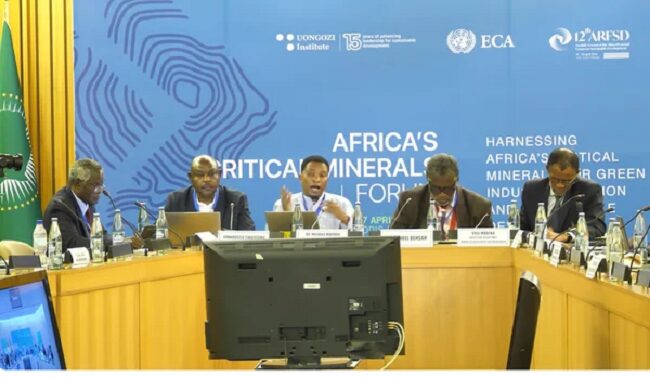
For decades, global narratives have celebrated Africa as a continent “rich in natural resources”. Yet, as Dr. Mwenda pointed out, this abundance has not translated into prosperity. Instead, Africa remains largely confined to the first step of the global value chain – extraction – while the real wealth is captured elsewhere through processing, manufacturing, and high‑value trade.
“The uncomfortable truth,” he stressed, “is that Africa’s resource wealth has not delivered meaningful economic transformation.”
Beyond Extraction: A New Vision for Beneficiation
Dr. Mwenda argued that the global shift toward green technologies – from electric vehicles to renewable energy storage – presents Africa with a rare opportunity. Critical minerals such as cobalt, lithium, manganese, and rare earth elements are in high demand. But to benefit, Africa must break away from the traditional extractive model.
He emphasised that beneficiation – the processing and transformation of raw minerals – must be understood not as a narrow technical intervention but as a comprehensive industrial strategy.
“Beneficiation requires more than machinery,” he noted. “It demands reliable energy, efficient logistics, skilled labour, supportive trade policies, and access to markets.”
Without these foundational elements, he warned, Africa risks replicating the same extractive patterns of the past, only this time under the banner of “cleaner” operations.
Regional Value Chains: The Only Viable Path
A central theme of Dr. Mwenda’s statement was the need for regional cooperation. No African country, he argued, can industrialise on the strength of its mineral deposits alone. Some nations have minerals but lack energy; others have ports but limited industrial capacity. Only by pooling strengths can the continent build competitive value chains.
He highlighted promising examples already taking shape. The Democratic Republic of Congo and Zambia are jointly developing a regional battery value chain, aiming to move from exporting cobalt and copper to producing battery precursors and components. The Lobito Corridor – linking Angola, DRC, and Zambia – is another strategic initiative designed to connect mineral‑rich regions to global markets.
However, Dr. Mwenda cautioned that such corridors must prioritise industrial development, not simply faster export routes.
“Development corridors should move Africa up the value chain, not accelerate the extraction of raw materials,” he said.
Morocco’s growing success in battery manufacturing, supported by strong industrial policy and market access, was cited as a model of what is possible when infrastructure, policy, and investment align.
Governance and Policy Alignment: The Missing Link
Dr. Mwenda also addressed the governance challenges that continue to undermine Africa’s mineral ambitions. He pointed to countries like Zimbabwe, which have introduced bans on raw lithium exports. While bold, such policies risk failure if not accompanied by investments in energy, processing plants, and industrial capacity.
“Policy bans alone cannot deliver beneficiation,” he warned. “We need alignment between mineral extraction, energy planning, industrial policy, and trade frameworks.”
Fragmented policies, unreliable power supply, and limited financing remain major obstacles. Yet, he noted that the restructuring of global supply chains – driven by geopolitical tensions and the search for diversified mineral sources – offers Africa a strategic opening.
From Competition to Coordination
Perhaps the most urgent shift Dr. Mwenda called for is a move away from national competition toward regional coordination. When African countries compete to attract investors through tax breaks or lax regulations, the continent loses collectively. Instead, he urged governments to focus on midstream value creation and ensure meaningful local participation in mineral‑based industries.
“Africa must not only extract minerals,” he concluded. “It must capture value.”
As PACJA continues to champion climate justice and equitable development, Dr. Mwenda’s message at the Africa’s Critical Minerals Forum – convened by UONGOZI Institute in collaboration with UNECA – sets the tone for a new era of African resource governance. The challenge now is whether African leaders will seize this moment to transform mineral wealth into shared prosperity across the continent.