

The recent meeting of the new IUCN Council reflected on the Union’s collective achievements in 2025 and looked towards building on the outcomes of the recent World Conservation Congress in the coming year. The Council welcomed 48 new IUCN Members, bringing the total number of IUCN Members to over 1,600, and appointed key positions in the Council and Commissions for the next four years.
“The World Conservation Congress in Abu Dhabi set an ambitious and necessary course for our Union. This Council now begins the work of implementation – advancing the Abu Dhabi Call to Action, our 20-year Strategic Vision, and the Programme for 2026–2029. IUCN’s strength lies in its ability to bring together science, policy and practice through its Members, Commissions and Secretariat. Our responsibility is to ensure that this collective effort delivers tangible, lasting results for nature and for people,” said Razan Khalifa Al Mubarak, IUCN President.
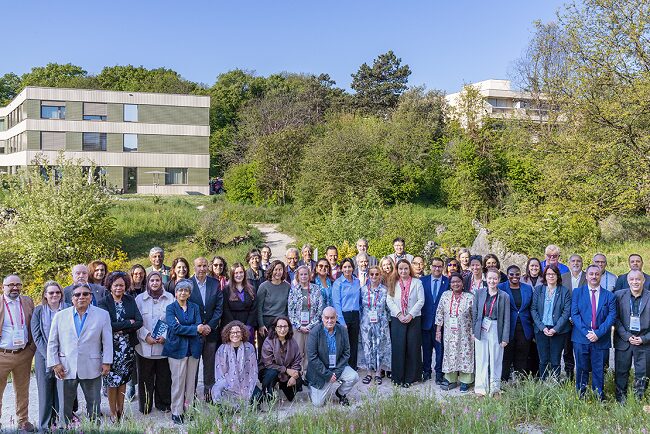
“As the world faces uncertain times, I am convinced that our Union remains strong and ready to face the challenges ahead. Following last year’s World Conservation Congress, IUCN has a renewed mandate and a new Council for the period 2025-2029. Having just convened, the Council decided to welcome 48 new Members to IUCN, which will strengthen our Union to drive enduring change,” said Dr Grethel Aguilar, IUCN Director General.
“Our ambitious new Programme and 20-year Strategic Vision set the ground for transformational conservation action, one that engages all of society across a range of economic sectors. With positive leadership and focus, we will continue to inspire and drive action at scale to create a just world that values and conserves nature,” added Aguilar
Several high-level appointments were made during the meeting, including Ms. Maud Lelièvre, Ms. Imèn Meliane, Mr. Ramón Pérez-Gil Salcido and Mr. Yinfeng Guo as Vice-Presidents of the IUCN Council. The members of the Council’s standing committees have been confirmed, with Ms. Erica McCreedy as Chair of the Governance and Constituency Committee, Ms. Ann-Katrine Garn as Chair of the Programme and Policy Committee, and Mr. Fernando Lloveras San Miguel as Chair of the Finance and Audit Committee. Sandrine Friedli Cela is the Legal Advisor, while 39 new members were appointed to IUCN Commission Steering Committees.
The Council approved IUCN’s Work Plan and the Director General’s Strategic Objectives for 2026, which aim to deliver the Union’s conservation mission according to the IUCN Programme 2026-2029 and IUCN World Conservation Congress Resolutions and Recommendations. Mobilising the Union’s financial resources, improving Secretariat operations, and supporting Members, Commissions and National and Regional Committees is paramount to achieving IUCN’s goals.
IUCN is dedicated to strengthening its role as the “voice for nature” and ensuring that the Secretariat invests in the skills and leadership needed to support the Union. During the meeting, the Council also approved IUCN’s 2026 budget to support this work. Alongside the 48 new IUCN Members, the Council further strengthened the Union’s constituents by officially recognising the IUCN National Committee of Armenia.
The IUCN Annual Report 2025 was approved as the Council acknowledged the significance of 2025 for the Union, with the World Conservation Congress in Abu Dhabi showing IUCN’s unique power to bring together the global conservation community. The Council noted this was the largest documented Congress to date, with 10,320 registered participants from 189 countries, and 1,040 IUCN Members attending the Assembly, IUCN’s highest decision-making body.
The Council began its work to support the implementation of the 135 Resolutions and nine Recommendations approved by IUCN Members during the Congress, reviewing the 22 Resolutions that call for specific actions by the Council. Developing a policy on geoengineering and convening a Task Force to develop a strategy on crimes that affect the environment featured among the topics of discussion, in addition to increasing the participation of subnational governments and accelerating equitable youth engagement across the Union, and putting Members at the heart of IUCN’s work.
The Council concluded on an optimistic note, looking ahead to supporting the Union’s work providing essential biodiversity knowledge, engaging in international policy discussions and implementing conservation projects on the ground, to deliver a successful term in the lead up to 2030.