

The Abia and Imo State Governments have expressed concern over the devastating human and environmental impacts of gully erosions in many communities in the two sister states of the South-East region.
A survey carried out in the two states revealed impressive strategic efforts to bring the phenomenon under check.
Speaking in an interview in Umuahia, the Executive Secretary of the Abia State Emergency Management Agency (SEMA), Dr Sunday Jackson, said the state government was working tirelessly to address the gully erosion ravaging communities in the state.
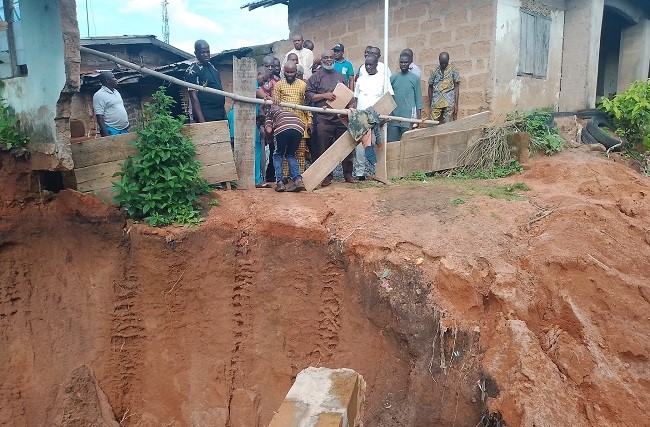
Jackson described Abia as “one of the states worse hit by gully erosion”, with active sites scattered across the three senatorial zones.
He further said that the state was among 33 other states projected to face high flood risk this year, based on the seasonal climate prediction and annual flood outlook released by the Nigerian Meteorological Agency (NiMet) and the Nigeria Hydrological Services Agency (NIHSA).
“With increasing rainfall, Abia, which is already prone to gully erosion, may record more cases,” he warned.
He commended Gov. Alex Otti for taking bold steps to tackle the challenge, citing the ongoing remediation works at Ossah in Umuahia North LGA and several other affected communities.
The SEMA boss, however, maintained that the state still needed support, pointing out that many farmlands and houses were being washed away, leaving scores of residents displaced.
“SEMA is taking proactive measures in security, awareness, and public education, but the magnitude of the disaster is beyond what the State Government alone can bear,” he said.
He promised that SEMA would collaborate with the National Emergency Management Agency (NEMA), the Ministry of Environment, and other critical stakeholders to carry out a downscaling exercise in flood-prone communities.
According to him, the exercise aims to sensitise residents to the impending flood disasters and associated risks.
“If we don’t do that, it might lead to loss of lives, loss of property, and environmental degradation,” Jackson said.
Dr Kenneth Anyalechi, the immediate past President of Ozuitem Development Union in Bende LGA, corroborated SEMA’s concern, saying that his community suffered so much damage by erosion due to its topography.
Anyalechi said Ozuitem, made of nine autonomous communities and about 100 villages, had been badly hit, with Umuikwuoma-Ndiambe, Ndi Okala-Ogboko, Nzerim-Ogboko, and Elugwumba-Odum among the worse affected.
He explained that gully erosion had cut off several villages from the rest of the community and neighbouring areas, in spite self-help palliative carried out by the community in 2021.
“Between 2010 and 2024, my community spent personal funds just to create access in and out of our village.
“In 2025, the Niger Delta Development Commission came to our rescue, but unfortunately, they stopped midway.
“The erosion has now cut us off from our water source,” he lamented.
Anyalechi appealed for government’s intervention to control the erosion and landslides so that residents can access water, farmlands, and the neighbouring communities.
Also, a community advocate and native of Elu-Ohafia in Ohafia LGA, Mr. Ndubuisi Ume-Ado, lamented the destruction of buildings and displacement of families by erosion, particularly in Amaekpu-Ohafia.
Ume-Ado said that erosion in Elu-Ohafia had cut off five communities, forcing residents to use dangerous alternative routes to access farmlands.
He revealed that 13 people were involved in a serious accident earlier in the year, while travelling through one of such routes.
He called for urgent government intervention to avert further loss of lives and property in the area.
In Imo, the Commissioner for Environment and Sanitation, Mr. Major Emenike, said that the state government was seriously committed towards intervening in several massive gully sites across the state’s three senatorial zones with its 2026 budgetary provisions.
Emenike said in Owerri that the state was “stepping in to address high-risk sites that have destroyed roads, markets, and homes”, while waiting for federal assistance.
He said that the government had initiated a multi-pronged approach to managing the state’s severe erosion menace, including both independent state projects and Federal Government’s collaborations.
He said that the Nigeria Erosion and Watershed Management Project (NEWMAP) and surveys had identified over 500 active gully erosion sites across the state.
According to the commissioner, the most critical sites are concentrated in the Orlu and Okigwe zones, specifically in Ideato North, Ideato South, Njaba, Orlu, and Mbaitolu LGAs of Imo.
“The 2026 fiscal plan targets approximately 15 to 20 priority gully erosion sites for active intervention and rehabilitation.
“These sites were selected based on their high-risk status, meaning they threaten major transit roads, residential clusters, or public utilities.
“Specific attention in this budget cycle was also directed toward sites in Akpulu (Ideato North), Umuaka (Njaba), and several critical corridors in Owerri, where urban runoff has accelerated soil degradation,” Emenike said.
He further said that the budget further captured a series of massive erosion sites for state-led intervention at Ugiri-ike, Inyishi, Dam site, Ogboko-Umuchima, Urualla, Umueshi, and Ugirinna.
The commissioner said the state was currently partnering with the Federal Government and the NEWMAP/European Investment Bank to tackle six major sites, particularly those in Izombe and Ezinihitte Mbaise.
“Restoration is already underway at the Nekede gully site, near Owerri, with Craneburg Construction firm handling the project,” he said.
The commissioner, who regretted the devastating infrastructure and economic impact of erosion on communities, said “the damage extends far beyond environmental degradation.
“In areas like Umuchima, the gullies have swallowed critical roads, residential houses, and local markets,” he said.
Emenike said that the state was still putting together the exact cost of the infrastructure and economic loss to the gullies.
He assured residents that the 2026 fiscal plan included adequate funding for a dual purpose: reclaiming the gullies and reconstructing the roads to restore connectivity between neighboring communities.
He admitted that households displaced by the environmental disaster had yet to be officially resettled by the government.
“The people have been calling over the issue, but we asked them to make their requests known, officially,” Emenike said.
He said that he was awaiting formal responses from affected residents and communities, following recent discussions on the necessary procedures for government assistance.
On the issue of early warning education and drainage cleaning, Emenike said, “we are de-silting the drains ahead of the return of the rainy season.
“My ministry is collaborating with the Imo Rural Roads Maintenance Agency to de-silt the drains to prevent flooding during the fast approaching rainy season.
“The idea is to also create public awareness on the dangers of throwing thrash into the drains,” he said.
Contributing, the National Emergency Management Agency (NEMA) raised concerns over the ravaging gully erosion in different parts of Imo.
NEMA’s Head of Operations in the state, Mr. Nnamdi Igwe, said Ideato belt, Orlu, Obowo, and parts of the Owerri zone bear the deepest brunt of the environmental crisis.
Igwe also said that residents were faced with “swallowed homes, obliterated farmlands, and severed roads”, and called for urgent intervention.
“In the Ideato North and South LGAs, collectively known as the Ideato belt, communities like Umuchima, Umueshi, Urualla, Akokwa, Umumaisiaku, Obodoukwu, Amanator, Isiekenesi, Umuokeh, Spibat, Works Layouts, Akwakuma, and Amakohia have suffered immensely.
“These sites lie along critical corridors such as Orlu-Mgbee-Umuchima-Akokwa-Uga and sections of the Umuahia-Owerri axis.
“Gullies have engulfed houses, vast farmlands, and vital roads, isolating schools and health facilities from residents,” Igwe said.
According to him, Orlu LGA stands out with the Uhuala Obibi Ochasi Community on the Orlu-former road axis, experiencing a monstrous 2-km-long gully.
The erosion scar, he said, stretches over 75 meters deep and spans 100 meters wide, expanding relentlessly into 2026.
He also said that more than 20 houses “have vanished into the abyss”, displacing hundreds and turning the area into a ghost town, with families fleeing for safety.
He said in Obowo LGA, the Umuokeh Community and 14 surrounding towns teeter on the brink.
He further said that massive gullies threaten to slice through the Umuahia-Owerri highway, which has been a lifeline for intra-state and inter-state travels.
He said that such a breach, if allowed to happen, could unleash chaos, stranding commuters and crippling commerce, while endangering countless homes.
He mentioned other hotspots to include Nekede in Owerri North, Mbaitoli’s Umueze-Obazu-Mbieri, Ehime Mbano’s Umunumo Ibeafor, and parts of Ikeduru LGA.
“The human toll is staggering, particularly in housing and displacement,” Igwe said.
An LGA official, who identified himself simply as Chidi, said that Uhuala Obibi Ochasi reported that over 20 houses were submerged and hundreds rendered homeless, with locals lamenting the deserting of their community.
Chidi lamented that in the Ideato belt, at least 30 homes were lost in previous years up to 2023, but ongoing expansion in 2025 to 2026 signaled more displacements and potential fatalities ahead.
“Agricultural devastation crippled livelihoods.
“Uhuala Obibi Ochasi has lost over two kilometers of farmlands, shutting out farmers from their farmlands and markets for years and decimating local trade.
“The areas echo this pain, with billions of naira in cumulative property damage from earlier periods, now ballooning further amid unquantified 2025 to 2026 losses,” he said.
He advocated immediate state-wide inventions, federal aid, and engineering solutions to halt the scourge.
It is the fervent hope by the affected residents and communities that government at all levels and the relevant agencies shall hasten with timely interventions to de-escalate the problem before the rains fully set in.
By Leonard Okachie