Home Blog Page 1897

Sudan’s sustainable natural resources scheme expands to three more states

0

The Sudan Sustainable Natural Resources Management Project (SSNRMP), which is currently being implemented in three states, is to be extended to three more states.
Sudau
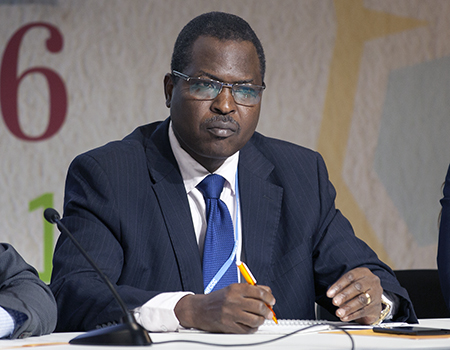
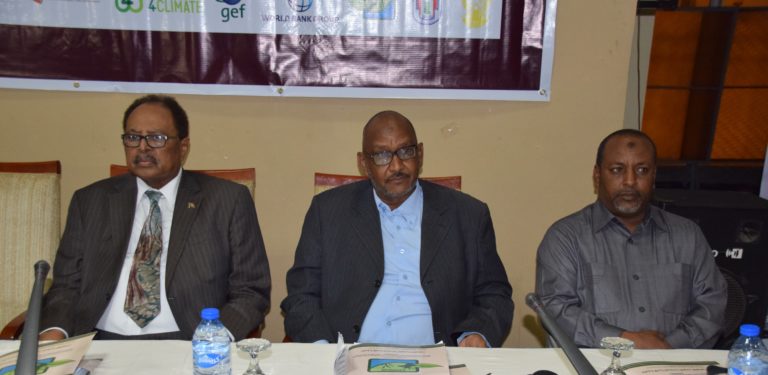
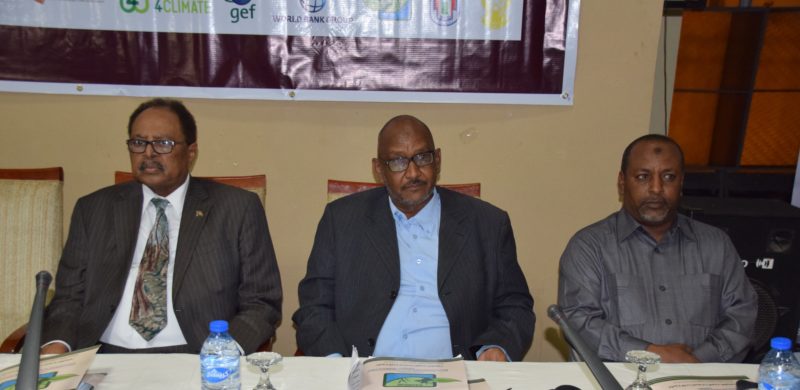
L-R: Sudanese Minister of Environment, Natural Resources and Physical Development, Dr Hassan Hilal; National Coordinator of the SSNRMP, Ibrahim Doka; and Sub-Secretary Minister, Dr Omer Mustafa, during the opening of the Workshop on Planning and Implementing a Communication Strategy in Khartoum, Sudan, on Monday, May 7, 2018

The disclosure was made by Dr Hassan Hilal, the Sudanese Minister of Environment, Natural Resources and Physical Development, in Khartoum on Monday, May 7, 2018 while declaring open the Workshop on Planning and Implementing a Communication Strategy, organised under the Building Resilience through Innovation, Communication and Knowledge Services (BRICKS) Project.

Dr Hilal described the SSNRMP as one of the Great Green Wall Initiatives (GGWI) projects being implemented in 19 villages in Kassal, Gezira, and White Nile states. According to him, the project, which was launched August 13, 2014, “is in the right track to achieve it is development objective by working in an integrated manner to achieve future sustainability”.

While stressing that the focus of the workshop underlined the importance of communication, the minister pointed out that the effective communication of any issue will result in “excellent results”. He added that communication mainly depends on collecting of correct information and the use of best tools or mechanism to convey the message to different audiences.

His words: “Here in Sudan, our project, the SSNRMP, pledged to give priority to communication. They conducted as an intensive communication study in which all stakeholders are included and this appears in the main action plan of the study, wherein 27 journalists were trained in line with an advice from the consultant. We achieved very good results such as the creation of on task force of environmental journalists.”

He disclosed that the best practices gained from SSNRMP were documented and disseminated, adding that one of the main outputs generated is that the project will now be extended to add three new states in the coming period.

On Wednesday, May 9, workshop participants visited the SSNRMP project sites. Initially, they were received at the Albutana University where a short video allowed the delegation to immerse themselves in the different components of the project and the impacts induced in the communities of the areas covered.

Under the leadership of the National Coordinator of the SSNRMP, Ibrahim Doka, and the Gezira State Coordinator, Madam Eiman Adawi, the participants visited the forest rehabilitation zone which covers four villages in the state of Gezira. On the spot, the delegation saw first-hand the degraded state of the forest and as well as the soil.

According to Doka and Adawi, the degradation, which dates back 20 years, is due to climatic variability exacerbated by the uncontrolled logging of forest resources and non-resilient agricultural practices.

“But, today, the awakening of conscience of the communities through the implementation of the project augurs a better tomorrow,” they stated, adding that the participatory rehabilitation process involves planting the Acacia Senegal, a tree species adapted to arid zones.

They added that, if weather conditions allow, the forest would regenerate within five years where rational management will be planned.

The second site visited was the Taybeen Village Community Garden located a few miles from the Wadbugul Forest. On-site activities consist of nursery production (forest rehabilitation plants and fruit trees), and other income generating activities.

According to Areeg Ali Ibrahim, community facilitator, the project’s activities have improved the living conditions of the population, who now have access to drinking water resources and financial empowerment.

Revenues generated by the sale of nurseries and other related activities, he added, enabled the construction of school buildings and the opening of a bank account, which ensures the sustainability of the project after the closing of the financing partners.

Community leaders, however, asked for the extension of the project beyond its five-year (2014-2019) period.

Costing $7.73 million and falling under the Sahel and West Africa Programme in Support of the Great Green Wall Initiative (SAWAP), the SSNRMP is being funded by the World Bank and the Global Environment Facility (GEF).

Other organisations involved in the SAWAP initiative are the International Union for the Conservation of Nature (IUCN), Sahara and Sahel Observatory, and the Permanent Interstate Committee for Drought Control in the Sahel (CILSS).

Sudan is a landlocked nation in northeast Africa comprising 18 states.
Stop attacks on children, UNICEF appeals to warring parties

0

With defenceless children increasingly targeted in conflicts, the United Nations Children’s Fund (UNICEF) has called on all warring parties around the globe to comply with international law and keep them safe from harm.

Syria
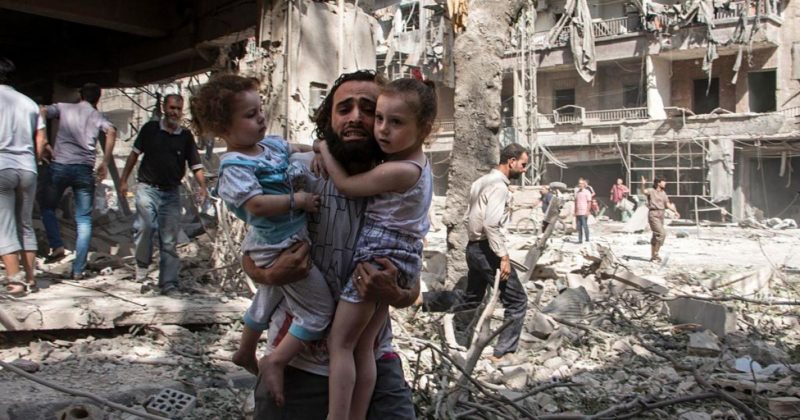
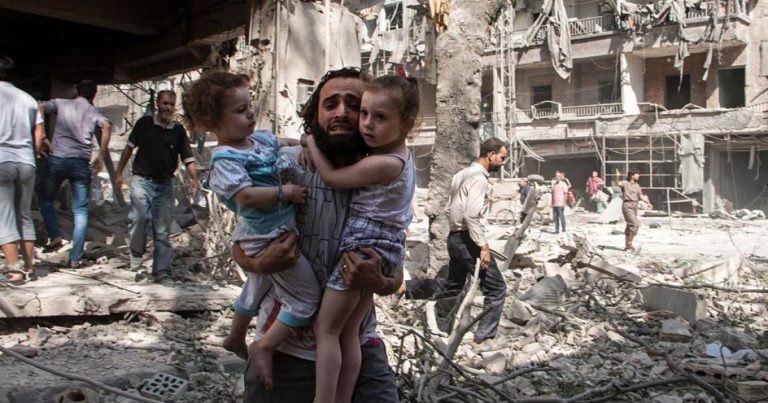
Children caught in the war in Syria

In the first four months of 2018 alone, hundreds of children lost their lives and many more wounded in countries ranging from the Central African Republic to South Sudan, and from Syria to Afghanistan.

“With little remorse and even less accountability, parties to conflict continue to blatantly disregard one of the most basic rules in war: the protection of children,” said Henrietta H. Fore, the Executive Director of UNICEF in a statement on Tuesday, May 15, 2018.

“The rules of war prohibit the unlawful targeting of civilians, attacks on schools or hospitals, the use, recruitment and unlawful detention of children, and the denial of humanitarian assistance. When conflicts break out, these rules need to be respected and those who break them need to be held to account,” she stressed.

In addition to the children caught in fighting, millions more are at the risk of starvation, abduction, child recruitment, abuse and displacement. Many are also losing their lives to deadly diseases that could have been prevented.

In Yemen, for instance, almost 4.3 million children are severely food insecure. In Syria, over 5.3 million children are internally displaced or refugees outside its borders and nearly 850,000 children continue to live in besieged or hard-to-reach areas.

The situation is equally worrying in South Sudan, where in addition to displaced and acutely malnourished children, some 19,000 young people continue to be used as fighters, messengers, porters, cooks and even sex slaves by warring parties.

In the statement, Ms. Fore said that in these crises and many more, UNICEF and partners are “doing all they can” to alleviate the suffering of children and their families.

“Despite funding shortfalls we are resolutely committed to serving the most vulnerable. We are vaccinating children, treating them for malnutrition, sending them to school, providing them with protection services, and trying to meet their basic needs,” she said.

Only 16 per cent of UNICEF’s funding needs for 2018 have been met.

In a separate statement, UNICEF denounced an attack in north-west Burundi which, according to several reports, deliberately targeted children.

The attack that took place in the Cibitoke province on May 11 claimed the lives of 25 people, including 11 children and came ahead of polls this week in a referendum.

Leila Pakkala, the Regional Director for Eastern and Southern Africa at UNICEF, reiterated the need to protect the young.

“Children need peace and protection, always,” she said, adding: “UNICEF calls on all parties to immediately ensure full respect of children’s right to safety and their protection from violence.”

Otodo Gbame evictees demonstrate on lagoon, seek church’s intervention

0

On Tuesday, May 15, 2018, the Nigerian Slum/Informal Settlement Federation (known as Nigerian Federation) and evictees from Otodo Gbame took their demonstration to the Lagos lagoon to commemorate one year since the final stage of the eviction of the community and six months since the violent crackdown on their last peaceful protest.

Otodo Gbame evictees
The protesting Otodo Gbame evictees

The evictees, along with sympathisers, marched from the Freedom Park, Ojota, to Lagos Government House, Alausa on November 15, 2017 to protest the forced eviction of April 9, 2017.

EnviroNews learnt that, on November 7, 2016, the Lagos State High Court restrained any eviction of the waterfront communities, including Otodo Gbame, an Egun fishing community, located around a prime real estate in the Lekki area of Lagos.

On June 21, 2017, the same court reportedly pronounced the forced evictions unconstitutional and ordered resettlement for those evicted. But the Akinwunmi Ambode administration seems to be foot-dragging on the matter.

Re-enacting the moment they became internally-displaced “boat people” during the final and most brutal stage of the eviction, thousands of the evictees – who remain homeless and in squalor till date – pushed out their canoes into the Lagos lagoon.

The evictees had gathered in solemn commemoration, joined by their peers from other waterfront communities and the Nigerian Federation, in a flotilla of boats between University of Lagos (UNILAG) Waterfront and Third Mainland Bridge in the early morning hours.

The event was marked with traditional Egun music and an on-water procession from UNILAG Waterfront past Makoko and Oko Baba Waterfronts to the headquarters of the Redeemed Christian Church of God (RCCG), where evictees called for support from religious and other leaders in their continued struggle for justice and to end forced evictions.

In company of local and international media coordinated by Megan Chapman, co-founder/co-director of Justice & Empowerment Initiatives (JEI) – Nigeria, the homeless evictees, after demonstrating on the lagoon, headed for the RCCG headquarters at Redemption Way, Ebute Metta, to deliver a letter to the church.

Taiwo Murtala, who coordinated the evictees, told EnviroNews their mission to RCCG.

“We want Governor Akinwunmi Ambode to understand that we deserve justice.

“With the opportunity of the procession, we are telling the governor, whose wife is a senior pastor of RCCG, to give us justice,” he said, adding that about 90 per cent of the evictees are Redeemers.

Elijah Atinkpo, media coordinator of the event, corroborated Murtala that they were at the RCCG to submit letter to the church leaders, as “Mrs. Ambode is a senior member of the church.”

“We feel that people like Vice president Yemi Osinbajo, who is a Redeemer, can help sit Ambode down and talk to him on our behalf, to see how we can arrive at a consensus that will favour both sides,” he said.

He was optimistic that the church can get justice for them because religious organisations are for the well-being of humanity.

The community’s demand, according to him, was for government to reinstate them at Otodo Gbame because they were living there for good reasons, one of which is their occupation, which is fishing.

On April 9, 2017, the final 5,000 evictees were chased into wooden boats on the lagoon and their homes set on fire.

Reports have it that over 30,000 people have been displaced and over 13, including Daniel Aya, killed, while 158 peaceful protesters have been arrested due to the eviction.

By Chika Onwuji

Schwarzenegger tells environment advocates to ‘stop whining’

0

The world’s regions should act together to protect the environment, rather than complain about the state of the climate, action film star and former California governor, Arnold Schwarzenegger, said on Tuesday, May 15, 2018 in Vienna, Austria.

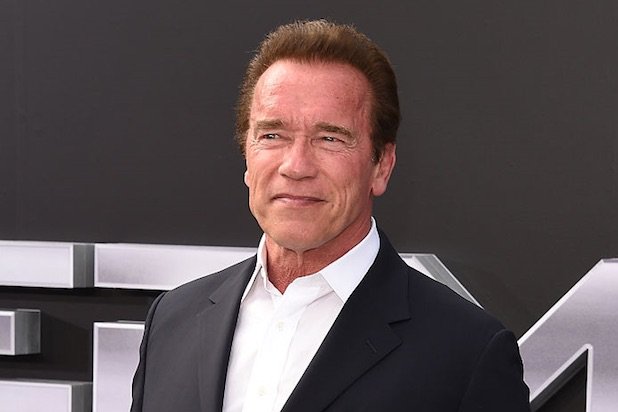
Arnold Schwarzenegger

“Stop whining,” he told an environment conference called the Austrian World Summit.

The Austria-born politician also issued an appeal to U.S. President, Donald Trump, who has pulled out of the Paris Agreement on climate protection.

“Which side will you choose?’’ Schwarzenegger asked.

He said: “We choose to make the planet great again and healthy again, playing on Trump’s slogan “Make America Great Again.’’

Schwarzenegger appeared in Vienna only weeks after heart surgery.

He joked that his surgeon had promised to take good care of him for political reasons.

“The doctor had said we are the only Republican with a heart, we are an endangered species,’’ Schwarzenegger stressed.

The former governor told the 1,200 attendees including UN Secretary General Antonio Guterres that they should adopt an athlete’s mindset when it comes to fighting climate change.

“We will keep winning, too often, we play defence instead of offence,’’ he said.

Report says the Vienna conference is linked to Schwarzenegger’s R20 initiative, which supports regions in developing green infrastructure.

Niger governor warns against felling of economic trees

0

Gov. Abubakar Bello of Niger State in Nigeria has warned that the full wrath of the law would be visited on those that continue with the habit of felling economic trees in the state.

Alhaji-Abubakar-Sani-Bello
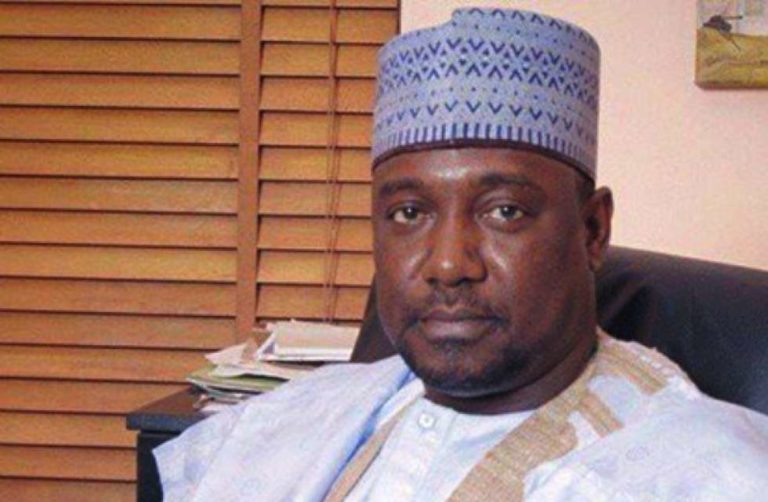
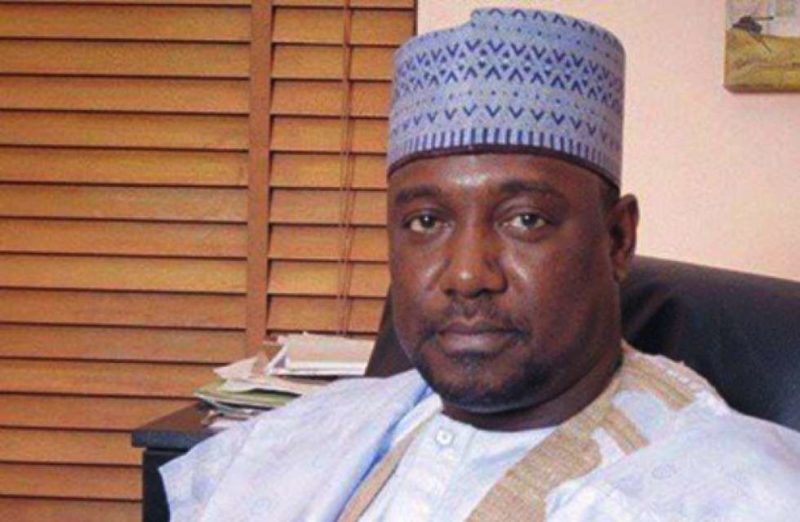
Alhaji Abubakar Sani Bello, Governor of Niger State

He gave the warning during the flag off ceremony of the 2018 cropping season and distribution of tractors to farmers in Minna on Tuesday.

Bello disclosed that the state government had put in place mechanism to check the ugly tide.

He called on stakeholders, traditional and religious leaders to continue to sensitise the people on the value of economic trees.

He said that the state would soon take the world lead in having the highest number of Shea tree as well as take advantage of the favourable weather for production of other crops such as rice, sesame seed, ginger and cashew nuts.

The governor added that the state government would exploit its agricultural potentials in the areas of grain reserve, ranching, animal husbandry, fisheries, development of economic trees and cash crops.

He said that the state government in 2016 approved the establishment of five hectares each for planting of Shea trees and oil palm plantations.

“This is to demonstrate the commercial viability of these high value tree crops and provide the platform for the establishment of over 5,000 hectares plantation by our farmers and private investors.

“We have also cleared over 5,000 hectares of land in various locations under the accelerated agricultural development scheme to encourage our youth to embrace farming,” he said.

By Rita Iliya

Nigerian leaders urged to address climate change issues

0

The Founder of GreenAid Africa, Dr Tabi Joda, has advised Nigerian leaders to address climate change issues which are threatening the wellbeing of the citizens.

Dr-Peter-Tarfa-DCC
Dr Peter Tarfa, Director, Department of Climate Change (DCC) in the Federal Ministry of Environment

He gave the advice at a one-day sensitisation programme on “The Role of Persons with Disability in the Fight against Climate Change in Nigeria’’ in Kaduna on Tuesday, May 15, 2018.

Joda noted that Nigerian leaders had, for a long time, been participating in roundtable discussions on climate change but they had yet to initiate any pragmatic strategy to tackle climate change issues.

The ecologist said that, since 2012, Nigeria started experiencing devastating disasters such as floods, fire outbreaks and landslides.

“These incidents have amplified the urgency in understanding that we are living in danger; a danger posed by climate change and we need to understand that there are problems right in front of us.

“The media call the incidents natural disasters but I insist that no disaster is natural.

“If the disasters are natural, that means something is driving them – human activities. And so, what are those human activities driving these disasters?” he asked.

He bemoaned the dearth of policy frameworks to tackle climate-driven disasters.

“We are quick to plunder our forests, causing lots of deforestation which result in desertification and land degradation; fuelling erosion and affecting our agricultural production systems.

“The vast open degraded lands are creating new weather variability, leading to uncertain weather conditions which are creating windstorms, destroying homes and communities.

“This also drives excessive weather activities, causing flooding, earthquakes and different kinds of disasters that threaten human existence.

“If we look around our communities, there are streets without gutters; even the streets with gutters are inundated with plastic bottles and bags.

“When rain falls, the waterways are all full and cannot channel water straight into the lowlands, thereby causing flood in homes.

“And you say these disasters are natural?  No, they are not,’’ he added.

Joda called on persons with disability to start advocacy campaign on climate change, stressing that they were part of those who suffered most from the consequences of climate change.

By Ezra Musa

NOSDRA warns against indiscriminate disposal of used oil

0

The National Oil Spill Detection and Response Agency (NOSDRA) has warned heavy-duty engine operators, generator repairers, roadside oil dispensers and automobile mechanic workshops against indiscriminate disposal of used oil.

FMEnv Retreat
Director-General, National Oil Spill Detection and Response Agency (NOSDRA), Sir Peter Idabor

Mr Peter Idabor, the Director-General of the agency, gave the warning on Tuesday, May 15, 2018 in Calabar, Cross River State, during an Outreach Community Programme on Management of spent oil.

The News Agency of Nigeria (NAN) reports that the workshop was organised for community dwellers, household users of generator oil, manufacturing industries, service stations, motor oil retailers among others.

Idabor, who was represented by Mr Charles Atebo, Director of Legal Services, NOSDRA, said it was important for users of spent oil to be aware of harmful effects of mishandling and mismanaging spent oil.

According to him, the aim of the workshop is to sensitise stakeholders on the phases of spent oil management with emphasis on spent oil generation, storage, transportation, recycling and disposal.

He explained that the agency was saddled with the responsibility of regulating and managing all oily wastes, oily or organic sludge and spent catalyst in the nation.

“The objectives of this programme are to create a sustainable interface with all stakeholders; communities, household users of generator oil, manufacturing industries, service stations, motor oil retailers, auto-mechanics among others.

“It is also to educate stakeholders on the deleterious consequences of mismanaging spent oil and to solicit stakeholders’ engagement and commitment for the project.

“The programme in itself is a bold initiative and given its importance. We intend to replicate this outreach in all the state of the federation,’’ he said.

Speaking, Mr Itaya Asuquo, Commissioner for Petroleum in Cross River State, said that the state has over 35 petroleum tank farms.

Asuquo added that the amount of spillage and pollution passing through the Calabar-Channel was high and could be dangerous to inland water.

“Something should be done by the Federal Government with a view to compensate the state.

“The state should be compensated because of the current spillage and pollution resulting from the operations in the tank farms,’’ he said.

Mr Mike Eraye, the state Commissioner for Environment, said that the activities of the various tank farms in Calabar metropolis had negatively affected the inland water.

“The people of Cross River are largely affected by oil exploration activities and this has badly affected our inland water,’’ he said.

Eraye, however, lauded the state governor, Prof. Ben Ayade, for placing premium on issues of environment in the state.

He said that the State Ministry of Environment was collaborating with the Federal Ministry of Environment to ensure that the challenges were addressed effectively.

By George Odok

Association warns traders against indiscriminate dumping of refuse

0

The Chairman, Traders Association, Gwagwalada Area Council, FCT, Mr Ifeanyi Ikpacha, has called on traders in the market to guard against indiscriminate dumping of waste in the area.

waste evacuation
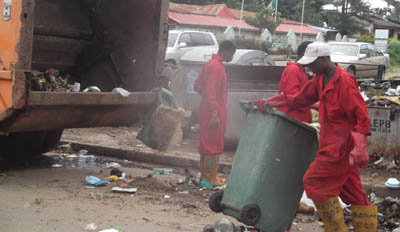
Officials of one of the AEPB waste evacuation contractors, on duty in Garki Area of Abuja

Ikpacha made the call in an interview with the News Agency of Nigeria (NAN) in Gwagwalada, FCT, on Tuesday, May 15, 2018.

He said the advice became necessary considering the harmful effects of refuse to health as well as ensuring environmental cleanliness and the well-being of the people.

He said dumping of refuse in the market and other places indiscriminately could be a breeding ground for mosquitoes and rodents which would lead to communicable diseases.

“I want to use this medium to appeal to the traders in the market and the general public to avoid indiscriminate dumping of refuse in the drains and along the roads.

“The association has also been sensitising the traders and residents on the dangers of indiscriminate disposal of refuse.

“We tell them to make the unkempt shops and environment clean in enhancing environmental cleanliness and promote a healthy living.

“Residents should try as much as possible to keep their environment clean; it is the responsibility of everybody to complement government’s efforts in this regard.’’

The chairman advised traders to always keep their dustbins tight and cover them at all times as debris from uncovered dustbins might drop into the gutters.

He also urged the traders to clean the gutters and canals in their immediate environment for the sake of their health and the health of the nation.

“The sensitisation is also to help the traders take a proactive step to curtail unhealthy habits.

“They should consider its health implications on human lives and also know that indiscriminate dumping of refuse can increase flooding in the city as well,’’ he said.

He, however, warned the traders to always dispose their wastes in designated places for easy evacuation by cleaning contractors.

By Gami Tadanyigbe

Ecologist urges prompt evacuation of waste to prevent disease outbreaks

0

An ecologist, Mr Habib Omotosho, has called on waste management agencies across the country to ensure prompt evacuation of waste to prevent the citizens from contracting diseases.

waste managers
Lagos waste PSP operators at work

Omotosho, the National Coordinator, Environmental Advancement Initiative, an NGO, gave the advice in an interview with News Agency of Nigeria (NAN) in Abuja on Tuesday, May 15, 2018.

“There is need for quick evacuation of waste, particularly during the rainy season, because uncleared garbage lying around in a neighbourhood usually attracts flies, rats and other vectors of disease which spread diseases.

“This leads to unhygienic conditions and a rise in the health problems in the area,” he added.

Omotosho attributed several illnesses afflicting the people to the lack of proper waste management channels in the country, saying that the development was also responsible for some environmental hazards.

“If waste, such as human excreta, liquid and solid waste from households and communities, is not properly managed, it can cause serious health hazards and lead to the spread of infectious diseases.

“In Nigeria, solid waste disposal sites are found on the outskirts of urban areas.

“However, these areas become sources of contamination to the people, particularly children, due to the breeding and proliferation of flies, mosquitoes, and rodents at the sites,’’ he said.

He underscored the need for the government to initiate good waste disposal procedures so as to safeguard the health of the people and their environment.

By Deji Abdulwahab

Lava threatens Hawaii exit routes, could spur more evacuations

0

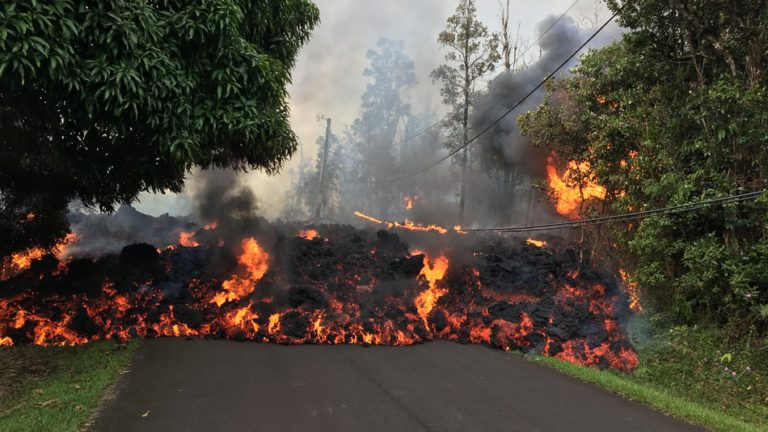
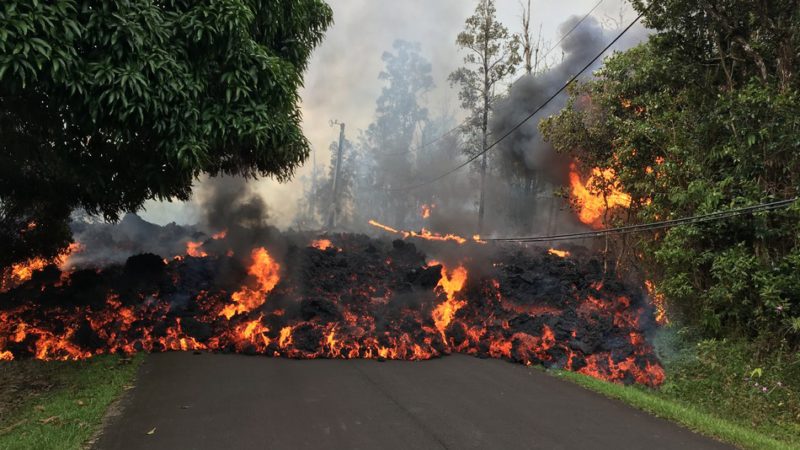
Lava flowing from giant rips in the earth on the flank of Hawaii’s erupting Kilauea volcano threatens highways.

Lava flow
A lava flow moves on Makamae Street in Leilani Estates on May 6

The threat raises the possibility that officials may order thousands more people to evacuate before escape routes are cut off on Tuesday, May 15, 2018.

Lava from a huge new fissure tore through farmland toward a coastal dirt road that is one of the last exit routes for some 2,000 residents in the southeast area of Hawaii.

More lava-belching cracks are expected to open among homes and countryside some 25 miles (40 km) east of Kilauea’s smoking summit.

This will possibly block one of the last exit routes, Highway 132.

Fountains of magma spouted “lava bombs” more than 100 feet (30 meters) into the air.

The molten rock travelled east-southeast toward the coastal road – Highway 137 – the Hawaiian Volcano Observatory said.

Mass evacuations will be triggered if either highway is hit by lava, said Hawaii National Guard spokesman Jeff Hickman.

“There’s a lot of worst-case scenario and roads getting blocked is one of them,” said Hickman.

Hickman stood on Highway 137, in the potential path of the lava flow, some two miles (3 km) away.

Dozens of homes have been destroyed since eruptions began 10 days ago.

Officials have ordered the evacuations of nearly 2,000 residents in the lower Puna district of the Big Island, home to around 187,000 people.

The American Red Cross said 500 people sought refuge in its shelters on Sunday night because of worsening volcanic activity.

Two more fissures opened in the past 24 hours, bringing the total to 19.

“It’s optimistic to think that this is the last fissure we’re going to see,” said Hawaiian Volcano Observatory Deputy Scientist-In-Charge Steve Brantley.

A similar seismic event in 1955 lasted 88 days, he said.

Unnerved by near-constant small earthquakes and emissions of toxic sulfur dioxide gas, Rob Guzman and his husband Bob Kirk left their home in Kalapana Seaview Estates while they still could.

“We just need the local government to calm down the panic that some of these 2,000 people are feeling that today, we’re going to be trapped with no way out,” said Guzman.

They left behind a banana farm and rental properties to go stay with friends.

The Hawaii Fire Department issued a “condition red” alert on Monday because fissures in the southeast area of the Lanipuna Gardens area were issuing high levels of sulphur dioxide.

“Condition RED means immediate danger to health so take action to limit further exposure.

“Severe conditions may exist such as choking and inability to breathe,” the department said in the alert.

While residents deal with noxious gas and lava on the ground, the U.S. Geological Survey is concerned that pent-up steam could cause a violent explosive eruption at the volcano crater.

Such steam launches a 20,000-foot (6,100-meter) plume that could spread debris over 12 miles (19 km).

Scientists had expected such explosions by the middle of this month as Kilauea’s lava lake fell below the water table.

The possibility exists, however, that water may not be entering the crater as feared, and gas and steam may be safely venting, scientists said.

“So far those explosions have not occurred and I think the key here is that the vent system is an open one.

”Therefore pressure is not being built or developed down at the top of the lava column,” Brantley told a conference call.