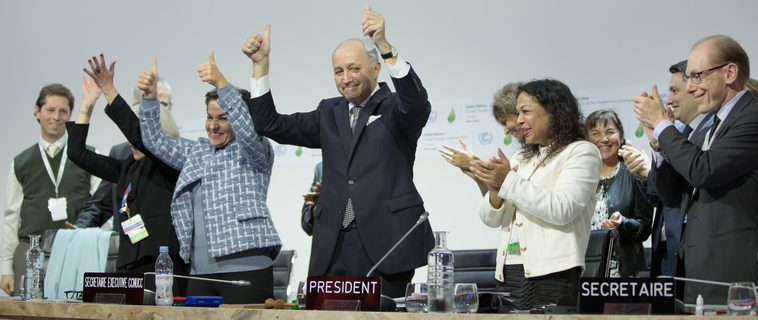
The historic speed with which countries approved the Paris Agreement must continue into equally speedy action at the UN climate talks that commenced on Monday in Morocco, international faith-based humanitarian and development network ACT Alliance has said.
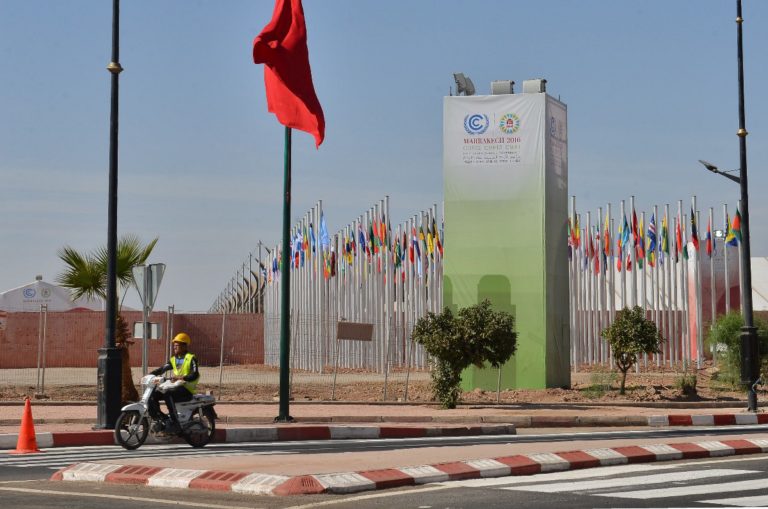
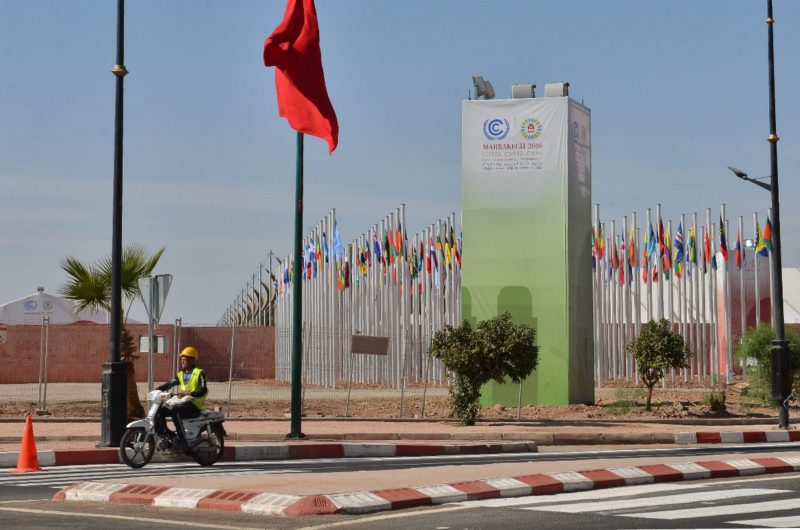
Venue of the conference in Marrakech
ACT Alliance is a network of 143 church and church related organisations working together in over 100 countries to achieve sustainable change in the lives of people affected by crisis, disasters, poverty and injustice.
Speaking as the COP22 talks began in Marrakesh and the UN Paris climate agreement entered into force on Friday 4 November, ACT Alliance said this meeting should be an “action COP” in which the targets set out in the Paris Agreement must now be fleshed out to ensure that the headlines are followed by ambitious rules.
The progress towards addressing the impacts of climate change truly took a step forward last year with the Paris agreement,” said ACT Alliance’s climate change working group lead Dinesh Vyas. “Governments have shown their commitment to tackling climate change and the agreements made at the Paris summit can now be fulfilled. However, an agreement with only headlines will not make any difference; therefore the agenda at the COP22 is very important to ensure that now the implementation must begin.”
The Paris climate agreement was adopted in December last year at the UN Climate talks, COP21 and, it is, according to the ACT Allinace, the first global agreement to include national commitments of action for all countries, as well as a mechanism to increase much needed ambition in the coming years.
However, Mr Vyas warned: “Action, not just a mechanism for increased ambition, is urgently needed to ensure that ambition to tackle global temperature rises by transitioning to an economy based on clean energy is truly scaled up. We all know that the collective ambition agreed in Paris is still too low and will not keep global warming below 2 degrees celcius, let alone 1.5 degrees celcius. This should be a core concern of all parties in the coming days.”
“I see the struggle people face to adapt to the devastating impact of climate change on a daily basis in my work,” he added, “so I look forward to seeing increased action by governments in both developed and developing countries to ensure people can adapt to these challenges and live full lives with the dignity they deserve.”
Eighteen government delegates who represent the governments of more than 57 million people on Monday called for the strongest protections yet to guard against tobacco industry interference in public health policymaking. The appeal, released in an open letter on the opening day of the World Health Organisation’s Seventh Session of the Conference of the Parties (COP7) holding in New Delhi, India, sets the stage for a landmark decision to protect international policy from industries with conflicts of interest.
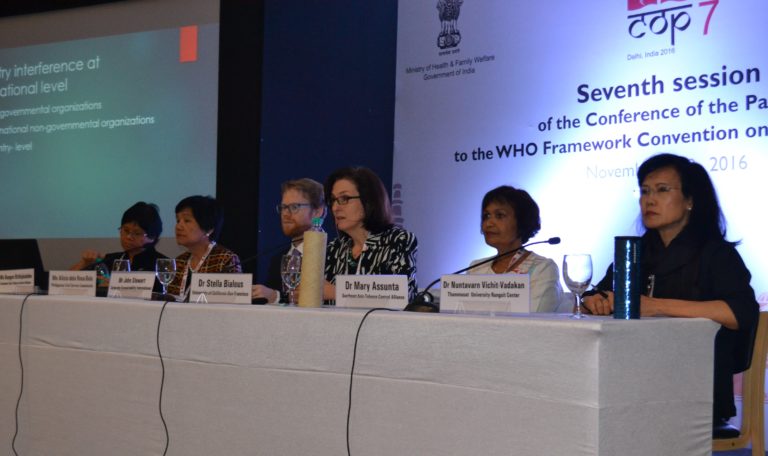
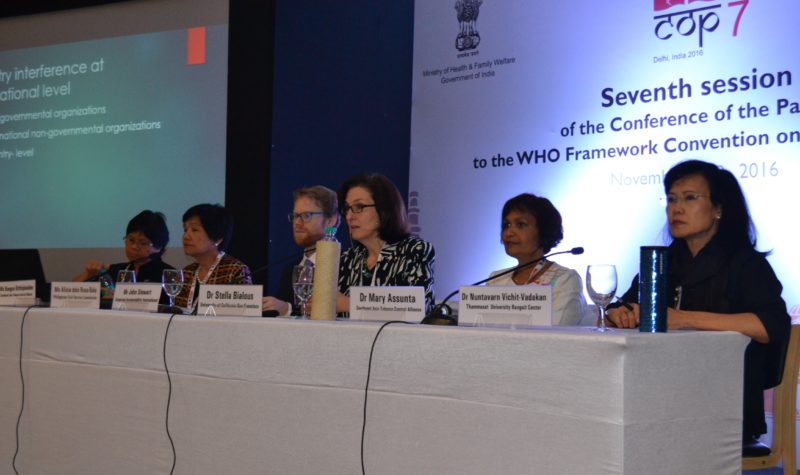
A gathering of delegates at the conference
The call comes as delegates from up to 179 countries and the European Union convene in India to determine the next frontiers in tobacco control. It also builds on the support of more than 100 civil society organisations from India and around the globe for delegates to protect the negotiations from industry interference.
At the negotiations, formally known as the seventh session of the Conference of the Parties to the Framework Convention on Tobacco Control (FCTC), governments are poised to advance life-saving tobacco control measures such as plain packaging and graphic health warnings. However, to date, the tobacco industry has exploited loopholes in order to infiltrate treaty meetings and block, weaken and delay outcomes that could save millions of lives. In fact, the FCTC Global Progress report has stated that the “tobacco industry continues to be the most important barrier in implementation of the Convention.”
“The tobacco industry is, hands-down, the single-largest threat to public health in the world,” said Dr. Sheila Ndyanabangi, Principal Medical Officer, Mental Health and Substance Abuse Control/ Tobacco Control, for the Ugandan Ministry of Health. “As delegates to the global tobacco treaty, we have an ethical responsibility to prioritise people’s health over the industry’s interests. Today, we recognise that the most urgent task before us is to protect policymaking from the corrosive influence of Big Tobacco.”
The global tobacco treaty contains a provision that protects policymaking processes from the tobacco industry at the international and national levels. The provision was created to address the tobacco industry’s strategies to upend regulations by influencing international and national policymaking bodies, as outlined by millions of internal documents. Despite this legal requirement, however, the tobacco industry has infiltrated negotiations through bribery, securing seats on government delegations, and posing as members of the public.
As the BBC exposed in November 2015, in spite of the treaty’s provision, British American Tobacco paid an official at the Burundi Ministry of Health and an FCTC representative to “support” the corporation’s interests in international negotiations about tobacco regulations. Tobacco industry interference has been so egregious that delegates have been forced to eject industry representatives from the last two international treaty negotiations.
“With recent wins against Big Tobacco’s legal bullying in Uruguay and Australia, we stand at a tipping point for public health,” said John Stewart, deputy director with Corporate Accountability International, an accredited observer to the global tobacco treaty proceedings. “Given the industry’s widespread lying, cheating, and outright bribery, governments are ready to act. The global tobacco control community is poised to protect decisions about people’s health from narrow corporate interests, and pave the way for a future where Big Tobacco and its bullying are a thing of the past.”
Akinbode Oluwafemi, deputy executive director of Environmental Rights Action/Friends of the Earth Nigeria (ERA/FoEN), said: “The time is now to put a final roadblock to Big Tobacco interference in public health policy. We have witnessed meddling in Nigeria; we have witnessed it across Africa and observed it at the global treaty meetings. Article 5.3 of the FCTC has proven to be the single most effective provision of the global treaty to block Big Tobacco interference.”
To date, dozens of governments have begun to implement measures in line with Article 5.3 at the national level, and more are expected to follow suit. For instance, Norway has divested more than $2 billion from the tobacco industry. Brazil adopted ethical guidelines for representatives of its tobacco control commission, CONICQ, requiring that it has no ties with the tobacco industry. The European Union has terminated its agreement with Philip Morris International. And the Philippines has restricted public officials from interacting with the tobacco industry to curb its influence.
In addition to Monday’s call to prevent industry meddling in public health, delegates also indicated plans to advance tools to hold the tobacco industry liable. The advances stem from a broader treaty directive called Article 19 that encourages governments to, among other recommendations, utilise legal systems to recoup the enormous costs of tobacco-related healthcare coverage.
The global tobacco treaty entered into force in 2005. To date, 179 countries and the European Union have become Parties to the treaty. It is said to contain the world’s most effective tobacco control and corporate accountability measures – estimated to save more than 200 million lives by 2050 if fully implemented.
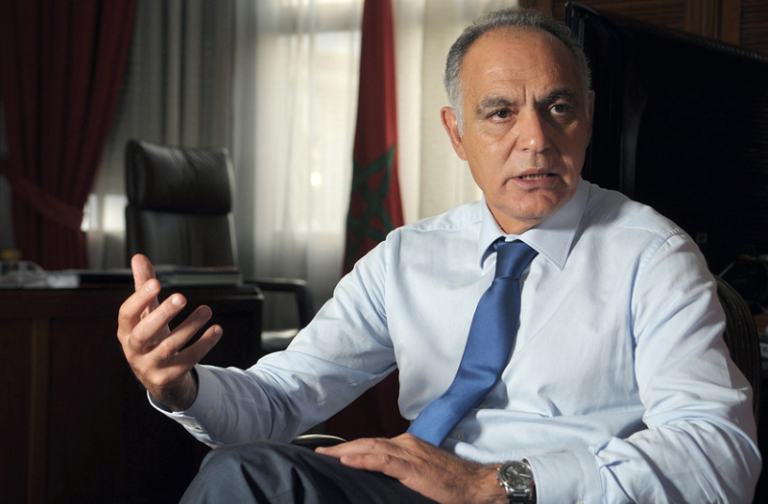
On Day 1 of COP22 holding in Marrakech, the theme was “Africa in Action.” Foreign Minister of Morocco and President of COP22, Salaheddine Mezouar, said in his opening remark that the conference being held “on African soil demonstrates a whole continent’s commitment to contributing to the global effort” to fight climate change. He emphasised the importance of helping all African countries fight climate change because the “sun does not ignore a village because it is small.”
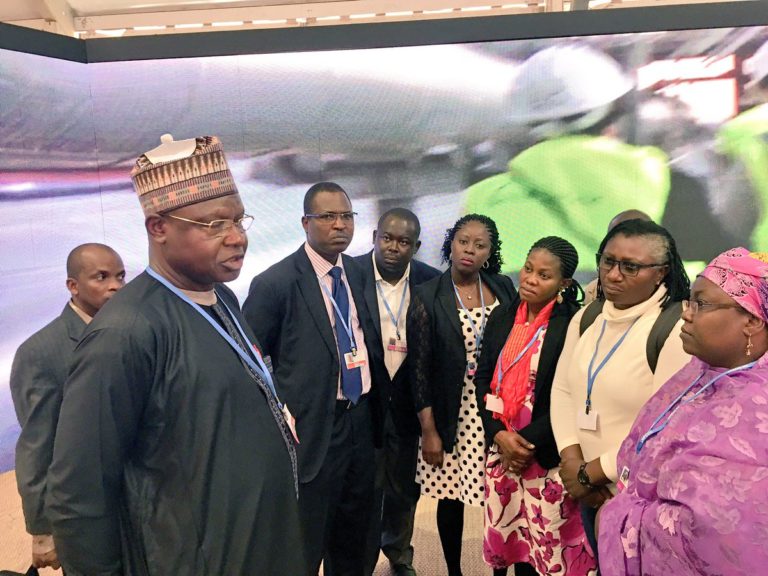
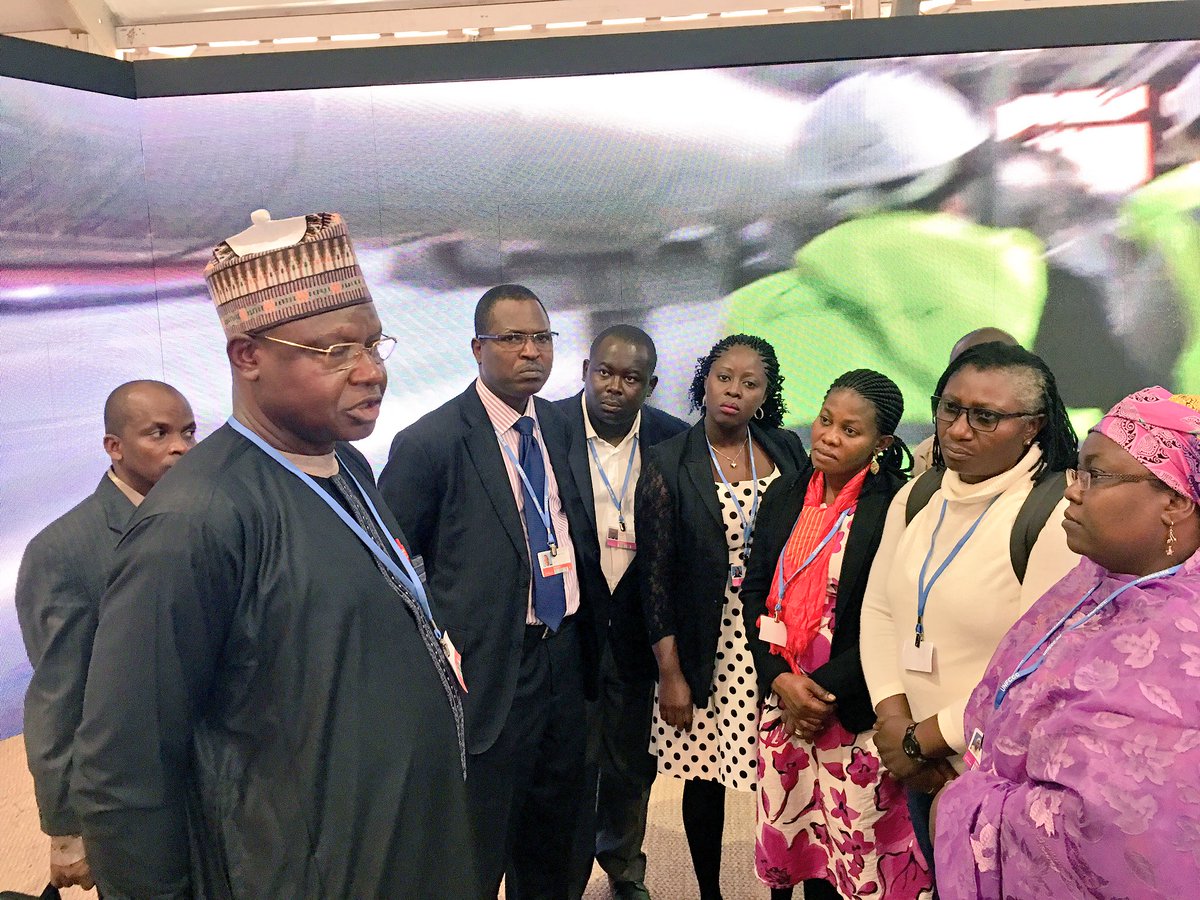
Environment Minister of State, Ibrahim Jibril (left), briefing members of the country’s delegation to the COP on Tuesday
The Africa pavilion, a large tent housing several separate country pavilions, was animated with big screens depicting desert, ocean, and forest scenes from around the continent. Space filled quickly with delegates, observers, and journalists as the opening plenary concluded and the conference was officially underway.
The pavilion will host many events throughout the 11 days. Getting rural areas more reliable access to energy and working with the international civil aviation industry were just two of the panel discussions taking place on Tuesday.
Several countries hosted events and panel discussions to highlight each of their efforts in climate action. Tunisia and Ethiopia partnered to discuss with German representatives how the three could create carbon market-based solutions to dealing with their environmental issues. Tunisia is especially interested in involving its cement sector. Nigeria also scheduled an event there on that day, where Environment Minister of State, Ibrahim Jibril, briefed members of the country’s delegation to the COP.
The Paris Agreement included a provision for “Loss and Damage,” a term that refers to what Pacific Island nations and the poorest countries around the world face as a result of natural disasters. A panel of scientists discussed climate insurance, of particular help to African farmers facing drought.
Information booths have been set up in a separate area of the venue as well to help make sense of the information being disseminated to participants. Hosts include climate activist organisations, private sector businesses, and academic research organisations.
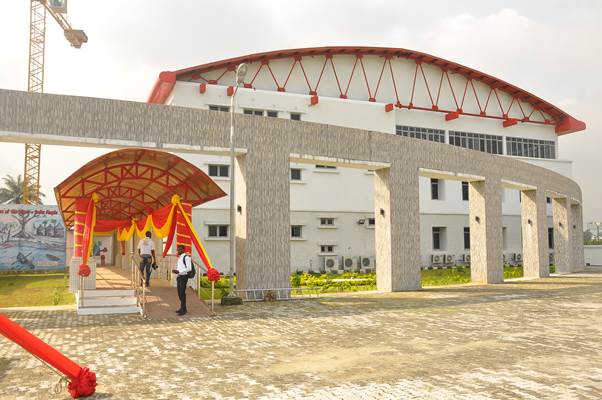
A modern e-library donated by Shell to the Port Harcourt Literary Society has opened its doors to book lovers and other literary enthusiasts. The N1.03 billion library is one of the N2 billion social investment projects Shell sponsored in the Niger Delta to mark Nigeria’s centenary anniversary. The others are a hospital and sports centre in Bayelsa and Delta states respectively. Shell spent N790 million on the project that was implemented via a Memorandum of Understanding with the Port Harcourt Library Society, which contributed an additional N240 million.
The e-library donated by Shell to the Port Harcourt Literary Society
“SPDC invested exclusively on this library project because of its strong conviction that it will deliver significant benefits and positively impact the lives of the people,” said Osagie Okunbor, Managing Director of The Shell Petroleum and Development Company of Nigeria Ltd (SPDC) and Country Chair Shell Companies in Nigeria, at the commissioning ceremony. “We are pleased to deliver an ultra-modern public library that would rank as one of the biggest and most IT-driven in the country. The feedback we’re receiving shows that the literary scene in the Garden City has already changed.”
Nigeria’s National Librarian, Prof Lenrie Aina, told journalists that the facility, named Port Harcourt Literary Society Library, is the “first complete public library in Nigeria,” because, aside from Shell ensuring supply of power, books and cooling, every comfort of book lovers was considered in the design and construction of the library.
Deputy Governor of Rivers State, Dr. Ipalibo Banigo, in a speech delivered by her Senior Special Assistant, Mrs. Inegogo Fubara, thanked SPDC for supporting the state government’s desire to provide sustainable and affordable education to the people.
Managing Director SPDC/Country Chair, Shell Companies in Nigeria, Osagie Okunbor; representative of the Deputy Governor of Rivers State, Ine Gogo Fubara; and Chairman, Board of Trustees Port Harcourt Literary Society, Chidi Amuta, at the inauguration of the Port Harcourt Literary Society Library donated by Shell to mark Nigeria’s centenary anniversary in Port Harcourt recently.
Chairman, Board of Trustees of the Port Harcourt Literary Society, Dr Chidi Amuta, said the library was designed to be the heart of the Port Harcourt Book Centre that was originally conceived to commemorate the recognition of Port Harcourt by the United Nations Educational, Scientific and Cultural Organisation (UNESCO) as the 2014 World Book Capital.
He added: “Oher structures awaiting donor evaluation and sponsorship include a writers’ hostel, an event centre/exhibition hall and a theatre. The Book Centre, like the Muson Centre in Lagos along which it is modelled, is conceived as a centre of culture and enlightenment.”
An elated Senator Magnus Abe said: “In everything Shell has done in the Niger Delta, today they have made a statement that will never go away. They have set us as a people as partners, in truth, because it is books that will develop the Niger Delta. So having associated themselves with books today in the lives of our children and in the lives of our youths, Shell has made an indelible contribution to the true development of this region. We will never forget you.”
The cynosure of all eyes at the event was 10-year-old Shawn Ene, who single-handedly raised over N250,000 for the donation of children’s books under the special support programme of Shell Nigeria staff’s volunteer group, Shell Employees Care. There were also poetry and drama performances at the commissioning of the library.
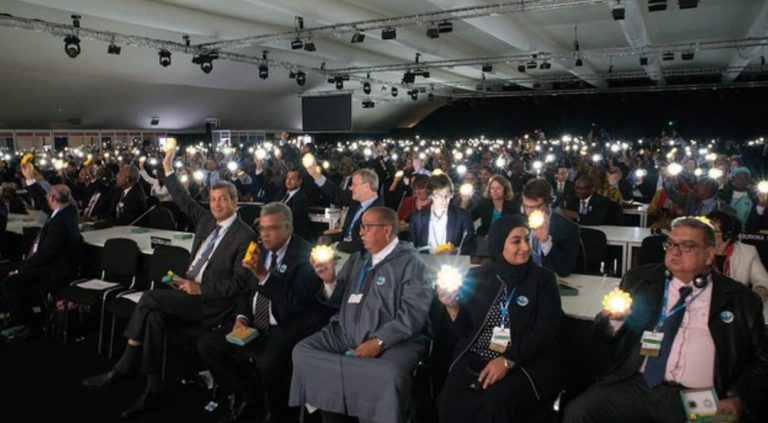
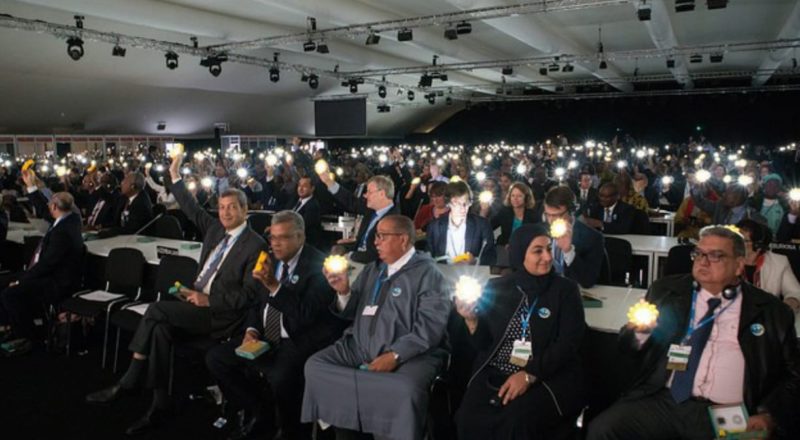
Delegates from 196 countries on Monday held up solar lanterns in a show of solidarity symbolising the transformation to clean technology which is essential to achieve the Paris Agreement goals.
Delegates holding their solar lamps during the opening ceremony. The gesture is a show of solidarity symbolising the transformation to clean technology which is essential to achieve the Paris Agreement goals
This took place as the 22nd Session of the Conference of Parties to the United Nations Framework Convention on Climate Change (UNFCCC) began Monday morning in Marrakech, Morocco.
The solidarity show was at the behest of Morocco’s Foreign Minister and newly-elected COP22 President, Salaheddine Mezouar, who underscored his country’s willingness to host the conference as a demonstration of Africa’s commitment to contributing to global efforts at tackling climate change.
“It emphasises Africa’s desire to take its destiny in hand, to reduce its vulnerability and strengthen its resilience,” he said.
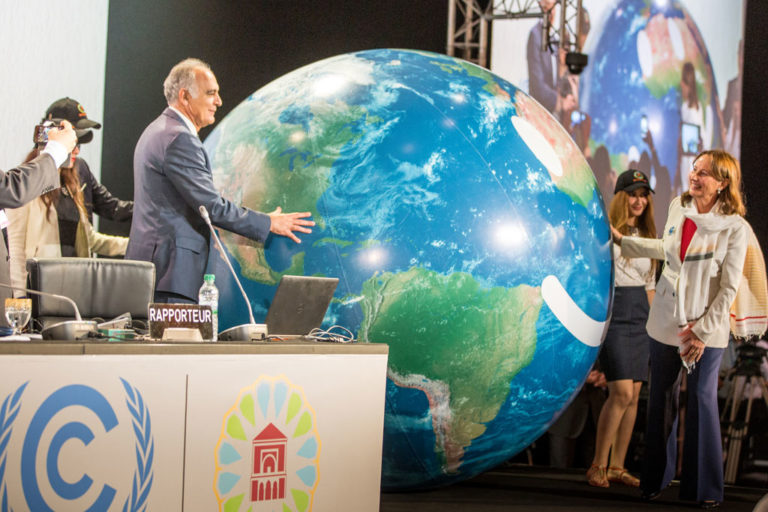
Together with Ségolène Royal, French Environment Minister and President of last year’s Paris UN Climate Change Conference, Mezouar handed out solar lanterns to all delegates at the opening ceremony.
Ratifying Paris Agreement
Acknowledging that the fact that the Paris Agreement is yet to put the world on track towards the goal of a maximum global average temperature of 1.5 to 2 degrees, as agreed by the international community in Paris last year, COP President Mezouar urged government delegates “to be more ambitious than ever in your commitments.”
“All over the world, public opinion must perceive change. It has to be a change at all levels, from local projects through to those that cross international borders and it must create genuine win-win partnerships,” he added.
In her last address before handing over the stewardship of the climate forum to her Moroccan counterpart, Ségolène Royal announced that 100 countries have ratified the Paris Agreement, which entered into force last Friday, a record time for an international treaty.
“We have made possible what everyone said was impossible, I therefore call on other nations to ratify the Paris agreement by the end of the year,” said French environment minister.
UNFCCC Executive Secretary, Patricia Espinosa, reasoned that whilst the early entry into force of the Paris Agreement is a clear cause for celebration, it is also a timely reminder of the high expectations that are now placed on governments: “Achieving the aims and ambitions of the Paris Agreement is not a given. We have embarked on an effort to change the course of two centuries of carbon-intense development. The peaking of global emissions is urgent, as is attaining far more climate-resilient societies.”
The place of climate finance
According to the UN climate chief, climate finance has to reach the level and have the predictability needed to catalyse low-emission and climate-resilient development. This clearly resonates with African Development Bank’s plan to triple its climate financing to $5 billion per year by 2020.
President of the bank, Dr. Akinwumi Adesina, believes that its game-changing plan, the High 5s carries the prospects of tacking the impact of climate change on agriculture and how agriculture fuels climate change through a multi-pronged approach.
The first priority, Light up and Power Africa also deals with climate finance, adaptation and low carbon development. The bank has committed to triple its climate finance to US$5 billion a year by 2020, including by leveraging more finance from climate funds,”Adesina says.
Amid growing alarm at the gathering pace of climate change and its impacts – rising seas, deadly storms, drought and wildfires – the world’s nations have moved quickly over the last year to tackle the still-growing problem.
US election shadows
As 15,000 negotiators, CEOs and activists settle in for the 12-day talks in Marrakesh, all eyes are on the United States, where voting Tuesday could thrust Trump into the White House. When it comes to global warming, the stakes could hardly be higher, US President Barack Obama has warned.
“All the progress we’ve made on climate change” – including the Paris pact, decades in the making – “is going to be on the ballot,” he said.
Democratic candidate Hillary Clinton has vowed to uphold Obama’s domestic energy policies and international climate commitments. Experts in Marrakesh say the Republican candidate cannot carry out his threat to “cancel” the still-fragile accord, but a Trump victory might cripple it.
“It would be a shock, and I hope we don’t see it,” Laurence Tubiana, France’s top climate negotiator declared. “But if Trump is elected, I am sure that Wednesday morning you will hear everyone at the COP say, ‘We’ll stick to the Paris Agreement’,” she added.
Engaging Non-state stakeholders
Latching on the call made by the UNFCCC Executive Secretary on full engagement of non-state actors, the Pan African Climate Justice Alliance (PACJA) representing small holder farmers, trusts, pastoralists, women and youth groups from across Africa made public today their expectations for COP22.
Demanding acceleration on actions to address climate change with real, measurable actions and rhetoric, Secretary General of the Alliance, Mithika Mwenda, urged delegates to provide a roadmap on the provision of adequate and predictable financial resources from developed country Parties to developing countries to enable them meet their commitments in their NDCs as stated in Article 9 of the Paris Agreement.
The civil society group also underlined the urgency in establishing a common and agreeable reporting and accounting framework for financial support to enhance transparency of actions and avoidance of double counting provide the required capacity building support to assist African Country Parties to meet their NDCs mitigation and adaptation commitments in the Agreement.
COP22 President, Salaheddine Mezouar, has promised that the Moroccan COP Presidency will be one focused on inclusiveness and transparency.
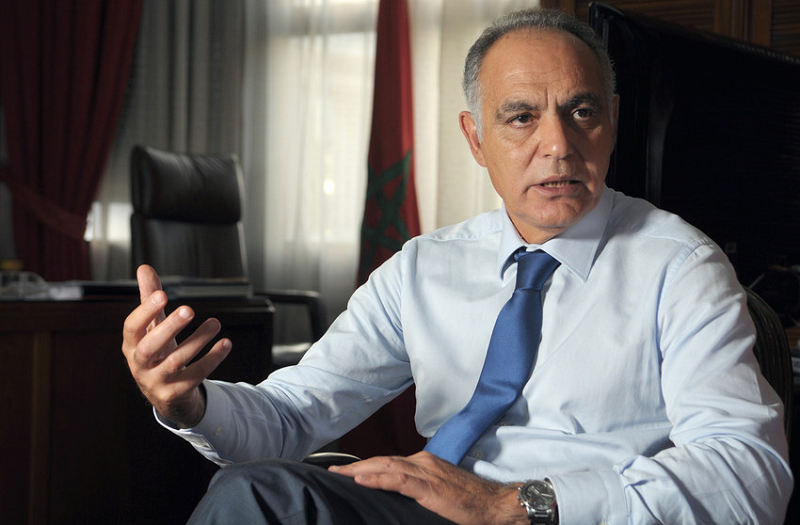
COP22 President, Salaheddine Mezouar
Mezouar, who made the submission on Monday at his first press conference as COP22 President on the opening day of the UN Climate Change Conference in Marrakech, highlighted the positive energy from the opening ceremony earlier in the morning that marked the transition from COP21 Presidency to COP22 Presidency. He thanked outgoing COP21 President, Segolene Royal, for all of her collaboration over the past year in preparation for COP22.
He pointed to remarks from HM King Mohammed VI made on the anniversary of Morocco’s Green March (November 6) in which he called for Marrakech to be the COP of action. According to him, “southern” countries have high expectations from the Marrakech conference in terms of climate finance, capacity building and technology transfer.
He alluded to the fact that there would be several announcements made over the next two weeks particularly in the areas of capacity building and adaption, including the Nationally Determined Contributions (NDC) Partnership designed to facilitate and strengthen capacity building support from developed countries towards developing countries.
The question around finance was raised, especially as related to projects in Africa. The COP22 President stressed that while the $100 billion dollar climate finance roadmap by 2020 for developing countries is a great start to leverage private financing, more needs to be done.
He expressed optimism about the emergence of green finance, including the Green Fund and said that COP22 would also concentrate on finding ways to optimise climate friendly financing, especially towards adaptation projects.
He noted that COP22 would be a COP of solutions, where partnerships, initiatives and projects will be made to reinforce capacity at the project level to help make them more “bankable.” According to the COP22 President, the key areas for climate finance to be addressed during COP22 are in renewable energies, water, agriculture forests and climate adaptation.
He added that one of the major initiatives that will be focused on during COP22 would be Morocco’s Adaptation of African Agriculture “AAA”. This initiative is designed to drive climate finance and technology solutions to smallholder farmers across Africa in order to boost sustainable agriculture on the continent.
The UN Climate Change Conference in Marrakech kicked off on Monday (November 7, 2016), just three days after the Paris Climate Change Agreement entered into force.
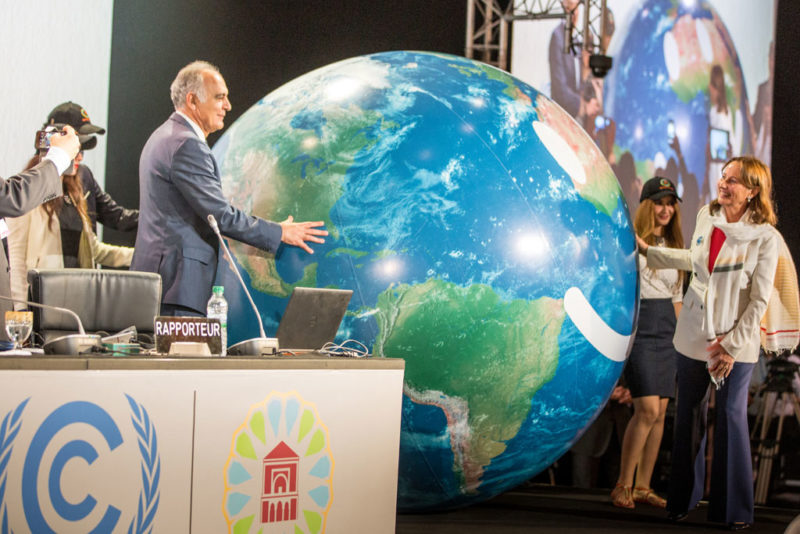
COP22 President and Morocco’s Foreign Minister, Salaheddine Mezouar (left), with COP 21 President and France’s environment Minister in charge of climate related international relations, Ségolène Royal, at the opening of COP 22 in Marrakech, Morocco. Photo credit: UNFCCC
At the opening, Morocco’s Foreign Minister and newly-elected COP22 President, Salaheddine Mezouar, underscored his country’s willingness to host the conference as a demonstration of Africa’s commitment as a whole to contribute to global efforts to tackle climate change. “It emphasises Africa’s desire to take its destiny in hand, to reduce its vulnerability and strengthen its resilience,” he said.
President Mezouar pointed to the groundswell of momentum building around the world. At the same time, he acknowledged the fact that the Paris Agreement does not yet put the world on track towards the goal of a maximum global average temperature of 1.5 to 2 degrees, as agreed by the international community in Paris last year.
Addressing government delegates, he said: “I would like to invite you over the coming eleven days to be more ambitious than ever in your commitments. All over the world, public opinion must perceive change. It has to be a change at all levels, from local projects through to those that cross international borders and it must create genuine win-win partnerships.”
Together with Ségolène Royal, French Environment Minister and President of last year’s Paris UN Climate Change Conference, Salaheddine Mezouar handed out solar lanterns to all delegates in the room, as a symbol of the transformation to clean technology which is essential to achieve the Paris Agreement goals. The delegates then held up the lights in a show of solidarity.
In her opening address Patricia Espinosa, Executive Secretary United Nations Framework Convention on Climate Change, said that whilst early entry into force of the Paris Agreement is a clear cause for celebration, it is also a timely reminder of the high expectations that are now placed on governments.
“Achieving the aims and ambitions of the Paris Agreement is not a given. We have embarked on an effort to change the course of two centuries of carbon-intense development. The peaking of global emissions is urgent, as is attaining far more climate-resilient societies.”
Ms. Espinosa underlined five key areas in which work needs to be taken forward, notably on:
Finance to allow developing countries to green their economies and build resilience. It is flowing and has to reach the level and have the predictability needed to catalyse low-emission and climate-resilient development.
Nationally determined contributions – national climate action plans – which now need to be integrated into national policies and investment plans.
Support for adaptation which needs to be given higher priority, and progress on the loss and damage mechanism to safeguard development gains in the most vulnerable communities.
Capacity building needs of developing countries in a manner that is both tailored and specific to their needs.
Fully engaging non-Party stakeholders, from the North and from the South, as they are central to the global action agenda for transformational change.
“Our work here in Marrakech must reflect our new reality. No politician or citizen, no business manager or investor can doubt that the transformation to a low-emission, resilient society and economy is the singular determination of the community of nations,” she said.
The 22nd Session of the Conference of the Parties (COP22) and the 12th Session of the Conference of the Parties serving as the Meeting of the Parties to the Kyoto Protocol (CMP12) opened on Monday, November 7, at the Bab Ighli village site in Marrakech with the election of COP 22/CMP12 President Salaheddine Mezouar and the official transition from the French COP21 to Moroccan COP22 Presidency.
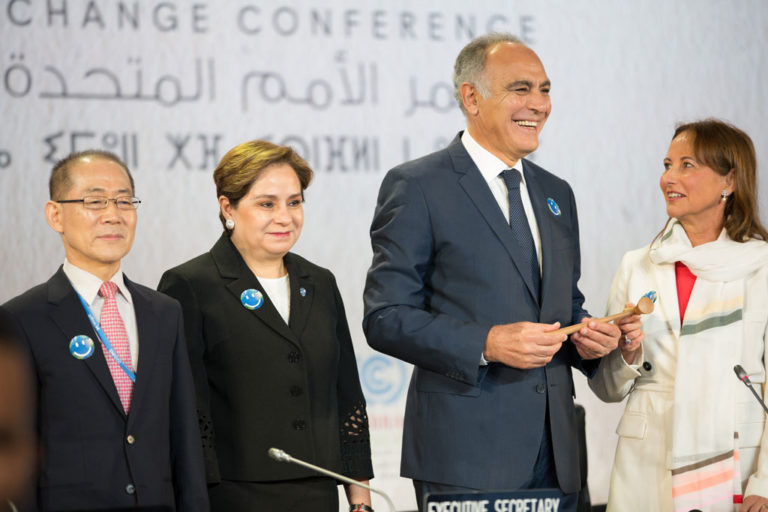
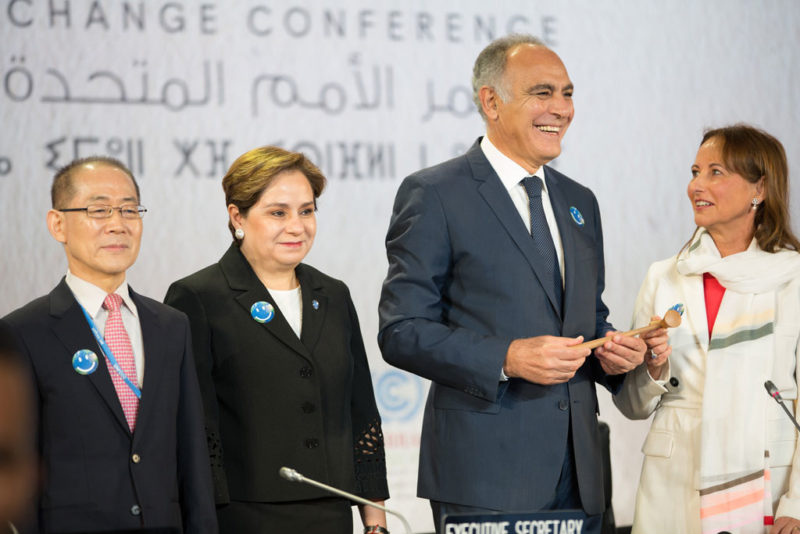
Left to right: Chair of the Intergovernmental Panel on Climate Change Hoesung Lee; UNFCC Executive Secretary Patricia Espinosa; COP 22 President Salaheddine Mezouar; and COP 21 President Ségolène Royal at the opening of COP22 in Marrakesh, Morocco, which officially assumed the COP22 presidency. Photo credit: UNFCCC
The official opening ceremony to the Marrakech Climate Change Conference featured remarks by COP22 President Salaheddine Mezouar, COP21 President Segolene Royal, UNFCCC Executive Secretary Patricia Espinosa, Intergovernmental Panel on Climate Change (IPCC) Chair, Hoesung Lee and the Mayor of Marrakech, Mohammed Larbi Belcadi, followed by a performance by a group of local drummers to set the beat for climate action over the next 11 days of the conference.
Segolene Royal opened the session by celebrating the entry into force of the Paris Agreement on November 4 and praised the close coordination between France and Morocco over the past year in the lead up to COP22.
“The rapid entry into force of the Paris Agreement is unprecedented and sends a powerful signal of world’s commitment to combatting climate change,” underscored the COP21 President.
Salahedinne Mezouar welcomed all participants to Marrakech for two weeks of climate action including the historic first meeting of the Parties to the Paris Agreement that will take place on November 15. The COP22 President called on all participants to commit to concrete climate initiatives and actions to support the most vulnerable countries to the impacts of climate change especially in Africa, least developed and small island developing states. He announced that during COP22 Morocco, along with a number of partners will launch the National Determined Contributions (NDC) Partnership to build capacity and direct climate finance flows towards the most vulnerable. He reiterated the importance of accelerating climate finance, innovation, transfer and capacity building to create the low-carbon economy the planet needs to stay below the 2 degree Celsius mark of global warming.
“Paris gave us a global commitment to climate change and COP22 in Marrakech will give us more ambitious climate action. We must all rise to the challenge in support of the most vulnerable countries in the fight against climate change” underscored the COP22 President.
Patricia Espinosa emphasised the historic significance of Morocco and Marrakech as host of the UN Climate Change Conference. COP7, held in Marrakech in 2001 produced the Marrakech Accords and COP22 will feature CMA1 and the first global climate action agenda that will feature thematic showcase events, dialogues and a high-level event to call on more coordinated and ambitious climate action between States and civil society.
“We need to work together with speed and scale on all fronts” said the UNFCCC Executive director.
The opening ceremony was brought to a close by an invigorating performance by a local traditional Moroccan drumming group, “Ostina Tono,” who set the rhythm for the two-week climate action conference in the Ochre City.
After a week of field investigations and discussions, the 6th Regional Conference on Human Rights and Agribusiness that held recently in Kota Kinabalu, Malaysia issued a resolution calling for moratoriums to halt the further hand out of concessions throughout the region. The meeting noted how land conflicts as a result of agribusiness expansion are proliferating and urged a pause in the hand out of licenses while community and indigenous peoples’ land rights are secured.
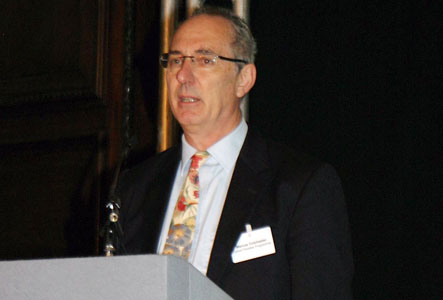
Marcus Colchester, Senior Policy Advisor of Forest Peoples Programme
“We have noticed that there is a failure in protecting native customary rights in the region,” said Marcus Colchester, Senior Policy Advisor of Forest Peoples Programme (FPP). “Land grabbing continues and native people are losing their land and rights. This needs to change. There’s a need for political reforms to close the gaps.”
The conference, which is the most recent of a series of events organised by the FPP in collaboration with the South East Asia National Human Rights Institutions Forum over the last five years, aimed at discussing and developing frameworks which can ensure that human rights obligations are binding on transnational and national agribusiness companies.
The meeting also examined the Roundtable on Sustainable Palm Oil’s Jurisdictional Approach to palm oil certification, which the state of Sabah in Malaysia is pioneering. This innovative and promising approach will apply the RSPO standard to all producers in the state. The aim is to make sure that by 2025 all palm oil produced in Sabah will be sustainable and RSPO certified. The conference made concrete recommendations on how to strengthen the process so it upholds UN principles on business and human rights and addresses the marginalized position that indigenous peoples and local communities have with government agencies in local and sub-national areas.
Before the conference, some participants had the chance to join two fact finding missions organised by the Jaringan Orang Asal SeMalaysia (JOAS) and indigenous organisations Partners of Community Organisation (PACOS) and Sabah Environmental Protection Association (SEPA), with the aim of investigating the challenges faced by communities in Pitas and Bigor, Nabawan (Sabah) due to the development of land-based projects in the areas. The results of the missions were shared and discussed at the event.
“The visits to Pitas and Bigor were an opportunity for the communities to look for solutions about the areas,” said Jannie Lasimbang, Secretary General of JOAS. “The message we would like to convene is that we are going for agribusiness but we also want to comply with international standards.”
Following the fact finding mission, participants to the meeting also called on the Chief Minister of Sabah to heed the appeals of the communities in Pitas, whose lands have been taken over by a shrimp-pond development project leading to the destruction of mangrove forests and loss of local peoples’ livelihoods. It also called for a revision of the law on ‘communal title’, to close loopholes that are being misused to favour corporate takeovers of community lands without proper consultation and without securing consent from the communities.
“It is in our present mandate to stop the breaching of human rights in the agribusiness sector,” said Francis Johen, Commissioner of the Human Rights Commission of Malaysia (SUHAKAM). “This requires support from different stakeholders, most importantly the government.”
As the 22nd Session of the Conference of the Parties (COP22) to the United Nations Framework Convention on Climate Change (UNFCCC) gets underway at Marrakech in Morocco, Oilwatch International, a network of resistance to the negative impacts of the oil and gas industry on peoples and their environment, notes that, with entrenched fossil fuel interests represented in the talks, it is no surprise the Paris Agreement reinforces the ability of transnational fossil fuel corporations to continue to profit from the extracting and burning of fossil fuels.
Jubilation greeted the adoption of the Paris Agreement last December in Paris, France. But Oilwatch has denounced the global pact and demanded an urgent transition to a post-petroleum civilisation based on renewable and clean energy and respect of human and Nature rights. Photo credit: unfccc.int
It is now accepted that climate change is a major crisis that can turn catastrophic for the planet if real actions to avert it continue to be avoided. This crisis can only be effectively dealt with by tackling the root causes. The burning of fossil fuels by humans for energy is the primary cause. Since the beginning of the industrial revolution, up to 80 percent of atmospheric capacity to absorb carbon emissions has been taken up by industrialised countries. The reality is that at least 80 percent of currently known fossil fuels must be left unburned to avoid catastrophic global warming and to avoid local destruction where fossil fuels are being extracted.
With these known facts, it would be expected that the Conference of Parties (COP) of the UNFCCC would focus on moving the planet from the pathway to catastrophic temperature rise. What has been seen, however, as exemplified by the Paris Agreement, is a clear denial of the fact that this crisis is rooted in the blind fixation on petroleum-dependent civilisation. The fact that the Paris Agreement did not as much as mention fossil fuels must not be lost on us. And neither must the reason. With entrenched fossil fuel interests represented in the talks, it is no surprise the agreement reinforces the ability of transnational fossil fuel corporations to continue to profit from the extracting and burning of fossil fuels.
Nations of the world have rapidly endorsed the Paris Agreement and now celebrate its record-breaking speed of coming into effect – a whole two years ahead of schedule. Oilwatch notes that this speedy endorsement of the Agreement is powered by the laxity it provides political leaders to appear to be climate champions and at the same time provide platform for carbon merchants, financial institutions and fossil fuel corporations to continue with business as usual.
Oilwatch International believes that the path to real climate action is the one built on the key principle of common but differentiated responsibilities (CBDR) and of a strictly binding requirement for nations to cut emissions at source according to their current and historical responsibilities and capacities. The present platform of vague, conditions-ridden nationally determined contributions (NDCs) is comparable to fiddling while the planet burns.
Oilwatch International calls on the peoples of all nations of the world to pressure their leaders gathered in Marrakech, Morocco, for COP22, to wake up to the reality of the fact that the Paris Agreement is a business package that creates new market mechanisms under the cover of NDCs and allows for the final takeover of the world’s remaining forests. It is also a political document that avoids the actions that would avert worse weather conditions already assaulting vulnerable communities and nations across the world.
Oilwatch rejects the perverse celebration of an agreement that locks the world on the path of extreme extraction, destruction of territories, communities and of Nature. We call for the barring of the fossil fuel industry from the COP as a means of opening the door for real progress. We already have the example of the tobacco industry being kicked out of the World Health Organisation (WHO) Framework Convention on Tobacco Control (FCTC), a critical pre-requisite for the success of its public health measures.
We denounce the Paris Agreement and demand an urgent transition to a post-petroleum civilisation based on renewable and clean energy and respect of human and Nature rights. The Paris Agreement positions the planet for a avoidable tragedy arising from a lack of both ambition and of action. Global warming is not waiting for politicians. Neither should citizens.
Oilwatch demands the recognition and payment of the climate debt as the true mechanism for climate finance and as reparations for centuries of pillage and ecological destruction.
Oilwatch salutes and stands in solidarity with citizens of the world fighting for justice at climate crime scenes, such as at Standing Rock (North Dakota, USA), Ogoni (Nigeria), Yasuni (Ecuador), the Sahrawi and those that have been displaced in order to grab rich lands for oil and mineral extraction.
We reiterate our call for the creation and recognition of Annex Zero communities, territories and nations that are KEEPING FOSSIL FUELS IN THE GROUND as true climate action that should be saluted rather than criminalised.
The time has come to end the petroleum civilisation and transit to a civilisation built on solidarity between humans and on deep respect for Nature.