A month following the end of the 22nd Session of the Conference of the Parties (COP22) to the UN Framework Convention on Climate Change (UNFCCC), the civil society pole, led by Driss El Yazami, President of the National Human Rights Council of Morocco, conducted its assessment.
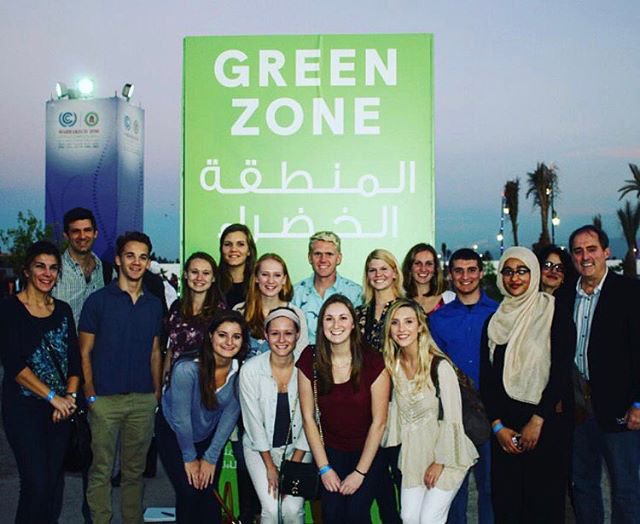
The civil society area is located in the Green Zone of the Bab Ighli site in Marrakech that hosted COP22 from November 7 to 18, 2016
By mobilising national and international civil society actors ahead of COP22, the civil society pole ensured a significant commitment by stakeholders in the fight against climate change. A diverse programme of meetings, debates, activities, conferences and side events demonstrated the commitment of civil society organisations and non-state actors for efficient and urgent climate action.
Mobilisation ahead of COP22 continues beyond COP22
In order to prepare civil society actors for COP22, the civil society pole supported the organisation of the MedCOP on Climate and six regional meetings in Morocco. This regional dimension will be pursued with meetings to be organised in other regions throughout the Kingdom.
The COP22 Moroccan Presidency established the mobilisation of civil society as one of its priorities. Thus, for the first time in COP history a meeting will take place in early 2017 between the Moroccan Presidency and civil society. The nine constituent groups will come together to take stock on COP22 and examine the different avenues of collaboration with Morocco during its presidency.
“COP22 showed remarkable mobilisation among Moroccan, African and international civil society that needs to be continued. We have to capitalise on its success and move forward. COP22 represented a turning point in civil society mobilisation,” declared El Yazami.
Mobilisation of civil society in numbers
Located in the Green Zone of the Bab Ighli site that hosted COP22 from November 7 to 18, 2016, the civil society area equaling 10,000m2, welcomed the participation of more than 300 exhibitors among 152 spaces, 680 activities, debates and conferences were organised. In total, 60 nationalities were represented. Interested by civil society initiatives and actions, 24,000 people on average per day, with a high point of 27,000 on November 15, visited the space.
Aware of the importance of civil society climate action and considering that the Paris Agreement goals will not be reached without strengthening the collaboration between state and non-state actors, high-level personalities such as Her Royal Highness Princess Lalla Hasnaa of Morocco, COP22 President Salaheddine Mezouar, the President of France, Francois Hollande, the President of the Comoros Azali Assoumani, the Mayors of Paris and Brussels, Anne Hidalgo and Yvan Mayeur, among others, visited the Green Zone.
The presence of civil society actors was also observed outside of the Bab Ighli site, particularly during the climate action march organised in the city of Marrakech that saw the participation of more than 7,500 people on December 13.
Ten highlights from civil society during COP22
Mobilisation of Moroccanuniversities with a meeting of 160 university presidents from around the world and 30 academic chancellors from Africa that adopted a common declaration.
COY12: more than 2,000 participantsfrom more than 30 countries.
Acultural COP with 12 exhibits (arts, photo, two concerts, two film competitions organised by youth in partnership with UNCEF and the French Embassy in Morocco).
A large trade-union meeting involving 40 trade unions from Africa and the Secretary General of the International Trade Union Confederation.
The 2nd edition of the Summit of Local and Regional Leaders for the Climate brought together more than 1,100 participants from 114 countries represented by more than 780 local and regional elected officials. The African continent was honoured with elected officials from 50 countries and 11 island states; including a climate finance roadmap for territories.
Meeting of Mediterranean regions presidents in preparation for the 3rd MedCop on Climate that will take place in Sicily in July 2017.
Meeting of 37 national human rights institutions from around the world on the implementation of the Paris Agreement and sustainable development goals.
International seminar of parliamentarians organised by the Moroccan Parliament and Inter-parliamentarian Union.
Presence of all UN agencies in both zones of the COP22 village.
More than 500 self-organised activities at the Cadi Ayyad University of Marrakech by the Moroccan Coalition for Climate Justice (CMJC) and international coalitions.
Countries in the Pacific Islands have taken stock of Nationally Determined Contributions (NDCs) submitted from the region. At two meetings held recently in Fiji, participants likewise assessed the status of as well as plan for implementation of NDCs, as well as exchange of country experiences.
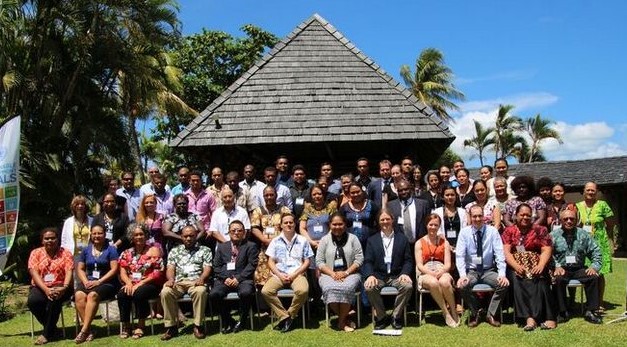
Participants at the Regional Dialogue in Fiji
The meetings also touched upon some of the technical and institutional issues that the countries in the region are facing in implementing their NDCs.
The Government of Fiji, the incoming Presidency for COP23 that will hold next November in Bonn, Germany, had played host two remarkable climate change meeting from 6 – 9 December 2016: Regional Dialogue on Nationally Determined Contributions (NDCs), for the Pacific Islands from 6 to 7 December 2016, followed by a Capacity-building Workshop on the MRV/Transparency Framework for the Pacific Islands from 8 to 9 December 2016.
The Regional Dialogue on NDCs brought together government representatives from the Pacific region, developed country representatives and international organisations/experts involved in the NDC process.
The dialogue, organised by the United Nations Development Programme (UNDP), the UNFCCC secretariat, and the UNDP/UNEP Global Support Programme (GSP) for National Communications and Biennial Update Reports, was attended by almost 60 participants, including representatives from 14 Pacific Island countries, as well as other countries and organisations.
This was the third in a series of joint UNDP/UNFCCC regional dialogues funded by a number of donors. The first was held in Costa Rica in June for the LAC region, and the second in Tunis in August for the Africa region. The Asia dialogue will take place in Turkey in February 2017.
The second event, a Capacity-building Workshop on the MRV/Transparency Framework for the Pacific Islands, was co-organised by the UNDP/UNEP Global Support Programme (funded by the Global Environment Facility – GEF) and by the Governments of Australia and Singapore with technical support from the UNFCCC secretariat. The workshop, attended by the same group of participants, was aimed at engaging the technical capacity of countries from the Pacific region to enhance their ability to participate effectively in the existing MRV arrangements and to prepare them for the implementation of the transparency framework under the Paris Agreement.
The EnviroNews Team wishes you a Happy Holidays and a Happy New Year
Year 2016 marked a remarkable turnaround as the world took vital initial steps towards implementing the landmark Paris Agreement and 2030 Agenda to achieve the Sustainable Development Goals (SDGs).
We would like to express our appreciation for your continued support, encouragement and commitment to our cause in ensuring a healthy and pollution-free environment via effective information dissemination.
We wish you a merry Christmas and a prosperous New Year.
The World Bank (International Bank for Reconstruction and Development or “IBRD”) has teamed up with BNP Paribas to promote the Sustainable Development Goals (SDGs) through an investment solution being developed for institutional and retail investors around the world.
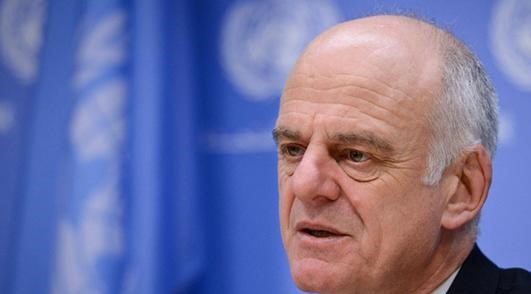
Dr. David Nabarro, Special Advisor on the 2030 agenda, Executive Office of the Secretary-General, United Nations.
The aim of the initiative is to launch a programme of equity index-linked World Bank bonds to allow investors to support and benefit from the global ambition set by the United Nations 2030 Agenda for sustainable development and the Sustainable Development Goals. The performance of the bonds will be linked to the performance of the Solactive Sustainable Development Goals World Index, which consists of eligible companies, based on Vigeo Eiris’ Equitics research, which maps the SDGs against the included companies’ products, services and behaviors.
The SDGs are a set of 17 interlinked goals established to guide international cooperation to achieve sustainable development, end poverty, build peace and tackle climate change. They were adopted by United Nations member countries in September 2015 and require active participation from governments, corporations and investors in all countries. The global goals promote clean water and sanitation, health, sustainable industry and infrastructure, affordable and clean energy, education, gender equality and much more. They are designed to help every individual and every community harness the benefits of development through peace, partnership, prosperity, people and planet.
“The United Nations Secretary-General recently launched a Financial Innovation Platform (FIP) to facilitate private sector engagement with the 17 Sustainable Development Goals. This new partnership by the World Bank and BNP Paribas is exactly the kind of initiative that the platform seeks to encourage,” said David Nabarro, Special Advisor on the 2030 agenda, Executive Office of the Secretary-General, United Nations.
“Achieving the Sustainable Development Goals will require increased collaboration from public sector, private sector, and individuals. The World Bank’s twin goals – eliminating extreme poverty and boosting shared prosperity – are aligned with the SDGs. By buying World Bank bonds, investors have the opportunity to support companies in a way that supports sustainable development,” said Arunma Oteh, Vice President and Treasurer, World Bank.
The new product will allow investors to contribute to the financing of sustainable development projects through the use of proceeds of the World Bank bonds and to benefit from the performance of the companies in the SDG index. The initiative will also raise awareness among the financial community of the various roles the private sector can play in supporting the achievement of the SDGs nationally and internationally. For example, investors can align their investment strategies to the SDG framework, banks can design innovative products supporting corporates aligned with the SDGs, and index providers can filter companies based on their contribution to the goals.
The initiative also highlights the World Bank’s overall sustainable development mandate and focus on working with its member countries to achieve a positive development impact for all projects. To achieve its twin goals to eliminate poverty and boost prosperity the World Bank is positioned to use financing, robust data and innovative products to help countries grow, invest and insure for the future.
“We are proud to be part of this initiative with the World Bank in support of the Sustainable Development Goals. This effort is in direct response to the UN Secretary-General’s launch of a Financial Innovation Platform (FIP) that calls for innovations and new financial models in support of the SDGs. Through this innovative program, we can help our clients meet their increasing need to align financial objectives with global sustainability objectives. Sustainable finance is one of the key pillars of our business and this partnership around the global goals is an important new development for us in this space,” said Olivier Osty, Executive Head of Global Markets, BNP Paribas.
“Solactive has been very active in the development of indices that meet the needs of an increasing number of ESG-conscious investors. With the Sustainable Development Goals Index series, Solactive is providing the basis for investment products that mirror the UN’s SDGs. As such, our contribution to the World Bank-BNP Paribas equity-linked bonds represents an important milestone for Solactive,” said Steffen Scheuble, CEO of Solactive AG.
“We are extremely pleased to be part of this initiative promoting investments in support of projects driving sustainable growth. This equity linked World Bank bonds program is a smart and secured solution for investors and a milestone on the road to supporting the SDGs,” said Nicole Notat, CEO at Vigeo Eiris.
The Green Climate Fund (GCF) has approved funding to support a proposed Asian Development Bank (ADB) programme that will assist seven Pacific island countries to transition to a renewable energy future.
A solar panel being prepared for use. Photo credit: greenchipstocks.com
The proposed Pacific Islands Renewable Energy Investment Programme will assist Cook Islands, Tonga, Republic of Marshall Islands, Federated States of Micronesia, Papua New Guinea, Nauru, and Samoa move away from diesel power generation and towards solar, hydropower, and wind energy.
“The programme offers an excellent opportunity for Pacific islands countries to share experiences and learn from the innovation ongoing in the region,” said Anthony Maxwell, ADB Principal Energy Specialist. “It will help finance transformation of the power grids in the region.”
The GCF board approved an initial $12 million grant for Cook Islands to install energy storage systems and support private sector investment in renewable energy. This investment will see renewable energy generation on the main island of Rarotonga increase from 15% to more than 50% of overall supply.
“The GCF funding will allow Cook Islands to ramp up renewable energy integration onto the grid, and lower the cost of power generation,” said Elizabeth Wright-Koteka, Chief of Staff, Office of the Prime Minister, Cook Islands. “This will have significant benefits to our economy and help achieve the Government’s objectives of a low carbon sustainable economy,”
The GCF Board also approved a $5 million capacity building and sector reform grant to develop energy plans, build skills, implement tariff and regulatory reforms, and foster greater private sector participation in the energy sector.
The proposed programme is anticipated to develop feasibility studies through ADB financing that will be proposed to the GCF for renewable energy projects worth over $400 million in the remaining six countries. The programme is expected to support 22 solar power plants, five wind farms, 8 hydropower plants, seven energy storage facilities, and 25 renewable energy mini-grids. The investments will reduce greenhouse gas emissions by an estimated 120,000 ton of carbon dioxide equivalent per annum.
The GCF was created by the United Nations Framework Convention on Climate Change. It has raised more than $10 billion, which it allocates to support low-emission and climate-resilient projects and programs in developing countries.
The ADB, based in Manila, is dedicated to reducing poverty in Asia and the Pacific through inclusive economic growth, environmentally sustainable growth, and regional integration. Established in 1966, ADB in December 2016 will mark 50 years of development partnership in the region. It is owned by 67 members – 48 from the region. In 2015, ADB assistance totaled $27.2 billion, including cofinancing of $10.7 billion.
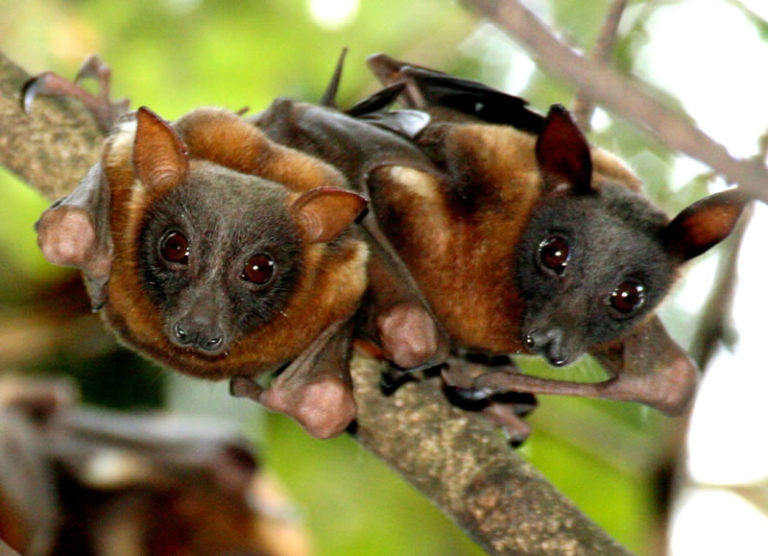
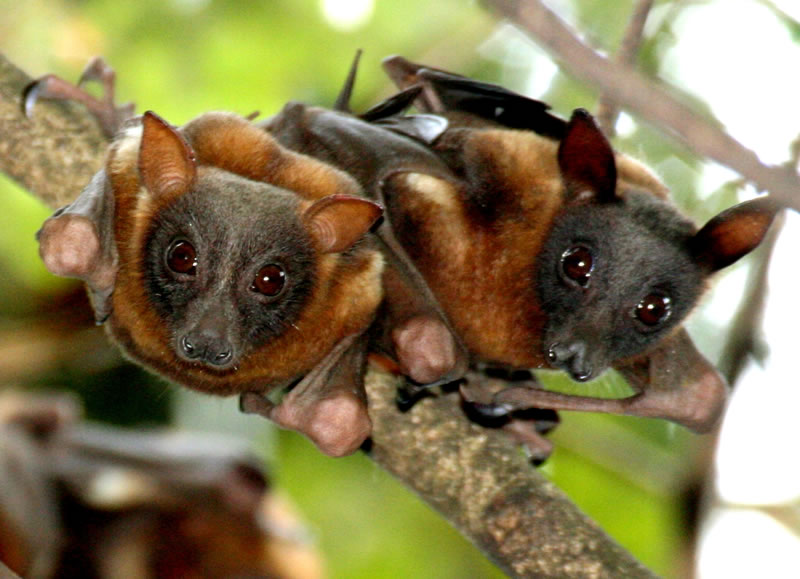
A massacre is looming on the island of Mauritius. The government wants to kill thousands of Mauritius flying foxes – giant fruit bats found only on the island – in response to complaints by orchard operators.
Flying foxes
Indeed, Mauritius has once again declared open season on flying foxes. Orchard owners consider the giant fruit bats to be a pest, and the government has called for a massacre – to be carried out by Christmas. But conservationists fear that the cull could lead to the extinction of the species.
The government claims that throngs of flying foxes descend on mango and lychee orchards, often stripping the trees bare. It therefore intends to have 10,000 flying foxes killed.
Conservationists have, however, taken up a campaign to stop the killing.
Reinhard Behrend of Rainforest Rescue said: “The ecological impact and sheer cruelty of the plan looms large: The impact of flying foxes on the island’s fruit crops has been debunked as a wild exaggeration. Furthermore, they play a vital role as pollinators and seed dispersers in the ecosystem as a whole.”
Rainforest Rescue is inviting signatories to a petition urging the Mauritian government to call off the cull and spare the flying foxes.
“The slaughter is completely unjustified,” says Vikash Tatayah of the Mauritian Wildlife Foundation.
One year ago, it had already initiated a “controlled cull” of 20,000 flying foxes – during which no less than 30,398 were confirmed killed.
While the government claims that they now number 65,000, experts agree that the population is considerably lower. A further cull could drive the species to the brink, as the International Union for Conservation of Nature (IUCN) warns. The Mauritius flying fox, Pteropus niger, which is currently listed as vulnerable by the IUCN, could soon become critically endangered, scientists warn, adding that a cyclone or an extended drought could then wipe them out.
A study by the University of Bristol in the UK debunked the orchard owners’ complaints, stressing that the flying foxes were responsible for only around 11% of the damage to fruit crops.
The study discloses: “Orchard mismanagement had a far greater impact. Placing nets around the trees could protect them against flying foxes and birds. Proponents of the cull ignore the fact that the Mauritius flying fox – the island’s largest endemic mammal with a wingspan of 80 cm – is a vital pollinator and seed disperser. A mass killing at this time of year would hit pregnant and nursing females hard, leaving orphaned juveniles no chance of survival.”
The Rainforest Rescue petition reads:
To: President Ameenah Gurib and the government of Prime Minister Anerood Jugnauth
Madame President, Mr. Prime Minister, Ladies and Gentlemen,
Your government is going forward with a “controlled cull” of thousands of flying foxes in response to assertions by orchard owners that the creatures are decimating their crops.
Environmentalists and scientists have spoken out against the plan in no uncertain terms:
The population of flying foxes is likely to be considerably lower than the frequently-cited 65,000 individuals. Scientists estimate the number to be no more than 50,000. According to the International Union for Conservation of Nature (IUCN), the killing could drive the species to the brink of extinction. Currently listed as vulnerable, the flying foxes could soon be critically endangered.
The complaint that the mammals are responsible for decimating fruit crops has been refuted. The flying foxes’ impact has been documented at a mere 11 percent of the total losses. A mass killing will not help fruit growers and does not make economic sense.
Environmental concerns and the sheer cruelty of the plan weigh heavily: the killing would ignore the vital role of the flying foxes in pollination and seed dispersal. It would take place at a time when females are pregnant or nursing their offspring. A significant part of the next generation would thus be wiped out.
Furthermore, the people of Mauritius reject the killing of flying foxes. A survey determined that around 90 percent harbored “neutral to very positive feelings” toward the animals.
Please take the warnings of scientists seriously and cancel the plan. Do not risk the extinction of a species that exists only in your country.
The killing would seriously damage the reputation of Mauritius throughout the world.
Electric avenues that can transmit the sun’s energy onto power grids may be coming to a city near you.
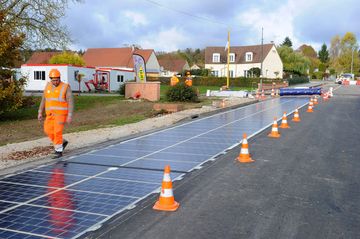
Wattway’s solar road in Tourouvre. Photo credit: Wattway
A subsidiary of Bouygues SA has designed rugged solar panels, capable of withstand the weight of an 18-wheeler truck, that they’re now building into road surfaces. After nearly five years of research and laboratory tests, they’re constructing 100 outdoor test sites and plan to commercialise the technology in early 2018.
“We wanted to find a second life for a road,” said Philippe Harelle, the chief technology officer at Colas SA’s Wattway unit, owned by the French engineering group Bouygues. “Solar farms use land that could otherwise be for agriculture, while the roads are free.”
As solar costs plummet, panels are being increasingly integrated into everyday materials. Last month, Tesla Motors Inc. surprised investors by unveiling roof shingles that double as solar panels. Other companies are integrating photovoltaics into building facades. Wattway joins groups including Sweden’s Scania and Solar Roadways in the U.S. seeking to integrate panels onto pavement.
To resist the weight of traffic, Wattway layers several types of plastics to create a clear and durable casing. The solar panel underneath is an ordinary model, similar to panels on rooftops. The electrical wiring is embedded in the road and the contraption is topped by an anti-slip surface made from crushed glass.
A kilometer-sized testing site began construction last October in the French village of Tourouvre in Normandy. The 2,800 square meters of solar panels are expected to generate 280 kilowatts at peak, with the installation generating enough to power all the public lighting in a town of 5,000 for a year, according to the company.
For now, the cost of the materials makes only demonstration projects sensible. A square meter of the solar road currently costs 2,000 ($2,126) and 2,500 euros. That includes monitoring, data collection and installation costs. Wattway says it can make the price competitive with traditional solar farms by 2020.
The electricity generated by this stretch of solar road will feed directly into the grid. Another test site is being used to charge electric vehicles. A third will power a small hydrogen production plant. Wattway has also installed its panels to light electronic billboards and is working on links to street lights.
The next two sites will be in Calgary in Canada and in the U.S. state of Georgia. Wattway also plans to build them in Africa, Japan and throughout the European Union.
“We need to test for all kinds of different traffic and climate conditions,” Harelle said. “I want to find the limits of it. We think that maybe it will not be able to withstand a snow plow.”
The potential fragility joins cost as a potential hurdle.
“We’re seeing solar get integrated in a number of things, from windows in buildings to rooftops of cars, made possible by the falling cost of panels,” Bloomberg New Energy Finance analyst Pietro Radoia said. “On roads, I don’t think that it will really take off unless there’s a shortage of land sometime in the future.”’
The Ogun State Government may have begun to reap benefits accruing from the automation of its forest operations. There are indications that the development is translating into increased revenue for the authorities.
Ibikunle Amosun, Governor of Ogun State. Photo credit: premiumtimesng.com
Commissioner for Forestry, Chief Kolawole Lawal, made the disclosure recently in Abeokuta, the state capital, while speaking with newsmen after a training programme organised by the Ministry for foresters, in the bid to to get them (the foresters) acquainted with the automation processes. The new process has been introduced for the state’s logging operations and activities in all the forest reserves across the state.
He said the automation system, which had been extended to all other forest reserves, became imperative having evaluated its efficacy in blocking leakages in its reserve in area J4 where the system had been test run, saying the result was satisfactory.
Kolawole said: “In just one week of implementation of the automated system in one of the reserves, the revenue generated from the area has rapidly increased as the process has cubed leakages, and it is time-saving and smooth to operate. That is the reason we decided to extend it and upgrade our operations across board.”
“We are now into a process which is devoid of foul play, this is a Ministry that had in recent past automated about two of its logging locations, J4 and J4 projects, but we still have other areas where our people still use Out Turn Volume (OTV), which is a manual way of logging.”
The Finnish Finland government has announced plans to stop using coal by 2030. Coal is believed to be one of the the dirtiest fuels on the planet.
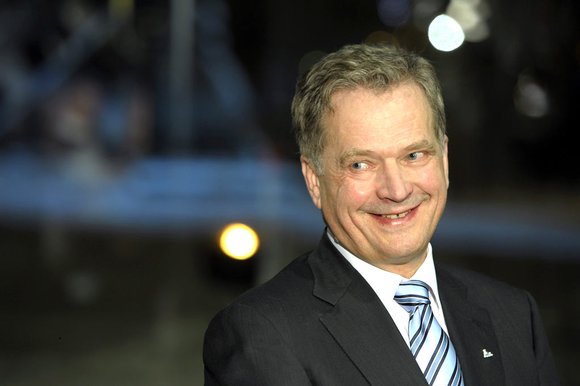
President of the Republic of Finland, Sauli Niinisto, was one of the first to sign the climate pledge
“Finland is well positioned to be among the first countries in the world to enact a law to ban coal … This will be my proposal,” Minister of Economic Affairs Olli Rehn told Reuters.
According to The Independent, the “Energy and Climate Strategy for 2030 and Beyond” is the country’s plan to phase out coal within 14 years. Finland aims to turn its energy production carbon-neutral by 2050 with plans to switch its traditional energy sources to biofuels and renewable energy.
The strategy will be presented to the Finnish parliament for approval in March.
Currently, Finland gets 8% energy from coal, mostly imported from Russia. However, renewable sources and nuclear make up 45% and 34% respectively.
Finland is not the only country trying to stamp out coal – other European countries as well as Canada have similar plans. The state of Oregon in the U.S. also wants to phase out the carbon-polluting fuel.
The 13th Meeting of the Conference of the Parties (COP13) to the Convention on Biological Diversity (CBD) ended on Saturday, 17 December, 2016 in Cancun, Mexico, where agreements were reached on actions to integrate biodiversity in forestry, fisheries, agriculture, and tourism sectors and to achieve the 2030 Agenda on Sustainable Development
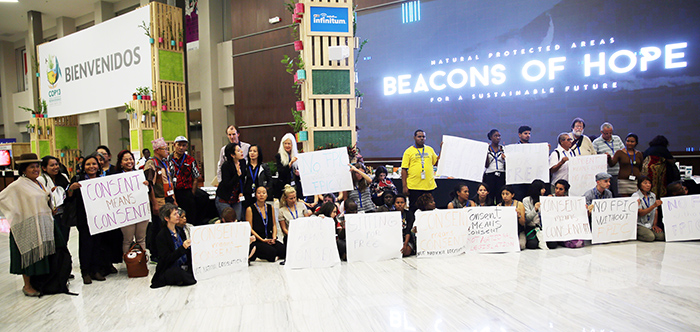
Taking action on biodiversity: Indigenous peoples and local communities representatives stage a sit-in protest at the main hall of the COP13 venue in Cancun, Mexico
Governments have agreed on actions that will accelerate implementation of global biodiversity targets, and enhance the linkage of the biodiversity agenda with other global agendas including the Sustainable Development Goals, the Paris Climate Agreement and others.
Governments from 167 countries agreed on a variety of measures that will intensify the implementation of the Aichi Biodiversity Targets, including mainstreaming, capacity-development and mobilisation of financial resources as well as actions on specific themes including protected areas, ecosystem restoration, sustainable wildlife management and others.
Governments followed through on the commitments in the Cancun Declaration made by ministers at the high-level segment of the meeting that took place on 2 and 3 December 2016. Parties agreed to advance mainstreaming biodiversity, the main theme of the meeting proposed by the Government of Mexico and use an integrated approach that would promote not only cross-sectoral linkages, but also linkages between efforts to implement national biodiversity strategies and action plans and Sustainable Development Goal strategies and plans.
“Governments demonstrated their commitment to achieving the Aichi Biodiversity Targets, and showed that the biodiversity agenda is central and essential to the global sustainable development and climate change agendas,” said Braulio Ferreira de Souza Dias, Executive Secretary to the Convention on Biological Diversity.
He added: “With the integration of three meetings addressing the Convention and its two Protocols, the world community also realised the importance of the Cartagena Protocol on Biosafety and the Nagoya Protocol on Access to Genetic Resources and Benefit Sharing in effectively contributing to the Targets and sustainable development”
“We received impressive commitments from governments, including excellent ones from the government of Mexico, in support of many of the Aichi Biodiversity Targets which gives us the momentum we need to achieve our goals by 2020.”
“The agenda of mainstreaming biodiversity provided Mexico with the momentum to conclude agreements which had eluded us for decades, such as the alignment of agricultural subsidies to preserve forests, or the protection of a vast proportion of our seas,” said Rafael Pacchiano Alamán, Secretary of Environment and Natural Resources of Mexico.
“For the next two years, Mexico will work with countries to translate the principles of the Cancun Declaration into legislation, policies and actions to meet the commitments we made.”
“We applaud and support the global community’s commitment made during this COP to integrate biodiversity considerations into the activities of other critical sectors of our economies: agriculture, fisheries, forestry, and tourism; and value it’s natural capital for sustainable development, as expressed in the Cancun Declaration,” said Naoko Ishii, Chief Executive Officer of the Global Environment Facility (GEF).
“The GEF, as the financial mechanism of the convention, is proud to have been confirmed in its critical role to support countries to meet their commitments under the Convention and its Protocols. We also feel encouraged by the strong support of many donor and recipient countries to maintain consistency with our current biodiversity programming strategy with integrated approaches in response to the Strategic Plan for Biodiversity, while seeking out new innovative and creating financing opportunities,” she said.
Capacity-building
The Parties agreed on an action plan (2017-2020) that will enhance and support capacity-building for the implementation of the Convention and its Protocols based on the needs of Parties with a focus on strengthening the implementation of the Strategic Plan for Biodiversity 2011-2020 and its Aichi Biodiversity Targets. For the Protocols, emphasis will be on supporting the implementation of the Strategic Plan for the Cartagena Protocol on Biosafety, and promoting the universal ratification of the Nagoya Protocol and the development of measures to ensure that it is fully operational, consistent with national legislation (Aichi Target 16).
The Parties also welcomed the Biobridge Initiative established at COP 12 by the Government of the Republic of Korea to contribute to the implementation of the Strategic Plan for Biodiversity 2011-2020 and achievement of the Aichi Biodiversity Targets.
Pollinators
The ‘Thematic Assessment of Pollinators, Pollination and Food Production’ by the Intergovernmental Science-Policy Platform on Biodiversity and Ecosystem Services (IPBES) was discussed. The COP encouraged Parties, other Governments, relevant United Nations and other organisations, as well as multilateral environment agreements, and stakeholders to use the assessment, as appropriate, in particular the responses outlined in the document to help guide efforts to improve conservation and management of pollinators, address drivers of pollinator declines, and work towards sustainable food production systems and agriculture.
Protected Areas
Protected areas and Aichi target 11 also advanced starting with commitment of the Group of Like Minded Megadiverse Countries to achieve Aichi target 11, and the announcement of the Host Country to announce establishment of marine protected areas that contribute achieving 23 per cent of marine areas within national jurisdiction under protection, which is more than double than that of global target of 10 per cent. The COP welcomed the progress towards achievement of Aichi Biodiversity Target 11 and recognised how this will contribute to the implementation of other Aichi Biodiversity Targets, the Sendai Framework for Disaster Risk Reduction 2015-2030, relevant targets of the Sustainable Development Goals, and Articles 5,7and 8 of the Paris Agreement.
Restoration
COP 13 adopted a short term plan of action on ecosystem restoration, as a contribution to reversing the loss of biodiversity, recovering connectivity, improving ecosystem resilience, enhancing the provision of ecosystem services, mitigating and adapting to the effects of climate change, combating desertification and land degradation, and improving human well-being while reducing environmental risks and scarcities. The action plan will help Parties, as well as any relevant organisations and initiatives, to accelerate and upscale activities on ecosystem restoration and supports achievement of the Strategic Plan for Biodiversity 2011-2020. As part of the Forest Landscapes Restoration Day at the Rio Conventions Pavilion, the Secretariat also reported on advancements under the Forest Ecosystem Restoration Initiative launched by the Republic of Korea at COP12.
Marine Agenda
Parties welcomed a new set of areas described from regional workshops as ecologically or biologically significant marine areas (EBSAs) in the Seas of East Asia, the North-West Indian Ocean and the North-East Indian Ocean. Parties also discussed means to enhance scientific methodologies and approaches to the description of EBSAs. Parties adopted a voluntary specific workplan to maintain and enhance the resilience of ecosystems in cold water areas within the jurisdictional scope of the Convention.
A decision on marine spatial planning and training initiatives, encouraged the application of marine spatial planning (MSP) and requested further technical work by the Secretariat as well as calling for further capacity building work under the Sustainable Ocean Initiative.
Parties took note of voluntary practical guidance on preventing and mitigating the impacts of marine debris on marine and coastal biodiversity and habitats. The guidance contains actions to enhance understanding of the scale and impacts of marine debris, improve waste management and recycling, reduce the production and consumption of plastics, increase production of environmentally friendlier materials and other actions.
Parties also requested the Secretariat to continue their work on the compilation, synthesis and dissemination of experiences and scientific research on the adverse impacts of underwater noise on marine and coastal biodiversity.
Biodiversity and climate change
COP 13 adopted a decision that welcomes the Paris Agreement and encourages Parties and other Governments, when developing their Nationally Determined Contributions, to fully take into account the importance of ensuring the integrity of all ecosystems. It encourages Parties to take biodiversity into consideration when undertaking climate change mitigation, adaptation and disaster risk reduction measures, and requests the Executive Secretary to prepare, in collaboration with relevant organisations, voluntary guidelines for the design and effective implementation of ecosystem-based approaches to climate change adaptation and disaster risk reduction.
Climate-related geoengineering
The Conference of the Parties reiterated the importance of the precautionary approach in relation to climate-related geoengineering, the importance of reducing anthropogenic emissions by sources and by increasing removals by sinks of greenhouse gases under the United Nations Framework Convention on Climate Change, and the need for more research and knowledge-sharing in order to better understand the impacts of climate-related geoengineering.
Article 8(j)
COP 13 took considerable steps to ensure that traditional knowledge relevant for conservation and sustainable use is protected and its use is encouraged with the consent of indigenous peoples and local communities.
Guidelines for the repatriation of traditional knowledge were adopted for traditional knowledge that will assist Governments in developing mechanisms at the national level to guard against the unlawful appropriation of traditional knowledge.
Additionally the Nagoya and Cartagena Protocols, in recognition of the significant contributions of indigenous and local communities to their work decided to use the term indigenous peoples and local communities in their decisions and official documents. This does not change the obligations of the Parties or the legal interpretation of the Protocols.
Work will continue on a glossary of key terms and concepts to be used for the Convention’s work on traditional knowledge and related issues and to finalise guidelines for then repatriation of traditional knowledge in order to assist indigenous peoples and local communities in restoring knowledge systems, for conservation and sustainable use of biodiversity.
Financial Mechanism
The COP adopted strategic guidance for the next four-year replenishment period of its financial mechanism, the Global Environment Facility. The four-year framework of programme priorities adopted by the COP guides the GEF in its development of its biodiversity strategy and the associated funding priorities for the 2018-2022 period. Parties took also note of the assessment of financial needs undertaken for the seventh replenishment which identified the need to double biodiversity allocation, and requested the Secretariat to transmit it to the GEF.
Resource Mobilisation
The COP urged Parties to increase their efforts to achieve the targets, including the doubling of total biodiversity-related international financial resource flows to developing countries. Parties are to report their progress accordingly, with a view to consider a more comprehensive stocktaking and an updated analysis of financial reports received, at SBI-2 and COP-14.
Cartagena Protocol on Biosafety
COP-MOP 8 adopted operational definitions of unintentional transboundary movements and illegal transboundary movements under the Cartagena Protocol. They also agreed to prioritise, under the Strategic Plan for Biosafety by 2020, operational objectives on biosafety legislation, risk assessment, risk management, detection and identification of LMOs, and public awareness, education and training to implementation the Cartagena Protocol. Parties deliberated on the voluntary Guidance on Risk Assessment of LMOs as a tool to assist in conducting risk assessment in accordance with the Cartagena Protocol while acknowledging that other guidance documents and national approaches can also assist in conducting risk assessment in accordance with the Protocol. They also agreed to extend the Online Forum on Risk Assessment and Risk Management of LMOs.
COP-MOP 8 also agreed to make available information in the Biosafety Clearing-House (BCH) with regards to transit and contained use of LMOs; Extend the Programme of Work on public awareness, education and participation until 2020 with priority areas/activities; Migrate the BCH to a new platform to integrate the clearing-houses of the Convention and its Protocols; Extend the mandate of the expert group (AHTEG) on socio-economic considerations; and to establish expert groups, as appropriate, to provide advice on one or more scientific and technical issues.
Nagoya Protocol on Access and Benefit-Sharing
Governments also agreed to a series of actions to further bolster the implementation of the Nagoya Protocol on Access and Benefit-sharing, which entered into force in 2014. During their second meeting held as part of the UN Biodiversity Conference, Parties considered progress made thus far, as well as the next steps to be taken to support the implementation of the Protocol. Among the decisions adopted at this meeting are progress made towards Aichi Biodiversity Target 16, the Access and Benefit-sharing Clearing-House, measures to assist in capacity-building and cooperation with other international organizations or initiatives. It should also be noted that Antigua and Barbuda and Argentina deposited their instruments of ratification to the Protocol during the meeting, thus bringing the total number of Parties to 93.
Furthermore, both the Parties to the CBD (COP13) and the Parties to the Protocol (COP-MOP 2) addressed the issue of digital sequence information on genetic resources and decided to consider, at their next respective meetings, any potential implications of the use of this information for the objectives of the CBD and the Protocol, respectively.
Decisions were also taken on Synthetic Biology, Invasive Alien Species, Sustainable Wildlife Management and others topics under the Convention and its Protocols. The decisions, in the form they were presented to the Parties for adoption (L documents), are available on the website of the Convention at: www.cbd.int/cop2016