The United Nations has acceded to an agreement that paves way for the Climate Technology Centre and Network (CTCN) to support developing countries with implementing climate technologies for the next four years
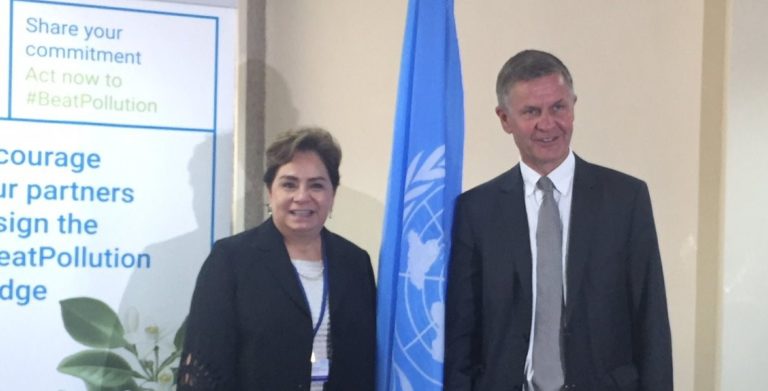
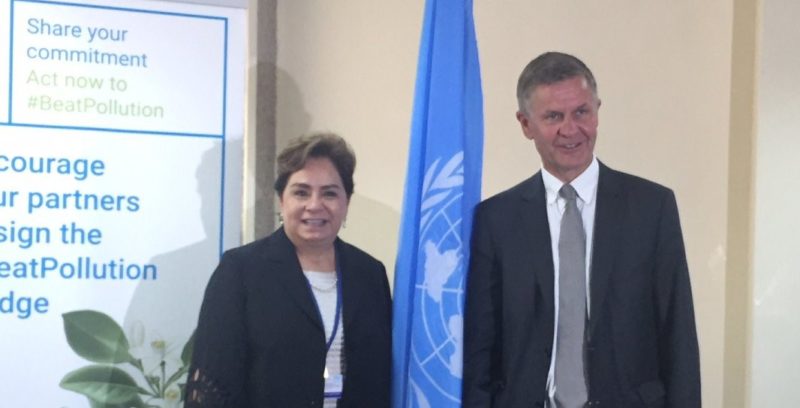
Erik Solheim, Executive Director of UN Environment (UNEP) (right), and Patricia Espinosa, Executive Secretary of the UN Climate Change Secretariat (UNFCCC)
At the end of 2017, heads of UN agencies signed an agreement for the CTNC to continue supporting developing countries in implementing climate technologies. This, according to the UN, is testimony to the successful work the CTCN has done since it was made fully operational in 2012.
In Nairobi, Erik Solheim, Executive Director of UN Environment (UNEP), and Patricia Espinosa, Executive Secretary of the UN Climate Change Secretariat (UNFCCC), signed an extension of the Centre’s operations for a further four years. Through this, the Centre will continue to provide services on climate technologies to developing countries, supporting them to translate their climate contributions into investment plans.
The Centre connects developing countries with technology experts from around the world, supporting them to identifying ways to accelerate low-emission and climate resilient development. It is currently working with more than 70 countries on such efforts.
The Centre is co-hosted by UN Environment and the United Nations Industrial Development Organisation (UNIDO), and supported by 400 network partners around the world.
The United Nations Environment Programme (UNEP) and the World Health Organisation (WHO) have agreed a new, wide-ranging collaboration to accelerate action to curb environmental health risks that cause an estimated 12.6 million deaths a year.
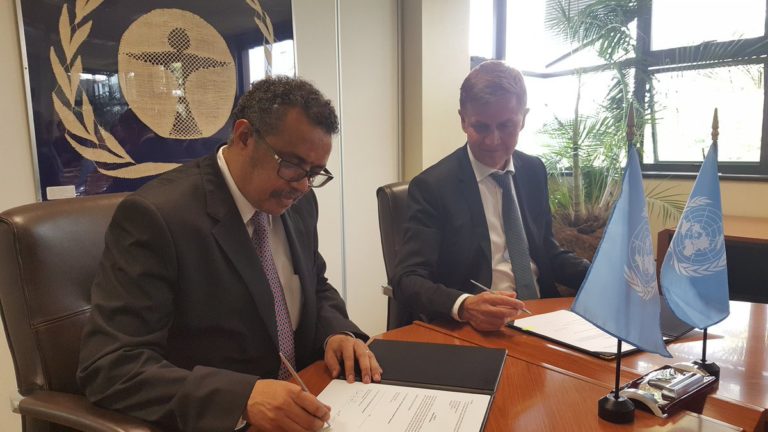
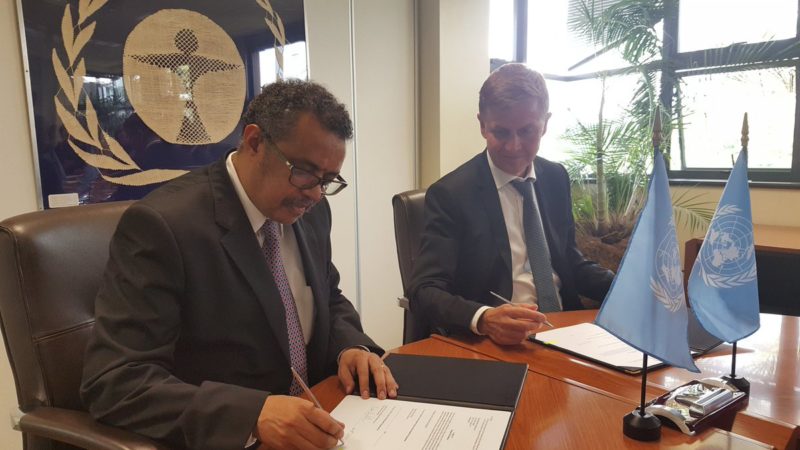
Mr Erik Solheim, head of UN Environment (right), and Dr Tedros Adhanom Ghebreyesus, Director-General of WHO, signing the agreement
On Wednesday, January 10, 2017 in Nairobi, Mr Erik Solheim, head of UN Environment, and Dr Tedros Adhanom Ghebreyesus, Director-General of WHO, signed an agreement to step up joint actions to combat air pollution, climate change and antimicrobial resistance, as well as improve coordination on waste and chemicals management, water quality, and food and nutrition issues. The collaboration also includes joint management of the BreatheLife advocacy campaign to reduce air pollution for multiple climate, environment and health benefits.
This represents the most significant formal agreement on joint action across the spectrum of environment and health issues in over 15 years.
“There is an urgent need for our two agencies to work more closely together to address the critical threats to environmental sustainability and climate – which are the foundations for life on this planet. This new agreement recognises that sober reality,” said UN Environment’s Solheim.
“Our health is directly related to the health of the environment we live in. Together, air, water and chemical hazards kill more than 12.6 million people a year. This must not continue,” said WHO’s Tedros.
He added: “Most of these deaths occur in developing countries in Asia, Africa and Latin America where environmental pollution takes its biggest health toll.”
The new collaboration creates a more systematic framework for joint research, development of tools and guidance, capacity building, monitoring of Sustainable Development Goals, global and regional partnerships, and support to regional health and environment fora.
The two agencies will develop a joint work programme and hold an annual high-level meeting to evaluate progress and make recommendations for continued collaboration.
The WHO-UN Environment collaboration follows a “Ministerial Declaration on Health, Environment and Climate Change” calling for the creation of a global “Health, Environment and Climate Change” Coalition, at the United Nations Framework Convention on Climate Change (UNFCCC) COP 22 in Marrakesh, Morocco in 2016.
Just last month, under the overarching topic “Towards a Pollution-Free Planet”, the United Nations Environment Assembly (UNEA), which convenes environment ministers worldwide, adopted a resolution on Environment and Health, called for expanded partnerships with relevant UN agencies and partners, and for an implementation plan to tackle pollution.
Priority areas of cooperation between WHO and UN Environment include:
Air Quality – More effective air quality monitoring including guidance to countries on standard operating procedures; more accurate environment and health assessments, including economic assessment; and advocacy, including the BreatheLife campaign promoting air pollution reductions for climate and health benefits.
Climate – Tackling vector-borne disease and other climate-related health risks, including through improved assessment of health benefits from climate mitigation and adaptation strategies.
Water – Ensuring effective monitoring of data on water quality, including through data sharing and collaborative analysis of pollution risks to health.
Waste and chemicals – Promotion of more sustainable waste and chemicals management, particularly in the area of pesticides, fertilisers, use of antimicrobials . The collaboration aims to advance the goal of sound lifecycle chemicals management by 2020, a target set out at the 2012 United Nations Conference on Sustainable Development.
BreatheLife campaign has engaged countries, regions and cities in commitments to reduce air pollution for climate and health benefits, covering more than 120 million people across the planet, including Santiago, Chile; London, England; Washington DC, USA, and Oslo, Norway, with major cities in Asia and Africa set to join.
Zambia has recorded 95 new cholera cases in the last 24 hours, with Lusaka, the country’s capital recording 83 of the cases, health authorities said on Wednesday, January 10, 2018.
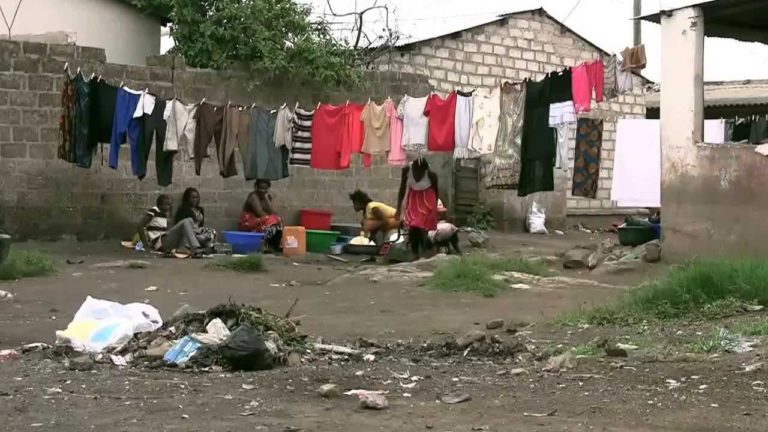
A slum neighbourhood in Kanyama, Lusaka
In a statement, the Ministry of Health said Lusaka recorded 83 new cases while 12 other cases were recorded in other parts of the country, bringing the cumulative figures since the outbreak of the disease in October 2017 to 2,905.
According to the statement, cases in the capital cumulatively now stand at 2,755 out of which 2,514 have been successfully treated and discharged.
The cumulative death toll in the city currently stands at 62, while the countrywide death toll stands at 67, the statement added.
Meanwhile, a multi-sectoral team assembled to handle the cholera epidemic has urged citizens to cooperate in efforts aimed at tackling the epidemic.
The team said in statement that apart from the oral cholera vaccination which had commenced, the team has continued to increase water points and burying of shallow wells as well as cleaning of markets in order to stop further contamination of food.
“Let us continue to work together until we eradicate this disease completely, medium to long term measures will be undertaken by government in order to achieve this,’’ the statement said.
Some 15 people are dead in California’s Santa Barbara County following devastating mudslides in the area stripped by recent wildfires.
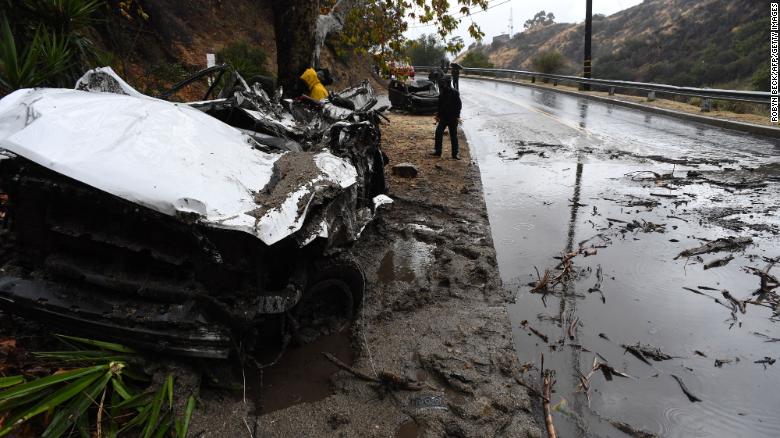
Mud fills a street after a rain-driven mudslide destroyed two cars and damaged property in a neighborhood under mandatory evacuation in Burbank, California, January 9, 2018. Photo credit: ROBYN BECK/AFP/Getty Images
More than two dozen people remain unaccounted for, leading officials to warn that the death toll will likely rise as emergency workers make it into damaged homes.
“It was literally a carpet of mud and debris everywhere, with huge boulders, rocks, down trees, power lines, wrecked cars – lots of obstacles and challenges for rescue personnel to get to homes,” Santa Barbara County Sheriff, Bill Brown said.
One man, Thomas Tighe, told a local news station that he witnessed two cars traveling sideways in the street through a “river of mud.” Another said the mud came “in an instant, like a dam breaking.”
On Wednesday morning, 300 people were trapped in the Romero Canyon area of Montecito because debris was blocking their way out of the neighborhood, Santa Barbara County spokeswoman Yaneris Muniz said.
“We can’t get to them, and they can’t get to us. … Once we have daybreak, you will see helicopters start rescuing people there,” Muniz said.
As the storm hit hard between 3 and 6 a.m. on Tuesday, sheriff’s office dispatchers handled more than 600 phone calls for assistance, Brown said.
Debris litters the area near a home on Tuesday, January 9, 2018 in Montecito in Santa Barbara County
US 101 in parts of Montecito and Santa Barbara will remain closed for at least 48 hours, authorities said on Tuesday.
By Tuesday, more than 5.5 inches of rain had fallen in parts of Ventura County over two days, the National Weather Service said. In Carpinteria, nearly 1 inch fell in 15 minutes, the agency said.
Thomas Tighe told CNN affiliate KCAL he was outside his Montecito home and heard “a deep rumbling, an ominous sound I knew was … boulders moving as the mud was rising.”
He saw two cars moving sideways down the middle of the street “in a river of mud.”
Peter Hartmann said the destruction was everywhere.
“There were gas mains that had popped, where you could hear the hissing,” he told the TV station.
“Power lines were down, high-voltage power lines, the large aluminum poles to hold those were snapped in half. Water was flowing out of water mains and sheared-off fire hydrants.”
Before the storm hit, Santa Barbara issued mandatory evacuations for 7,000 people, including in parts of Carpinteria, Montecito and Goleta, which are below areas scorched by wildfires, county spokeswoman Gina DePinto said.
“While some residents cooperated with the evacuations, many did not. Many chose to stay in place,” said Brown, the sheriff.
Sheriff deputies spent Monday conducting door-to-door evacuations for 7,000 people in a mandatory evacuation area. But the area where homes were destroyed, south of Highway 192, was not in a mandatory evacuation zone.
Rescue personnel still have areas to search, Brown said.
“It was literally a carpet of mud and debris everywhere, with huge boulders, rocks, (downed) trees, power lines, wrecked cars — lots of obstacles and challenges for rescue personnel to get to homes,” Brown said.
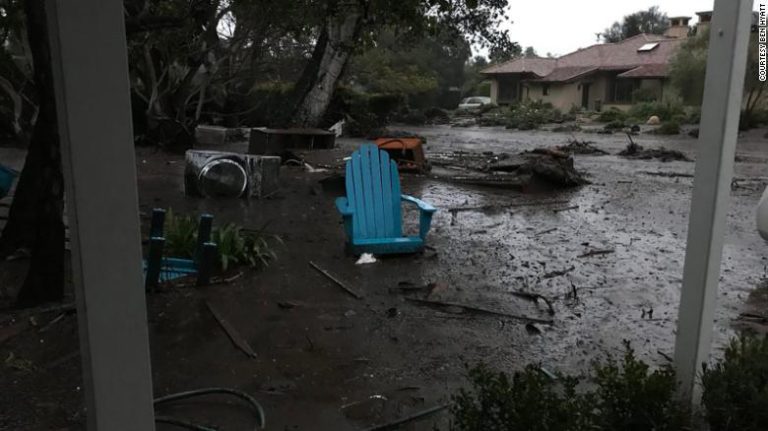
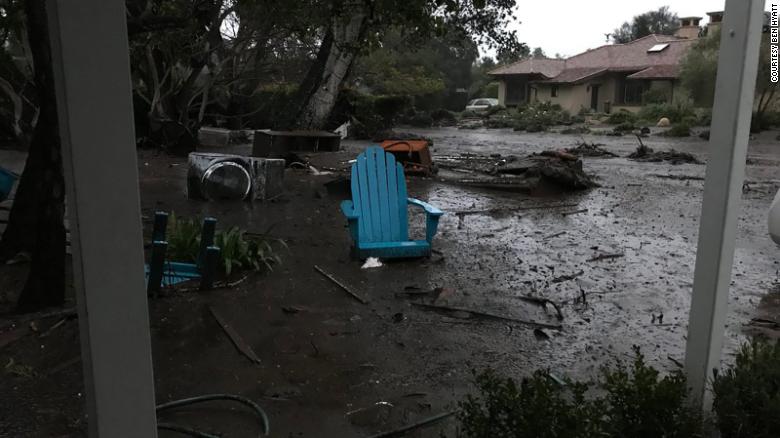
Ben Hyatt said a river of mud crashed through a neighbor’s house in Montecito, a community of about 8,000 east of Santa Barbara.
“Apparently, one of their cars ended (up) in their backyard. We have neighbors at (the) top of the street that evacuated to their roof,” Hyatt said.
Hyatt said his Montecito house was “surrounded by mud,” and a washing machine had drifted into his front yard.
“Mud came in an instant, like a dam breaking. (It) surrounded the house, 2 to 3 feet,” he said.
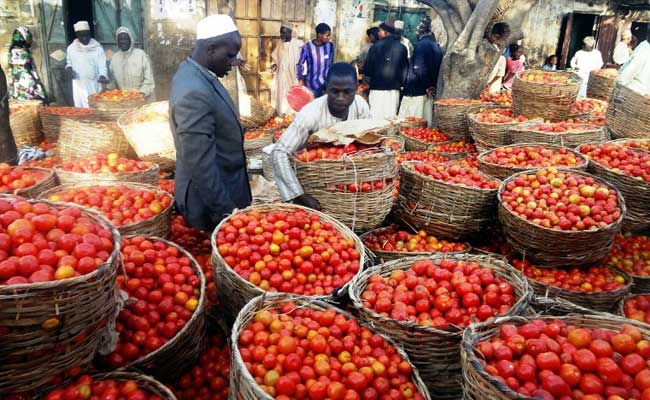
Some stakeholders in the tomato industry have expressed concern that the one-month closure of Tiga Dam in Kano State will adversely affect the production of tomatoes.
Tomatoes
The stakeholders expressed their concerns in separate interviews with the News Agency of Nigeria (NAN) on Wednesday, January 10, 2018 in Lagos.
They said the closure of the dam would cause the price of tomatoes to soar, thereby affecting the nation’s quest to achieve self-sufficiency in the production of the commodity.
NAN reports that Tiga Dam was built in 1974 and supervised by Hadejia-Jama’are River Basin Development Authority with the aim of improving food security through irrigation projects for farmers.
Alhaji Sanni Danladi-Yadakwari, the Secretary, Tomato Growers Association of Nigeria (TOGAN), said farmers were not given prior notice by Hadejia-Jama’are River Basin Development Authority before the dam was shut on Dec. 4, 2017 for maintenance.
According to him, the unplanned and ill-timed closure of the dam has destroyed over 60 per cent of tomatoes planted by farmers in four local government areas of Kano State.
“They usually notify us before they shut the dam for routine maintenance so that we can plan our planting season or make alternative plans but this time around it was done arbitrarily without notification,’’ he said.
According to him, over 5,000 tomato farmers are affected and it cost about N500,000 to cultivate a hectare of tomato farm “and as it is, we cannot recoup 10 per cent of our investment’’.
“The negligence of the authority has destroyed our source of livelihood and cost us millions of naira.
“The produce will not yield desired results and tomatoes grow best in temperatures of 20 to 27°C and its fruit setting will be poor when the average temperature exceeds 30°C.,’’ he said.
Danladi-Yadakwari said that the dam’s authority later opened it on Jan. 4, but the pressure of the water was low and insufficient to neither irrigate the farms nor salvage the damage to the produce.
According to him, the incident has rendered many farmers’ efforts to boost food production and support the Federal Government’s drive to end tomato paste importation fruitless.
He urged the government to assist the farmers with funds, adding that most of the affected farmers wanted to divert to rice and wheat production for the present planting cycle.
Alhaji Abdulkarim Kaita, the Managing Director, Dangote Tomato Processing Plant, said that the damage to tomato farms would stall the company’s plan to commence operation in its 20 million dollars tomato-processing plant situated in Kadawa, Kano.
NAN reports that Kadawa irrigation area, Kano is believed to be the largest tomato producing area in the country.
Kaita said that activities in the plant commissioned in March 2016 had been hindered due to lack of fresh tomatoes as raw materials from farmers.
“The 1,200 tonnes a day plant needs about 40 trucks of fresh tomatoes each day as input with each truck handling 30 tonnes of produce.
“Our production aims to assist the country substitute its import of tomato paste to become a net exporter but that has been stalled.
“The ill-timed closure of the dam is not good for national development. It will not allow the tomato policy to be effective, thereby giving smugglers and importers free opportunity to operate,” Kaita said.
He said that Dangote’s facility, when reopened would produce more than 400,000 tonnes of tomato paste annually.
Kaita urged the government to probe the closure of the dam, adding that stakeholders were suspecting the alleged connivance between importers and the dam management to sabotage the tomato policy.
Mr Richard Ogundele, a Value Chain Development Expert, said the incident would affect tomato output, increase price of the produce and affect farmers’ ability to repay their loans.
Ogundele is the Group Intervention Manager for Growth and Employment in States (GEMS4), a project financed by the World Bank and UK’s Department for International Development (DFID) in Nigeria.
“The implication of the maintenance of the dam as scheduled by the dam management is not just right for national tomato sector development.
“I have worked with thousands of farmers in the GEMS4 project for the last five years to ensure that tomato production becomes better and wastages reduced.
“Now that production has begun to ramp up, the dam management are slowing it down. This is not right,” he said.
Ogundele called for a strong collaboration between the dam management and farmers toward ensuring a hitch free production cycle to boost food production, jobs and wealth creation.
NAN reports that data from the Federal Ministry of Agriculture and Rural Development shows that the country produces about 1.8 million tonnes of fresh tomatoes annually.
About 900,000 tonnes rot before they get to the market due to bad roads and storage facilities.
To augment the supply deficit, the country annually imports about 150,000 tonnes of tomato concentrate worth $170 million.
President Donald Trump’s administration will not allow drilling for oil and gas off the coast of Florida after a plea from the state governor, Interior Secretary Ryan Zinke, said.
Off-shore oil drilling
“I support the governor’s position that Florida is unique and its coasts are heavily reliant on tourism as an economic driver,” Zinke said in a statement.
“As a result of discussion with Governor (Rick) Scott and his leadership, I am removing Florida from consideration for any new oil and gas platforms.”
The Trump administration, last week, proposed opening nearly all U.S. offshore waters to oil and gas drilling, a move aimed at boosting domestic energy production and which sparked protests from coastal states, environmentalists and the tourism industry.
The administration’s decision on Tuesday removes from consideration a portion of the eastern Gulf of Mexico, an area that oil drillers have said they are interested in exploring – but not all of it.
Florida state waters extend three nautical miles from shore on the Atlantic, and nine nautical miles on the Gulf side, according to the Florida Fish and Wildlife Conservation Commission.
Scott, last week, announced his opposition to the drilling plan and said he had asked to meet with Zinke.
Zinke’s decision to exempt Florida from offshore drilling leaves the door open for other governors opposed to offshore oil and gas development to seek a similar prohibition for their states.
Oceana, an environmental lobby group, said it was pleased that Zinke had removed Florida from areas open to drilling.
“Such a quick reversal begs the question: Will the Trump administration give equal consideration to all the other coastal governors from both parties who overwhelmingly reject this radical offshore drilling plan?” Oceana campaign director, Diane Hoskins, said in a statement.
Republican and Democratic governors from most other coastal states have also said they oppose any offshore drilling, citing potential damage to the lucrative tourism industry.
“President Trump has directed me to rebuild our offshore oil and gas programme in a manner that supports our national energy policy and also takes into consideration the local and state voice,” Zinke said in Tuesday’s statement.
Zinke said last week that the department’s draft National Outer Continental Shelf Oil and Gas Leasing Programme for 2019 to 2024 would make over 90 per cent of the outer continental shelf’s total acreage available for leasing to drillers, a national record.
That would reverse the Obama administration order placing 94 per cent of the Outer Continental Shelf off limits to drillers.
Obama’s 2017-2022 plan would be replaced by the new programme when it is finalised.
The effort to open previously off-limits acreage in the Atlantic, Arctic and Pacific oceans comes less than eight years after BP Plc’s Deepwater Horizon oil spill in the Gulf of Mexico – the largest in American history.
The disaster caused billions of dollars in economic damage and led the Obama administration to increase regulation of the industry.
The Defense Department has also raised concerns about opening drilling that had been banned off the eastern Gulf of Mexico, where military exercises are held.
Environmentalists have urged Germans to eat half as much meat as they currently do, in order to meet climate goals.
Meat packaging in Germany
The organisations said as they presented the “Meat Atlas 2018’’ in Berlin on Wednesday, January 10, 2018 that, without a reduction in meat consumption and animal numbers, it would also be impossible for Germany to ensure the conservation of many other flora and fauna.
“Less and better is the solution,’’ said Hubert Weiger, director of the German Association for the Environment and Nature Conservation (BUND).
“This year, the German federal government has to set the guidelines for a sustainable reorganisation of the keeping of animals.’’
The groups are demanding an obligatory identification system for meat and the disposal of the nitrate surpluses caused by the overproduction of manure.
They also want a limit of two cattle or 10 pigs per hectare of land, but in general the number of pigs bred for meat needs to drop by several million, they said.
Industry statistics showed that in 2016 Germans consumed an average of 59 kg of meat per capita, an increase of 1.5 kilos on the 2017, but not much less than they consumed 10 years ago.
The German Society for Nutrition also recommends that people should only eat half this amount.
The “Meat Atlas’’ has been published each year since 2013 by BUND, the Heinrich Boell Foundation and the French newspaper Le Monde Diplomatique.
The Federal Ministry of Environment says it will start sensitising communities on the effects of land degradation across the country.
Desertification and land degradation are said to be serious challenges that can lead to hunger and poverty
Mr Bala Gukut, the Deputy Director, Drought and Desertification Amelioration Department, disclosed this to the News Agency of Nigeria (NAN) on Wednesday, January 10, 2018 in Abuja.
He said that the federal government had set up a working committee on March 9, 2017 to work out a report aimed at achieving land degradation neutrality project by 2030.
He added that the government would be setting up another committee to handle the awareness exercise for effective implementation of the project.
“The committee will ensure that the exercise gets to all the communities at the local government level.
“The committee is expected to split the members into various teams to ensure that their efforts are effective and to come up with positive results.
“The land degradation project is what I call `top bottom approach’, meaning that the committee will start the awareness creation from local to the federal levels.
“We will begin from the people, plan with them, go with them and work with them; this will help us to know what they are doing to preserve their land.
“With that, we can bring in our scientific ideas, introduce it to them and tell them to use the practice this will enable effective implementation of the project,’’ Gukut said.
According to him, implementation is the key approach of any project; the committee will let them know the implication of degraded land.
“They will also educate them on how they can manage their land, the kind of activities they do that can damage their land.
“The committee will also let them know what can be done to avoid such damage, these are the kind of awareness we want to start with,’’ he said.
Gukut said that Nigeria was among the first countries that sent her report to the United Nations Convention to Combat Desertification (UNCCD) on the land degradation and neutrality.
He noted that about 110 countries were currently participating to achieving land degradation neutrality by 2030.
According to him, we don’t know the exact number of countries that have sent their report to the UNCCD, but the UNCCD said Nigeria was one of the first countries that had completed and submitted its report.
The Federal Ministry of Water Resources is intensifying its public awareness campaign on the effects of climate change on water resources development in the country.
Suleiman Adamu Kazaure, Water Resources Minister
Mr Mukaila Babarinde, the Head of Climate Change Unit in the ministry, made this known in an interview with News Agency of Nigeria (NAN) in Abuja on Wednesday, January 10, 2018.
He said that geographical phenomena such as volcanic eruptions, global warming and change in weather patterns were some of the consequences of climate change.
He also said that indiscriminate drilling of boreholes could cause landslide, while industrial activities could induce changes in weather.
He said that the outcomes of climate change included diseases, premature deaths and intense droughts.
Babarinde said the impact of climate change was increasing becoming unbearable, as agricultural and cropping seasons no longer followed particular patterns.
He said that in order to address these climate change-induced challenges, there was a need to develop practical adaptation programmes that would enhance the capacity of the society to cope whenever changes occurred.
He said that this would be achieved through the training of stakeholders and people at the community levels to understand the effects of climate change.
Also speaking, Mr Richard Inyamkume, the Senior Programme Officer, Climate Change Mitigation and Adaptation Initiative (CCMAI), urged the Federal Government to initiate plans to mitigate the causes of climate change.
He said that such policy was necessary in efforts to reduce the huge negative impacts of climate change, which might affect more Nigerians in 2018 and beyond.
“Climate change impact on communities in Nigeria is relatively huge and may affect more Nigerians in the coming years, if we do not take proper steps to mitigate its causes,’’ he said.
NAN recalls that the House of Representatives recently passed a bill to provide a legal framework for mainstreaming climate change responses and actions into public policy formulation and implementation.
The bill also proposed the establishment of a council to coordinate climate change governance and support adaptation strategies, while mitigating the adverse consequences of climate change in the country.
The Zambian Government on Tuesday, January 9, 2018 placed a temporary suspension on issuance of passports and national identity cards in Lusaka, the country’s capital, following an outbreak of cholera.
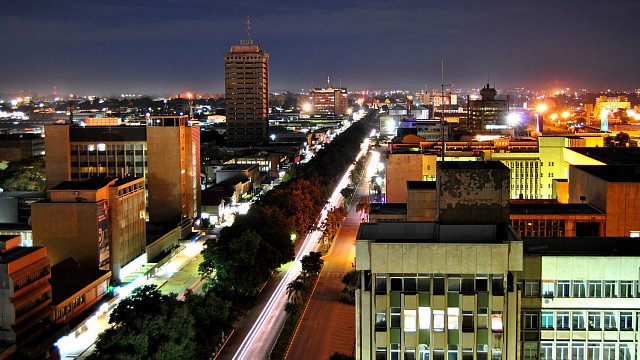
Lusaka, Zambia
Minister of Home Affairs, Stephen Kampyongo, said the suspension was necessitated by the escalating cases of cholera in the city.
According to him, the suspension is also in line with the government’s ban on public gatherings in some parts of the city.
He said the issuing office would only attend to emergency travels.
“There is no need to panic as this will be temporal to allow for efforts to prevent the spread of cholera,’’ he told reporters during a news briefing.
The cholera outbreak which mainly affected Lusaka since Oct. 2017 has prompted the government to ban public gathering as well as defer opening of schools.
According to figures from the health ministry, cholera cases in Zambia have surpassed 2,800, while the toll presently stands at 64.
Zambian President Edgar Lungu expressed optimism that the measures put in place by the government to contain the water-borne disease were adequate but highlighted the need to clean up cities to improve hygiene.