The Lagos State Parks and Gardens Agency (LASPARK) says it has intensified the pruning of overgrown trees across the state in preparation for the rainy season.
General Manager of LASPARK, Mrs Bilikiss Adebiyi-Abiola
The General Manager of LASPARK, Mrs Bilikiss Adebiyi-Abiola, said on Saturday, February 24, 2018 in Lagos that the move was to avert windstorm disaster associated with the rainy season.
Adebiyi-Abiola said that the agency had so far pruned over 500 trees in different locations across the state.
She called on residents to notify the agency of any overgrown tree within their communities.
According to her, some of the trees, apart from their tendency to wreak havoc during windstorm, are already competing with electric cables and poles.
”Calling the attention of the agency to overgrown trees in different parts of the state will help to prevent loss of lives and property.
”I am, therefore, seeking your support to report to the agency any of these trees that can affect, not only you, but other members of the society.
”This is because it is not possible for the representatives of the agency to be everywhere at all times to assess urgent issues related to these trees.
”This is what is required of you as a responsible citizen and this is what I am encouraging you to do,” she said.
Adebiyi-Abiola also urged residents to desist from cutting down trees without permission from the state government.
She said that the zero-tolerance stance to tree cutting and pruning without clearance from LASPARK still persisted.
The general manager reaffirmed the state government’s commitment to enforcing all Environmental and Greening Laws.
“This is to curb the menace of indiscriminate tree pruning and felling in all nooks and crannies of the state,’’ she said.
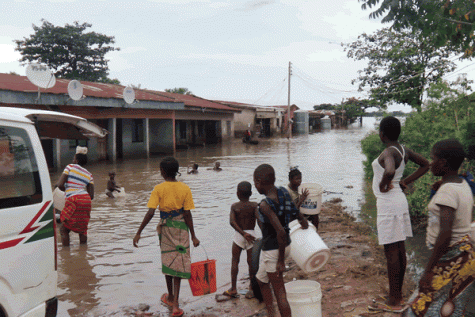
Makurdi, the Benue State capital city, on Friday, February 23 recorded its first rainfall in 2018.
Flooding in Makurdi. Photo credit: Sahara Reporters
The News Agency of Nigeria (NAN) records that that the rain, which was preceded by a mild breeze, started at about 10 pm and lasted till 1 am on Saturday.
NAN reports that the rain arrived much earlier than last year when it came in March.
NAN also reports that apart from 2014 which experienced early showers, the rain always set in around March.
NAN reports that the heatwave that had tormented Makurdi residents has eased for a more humid weather with farmers warming for an early commencement of the cropping season.
The Conservator-General, Nigeria National Parks Service, Alhaji Ibrahim Goni, on Friday, February 23, 2018 warned parks security officers now carrying arms and weapons against cases of accidental discharge.
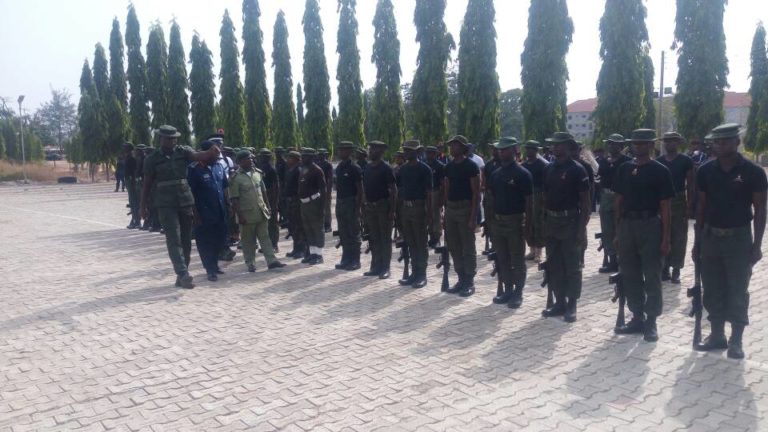
Conservator-General, Nigeria National Parks Service, Alhaji Ibrahim Goni, inspecting a guard during the passing out parade of 40 Park Rangers at the Civil Defence Corps Training School, Abuja
Goni gave the charge in Abuja at the passing out parade of the pioneer set of the National Parks Services Trainees on “Arms and Weapons Handling”.
He said the training being carried out by the Nigerian Security and Civil Defence Corps (NSCDC) was aimed at equipping officers and men of the service with requisite skills and techniques to discharge their duties efficiently.
“You should strictly use the lessons of this training for the interest of the nation, be civil in your conduct and always operate within your rules of engagements.
‘‘There should be no cases of accidental discharge and do not use your training to harass or intimidate innocent Nigerians,’’ he warned.
He said the task of park protection and conservation was not an easy on as officers have to trek long distances on rugged terrains and in harsh weather conditions.
‘‘In discharging our field duties, we face open confrontations by poachers of wild animals, loggers of timber, miners of mineral resources and cattle herders, which in most cases result in casualties.
‘‘Therefore, it has become imperative to equip officers and men with the right training to protect national infrastructure in the national parks with minimal or no casualties.’’
The conservator-general said the service was in ‘‘collaboration with the NSCDC.’’
He commended the Commandant-General of the NSCDC, Mr Abdullahi Muhammadu, and his men for the opportunity to equip men of the service.
‘‘The result of this training is a testimony that the NSCDC has one of the best facilities and instructors for training of this nature in the country.’’
In his remarks, Muhammadu said the occasion was to celebrate excellence, professionalism and coming of age of the corps.
‘‘This passing out parade was indeed a most heart-warming to note that we are not only capable of training our own but capable of training others.
‘‘I congratulate your officers for being receptive to knowledge and for successfully undergoing both academic and the very vigorous arms and combat training.
‘‘Eschew any behaviour that could tarnish your integrity, image of your organisation and the nation at large,’’ he said.
Highlights of the occasion were the review of the parade by the two commandant-generals and presentation of certificates to two outstanding trainees.
They are Ogundayo Kazeem (API) and Dauda Waliu (ACPI) for best marksmanship award.
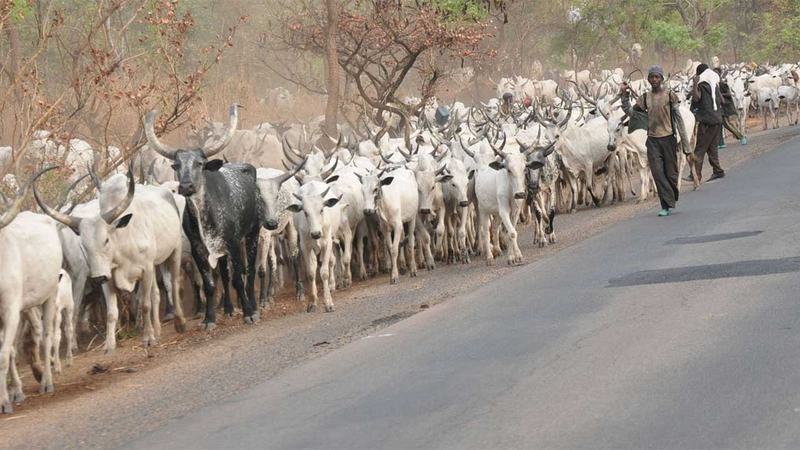
A Makurdi Magistrates’ Court on Friday, February 23, 2018 sentenced three herders – Iliya Garba, Hassan Abdullahi and Lanshak Lonfalk – to a year imprison each for violating the Benue State Anti-Open Grazing Law, 2017.
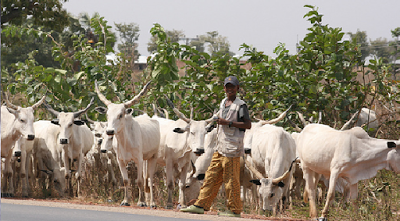
Herdsmen grazing their cattle
The convicts were charged with criminal conspiracy and open nomadic livestock rearing and grazing.
The offences are punishable under Sections 97 of the Penal Code and 19 (2) of the Open Grazing Prohibition Ranches Establishment Law of Benue, 2017.
The prosecutor, Insp. Michael Iorundu, told the court that the joint patrol team of “Operation Zenda”, led by Sgt. Edward Shinyi, arrested the herders on Feb. 18, 2018.
He said that they were brought to the State Criminal and Investigation Department in Makurdi, the state capital.
“The team reported that the three herders, and others now at large, were openly grazing their cattle along Yeluwata Road in Guma Local Government Area of Benue.
“When the case came up for mention, the herders pleaded guilty to the charge against them, saying that they were not aware that open grazing had been prohibited in Benue,’’ he said.
The Magistrate, Mrs Lillian Tsumba, said that the herders were first offenders who were also illiterates and not even aware that open grazing has been prohibited in Benue.
Tsumba said that a law such as open grazing prohibition required massive exposure and education of persons at the grassroots.
She, however, said law is law and must be obeyed in spite of ignorance.
The magistrate sentenced the herders to a year imprison each, with N500,000 option of fine each.
By most comments from Nigerians, Plateau is rated as one of peaceful states in the country, presenting a unique, friendly weather and abundant tourism potential.
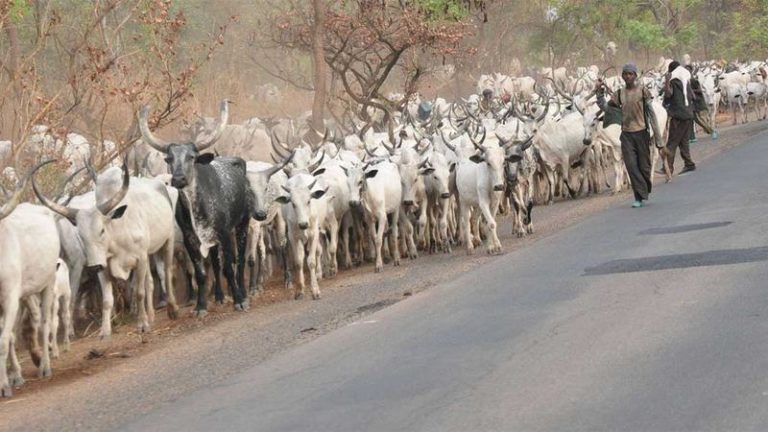
Herdsmen
These attributes have, no doubt, given reasons why the state has witnessed patronage from both local and foreign tourists.
However, concerned citizens of the state expressed concern that the plateau may seem to exist on past glory and status due to some evolving socio-political challenges, sometimes, resulting in violence.
For instance, they cite a religious violence in 2001 in which many lives and property worth millions of naira were lost.
During the violence, hoodlums took the advantage and razed down the one of the largest markets in West Africa – Terminus Market – located in Jos.
They believe that the state has not recovered from the huge economic loss that the violence and other ones have caused it as many investors are discouraged from investing in the state.
Observers also raise concern about the trending clashes between herdsmen and farmers that can further deplete the potential of the state.
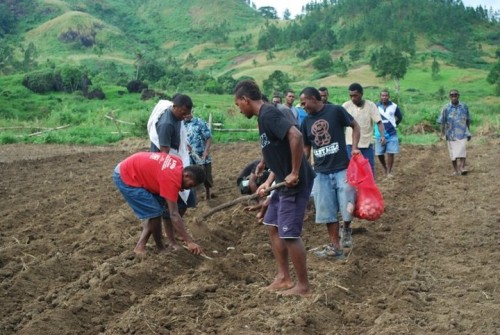
Farmers. Photo credit: smeonline.biz
The clashes between the two groups, like other disturbances, will not occur without blood-letting and loss of property, as they observe.
In most cases, the clashes, when they occur, will displace many people, forcing them to seek refuge elsewhere.
They observe further that Riyom, Barkin Ladi, Bokkos, Mangu, Bassa and few communities in Jos South local government areas of the state are worst hit in such conflicts.
They also note that although successive governments in the state had made efforts at subduing the conflicts, they have been recurring.
Worried by the development, Gov. Simon Lalong of the state constituted many peace committees to address the issue with a view of providing a way for peace.
The government also established a peace building agency and a special security committee, headed by a lawmaker, Mr Yusuf Gagdi, to proffer ways of finding lasting peace in all parts of the state.
These efforts notwithstanding, concern citizens insist that clashes between farmers and herders recur daily in different parts of the state.
But the Catholic Archbishop of Jos, Most Rev. Ignatius Kaigama, observed that constant clashes between the two groups indicated that government had not paid enough attention to agricultural sector.
“While the farmers produce enough food for us to consume, the herders produce beef and other nutrients from their cattle for the consumption of the public.
“They are both vital aspects of our existence; but because we concentrate too much on oil, these groups are often alienated, margnalised or treated with indifference.
“I urge governments at all levels to invest heavily in supporting these groups; in fact, huge amount of money should be budgeted to ensure herders have all it takes in rearing animals.
“The government should provide farmers with good and modern agricultural tools alongside soft loans to enable them to produce enough food.
“It is my firm belief that when government is able to meet the needs of the two groups, the incessant attacks and counter-attacks between them will die a natural dead,’’ the cleric said.
Kaigama, however, urged the herders and farmers to live in peace for the development of the state.
Similarly, the Church of Christ in Nations, pleaded with the state government to ban open grazing urgently and address the ongoing face-off between herders and farmers in the state.
Rev. Dachollom Datiri, the president of the church, observed that open grazing had made farmers to suffer loss.
He also charged the security agencies to live above board and intensify efforts in unmasking the unidentified gunmen to face the wrath of the law.
Supporting Datiri’s view, former state Gov. Jonah Jang, said: “There is no gainsaying that the time is now and most appropriate for open grazing to be outlawed.
“I wish to call on the government of Plateau to enact its own anti-open grazing law in the interest of our people and the longevity of the lives that God, in His provision, chose to give us.’’
Pushing further on the need to curb farmers and herders clashes in the state, the Plateau Youth G17, presented to the state House of Assembly a bill seeking the enactment of anti-open grazing law in the state.
Presenting the draft bill to the state House of Assembly, the convener of the group, Mr Dachung Bagos, said “the bill seeks to prohibit open rearing and grazing of livestock.’’
Bagos said if the bill was passed as law, it would ban open grazing of animals and allow the establishment of commercial ranches, as against the public ones or cattle colonies being proposed by the government.
“Ranching is purely a private business; if you want to rear your cows you are free to get a land for that purpose, not that government should take up that as part of its responsibility.
“This bill, if giving due consideration, will go a long way in curtailing the incessant attacks and counter attacks we are experiencing on the Plateau.
“It will provide an environment that is conducive and safe for both farming and rearing of animals,’’ he said.
While efforts are ongoing to ensure peace, the Police Command in the state said it had organised a stakeholder’s meeting to find best ways of addressing the lingering clashes between farmers and herdsmen in some parts of the state.
Mr Undie Adie, the Commissioner of Police in the state, said that the clashes between the two groups had been a serious threat to peace in the state.
“We are not to apportion blames or call each other names, but I called this meeting to fashion out ways that will lead to lasting peace in the state.
“We cannot continue to kill and destroy each other’s farm lands, houses and other property; we have come together as a people to work out ways that will take us back to those old good times where we were all living as brothers and sisters,’’ he said.
The commissioner urged the people not to take laws into their hands, but to report any incidence to the nearest police station or any security outfit nearest to them.
“When you take laws into your hands, it fuels more crises, but when something happens, your duty is to report to us and we will take it up from there and do the needful,’’ he said.
However, Alhaji Sanusi Ajiya, the National Vice Chairman of Police Community Relations Committee, said that the police alone could not bring the needed peace in the society.
“It is incumbent on everybody to develop ways and agree to work towards lasting peace in the state and Nigeria in general.
“This is why I commend the Commissioner of Police for this laudable initiative aimed at bringing peace to our state,’’ he said.
Sharing similar sentiments, Mr Joseph Lengman, the Director General, Plateau State Peace Building Agency, said there must be a proper diagnosis of the situation, actors involved and the interests in conflicts before seeking solutions.
He observed that the inability of successive governments to find a sustainable solution to the problem was because of lack appreciation of what the problem was all about before taking action.
“We must desist from having a blanket assumption of what these clashes are all about; and so the need for us to cross-examine the problem and place it in a proper perspective before making conclusions.
“If we think that the problem of farmers and herders begins with the farmers on one hand and on the other hand ends with the herders, then we making a very big mistake.
“The components that were largely ignored or undermined must be better appreciated in addressing this challenge, because the peripheral solutions cropping up will not solve the problem.
“So, we must know what the crisis is all about before doing any other thing, because anything short of that can be counterproductive,’’ Lengman said.
He called on the people of the state to put aside emotions and swallow the bitter pills in proffering lasting solutions that would completely address the lingering problem in the state.
He also pleaded with the security agencies and other stakeholders to work diligently to sustain peace in the state.
The Lake Chad Basin Commission (LCBC) has listed insurgency, climate change, and non payment of annual contributions as challenges to full implementation of its programmes in the region.
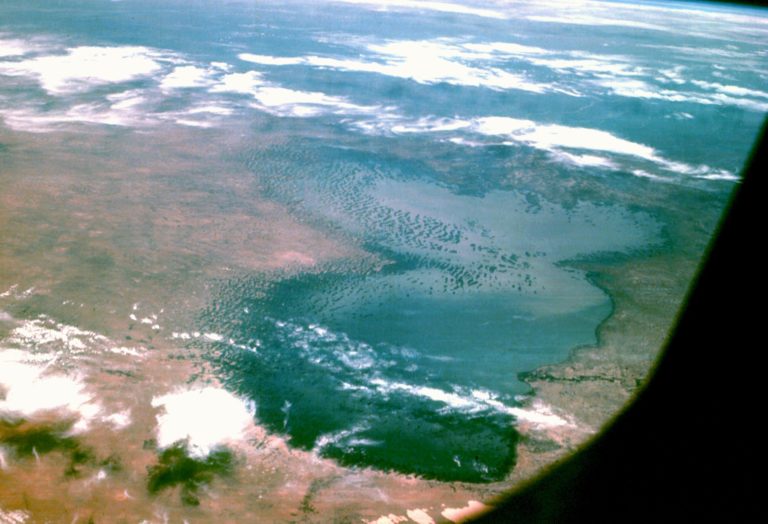
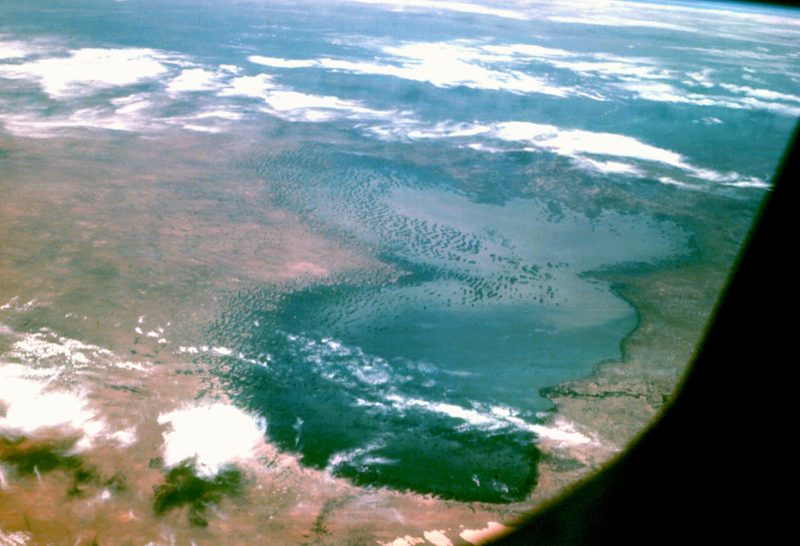
Lake Chad viewed from Apollo 7
LCBC Executive Secretary, Alhaji Sanusi Abdullahi, said this at a meeting of the Committee of Experts to the 63rd Ordinary Session of the Commission’s Council of Ministers in Abuja.
He said the non-payment of annual contribution by member states led to the inability to meet more than 70 per cent of its programmes.
He commended the Nigerian Government for meeting up its contribution through the payment of $1 million to promote the region.
He said since 2014, activities of insurgents prevented the commission from carrying out programmes, especially in the rural areas, while commending the efforts of the Multi National Joint Task force to stabilising the region.
“Our major challenges were the non-payment of annual contribution by member-states as and when due, and security challenges coupled with the effects of climate change in the Lake Chad Basin.
“Only Nigeria has settled its financial obligations to the commission, it is important to stress that member countries need to meet their financial obligations to earn the respect of our technical and financial partners.
“Thus, we were for most of the years not able to achieve 70 per cent of budget execution. From 2014, security challenges became worse resulting to preventing us from executing programmes for the rural communities”.
The executive secretary said the commission has been able to re-activate, expand and strengthen the remodelled Multi National Joint Task Force fighting to restore peace and sustain the Lake Chad basin.
According to him, the huge progress made towards the realisation of the inter-basin water transfer project to recharge the basin and save it from extinction is worthy of note.
Sanusi said the programme to rehabilitate and strengthen the resilience of the basin was ongoing despite challenges, expressing hope that it would pick up by the end of the first quarter of 2018.
The Minister of Water Resources, Mr Suleiman Adamu, said the objective of the meeting was to consider and approved the programme of activities for 2018.
He urged the committee to deliberate carefully to promote livelihood of the inhabitants of the basin.
Adamu, represented by the Permanent Secretary, Dr Musa Ibrahim, said the upcoming international conference of the Lake Chad would draw global awareness on the socio-economic challenges arising from the Lake’s shrinkage.
He expressed the commitment of the Federal Government to passionately support policies and programmes for the sustainable development of the Lake.
He said that it would be an opportunity to deliberate on its threat to livelihoods including insecurity with the overall goal of developing a comprehensive programme and action plan.
The minister added that the conference would also inform stakeholders on the consensus on the different solutions to restore the lake.
The News Agency of Nigeria reports that the Federal Government in partnership with the Commission and UNESCO will hold an international conference on the Lake Chad Basin from February 26 to 28, 2018.
The Congolese Minister of Environment, Amy Ambatobe, has reinstated 6,500 km² of logging concessions that were cancelled in August 2016 by the then Environment Minister, Robert Bopolo, following instructions from then Prime Minister, Augustin Matata Ponyo.
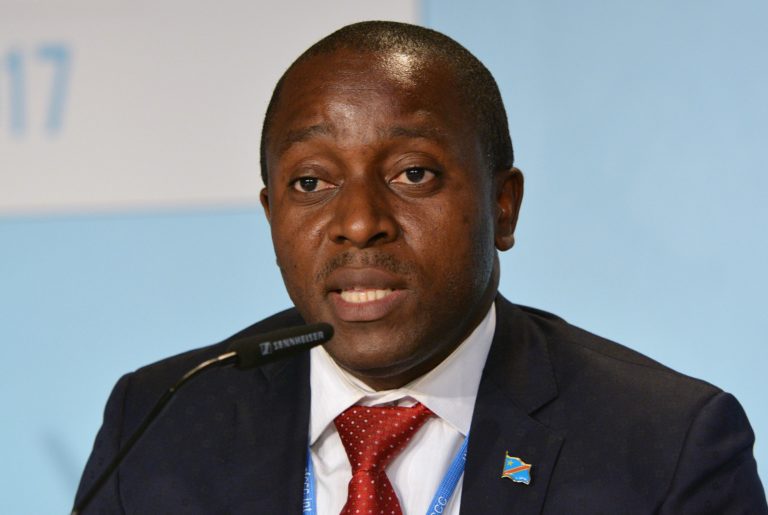
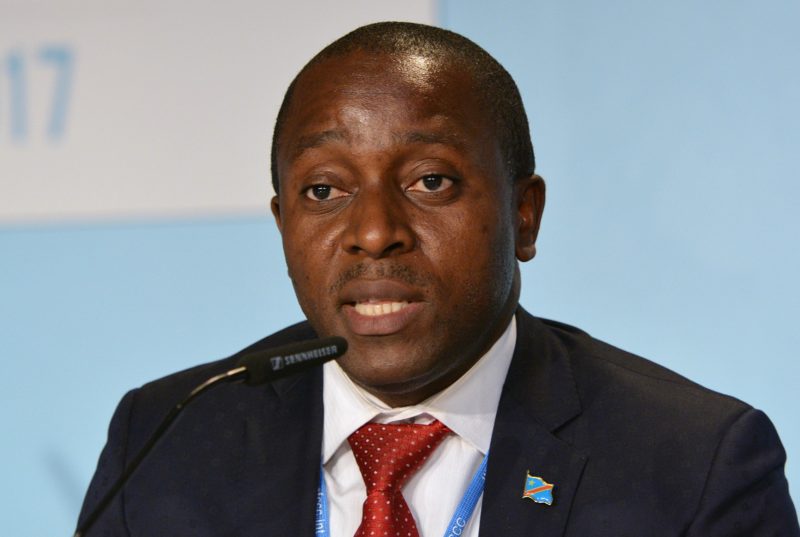
Amy Ambatobe Nyongolo, Minister of Environment and Sustainable Development, DRC
The three concessions reinstated on February 1, 2018 were awarded to the Chinese-owned logging companies Forestière pour le Développement du Congo (FODECO) and Société la Millénaire Forestière (SOMIFOR). Two of the concessions overlap with a recently discovered peatland deposit covering 145,000 km² and believed to contain 30 billion tons of carbon. Expanding industrial logging into these areas is considered to be among the biggest threats facing them.
“We are alarmed that the Minister of Environment has illegally reallocated these concessions in breach of the 2002 moratorium on new industrial logging titles despite their earlier cancellation. Greenpeace Africa calls on the Congolese government to revoke these concessions once more and, this time, sanction the perpetrators,” said Irene Wabiwa Betoko, Greenpeace Africa Senior Campaign Manager.
In October 2017, the Norwegian-funded Central African Forest Initiative (CAFI) greenlighted the transfer of $41.2 million to the DRC’s national fund for Reducing Emissions from Deforestation and forest Degradation (REDD+). This was supposed to be done only after the Congolese government put in place a “robust action plan” with internal oversight measures. However, CAFI’s failure to insist on measures to prevent future breaches of the moratorium has meant that significant funds have been disbursed in the absence of due diligence.
Jo Blackman, Campaign Leader at Global Witness, said: “We call on CAFI to immediately suspend future funding until the DRC’s government cancels these concession allocations, guarantees that the moratorium will be respected and sanctions those responsible for these illegalities.”
Lars Løvold, Director of Rainforest Foundation Norway added: “It is surprising that elements within the DRC government apparently are willing to risk cancelling the whole 200 million dollar agreement between CAFI and DRC by insisting on short-sighted illegalities.”
During a photo opportunity aboard the Greenpeace ship Esperanza on October 31 2017, the DRC Environment Minister solemnly committed himself to the protection of the country’s peatlands by stating: “I’m sending here a message to the entire international community for the mobilisation of funding and to help DRC Government to protect these sensitive areas and to improve the livelihood of communities living around these peatlands.”
Simon Counsell, Executive Director of Rainforest Foundation UK, said: “The issuing of new logging concessions sends a clear signal to the international community that the DRC government is abandoning any pretence at reducing emissions from deforestation and forest degradation. Any new large-scale logging operations on peatland forests in particular are likely to cause massive emissions of greenhouse gases. Donors such as Norway and the World Bank will need to reconsider whether REDD programmes in DRC are credible and supportable.”
The International Institute of Tropical Agriculture-managed Cassava Weed Management Project (IITA-CWMP) says it will partner with cassava growers in the country to boost its productivity.
Dr Nteranya Sanginga, Director General of the IITA
Mr Godwin Atser, IITA Communication and Knowledge Exchange Expert, disclosed this in an interview with the News Agency of Nigeria (NAN) on Friday, February 23, 2018 in Abuja.
Atser said the institute had observed the challenges faced by the rural farmers and was determined to proffer solutions through science-oriented innovations.
He said the IITA would provide innovations to educate big time cassava growers in the states on ways of tackling several challenges in growing the commodity.
“We want to see increase in yield in Nigeria, and our innovation in cassava weed management will help states with cassava as a priority crop to tackle weeds, a major constraint to cassava transformation,” he said.
He explained that the institute had in one of its forums tagged, “Nigeria Zero Hunger Forum“, strategised ways to tackle some of the challenges facing productivity in the sector.
Atser said the IITA was working hard to address the adulteration of herbicides by unqualified personnel to address issues of weeds control in the farms.
He said the practice was not helping matters and it undermined efforts by resource-poor farmers to raise their productivity.
“The uncontrolled influx of adulterated herbicides in the Nigerian market is jeopardising the gains made so far in transforming agriculture and efforts to attain zero hunger in the country.
“The goal to attain zero hunger is a commitment Nigeria has made since the declaration of the Sustainable Development Goals (SDGs) in 2015.
“And as an agricultural institute, we are to collaborate to provide solutions to some of these challenges in order for the country to attain food self-sufficiency and food security, “ he said.
He said that enhancing value of cassava in Nigeria had posed various challenges to cassava growers, hence the need to employ science and technology to develop higher-yielding and pest-resistant cassava varieties.
Europe is increasing the suffering of African migrants trying to cross the Sahara, the Red Cross chief said, urging lawmakers not to put security above human rights.
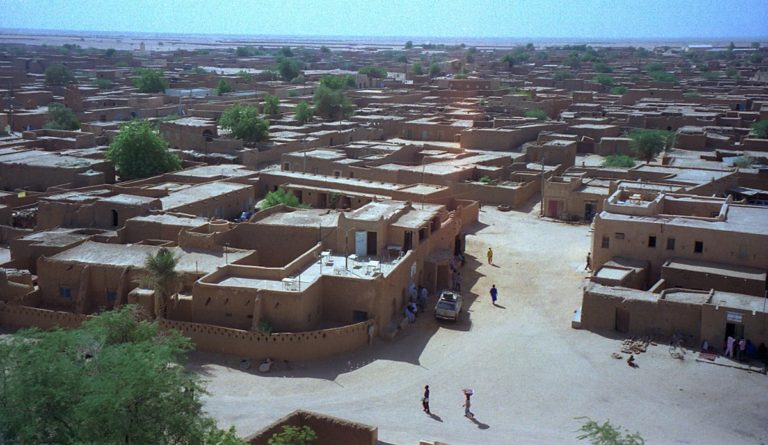
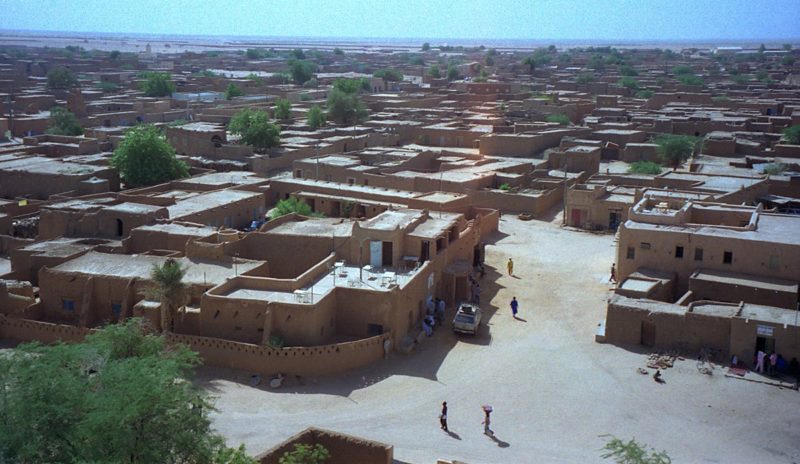
Agadez, Niger Republic
Francesco Rocca, head of the International Federation of Red Cross and Red Crescent Societies (IFRC), met migrants in Niger who said they were stranded, unable to head north to Europe or return home.
“When we talk about European migration policies, it is only about security – how they are not allowed to enter – and not about the dignified manner in which you have to treat human beings,” he told the Thomson Reuters Foundation.
“Cynicism has increased a lot. I think we are sick and we have to find a way to cure this disease,” he said in Agadez, a desert transit hub in Niger for Africans hoping to reach Europe.
Europe has responded to waves of illegal migration in recent years by sponsoring security crackdowns in transit countries so that people are stopped before reaching its borders.
The ICRC said no fewer than 350,000 people traveled through Niger in 2017 in spite of a law passed two years earlier that saw smugglers jailed and soldiers posted throughout the desert.
The red cross said since the law, four times as many migrants have been hospitalised in Agadez each month for injuries because they travel at night, across mountains and through dangerous desert terrain rather than taking safe roads.
ICRC said some of the Africa migrants stranded in Agadez fled conflicts, though most left home hoping to find work.
Men from Senegal, Gambia and other countries squatting in mud ghettos told the Thomson Reuters Foundation that they were afraid to continue their journeys and had no money to get home.
“The problem is how high a price these human beings are paying for EU policies,” Rocca said, describing Europe’s approach as cruel and ineffective and calling for more support to migrants and communities hosting them.
The Italian lawyer said Europe’s migration polices have failed for decades as people continue to move but they are forced to use more dangerous routes.
“People in Agadez told me that the Sahara is just as deadly as the Mediterranean,” he said in a statement, referring to the thousands who drown in overcrowded boats each year.
“The difference is that we don’t know how many people have died there, or what inhumanity they have faced.”
International scientists have called for concerted efforts to stop spread of the invasive alien species, which they say are contributing to Africa’s inter-community conflicts, a local news reported on Thursday, February 22, 2018.
Invasive plant species
The scientists, who ended a workshop on invasive species in Nairobi, Kenya, said such species are also responsible for tremendous economic losses through loss in forest and agricultural productivity, and the spread of diseases.
Arne Wilt, Invasive Species Coordinator at CABI’s Invasive Species Coordinator, attributed Africa’s rising intercommunity and human-wildlife conflicts to the increase of invasive species.
Wilt said the invasions by the species in adjoining agro-ecosystems reduce crop and pasture production, hence forcing some communities to encroach into others land.
“Pastoralists and farmers’ conflicts have grown, spread and intensified over the past decade hence posing a threat to security in some countries,’’ Wilt noted.
Wilt said such species also forced wildlife to forage outside on farms, resulting in increased human-wildlife conflict.
According to him, such problems have been pronounced in Nigeria and Kenya in recent years.
Hiver Boussini, Animal Health Officer with the African Union Inter-African Bureau for Animal Resources (AU-IBAR), said livestock production is also affected when invasive weeds colonise prime grazing land, thus driving farmers into marginal areas.
“Competition for access to resources and fear of the plant and disease spreading across the area leads to conflicts between communities,’’ he added.
Boussini said that elephant-human conflict in Central Kenya is also an example of conflict caused by invasive species as the presence of Opuntia stricta forces the wildlife to move to farms.
“It is time that the African governments allocate funds for the eradication of invasive species,’’ he added.