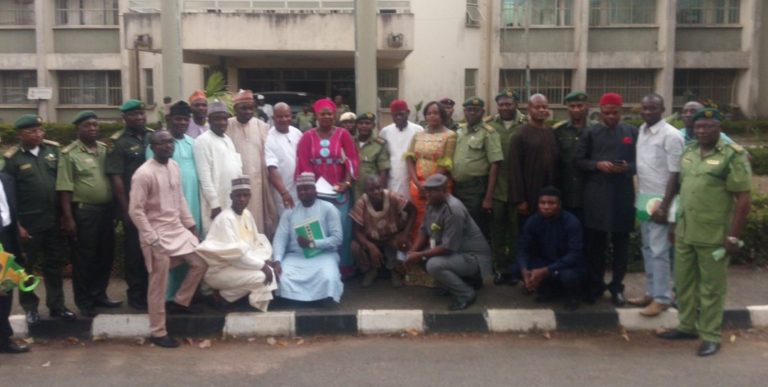
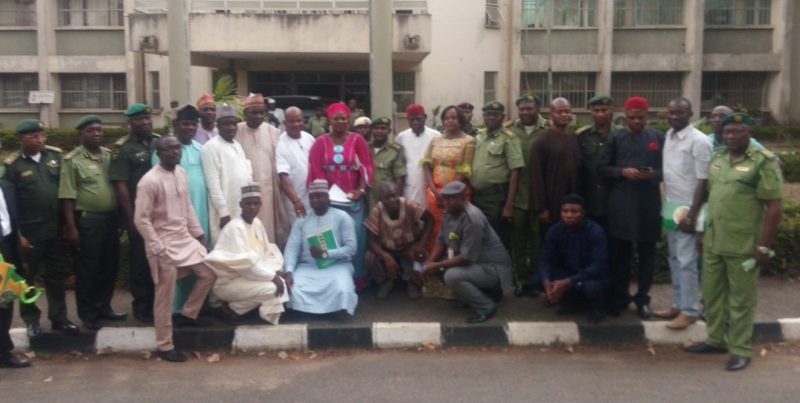
The newly inaugurated Nigeria National Parks Service board members on Monday, March 12, 2018 pledged to ensure best international service delivery at all parks across the country.
Members of the newly inaugurated National Parks Service Board
The board chairman of the Parks Service, Chief Ben Nwaobasi, gave the assurance while briefing newsmen at the parks headquarters in Abuja.
After a closed door meeting with Alhaji Ibrahim Goni, the Conservator-General of the Parks Service, Nwaobasi said the board got a comprehensive briefing on the Parks Service.
“The brief is very good; members of the board will study it and come up with recommendations to the problems outlined in the brief.
“We are happy that the Conservator-General, his team has done very well, and in the cause of the brief we all agreed to show love and commitment to the job.
“We are going to make better adjustments and make sure that we put our foot prints here so that other people coming will know that we have done well.’’
He said that the agenda of the board was to work tenaciously to support some good impressions at the Parks Service and as well tackled the challenges outlined.
“It’s good to have challenges but what is important is that we are equal to the task, and we have seen the achievements so far and we are going to encourage them to achieve more.
“We will have a close working relationship to ensure guidance on application of Public Service Rules and Regulations to help us improve service delivery to boost revenue generation potential.
“We will also ensure that we leave the place better than we met it,’’ he assured.
Goni in an interview with the News Agency of Nigeria (NAN), said the service would be repositioned for international best service delivery to boost its revenue generation potential.
He said that since one of the roles of the Parks Service was to protect the environment and indigenous genetic resources, it would be upgraded to an international standard to enable it to attract more tourists.
“The Parks Service plays significant roles in science, research and educational development, especially in agriculture, medicine, psychology and spiritualism.
“The nation in essence should pay more attention to the protection and conservation of its ecosystem,’’ he said.
Goni said that the Parks Service was being overhauled in the areas of capacity building, infrastructure development, research and development, among others.
He, therefore, called for the support and collaboration of other agencies and the private sector in efforts to make the National Parks among the best in the world.
The plan to annually celebrate the World Wildlife Day was conceived during the 68th session of the United Nations General Assembly in December, 1983 as a means to raise awareness of the world’s wild fauna and flora as well as to recognise the importance of the Convention on International Trade in Endangered Species (CITES) in ensuring that international trade of Wild Flora and Fauna does not threaten the survival of species.
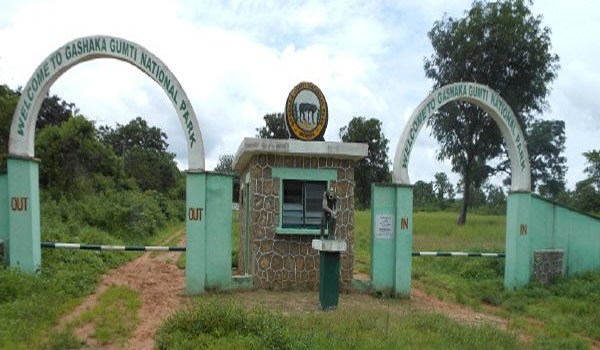
The Gashaka Gumti National Park. Government has been urged to strengthen the National Park Service to enhance their capacity for wildlife conservation and protection
The theme of World Wildlife Day 2018 “Big cats – predators under threat” is a step further from last year’s theme ‘‘Listen to the Young Voices’ as a way to ensure the realisation of CITES objective in the 182 member states of the United Nations, on the need to urgently rise to the demands of conserving all form of wildlife especially the big predators – who are now globally threatened – with their condition in Nigeria even more dire!
With reference to the 2016’s World Environment Day, Amina Mohammed, who until her recent UN’s appointment was the Minister of Environment said, “The status of wildlife in the country leaves much to be desired, as the rate of depletion of the population of animals like the elephants, leopards, giraffes and crocodiles amongst others is frightening. Today I know that if somebody says, what is really the status, or figures for wildlife in Nigeria? I am not sure I can tell you as the Minister of Environment. And if I am going to say something, it is probably 10 years old in terms of its information and data.”
It almost two years since Amina Mohammed promised that the government would develop the capacity to know what the baseline was, what animal was where, which was endangered, what needed to be done to protect those animals and to increase their population in Nigeria.
For long, Nigeria has rested on an erroneous notion that our wild animals were plentiful and not under any threat of extinction, however, following the recent publication of the International Union for the Conservation of Nature (IUCN) Red List of globally threatened species which revealed that 148 animals and 146 plant species found in Nigeria were threatened at various degrees including some species near extinction, we hope it is not too late to right the wrongs. Out of the very large landmass that Nigeria boasts of, we have only seven National Parks. There is the need to invest in our National Parks to see clear prioritisation of our biodiversity and wildlife heritage by the governments at all level in Nigeria.
Human activities like hunting, grazing, land deforestation, mining, infrastructural construction, aerodromes, power lines, and related activities have destroyed our wildlife flora and fauna than natural factors like climate change and fire occurrences by over 40% in the last 25 years. Another adjoining factor is that occupants of host communities earmarked as protected areas see their surrounding areas as traditional hunting grounds.
We must take a cue from smaller countries like Gabon with 13 well-managed national parks, Egypt with 25 national parks and Kenya with 23 national parks only aside game reserves, wildlife sanctuary and other forms of protected areas in countries like Botswana, South Africa, Tanzania and Madagascar.
Sadly, fewer than 50 lions remain in Nigeria while the global value of illegal wildlife trade is soaring beyond $50 – 150 billion per year, conversely, less than 7,100 cheetahs remain in the wild, globally. These and many more statistics of the state of wildlife suggest that the time for urgent action is now!
The Federal Ministry of Environment and the Federal Ministry of Agriculture and Rural Development, must create an operational synergy between associated government and non-government stakeholders. On the other hand, the government must undertake the following:
Strengthen the National Park Service to enhance their capacity for wildlife conservation and protection.
Increase awareness and education on the intrinsic value of wildlife to the society.
Swift and clear penalties to illegal poachers and hunters to mitigate further illegal harvesting of wildlife.
Infrastructural development plans to incorporate the wildlife protection/survival programme through effective Environmental & Social Impact Assessment.
Finally, monitoring and data compilation must complement environmental education and awareness; the fiercest of wild animals cannot protect themselves from those out to poach or illegally traffic them, it’s up to you and me, together we can restore Nigeria’s wildlife heritage and give a voice to the younger ones!
By Dr. Joseph Onoja (Ag. Director General, Nigerian Conservation Foundation)
If there is one thing on which political thinkers all over the world agree on, it is the idea that a leader has no glowing legacy or historic impact unless he or she has a robust successor plan. The baton of personalised political principles must be transmitted to a prepared protégé.
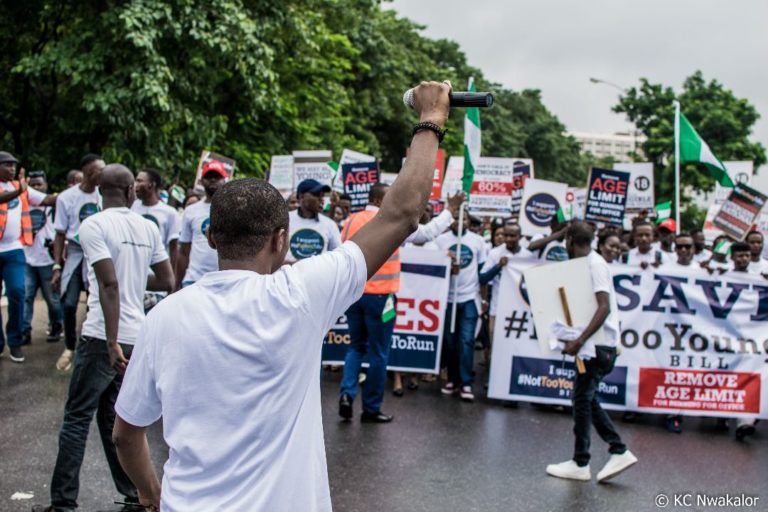
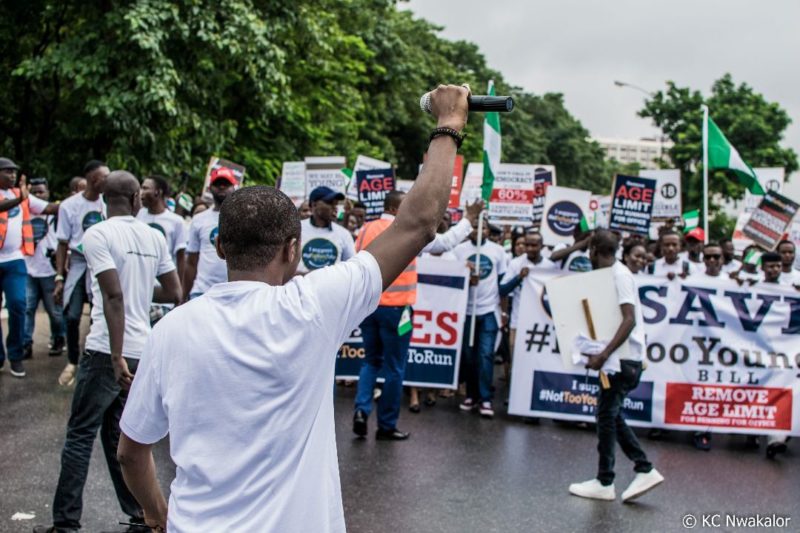
Hamzat Lawal (backing the camera) leading a Not Too Young To Run rally
However, present day democratic realities have made the world reach a consensus that the best replacement plan is via institutions and policies. The best leaders, therefore, are the ones who, while in office, molded these factors in a way that the next generation finds in them tools that make service to country a seamless exercise.
Now that the Age Reduction Bill, popularly referred to as the Not Too Young To Run Bill, has received affirmative votes from more than 24 State Assemblies of the Federation, there is no person on a better advantageous footing to leverage the historic significance of this momentous bill than our own President Muhammadu Buhari.
For those that are yet to know, the Not Too Young To Run Bill seeks to reduce the age for running for elective offices in Nigeria. It was first passed by the National Assembly in a celebrated vote in July 2017. Thus, the amendment as passed by the National Assembly and State Assemblies reduces the qualifying age of the President from 40 to 35; House of Representatives from 30 years to 25 years and State House of Assembly from 30 years to 25 years. The age for the Governor and Senate was retained at the current 35 years.
Undoubtedly, the passage of the bill by the states is very significant, not only because of the extraordinary speed, but because of its legal and moral implications.
With this passage, the bill has met the constitutional threshold prescribed by Section 9 (2) of the 1999 Constitution of the Federal Republic of Nigeria (as amended). The Section stipulates that any amendment to the constitution must be approval by at least 24 State Houses of Assembly.
Moreover, given that the chambers of the State Assemblies are the very representatives of the thousands of village squares and the decisions that emanate from them in the nooks and crannies of the nation’s localities, we can assume that the grassroots have spoken. Truly, the masses of Nigeria are on the side of the youth!
What is more, a particular incident in one of the State Assemblies demonstrated that #NotTooYoungToRun is a movement that holds the best of promise not only for young people, but for every guardian of our young democracy. The interesting development transpired at the Taraba State House of Assembly when, having earlier voted against the Bill on 20th December, the House reversed itself on Monday, February 19, and passed the Age Reduction Bill. It was an overwhelming turnaround, as 22 members voted YES while two abstained.
I believe, therefore, that it is as gladdening to every Nigerian as it is to me, that we as a people have written our name in gold by showing that political inclusion is possible in our clime.
Nevertheless, with the unprecedented feat recorded so far, the world now seems to be holding its breath as it watches the ball roll over to President Buhari, who is expected to assent to the constitutional amendment. Once the President gives his assent, the bill becomes law. Young people can then run for political office even in the next general elections in 2019.
To be candid, because of #NotTooYoungToRun, President Buhari has a date with destiny. Throughout generations past, men and women in positions of power have rewritten history by singular acts of valor not with the sword but with conscious offerings enacted simply to build bridges that ushered in a new paradigm in socio-political fundamentals.
The peculiarity of a government that came riding on the mantra of “Change” is that Providence has offered it an opportunity to prove its own spirit, as change is a word that signifies an age-input parameter. Posterity can only be kind to soldiers who never reneged on their own revolution. Could it be, that The Almighty has offered this Administration a reason to properly hoist its own flag?
Of course, the #NotTooYoungToRun is a movement that enjoys an emotional and political acceptance across all divides. Hence, in signing the Age Reduction Bill, Buhari could find his finest hour.
But importantly, there are three reasons why President Buhari must take advantage of this opportunity. Firstly, he was recently crowned as Africa’s Anti-Corruption Champion by no other than the African Union. What I see in this momentous coronation is the potential for an apotheosis when the president takes advantage of the Nigerian youthful population. Nigeria, being the most populous country in Africa, has a ready-made field for Buhari to mainstream his anti-corruption ethos when he looks towards tomorrow and the youths he will raise to continue the battle he has initiated today.
In signing the Age Reduction Bill, I believe the president will be saying to those that made him the African Anti-Corruption Champion, “I am ready to make politics in Nigeria as inclusive as it can be, because I need to catch them young and train them when they are still trainable. I want to show other African leaders who are still hesitant, that the real Anti-Corruption fight is in the political selection process.”
Secondly, President Buhari served Nigeria as a former military Head of State at the youthful age of 42, and so could easily become the poster boy for generational political transition.
By assenting to the bill, he will be birthing a new era in Nigerian politics, in scoring the psychological goal that his comeback to politics which he was forcefully ushered out decades ago is, perhaps, a mission to reignite the youthful patriotism that motivated him to intervene in politics in the first place. This time around, by signing the Bill, he would be taking the pains to fulfil the democratic and legal processes that mainstream Nigerian youths with similar patriotic drive, for good.
Thirdly, immediately after the passage of #NotTooYoungToRun Bill in over 24 States as constitutionally required, something remarkable happened as the British High Commissioner to Nigeria, Paul Arkwright immediately took to his official Twitter handle to urge President Buhari to assent to the bill as soon as it was transmitted to him by the National Assembly.
What I saw in this development is that all eyes are on Nigeria. Given that many countries of the world do not give young people the opportunity to play a part in political governance, Nigeria is surely becoming a bastion of modern democratic best practices, with leaders that are determined to make a difference. The diplomatic community and the global society are now waiting for our president to put an icing on the cake by demonstrating a commitment to inclusive democratic ideals. This is because by taking concrete steps to address political inequality and harnessing demographic dividend, the president sets the stage to take advantage of our country’s teeming youth population which if not properly and creatively engaged could equally turn into a demographic disaster.
By Hamzat Lawal (An activist and currently the Co-Founder/Chief Executive of Connected Development (CODE); @HamzyCODE)
The month of March, 2018 is here and, in less than 10 days from now, on Thursday, the 22nd the international community will be celebrating this year’s World Water Day on the theme: “Nature for Water.” The aim is to demonstrate the potential of nature-based solutions for water and how they can be considered for water management policy and practice.
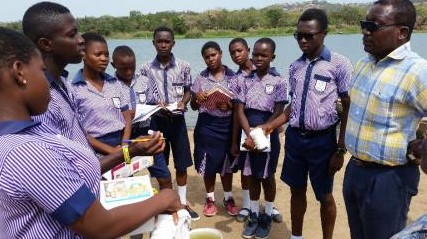
Dr. Ronald Abrahams, Officer of the Water Resources Commission in-charge of the Densu River Basin (right), demonstrating the use of the Water Monitoring Kit to school children of the Joy Academy in Galilea in the Ga South Municipal Assemble area. This forms part of activities for this year’s celebration World Water Day celebration in Ghana
All over the world, preparations are on-going for a successful celebration that will highlight the importance of maintaining and protecting water ecosystems – such as forests, aquifers, river banks, lakes, wetlands and mangroves. This will ensure the continuation of their normal functioning that provide services including filtering and storing water for the benefit of humans and other life forms. However, when freshwater ecosystems are abused, they are unable to effectively perform these crucial functions.
In Ghana, the Day’s observance has begun earnestly with activities including school children monitoring the quality of water in the Weija Dam. The dam lies within the portion of the Densu River Basin in the Ga South Municipal Assemble of the Greater Accra Region. The socio-economic lives of the catchment communities such as Manhean, Galilea and Ngleshie Amanfro revolve around the dam. It supports a vibrant fishing industry in the area, serves as a source of water for some of the community members and also enable herdsmen to water their cattle.
The 10 students selected from the Joy Academy School at Galilea are monitoring the water in the Weija Dam to ascertain its health or pollution status. They are using a simple Water Monitoring Kit to check for several things including thermal pollution or temperature of the water, the dissolved oxygen content, turbidity and PH. All of these, depending on the levels and density have implications for aquatic life and for human consumption. They further give an indication of the type and scope of human activities and how they are impacting the water.
The children will also be looking out for bio-indicators such as the presence of dragon flies or butterflies, which gives an indication of the environmental integrity of the entire water ecosystem.
The Densu River Basin Officer, Dr. Ronald Abrahams of the Water Resources Commission (WRC), assisted the children to conduct the monitoring at the river side. During that period, one could observe all kinds of human activities taking in the water body – women washing clothing’s and bowls, some dumping fish waste, others washing their feet, while others fetched water to take home, cattle could be spotted on the other side drinking from the river, while, fishermen were just lazing in their boats, as it was not yet time for them to go fishing.
Apart from monitoring the water in the Weija Dam, the children will also monitor treated piped borne water supplied to sections of the communities.
The results will be presented during the durbar to climax the Day’s celebration on Thursday, March 22nd at Manhean.
Prior to the trial monitoring, Dr. Abrahams and some members of the National Planning Committee for World Water Day celebration in Ghana, had interacted with and sensitised the children together with about 50 other students on the theme for the celebration.
The Chairperson of the Committee, Mrs. Adwoa Dako, said the Day was instituted during the United Nations Conference on Environment and Development in 1992 also known as Rio de Jeneiro Earth Summit. She said the purpose is to draw attention to the importance of freshwater ecosystems and advocate for their sustainable management.
Dr. Ronald Abrahams introduced the Water Monitoring Kit to the children and took them through the monitoring process.
About a fortnight earlier, on Tuesday, February 27, the Day’s celebration was formerly launched at a media interaction organised by the Planning Committee, for a group of journalists and the Chief and elders of Ngleshei Amanfro and the surrounding communities.
Dr. Jonas Kpakpa Quartey of the Centre for African Wetlands, University of Ghana, Legon, briefed the gathering about the “Importance of the Health of Freshwater Ecosystems.” He said they are important for domestic uses and in supporting livelihood activities such as the local fisheries, irrigating farmlands, and providing raw materials for craft works and buildings.
Dr. Quartey added that healthy freshwater ecosystems also serve as vital sources for energy production, support recreation and tourism, and provide natural solutions including strengthening the resilience of an area or people to climate induced natural disasters.
He said freshwater ecosystems are threatened by rapid population growth, changes in land use, development of water infrastructure such as dams, industrial discharges, and dumping of rubbish and faeces. Dr. Quartey explained that these developments render freshwater ecosystems unhealthy, making the water unsafe for human consumption and aquatic life.
Additionally, unhealthy freshwater ecosystems, affect the livelihoods of people, foster food insecurity, retard economic growth, make people vulnerable to water related diseases, and increase water related natural disasters including droughts, floods and tropical storms. It could further lead to water scarcity, which may induce conflicts amongst communities, regions and countries in extreme cases.
Dr. Quartey stressed the need to protect and conserve freshwater ecosystems through effective management of freshwater sources. He called for sound management practices such as establishment of buffer zones around water bodies, avoiding use of chemicals in fishing, stopping deforestation and re-planting degraded areas, and discontinuing the conversion of wetlands.
A presentation on “The Role of the Community in securing our Water Bodies,” delivered on behalf of the Executive Secretary of the WRC, Ben Ampomah noted that livelihood associated activities such as improper household waste disposal, washing in water bodies, farming along river banks, improper fishing methods, illegal sand winning and illegal mining, all pollute water bodies.
He urged communities to develop coping strategies that involve local technological innovations, best practices and demonstrate practical knowledge in their livelihood activities to ensure efficient use of their water resources.
Quranchie Adama-Tettey of the Greater Accra Metropolitan Area (GAMA) Sanitation and Water Project presented highlights of the project, which is funded by the World Bank to the gathering. He said it seeks to increase access to improved sanitation and water supply within the area, in accordance with goal 6 of the Sustainable Development Goals (SDGs).
SDG 6 is on water and seeks to: “ensure availability and sustainable management of water and sanitation for all.” The second of its six targets aims to achieve by 2030, access to adequate and equitable sanitation and hygiene for all, and end open defecation, paying special attention to the needs of women and girls and those in vulnerable situations.
Mr. Adama-Tettey touched on the “Get a Complete Toilet Project,” packaged to assist households get their own toilet facilities at a discount rate of GH¢1,100. He said the purpose is to stop open defecation and its associated health risks, adding that “households with rooms already available for the facility to be fixed in will pay GH¢600, while those who require the complete facility will pay the full cost.”
He explained that “it is possible for people to make payments in installments, as the package comes with a flexible payment schedule for those who cannot pay cash down.”
The Assembly member for Galilea, Isaac Nelson Akrobotu called for more education on protecting the Weija Dam and its environs, stressing the need for the Assembly to enforce bye laws protecting water bodies.
For his part, Chief Nii Kwashie Gborbilor of Ngelsei Amanfro noted that dumping of rubbish and open defecation are issues in the area. He urged the people to take the sensitisation seriously and conduct themselves in a responsible manner, since it is for their own good.
“… these things create diseases for us and will affect our future, so let’s take all the words in good faith and join in the celebration of World Water Day and the climax durbar that we are privileged to be hosting on Thursday March 22nd,” he said.
At an earlier meeting with some members of the Planning Committee to discuss and plan towards the event, Nii Gborbilor stated, “… this year’s celebration should create in us a sense of value for water, to manage the resource well, use it wisely and protect it for our own well-being and for future generations.”
As part of its activities to mark the 2018 International Women’s Day (IWD), Africa Women Water Sanitation and Hygiene Network (AWASHNET), a non-governmental organisation (NGO) working for women in the areas of water and hygiene, has called on Lagos State government to adequately fund the water sector in the state.
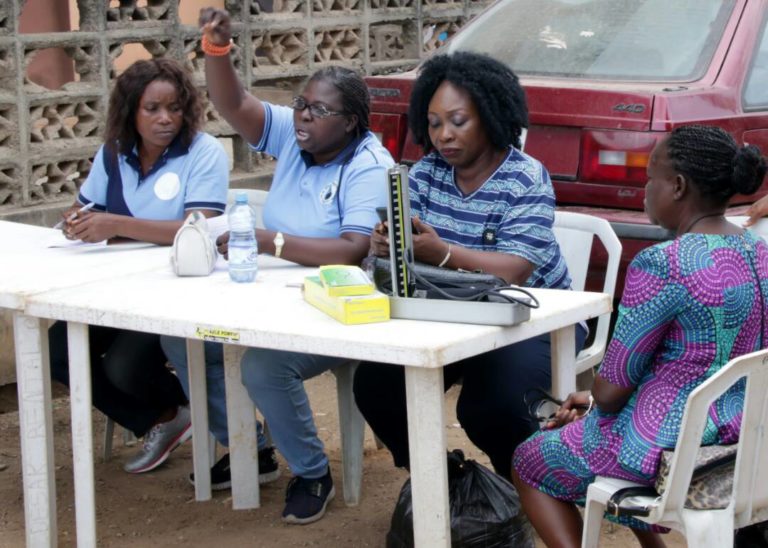
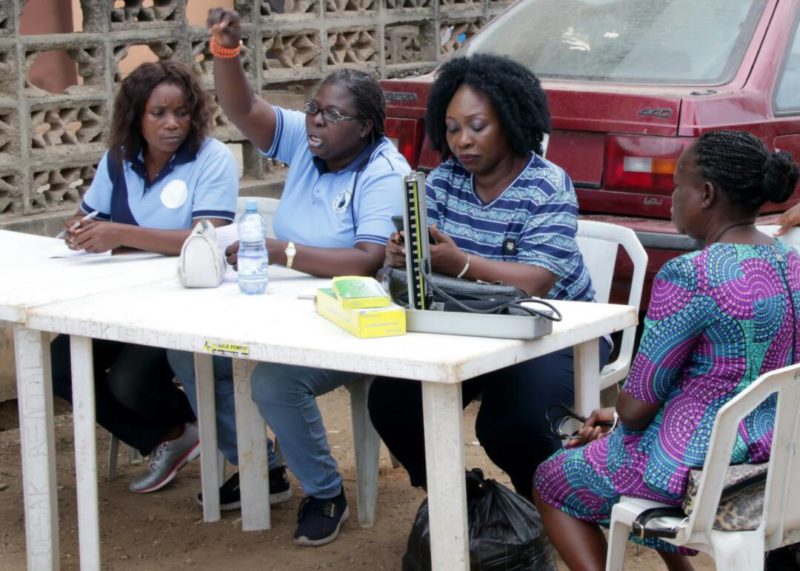
L-R: Miriam John, secretary, Africa Women Water Sanitation and Hygiene Network (AWASHNET); Funmi Sessy, chairperson; Vicky Onyekuru, vice chairperson; and a medical personnel, at the non-governmental organisation’s sensitisation on water and medical outreach in Orile Agege, Lagos
“Instead of privatising the water infrastructure in Lagos, the state government should adequately fund the water sector, letting the public manage it,” said AWASHNET.
This comes amid plans by the state government under Governor Akinwunmi Ambode to private water supply in the state.
AWASHNET is part of the “Our water Our right” coalition who rejected Veolia, Metito and the Spanish company, Abengoa, pencilled in by the state government to take charge of water infrastructure in the state.
Veolia, a French multinational corporation adjudged the largest water privatiser around the world, allegedly mismanaged several water systems across the globe, while Metito and Abengoa were said to have issues in their operations in some parts of the world.
The civil society group was apparently responding to the cries of residents of Adebari Ileogu Community in Orile Agege Local Council Development Area (LCDA) of Lagos for relevant government authorities to come to their aid in the area of making potable water available for their use.
It, however, suggested alternative strategies to tackle the water crisis in the state rather than privatisation.
Adebari Ileogu cuts a picture of a community starving in the midst of plenty, as the popular Iju Water Works is just at a shouting distance.
According to the vice chairman of the community, Sunny Dawodu, “Iju Water Works is five minutes walk from here. But while other people far away enjoy the water, we don’t. Government should help us to connect our area with Iju Water Works.”
Chairman of the landlords’ association in the area, Azeez Olaosebikan, said the people see any call for meeting as an avenue of the convener to make money, so they always ask “what is in it for us?”
He said the only community borehole in the community, which was constructed in November 2015 by Adeyinka Akeem, a House of Representatives member, packed up since two years, and no one knew what went wrong, adding that the people’s apathy kills efforts to raise money to fix it.
When he asked AWASHNET what it could do to salvage the situation, he was told that the civil society group’s duty was to amplify their voices, for the authorities to be aware of their plight. “We can only draw the attention of the local government chairman to the problem. If he didn’t respond, the state government will be notified.”
The African Academy of Sciences (AAS) has joined science leaders from around the globe to call on the Commonwealth Heads of Government to use the best available science to guide action on climate change.
Prof Felix Dapare Dakora, President, African Academy of Sciences (AAS)
The call is part of a Consensus Statement on Climate Change, launched on Monday, March 12, 2018 by 22 national academies and societies of science from around the Commonwealth, ahead of next month’s Commonwealth Summit in the United Kingdom.
The consensus statement, which represents the consensus views of tens of thousands of scientists, marks the first time Commonwealth nations have come together to urge their Governments to take further action to achieve net-zero greenhouse gases emissions during the second half of the 21st Century.
AAS President, Prof Felix Dapare Dakora, said that the greenhouse gas emission reduction commitments agreed to by 160 parties in the 2015 Paris Agreement are only the first step in a long journey.
“Even if all the country commitments from the Paris Agreement are met, the latest data shows that by the end of the century the global climate is likely to be 3°C above pre-industrial levels.
“This is substantially higher than the Paris target to limit warming to less than 2°C, and would have profound impacts affecting billions of people throughout the world,” said Prof Dakora.
Sustainability is one of the key themes to be discussed by Commonwealth leaders at the 2018 Commonwealth summit, with a particular focus on the resilience of developing and vulnerable countries to climate change.
Prof Dakora added: “Recognising different capacities, challenges and priorities, the approaches of each nation will not be the same. But, they must be informed by the best available scientific evidence, monitoring and evaluation.
“The AAS stands ready to assist the African governments, and indeed broader Commonwealth efforts, by providing sound scientific advice on issues relating to climate change.”
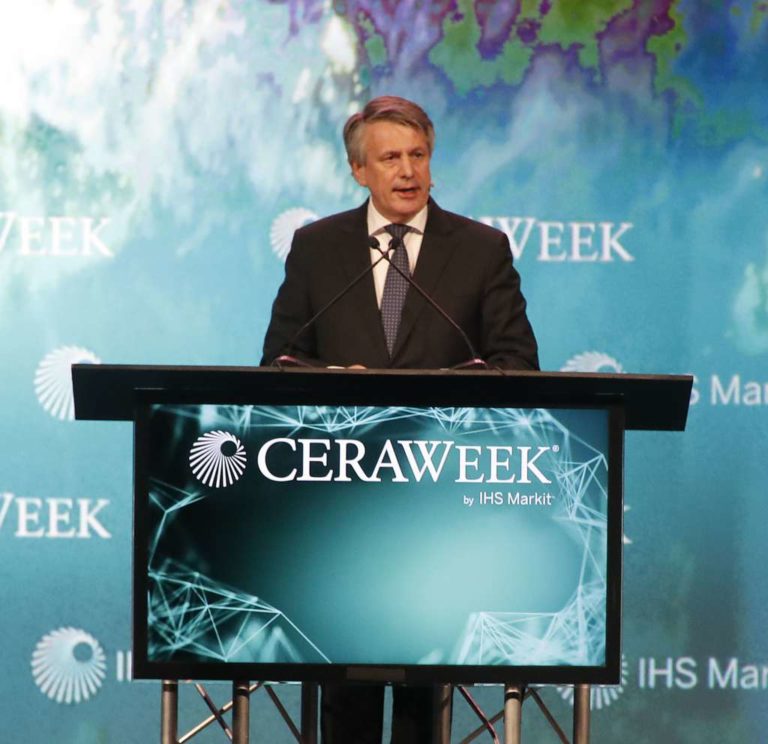
Royal Dutch Shell Chief Executive, Ben van Beurden, said on Wednesday, March 7, 2018 that climate change is the biggest issue facing the energy sector, encouraging the European oil major to invest more in cleaner-burning gas and renewable energy.
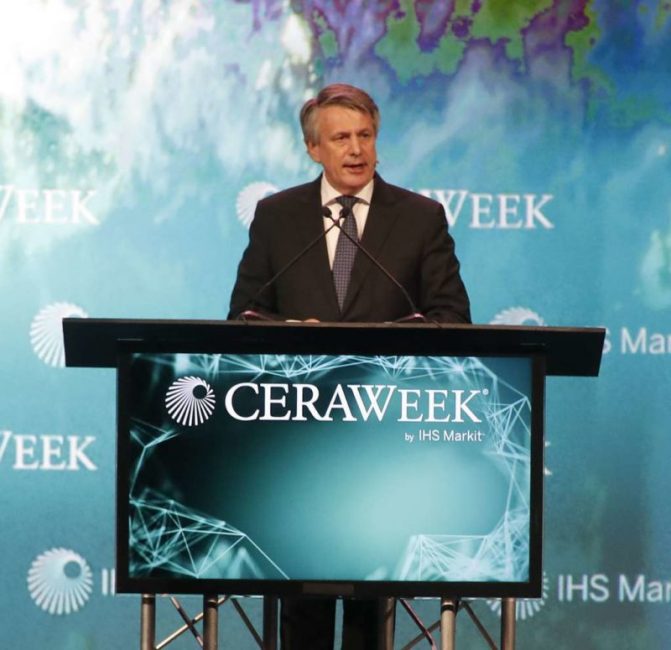
Royal Dutch Shell CEO, Ben van Beurden, speaks at the CERAWeek conference at the Hilton Americas, on Wednesday, March 7, 2018, in Houston, Texas. Photo credit: Karen Warren, Houston Chronicle
Shell aims to cut its carbon footprint in half by 2050 while shifting its roughly 50-50 oil and gas balance to a portfolio that’s closer to 70 percent gas, van Beurden said at the CERAWeek by IHS Markit conference in Houston, Texas, USA. Shell already is the world’s leader in liquefied natural gas.
“There’s no other issue with the potential to disrupt our industry on such a deep and fundamental level,” van Beurden said of climate change and the need to help meet the Paris climate accord goals, even though the United States plans to split from the agreement under the Trump administration.
The emphasis goes beyond making Shell’s own operations cleaner and more efficient because most of the emissions come from Shell’s products after they are sold. So Shell intends to invest more in offshore wind farms, biofuels, carbon capture projects and the planting of trees and forests.
Shell is rolling out a new programme in Europe to charge about 1 or 2 cents more for gasoline to fund tree-planting projects worldwide.
“Oil and gas will continue to be the core for Shell for many decades to come,” van Beurden said. But they must become cleaner. “We are businesses; we’re not charities.”
As such, Shell is planning to grow more in U.S. shale in West Texas’ Permian Basin, as well as in the deepwater Gulf of Mexico on both the U.S. and Mexican sides of the Gulf.
With a growing focus on natural gas, van Beurden said Shell and other players must continue to work to reduce and eliminate methane leaks and emissions or risk having natural gas’ role “fatally undermined.”
Last year, van Beurden said global oil demand could peak as soon as the late 2020s. He didn’t back away from that on Wednesday, but he said that is just one possible scenario. Oil demand could instead peak in the 2030s or even later, he said.
The National Coordinator of New Partnership for Africa Development (NEPAD) in Nigeria, Mrs Gloria Akobundu, says climate change is impeding agricultural processes, and leading to reduction in crop yields.
National Coordinator of New Partnership for Africa Development (NEPAD) in Nigeria, Mrs Gloria Akobundu
Akobundu made the observation at a workshop on “NEPAD Climate Smart Agriculture for Women Farmers in Imo State” organised by Programmes Development and Implementation Department of NEPAD in Owerri, the Imo State capital.
She said the impacts of climate change were being felt in almost all the rural communities in the six geo-political zones of the country.
She said the effects were manifesting through changes in land water regimes, changes in frequency and intensity of droughts, flooding, water shortages, worsening soil conditions, desertification, diseases and pest outbreaks on crops and livesstock.
Akobundu said that the South-South geo-political zone was mainly affected by sea level and deforestation-induced changes, South-East by erosion, flooding and land degradation, North-Central by changes due to de-vegetation and overgrazing, while the North-East was by drought, desertification and heat stress.
“These impacts result in the reduction in crop yield (fall in agricultural productiity). especially in the northern parts of the country, changes in food security, employment, incomes and economic growth.
“It also leads to displacement of people from coastal and densely populated, low lying areas, exposure of millions of people to new health risks, especially from vector based diseases like malaria and schistomiasis, water-borne disesases such as cholera, dysentery and malnutrition,” she said.
The NEPAD boss said that women formed a critical mass in Nigeria and contributed 80 per cent of the country’s GDP, while available statistics showed that majority of rural farmers were women.
“Therefore, this workshop is of essence as it will enable women farmers to have an in depth knowledge on climate change including its causes and impacts on agricultural activities.
“It will also enable them to improve their agricultural produce and become self-reliant in line with the mandate of NEPAD aimed at eliminating poverty and empowering women,” she said.
Me Edidong Abang of the Programmes Development and Implementation Department of NEPAD said the workshop was designed only for women engaged in farming.
He said that most farmers in rural areas were not aware of climate change as it affected farming methods and products, adding that the workshop was to enlighten women who were constituents of all farmers association in Imo.
Abang said that the programme would be organised and sustained nationwide, adding that Imo was the first beneficiary of the programme among states aside Abuja.
He said NEPAD would sign a Memorandum of Understanding (MoU) with some institutions that would continaully train women for the programme to succeed and micro finance banks where they would access loans.
Mr Paulinus Aju, the Deputy Rector (Academics). Imo Polytecnic in Umuagwo, who delivered a lecture on “Climate Change and Agriculture in Nigeria: Causes, Effects, Adaptation and Prospects”, said that the workshop was apt as climate change affected every aspect of human endeavour.
He stressed the importance of rain, humidity and wind, saying their presence and absence affected agricultural processes and yields.
He said the worksop was for farmers to have knowlegde of climate change and what to do to elminate its negative effects on their agricultural products.
Aju said information from Inter-governmental Panel on Climate Change, NIMET and NEMA would also be of immense benefit to farmers.
Mrs Ijeoma Nwachukw, a woman leader in All Farmers Association of Nigeria, and Chief Jephet Duru, Chairman All Farmers Association of Nigeria, Imo State Chapter, commended NEPAD for orgaising the programme.
They said the pariticipants comprised women farmers from the various local government areas of the state and promised that the women would ensure the message got to the grass roots.
“The lecture on climate change is very important to every farmer. It will go a long way in changing the perception of every farmer present on modern farming system for better productivity.
“We will equally organise the programme in our different locality as it is more of a train the trainers workshop,” Nwachukwu said.
NAN reports that the highpoint of the programme was the presentation of cirtificates and starter packs to participants.
Two United Nations (UN) humanitarian agencies are jointly seeking $80 million to provide food assistance to refugees in Ethiopia, which hosts the second largest number of those in Africa.
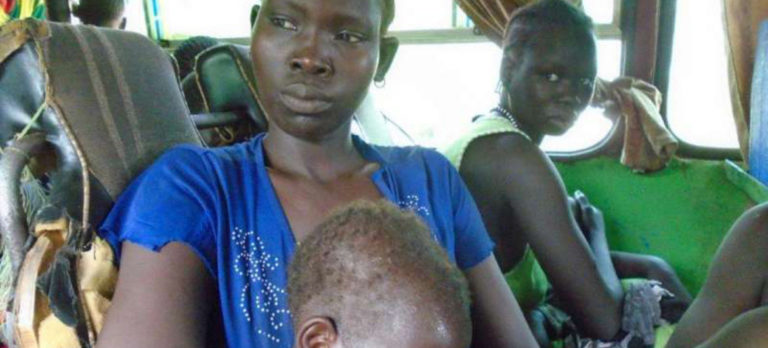
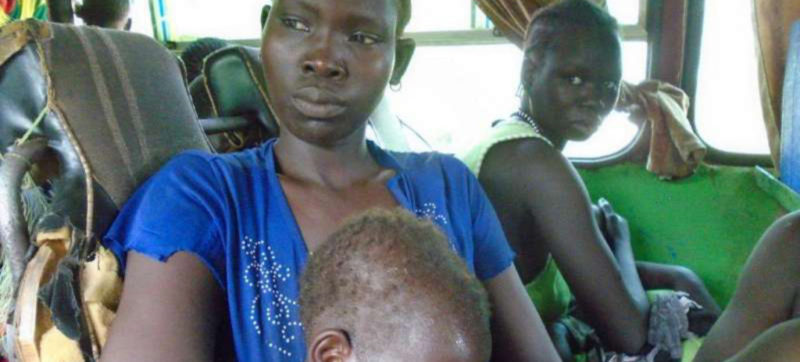
A Sudanese refugee with her child on one of the buses that moved volunteers from the flood-prone Leitchuor and Nip Nip refugee camps in western Ethiopia. Photo credit: UNHCR/S. Momodu
The World Food Programme (WFP) and the Office of the UN High Commissioner for Refugees (UNHCR) have said that food ration was cut by 20 per cent last year to below the 2,100 kilocalories per day required to sustain an average person.
The agencies are warning of deeper cuts from April unless new funding is received in March.
“After fleeing conflict and deprivation in their home countries, refugees deserve to be protected and supported,” said Samir Wanmali, WFP’s Acting Country Director in Ethiopia.
Ethiopia hosts more than 900,000 refugees, including those from Eritrea, Kenya, Sudan, South Sudan and Somalia.
Without new contributions, 650,000 refugees living in camps could soon become even more hungry and may eventually face severe hunger that could put lives at risk.
Particularly at risk are young children who risk becoming stunted if they do not receive the right nutrients during the first 1,000 days of life.
“The malnutrition rates in the camps are already high – further ration cuts could have a devastating effect,” said UNHCR Deputy Representative, Matthew Crentsil.
Recent assessments show that malnutrition rates among children under the age of five are above the emergency threshold of 15 per cent in nearly half of the 26 refugee camps.
Conflict and drought in neighbouring countries continues to force people to seek refuge in Ethiopia, which has a long tradition of hosting refugees. In 2017, nearly 110,000 refugees arrived in Ethiopia.
The River Ethiope Trust Foundation (RETFON), in partnership with the Earth Law Centre (ELC), has secured rights recognition for the River Ethiope, an inland river flowing across several communities within Delta State, in Nigeria’s south-south geo-political zone.
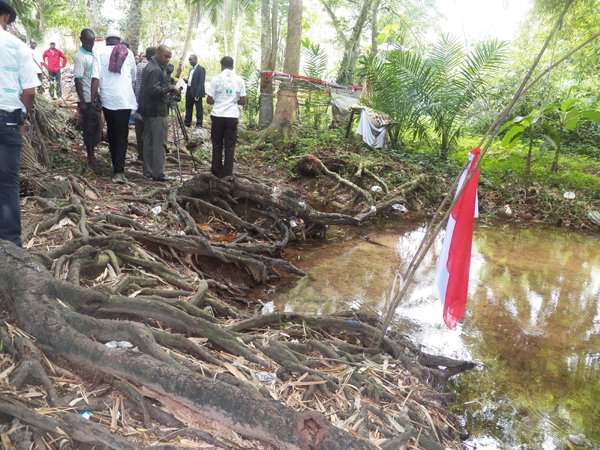
Umuaja, source of Ethiope River
The development makes River Ethiope the first waterway in Africa to possess legal rights.
According to the promoters of the initiative, the river, as a legal entity possessing rights, will have a broad suite of recognised legal rights that would set it on a path to permanent restoration. It will also have standing to utilise the court system as a plaintiff in search of injunctive relief or damages, as necessary, it was gathered.
Founder of RETFON, Irikefe Dafe, disclosed that the development was informed by the realisation of the fact that the only permanent method to restore the river to health is to give it legal rights that are equivalent to those enjoyed by humans and other entities.
“And considering the immense ecological, religious and cultural significance of the river, it is a prime candidate to be the first river in Africa to have its inherent rights recognised,” he said.
Dafe noted that, in the course of the project, RETFON enjoyed support from community leaders, governmental departments, and national and international actors.
“In particular, the younger generation is deeply inspired to protect the environment in Nigeria,” he said, listing some of the rights to which the River Ethiope is entitled to include: (1) the right to flow, (2) the right to perform essential functions within its ecosystem, (3) the right to be free from pollution, (4) the right to be fed from sustainable aquifers, (5) the right to biodiversity and (6) the right to restoration.
Timothy Collins of the ELC submitted: “These rights are intentionally drafted broadly to give stakeholders and government the opportunity to adapt them to local needs. Under RETFON’s leadership, and considering the wisdom and input of local communities, ELC’s legal experts will provide counsel on how to define and implement the rights of the River Ethiope.
“And in the meanwhile, RETFON’s bilateral efforts will continue to build precedent until a valid argument can be made that the River Ethiope is exercising its legal rights in every capacity, and all that remains is formal recognition.”
The River Ethiope runs from the Umuaja community in the Ukwuani Local Government Area (LGA) and meets the sea at the Sapele LGA. The River flows for approximately 70km through Ukwuani, Ethiope East, Okpe and Sapele LGAs, which combine to for a place of abode to an estimated population of 1.7 million people.
The River is a place of worship for adherents to the traditional Olokun and Igbe religions. It famously originates at the base of a giant cottonwood tree. The area surrounding the source is a specific concern, as human visitation over time is said to have destroyed precious root systems that filter groundwater and prevent erosion. A concentration of vehicular traffic creates high levels of airborne pollutants as well, it was gathered.
“By establishing legal rights for the River Ethiope, we hope to create a replicable model for all – to usher in a new era of living in harmony with the waterways upon which we rely, and reverse the degradation of all Nigerian rivers,” said Collins.