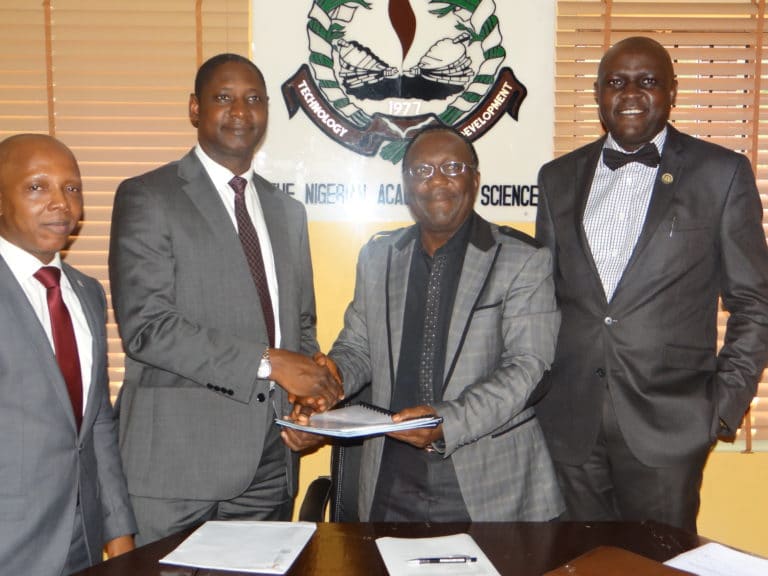
The Nigerian Academy of Science (NAS) and Vitafoam Nigeria Plc have agreed to maximise the benefits of science and increase the awareness of such benefits, in the hope that it will result in increased support for the development and application of science in the society.
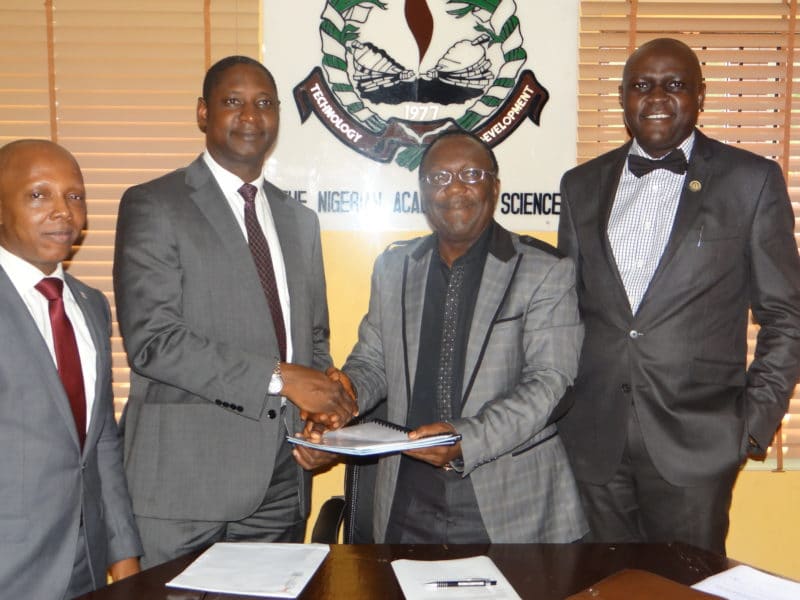
Officials of the Nigerian Academy of Science (NAS) and Vitafoam Nigeria Plc during the agreement signing ceremony in Lagos
Courtesy of an agreement signed on Tuesday, July 10, 2018, both parties will partner over a period of three years to conduct periodic media roundtables and annual media awards. The roundtables and awards were reportedly instituted by the Academy to promote excellence in science and science-related journalism. This, NAS believes, is a crucial step in ensuring that public awareness and focus on science are increased through science reporting by the print, online and broadcast media.
“The Nigerian Academy of Science believes science reporting can be improved by holding media roundtables and awarding prizes to stimulate skills development and expertise among journalists. In this regard, media roundtables will be held regularly, and two science prizes will be awarded at an annual luncheon for science journalists. These would be for the science journalist of the year,” Dr. Oladoyin Odubanjo, Executive Secretary of the NAS, submitted in a statement.
The agreement signing ceremony was held at the Academy’s secretariat in Lagos. The team of Vitafoam Nigeria Plc, which was led by the Managing Director, Mr. Taiwo Adeniyi, includes the Group Head, Admin. & Legal Services, Mr. Lekan Sanni; General Manager, Vitapur Nig. Ltd, Mr. Yemi Mofikoya; and National Sales Manager, Mr. Dahiru Gambo. The President of the Nigerian Academy of Science, Professor Mosto Onuoha; and the Executive Secretary of the Academy, Dr. Oladoyin Odubanjo, were at hand to receive them at the secretariat.
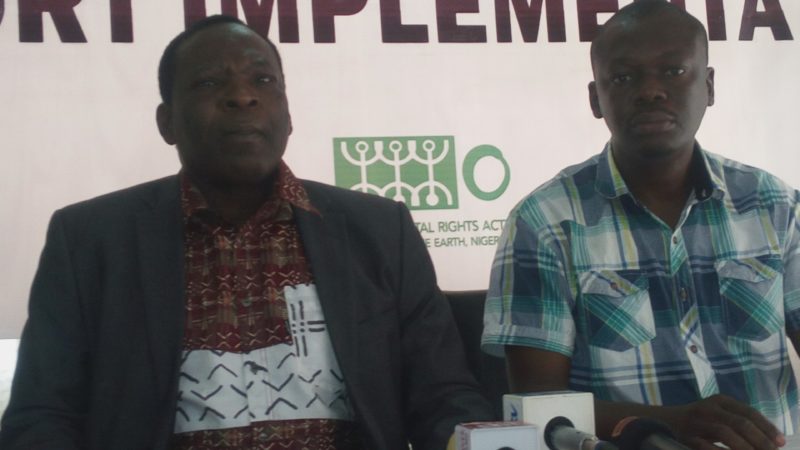
The Environmental Rights Action/Friends of the Earth Nigeria (ERA/FoEN) has frowned at the Federal Government’s plan to resume oil exploration in Ogoniland even when the clean-up of the Ogoni environment is yet to take off as recommended by the United Nations Environment Programme (UNEP).
Executive Director of Environmental Rights Action/Friends of the Earth Nigeria (ERA/FoEN), Dr. Godwin Ojo (left); with the ERA/FoEN Head of Media, Philip Jakpor
The ERA/FoEN position was informed by media reports indicating that Ogoni elders petitioned Vice President Yemi Osinbajo earlier this month, alleging that the delay in commencement of the Ogoni clean-up was because the Petroleum Minister was tying the clean-up process to resumption of oil exploration in Ogoniland.
The petition was said to have been signed by Rivers State Senator, Bennett Birabi, Dr. Desmond Nbete, Mr. Ledum Mitee, Mr. Baritor L. Kpagih, Prof. Johnson Nna, Chief Monday Abueh and five others.
In the letter, the petitioners expressed concern that “two years after the much-publicised flag-off ceremony for the clean-up of Ogoni land as recommended by the UNEP by the Vice President, the Minister of State for Petroleum Resources is now tying the expected commencement of the clean-up and remediation process to resumption of oil and gas activities in our land by his preferred company”.
ERA/FoEN Executive Director, Godwin Uyi Ojo, said: “This news is not surprising to us as we have over the course of the last three years alerted that the clean-up process was mired in needless controversy and lack of clarity.
“It is very disturbing that the quest to sure up oil revenue has taken front seat in the Ogoni clean-up exercise while the clean-up proper which will restore the dignity of the people is now subject to needless back and forth.”
Ojo said ERA/FoEN is in solidarity with the Ogoni people and Gbo Kabaari Ogoni that the clean-up of their violated environment should not be tied to resumption of oil exploration, even as he added that “the Ogoni people are getting frustrated at the government’s perceived lack of sincerity with the UNEP-recommended exercise”.
He noted that the Ogonis, Nigerians at large and the international community are anxious to see the first drop of oil to be cleaned properly so that restoration work can commence.
“Resumption of oil exploration is a distraction and secondary for now because the critical clean-up has taken the backseat. What the Ogoni people require and demand as a right is the immediate commencement of the clean-up. Enough of this drama,” Ojo insisted.
While health systems, clean water and education are a plain given in many parts of the world, millions of people still do not have sufficient access to these basic public goods. In fact, carbon prices could make substantial financial resources available for succeeding with the global Sustainable Development Goals (SDGs) set by the United Nations, a team of scientists now finds.
Lead author Dr. Max Franks of the Potsdam Institute for Climate Impact Research (PIK)
At the same time, carbon pricing could be a central contribution to meet global climate targets and limit global warming to well below 2°C until the end of the century.
“Currently we have a twofold problem,” explains lead author Max Franks from the Potsdam Institute for Climate Impact Research (PIK), adding: “There is a huge underprovision of basic necessary public goods such as public health systems, access to schools and clean water. On the other hand, greenhouse gas emissions are still rising and there is an overuse of the atmosphere, a global common good, as a disposal space for these emissions”.
So far, the two problems have mostly been dealt with separately. “But if you look at both climate and sustainable development policies at the same time, it turns out that carbon pricing could indeed address both problems simultaneously and effectively,” Franks says.
A switch from today’s fossil fuel subsidies to carbon prices for carbon dioxide emissions could generate additional revenue for governments to finance progress towards sustainable development, the scientists find in their study published in Nature Sustainability. Redirecting fossil fuel subsidies alone could completely cover public financing needs for the SDGs in Egypt, and to a large extent in other lower and lower-middle income countries in sub-Saharan Africa, like Togo, the Republic of Congo and Senegal, the researchers show.
“Moreover, revenues of a combined fiscal reform that removes subsidies and replaces them with a substantial carbon price could provide more than two thirds of the public funds required for the SDG agenda for several countries in South- and Southeast Asia,” Franks explains. “In India, more than 90 percent of the entire public financing needs for the SDGs could be covered, as our study shows, so there really is a huge potential of making use of carbon price dollars for health, education, and other public goods.”
Fossil fuel subsidies: a burden for both the environment and the public budget
In the least developed countries of sub-Saharan Africa, however, the financing potential of carbon revenues is often outweighed by the especially strong development needs. Nonetheless, the study identifies countries in which carbon pricing could contribute more than a fifth of the required public funds for reaching the SDGs – countries like Burundi, Mauritania, Nigeria, the Republic of Congo, Senegal, Swaziland, Togo, Uganda and Zimbabwe.
“Currently, governments subsidise fossil fuel in support of certain industries or to keep fuel prices low for consumers. This is not only a burden for the environment but also for national budgets. To give an idea, in the countries we’ve analysed, the total amount spent on fossil fuel subsidies would have been enough to finance 20 percent of the estimated total public financing needs for the SDGs,” Kai Lessmann from PIK says. “Removing these subsidies would free substantial domestic public funds for other urgent uses, like alleviating extreme poverty. National carbon prices instead of subsidies on fuels would, of course, generate still more public funds. At the same time this could be an efficient way to reduce carbon dioxide emissions throughout the economy.”
Development aid should focus on capacity building, for establishing tax administrations
The scientists compared the potential to mobilise domestic resources with a removal of all subsidies on fossil fuels and, in a second step, combined this with a carbon price consistent with the United Nation’s 2°C limit for global warming. Based on the Fifth Assessment Report of the Intergovernmental Panel on Climate Change (IPCC), the study assumes that price to start at $40 per ton of CO2 in the year 2020 and to rise to $175 in 2030. To put these prices in perspective, the UK was able to take a first important step in mitigating climate change by introducing a carbon price of £18 ($25) per ton of CO2 in 2013, which was already enough to phase out coal. Interaction effects such as reduced income of fossil fuel exporting countries, or positive growth effects due to better health, education and infrastructure could not be taken into account – hence the results should be taken with a grain of salt and are supposed to provide information on the magnitude of the potential rather than exact numbers. However, it still becomes clear that the additional revenues that become available for public finance are quite substantial, particularly with carbon pricing.
“Switching from fossil fuel subsidies to carbon pricing could make a key contribution to sustainable development in Asia and Africa by covering a significant part of the required public funds,” Ottmar Edenhofer concludes, Chief Economist and designated Director of the Potsdam Institute for Climate Impact Research and Director or the Mercator Research Institute on Global Commons and Climate Change (MCC). “It turns out that carbon pricing could balance the scales of climate policy and sustainable development agenda and help achieve global climate goals and progress towards sustainable development at the same time. Public support for carbon prices could also increase with the knowledge that recycling carbon pricing revenues to finance SDGs yields huge benefits for the broad population. An important take-away message of our paper is that development policies should focus on building local capacities for strengthening tax administrations, in particular with the aim of implementing carbon pricing.”
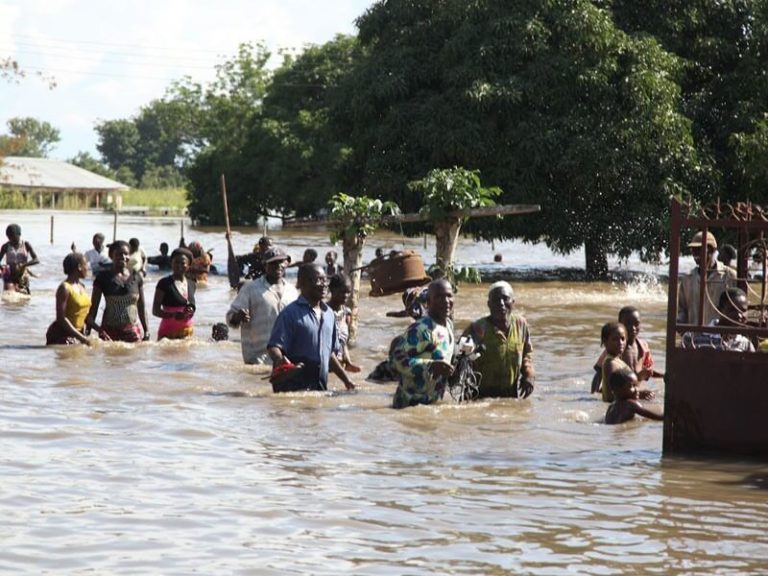
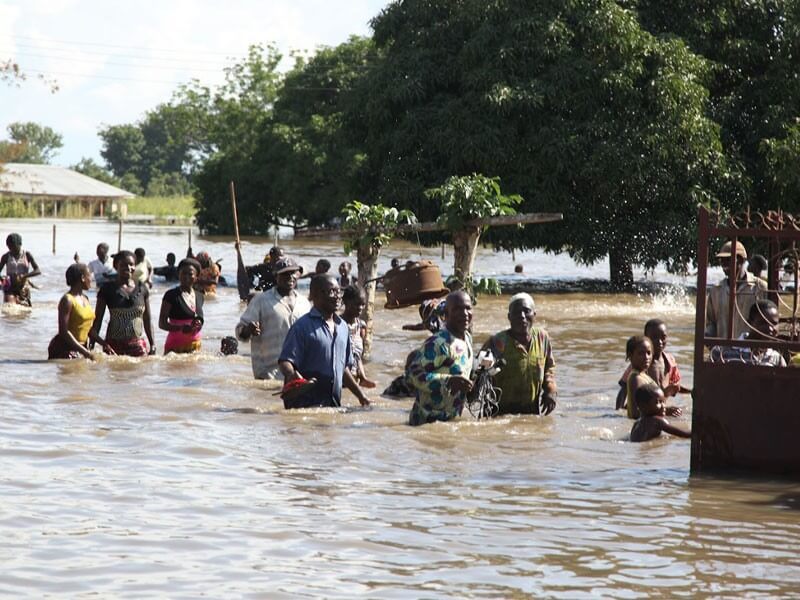
The Katsina State Emergency Management Agency (SEMA) on Monday, July 16, 2018 said that 38 persons had lost their lives following a rainstorm in Jibia Local Government Area of the state.
A flood ravaged community
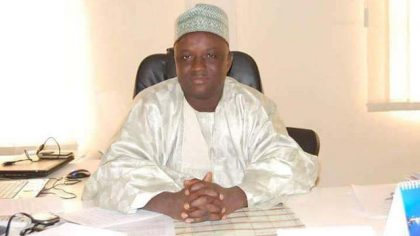
Dr Aminu Waziri, the Executive Secretary of the agency, told newsmen in Jibia that the disaster, which occurred on Sunday night, lasted for several hours.
Waziri said areas affected by the disaster include Tundun Takari, Dan Tudu, Unguwar Kwakwa and Unguwar Mai Kwari areas located around river axis.
He said a rescue team was still in Jibia giving assistance to the people.
According to him, Gov. Aminu Masari has visited the area to assess the damage done to property.
“What we are doing presently is to find temporary accommodation for people whose houses have been washed away or damaged.
“As I speak with you now, no fewer than 38 people have lost their lives.
“Sympathisers from our neighbouring country, Niger Republic, helped us to remove two bodies from a river.
“We have already buried 21 bodies, while arrangements are being made to bury the remaining 17 dead bodies.
“Over 200 houses were either washed away or damaged by the rainstorm,” he said.
The News Agency of Nigeria (NAN) reports that the rainstorm has also destroyed several farms and killed hundreds of animals in the area.
The Federal Capital Territory Administration (FCTA) said on Monday, July 16, 2018 that it has initiated programmes under the Public-Private Partnership to address 1.7 million housing deficits in Abuja, the Federal Capital Territory (FCT).
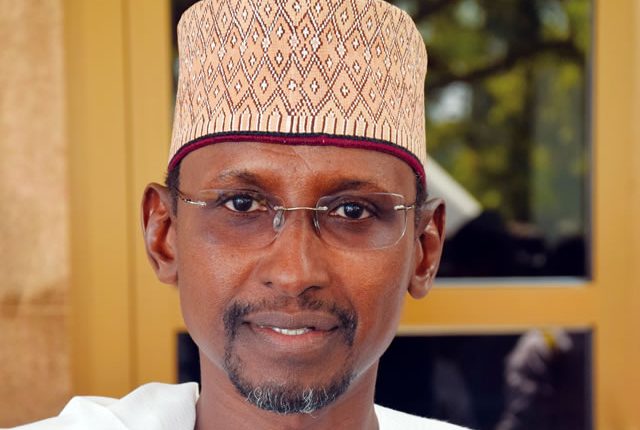
FCT Minister, Mohammed Bello
FCT Minister, Malam Muhammad Bello, said at the opening of the 12th Abuja Housing Show in Abuja that this initiative was in line with private sector driven housing policy.
The minister said that the Nigerian government had formulated a National Housing Policy in 1991 to ease the provision of adequate, accessible and low-cost housing for its citizens.
Bello was represented at the event by Mr Umar Shuaibu, Coordinator, Abuja Metropolitan Management Council (AMMC).
The conference has its theme as: “Driving Growth and Sustainability in Nigeria Housing and Mortgage Markets-Improving Structures and Policies for Impact”.
He noted that the goal of the policy was not realised due to several factors ranging from lack of political will, policy inconsistency, poor financing to weak institutional structures.
He said the policy was, therefore, amended in 2004 in which the Federal Government adopted a more market-oriented approach to housing delivery, limiting its role to that of an enabler and regulator instead of a provider.
“The limitation of the role of the public sector is to allow for more active private sector participation in direct housing provision.
“The revised policy established financial institutions and procedure that will make funds available through the primary mortgage institutions for affordable housing production.
“The new policy, therefore, acknowledged the private sector as a key partner in the delivery of housing for the country.”
The minister noted that due to the importance of housing, the Abuja Master Plan has apportioned a land area of 12,486ha for housing development, which represents 49 per cent of the total land area in the territory with 100 per cent funding by the government.
He, therefore, said since mid-2000, funds allocated to the FCTA by the Federal Government had continued to dwindle, thereby making it difficult to cater for the large population influx into the city.
Also, Mrs Amma Pepple, former Minister, Land, Housing and Urban Development, was worried about the challenges of housing which had remained the same since she left the sector.
Pepple called on stakeholders to put more efforts in addressing the supply and demand of housing in the country.
“I go to some areas in Abuja but discovered there are no infrastructures and landlords keep collecting rent without putting in place infrastructure for housing.
“When I visited other countries, they made available good road networks, electricity, water and others before you acquire a place.
“Government needs to participate in building projects because if it provides the land with low cost of materials, it will make it easier for Nigerians to acquire houses.”
Earlier, Mr Mustapha Boss, Secretary to the Government of the Federation, says affordable and accessible housing is human right as the constitution compels the Nigeria state to provide adequate shelter to all its citizens.
Boss, who was represented by his Permanent Secretary, Mr Gabriel Aduda, noted that access to decent and safe housing provision at affordable pricing should be a birth right for every Nigerians.
He, therefore, said that the government alone cannot do this, but needed the help of private sectors to address the issue of interest rate, politicisation and mortgage financing confronting the housing sector.
Gov. Godwin Obaseki of Edo State said there was need to turn housing policies to implementation action to enable Nigerians reach optimal capacity of acquiring shelter.
Obaseki, who was represented by Mr Festus Osagie, Director-General, Edo State Liaison Office, said Nigeria has the potential to grow its housing sector with the political will it has.
The show is a forum to bring together all real estate stakeholders to discuss and explore ideas to move Nigerians housing industry to international standard.
The conference, which began in 2005, has in attendance participants from private, public, housing sector and exhibitors.
Some of them are Urban Shelter, Platinum Mortgage Bank, Federal Mortgage Bank, Haven Homes, Nigerite Limited, NMRC, Brains and Hammers, among others.
The work being done by the country leading up to the development of National Communications under the United Nations Framework Convention on Climate Change (UNFCCC) is key to addressing the numerous ecological challenges facing the nation.
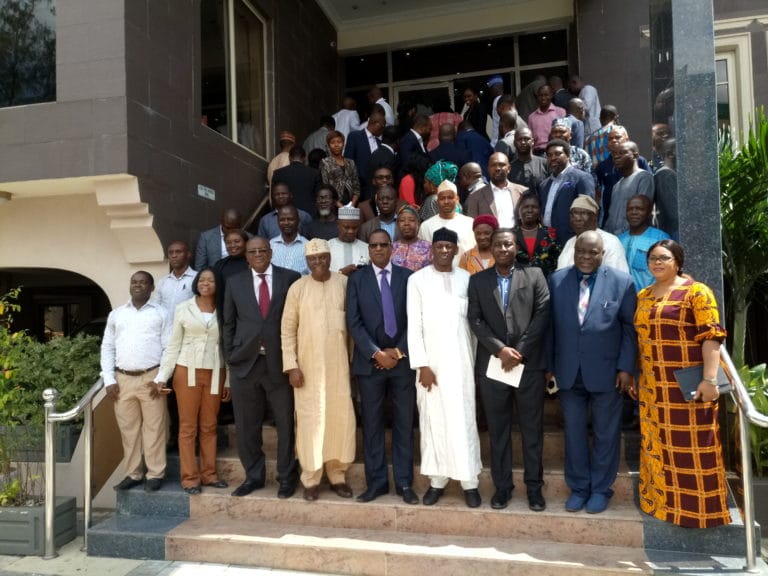
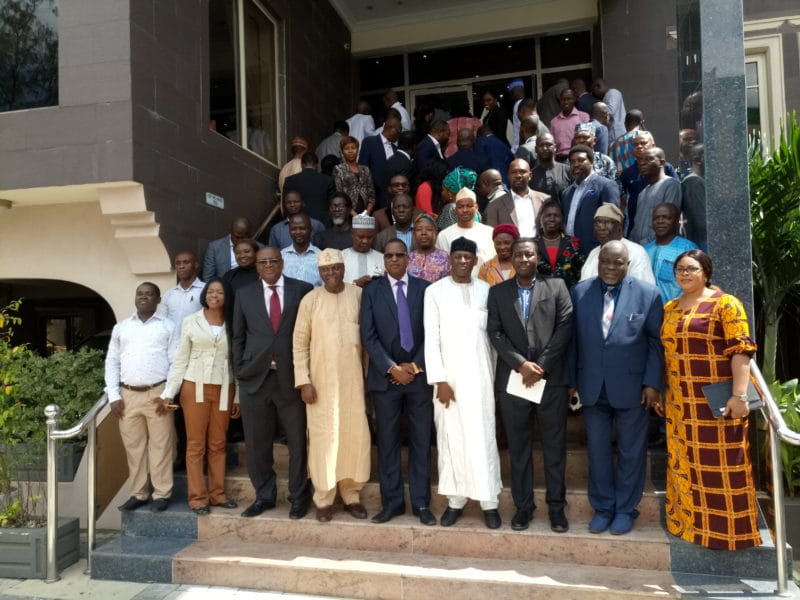
Participants at the stakeholders focus workshop for the review of the Draft Third National Communication to the UNFCCC
Dr Shehu Ahmed, Permanent Secretary in the Federal Ministry of Environment, who made the submission in Lagos on Monday, July 9, 2018, said that the initiative also helps Nigeria to plot its path towards the positive future its citizens collectively desire.
Dr Ahmed spoke while delivering his opening remarks during a two-day stakeholder focus workshop for the review of Nigeria’s Draft Third National Communication (TNC) to the UNFCCC.
The objective of the workshop was to present the draft TNC document to broad stakeholders and private sector for further input and also ascertain that their previous input is properly reflected in the document for the purpose of producing a robust TNC reflecting national circumstances and comparable to other parties to the Convention.
Dr Ahmed said: “Nigeria is highly vulnerable to the adverse effects of climate change, with significant impacts expected in all regions of the country, and in all sectors of the economy. The vulnerability of Nigeria is further compunded by interplay of a variety of factors, including not only our size, but the fragility of our national ecosystems, low level of awareness, human and financial resources, institutional and technological capability.”
Mr Muyiwa Odele of the United Nations Development Programme (UNDP), which is supporting the initiative, said that the organisation, within the framework of partnership with the Department of Climate Change in the Ministry, has over the years provided support aimed at promoting national actions on climate change towards sustainable development.
His words: “Our support is geared at assisting Nigeria meeting its obligations to the UNFCCC through timely preparation and submission of its report – to date we supported the preparation of – the First and Second National Communications, and now the Third Communication.”
Odele congratulated Dr Ahmed for demonstrating high level political leadership for the TNC and the issue of climate change.
Lagos State Commissioner for the Environment, Mr Babatunde Durosinmu-Etti, underlined the need to set an ambitious emission reduction target and also draft policies that enhance the growth of low carbon technology and a green economy.
Nigeria at the weekend made considerable progress in its bid to curb the use of dental amalgam, especially for women and children.
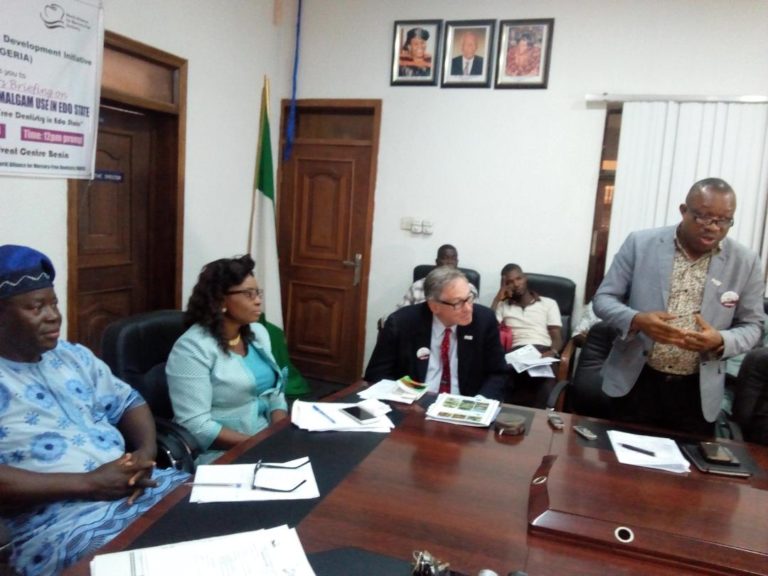
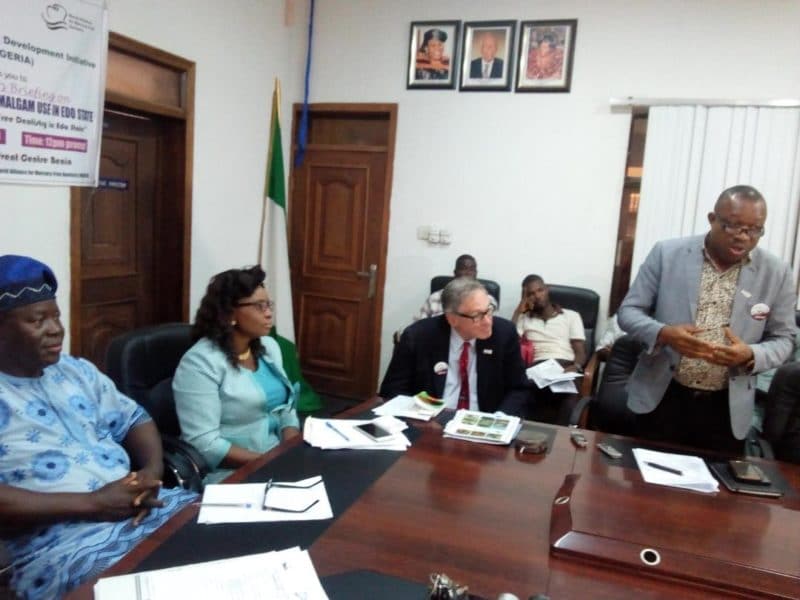
Representative of Edo State Commissioner for Environment and Sustainability, Mr. Ehon Godfrey; representative of Commissioner for Health, Pastor Mrs. H.C Enunwaonye; Charlie Brown; and Dr Leslie Adogame, at the stakeholders’ briefing on phase-down of amalgam in Edo on Saturday, July 14, 2018 in Benin, Edo State
At two separate events in Lagos and Benin on Friday, July 13 and Saturday, July 14, 2018 respectively, stakeholders restated the resolved to end the application of amalgam, which contains mercury that is harmful to man and the environment.
During a visit on Friday by officials of the World Alliance for Mercury Free Dentistry and SRADev Nigeria to the Lagos State Ministry of Health, officials underlined the need for the phased-down of dental amalgam for the state to be a multi-stakeholder approach.
While considering an immediate withdrawal of use of amalgam for children, they set a 2020 date for eventual phase-out of the use of the product for pregnant and lactating mothers.
The campaign, said the participants, would likewise entail medical education in general hospitals in the state by the Ministry of Health, as well as public sensitisation programme.
It was also agreed that working groups – technical and general – would be constituted towards achieving stated objectives. It will include health and environment ministries, teaching and general hospitals, professional body associations of restorative and paediatric dentists, government departments, civil society organisations and the media.
The daylong meeting held at the Gbagada General Hospital was graced by dignitaries like Charlie Brown of the World Alliance for Mercury Free Dentistry, Dr Leslie Adogame of SRADev Nigeria, Prof Godwin Arotiba of the University of Lagos, Dr Lara Agbaje of the Lagos State Dental Services, Dr Adenike Awotile of the Lagos State University Teaching Hospital, Dr Olubunmi Okunnu of the Lagos State Ministry of Health, Dr Yetunde Ajayi of the Lagos University Teaching Hospital, Dr Opeyemi Okoisor of the Nigeria Dental Association, and Dr A. O. Loto.
On Saturday in Benin City, the Edo State Government restated its commitment to end the use of dental amalgam in the state.
A resolution was reached at a one-day maiden stakeholders’ workshop on phasing down of dental amalgam use in Edo State organised by Sustainable Environment Development Initiative (SEDI) with the auspices of World Alliance for Mercury-Free Dentistry.
Participants called for an end to dental amalgam use in children under 16, pregnant and breastfeeding women by July 1, 2018 and, urged the Federal Government, others states and all nations of Africa to end amalgam use in children.
Attended by state officials, civil society groups from the South-South region, Benin Chapter of the Nigeria Dental Association (NDA), President of the World Alliance for Mercury Free-Dentistry and the media, state officials said at the event that there is need to gradually eliminate the use of amalgam in and shift to the alternatives.
Edo State Commissioner for Health, Dr. David Osijo, who was represented by an Assistant Director, Nursing Services, Ministry of Health, Pastor (Mrs.) H.C Enunwaonye, emphasised that consideration is being given to compost as a better alternative to amalgam use in dentistry.
He said that, as the Health Commissioner of the state, he supported the use of alternatives to amalgam because of the danger it poses both to the human health and the physical environment. He assured that the state governor would be willing to end use of amalgam in the state when it gets to his knowledge.
He commended the efforts of the stakeholders particularly the civil society group that have been championing the campaign in Nigeria and for using Edo as a pilot state in the global initiative and the World Alliance for Mercury Free-Dentistry.
His counterpart in the Ministry of Environment and Sustainability, represented by Mr. Ehon Godfrey, said the campaign was coming at a time when the environment is deplorable and degraded because of chemicals.
He called for more sensitisation and advocacy to various communities on the alternatives to dental amalgam.
The commissioner added that the reason that people adduced for the use of amalgam is because its cheap and available, adding that the alternatives to amalgam should be made available for people to use.
In his welcome remarks, National Vice-chairman, civil society group on phase-down of dental amalgam in Nigeria, Dr Tom Aneni, said transformative steps have to be taken to move Nigeria on to a sustainable path and ultimately ensure an amalgam-free Africa.
Aneni said one of the challenges of the campaign to phase-down amalgam is the lack of policy/regulation in the country but that work was in progress to get it.
According to him, a phase-down of dental amalgam in Nigeria would ensure improved dental health and a cleaner environment in Nigeria for children, women and men, thereby promoting disease prevention, health promotion and prevention; show that it is possible for a broad range of stakeholders to agree on a common goal; access various opportunities of support available from the Global Environment Facility (GEF); and ensure a faster adoption of the phase down campaign in African region in such a way that no one is left behind.
Consultant, Paediatric Dentistry, University of Benin, Dr. Ogordi Philip, disclosed that the department does not put amalgam in children; rather, it uses compost.
He said, “Amalgam should be dental history and not for clinical use.”
Ogordi called for teaching/training of practitioners on the use of alternatives to amalgam in the country.
Secretary, NDA Edo State chapter, Dr Franklin Abhulimen, said the chapter is in full support of phase-down of dental amalgam based on several reasons for health and the environment.
“We want end to amalgam use in practice, there is need for change because of the way mercury flies around in the clinics,” Abhulimen said, even as he called for a policy on amalgam in Nigeria which he said the chapter will follow suit as soon as it is developed.
National Chairman of civil society for mercury phase down, Dr. Leslie Adogame, noted that Nigeria started the campaign way back when the discussion on mercury started.
He explained that there was some resistance at the beginning because of training practitioners have received on amalgam and that science had not really come up with alternatives but that science has since come up with alternatives.
Adogame hinted that the federal government had started the process to develop a national policy on the phase down since it ratified the Minamata Convention on Mercury in February, 2018.
He called for collaboration between the ministries of health and environment in Edo State so that the objectives of the campaign can be achieved.
He also commended the President of the World Alliance for Mercury-Free Dentistry, Mr. Charlie Brown, for his commitment to the campaign and interest in Nigeria.
“It is do able to phase out amalgam,” he added.
In a brief comment, Brown described the event as a celebration of the maiden stakeholders’ summit that was held last year.
Brown said phase down amalgam is something that Africa can do even if the west is saying “do not do it”. He called on civil society groups to take the message to the regions.
The Nigerian Meteorological Agency (NiMet) has warned that many parts of the country are likely to experience flooding due to a shift in rainfall pattern caused by climate change.
Director-General/Chief Executive Officer of NiMet, Prof. Sani Mashi
Director-General of NiMet, Prof. Sani Mashi, gave the warning in an interview with the News Agency of Nigeria (NAN) at the weekend in Abuja.
Mashi said that distortions had occurred in the pattern of rainfall leading to variation in the amount of rain that was expected in the country.
He explained that, in line with NiMet’s 2018 Seasonal Rainfall Prediction (SRP), so much water would be made available on the surface between the last week of July and end of August.
According to him, once it rains, the ground cannot comfortably contain and absorb the water, making it to runoff and resulting in so much water on the surface.
“Unless adequate provision is made to accommodate the amount of water that is running on the surface, the likelihood of flood is going to be very high, especially in the areas that are adjoining the riverine locations.
“What it means is that, already, we are receiving a very large amount of rain within those locations and because there are rivers within those locations, the rivers are already conveying water towards those areas.
“The rivers are already bringing so much water and you are receiving high amount of rainfall within those particular areas.
“It means that when the two runoff waters combine, the spaces for the water to pass will be minimal and because of this, there is likelihood of flood across these areas,’’ he said.
Mashi said that the flash points of flooding had been identified and presented to the public by the Nigeria Hydrological Services Agency (NIHSA), the agency responsible for flood monitoring.
He explained that NiMet and NIHSA were working together to ensure that accurate flood information was made available to the public to minimise the impact of flood in the country.
NAN recalls that NIHSA had in its 2018 Annual Flood Outlook, announced that 380 Local Government Areas in 35 states would experience flooding this year.
According to NIHSA, flooding will be high in about 78 LGAs, although the situation will generally not be as severe as what the country experienced in 2012.
The Acting Director-General, NIHSA, Olayinka Ogunwale, during the presentation in May, stated that the government had been issuing warnings to residents in flood-prone areas to relocate from such locations.
“It is important to let those in flood-prone areas know that the country will experience flooding in 2018 and people in such locations should evacuate,’’ Ogunwale said.
The UN Office for Coordination of Humanitarian Affairs (UN-OCHA) says an estimated three million displaced persons face critical food and nutrition insecurity in the northeast of Nigeria.
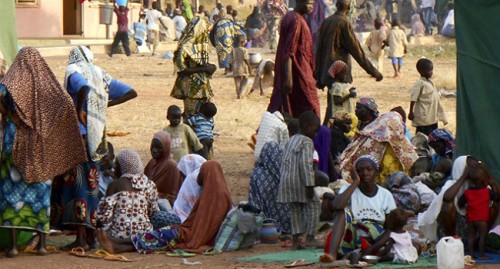
Women and children in a IDPs camp. The displacement was informed by the Boko Haram insurgency. Photo credit: channelstv.com
OCHA, in its humanitarian situation report for the month of June, said no fewer than 1.7 million persons were displaced by the conflict in the region in the past nine years.
According to the fact sheet, the number of people estimated to be facing critical food and nutrition insecurity is projected at three million, following recent assessments exercise in the area.
It said that humanitarian actors and partners were carrying out a re-targeting exercise in Borno and Yobe to ensure that the most vulnerable people receive food assistance.
OCHA also said: “Large-scale displacements continue to take place weekly; in the past seven months, since hostilities intensified in the northeast, more than 130,000 people have been displaced.
“In May alone; 21, 207 people arrived in various locations. Bama, Ngala, Gwoza, Dikwa and Biu recorded the highest number of new arrivals.
“These movements present major humanitarian challenges as resources are already overstretched in the locations where these civilians arrived.
“Given that military operations have been announced to continue throughout the 2018 rainy season, displacement trend is likely to continue until end of August.’’
To cope with the situation, the UN agency disclosed that it had adopted a contingency response plan for the expected high-level displacement due to military operations.
It explained that the plan aimed to provide life-saving assistance to about 115,000 IDPs, expected to move from hard-to-reach areas to key towns in Mobbar, Kukawa, Monguno, Ngala, Kala Balge, Dikwa, Bama, and Gwoza local government councils of Borno.
“About 41.7million dollars is urgently needed to ensure sufficient preparedness and response activities to facilitate life-saving assistance for the new arrivals.
“These include shelter and non-food items; health care, food, water and sanitation, protection and nutrition,” it said.
The organisation revealed that it had initiated resource mobilisation efforts for the Rainy Season Contingency Plan, to support 463,000 vulnerable persons in extreme weather localities such as Bama, Damasak and Rann.
OCHA noted that it had already commenced distribution of life-saving items including food, seeds, medicines, emergency shelter, non-food items and hygiene kits.
The UN humanitarian body expressed satisfaction with effective response to control cholera outbreak in Adamawa, Borno and Yobe States, recorded between February and May.
It lauded the timely response of the Water, Sanitation and Hygiene (WASH) programme and government to control the disease, adding that surveillance, monitoring and hygiene promotion activities were ongoing in the affected areas.
The document further showed that the agency had set up five humanitarian hubs in Maiduguri, Gwoza, Bama, Ngala and Dikwa while additional four others would be established in Banki, Damasak, Monguno and Rann liberated communities.
OCHA explained that the hubs were designed with safe accommodation and internet connectivity, to enhance aid workers’ presence in the field and stimulate effective response.
“Following an early recovery perspective, the maiden Lake Chad Basin Governors’ Forum for Regional Cooperation on Stabilisation, Peace Building and Sustainable Development was held in Maiduguri between May 7 and 8.
“The aim was to promote continuous dialogue to strengthen coordination and collaboration on cross-border initiatives at the sub-national level around the Lake Chad Basin.
“In preparation for the 2019 Humanitarian Needs Overview, data collection for a multi-sector needs assessment will be launched by mid-June in Borno, Adamawa and Yobe, while data analysis is expected to start in July.’’
The organisation noted, however, that despite the generosity of donors, humanitarian response in the northeast was hampered by lack of fund for the 2018 Humanitarian Response Plan (HRP).
“As at May 31, only 39.7 per cent of the $416.4 million total funds needed have been received, according to the funding levels reported on the Financial Tracking Service (FTS).
“For the response to be sustainable and to avoid interruption in life-saving services, it is crucial that additional funding is urgently received across all sectors,’’ OCHA stated.
General Manager, Lagos State Parks and Gardens Agency (LASPARK), Mrs Bilikiss Adebiyi-Abiola, said on Saturday, July 14, 2018 that the state planted 7,539,221 trees in 11 years.
General Manager of LASPARK, Mrs Bilikiss Adebiyi-Abiola
Adebiyi-Abiola made the disclosure in a statement in Lagos during the commemoration of the ‘‘Tree Planting Day.”
She stressed the importance of planting more trees, describing it as a worthy global mission to enrich mother earth.
‘‘When the tree planting programme was institutionalised 11 years ago, we had no doubt in our mind that it will be a sustainable project.
‘‘Today, to the glory of God and your unwavering support, we have planted 7,539,221 trees. Our 10 million target by year 2020 is surely achievable.
‘‘Trees act as a kind of environmental ‘buffer’ for the entire ecosystem.
‘‘They help improve the extremes of climate; such as heat, cold and wind, and create a surrounding where humans and animals can live comfortably.
‘‘Today, we only see walls, buildings, cars, large signboards, tarred roads and concrete, instead of trees, beautiful flowers, parks and gardens.
‘‘We are used to having a polished lifestyle which has no benefit to the ecological system,” she said.
According to her, Lagos is faced with increasing population, along with the pressure of industrialisation and vehicular emissions.
She said that this had led to considerable rise in urban pollution affecting air, water, and land.
The General Manager noted that vehicular traffic and industrial emissions had significantly increased air pollution in recent times.
Adebiyi-Abiola urged citizens to be aware of the risks to people’s health and well-being because of removing trees from the environment.
‘‘The benefits that urban trees bring cannot be quantified.
‘‘Apart from its capacity to reduce urban temperatures by 4°C, it can also absorb pollution of all kinds, particulate, chemical and even noise from the environment.
‘‘We, therefore, need to build according to nature’s laws and rise above the financial, ecological and social tides of urban growth.
‘‘Let us come together and incorporate ecological principles into better urban planning and development,” she said.
The General Manager commended Lagosians who had shown incredible support for the state’s greening programmes.
She expressed happiness that some people had started marking their birthdays with planting of trees while tree competitions had sprung up in most of the schools.
‘‘Elderly have reignited their lives by relaxing at various parks, parents now bring their children to parks on weekend and during holidays to catch fun.
‘‘Market men and women including taxi drivers, artisans, corporate bodies and teachers are also competing for top prizes for best planted tree.
‘‘The ‘Me and My Tree’ clubs in secondary schools across the state are now being used as an agent of change.
‘‘This is the extent we have gone in bringing Lagosians back to nature,” she said.
Adebiyi-Abiola said that to enhance the general wellbeing of Lagosians, Gov. Akinwunmi Ambode recently ordered the total closure of the Olusosun dumpsite.
She said that the site was presently undergoing transformation and very soon would be converted to Green Belt and tourist’s attraction, in line with international standard and best practices.
The environmentalist said that the administration was committed to a holistic environmental regeneration and sustainability.
She said that the Cleaner Lagos Initiative (CLI) which encompassed every facet of the environmental lives was making tremendous progress towards delivering a cleaner, greener and healthier state that would be the pride of all.
According to her, the tree’s right to live should be recognised and it should be allowed to live until it is proven that it cannot do so without a clear, demonstrable and quantifiable danger.
‘‘It is high time we acted; this is our planet, let us work together to save and preserve it for generations yet unborn.
‘‘All our actions should be geared towards saving the planet earth, saving lives by planting more trees. That is the only way to go,” she said.