A crocodile attacked and ate a woman and her five-month-old baby, who had gone to fetch water from a lake in north-western Uganda, officials said on Monday, September 3, 2018.
A crocodile
The attack on the shores of Lake Albert on Friday is yet another example of human-animal conflict in Africa.
This is a situation where species often have to fight over natural resources – land and water – and many rural families don’t have access to running water at home.
“We are advising people to avoid areas where these man-eater crocodiles are,” Uganda Wildlife Authority (UWA), Spokesman, Bashir Hangi, said.
“Crocodiles stay in fish-breeding areas, but when the fish get depleted, they come on the surface and attack and eat humans,” Hangi said.
Local newspaper The Daily Monitor said other villagers on the lake shore had tried and failed to save the woman and her baby.
“Residents tried to save her, but their efforts were fruitless as the crocodile had already disappeared with her body in the waters,” the paper reported.
A 700-kilogramme crocodile which had killed and eaten five people over the past five years was captured on Saturday on the eastern shores of Lake Victoria, another UWA official, Peter Ogwang, said.
“The attacks by these animals are now increasing. Right now, I am in Ngoma (central Uganda) tracking down a crocodile which has eaten 32 goats in the village,” he said.
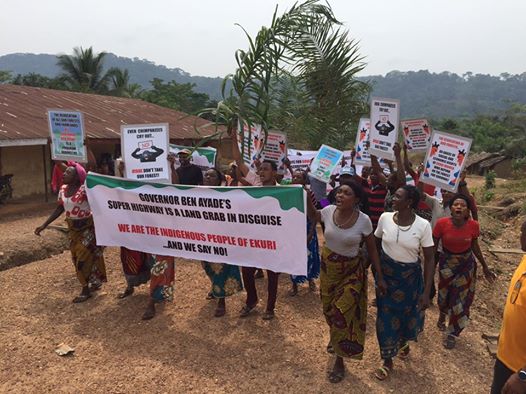
Over 500 women from nine communities in Etung, Obubra and Akamkpa Local Government Areas (LGAs) of Cross River State are clamouring for the state government to formally return to them parcels of land initially designated for setbacks under the proposed superhighway project.
Local community dwellers kicking against the super highway project that threatens hectares of their forests and farmlands
On February 7, 2016, the Cross River State Government revoked 5,200km2 of settlements, farmlands and forests for the superhighway road project with a width of 10km on either side of the road from the centre and a length of 260km. The revocation caused local and international uproar, as it affected host communities’ wellbeing and threatened the forests.
However, on June 2017, the Federal Ministry of Environment directed the Government of Cross River State to comply with 23 conditions before an Environmental Impact Assessment (EIA) certificate is released. Two of the conditions were: First, the gazetting of the reversed setback so that these lands are reverted to affected communities. Second, payment of compensations to affected persons for crops and property destroyed during the construction of the superhighway road that started without an EIA.
Over a year after, it appears the Cross River State authorities are yet to comply with the Federal Government directive to gazette the setback and pay compensation for crops and property allegedly destroyed.
Bothered by the development, women and girls of Edondon and Okokori communities, Etara and Ekuri Eyeyeng communities, Old Ekuri and New Ekuri, Iko Esai, Owai and Ifumkpa communities in Obubra, Etung and Akamkpa LGAs in Cross River have written a letter of protest to President Muhammadu Buhari, urging Mr President to take a decisive action, and put pressures on the Cross River government to gazette the reversed superhighway setback.
Dated Monday, August 27, 2018 and titled “Protest Letter for Non-gazeting of the Reversed Setback of the Cross River State Superhighway Road Project”, the letter reads in part: “Mr. President, we wish to inform you that, after one year, the Government of Cross River State has not complied with the directive of the Federal Ministry of Environment to gazette the setback and pay compensation for our crops and property destroyed illegally. Our fears are heightened more than ever before as the Government of Cross River State of recent is still talking about companies bidding for the superhighway road project when pending crucial issues are unaddressed.
Also, non-gazetting of the reversed setback, legally or technically, means that our lands – settlements, farmlands and forests – all still belong to the Government of Cross River State and, for us, we are mere settlers pending our forced eviction to become another Internally Displaced Persons (IDPs) in Nigeria.
“The action of the Government of Cross River State not to gazette the reversed setback is a clear demonstration of unwillingness of government to return our lands to us. Furthermore, because we are marginal people, poor and voiceless, is the underlying reason that the government we voted for has refused to pay compensation for our crops and property destroyed illegally and further penurise us.”
The women went ahead to list their demands, which include:
The Government of Cross River State to take decisive action and gazette the reversed setback of the superhighway road project so that our settlements, farmlands and forests are returned to us.
The Government of Cross River State to pay adequate compensation for farm crops and property destroyed during the construction of the superhighway.
The Government of Cross River State to restore the forests opened by planting indigenous tree species to mimic the forest ecosystems.
The Government of Cross River State to respect the Multilateral Environmental Agreements (MEAs) signed by Nigeria (CBD, UNFCCC, etc) so that the forests that we depend upon, continues to sustain our livelihoods.
The Government of Cross River State to respect our rights (as indigenous peoples) to life, food, culture, traditional knowledge, social and economic wellbeing and lands without which we are doomed.
The Federal Ministry of Environment not to approve the EIA Report submitted by the Government of Cross River State as it is not only defective, but its approval will empower Governor Ben Ayade to destroy all the forests in the state, and rubbish the environmental sustainability the state is globally known for.
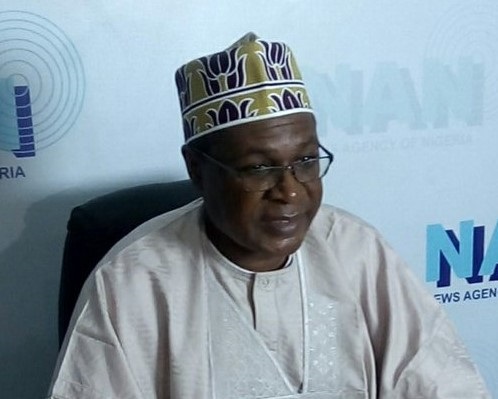
Nigeria has lost 96 per cent of its forest due to deforestation, according to the Director-General, Nigerian Conservation Foundation (NCF), Dr Muhtari Aminu-Kano.
Director-General, Nigerian Conservation Foundation (NCF), Dr Muhtari Aminu-Kano
He said the country currently has only four per cent of its original forest cover.
“About 96 per cent of our original forest have been lost; it is catastrophic. It is sad that we are losing vegetation cover and there is absolute need to make concerted effort to grow more trees because the more the merrier not only in Lagos but across the country,” he told the News Agency of Nigeria (NAN) in Lagos.
Aminu-Kano said the NCF was exploring ways of increasing the country’s vegetation from four per cent to at least 25 per cent in the next 30 years.
One of the ways, he said, is to plant more trees and stop felling of trees as fuel for cooking and furniture purposes.
The director-general said: “We are exploring ways of gaining back some of what we have lost through the ‘Green Recovery Nigeria Initiative’ that will bring stakeholders like the government, faith leaders, traditional rulers and others to thinker on solutions.
“We have only four per cent of our original forest cover now and we think that is catastrophic and requires massive efforts to increase that coverage to at least 25 per cent across the country in 30 years.
“We want to see more trees everywhere because they will help to save humanity from global warming as they breathe in what we breathe out and then they breathe out what we breathe in for survival.’’
Aminu-Kano, therefore, called for urban regeneration like the one being implemented by the Lagos State Parks and Gardens (LASPARK), describing it as commendable.
“I think it is time for urban regeneration like what LASPARK is maintaining and I hope they will up their game. We need to plant more trees as wood to stem the firewood crisis facing Nigeria.
“We could also explore tree plantations for timbers so that we do not cut down our forest for the purpose of furniture.
“It also means leaving trees on farmlands so that we do not just clear everything and plant perennial crops, thereby reducing our forest cover,” he explained.
On Nigeria’s coastal erosion, the NCF D-G called for a holistic approach toward arresting the ravaging strong ocean currents from the Atlantic.
He noted that the currents have compounded coastal erosion in Lagos and some states in the South.
Aminu-Kano said the various efforts to provide immediate remedies to shoreline erosion cases in Lagos had moved the problem to other parts of the state and beyond.
Giving a brief history, he said that the problem of coastal erosion started in the 1930s when moulds were built around the Apapa Port to make it easy for vessels to berth.
According to him, the move transferred the problem to Victoria Island compelling the Lagos State Government to begin the Eko Atlantic City Project to stop the Bar Beach erosion but pushed the problem eastward to other parts of Lekki.
Aminu-Kano said some houses and communities were disappearing overnight due to the fast-moving ocean currents and called for urgent multi-level action.
“We do not hear of Bar Beach erosion or Victoria Island anymore, but it has pushed the problem more eastwards and this is the same with many other environmental issues.
“If you do development and look only at your immediate environment, then, you are not looking at the whole picture and you are pushing the problem somewhere else or at another time.
“The current situation of the Nigerian ocean and the nature of the Atlantic on our side is not really very favourable to Nigeria because the Atlantic is very turbulent in the Nigerian coastal waters and close to the high seas in our side and, therefore, it comes with force.
He expressed satisfaction that the Lagos State Government had saved about 14 kilometres of the coastlines by constructing groins eastward the Eko Atlantic City at a cost of N1 billion each and appealed for the Federal Government’s support.
“The project is too expensive and the problem overwhelming for Lagos alone to handle. Those groins are expensive and from what we hear that to build a groin is in the region of N1 billion.
“Our call has always been that the federal government steps in through the Ecological Funds which are set up specifically to address this kind of issue.’’
Aminu-Kano also wants federal government’s intervention in tackling coastline erosion in Ayetoro area of Ondo State and other states including the Niger Delta Region being ravaged by the turbulent ocean currents.
On the Lekki Conservation Centre in Lagos, he disclosed that no fewer than 140,000 visitors including local and foreign tourists were recorded at the facility from 2016 to date.
Besides a nature trail, the Lekki Conservation Centre houses the corporate head offices of the NCF.
Aminu-Kano said the number of visitors increased in the current year from the 60,000 recorded in 2017.
“The numbers have really been up recently; we used to have 5,000 or 7,000 visitors a year but from 2016 the number really went up to 40, 000 at an average of about 120 people per day.
“To us as far as environmental education is concerned, the fact that at least 120 people every day want to go out and experience nature it is good in itself.
“In 2017, it was even higher as we had between 50,000 to 60,000, and it is even higher this year.
“We are quite satisfied that we are getting increased numbers of people wanting to come and learn about nature, experience the forest and natural environment and we think they will take this information out there,’’ he said.
On the centre’s “Catch Them Young’’, the director-general expressed satisfaction that schools have been bringing their students and pupils to the centre on daily basis.
“We have had at least four schools bringing their pupils in large numbers every week day of the year. So, we are really catching them young to imbibe the culture of love for nature,’’ Aminu-Kano said.
He disclosed that the centre had mapped out enlightenment strategies to reach out to the ordinary people on the street apart from the elite and the students who have embraced the campaign.
As part of the strategies to attract more people, Aminu-Kano said the entrance fee had not been raised in the last five years and also ruled out any raise for now while registered members are exempted from paying entrance fee.
The NCF director-general lauded the Lagos State Government and Chevron Nigeria Ltd for their interventions in providing link roads and other infrastructure at the facility.
By Itohan Abara-Laserian, Grace Alegba and Okuanwan Offiong
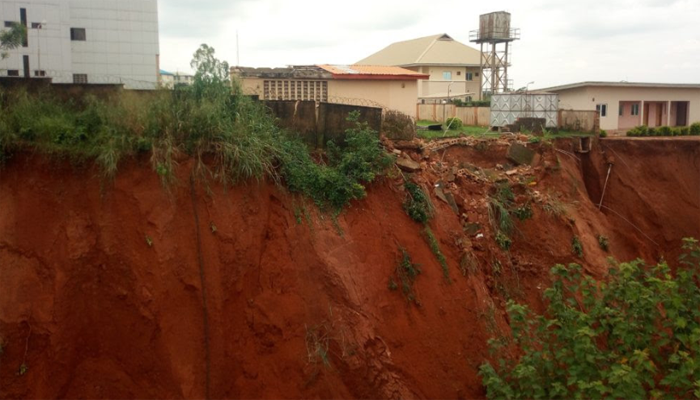
The Grand Riviera, a popular three-star hotel in Awka, Anambra State, is facing imminent collapse due to gully erosion occasioned by rainfalls, the News Agency of Nigeria (NAN) reports.
The Federal High Court, Awka is under serious gully erosion threat and at the verge of imminent collapse
The hotel, the Anambra High Court which is beside it, and the Federal High Court which is a few metres away, are all being threatened by erosion.
NAN reports that the Federal High Court has already lost part of its premises to the erosion and two other buildings are seriously threatened by the environmental challenge.
Mr Tagbo Igboka, the manager of the hotel, said that gully erosion started washing away the foundation of the 12-year-old hotel only about two years ago.
Igboka said the hotel’s management had spent not less than N20 million on erosion control and repair works since the “unwanted visitor” started encroaching.
“This is a very popular hotel in Awka. Two former presidents have lodged here including former governors and ministers but, as you can see, erosion is threatening to destroy it.
“This monument has served for 12 years, but we have battled this menace for five years and spent no less than N20 million to prevent the worst from happening.
“We have received high-powered delegations on inspection here; people from the Federal Ministry of Environment, the ecological fund and even our own state ministry of environment have visited.
“However, there has not been any intervention to mitigate the threat from them. The entire buffer you see here, even this one that recently gave way, was done by us.
“Yet as a corporate organisation, we have been paying our dues to government,” the manager told NAN.
Igboka noted that the problem was caused by a particular erosion channel which had made the entire zone a “disaster area”.
He said that if the channel was linked to the Imoka River, the problem of erosion would be solved.
The manager expressed the fear that the hotel, which is valued at hundreds of millions, would become rubbles at the onset of another rainy season if nothing was done about the challenge.
Igboka called on the federal and the state governments to speedily intervene to control the menace to prevent an avoidable predicament turning into a disaster.
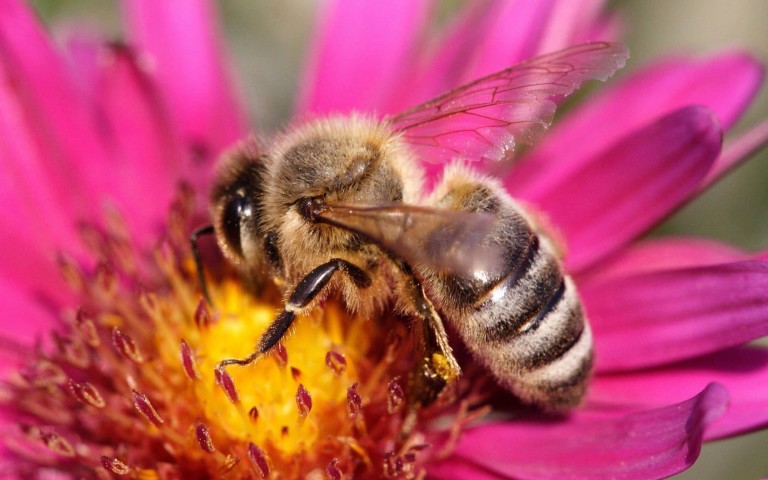
Some bee keepers and farmers have said that beekeeping and pollination activities could improve agricultural yields by 90 per cent and contribute to food security in Nigeria.
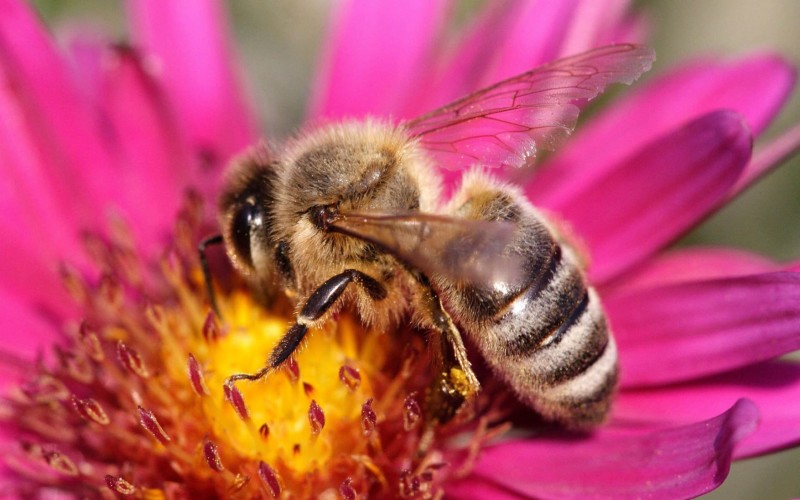
Bee pollination
The farmers, who gave the advice at a media engagement with Api-Exposition Africa 2018 Organising Committee in Abuja on Saturday, September 1, 2018 said that beekeeping could also provide employment opportunities for youths.
The media engagement was to avail journalists the opportunity to create awareness on the need for bee stakeholders to participate in the upcoming “ApiExpo 2018” slated for Abuja in September.
Mrs Obianuju Okpo, the National President, Women in Beekeeping, said that practicing and promoting bee-keeping was necessary to ensure food security and achievement of the Sustainable Development Goals (SDGs) in Nigeria.
She said that the world beekeeping trade value, according to the Food and Agriculture Organisation (FAO), stood at $450 billion (N162 trillion) annually, while the pollination services were valued at $250 billion (N90 trillion).
Okpo said that Ethiopia had a market share of 40,000 tonnes worth $255.3 million in the world annual production of bee products especially honey.
She noted that the economic, health benefits of bees and its derivatives were enormous, adding that herbs produced across the world contained about 45 per cent of bee-products.
“Cashew can increase its yields by 212 per cent due to bee pollination,’’ she said.
Mr Oluwaseun Johnson, the Leader, Mobilisation Team, said that pollinators such as bees, birds and bats affect 35 per cent of worlds’ crops production.
He noted that bees pollinate apples, almonds, oranges, avocados, pumpkin and cucumber by 90 per cent, saying that fruits will be non-existent without the bees.
Dr Dooshima Kwange, the Chairman of the ApiExpo Organising Committee, said that Nigeria would host the 6th Edition of the ApiExpo Africa.
Kwange said that ApiExpo was a continental exposition organised by ApiTrade Africa to bring together every allied industry around the global beekeeping industry.
She expressed optimism that the exposition would help bring together bee stakeholders across the world with a view to promoting the potentials of the sub-sector.
“This meeting is to acquaint the media with information about apiculture sub-sector and its potentials for wealth creation, economic diversification and sustainable development, to reach bee farmers and stakeholders in the rural areas,’’ Kwange said.
Mrs Ngozi Ibe, an official of the Nigeria Export Promotion Council, noted that beekeeping would encourage ecological awareness and generate income without destroying the environmental habitat.
The News Agency of Nigeria (NAN) reports that ApiExpo bee-stakeholders from all African countries, Europe and Asia have indicated interest to participate in Nigeria’s Expo from Sept. 24 through Sept. 29.
The event is targeted at creating international trade opportunities and foreign markets access for the beekeeping industry and attract national and international investments into the industry.
The Federal Government says it has developed a N6.7 billion robust plan of action for the reconstruction, rehabilitation and resettlement of northeast devastated by Boko Haram activities.
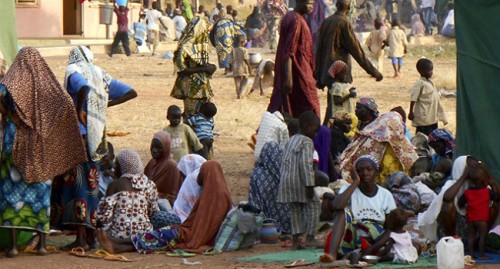
Women and children in a IDPs camp. The displacement was informed by the Boko Haram insurgency. Photo credit: channelstv.com
Nigeria’s Ambassador/Permanent Representative to the UN, Prof. Tijjani Bande, said this at a side event tagged “Strengthening the Humanitarian and Development Partnership in the Lake Chad Region” at the UN headquarters in New York.
The Nigerian envoy said that the comprehensive socio-economic plan, known as “Buhari Plan”, aims to advance the humanitarian and development nexus in the country.
Bande said Nigeria was spearheading the event based on the need to promote across board collaboration and cooperation among countries of the Lake Chad region, the donors and a whole range of humanitarian and development partners.
“At our national level, the $6.7 billion Buhari Plan of Action for the comprehensive Reconstruction, Rehabilitation and Resettlement of the North Eastern Nigeria and the Lake Chad represents an ambitious humanitarian cum development initiative on the part of a national government.
“It is to demonstrate its total and unshakable commitment to the socio-economic development of the entire area.
“It is unmistakably true that beyond the current challenges lie numerous prospects for harnessing the capacity of the people and natural endowment of the area to facilitate integrated regional socio-economic development.
“Therefore, the occasion of this side event and its subsequent follow up actions would present opportunity for enhancing the objectives of several initiatives on the Lake Chad such as the All Lake Chad Governors Forum which held its inaugural meeting in Maiduguri, Nigeria in May.
“Also, the Berlin Conference on the Lake Chad has been slated for the first week of September 2018 and would build substantially on the outcomes of the February 2017 Oslo Donors Conference on the Lake Chad.
“I would like to take this opportunity to call on all stakeholders to redouble efforts and commitment towards making the coming Berlin Conference on the Lake Chad of Sept. 3 to 4, 2018 a watershed.
“This is in our collective resolve to further mobilise resources and demonstrate implicit commitment to plans that will ensure moving quickly beyond the immediate humanitarian need to concrete sustainable developmental projects capable of substantially elevating the lives of the majority of people in the region.”
The Nigerian envoy stressed the need for collaboration and cooperation among countries of the Lake Chad, the donors as well as humanitarian and development partners.
According to him, collaboration between the humanitarian and development agencies has gained traction at the UN in recent times such that the involvement of national governments is needed to make it work.
He said the protracted humanitarian and development challenges in the Lake Chad region had place enormous responsibilities on all to remain engaged in discussion aimed at scaling up national, regional and global responses to the crisis.
These responses need to be bolstered by strengthened coordination at the UN level to ensure a more synergised delivery of assistance, the Nigerian envoy emphasised.
“Let me emphasise that the recharge of the Lake Chad Basin, capacity building, and restoration of livelihood, through facilitation of occupational opportunities, job creation, skill acquisition and others are central to finding lasting solution to the problem in the region.
“To realise all these would entail our collective commitment to a broad range of actions, facilitated by strong international cooperation and partnership, involving the UN agencies and development partners, like the World Bank and African Development Bank among others,” Bande said.
Magagi Louan, Minister of Humanitarian Action and Disaster Management of the Republic of Niger, said the political leadership from the region were working together to ensure comprehensive response to the crisis in the Lake Chad.
Louan said several mechanisms to address the problem included the institutionalisation of joint security architecture such as the Multinational Joint Task Force and promotion of collaborative social-economic projects under the auspices of the Lake Chad Basin Commission.
Also commenting, Alifei Moustapha, Permanent Representative of Chad to the UN, disclosed that Chadian Government had set up a new coordination mechanism across the ministries to identify local requirements and develop flexible coherent responses to address the Lake Chad problem.
On his part, Michel Monthe, the Permanent Representative of Cameroon to the UN, stated that his country would finance resilience and socio-economic projects and called for response to humanitarian needs while simultaneously reducing risk and vulnerability.
The event, sponsored by Nigeria, Cameroon, Niger, Chad, UN Development Programme and UN Office for the Coordination of Humanitarian Affairs, also featured presentations by UN Humanitarian Coordinators for the four countries.
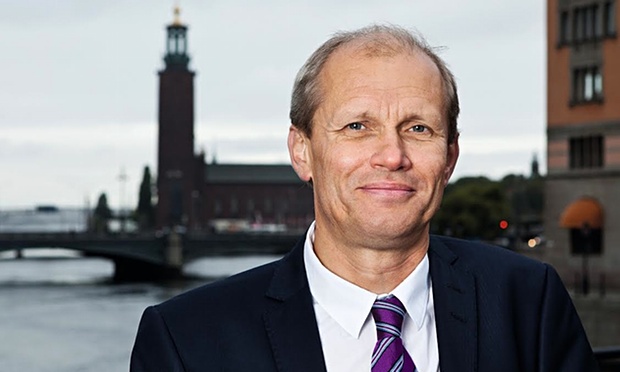
Organised by the Stockholm International Water Institute (SIWI), the World Water Week, believed to be the world’s leading annual water event, attracted over 3,600 participants from 133 countries who attended nearly 300 sessions. Known for its diverse participation from different sectors and countries, participants under 35 were more vocal than ever this year.
The importance of this was underlined by SIWI’s Executive Director Torgny Holmgren. “We are on the right track!” he said, adding: “There are many great things going on.”
Antonella Vagliente from Young Water Solutions stressed how young people from indigenous backgrounds are turning traditional knowledge into new businesses: “They have adapted their lifestyles and their communities to nature and we have a lot to learn from that,” she said.
This year’s theme “Water, ecosystems and human development”, focused on nature-based solutions and how they can be combined with conventional practices. The message was clear – a combination of green and grey approaches is the only way forward.
“Our take-away is that nature-based solutions do work,” commented Andrea Erickson of The Nature Conservancy, after experiencing showcases from around the world.
Viktoria Granström, Water Initiative Leader at IKEA Industry, described how she, after starting her job in 2008, looked for good examples of corporate water strategies: “I thought that maybe some other industry group has done the same. Unfortunately, I did not find any group water strategy including all types of water.”
She urged companies to take action on water: “Set your own rules for what is accepted by you! And many of these solutions have very short payback time!”
During the Week, H.R.H. Crown Princess Victoria of Sweden presented the Stockholm Water Prize to Professors Bruce Rittmann, USA, and Mark van Loosdrecht, The Netherlands, and awarded the Stockholm Junior Water Prize to Caleb Liow Jia Le and Johnny Xiao Hong Yu, Singapore.
The 2019 World Water Week will be held 25-30 August on the theme “Water for society – including all”. It will move to a new venue: the multi-purpose, Tele2 Arena in central Stockholm.
The National Emergency Management Agency (NEMA) has called for stronger synergy among disaster stakeholders for easy coordination of activities during emergencies.
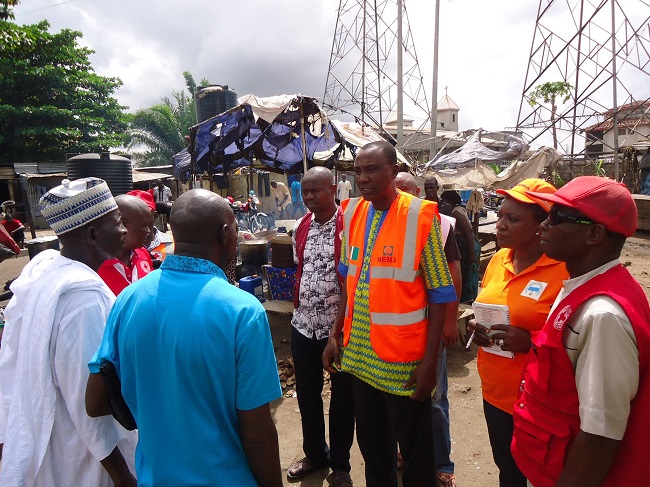
NEMA officials on duty
The NEMA Coordinator, Imo/Abia Operation Office, Mr Evans Ugoh, made the call in Owerri, Imo State, on Saturday, September 1, 2018 during a meeting of disaster management stakeholders.
The meeting was organised by NEMA in collaboration with Imo State Emergency Management Agency (ISEMA).
Ugoh said the meeting was aimed at ascertaining the level of readiness of other disaster management agencies for effective service delivery.
He said collaboration among the agencies would a long way to ensure effective disaster management.
In his contribution, the Commissioner of Police in Imo, Mr Dasuki Galadanchi, gave the assurance that the police would continue to collaborate with NEMA to ensure effective disaster management.
Galadanchi said that effective communication would be a stronger tool for the synergy.
He also said effective decentralisation of NEMA would improve its activities in local government areas.
“We must begin to carry activities to villages,’’ he said.
The Executive Director of ISEMA, Mrs Uche Ezeonyeasi, said that the agency was on the verge of opening annexes in local government areas.
The police, Federal Road Safety Corps, Nigerian Security and Civil Defence Corps and Fire Service were represented at the meeting.
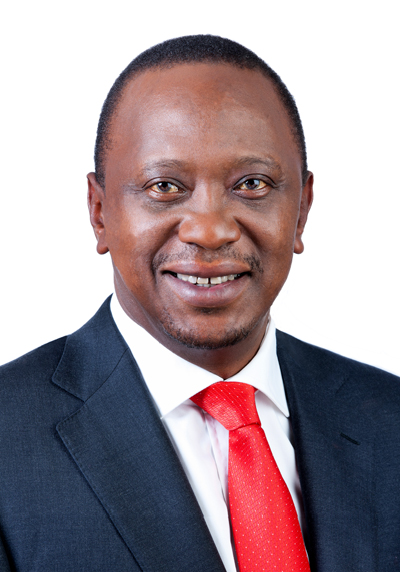
Kenya plans to partner with the World Bank to increase supply of affordable houses, Charles Mwaura, the Principal Secretary, Ministry of Transport, Infrastructure, Housing and Urban Development, said on Friday, August 31, 2018.
Uhuru Kenyatta, the President of Kenya
Mwaura said the Kenya government would provide $20 million while the World Bank will provide $160 million as seed capital for the Kenya Mortgage Refinance Company (KMRC).
“The KMRC will provide concessional loans to banks and other financial institutions to provide mortgages at low interest rates.
“This will help the government to facilitate the provision of 500,000 affordable and social housing units by end of 2022,” Mwaura said.
He said most poor households in urban centres were locked out of homeownership as they cannot afford monthly repayment of home loans.
“By providing subsided loans, we hope to increase the supply of affordable houses in the market,’’ Mwaura said.
He noted that there were currently about 25,000 mortgages in the country against a population estimated at 45 million people due to the high cost of finance.
He said that with the operationalisation of the KMRC, more people will be able to purchase their own homes.
He added that most of the houses constructed by the real estate sector were designed for middle- and high-income earners forcing the low-income segment to live in informal settlements.
Mwaura said the demand for housing units in urban areas had been estimated at 250,000 units against a supply of 50,000 housing units annually.
“This means that there is a deficit of about 200,000 housing units per year and a cumulative backlog of 1.85 million housing units,” he added.
“We would further seek to achieve levels of affordability where Kenyan households should be able to own a house by paying monthly installments equivalent to what they are currently paying as rent,” he observed.
Mwaura said the government had formulated a development framework which will be key in the implementation of affordable housing agenda.
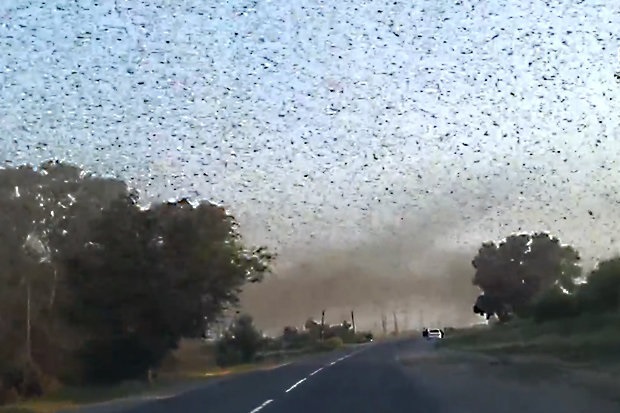
Wheat, maize, and rice yields, particularly in northern climates, are projected to fall as insects in temperate regions thrive in a warmer climate, a new research has shown.
Swarm of locusts in the sky above Russia. Photo credit: Daily Star
The study, which was published on Friday, August 31, 2018 in the journal Science, models increases in insect populations and their metabolic rates in a warmer world, and projects a 50 to 100 percent increase in pest-induced crop losses in European wheat, and 30 to 40 percent increases in north American maize, even if countries meet their existing commitments to reduce greenhouse gas emissions.
“In some temperate countries, insect pest damage to crops is projected to rise sharply as temperatures continue to climb, putting serious pressure on grain producers,” said Joshua Tewksbury, co-lead author of the research and a director of Future Earth, an international research network for global sustainability.
Insect pestilence already reduces net yields of wheat, maize and rice, three staple grains – these grains provide 42 percent of total calorie consumption worldwide. However, models assessing the agricultural effects of climate change rarely consider losses due to insects.
Future bugs, however, in a warmer climate are expected to be even hungrier and more numerous. Warmer temperatures have been shown to accelerate an individual insect’s metabolic rate, leading it to consume more food during its lifespan. And while pest populations may decline in some hotter tropical areas, they are expected to increase elsewhere as temperatures rise and additional ecosystems become favorable to the insects.
The researchers calculated the potential for crop damage through 2050 by combining robust climate projection data, crop yield statistics, insect metabolic rates and other demographic information.
The study finds that Europe’s bread basket could be among the hardest hit. Currently the most productive wheat producing region in the world, pest impacts on European wheat could create a total annual pest-induced yield loss that could top 16 million tons. Eleven European countries are predicted to see 75 percent or higher increases in insect-induced wheat losses, including the U.K., Denmark, Sweden and Ireland.
Insects could also create major impacts on maize and rice yields in North America and Asia, respectively. The U.S., the world largest maize producer, could see an almost 40 percent increase in insect-induced maize losses under current climate warming trajectories, a reduction of over 20 million tons annually. Meanwhile, one-third of the world’s rice production comes from China, where future insect-induced losses could top 27 million tons annually.
“On average, the impacts on insects adds up to about a 2.5 percent reduction in crop yield for every degree C increase in temperature – for context, this is about half the estimated direct impact of temperature change on crop yields, but in north temperate areas, the impact of increases insect damage will likely be greater than the direct impact of climate on crop yields,” said Tewksbury, who is also a research professor at CU Boulder.
The study recommends changes to global agricultural practices, including increased selection for heat- and pest-resistant crops and new crop rotation patterns to reduce vulnerability to insects. In some extreme cases, greater pesticide use may become necessary to secure regional food supplies, even at the cost of possible associated health and environmental damage.
Additional co-authors of the study include Michelle Tigchelaar, David Battisti and Raymond Huey of the University of Washington; Scott Merrill of the University of Vermont; and Rosamond Naylor of Stanford University.