The Ministry of Mines and Steel Development says it has commenced nationwide environmental monitoring to ensure mining title holders comply with mining laws and regulations.
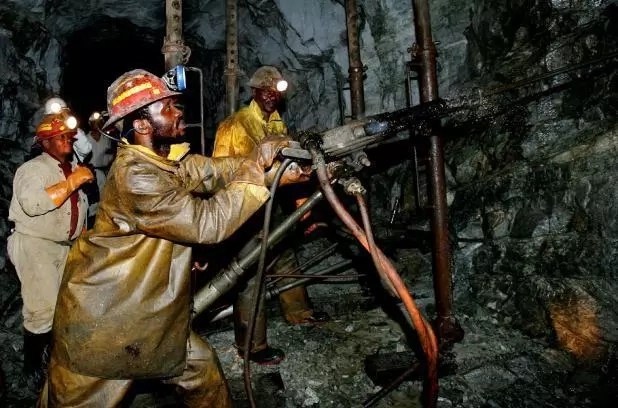
Mining in Nigeria
Mr Sallim Salaam, the Director, Mines Environmental Compliance Department of the ministry, told the News Agency of Nigeria (NAN) on Sunday, November 4, 2018 in Abuja.
Salaam said that the programme would be conducted in the six geo-political zones of the nation.
He said that the states selected from the six political zones include Edo, Cross River, Oyo, Ebonyi, Nasarawa, Benue, Kogi, Kaduna and Zamfara, as well as the Federal Capital Territory (FCT).
The director said that some teams from the department had visited six mining sites in Ogun and six others in Edo, adding that samples were taken from all the sites for analysis.
“We also visited lead and zinc mining sites in Ebonyi and a granite mining site in Calabar.”
He added that the programme, which started in October, would be completed by middle of December.
Salaam said the essence of the programme was to monitor mining title holders in those states to ensure that their mining activities did not pose environmental, social and health hazard to their host communities and workers.
” We want to ensure that they comply with all environmental requirements about fulfilment of “Environmental Protection Rehabilitation Programme.
“The idea of this programme is to also ensure that all title holders reclaim all sites mined and to revert to the status-quo as required by the law,” he said.
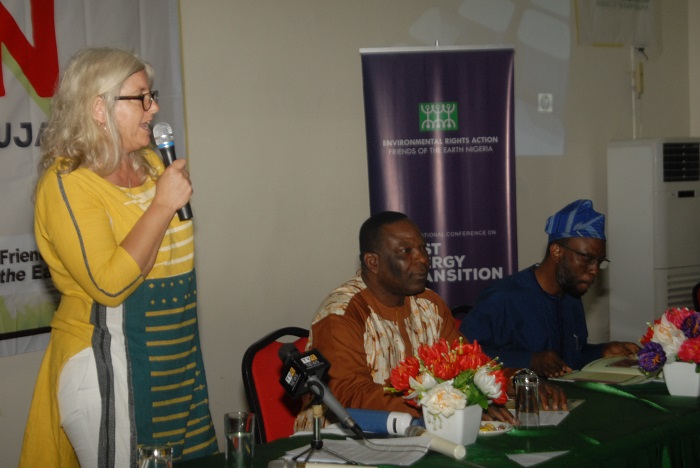
Member groups of Friends of the Earth International (FoEI) have called on governments of Africa to look beyond oil in their quest for development. The call was made at a conference on Just Energy Transition orgamnised by the Environmental Rights Action/Friends of the Earth Nigeria (ERA/FoEN) in Abuja.
L-R: Karin Nansen, Chair of Friends of the Earth International; Dr. Godwin Uyi Ojo, ED of ERA/FoEN; and Professor Lanre Fagbohun, Vice chancellor of Lagos State University, at the Just Energy Transition Conference in Abuja
In his opening remarks, Dr Godwin Uyi Ojo, Executive Director, ERA/FoEN, said that while Nigeria and other African countries continue in the quest to transit from oil, the developed world should not exploit this quest to recolonise Africa and perpetrate inequalities.
Ojo noted that while there has been tremendous growth across the globe from the start of the industrial revolution to the present, the consequence of unrestrained economic expansion has been the incredible increase in greenhouse gas emissions and the warming of the climate.
He disclosed that scientists recently revealed that the warmest years recorded in history have occurred in the last five years and that every year gets progressively warmer than the last with many communities experiencing first-hand, the impact of the climate crisis.
He also pointed out that a recent Inter-governmental Panel on Climate Change (IPCC) special report released on October 8, 2018 paints a frightening scenario of “irreversible impacts on humans and the ecosystem if we fail to act.”
The same report, he said, calls on the global community to act immediately and show more ambition so that rising temperature does not exceed the 1.5-degree Celsius threshold, if the earth is to have the opportunity of containing the impacts of climate change.
To achieve this there must be comprehensive phase out of fossil fuels, faster electrification, lower energy demands, changes in consumption and dieting patterns as well as protecting and restoring degraded ecosystems.
Because of these, he said there is need for urgency and ambition for a Just Energy Transition which developed nations have leapfrogged into.
According to him, the national budget for renewable energy has reached an investment of US$286 in 2015 alone.
Despite this, he explained that more than 1.6 billion people have no access to electricity and about 2.4 billion depend solely on fuel wood.
“The rising energy demand is also leading to increasing violent resource conflicts at the sites of extraction. Nigeria is nowhere near meeting its nationally determined commitment to addressing climate change and reducing carbon emissions. About 70 percent of the 170 million population depend solely on fuel wood for energy and representing one of the world’s highest deforestation rate of 3.5 percent annually.”
He added however, that, “while over-consumption continues unabated in rich and industralised countries, others that are less endowed face energy poverty on a daily basis. Energy Colonialism is killing Africa and replicating already existing inequalities in renewable energy access hence the need for Energy Democracy. “
The ERA/FoEN boss noted that, theoretically, Nigeria has shown some ambition to reduce its carbon emissions by 20% unconditionally and 45% conditionally by 2030 given the needed finance and technology by rich countries.
He however pointed out that one fundamental challenge facing Nigeria and other African countries is minerals and oil-dependency on raw materials and sources of revenue.
ERA/FoEN, according to him, has a manifesto on the way forward. He said the conference, which coincides with the 25th anniversary of ERA/FoEN, presented the opportunity to present the manifesto to the Nigerian government.
The event was graced by representatives of government, civil society and communities from across Africa, Latin America, Asia, United States and Europe. Speakers included Karin Nansen, chair of Friends of the Earth International; Professor Lanre Fagbohun, the Vice Chancellor of Lagos State University; and Comrade Uche Onyeagucha, former House of Representatives member, among others.
Over 75% of the world’s land surface is said to be significantly impacted by human activity. The consequences are evident in more and severe droughts, high loss of wildlife and new trends in internal displacement and forced migration, say observers, adding that inaction on land degradation for most of the 169 countries affected by land degradation is due to the lack of accurate data and the tools to monitor it.
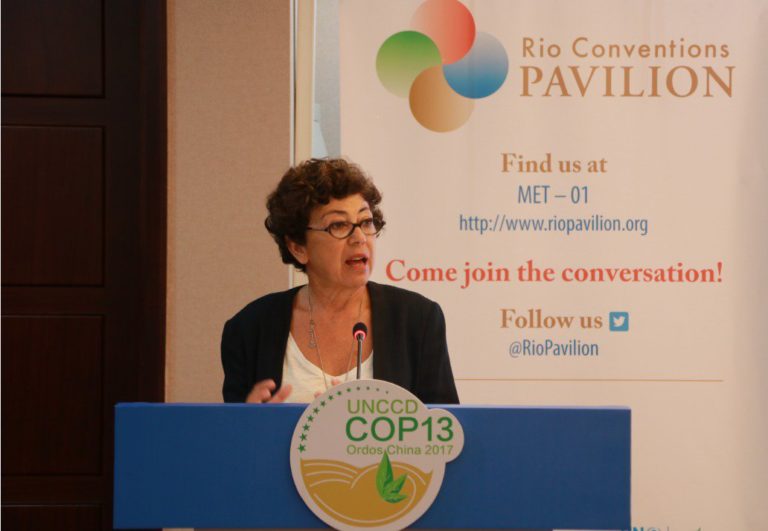
Monique Barbut, Executive Secretary, UNCCD, speaking during the conference
In what appears to be a landmark decision, the Group of Earth Observations (GEO) has launched a new, innovative initiative that will put Earth Observation (EO) data in the hands of national and local decision makers, thereby addressing this need.
The GEO LDN Initiative unveiled in Kyoto will bring together Earth Observation data providers and governments to develop the quality standards, analytical tools and capacity building needed to strengthen land degradation monitoring and reporting, using remote sensing and data collected on site. At the touch of a button, governments will have the right data to prioritise interventions and monitor outcomes to plan and manage land better. Following the announcement, Germany pledged an initial contribution of €100,000 ($113,000) for the initiative.
To date, 119 governments have pledged to take the measures needed to avoid, halt and reverse land degradation to ensure the amount of productive land stabilises by 2030 and beyond.
“The world is gripped by a growing sense of crisis regarding the sustainability of the global environment, and the deteriorating global environment affects our daily life. Within this context, we are being tasked with acting, as ‘global citizens’, against the various global issues that cannot be solved by one country alone,” said Keiko Nagaoka, Japan’s State Minister of Education, Culture, Sports, Science and Technology, when he opened the GEO 2018 Congress.
GEO, an intergovernmental organisation whose mandate is to improve the availability and sharing of data on Earth observations to benefit all life on Earth, is made up of government, academic and research institutions, data providers, businesses, engineers, scientists and experts who share data to create innovative solutions to pressing global problems.
“Land degradation is an existential crisis. Until now, monitoring it in real time felt like an insurmountable challenge. No longer. With Earth observation datasets and the practical tools to use them readily available, decision-makers and land users will have immediate and actionable information to scale up sustainable land management and planning. It is a first step to boosting our resilience,” said Monique Barbut, Executive Secretary, United Nations Convention to Combat Desertification.
The Initiative responds to a call made from the UNCCD’s Conference of the Parties last September to bring data providers and data users together to support global efforts to avoid, reduce and reverse land degradation globally.
Welcoming the Initiative, Jennifer Morris, President of Conservation International said, “it is time to move from measurement and monitoring to action. From Conservation International’s experience in the field we know restoring nature is an important piece of building healthy lands that can support productive and sustainable landscapes. Earth observation, and tools like Trends.Earth, can support local and national governments in prioritizing and implementing restoration actions.”
To ensure the initiative gets off to a flying start, three Working Groups emerged from the discussions in Kyoto. One will focus on building national capacities; the second will develop data quality standards and protocols for the SDG indicator land degradation (15.3.1) and its sub-indicators; and, the third will establish platforms with high computing capacities so partners can collaborate on big data analytics, such as open data cubes.
According to Barron Joseph Orr, Lead Scientist, United Nations Convention to Combat Desertification, “if the ability to process, interpret and validate geospatial data can be enhanced, it would lead to real national ownership. UNCCD Parties are clear about their data needs so delivering for governments and local communities will drive the work programme of the new GEO LDN Initiative.”
The partnership and cutting-edge technology developed for the GEO LDN initiative will move efforts to achieve the Sustainable Development Goals target on land degradation into the fast lane. The target of achieving land degradation neutrality is widely accepted to be an accelerator and integrator for achieving the other 17 Goals.
Global Environmental Facility’s Small Grant Programme (GEF-SGP) said it exhibited its programmes and projects to educate Nigerians on the benefits in tackling environment issues.
GEF-SGP National Coordinator, Mrs Ibironke Olubamise
Its National Coordinator, Mrs Ibironke Olubamise, made this known to the News Agency of Nigeria (NAN) on Wednesday, October 31, 2018 in Akure, Ondo State, on the sidelines of the 2018 National Council on Environment (NCE) meeting.
The NCE, which held from October 29 to 31, had “Environment and Security: Consolidating Nigeria’s Environmental Reforms towards Sustainable Development” as its theme.
Olubamise said that the essence of GEF-SGP exhibition at the NCE meeting was to create awareness and encourage people to learn more about GEF and how Nigerians could fit into the benefits of the programme.
“Many other countries are tapping into it but whether due to ignorance, in Nigeria, the response is low, especially the state governments.
“So, we hope that with this exhibition, we will have more responses from state governments to come and see what GEF is doing to address the issues of environment.’’
According to her, Nigerians can tap GEF benefits through the Small Grant Programme.
“We give grants through Non-Governmental Organisations (NGOs) or Community-Based Organisations (CBOs) to implement any environmental initiative that will add value to their livelihood.
“We are not only encouraging people to reduce pressure on their environment, but we also provide them alternatives to fall on.
“The GEF Small Grant programme can give support to community-based initiative; they get the grant and carry out the project. Some of the projects have won the international award.’’
According to her, the medium grant size and full grant size are being coordinated by the Federal Ministry of Environment.
“One NGO may not be able to apply for that, but they can work together to start with the medium size project and then, do something good that will help the environment,’’ Olubamise said.
She attributed the low turnout of exhibitors to limited resources compared to previous NCE meetings.
“I was expecting a lot of other organisations doing very good work on environment to be part of this exhibition.
“Unfortunately, I think, may be, because of limited resources, they could not come.
“Or the Ministry of Environment could not invite as many organizations, institutions and even individuals that are doing marvelously well in environmental management,’’ she said.
Other government agencies and NGOs in the environment sector showcased their research materials that sought to address relevant issues.
Although Americans have recently become more worried about global warming, it is ranked lower in priority compared to other, more immediate and visceral issues. According to a recent Pew Research Centre poll, 46% of Americans said that climate change should be a top priority for the president and Congress relative to other issues like terrorism (73% of Americans), healthcare costs (68%), and social security (67%).
A similar pattern appears to have emerged in a recent research on American public opinion by the Centre for Climate Change Communication, George Mason University in Fairfax, Virginia.
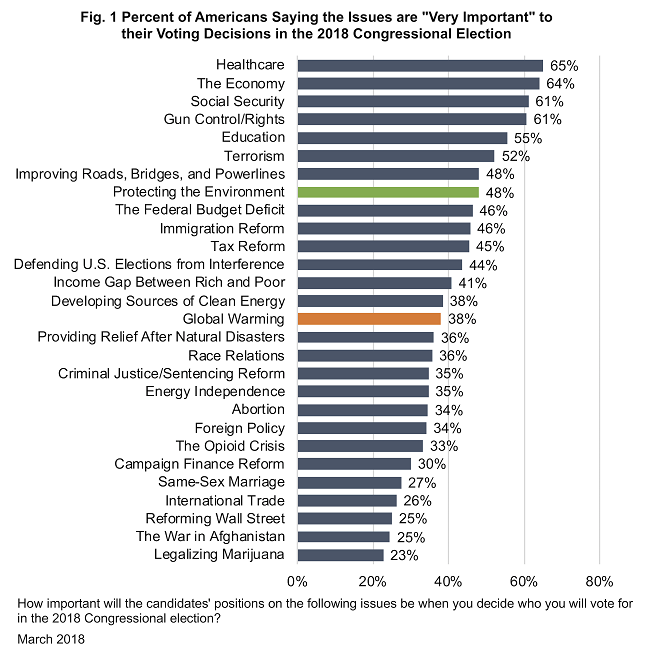
Out of 28 different issues registered voters say will influence their vote for Congress in 2018, global warming ranked 15th in importance (Fig. 1). Nearly four out of 10 Americans said that a candidate’s position on global warming will be very important to them when deciding whom to vote for in the 2018 Congressional election.
2018 US Congressional election: Percent of Americans saying the issues are “very important” to their voting decisions
The low priority ranking of climate change is said to be partly due to the human tendency to prioritise current risks and discount future threats. As a result, despite the heroic efforts of many scientists, activists, politicians, and other advocates, across the globe and in the U.S. in particular, “policies are lagging very, very far-miles, miles, miles behind the science and what needs to be done,” according to Nobel prize-winning economist William D. Nordhaus.
Americans’ political ideologies and partisan affiliations, however, have a strong influence on how they view climate change. The Pew Research Centre poll above found that 68% of Democrats – as compared with only 18% of Republicans – said that climate change should be a top policy priority. Similarly, the George Mason University 2018 research found that, among registered voters, global warming was ranked as the fourth most important issue to the voting decisions of liberal Democrats while it was ranked as the least important out of 28 issues by conservative Republicans.
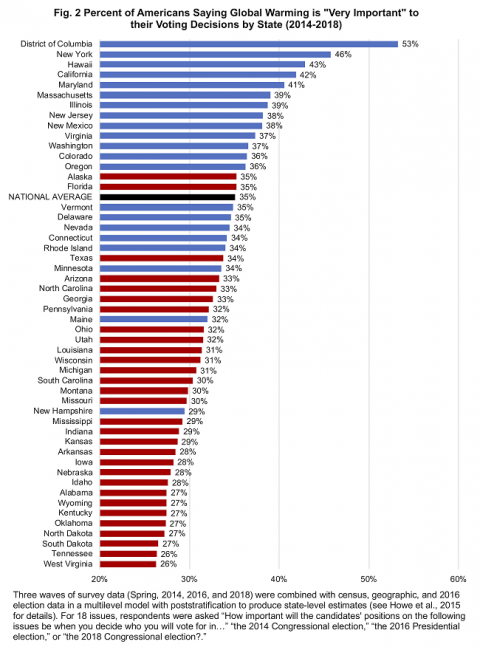
Using the models underlying our Yale Climate Opinion Maps, clear differences emerged between red and blue states (that is, voted Republican or Democratic in the 2016 presidential election). On average, blue state residents are much more likely than those in red states to say global warming will be important to their voting decisions, with a few exceptions (Fig. 2).
For instance, red states Alaska and Florida hover around the national average. In Alaska, climate change has caused flooding and permafrost melting, which is damaging roads, buildings, airports, railroads, and pipeline infrastructure. One study estimates these damages will cost $5.5 billion by 2100. In Florida, “a wealth management company worth $1.5 billion is advising customers that South Florida’s real estate market might be a risky place to invest” due to sea level rise. More severe hurricanes and harmful algal blooms may also be a factor.
Anthony Leiserowitz, Director of the Yale Programme on Climate Change Communication, said in a recent Los Angeles Times article, “This is not just a political issue anymore in some places… voters are seeing the consequences (of warming) right here, right now.”
2018 US Congressional election: Percent of Americans saying global warming is “very important” to their voting decisions by state
In addition to Washington DC, where global warming ranked 8th in voting issue importance, New York (11th in ranking), Hawaii (9th), and California (13th) top the list of states where the issue is most highly ranked. Greater exposure to coastal storms, wildfires, and other extreme events is likely influencing residents’ opinions in these states. The Yale Climate Opinion Maps show Washington DC and New York also have the highest population percentages who believe that global warming is affecting the weather (75% and 71%, respectively).
Residents in these states also talk about global warming more than those in most other states. By contrast, just over a quarter of Americans say global warming will be important to their voting decisions in Alabama (17th in issue importance ranking), Kentucky (16th), and West Virginia (17th) – the same red states where residents are less likely to talk about global warming and hear about it in the media.
Although many Americans rank global warming as a relatively low priority voting issue, the more general issue of environmental protection is a higher voting priority: about half of registered voters say that a candidate’s position on protecting the environment will be very important to their vote (Fig. 1).
Given that many existing environmental problems, as well as the economy, public health, and community infrastructure, will be impacted by climate change, it is important that Americans understand the connections. A warmer climate means more severe weather, increased stress on most species, less fresh water, more acidic oceans, and less permafrost. In contrast, a rapid transition to clean, renewable energy sources would provide cleaner air, improve public health, and provide economic opportunities along with many other co-benefits beyond reducing climate change. Many climate solutions actually have bi-partisan support, an important fact that is greatly overlooked in the current era of extreme political partisanship.
As more Americans come to better understand that many environmental, health, and economic impacts of climate change are interrelated – and as the costs of clean energy continue to drop – it is likely that the issue will become a bigger voting priority in the public.
The Ministry of Foreign Affairs and International Cooperation (MOFAIC) and the Abu Dhabi Department of Urban Planning and Municipalities on Saturday, October 17, 2018 signed an Agreement with the United Nations Human Settlements Programme (UN-Habitat) for Abu Dhabi to host the 10th session of the World Urban Forum (WUF10) in 2020. This will be the first time an Arab country hosts the landmark Forum.
Abu Dhabi, UAE
Besides being the capital and the second most populous city of the United Arab Emirates (the most populous is Dubai), Abu Dhabi is also capital of the Emirate of Abu Dhabi, the largest of the UAE’s seven emirates.
WUF10 will be convened by UN-Habitat and jointly organised with the Abu Dhabi Department of Urban Planning and Municipalities, along with partners including the Abu Dhabi Department of Culture and Tourism, Abu Dhabi National Exhibition Centre, Ministry of Foreign Affairs and International Cooperation and General Secretariat of the Executive Council.
Established in 2001, WUF is the world’s premier gathering on urban issues. The Forum examines the impact of rapid urbanisation and its implications for social, economic and environmental policies in communities, cities and towns. UN-Habitat, the convener of the Forum, is the United Nations focal point for sustainable urban development working for an inclusive and prosperous urban future.
The Forum will provide a platform to discuss 21st century city planning within a context of rapid development with specific cultural and demographic considerations. It will showcase the Abu Dhabi Planthrough which the city aims realise its long-term sustainable development vision through concrete achievements that position the Emirate as a benchmark in a region with one of the fastest rates of urbanisation in the world.
In the lead up to the Forum, the Abu Dhabi Department of Urban Planning and Municipalities will host the first Pan-Arab Urban Development Symposium in partnership with UN-Habitat in April 2019. Key decision makers, city authorities and urban experts from 22 Arab countries engaged in implementing the New Urban Agenda – to make cities inclusive, safe, resilient and sustainable – will be invited to exchange views and compare experiences about urban challenges facing fast-changing Arab cities.
H.E Mr. Falah Al Ahbabi, Chairman of the Abu Dhabi Department of Urban Planning and Municipalities, said: “We are extremely pleased Abu Dhabi has been chosen to host the 10th session of the World Urban Forum, particularly as it marks the first time an Arab nation has hosted this global event. Abu Dhabi has already attracted international merit for implementing urban sustainability in innovative ways, having itself experienced a phenomenal shift towards urbanisation in a relatively short space of time. This Forum provides an opportunity to showcase these achievements and Abu Dhabi’s role in promoting and implementing sustainable urban development as well as cementing our reputation as a global hub for innovation.”
“I would like to congratulate Abu Dhabi and commend the timely preparations and planning already underway by the city authorities and by the United Arab Emirates Government for this important event,” said UN-Habitat Executive Director, Maimunah Mohd Sharif. “Abu Dhabi, like so many cities in this region, is undergoing rapid and transformative urbanisation and we commend the focus on sustainability shown by the Government. This open, inclusive Forum, with its high-level participation, is a unique opportunity to focus on how urban development can be implemented in a sustainable way around the world.”
H.E. Mr. Falah Al Ahbabi added: “We are delighted and eager for the opportunity to discuss solutions that are being tested by pioneering cities around the world while also showcasing our city, country and renowned Emirati hospitality. Hosting the World Urban Forum in 2020 also provides the opportunity to celebrate our late Founding Father, His Highness Sheikh Zayed’s vision which put us firmly on the path to sustainable development, as well as recognising our young country’s achievements in what will be the 49th year since the union of our emirates.”
WUF10 will lead to new partnerships and actions to meet the challenges of urban areas. Key topics including human capital, resource management, education and culture, mobility, data and much more, will be discussed during the conference.
The Forum plays a key role in implementing the New Urban Agenda, a framework unanimously adopted at the United Nations Conference on Housing and Sustainable Urban Development (Habitat III), laying out how cities should be planned and managed to best promote sustainable development. Abu Dhabi strongly supports the New Urban Agenda as it represents its own ideal for creating a sustainable Emirate by preserving and enriching its physical and cultural identity, while improving quality of life for all its residents. Abu Dhabi’s urban development vision encompasses four pillars: economic, social, cultural and environmental.
The Forum will bring together some 20,000 delegates from more than 150 countries. It will provide an opportunity to strengthen relationships and engagement and demonstrate the feasibility of incorporating sustainable and context-based practices in developed and developing countries.
The UN Food and Agriculture Organisation (FAO) says food security has improved in northeastern states with the number of food insecure people dropping from 5.2 million to 2.9 million.
Minister of Agriculture and Rural Development, Chief Audu Ogbeh
The FAO Representative in Nigeria Mr Suffyan Koroma, represented by Mr Patrick David, the FAO’s Programme and Liaison Officer, said that the number dropped between August 2017 and August 2018 in Adamawa, Borno and Yobe states.
Koroma disclosed this at the presentation of October 2018 Cadre Harmonise (CH) Analysis Outcome for 16 states and FCT in Abuja on Friday, November 2, 2018.
Cadre Harmonise is an early warning and food insecurity nutrition analysis tool to serve Food Crisis prevention and Management Framework which considers various food security and nutrition outcomes in 16 states.
He noted that the number reduced because of massive support from the government and the international community.
“Despite this improvement, there is still a huge need to respond to and FAO in partnership with WFP supported and will continue to support the Government of Nigeria in providing emergency and resilient livelihood assistance.
“We will also provide nutritious food crops, cash crops and livestock support to more than one million vulnerable individuals identified through the cadre harmonise,’’ he said.
Ms Myrta Kaulard, the World Food Programme (WFP) Country Director, emphasised the need for data collection to shape the right way of intervention and assist government policies.
Kaulard said that there were increased number of people who do not have access to land and could not return to farming activities.
She said that tackling insecurity and access to land in the northeast were priorities to reduce the number of people who required assistance in the area.
“WFP looks at the policies and actions by state and federal authorities and where there are gaps, we provide food assistance or cash requirements for the affected people to buy food.
“The result of these joint efforts is very encouraging because in 2016, there were concerns of famine in the Northeast and year after year, we have seen a gradual improvement in conditions,’’ she said.
Dr Abdulkadir Mu’azu, the Permanent Secretary, Federal Ministry of Agriculture and Rural Development, emphasised the need for data collection which was the major aim of the cadre harmonise analysis.
Mu’azu, represented by Mr Matthew Owolabi, a director in the ministry, said that the government would continue to support all stakeholders and take appropriate actions required based on the analysis.
Dr Issoufou Baoua, the Food Security Analyst Expert of Cadre Harmonise, said the analysis was done in October 2018.
Baoua said that the analysis was done with evidence and data from climate change and livelihood support in the 16 states.
He said that although there were still challenges to be addressed, the food security situation had improved in the 16 states when compared with two to three years back.
The experts listed the states where the analysis as Adamawa, Bauchi, Benue, Borno, Gombe, Jigawa, Kaduna, Kano, Katsina, Kebbi, Niger, Plateau, Sokoto, Taraba, Yobe, Zamfara and the FCT.
The News Agency of Nigeria (NAN) reports that the CH analysis started in Nigeria in 2015 to help support and assist government interventions on food and nutrition security.
It is being supported by the FAO, WFP, and Committee for Drought Control in the Sahel (CILSS), among others.
The Director-General (DG) of Nigeria Maritime Administration and Safety Agency (NIMASA), Dr Dakuku Peterside, on Friday, November 2, 2018 said that the agency would enforce strict compliance on sulphur pollution.
Shipping
Peterside said the measure would be in line with International Maritime Organisation (IMO) regulation which put a maximum of 0.5 per cent sulphur cap on all fuel used by vessels by the year 2020.
According to a document signed by Isichei Osamgbi, NIMASA Head, Corporate Communications, the D-G made the statement during an interactive session with newsmen at the ongoing maritime week in Dubai.
“That part of the requirements adopted at the 73rd meeting of the Marine Environment Protection Committee (MEPC) of the United Nations maritime organ is to reduce the sulphur content permitted in ships’ fuel oil globally to 0.5% with effect from 1st January 2020.
“The 2020 fuel challenge is geared towards energy efficiency, environmental pollution control, health as well as core regulatory enforcement issues.
“As a maritime nation, we cannot afford not to comply with the IMO standard which will also do a lot in mitigating global warming and other related environmental issues”, Peterside said.
He said that the IMO ban which related to fuel intended for combustion, propulsion and operation purposes on board ships will enter into force on March 1, 2020.
Peterside said that all member states were expected to comply with the stated standard by this date.
He said that it would in the best interest of Africa to ensure compliance because the continent did not have the technology to mitigate effects of sulphur fuel on the environment.
The maritime boss enumerated some of the steps the agency planned to take to manage the transition and ensure compliance to include embarking on massive enlightenment and stakeholder’s engagement.
The agency would collaborate with fuel refiners and suppliers and a schedule for pre-enforcement to engender the right approach.
“It is worthy of note that the IMO has been working to reduce harmful effects of shipping on environment since 1960.
“The Annex VI to the International Convention for the Prevention of Pollution from Ships (MARPOL) was adopted in 1997 to address air pollution from shipping.
“The regulation 14.1.3 of Annex VI of the convention seeks to control airborne emissions of compounds such as sulphur oxides, nitrogen oxides and other ozone depleting substances arising from shipping activities.
“All these is in order to mitigate its effects on health and the environment,” he said.
“After years of suffering from the deadly impacts of lignite mines and coal burning in their lands, the villagers of Muğla came together to remind us all that coal pollution affects everyone – no matter where it is burned, we all pay its environmental and health impacts,” says Efe Baysal, Turkey Campaigner, 350.org.
A new report released on Friday, November 2, 2018 shows the “The Real Costs of Coal: Muğla” in Turkey by CAN Europe. The research places a spotlight on plans to expand three coal-fired power stations in Muğla city and demonstrates the huge price those living nearby and those in countries further afield face from air pollution.
The Real Costs of Coal: Muğla shows that since the plants became operational in 1983, the three coal plants are responsible for the release of: 9.5 million tons of sulphur dioxide, 890,000 tons of nitrogen oxides, 65,000 tons of dust, and 28,000 kg of mercury.
According to health impact modelling carried out by the study, the pollution has caused more than 45,000 premature deaths, hospitalisation of around 46,000 people due to respiratory and cardiovascular illnesses and the loss of 12 million working days, a price too high to pay. The testimonies of the villagers living in Muğla support these findings, according to 350.org.
Dr. Haluk, a resident of Karacahisar Village, said: “In the last decade, the cause of death in our village has changed significantly, it’s mostly cancer. We also see more and more young children, and non-smokers with acute respiratory diseases.”
The findings of the report come at a moment when health experts around the world have met in Geneva for the first WHO Global Conference on Air Pollution and Health. The Conference is expected to deliver a “Call for Urgent Action” on air pollution, an issue caused primarily by burning of coal.
Due to the transboundary nature of pollutants, Muğla’s coal plants’ costs to health are being felt in Europe and East and North Africa, with the largest transboundary impact taking place in Egypt, followed by Israel, Greece and Palestine.
Since coming online in 1984 the three plants have released 360 million tons of CO2, an expansion will mean spewing another 328 million tons of CO2 into the atmosphere.
“The expansion of any new coal power plant is inconceivable given the findings of the IPCC report released this October. Every ton of coal burned makes an immediate contribution to the quantity of CO2 in the atmosphere causing long term and irreversible climate change. We need to keep fossil fuels in the ground now to ensure that we stay below 1.5 degrees to avoid catastrophic climate change,” says Hoda Baraka, Global Communications Director, 350.org
An environmentalist, Mr Taiwo Adewole, says the the review of the Lagos State Environmental Law 2017 is long overdue.
Akinwunmi Ambode, Governor of Lagos State. Photo credit: ecomium.org
Adewole, Chief Executive Officer of Taiwo Adewole and Associates, told the News Agency of Nigeria (NAN) on Friday, November 2, 2018 in Lagos that the 2017 Environmental Law was done in a hurry.
He said that the previous Environmental Law was done to favour of Visionscape Sanitation Solutions and the state lawmakers had seen the flaws and now want to set the record straight.
“There are a lot of flaws because it was rushed and passed into law just to favour Visionscape, all in the name of Pubic Private Partnership (PPP),” the environmentalist said.
He said that while reviewing the law, the aspects of first line charge payment to Visionscape and total scrapping of the Private Sector Participants (PSPs) should be investigated.
According to him, the area of introduction of Waste Collection Operators (WCO), which is selective of some selected PSPs, and killing of the Lagos Waste Management Authority (LAWMA) should be reviewed.
“The new law should give all opportunity previously given to Visionscape to the PSPs in terms of PPP and funding based on first line charge and signing of bonds for the indigenous PSP/investors,” he said.
NAN reports that the Lagos State House of Assembly on Thursday began a three-day retreat to review the state’s Environmental Law and nine others, to meet global best practices.
The Speaker, Mudashiru Obasa, said the House was committed to moving the state forward with realistic laws.
Obasa said that, to move Lagos State forward, there was the need to put in place laws that were enduring and in conformity to the interest of the people.
“We must restructure them (selected laws) and introduce new laws where applicable. We need laws that can satisfy the interest of our constituents.
“In our parliamentary business, we need to pick laws that we have passed and see areas we need to tinker with, so that we continue to do what we were elected for,” he said.
Obasa said that Lagos had a good environmental law in place but had problems with the implementation.
“We are here because people raised eyebrows over some aspects, and we want to see how we can amend them.
“We have brought in people who have served as commissioners, as insiders, to tell us what is wrong with the laws and what we need to do.
“We will continue to review our laws. It is by going through them regularly that we will prepare our state for a better law.
“Even if a law was passed yesterday, we can come around to review it today,” he said.