With a base at the lively country pavilion, members of the Nigerian delegation have been quite active at the UN Climate Change Conference (COP24) in Katowice, Poland.
They comprise civil society players, negotiators, business officials, government functionaries and media practitioners.
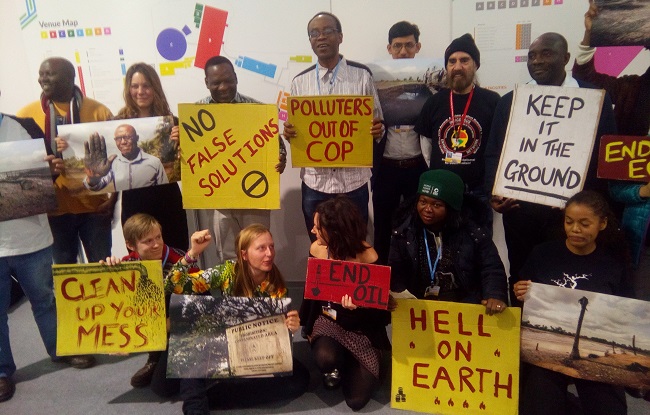
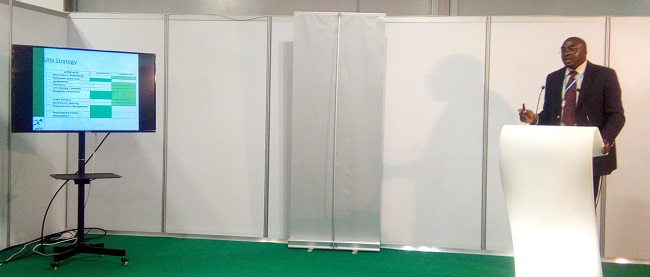
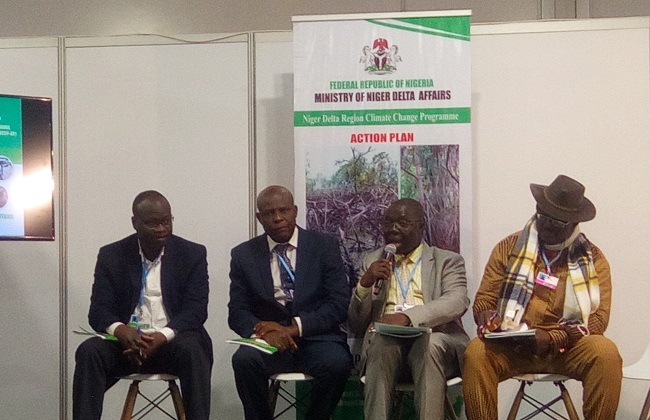
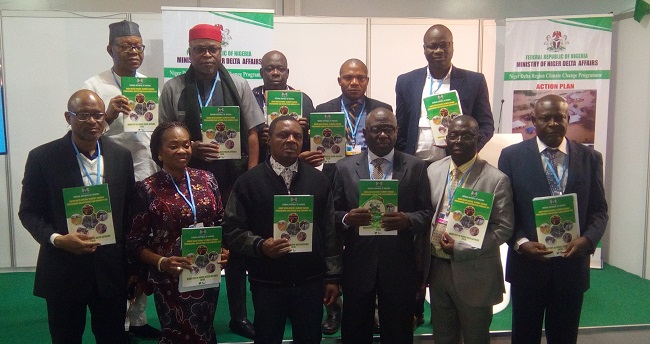
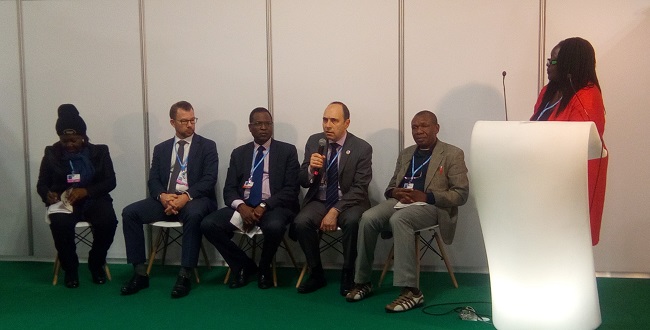
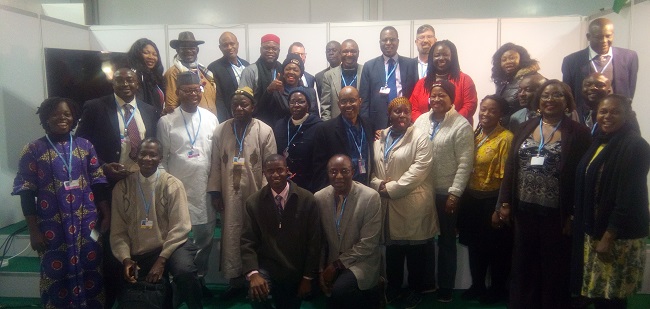
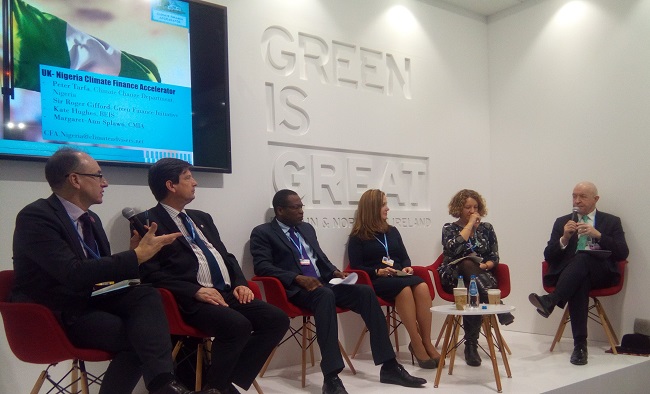
The activists confronting Shell at the COP: Three Nigerians – Nnimmo Bassey, Gowin Ojo and Rita Uwaka are part of the actionDr Onoja Joseph of the Nigerian Conservation Foundation (NCF) making a presentation at the Nigeria Pavilion on Wednesday, December 12A panel discussion session during a side event organised by the Ministry of Niger Delta Affairs featuring, among others, Dr Samuel Adejuwon and Senator Foster OgolaFormal presentation of the “Niger Delta Region Climate Change Programme and Action Plan (NDRCCP-AP) at COP24 on Wednesday, December 12A panel discussion segment during a side event organised by the Nigeria REDD+ ProgrammeParticipants at the close of the Nigeria REDD+ Programme side eventDr Peter Tarfa as a panelist during a panel session on “UK-Nigeria Climate Finance Accelerator” on Tuesday, December 11
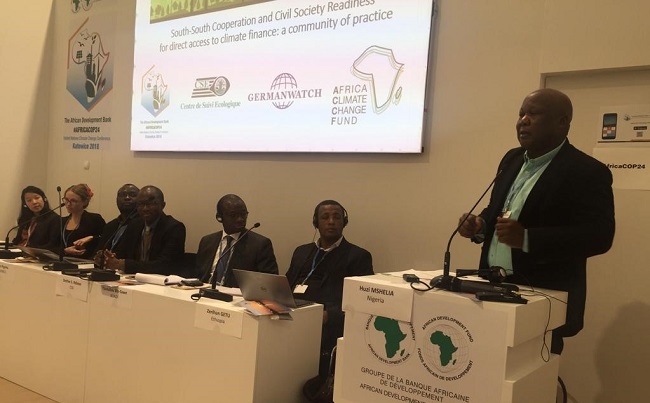
Huzi Mshelia making a presentation during a session organised by the African Development Bank (AfDB)
The Nigerian pavilion at COP24 has positively impacted Nigeria’s image and performance at the ongoing UN climate change summit in Katowice, Poland.
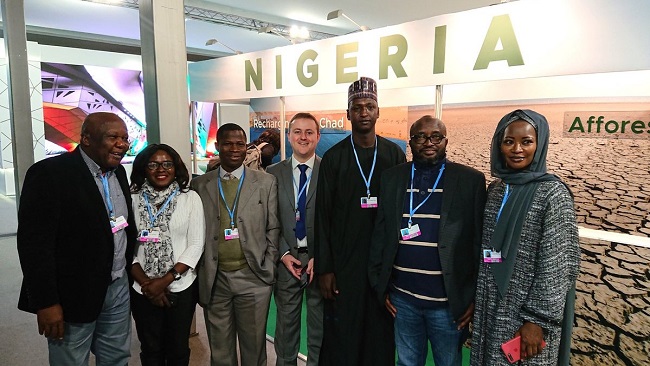
Some members of the Nigerian delegation beside the pavilion
Director, Department of Climate Change in the Federal Ministry of Environment, Dr Peter Tarfa, who made the submission on Wednesday, December 12, 2018, said the facility gave the nation the stage to show the world what it has been doing in terms of climate action.
“It has impacted our performance at the COP24 in Katowice very, very positively because it has given us a platform to come a showcase what we have been doing back home,” he said, adding that Mr President even visited the place and expressed his approval and commendation.
“There was never a time that any president of Nigeria since the start of the COPs ever visited the Nigerian pavilion. But President Muhammadu Buhari made history when he did so last week. He came here. He looked at all the signs here especially the ‘Deforestation’ sign and asked: ‘Do we still have forests?’ It shows how passionate he is towards issues related to the environment and climate change,” said Dr Tarfa.
The pavilion has in COP24 played host to several programmes organised by organisations such as the Federal Ministry of Environment (NEWMAP: Supporting Nigeria’s climate change response agenda and the Paris Agreement), Nigeria National Petroleum Corporation (Addressing climate change in the Nigerian oil & gas sector), Federal Ministry of Water Resources (Outcomes of international conference on Lake Chad), Anambra State Government (Mainstreaming climate disaster loss and damage solutions to sustainable development in Anambra State of Nigeria), Ministry of Niger Delta Affairs (Addressing the environmental and climate change impacts in the Niger Delta Region of Nigeria), National Green Campus Initiative, Climate and Clean Air Coalition(Nigeria national action to reduce short-lived climate pollutants: Delivering multiple benefits for clean air and climate), Women Environmental Programme (Using climate change capacity building to transform community people’s behavioral and adoption of climate smart practices), Green Bonds (Green Bonds: Making Articles 2 and 6 a reality), Kaduna State Government (Building resilience against climate-induced displacement) and the Nigeria Meteorological Agency (NiMet at a glance: Synopsis on climate change mitigation and adaptation strategies in Nigeria).
Others include Global Eco Strategies Limited (Blockchain technology financing for clean energy Nigeria), OSSAP-SDGs, United Nations Development Programme *Achieving the SDGs through climate action), National Assembly (Role of the Nigerian Parliament in the implementation of the Paris Agreement), Nigeria Incentive-Based Risk Sharing System for Agricultural Lending (De-risking and catalysing finance and investments across climate smart agricultural value chains), Federal Capital Territory Authority (Resilient infrastructure development in FCT: Key to enhancing Nigeria’s NDC implementation), Nigerian Conservation Foundation (Delivering national climate action and sustainable development goals through re-greening Nigeria), African Centre for Agriculture and Social Inclusion (Smallholder youths and gender action in climate change impact – Jigawa State of Nigeria in view), Nigeria REDD+ Programme (Developing a finance strategy for incentivising and implementing REDD+ activities, and opportunities for public-private partnerships), Infintum Global Projects (Catalysing carbon neutral and carbon negative through infrastructural development in developing nations), and Ecologistics Integrated Services Limited (National preparation for conference of parties for developing nations).
The second part of the high-level segment of the UN Climate Change Conference COP24 resumed on Tuesday, December 11, 2018 with the UN’s Climate Chief, Patricia Espinosa, and other top UN officials making passionate pleas to governments to finish the work they set for themselves and conclude the conference with a strong and effective outcome.
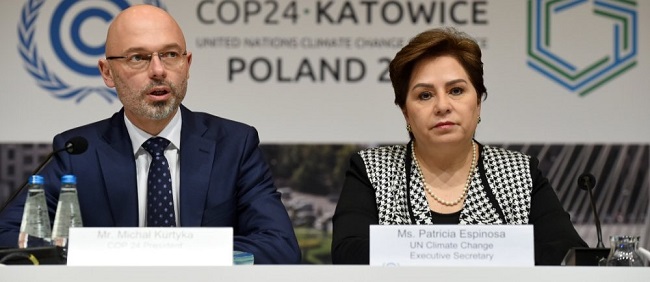
Patricia Espinosa, Executive Secretary of the UNFCCC (right), with Michał Kurtyka, President of COP24
The main objective of the conference is to finalise the implementation guidelines of the Paris Agreement.
With more than 100 ministers now in Katowice to provide political guidance, and with only a few days left to go, Ms. Espinosa said: “Many political divisions remain. Many issues still must be overcome. But I believe it’s within our grasp to finish the job. Let’s complete the Paris Agreement Work Programme and, by doing so, immediately unleash the power of the Paris Agreement itself.”
Ahead of COP24, the UN’s Intergovernmental Panel on Climate Change (IPCC) issued a special report on the achievability and implications of a 1.5°Celsius global average temperature rise compared to pre-industrial levels, the lower temperature goal of the Paris Agreement on Climate Change.
In Katowice, Hoesung Lee, Chair of the IPCC, reiterated the key findings of the report, namely that the temperature goal is achievable, but that this can only happen if there if governments take urgent and far-reaching action in all aspects of society, with many implications for policy-making.
“Every bit of warming matters. Every year matters. Every choice matters. With this report, the scientific message is clear. It is now up to you, the governments, to act,” he said.
Mr. Petteri Taalas, Secretary-General of the World Meteorological Organisation, also addressed ministers and delegates. He warned that current levels of greenhouse gas emissions were unsustainable and were already leading to dramatic climate change impacts around the world, from the melting of Artic ice to many incidents of fires flooding this fear.
“We are expecting a 2 to 4 percent increase in global carbon dioxide emissions this year. If we are serious about the Paris Agreement, we need to see different numbers.”
He also pointed out that even if pollution of the atmosphere is stopped today, the current levels of CO2 would stay in the atmosphere for many years to come, locking in extreme weather.
At the end of her speech, Ms. Espinosa alluded to the words of Mae Jemison, the first black female astronaut in space, who spoke about traveling to space and exploring the unknown.
“What struck her most was looking back at Planet Earth and seeing not just the beauty of our planet, but the thinness and fragility of the atmosphere surrounding it—the thin blue line protecting all life on Earth. That’s what we’re fighting for. That’s what we’re here to protect: That thin blue line of life. That thin blue line of hope.”
The Women Environmental Programme (WEP), Solidaridad Network Organisation, Alex Ekwueme Federal University Ndufu-Alike (AE-FUNAI) and Climate and Sustainable Development Network (CSDevNet) at the ongoing 24th Session of the Conference of Parties (COP24) to the United Nations Framework Convention on Climate Change (UNFCCC) holding in Katowice, Poland, presented smart projects and practices that can contribute towards achieving the Nationally Determined Contributions (NDCs) commitments and the Paris Agreement in West Africa.
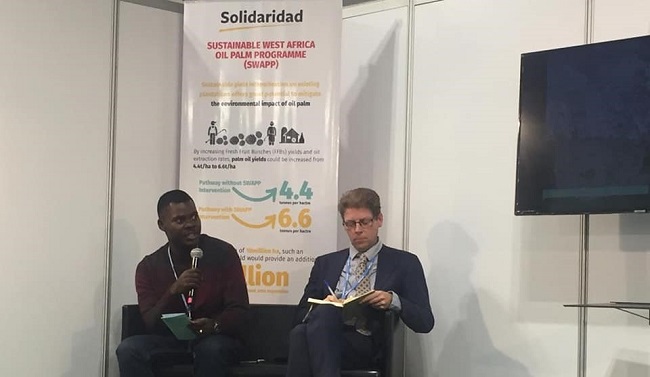
John Baaki of WEP (left) and Jan Maarten Dros of Solidaridad during the side event at Nigerian Pavilion at COP24
The smart projects and practices were presented at a side event the organisations collaboratively hosted at the Nigerian Pavilion at COP24 on December 6, 2018.
Welcoming participants to the event and declaring the event open, the Director, Department of Climate Change, Federal Ministry of Environment, Nigeria, Dr. Peter Tarfa, appreciated the collaboration of the organisations as he stated that this is needed to find a collective solution to climate change challenges.
Speaking on the collaboration, Atâyi Babs, National Network Coordinator of CSDevNet who moderated the event, described the COP24 side event as one of the quick wins recorded by the National Civil Society Framework on Paris Agreement and SDGs, recently launched by the network in Nigeria.
“The Framework which comprises a broad spectrum of Nigerian CSOs was established to enhance Nigerian Civil Society participation in post-Paris Agreement activities, amplify voices of vulnerable people and ensure that the recognised role of CSOs within the provisions of the Paris Agreement is at the centre-stage of the implementation in Nigeria and today’s event is a shining example in that regard,” Atâyi said.
The organisations took turns to present their smart projects and practices that they have implemented.
Mr John Baaki, WEP’s Programme Manager, presented the following projects and practices by the organisation:
Trees planting project involving 2,000 trees across the FCT as well as Benue, Kano and Katsina states with support from Trees for Cities. This project, WEP said, would help to remove greenhouse gases from the atmosphere, prevent land degradation and provide a source of income for communities where the project has been implemented.
Solar dryer tent: WEP also constructed a solar dryer tent for the farmers of Adogo, a community in Nigeria’s Mbaya district of Buruku Local Government, Benue State where sun drying was the only way to preserve produce as local women would lay fruits and vegetables on the ground to dehydrate them for future use. Sun-drying is unfortunately time-consuming and weather dependent and exposes food to contaminants like dust and insects. With the construction of solar dryer tent in the community, drying becomes faster, more hygienic and post-harvest losses would be reduced.
WEP also presented initiatives that advocate for the implementation of the Gender Action Plan of the UNFCCC in Nigeria as well as the initiative that trains women to upcycle waste plastic bags into shoes and other products.
Solidaridad on the other hand presented her “National Initiatives for Sustainable Climate-Smart Oil Palm Smallholders – NI-SCOPS” project, sharing experiences from Asia and Africa. Jan Maarten Dros, Climate Innovation Manager at Solidaridad, led the discussion on behalf of Solidaridad Network on effective approaches for implementing the project NI-SCOPS in Asia and Africa.
Dr. Samson Samuel Ogallah, who is the Senior Climate Specialist at Solidaridad, added that the NISCOPS project with the support from the Dutch Government focused on four countries in Asia and Africa. The countries include Ghana, Nigeria, Malaysia and Indonesia. Dr. Ogallah added that the project will contribute the countries’ efforts at addressing the impacts of climate change, achieving their NDC commitment under the Paris Agreement and the Sustainable Development Goals.
The Regional Director for Solidaridad West Africa, Isaac Gyamfi, during one of the COP24 events, also highlighted some of the milestone achieved so far in the region. These include supporting smallholder producers to increase their productivity and improved livelihood, facilitating market opportunities for farmers, credit and input access for small and medium scale enterprise farmers and stimulating public-private partnerships while ensuring continual improvement for sustainable climate smart production systems.
AE-FUNAI also shared experiences of her initiatives of greening the university through tree planting.
According to the organisers, the aim of sharing the smart projects and practices is so that they can be replicated by communities to address their climate challenges.
A group of activists from different organisations on Tuesday, December 11, 2018 took to the streets outside the Westin Hotel in Cape Town where the South African Energy Week is taking place to protest the DBSA’s plans to fund the Thabametsi coal plant in Lephalale.
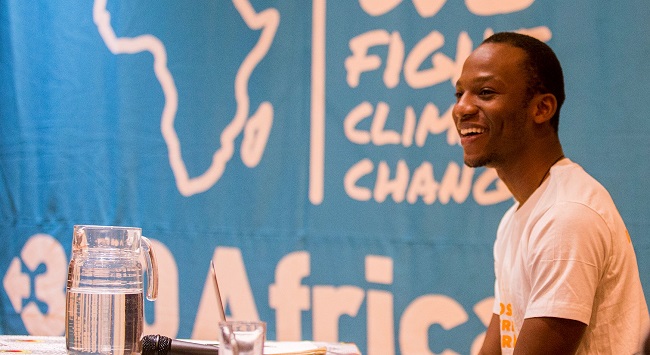
350Africa.org divestment campaigner, Ahmed Mokgopo. Photo credit: Jennifer Bruce/350Africa
Plans for the Thabametsi plant and for new coal development in South Africa are said to be inconsistent with the need to limit global temperature increase to below 1.5°C, as confirmed by the latest IPCC report. The study clarifies that limiting the rise in global temperatures to 1.5°C would be significantly better than breaching the 2°C threshold, supporting calls for a rapid decline in fossil fuel use and a rapid transition to energy systems based on 100% renewable energy.
350Africa.org divestment campaigner, Ahmed Mokgopo, said, “The DBSA has already recognised the opportunity for clean energy which holds true to just and sustainable development. However, their inconsistency in funding renewables and fossil fuels at the same time, overshadows what could see them as leaders in promoting clean energy development for the continent.
“With Energy Week South Africa taking place this week, we encourage the DBSA to commit to 100% renewable energy financing to avoid undermining their ambition to ‘Make Change Happen’. This presents an opportunity for the bank to truly live up to its mandate and align all of its energy lending with South Africa’s commitments to reduce greenhouse gases in accordance with the Paris climate agreement currently being discussed at COP24, in Poland.”
Last week, nine Multinational Development Banks announced a framework “reinforcing their commitment to combat climate change”, signaling a move by financial institutions globally to clean up their investments – an example the DBSA should follow, according to 350Africa.org. It adds that the DBSA has an opportunity to not take the Thabametsi project into consideration and, by doing so, make a clean break from coal.
Communities directly impacted by Shell’s alleged abusive practices on Tuesday, December 11, 2018 spoke out as fossil-fuel trade association IETA hosted representatives from the Big Polluter for an event at the U.N. Framework Convention on Climate Change’s 24th conference of the parties (COP24) holding in Katowice, Poland. The side event held just days after a Shell executive was said to bragged about the corporation’s influence over the Paris Agreement.
“We have a message for Shell and companies that pretend the solution to the climate catastrophe doesn’t demand the end of fossil fuels. To the Shell executives who got rich from the suffering of the Ogoni people and communities living on the frontlines of dirty energy and climate change impacts we say: You are the last gasp of a system on the way out. You are on the wrong side of history. We will not rest until you stop extracting fossil fuels and pay for the damage you have caused,” stated Sara Shaw of the Friends of the Earth International.
Nnimmo Bassey of the Health of Mother Earth Foundation said: “Yesterday, the world celebrated 70th anniversary of the Universal Declaration of Human Rights. In the Niger Delta we have endured 60 years of gross oil pollution, gas flares and human rights abuses. Today, the world has 12 years to right the wrongs. Shell and their cohorts must be kicked out of the COP and held to account.”
Godwin Ojo, Environmental Rights Action/Friends of the Earth Nigeria: “We must kick Big Polluters out of the talks. Big Polluters are writing the script behind the scene and this side event is an evidence. We need to kick them out of the COP process.”
Alberto Saldamando, Indigenous Environmental Network and It Takes Roots delegation: “This is so transparent – everything we’ve been saying about the role the market mechanisms are playing, is possible to see right here. It is a false solution. A loophole for dirty energy corporations to continuing polluting, through offset mechs these corporations are continuing to pollute and devastate environmental justice communities.
Sriram Madhusoodanan, Corporate Accountability: “Second thing is that the majority of forests that are offset are on indigenous lands – in this form REDD+ and other kinds of offset mechanisms are fueling land grabs and massive violations of human rights in the global south. We must reject their presence and influence here.
“This is precisely why the UNFCCC needs a conflict-of-interest policy. The only thing Shell Oil should be contributing at these talks is a commitment to remunerate countries for the devastation its decades of climate deception and carbon extraction have caused. Instead, it’s using every tool at its disposal to convince governments here to advance its dangerous schemes. Shell is savvier in advocating its agenda, to be certain, than the Trump Administration in its oxymoronic sideshow for ‘clean fossil fuels.’
“But its intention is similar: To greenwash and otherwise obfuscate its role in writing a Paris roadmap written by and for the world’s biggest polluters. But media, negotiators, and civil society won’t be duped: The growing movement – represented by the People’s Demands for Climate Justice – calling to keep fossil fuels in the ground and kick Big Polluters like Shell out of climate policy is determined to ensure the Paris Rulebook advances true climate justice.”
Collin Rees, Oil Change International: “For decades, Shell has violated human rights and devastated communities around the globe. It’s done this while wrecking the climate and doing everything it can to lock in decades’ more extraction of dirty fossil fuels and profits for its executives. Canada should be ashamed for lending credibility to today’s panel and legitimising Shell’s presence at the UN. It’s time for governments to reject false solutions like Shell’s Sky Scenario, kick Shell out of the climate talks, and stand with the frontline communities most impacted by Shell’s greed.”
Rita Uwaka, Environmental Rights Action/Friends of the Earth Nigeria: “Shell is a big-time polluter playing saint at the COP. Their track record of environmental degradation and human rights abuses have continued to affect communities in the Niger Delta with differentiated impacts on women and vulnerable groups. Having Shell organising a side event at this COP to promote false solutions is not only a slap on our faces and impacted communities in the frontline, it is a sacrilege on Mother Earth. If we must make progress with the climate talks, Shell should be kicked out of COP. We demand Climate Justice for all.”
Earlier in the day, the People’s Demands, a set of six calls to governments, were delivered to the UNFCCC Executive Secretariat. Over 300 organisations from over 129 countries support the demands, which include a call for an end to corporate capture.
According to the activists, countries have failed to make substantive progress at this year’s talks, and corporate capture of the climate negotiations has become a contentious issue. They disclosed that the conference is bankrolled by some of the largest oil, coal, and gas corporations in the European Union, “which raises questions about the level of access and influence fossil fuel corporations have at the talks”.
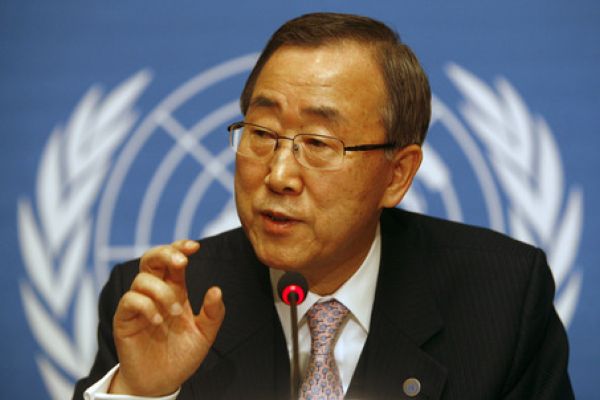
Former UN Secretary-General, Ban Ki-moon, said that eliminating poverty, the number one goal of the UN Millennium Development Goals, had been achieved thanks to the development of China.
Former U.N. Secretary-General, Ban Ki-moon. Photo credit: www.afrik.com
Speaking in China on the sidelines of a forum on international affairs in China’s southern city of Guangzhou, Ban said China’s reform and opening-up have lifted hundreds of millions, both in China and elsewhere, out of poverty.
“The World Bank announced proudly in 2010 that the number one goal of the UN Millennium Development Goals was achieved if we look at the statistics internally, it is because of China,’’ Ban said.
“China has also been contributing a lot to development issues and this is a highly commendable contribution.’’
Ban noted China’s voiced determination to carry on with its reform and opening-up.
“Now that you’re beginning another 40 years of reform and opening-up, I am quite confident that this will help greatly in implementing Sustainable Development Goals,’’ he said.
“Again, number one goal of Sustainable Development Goals is to eradicate all the absolute poverty around the world.’’
Ban said during the 2018 Imperial Springs International Forum, which gathered some 200 former world leaders, renowned scholars and business elites in Hangzhou for discussions on the theme: “Advancing Reform and Opening-up, Promoting Win-win cooperation’’.
The South Korean career diplomat, who served as UN secretary-general from 2007 to 2016, also highlighted recent increasing challenges to multilateralism that had underpinned the world peace and prosperity over the past decades.
“The international peace, security, and prosperity have been underpinned during last seven decades under the multilateralism systems, and multilateralism is now symbolised with the UN and the UN Charter,’’ Ban said.
Some countries are “not respecting multilateralism, which has been backbones of international society. This is really worrisome’’.
Ban also mentioned the trilateral meeting between him, the Chinese and American leaders during the Group of 20 (G20) Hangzhou Summit in 2016, when both China and the U.S committed to the Paris Agreement.
That has really accelerated the process of the Paris Agreement coming into effect.
“So, that was a great step in terms of China’s contribution to international multilateralism,’’ he said.
Ban said it was important that the U.S. and China, the two largest economies and most important leading countries, should be able to work together harmoniously, to deal with all global challenges.
The diplomat said he was encouraged by the Belt and Road Initiative proposed by China, which meant that people around the world could share the benefit from China’s development achievement.
“We share a future,’’ said Ban, adding that the Belt and Road Initiative is in line with Chinese President Xi Jinping’s vision of building a community with a shared future for mankind.
“It’s very important that the countries along the Belt and Road will benefit and corporate with each other, to build infrastructure and have economic and social development.
“This will help not only those countries, but also China. So, it’s a mutual cooperation,’’ he said.
“The global challenges require global solutions. We are all in this together. We have to work together.’’
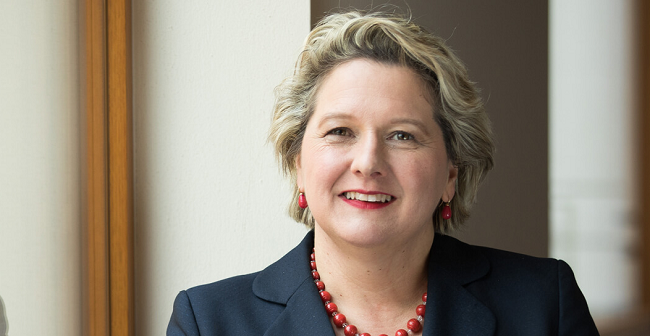
Germany will increase its financial aid for developing countries in the fight against climate change, German Environment Minister, Svenja Schulze, said on Tuesday, December 11, 2018.
German Environment Minister, Svenja Schulze
Germany will increase its financial aid by €70 million (479 million), in what Schulze said is “a symbol of solidarity.”
“Those who suffer most under climate change are the ones who have contributed the least to it happening,” she said.
She was speaking at a UN climate conference in Katowice, during which delegates from around 200 states are focusing on fleshing out a rulebook for financing and implementing the 2015 Paris agreement.
The Paris pact provides an outline for countries working together to limit the Earth’s warming to between 1.5 and 2 degrees Celsius.
Most efforts to prevent the planet heating up relate to stopping the release of greenhouse gases as soon as possible.
The rulebook is set to be agreed upon by Friday – however, if necessary, the climate conference could end up taking longer than planned.
Germany is the main contributor to the fund for developing countries faced with dealing with climate change.
So far, it has invested €240 million overall.
Schulze was due to hold a speech at the conference on Tuesday afternoon, in which she would highlight Germany’s further efforts to combat climate change.
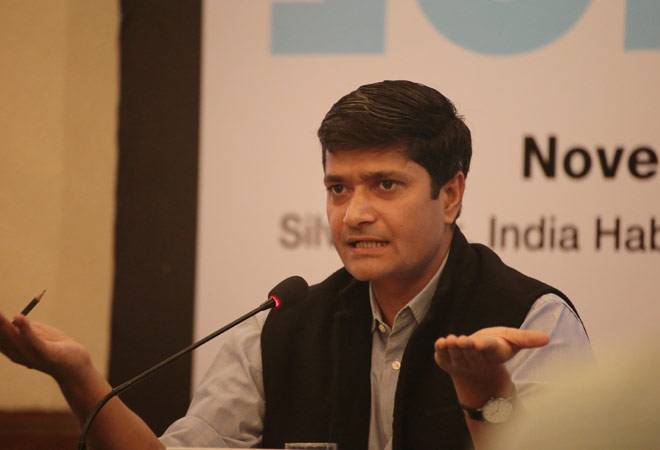
Independent public research and advocacy think tank based in New Delhi, India, the Centre for Science and Environment (CSE), believes that the 24th Session of the Conference of the Parties (COP24) to the United Nations Framework Convention on Climate Change (UNFCCC) that is ongoing in Katowice, Poland, is heading towards a weak outcome.
Chandra Bhushan, Deputy Director General, Centre for Science and Environment (CSE)
CSE analysts attending the global negotiations say there are major disagreements between Parties on a wide range of major and minor issues, and that there is little time left to bridge those disagreements.
“Considering that the Paris Agreement itself is a weak regime, having a weaker rulebook will make it inconsequential. This is something that the world cannot afford. It would be a better choice to have no rulebook here at Katowice than have a weak, ineffectual rulebook,” said Chandra Bhushan, the CSE deputy director general, who is heading the group’s delegation at the COP.
CSE, COP-watcher and analyst organisation, is recommending that countries should work for another year to develop a consensus on a robust and meaningful rulebook and then finalise it by 2019.
Contested terrains
The disagreements at Katowice run across the entire rulebook. Major points of contest relate to the issue of differentiation between developed and developing countries:
Equity
There are a few elements under the Paris Agreement where equity between the countries must get operationalised. These include communication on NDCs, ex-ante provision and review of financial commitments, and global stocktake on collective progress to meet the goals of the Paris Agreement. The process of operationalising equity has become a serious bone of contention between developed and developing countries. Developed countries are opposing an ex-ante review of their financial commitments and operationalisation of equity in GST. In fact, there is not even a consensus on what “finance” should mean.
Transparency
How would flexibility (less stringent reporting requirements) be reflected in the transparency framework is another issue of concern. While the US and EU have pushed for selective flexibility meant only for least developed countries and island states, India and China are demanding flexibility for all developing countries.
Reporting on NDCs
The current set of Nationally Determined Contributions (NDCs) are heterogenous. There is a need for clarity and guidance on standards to make the NDCs standardised for easier assessment and comparability. However, there has been no agreement on common time frames, baselines, scope or technical duration of NDCs.
Adaptation and loss and damage
Developed countries have opposed provision of finance in implementation of adaptation communications, while developing countries have sought parity of mitigation and adaptation finance. Developing countries are fighting hard for inclusion of loss and damage as sources of input under the Global Stocktake process, as also its inclusion under the transparency framework for reporting of action and support; developed countries are opposing it.
The discussions on other issues including new market mechanisms are likely to be pushed down to next year owing to greater technicalities and complexities in different countries’ stances.
The IPCC Special Report on 1.5oC makes it clear that the 2oC threshold referred to in the Paris Agreement is more dangerous than previously thought, and that unprecedented economic transformations are needed in the next decade to keep warming under the 1.5oC benchmark. This requires rapid phase-out of fossil fuels and drastic curtailment of wasteful consumption.
According to the recently released UN Emission Gap Report, the level of ambition needs to be multiplied five-fold to stay under 1.5oC. Even then, at Katowice, countries like US and Saudi Arabia are fighting over whether to welcome the IPCC Report or just take note of it under SBSTA. Further, there is not even a discussion happening on how to raise ambition, say CSE analysts.
“There is no discussion on how countries will revise and update their NDCs by 2020, which is critical to keep temperature increase within liveable limits,” says Vijeta Rattani, programme manager-climate change, CSE.
“The bottomline is that countries are sparring even on procedures. For example, they failed to reach a consensus on the adoption of the IPCC Special Report on 1.5oC, which was commissioned under the Paris Agreement. All this shows that countries are not ready and willing for a meaningful negotiation. In such a situation, forcing a weak rulebook in the name of consensus would be very harmful for the world,” added Bhushan.
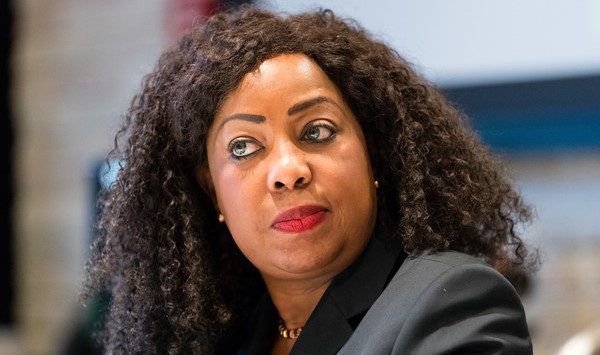
The sports sector and UN Climate Change on Tuesday, December 11, 2018 launched the Sports for Climate Action Framework to gather sports organisations, teams, athletes, and fans in a concerted effort to raise awareness and action to meet the goals of the Paris Agreement.
FIFA Secretary General, Fatma Samoura
Representatives of the diverse global sports industry, working with UN Climate Change over the past year, created the Framework to drive emission reductions of sports operations and tap the popularity and passion of sport to engage millions of fans in the effort.
The launch event, which took place on the margins of the UN Climate Change Conference (COP24) in Katowice, Poland, featured founding signatories: International Olympic Committee (IOC), FIFA, International Sailing Federation, World Surfing League, Forest Green Rovers Football Club, and the French Tennis Federation (Roland Garros), Tokyo 2020 Summer Olympics, and Paris 2024 Summer Olympics.
“The IOC is proud to have taken on a leadership role in the Sports for Climate Action Initiative,” said HSH Prince Albert II, Chair of the IOC Sustainability and Legacy Commission, speaking at the event. “With its global reach, universal appeal and the power to inspire and influence millions of people around the globe, sport is uniquely placed to drive global climate action and encourage crowds to join in. As countries here in Katowice prepare to turn their climate commitments into reality, we stand ready to leverage the power of sport to support their efforts.”
The Framework has two overarching objectives: achieving a clear trajectory for the global sports community to combat climate change and using sports as a unifying tool to drive climate awareness and action among global citizens.
Sports organisations recognise in the Framework that they need to take an active part in achieving the goal of the Paris Agreement, climate neutrality by mid-century, and they see their climate efforts also contributing to the broader Sustainable Development Goals.
“You recognise that because you’ve built significant global trust and moral leadership, and because sports touches on every cross-section of society, you can drive positive change throughout the world,” said UN Climate Change Executive Secretary Patricia Espinosa. “I’m here to encourage you to use your significant global leadership position to help us address the greatest challenge of our time: climate change.”
Sports produces climate-changing emissions in many ways, through associated travel, energy use, construction of venues, catering, and other ways. Work has in fact already begun. The International Olympic Committee and UN Climate Change have cooperated in the production of a climate action guide – “Sustainability Essentials: Sports for Climate Action” – for use by sports federations and others, which was released at the event.
As part of IOC’s contribution to the initiative, IOC also released at COP24: “Carbon Footprint Methodology for the Olympic Games and Paralympic Games”, which provides detailed guidance to the Organising Committees on how to measure the carbon footprint of the Olympic and Paralympic Games.
Together, these publications provide essential guidance for how to make sports more sustainable and climate smart and are an essential initial input to the new initiative.
The sports sector accepts its responsibility to reduce greenhouse gas emissions in line with the goal of the Paris Agreement – limiting global average temperature rise to 2 degrees Celsius and to strive for the safer 1.5-degree target. Sports for Climate Action now invites sports organizations, governing bodies, federations, leagues, and clubs to join this initiative by uniting behind a set of principles to get on track for the net-zero emissions economy of 2050.
“Our commitment to protecting our climate remains unwavering. We recognize the critical need for everyone to help implement the Paris Agreement and accelerate the change needed to reach greenhouse gas emission neutrality in the second half of the 21st century,” said FIFA Secretary General, Fatma Samoura. “FIFA welcomes the UN’s development of the Sports for Climate Action Framework, and I am pleased to confirm that FIFA will support the vision outlined in the new framework.”
Sport also recognises its unique, indeed unparalleled, ability to inform and mobilise millions of people around a love of sport and admiration for their sport heroes.
“Climate change is the biggest challenge facing the planet. UEFA firmly believes that football, with its strong and ever-growing environmental conscience, in particular in areas such as sustainable event management, has a duty to play a role in addressing this issue. This is why we are happy to have the opportunity to sign the United Nations Sports for Climate Action Framework,” said UEFA President Aleksander Čeferin.
The 17 signatories who signed on to the framework are: International Olympic Committee, AC Fukushima United Co. Ltd., FIFA, Forest Green Rovers Football Club, Formula E, French Tennis Federation – Roland Garros, International Sailing Federation, Kamakura International Football Club and Gangsters, Kyoto University American Football Club, Kyoto University Football Club, Paris 2024 Summer Olympics, Rugby League World Cup 2021, Sano High-School Rugby Club, Tokohu Ice Hockey Club Co., Ltd (Free Blades), Tokyo 2020 Summer Olympics, UEFA and World Surf League.
The sport sector believes it can do more by working together, according to the principles and objectives laid down in the Sports for Climate Action Framework.
In early 2019, the adopters of the Framework will be invited to form working groups to plan, pursue and enhance work under each of 16 principles laid out in the Framework.