Home Blog Page 1737

Government, stakeholders seek to validate draft forest emission reduction Level

0

The Federal Government has promised to ensure Nigeria attains the 120-degree global emission reduction level with the validation of the National Forest Emission Level Document (FREL).
Forest Reference Emission Level
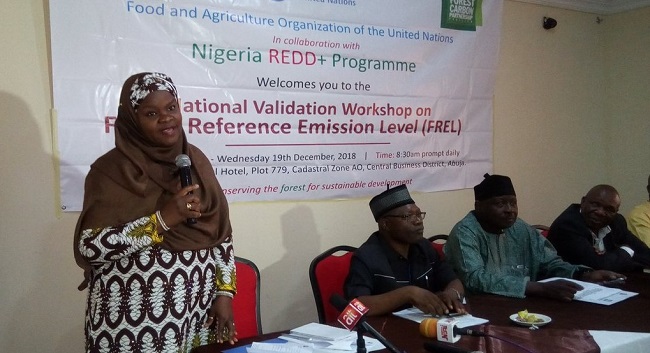
L-R: Halima Bawa Bwari of the Department of Climate Change, Federal Ministry of Environment; Dr John Fowenba, Consultant to the FAO; Sagir El Mohammed, a representative of the Permanent Secretary, Federal Ministry of Environment; and Dr Moses Ama, National Coordinator, Nigeria REDD+ Programme, during the National Validation Workshop on Forest Reference Emission Level (FREL) in Abuja

Mr Lawrence Alibo, the Permanent Secretary, Federal Ministry of Environment, gave the promise on Monday, December 12, 2018 in Abuja at the validation workshop on FREL.

Alibo said that this became imperative as FREL was a benchmark on which Reduction of Emissions from Deforestation and Forest Degradation in Developing Countries (REDD) was measured.

He said that government was working in line with the pledge made by President Mohammadu Buhari at the COP21 in Paris Convention to attain the 120 degree Nationally Determined Contributions (NDC) to reduce global emissions.

He quoted the president as saying that the reduction would meet 20 per cent conditional attainment and 45 per cent unconditional emission reduction.

Alibo said that the validation came at the right time to serve as an opportunity for the country to gauge its performance not only in implementing REDD+ but also in meeting its commitment to the NDC.

He said that the workshop symbolised an advancement of the earlier sub-national FREL development under the UNREDD+ programme and submitted to UNFCCC after a successful technical assessment.

The UN Programme on Reducing Emissions from Deforestation and Forest Degradation (UN-REDD) programme created in 2008 is a collaborative programme of the FAO, UNDP and the United Nations Environment Programme (UNEP), on Reducing Emissions from Deforestation and Forest Degradation in Developing Countries.

“The success story of the UNREDD has continued to serve as a pedestal for the country’s continuous progress toward its climate change mitigation targets, especially in the forestry sector.’’

He said that the steady progress being made had attributed to the additional funding from the World Bank.

According him, this has enabled the expansion of implementation in Ondo, Nasarawa and River states where pilot activities are undertaken.

Ajibo challenged participants to see the workshop as an opportunity to work out modalities on how best to reverse the negative effects of climate change in Nigeria.

“In addition to scaling up emission reduction activities in order to limit the increase in average global temperatures to well below 2 degrees centigrade between now and 2020.’’

Mr Suffyan Koroma, the FAO Country Representative in Nigeria, commended the participants for raising awareness on “National Forest Inventory under REDD programme’’.

Koroma, who was represented by Mr John Fonweban, FAO Forestry Officer REDD + Programme, said the objective of the workshop was to review and adopt the National FREL Report for Nigeria prior to its eventual submission to the UNFCCC for technical assessment.

He said that the step would also enable participants to estimate emission factor for accurate figure based on the destruction of the different types of forest in Nigeria.

Koroma said that FREL would serve as a standard on which future REDD+ activities would be measured during the implementation of the strategy in the country.

The FAO official said that the workshop had become imperative to verify all data collection because inadequate data had been a major factor militating against forestry development in Nigeria.

He said that the socio-economic aspect of the inventory was also very crucial as they provided a better understanding of forest resource use by the population.

Koroma said that the inventory would also help in the establishment of possible links between forest resources use, employment and livelihoods.

“It is an inventory that covers all the land use types in the sense that you have one hectare of forest destroyed and used for agric plantation, you will be able to see how much you are losing,’’ he said.

The FAO official said that the workshop would also serve as tools for advocacy and resource mobilisation for sustainable forest management at the country level.

He said that FAO had succeeded in building the capacity of the relevant stakeholders with the use of modern forestry equipment and techniques as well as in the use of Remote Sensing/GIS (SEPAL) tools for land use mapping.

“It also assisted in change detection and accuracy assessment for Activity Data (AD) estimation.’’

A Forest Reference Emission Level or Forest Reference Level (FREL and FRL) is one of the four elements a country is required to develop in order to participate in REDD+ under the UNFCCC.

The FREL and FRL are benchmarks to assess the country’s performance or judge its effectiveness in the implementation of REDD+ activities.

Participants at the three-day workshop were drawn from ministries of environment across the country and other relevant agencies.

The last forest inventory in Nigeria was conducted over 20 years ago.
Don tasks government on adverse climate change challenge

0

A don, Prof. Magnus Ojeifo, has urged the Federal Government to intensify efforts to reduce the impact of climate change in the country.

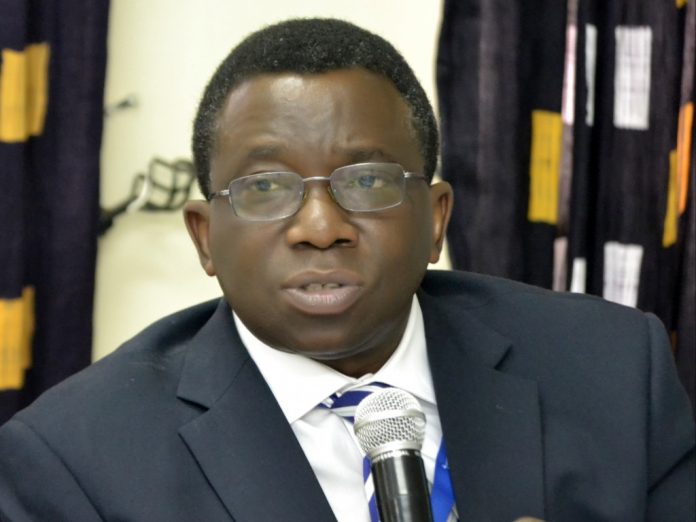
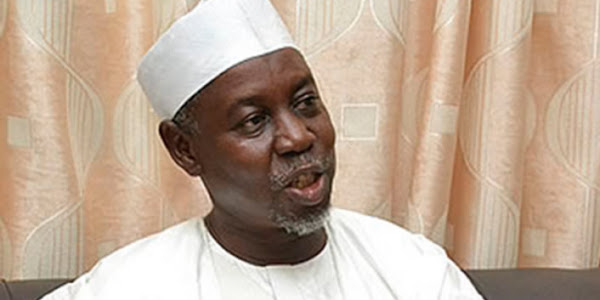
Alhaji Suleiman Hassan
Alhaji Suleiman Hassan, Minister of Environment

Ojeifo, a professor of Geography and Environmental Management at the Ambrose Alli University Ekpoma, Edo State, made the call at a workshop on “Climate Change Impact: Mitigation and Adaptation Measures”.

The programme was organised by Inter-Africa Committee in conjunction with the Global Environmental Facility (GEF).

“The effect of climate change has challenged governments and organisations to take certain actions with the view to curbing global warming and reducing its effects.

“Efforts must be made by government to stop or reduce gas flaring and oil spills in oil producing communities,” he said.

Ojeifo said that programmes at curbing gas emissions had not been properly initiated because of lack of technology, poverty, poor legislation and policies.

According to him, climate change is the rise in the earth’s surface temperatures globally due to anthropogenic or human activities.

“Climate change, also known as global warming, begins with the greenhouse effect caused by the interaction between the earth’s atmosphere and incoming radiation from the sun.

“Its effect is increased through anthropogenic activities.What this means is that the atmospheric gases are primarily responsible for the greenhouse effect known as greenhouse gases.

“When water vapour, Carbon Dioxide (CO2), Methane (CH4) and Nitrous Oxide (N2O) are released in large amounts into the atmosphere through human activities, it increases the natural greenhouse effect which results in rising temperatures globally,’’ he said.

The don described climate change as the most disturbing global environmental challenge, adding that the activities include burning of fossils, improper waste disposal, bush burning and deforestation.

He said that scientific evidence showed that climate change was likely to have negative impact on the global effort to achieve the United Nations’ SDGs.

“In particular, climate change will obstruct efforts to reduce the existing poverty being experienced by some of the world’s population.

“Climate change is also likely to lead to changes in the ecosystem, which will consequently contribute to degradation and reduce availability of water and food globally.

“It is therefore more likely to become the world’s major driver of increased human conflict,’’ he said.

Ojeifo also called on Federal Government and relevant stakeholders to tackle climate change challenges to improve and sustain the nation’s climate and environment.

He added that government should encourage initiative at developing modern technology that involved the manufacture of solar and programmes to support technological initiative for climate change.

In the same vein, the don said intensive agriculture, landuse planning, infrastructural provision, tree planting, and modern methods of farming as some of the adaptation necessary for sustainable growth and development.

Earlier, the Edo Project Coordinator, Inter-Africa Committee, Mr Felix Okoanegbete said that the organisation “is a grassroots one with actions that address global environmental problems ranging from deforestation to climate change.’’

“IAC is aimed at identifying community-based approaches that are relevant to the needs of the people.

“The organisation also supports projects that are relevant,effective and efficient in addressing grassroots issues of livelihood, poverty,gender equality and women empowerment in achieving global environmental benefits,” he said.

The IAC is an NGO operating in 28 states. 

By George Edomwonyi 

Government inaugurates four-year Action Plan for Health Security

0

The Minister of Health, Prof. Isaac Adewole, has inaugurated the National Action Plan for Health Security for the Year 2018 to 2022, to strengthen response in 19 public health threats and improve response to health emergencies.

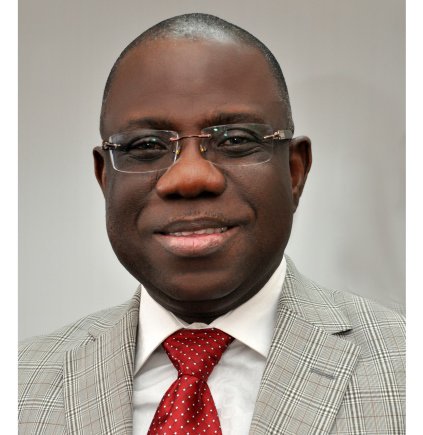
Isaac Adewole
Minister of Health, Isaac Adewole

Inaugurating the plan on Monday, December 17, 2018 in Abuja,the minister said the implementation would help to entrench and resolve to build a safer and prosperous Nigeria.

Adewole said that Nigeria had a Joint External Evaluations of the International Health Regulations in June 2017, which demonstrated many critical gaps that needs to be filled to protect the country from next major event.

“As I listened to the result of the evaluation we scored 40per cent, which is failure, in medical school you need to score 50 per cent in medical school to record a pass.

“We are deeply worried about the result, and then I did remark that we should be bothered about the base line and what happened thereafter.

“This result has helped to guide the NAPHS planning processes and to develop a roadmap for security strengthening in Nigeria,’’ the minister said.

Adewole noted that preparedness for health security is like an insurance policy for the national health prosperity.

“Although we hope that we never face a deadly epidemic like the West Africa Ebola epidemic of 2014-2016, we need to ensure that we are ready at all the time,’’ he said.

He added that Nigeria was making progress in the emergency response programmes and other several areas, stressing that ‘’Mr President receives weekly update on the state of national health emergency in Nigeria, tome that is unusual.’’

He noted that while Nigeria was making progress in national health emergency, the development of the National Action Plan for Health Security was what was required to achieve more success.

Earlier, Dr Chikwe Ihekweazu, the Director-General, Nigeria Centre for Disease Control (NCDC), said that the framing of the plan was to demonstrate that health doesn’t only have health benefit but also provide economic and security benefit.

He said there was need to come together and jointly own a response across the 19 areas, including surveillance, port health, immunisation and medical counter measures, among others, in order to achieve desired results.

He said the five-year plan include collaborative efforts from many stakeholders integrates preparedness and response. The director-general said the plan articulates all aspects of what to be done, it set out desirables, milestone to be achieve and provides platform for bringing everyone together.

He added that major initiatives that have been identified to come out of the plan includes digitalisation of disease surveillance across the country; building strong laboratory architecture, and building epidemiology workforce at every level.

Similarly, the Director-General, World Health Organisation (WHO), Dr Tedros Ghebreyesus, said keeping the world safe was one of the organisation’s top priorities, adding that global health security is a shared responsibility.

Represented by the Officer in Charge WHO Nigeria, Dr Clement Lasuba, the director-general said scaling up and financing the implementation of the International Health Regulations was vital for building sustainable capacities to detect and respond to emergencies.

He added that the best defence against outbreaks and other crises was strong, resilient health system based on people-centred primary care. 

Five bodies with signs of carbon monoxide poisoning found in Russia

0

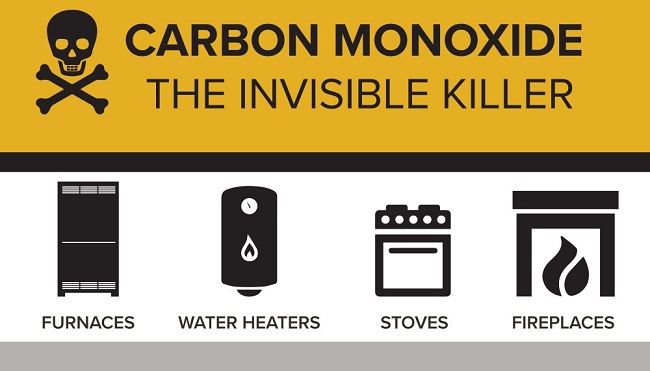
Five bodies with signs of carbon monoxide poisoning were discovered in a boiler room of a non-residential building in the town of Domodedovo South of Moscow, the Russian Investigative Committee said on Monday, December 17, 2018.

Carbon monoxide
Carbon monoxide is widely regarded as a silent killer

It said in a statement that the deceased were citizens of countries neighbouring Russia aged from 28 to 59.

During the inspection of the scene, a gas cylinder, a gas stove and bottles with alcohol-containing products were found, the statement said.

The Investigative Committee has opened a criminal case to determine if there was a violation of safety rules.

An investigation, including forensic medical examinations of the bodies, is underway to establish the circumstances of the incident.

Winter freeze claims first victims in Serbia

0

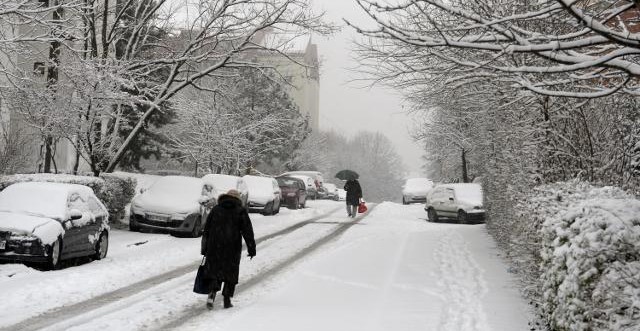
Two people froze to death in Serbia on Monday as cold spell descended on the region, State Broadcaster — RTS — reported, citing Police.

Serbia winter
The winter freeze in Serbia has claimed its first victims

The two men, aged 48 and 61, apparently froze after falling asleep under the influence of alcohol.

The temperature in the central Balkans plummeted on Dec. 10, with three days of heavy snowfall, marking the end of an unusually mild autumn.

The freezing weather is expected to linger until December 22, 2018. 

Shell’s Bonga hits 800m barrels mark

0

In 13 years of deep-water exploration, the Bonga vessel of the Shell Nigeria Exploration and Production Company (SNEPCo) has produced over800 million barrels of crude oil, confirming the company as a pacesetter in offshore oil and gas production in the Gulf of Guinea.

Bayo Ojulari
SNEPCo Managing Director, Bayo Ojulari

In its review of the performance of the Bonga Floating Production, Storage, and Offloading (FPSO) vessel for 2018, SNEPCo’s Managing Director, Bayo Ojulari, expressed satisfaction with the consistent availability and optimal performance of the vessel which began operation at the Bonga field in OML 118 in 2005 under a production sharing contract with the Nigeria National Petroleum Corporation (NNPC).

“We are relentless in our pursuit of excellence on all fronts, and this we have consistently demonstrated with the management of Bonga to the satisfaction of our government and co-venture partners,” Ojulari said in Lagos on Monday, December 17, 2018.

“We leverage the Shell group’s global expertise in technology and new advancements in the industry to continue to unlock Bonga’s huge potential, one such example was the completion and inauguration of the Bonga North West Cross Over module in 2014, a first in the history of Shell which launched the beginning of a new phase delivering the reservoirs proven volumes and maintaining production of the FPSO at full capacity,” the SNEPCo MD added.

According to Ojulari, SNEPCo, with the support of NNPC and the co-venture partners – Total E & P, Nigerian Agip Oil Company, and ExxonMobil – has also done so much for Nigeria and Nigerians in its years of operations in revenue and taxes accruable to the government, and social investments in education, sports and health across the country.

In the last three years, SNEPCo has spent over $3millionyearly in scholarships and other intervention in schools across Nigeria including the popular NNPC/SNEPCo Cradle-to-Career scholarships for the six years of secondary school for children from rural areas. The scholarships with over 375 beneficiaries since its commencement in 2014, cover tuition, boarding and maintenance allowances in leading schools in select Nigerian cities.

Ojulari said, “Our health and education programmes are aimed at improving healthcare; bridging the educational opportunity gap between urban and rural school populations; providing educational grants; improving ICT education; and supporting displaced persons.”

The Bonga Asset Operations Manager, Elohor Aiboni, described the FPSO as a jewel noting however that SNEPCo’s achievements did not come without their challenges. “We overcome our challenges with the ingenuity and integrated delivery approach of our staff who work together every day to deliver one of the best assets in the world. “I’m proud to say that over 95percent of SNEPCo’s staff are Nigerians and they have distinguished themselves as some of the best in the industry within and outside Nigeria.”

SNEPCo’s resounding performance, Aiboni said, had been delivered with zero fatality since first oil. “In 2016 the team also won the Shell CEO HSE Award for disciplined and focused safety culture.”

In recognition of its pioneering initiatives in Nigeria,SNEPCo was in early 2018 honoured as the best Nigerian oil and gas company in technology and innovation at the maiden edition of the  Nigerian International Petroleum Summit (NIPS) held in Abuja for pioneering in-country Subsea Tree Refurbishment, a remarkable feat in local capacity potential which resulted in significant savings. This was the first time in the Nigerian oil and gas industry that a Subsea Tree was fully stripped down and refurbished locally with all its original functionality restored.

The Bonga field increased Nigeria’s oil production by 10%when output began in 2005 and has since stimulated the growth of support industries in addition to helping to create the first generation of Nigerian oil and gas engineers with deep-water experience. The FPSO has potential to produce 225,000 barrels of crude oil and 210 million standard cubic feet of gasper day.

The FPSO vessel’s capacity was upgraded in recent years,allowing SNEPCo to expand the field with further drilling of wells in Bonga Phases 2 and 3 and through a subsea tie-back that unlocked the nearby Bonga North West field in August 2014.

Bonga North West can produce approximately 65,000 barrels of oil equivalent a day and was named Engineering Project of the Year 2015 at the prestigious Platts Global Energy Awards in New York.

1.5m Rwandese to get AfDB’s €115m water lifeline

0

The Board of the African Development Bank (AfDB) has approved additional funding support of €115 million to Rwanda’s Sustainable Water Supply and Sanitation Programme, enabling 1.5 million people to access improved, reliable and sustainable water supply services.

Wambui Gichuri
Wambui Gichuri, the AfDB’s Director for Water Development and Sanitation

The funding will cover strategic cities and address water and sanitation challenges in areas with a low access rate of 45% − a figure that is way below the national average of 85%.

The new financing is to scale up the country’s largest water and sanitation sector investment programme, which is co-financed by the European Investment Bank and the OPEC Fund for International Development.

In November 2017, the bank approved an initial $121 million loan and $50 million Africa Growing Together Fund (AGTF) loan to Rwanda under its Sustainable Water Supply and Sanitation Programme.

“The bank’s support to this programme further goes to deepen and consolidate the impact of its investments in enhancing resilience to climate change and inclusive growth,” said Wambui Gichuri, the AfDB’s Director for Water Development and Sanitation.

The Government of Rwanda is said to have shown consistent commitment to sector reforms and economic transformation in furtherance of its recently-approved National Strategy for Transformation − designed to propel Rwanda into an upper middle-income country by 2035. The programme is bolstered by the country’s new Vision 2050, which aims to ensure a high standard of living for all Rwandans.

Of the 1.5 million people to be provided water access under the additional funding, 700,000 live in peri-urban/rural areas.The AfDB is the main development partner in Rwanda’s water and sanitation sector which is reported to have seen a positive record of accomplishments. The additional financing will enable the government to undertake the programme. 

Buses in Cote d’Ivoire to be fueled with compressed natural gas

0

The Ivorian Minister of Transport, Mr Amadou Koné, and several government ministers have launched what has been described as a ground-breaking initiative that is in line with the country’s commitment to the Paris Climate Change Agreement.

Compressed natural gas fuel station

The Minister unveiled a fleet of buses commissioned by the Société des Transports Abidjanais (SOTRA), supplied by IVECO and fuelled by compressed natural gas. ENGIE and Tractebel collaborated to engineer, supply and install the first ever compressed natural gas (CNG) fuelling station in Abidjan.

The CNG fuelling station is located on SOTRA’s premises in Yopougon, Abidjan, and will facilitate the operation of the new range of compressed natural gas buses. When fully commissioned, the gas fuelling station will have a compression capacity of 1360 m³/h, and will be split into two units, each equipped with two hoses, enabling four buses to charge at any one time.

The Abidjan station is said to be the first stage in the Ivorian government and public transportation companies plan to increase the number of CNG buses and ensure that the region is working towards fulfilling its commitment to the COP 21 agreement. More importantly, it will lead the way for other African countries that are keen to further embrace clean technologies. Countries including Ghana, Togo, Benin and Cameroon are reportedly monitoring the success of the initiative with the intention of replicating the project.

As part of the deal between IVECO and the Société des Transports Abidjanais (SOTRA), 50 Crealis buses will run on compressed natural gas in Abidjan. The particle emission levels will be nearly zero, and their Nitrogen Oxide emissions will be reduced by 60 per cent. The buses will serve within Abidjan’s wider urban area, it was gathered.

Officials revealed that ENGIE and Tractebel have a unique level of expertise and a local presence that was vital to the success of the venture. They are regarded as specialists in delivering infrastructures which provide alternative fuels for green mobility solutions.

Praises, knocks greet COP24, outcome

0

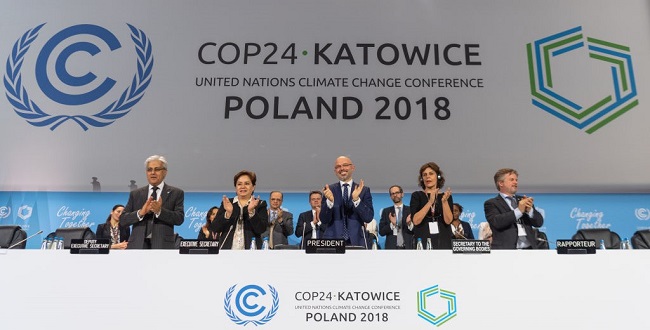
After two weeks of deliberations and negotiations, the 24th Session of the Conference of the Parties (COP24) to the United Nations Framework Convention on Climate Change (UNFCCC) ended on Saturday, December 15,2018 upon the approval of the Paris Agreement Work Programme, otherwise known as the “Katowice Climate Package”.

COP24 Conclusion
Michal Kurtyka (M), President of the UN Climate Change Conference COP24, and other participants of the climate summit are pleased and applaud the decision of the compromise at the world climate summit. The aim of the agreement is to limit global warming to well below two degrees. Photo credit: Monika Skolimowska /dpa-Zentralbild / Getty Images

The conclusion has however attracted a barrage of comments from stakeholders who have on one hand hailed it as a welcome development and,on the other hand, condemned it for being weak and lacking direction.

United Nations Secretary-General, António Guterres, was however full of praises for COP24, which he said has displayed the resilience of the Paris Agreement.

He said: “The approval of the Paris Agreement Work Programme is the basis for a transformative process which will require strengthened ambition from the international community. Science has clearly shown that we need enhanced ambition to defeat climate change.

“From now on, my five priorities will be: ambition, ambition, ambition, ambition and ambition.

“Ambition in mitigation. Ambition in adaptation. Ambition in finance. Ambition in technical cooperation and capacity building. Ambition in technological innovation.

“Ambition will be at the centre of the Climate Summit that I will convene in September 2019.

“And ambition must guide all Member States as they prepare their Nationally Determined Contributions (NDCs) for 2020 to reverse the present trend in which climate change is still running faster than us.

“It is our duty to reach for more and I count on all of you to raise ambitions so that we can beat back climate change.”

Johan Rockström, resilience scientist who as Director Designate is leading the Potsdam Institute for Climate Impact Research, spoke in a similar vein, describing the Katowice agreement as “a relief”.

His words: “Countries recognise the need for global collaboration to deal with the global climate crisis. The Paris Agreement is alive and kicking, despite a rise in populism and nationalism. With the rulebook now finally adopted, the Paris agreement can be implemented. Overall, the Katowice decisions provide enough momentum to move forward.”

But he frowned at the fact that the UN Summit failed to align ambitions with science, “in particular missing the necessity of making clear that global emissions from fossil fuels must be cut by half by 2030 to stay inline with the IPCC 1.5 C report.”

He said: “This is a real concern. We continue to follow a path that will take us to a very dangerous 3-4 degrees warmer world within this century. Extreme weather events hit people all across the planet already now,at only one-degree global warming. Especially the US is a hard-hit victim, a nation that played an unfortunate role at the climate summit, which already suffers and will suffer even more in the future from an increase of regional droughts and hurricanes.

“However, Katowice is only one step on the long and winding road to achieving sustainable prosperity within a fossil-fuel free future. All of us need to stop tip-toeing and speed up our steps. And Europe can and must be a forerunner.”

Ottmar Edenhofer, climate economist and acting Director at the Potsdam Institute for Climate Impact Research, also expressed cautious optimism on the issue, saying: “Once again, governments across the world have proven that they’re capable and willing to cooperate in order to protect their citizens from climate risks. Despite a growing number of populist governments, multilateralism succeeded.

“However, the world needs more than climate policy targets and processes – it needs concrete measures, and they must be taken now.  In this respect, climate change can no longer be simply regarded as the biggest market failure of all time – with the continued rise of global greenhouse gas emissions after years of negotiation, it has also become an unprecedented government failure.

“Through appropriate policy measures – like effective CO2pricing – governments have to build a new trust-relationship to citizens.Carbon pricing cannot solve everything, yet without it nothing can be solved.And governments can actually use carbon pricing to enhance social justice,because the generated income can and must be given back to the people, be it through electricity tax cuts, infrastructure investments, or Christmas cheques.”

Joseph Onoja, Director of Technical Programmes at the Nigerian Conservation Foundation (NCF), gave the summit a thumbs-up for eventually arriving at a decision, but likewise offered a word of caution and advice.

He said: “Suffice to say that it was a tensed gathering because a decision was not reached until the very closing minutes of the summit,the good thing is that the decision was made at the end. It is indeed a right step towards the right direction. However, it is time for action.

“Climate change is not waiting for humanity to act. We have negotiated for long. Now is the time to act. As for the content, it will not be completely water tight, but we have a good enough document to work with, which will be impactful if implemented.

“In terms of the commitments, countries were committed to their interests but, at the end, the global interest won and that is the beauty of negotiation. Now is the time to act.”

Environmentalist and renewable energy expert, Huzi Mshelia, opined that, going by the COP’s outcome, countries have shown commitment to the process to the extent that they acknowledged the climate change threat and are engaging.

“The adoption of the guidelines, even without conclusion on markets, is a good step in the right direction because it could have been tragic to come out of Katowice without anything,” he stated.

He went further: “For a start, the guidelines would prompt further action albeit not as urgently as the situation deserves. The development in Katowice has reinforced my earlier belief that we need to do more domestically, particularly the mobilisation of local financial resources to address our vulnerabilities. While the international climate regime isencouraged, domestic actions are, in my opinion, even more critical and urgent.

“For Nigeria, the economy is directly at risks of climate change and our response is to immediately build appropriate safeguards to climate-proof the economy; any other approach will show lack of understanding of the dynamics of this phenomenon.”

But environmental activists and Director, Health of Mother Earth Foundation (HOMEF), Nnimmo Bassey, faulted the basis of the summit as well as its outcome.

His words: “The Paris Agreement was not the best agreement that the world needed to tackle global warming. A Rulebook to implement a set of voluntary nationally determined commitments does not add up to change the climate trajectory, sadly. The Paris Rule Book does not address the key cause of global warming: continual extraction and burning of fossil fuels.

“The outcome of Katowice is essentially business as usual, a postponement of many issues yet to be decided and a broad weakening of the justice basis of the Climate Convention. It will essentially give a tiny nudge to act and that action will mostly be in the frame of false solutions based on market mechanisms and other carbon offset routes. COP24 was an arena for power play and left vulnerable nations, that were never part of creating the problem,with the burning end of the climate stick, unfortunately.“The world can and must do better. Polluters must be kept away from future climate conferences. Nations must agree to keep fossil fuels in the ground as required by science. Time to ensure that all concerns are based on the best interest of the people and the planet.”

Tons of antibiotics harmful to human health found in pork

0

More than 12,000 tons of antibiotics that are harmful to human health has been found in pork in Kenya, an official with the World Animal Protection said.

Victor Yamo
Victor Yamo

Victor Yamo said that symptoms of the overuse of antibiotics in pig farming are now contributing to the superbug crisis.

“Traces of antibiotics have been traced in supermarkets where pork is sold to consumers,” Yamo told journalists during a media briefing in Nairobi, Kenya.

Yamo said that farmers and factories have been applying antibiotics in treating animals from being sick but do not know that they are contributing to the superbug crisis in animals.

He said that farms are becoming more industrialised to meet the global demand of animal protein but in the process, they end up using dangerous methods to meet the demand of consumers.

Yamo told consumers to buy safe and quality pork from established companies with labeled products adding that the increase of small-scale producers is likely to play a role in the current problem.

“There is need to clearly label pork products to avoid causing harm to unsuspecting consumers,” Yamo added.

He said that failure to take precaution could lead to superbugs to cause food poisoning, blood poisoning, urinary tract infections and even death.

The official urged supermarkets to improve the lives of pigs by only sourcing pork from high-welfare farms.

“Factory farm conditions for pigs cause them immense pain and stress, which involves a steady overuse of antibiotics,”he added.

He called on supermarkets to demand that their suppliers improve the welfare of pigs by keeping them in cleaner places.

Yamo said that the Kenya national action plan and national policy are set to address the problems once they become effective.

“We are working in collaboration with farmers to ensure that the pork produced are of good quality for human consumption,” he said.

The world animal protection did a global study that has exposed the use of antibiotics in pig farming.

The organisation said that with the current food insecurity particularly in Africa, there is need to ensure that the existing food chains are kept clean according to the regulations developed by the country’s policies.

By Duncan Mboyah