A senior U.S. government official has called for joint efforts in the management of drugs abuse.
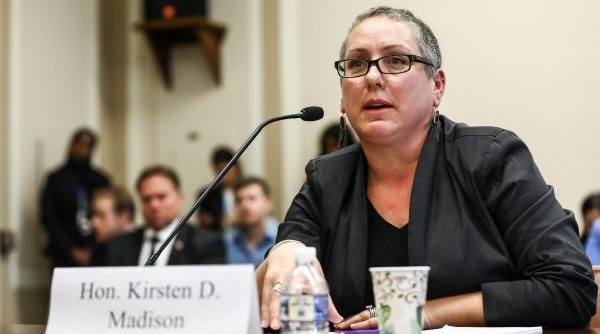
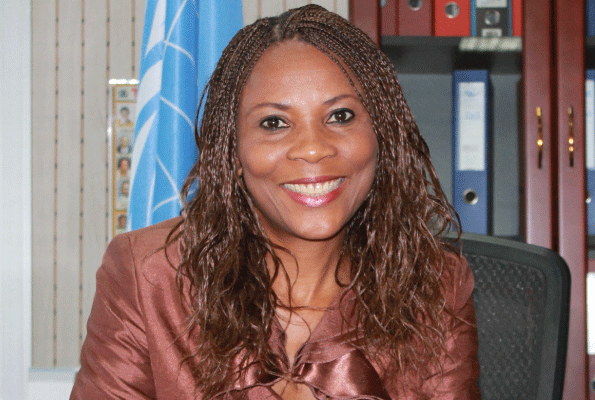
Kirsten Madison
Kirsten Madison, U.S. Department of State’s Assistant Secretary of the Bureau of International Narcotics and Law Enforcement Affairs (INL), said that, with the increasing cases of alcohol and drug abuse, there is need to combine skills, experience and knowledge to help tackle the problem.
“We need exchange expertise, conduct and engage in training and network with peers who grapple with and solve similar problems globally,” Madison told delegates attending a five-day international conference on drugs and demand reduction in Nairobi, Kenya.
Madison said that reducing demand for drugs is an essential component of a comprehensive approach to combating the crisis.
She said that the U.S. government is ready to provide specialised, universally applicable evidence-based training programmes for preventing and treating people with substance use disorders.
“We follow a framework to advance a sustainable evidence based public health approach to drug use which aims to generate systematic and generational change,” she said.
The official said that drug abuse isimportant for the U.S. government more so after more than 70,000 died from drug overdose last year.
The official said that drug use produces serious implications for public health security, economic productivity, families and communities.
“We need to partner with the academia andthe UN to translate science into practice by unlocking it into step-by-step through training modules in finding a lasting solution to the problem,” she said.
She called on those involved directly with the management of alcohol and drugs abuse programmes to ensure that treatment they provide is in line with the international treatment standards.
Madison revealed that, through a partnership with the United Nations Office for Drug and Crime (UNODC), the U.S.government is supporting a quality assurance system to enable national governments evaluate and rate treatments centers.
“Across all aspects of our work,interventions must be tailored for populations with specific clinical needs such as children, people in rural areas and individuals undergoing recovery,”she told delegates.
The five-day international conference on drugs and demand reduction that was attended by over than 1,000 delegates started in Nairobi on Monday, December 10, 2018.
It was graced by government officials, anti-narcotic
drug agencies, representatives from the academia and non-governmental organisations.
Late in the evening of Saturday, December 15, 2018 in Katowice, Poland, the UN climate negotiations (COP24) ended, with Parties adopting a set of guidelines for the implementation of the Paris Agreement.
UN’s Climate Chief, Ms. Patricia Espinosa, has described the outcome of the conference as “an excellent achievement”
The implementation of the agreement, according to the United Nations Framework Convetion on Climate Change (UNFCCC), will benefit people from all walks of life, especially the most vulnerable.
The agreed “Katowice Climate Package” is designed to operationalise the climate change regime contained in the Paris Agreement. Under the auspices of the United Nations Climate Change Secretariat, it will promote international cooperation and encourage greater ambition.
The guidelines will promote trust among nations that all countries are playing their part in addressing the challenge of climate change.
President of COP24, Mr. Michal Kurtyka of Poland, said: “All nations have worked tirelessly. All nations showed their commitment. All nations can leave Katowice with a sense of pride, knowing that their efforts have paid off. The guidelines contained in the Katowice Climate Package provide the basis for implementing the agreement as of 2020.”
The Katowice package includes guidelines that will operationalise the transparency framework.
It sets out how countries will provide information about their Nationally Determined Contributions (NDCs) that describe their domestic climate actions. This information includes mitigation and adaptation measures as well as details of financial support for climate action in developing countries.
The package also includes guidelines that relate to:
The process for establishing new targets on finance from 2025 onwards to follow-on from the current target of mobilising $100 billion per year from 2020 to support developing countries
How to conduct the Global Stocktake of the effectiveness of climate action in 2023
How to assess progress on the development and transfer of technology
The UN’s Climate Chief, Ms. Patricia Espinosa, said: “This is an excellent achievement! The multilateral system has delivered a solid result. This is a roadmap for the international community to decisively address climate change.
“The guidelines that delegations have been working on day and night are balanced and clearly reflect how responsibilities are distributed amongst the world’s nations.
“They incorporate the fact that countries have different capabilities and economic and social realities at home, while providing the foundation for ever increasing ambition.”
The agreed guidelines mean that countries can now establish the national systems that are needed for implementing the Paris Agreement as of 2020. The same will be done at the international level.
Functioning together, these systems will ensure that nations can act in an atmosphere of trust and assess progress of their climate actions.
“While some details will need to be finalised and improved over time, the system is to the largest part place,” Ms. Espinosa added.
The main issues still to be resolved concern the use of cooperative approaches, as well as the sustainable development mechanism, as contained in the Paris Agreement’s article 6. These would allow countries to meet a part of their domestic mitigation goals using so-called “market mechanisms”.
Market mechanisms provide flexible instruments for reducing the costs of cutting emissions, such as carbon markets.
Here, the Paris Agreement recognises the need for global rules to safeguard the integrity of all countries’ efforts.
These global rules are important to ensure that each tonne of emissions released into the atmosphere is accounted for.
In this way, progress towards the emission limitation goals of the Paris Agreement can be accurately measured.
“From the beginning of the COP, it very quickly became clear that this was one area that still required much work and that the details to operationalize this part of the Paris Agreement had not yet been sufficiently explored,” explained Ms. Espinosa.
“After many rich exchanges and constructive discussions, the greatest majority of countries were willing to agree and include the guidelines to operationalize the market mechanisms in the overall package,” she said.
“Unfortunately, in the end, the differences could not be overcome”.
Because of this, countries have agreed to finalise the details for market mechanisms in the coming year in view of adopting them at the next UN Climate Change Conference (COP25).
Talanoa Dialogue and Action Before 2020
The Fiji-led Talanoa Dialogue, a year-long inclusive dialogue around ambition as it relates to the Paris Agreement, concluded at COP24, with the Global Warming of 1.5C Report by the Intergovernmental Panel on Climate Change (IPCC) as a major input.
“As the decision adopted indicates, there is a clear recognition of the IPCC’s role in providing scientific input to inform countries in strengthening their response to the threat of climate change,” Ms. Espinosa underlined.
“I thank all experts for their hard work and important contribution to the IPCC’s work,” she added.
The final High-Level session in Katowice resulted in the Talanoa Call for Action, which calls upon all countries and stakeholders to act with urgency.
Countries are encouraged to factor the outcome of the dialogue into efforts to increase their ambition and to update their nationally determined contributions, which detail nations’ climate actions, in 2020.
A High-Level stock-taking of actions taken before 2020 gave countries the opportunity to assess their current level of ambition. Another stock-taking is planned for 2019.
“While there are clearly gaps that remain, the stock-take of actions taken before 2020 and the Talanoa Dialogue have clearly shown that the world has built a strong foundation for climate action under the Paris Agreement,” said Ms. Espinosa.
Major Announcements
Many developed countries pledged financial support to enable developing countries to act. This is especially important for the replenishment of the Green Climate Fund.
Countries have sent significant positive signals towards GCF’s first formal replenishment, with Germany and Norway announcing that they would double their contributions.
The Adaptation Fund received a total of $129 million.
The engagement of multilateral development banks (MDBs), international organisations, businesses, investors and civil society at COP24 helped to build the political will towards the outcome in Katowice.
Many made key announcements, that were critical to build momentum. These include:
The World Bank’s pledge of $200 billion in climate action funding for the period 2021-2025;
The MDBs announcement to align their activities with the goals of the Paris Agreement;
The commitment by 15 international organisations to make their operations climate neutral;
The announcement by the C40 Cities coalition, which includes cities across the globe, to work with the IPCC to identify how the Global Warming of 1.5C report can apply to cities’ climate actions.
Many more announcements were made, and inspiring examples of climate action showcased at the Global Climate Action High-level events.
The next United Nations Climate Change Conference will take place in Chile and consultations will provide clarity on the city and exact date of the conference in due course.
As critical negotiations on how to enact the Paris Agreement on climate change ended on Saturday, December 15, 2018 in Katowice, Poland, legal and policy experts joined grassroots campaigners in sharing their views at the direction of the talks.
Greta Thunberg
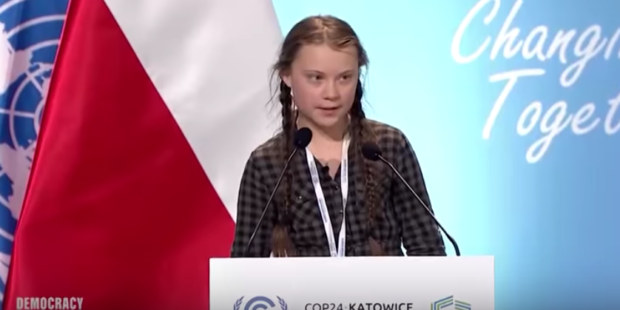
Fifteen-year-old Swedish schoolgirl and climate activist, Greta Thunberg, told delegates in a viral speech on Thursday that “the sufferings of the many pay for the luxuries of the few,” and the Global Campaign to Demand Climate Justice led hundreds of activists in a sit-in occupation of the main area of the COP venue on Friday afternoon.
Negotiators then faced a gruelling late night as they attempted to find possible agreements, not reaching conclusions until Saturday evening.
Civil society representatives have been commenting on the final outcomes of the two weeks of talks.
Antonio Zambrano Allende, Clean Energy Coordinator of the Citizen Movement Against Climate Change (MOCICC), said: “The IPCC is crystal clear: to stay below 1.5 C warming we must act immediately to transform our economies. The cost of such action and the cost of adapting to and coping with even 1.5 C would undoubtedly be high, but the IPCC is also clear that the human and economic cost of any further warming would be enormous.
“In Katowice, the interests of rich people in rich countries dictated that, whatever the cost, it will be borne by the world’s poor, rather than those responsible – the world’s rich and rich countries – who have abandoned their moral and legal obligations yet again.”
Lidy Nacpil, Coordinator of the Asian People’s Movement on Debt and Development: “Developed countries have kicked out anything meaningful about finance from the decision. They have refused to immediately begin work to set a new long-term finance goal and have failed to restock the Green Climate Fund.
“Money makes the world go round – it also makes the difference in terms of whether or not we can meet the Paris Agreement goal of limiting warming to 1.5 C.
“Without a clear sense of what new grant finance is on the table, our governments are in an impossible position where they are forced to choose between the urgent needs of our people and picking up the slack for rich country laziness.
“Worse still, rich countries are even trying to turn developing countries into donors, completely shifting the responsibility to those who have contributed the least to the climate crisis. It’s as if they came into my home, burnt it down, and are now asking me to pay.”
Aaron Pedrosa, Executive Director of Bulig Pilipinas: “Climate change shocks are already hitting us in the South. As the storms, droughts, and floods increase so do the human and economic costs of the resulting loss and damage. We needed the Katowice COP to come up with a strong decision on ‘loss and damage’ to protect our communities at the frontlines.
“Instead, developed countries have spent two weeks blocking any link between loss and damage and finance right across the guidelines, to the extent of even relegating loss and damage to a mere footnote in the global stocktake text at one point.
“This outcome keeps the issue on the table but the fight we had to have to get it, and what was sacrificed in other areas, shows how determined developed countries are to shirk their responsibility. How many lives have to be lost in the South before they act?”
Meena Raman, legal expert at Third World Network: “One country in particular drew heat from media, activists, and even other Parties. Although Saudi Arabia, Kuwait, and Russia also objected to the COP ‘welcoming’ the IPCC Special Report, it was the United States that stood alone in openly rejecting the actual findings of the report. Its influence was not limited to this, however, as observers noted.
“The United States’ fingerprints are all over this outcome. Even though they are withdrawing from the Paris Agreement and will not be bound by these rules, still they want to ensure developing countries have onerous reporting obligations without support.
“So, what we have is the biggest polluter in history and the world’s current largest oil producer telling developing countries ‘you have the same responsibilities as we do’ while at the same time blocking progress on the necessary technology transfer and finance support.
“They have always said their way of life is not up for negotiation. They would rather trade away the right of the rest of the world to live.”
Asad Rehman, Director of War on Want: “The United States may be the official voice of Big Polluters at the climate talks but junior partners like Australia, Japan, and the EU have all been working hard to write a set of rules that do nothing to narrow their profit margins and everything to shift the burden to poor and vulnerable communities everywhere. The result is millions will he condemned to losing their homes, livelihoods, and even their lives. This is not only moral and political cowardice but a crime against people.
“The rulebook is the tail and the Paris Agreement is the dog. One should control the other. But in Katowice we have seen a cynical and coordinated attempt by developed countries, led by the United States, to have the tail wag the dog by using the rulebook to do what they couldn’t do in Paris – completely remove any recognition of their greater responsibilities.”
Sara Shaw, Co-Coordinator of Friends of the Earth International: “We always knew this was going to be a tough conference, taking place deep in the heartlands of the Polish coal industry, with companies like Shell, Exxon and BP inside the negotiations promoting the myth that we can stop climate change without dismantling the fossil fuel industry.
“We stand on the brink of catastrophe because corporate interests and fossil fuel money have infiltrated the climate talks to perpetuate the dirty energy system regardless of the cost for people and planet. The fact that Shell boasted this week of how it helped to write the Paris Agreement is only more evidence of this reality.
“We urgently need to fund real solutions, not waste time with dangerous distractions. But here we saw Brazil hold up the talks to allow speculators to profit off its forests through carbon credits. Carbon trading is a failed policy and that Brazil is trying to manipulate it here is just another example of why. That Brazil is prepared to copy the Trump playbook and push ideas that are obviously contrary to real climate action at these talks bodes badly for future progress.”
Sriram Madhusoodanan, Deputy Campaigns Director of Corporate Accountability: “Although civil society welcomed the call by some developing countries for countries to come to the 2019 Climate Summit in New York with improved pledges of both mitigation and, for developed countries, scaled-up finance, they expressed faith not in the process to deliver transformative change, but in people in the real world.
“While outside of the negotiations, the world is waking up to the stark reality of climate change and the short window we have for action, inside COP Global North government have used COP24 to bury their heads further in the sand and force corporate false solutions like carbon markets to the center of the global response.
“But, despite Global North obstruction, we’ve never seen a more united, organised and energised movement to demand climate justice. Governments are demanding it. People are demanding it. And we will get it.”
Mohamed Adow, International Climate Lead, Christian Aid: “To be honest, the most hopeful stories about climate change over the past two weeks have been from outside the walls of the summit. School children striking for their future, grass roots movements mobilising and even the world’s biggest shipping firm, Maersk, announcing it will go net zero emissions by 2050. The global transition is under way and cannot be stopped. The question is will governments help it go fast enough to help the world’s poorest on the front lines of climate change.”
World leaders arrived at the UN climate talks in Katowice with a mandate to uphold the Paris Agreement and respond to the emergency of the climate crisis. The IPCC 1.5C Report makes it clear that every tenth of a degree of warming matters and we need to act now to cut emissions in half within the next 12 years.
Observers insist that governments at COP24 did not respond with the political will to tackle the urgency of the climate crisis
But these past two weeks, say observers, governments did not respond with the political will to tackle the urgency of the climate crisis informed by the latest science.
The United States and a handful of nations like Saudi Arabia allegedly sought to routinely disrupt the process but far too many countries came unprepared to strengthen the international climate regime and chose to stay on the sidelines.
Countries, they noted, must bear the weight of their decisions and acknowledge their lack of leadership to support the most vulnerable countries, who have committed to stronger climate targets by 2020.
The overbearing presence of the fossil fuel industry combined with a weak Polish Presidency cast a shadow over the talks, they emphasised.
In Katowice, governments were expected to craft robust rules for the Paris Agreement that will drive climate action, adopt a COP decision to enhance climate targets by 2020 and deliver adequate and predictable finance and support to fully implement nationally determined contributions (NDCs).
Countries nevertheless agreed to a comprehensive set of rules that will help operationalise the Paris Agreement, despite failing to establish any rules for carbon markets post-2020. On transparency, guidance for NDCs and accounting, a strong basis has been created that ensures parties will be accountable for their commitments. A robust framework has been created for the Global Stocktake, taking into account equity and best available science.
The framework for carbon markets proved to be too contentious to land an agreement. Even the most basic and essential accounting requirements could not be agreed upon, such as avoiding double counting of emission reductions, or the transition of flawed pre-2020 markets, could not be resolved and led to postponing the entire set of rules related to article 6 to COP25. Developed countries are still largely free to account as they see fit for the finance they provide and mobilise to meet the $100 billion goal by 2020.
While the talks saw much-needed financial pledges to the Green Climate Fund (GCF), to the Least Developed Countries Fund – and for the first time Adaptation Fund pledges crossed the $100 million threshold, wealthy nations must offer larger and more predictable channels of funding that will instill confidence in developing countries to implement national climate plans. The dearth of adequate finance of most countries continues to undermine trust. The replenishment process to the GCF in 2019 must be a race to the top with countries following the example of Germany to at least doubling on their current commitments. Developed countries must also honour the $100 billion in the next two years.
Outside the isolation tank of the COP is the real world where thousands of children are boycotting school to demand action, people are taking on fossil fuel lobbies, risking arrest and bringing cities to a halt and farmers are marching against escalating impacts.
“Our current collective climate targets set us on a 3C warming pathway, but people are refusing to accept a status quo that consigns our future and that of other species to a smouldering pile of ash,” they stressed, adding that COP24 was a test on climate multilateralism – one that countries have barely passed.
“Countries reaffirmed their decision in Paris to submit national climate commitment by 2020. Now delegates must return to their capitals and begin domestic processes to enhance ambition by 2020. Nothing short of this will do. They must bring these commitments to the UN Secretary General’s Summit in 2019 and set a clear direction of travel for 2020 that will spur businesses and cities to accelerate their own actions and infuse momentum into the real economy.
“The arrest, detention and deportation of participants entering COP24 by Polish authorities shows how civil society voices are actively stifled and people are prevented from doing their work on climate change. It is the responsibility of the UN to ensure this can never happen again and guidelines are in place in host countries for international conferences.
“Chile, as the next COP Presidency, needs to show real commitment and immediately ratify and sign the Regional Agreement on Access to Information, Public Participation and Justice in Environmental Matters, known as the Escazú Agreement.”
Late on Saturday (December 15, 2018) evening, the UN climate negotiations drew to a close, with Parties adopting a set of guidelines for the implementation of the Paris Agreement.
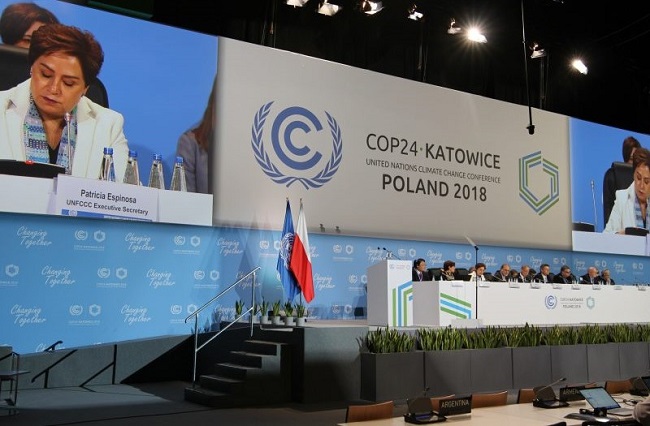
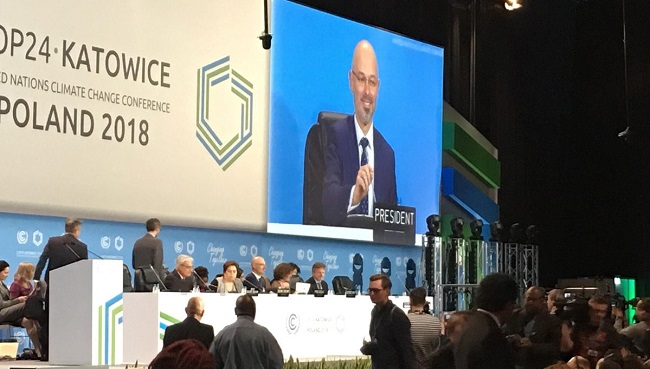
The COP24 opening plenary meeting
Commenting on the decision, Chair of the Least Developed Countries Group, Gebru Jember Endalew, said: “While there are parts of the package that could and should have been stronger, the implementation guidelines adopted today provide a strong basis to start implementing the Agreement. The next step, of course, is for countries to take urgent, ambitious action to fulfil their Paris Agreement commitments.
“This year, it has been made very clear that no country is immune to the impacts of climate change, but it is the nearly 1 billion people living in the 47 least developed countries that are often hit the hardest, suffer the most, and have the least capacity to cope.
“Parties need to revise and enhance their Nationally Determined Contributions before 2020 in line with their fair share. It is well known that current pledges will not be nearly enough to limit warming to 1.5°C. To achieve the visions and the goals of the Paris Agreement, countries must commit to greater levels of climate action and support and follow through on those commitments.
“It was beyond disappointing that all countries were not able to welcome the IPCC report on 1.5°C here in Katowice. We cannot ignore its findings, and we absolutely must not ignore its recommendations. We must – and, importantly, we can – limit warming to 1.5°C, and that means making transformative changes across all aspects of society. The world’s 47 Least Developed Countries wholeheartedly and unequivocally welcome the IPCC Special Report on 1.5°C.
“To avert the devastating loss and damage of 1.5°C warming, all countries, and particularly those most responsible for causing this crisis who have the greatest capacity to respond, must urgently cut emissions and provide the climate finance needed to poor countries that are still developing. This is a matter of justice and a matter of survival.
“Levels of climate finance must meet the actual costs for our countries to adapt and address the impacts of climate change, to protect our people and our communities. Our countries also have ambitious plans to tackle climate change and develop sustainably, but we currently lack the resources to make those plans a reality.
“In 2019, it will be critical that Parties carry forward the momentum from the Talanoa Dialogue. We welcome the UN Secretary-General’s climate summit in 2019, which will be an important platform for countries to commit to bolder, stronger, fairer and faster action and support.”
Members from Climate Action Network also expressed their views over the outcome of the two-week summit.
Simon Bradshaw, Climate Change Advisor for Oxfam Australia: “The leadership vacuum from those with the responsibility and power to prevent suffering from climate change on a terrifying scale is shameful. We are standing with leaders from the Pacific and other vulnerable regions, communities taking their survival into their own hands, children who will have to inherit this increasingly hostile planet, and all those leading the fight for climate justice.”
May Boeve, Executive Director of 350.org: “Hope now rests on the shoulders of the many people who are rising to take action – the inspiring children who started an unprecedented wave of strikes in schools to support a fossil free future; the 1,000+ institutions that committed to pull their money out of coal, oil, and gas; the many communities worldwide who keep resisting fossil fuel development and calling for a fast and just transition to 100% renewable energy systems for all.”
Mohamed Adow, Christian Aid’s International Climate Lead: “This was the first opportunity since the IPCC report for countries to prove to the world that they were taking this seriously. They’ve just about scraped a C minus when the scientists of the IPCC showed that they needed to get straight As. Countries such as the USA, Saudi Arabia, Russia, Australia and Brazil have clearly not shown up prepared to do what they said they would. Without more homework nations are not going to solve the climate crisis.”
Bee Moorhead, representing Interfaith Power & Light: “As American faith communities, we are disappointed at our national leaders’ lack of courage and failure to exert moral leadership. We have great confidence in the capacity of the American people to lead morally and technologically, in business and in civil society – our challenge is to build political will and to elect leaders who will act courageously on behalf of vulnerable people and our common destiny.”
Christoph Bals, Policy Director, Germanwatch: “Germany has played a dynamic role at this COP by providing necessary money for climate and resilience action and as a co-initiator of the high ambition coalition. But now Germany must show leadership by action. Coal exit, transformation of the mobility system and a carbon price must be regulated next year in the German Climate Law. Germany should also initiate transformative climate partnerships with developing and emerging countries.”
Sven Harmeling, Global Policy Lead on Climate Change, CARE International: “At COP24, a number of powerful countries driven by short-sighted interests pushed to abolish the ambitious 1.5°C limit and throw away the alarming findings on harmful climate impacts of the IPCC Special Report. The most vulnerable countries, civil society and people on the ground have been leading the fight for climate justice. While governments accomplished the task of adopting a rulebook to further the implementation of the Paris Agreement, the world now requires much faster and stronger climate action at the national level, and support for poor countries to build climate resilience.
“Vulnerable countries can not carry the weight of the world on their shoulders. Multilateralism was held hostage at COP24 by a few powerful countries. It is unacceptable for governments to continue to cower behind the inaction of the United States and other big polluters. Countries that have been bystanders in this process must bear the weight of their decisions and acknowledge their failure to follow the lead of the most vulnerable.”
Jennifer Morgan Executive Director, Greenpeace International: “A year of climate disasters and a dire warning from the world’s top scientists should have led to so much more. Instead, governments let people down again as they ignored the science and the plight of the vulnerable. Recognising the urgency of raised ambition and adopting a set of rules for climate action is not nearly enough when whole nations face extinction.
“Without immediate action, even the strongest rules will not get us anywhere. People expected action and that is what governments did not deliver. This is morally unacceptable, and they must now carry with them the outrage of people and come to the UN Secretary General’s summit in 2019 with higher climate action targets.
“While outside of the negotiations, the world is waking up to the stark reality of climate change and the short window we have for action, inside COP Global North government have used COP24 to bury their heads further in the sand and force corporate false solutions like carbon markets to the center of the global response.”
Sriram Madhusoodanan, Deputy Campaigns Director of Corporate Accountability: “But, despite Global North obstruction, we’ve never seen a more united, organized and energized movement to demand climate justice. Governments are demanding it. People are demanding it. And we will get it.”
Sierra Club Executive Director Michael Brune: “There’s simply no debate; fossil fuels have no place in a liveable future. While Donald Trump may seek to further isolate the U.S. on the world stage, leaders from across the globe continue to work together to tackle the climate crisis. At a time when science makes it clear that we have only 12 years to deeply cut carbon pollution to avoid climate chaos, the climate negotiations have continued to bring the world together to move towards a sustainable climate and healthy communities.
“Following yet another year of devastating and historic hurricanes, wildfires, floods, and droughts, it has been the unstoppable power of people that has continued to drive climate progress, from retiring more than half of the U.S. coal fleet to moving cities to 100 percent clean energy.The American people are joined by the rest of the world in signaling that they will not tolerate any more of Trump’s shameful blustering and inaction, and they have taken up the mantle of climate action while Trump abdicates any semblance of global leadership. The Sierra Club is proud to continue to join with allies in the movement driving that progress and ensure the transition to clean energy leaves no one behind.”
Erika Lennon, Senior Attorney at the Center for International Environmental Law (CIEL) : “Simply put, the outcome of COP24 is not compatible with the Paris Agreement, which promised to protect, respect, and consider human rights in climate action. The rulebook gavelled in at the Spodek Center in Katowice offers too little people-centered, rights-based guidance for countries to jointly deliver on the Paris promises, conditions that the IPCC recognizes as necessary to keep global temperature increase below 1.5 degrees Celsius. As delegates return home and countries work toward increasing ambition and enhancing national climate commitments, they must also remember that they are already bound by international agreements to respect human rights, and that these must drive how they implement necessary climate action and ensure equity.”
Karin Lexén, Secretary General of the Swedish Society for Nature Conservation: “Two months ago, the scientific community sent an emergency message on the state of the climate crisis. Coming to Katowice, we demanded no less than an emergency response. This was not delivered. Now all countries must urgently pick up the baton, do their homework and get ready to radically scale up climate action at home. In Sweden, we demand a ban on fossil fuels by 2030.”
Hanna Aho, Climate Policy Adviser, Finnish Development NGOs – Fingo: “The science is clear, and we need bolder climate action now. Each country must go home and prepare a 1,5 degrees compatible plan where ambition is increased by 2020. Finland wants to show leadership by banning the energy use of coal by 2029. We demand this happens together with a ban on peat energy use by 2025. The change is in the hands of the Finnish people as we prepare for parliamentary elections in 2019.”
Otto Bruun, Climate Policy Officer, Finnish Association for Nature Conservation: “This autumn climate scientists highlighted a safe option to avert climate chaos. Early retirement of fossil fuels should go hand in hand with the protection and restoration of natural ecosystems. While the governments at the Katowice conference did not produce the rulebook to match the ambition of the Paris treaty, governments must now mind the gap in ambition and increase their efforts at once. The April 2019 general election in Finland looks set be a climate election. Our collective ambition in civil society is to drive through an unforeseen and just policy shift to immediately protect and restore forest and peatland carbon sinks and stocks while retiring fossil fuels altogether within two decades.”
Gilles Dufrasne – Policy Officer, Carbon Pricing – Carbon Market Watch: “The last-minute article 6 standoff showed that financial interests still trump environmental integrity in some countries, despite the indisputable evidence of the climate crisis. A few countries prevented the most essential accounting requirements to be adopted, while in parallel defending the future of the flawed Clean Development Mechanism. This could blow a hole in the Paris Agreement by allowing NDCs to be met through credits with little environmental integrity, and double counting them.”
Alden Meyer, Directory of Strategy & Policy, Union of Concerned Scientists: “The recent IPCC Special Report on 1.5 Degrees represents a wake-up call from the world’s top scientists, making clear that we face a planetary emergency unless we take profound and rapid action to cut emissions of heat-trapping gases. While the United States and three other major oil-producing countries prevented the urgency of action from being fully reflected in the final decision, most countries indicated they have heard the dire warning from scientists.
“World leaders must come to next September’s climate summit in New York being organised by UN Secretary-General António Guterres with a clear indication of how they intend to substantially raise their climate ambition by 2020. This will be the acid test of how serious they are in their professed commitment to averting a climate catastrophe.”
Rachel Cleetus, Policy Director in the Climate & Energy Programme and lead economist, Union of Concerned Scientists: “In Katowice, world leaders failed to adequately address the needs of people suffering from climate change right now, including small island nations and even some U.S. communities who face existential threats. The latest IPCC report confirms that climate change is here and now, impacts are only going to get worse, and current national commitments are nowhere near what is needed to limit warming to 2 degrees Celsius, let alone 1.5 degrees, as countries agreed to in Paris.
“The barely adequate outcome in Katowice means there’s much work ahead to ensure countries live up to their responsibilities to put more ambitious action on the table by 2020. Every fraction of a degree avoided matters. Children around the world, including those who inspired us by their climate strikes this week, will hold countries accountable to do their homework and come prepared to ace the exam on robust climate action.”
Wendel Trio, Director of Climate Action Network (CAN) Europe: “The weak outcome of this COP runs contrary to stark warnings of the IPCC report and growing demand for action from citizens. Governments have again delayed adequate action to avoid catastrophic climate breakdown. The EU needs to push ahead and lead by example, by providing more support to poor countries and increasing its climate pledge before the UN Secretary General Summit in September 2019. It must be a significant increase, even beyond the 55% reduction some Member States and the European Parliament are calling for.”
Stephan Singer, Interim Focal Lead, Climate Action Network: “In order to bring governments on track to a development that does not violate serious climate thresholds like the 1.5 C guardrail, CAN supports the plethora of actions and commitments by non-state actors. From health providers, youth, faith communities, indigenous peoples and farmers that are rising up to stop coal, fight forest destruction, going on school strikes, from clean businesses that purchase all energy from renewable power to trade unions that embark on a Just Transition process, from cities that are declaring climate emergencies and pursuing full decarbonisation efforts to progressive financial actors that ban fossil fuels from their portfolios. All these actions and many more have to magnify and multiply in next years. CAN members will stand with the vulnerable people to hold all governments to account.”
Sebastian Scholz, Head of Climate Policy, NABU/BirdLife Germany: “Again at this COP civil society made their demand clear to those decide to stay within the limit of 1.5 degrees of global warming. None the less several issues weren’t solved by the delegations. Even the alarming findings of the IPCC Special Report weren’t properly integrated into the outcome. Germany did well in ramping up finance pledges at this COP, but this cannot be a buyout of actual mitigation measures. The coal phase can not be postponed any longer.”
Manuel Pulgar-Vidal, Leader of WWF’s Climate and Energy Practice: “World leaders arrived in Katowice with the task of responding to the latest climate science which made clear that we only have 12 years to cut emissions in half and prevent catastrophic global warming. They’ve made important progress, but what we’ve seen in Poland reveals a fundamental lack of understanding by some countries of our current crisis. Luckily, the Paris Agreement is proving to be resilient to the storms of global geopolitics. Now we need all countries to commit to raising climate ambition before 2020, because everyone’s future is at stake.”
Farhana Yamin, Extinction Rebellion, UK: Governments here had a simple task: accept the findings of the IPCC Special Report on 1.5 and use it to bring forward new NDCs that truly respond to the planetary emergency. A handful of countries stopped that from happening. We pay tribute to activists, students, civil society and the leaders of vulnerable countries who are rising up all over the world demanding more. We need now to work together to build an emergency coalition focused squarely on tackling climate devastation and providing support to those already suffering loss and damage.
Harjeet Singh, Global Lead on Climate Change, ActionAid International: “Our governments have failed us. Some of the most powerful countries in the world are led by reactionary climate deniers and their views have been allowed to water down the ambition and cooperation needed to avert catastrophic climate change.
“Rich countries have a moral and a legal responsibility to provide money and technology to developing countries to make their economies greener and tackle the impacts of climate change. Instead of taking this seriously, they pushed through a rulebook riddled with loopholes allowing them to avoid this responsibility.
“The climate crisis simply cannot be fixed without financing. It’s hugely frustrating to see a Paris Rulebook that goes backwards on delivering real finance and real action.
“The worst affected communities have shouted from the rafters about the loss and damage they’re experiencing right now. More than 20 million people a year are being forcibly displaced by sudden, extreme weather events. The agreement to now officially monitor losses shows that, although these communities are finally being heard, the world is still standing back and watching climate change like it’s a slow-motion car crash. Citizens and young people around the world recognise the urgency of action on climate change.
“High level talks have disappointed us over and over, but we know that the real solutions lie in local movements and communities that use their votes and voices to hold their governments accountable for solving the climate crisis. Change is possible.”
Catherine Abreu, Executive Director, Climate Action Network Canada: “What really matters is what everyone does when they leave Katowice and go home. The last two weeks have seen plenty of lovely declarations of countries’ commitments to ambition, but precious few specifics on how individual governments plan to respond to the devastating climate chaos of 2018 and deliver the climate action that science demands. Countries like Canada need to follow the leadership of braver, poorer nations who, even in the face of floods and fires, have told the world exactly how they plan to get to a 1.5-degree compatible climate pledge.
“The world’s scientists tell us we have 12 years to cut climate pollution in half and give human civilisation a shot at thriving. Knowing this, some countries – particularly the world’s most vulnerable – came to COP24 ready to work. It is thanks to them we made some progress here. Others – particularly Saudi Arabia and Brazil – nearly derailed the process. The world has no time for such self-interested games.”
The United Nations Development Programme (UNDP) has called on the international community to evolve measures to prepare the African continent for the ravages of climate change.
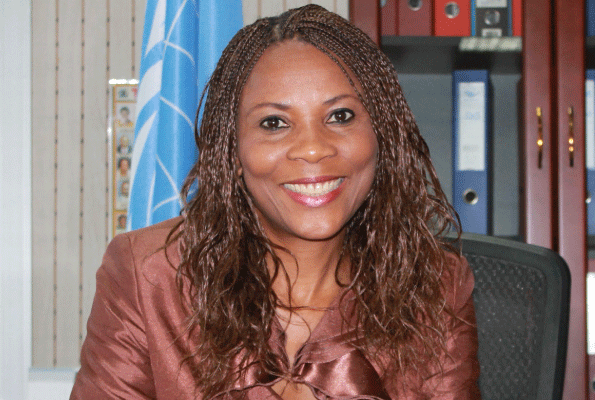
Ahunna Eziakonwa
Ms Ahunna Eziakonwa, Director of UNDP’s Africa Bureau, who made the call at the 24th Session of the Conference of the Parties (COP24) to the United Nations Framework Convention on Climate Change (UNFCCC) in Katowice, Poland, said preparing Africa for the reality of climate change “cannot be an afterthought.”
Eziakonwa said: “Taking reactive approaches to food security and disaster recovery costs the people of Africa billions of dollars in lost GDP, and syphons off government resources that should be dedicated to education, social programmes, healthcare, business development and employment”.
According to a new report launched by the UNDP, Africa is at a “tipping point” as global warming increases, and urgent action needs to be taken across the continent now to mitigate risks and safeguard a decade of social and economic gains.
For two weeks, the COP24 has brought together thousands of climate action decision-makers, advocates and activists, with one key objective: adopting global guidelines for the 197 parties of the 2015 Paris Agreement.
At the Paris Agreement, countries committed to limiting global warming to less than 2 degrees centigrade – and as close as possible to 1.5 degrees centigrade – above pre-industrial levels.
Ahunna noted that despite major structural inequalities, nations across the continent have achieved “impressive economic, political and social growth in recent decades.”
She, however, argued that “climate change, droughts, floods, changing rainfall patterns and conflict have the potential to unravel efforts to reduce hunger and achieve the goals outlined in the Paris Agreement, and the 2030 Agenda for Sustainable Development.”
The UNDP study shows that, should the world fail to limit global warming to less than 2 degrees centigrade, families will find it hard to feed themselves, and the risk of famine and increased poverty will rise along with temperatures.
Higher levels of poverty would further limit the capacity of communities to manage climate-related risks, according to the report.
The report warned that failure to mitigate climate-related risks could translate into more risky migration patterns, serious epidemics such as the 2014 Ebola outbreak across West Africa, and greater political instability.
Drawing on years of data from projects geared to enabling communities to adapt to a changing climate and build resilience, the report shows that as emissions continue going up, support for climate adaptation initiatives must be increased urgently and accelerated across the continent, especially across the 34 African least developed countries.
However, measures to enable communities to adapt to the changing climate is a costly matter that would require creative financial mechanisms and substantial engagement with the private sector to meet.
It would also require developed nations to make good on their 2015 Paris Agreement commitments to dedicate $100 billion annually to supporting climate action in developing nations.
The report analyses several noteworthy successes in climate change adaptation in Africa over the past decade, including projects aimed at improving food security in Benin, Mali, Niger and Sudan.
It also analysed supporting governments in having improved climate information and early warning systems to save lives from fast-acting storms; and empowering women to be effective climate action champions.
A Professor in the University of Agriculture, Markurdi, Benue State, Prof. Isaac Itodo, has urged the Federal Government to come up with a better regulatory framework on renewable energy to address the nation’s electricity deficit.
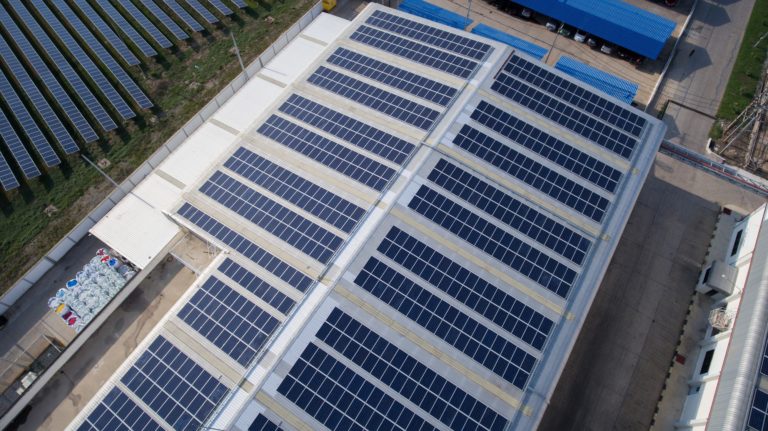
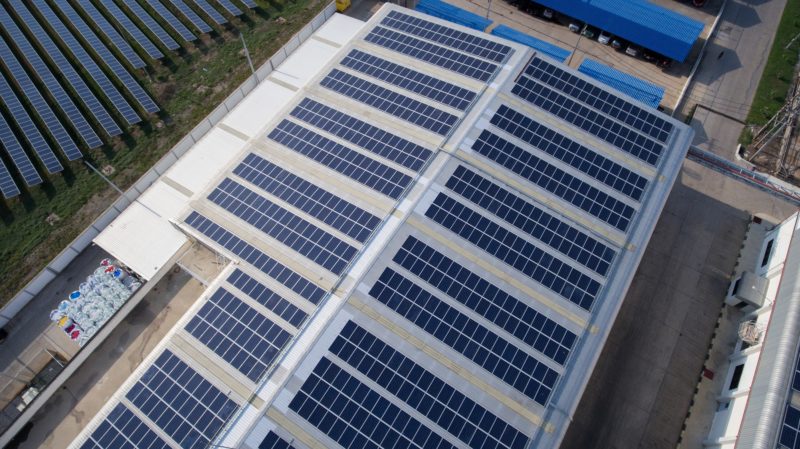
Aerial view of solar panels on rooftop
Itodo made the call on Saturday, December 15, 2018 at a “Knowledge sharing Workshop on: Sustainable Biogas Generation as an Alternative Energy Resource in Nigeria” in Delta State.
The event was organised by the Higher Education Partnership for Subsaharan Africa (HEP-SSA) projects and held at the Federal University of Petroleum Resources (FUPRE), Effurun.
Itodo, who spoke on “Sustainable Energy Resources: Practical Experience with Biogas Production and Utility”, said renewable energy in the country lacked proper regulation and technical expertise among others.
According to him, most of the biogas plants built in Nigeria were based on “try and error”, adding only about 25 biogas facilities are functional in a country of over 180 million population.
The biogas expert said that Nigeria cannot meet her huge energy demand through hydro power source hence the need to urgently diversify.
“The 8,000 megawatts we generate as electricity is a mere theory, Nigeria needs a minimum of sustained 35,000 megawatts to drive her industrialisation and other sector of the economy.
“Energy consumption per capita is a parametre for measuring the economic index of a nation,” he said.
Speaking with newsmen, Itodo said there were different forms of renewable energy among which are: biofuel which includes biogas, solar and thermal, among others.
“We must keep fate with the renewable energy technology because that is the only way the country can be energy independent and by implication stimulate other infrastructure like the ICT.
“Renewable energy is the only way we can reduce our electricity deficit and improve our energy per capita consumption.
“Our energy per capita consumption is very low compared to average countries in Africa like Gabon and others,” he said.
Itodo said there was need for experts in the renewable energy sector to meet periodically to brainstorm and deploy various technology to meet the electricity demands of the country.
“To build a biogas plant is try and error in Nigeria, it takes me almost three years to get a biogas facility working despite having a Phd in it.
“What you have in the laboratory is almost different from what you have in the field, so people should form groups certified by the regulatory agency and start training on biogas,” he said.
Earlier, Dr Omonigho Otanocha, project coordinator, FUPRE-HEP-SSA, said the aim of the workshop was to share knowledge on the importance of biogas to the people, environment and the country.
He said the programme was aimed at propagating the sustainable production of biogas as well as scale up technology so that Small and Medium Scale Enterprises and households can use the organic substances generated to produce energy.
“This project will last for two years between 2018 and 2020.
“It will be held in other four universities in Nigeria which include: Edo State University, Iyamho; University of Abuja; Alex Ekwueme University, Ebonyi; and Federal University of Agriculture, Abeokuta to build research and development,” he said.
The FUPRE Vice Chancellor, Prof. Akaehomen Ibhadode, who was represented by Prof Akpofure Oke, declared the workshop open.
Other resources persons including Prof. Kai Cheng of Brunel University, London also spoke at the event.
A not-for-profit outfit, The Rural Environmental Empowerment (TREE) Initiative, has signed a Memorandum of Understanding (MoU) with the Forestry Research Institute of Nigeria (FRIN) on the conservation of the forest.
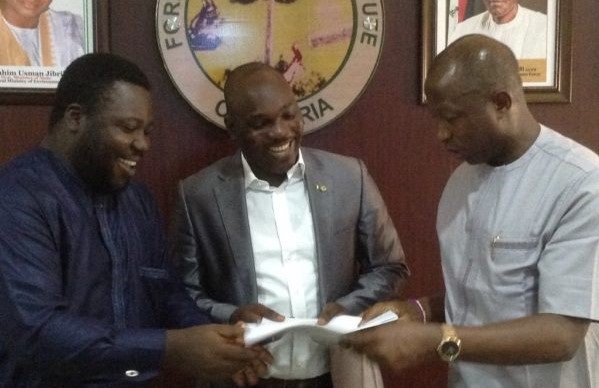
Dr. Shola Adepoju, Director-General, Forestry Research Institute of Nigeria (FRIN) handing over the signed Memorandum of Understanding to the Co-Founders of The Rural Environmental Empowerment (TREE) Initiative, Mr Sola Kolawole (second left) and Mr Ropo Egbeleke (left) at the institute in Ibadan, Oyo State
The News Agency of Nigeria (NAN) reports that the MoU was signed at the institution by Dr. Shola Adepoju, the FRIN Director-General, and the TREE Initiative founders.
Dr Oladapo Akinyemi, FRIN Research Coordinator, told NAN that it was imperative for the institute to sign such MoU aimed at afforestation, agroforestry and re-vegetation.
“This is a welcome development from TREE Initiative. As a reputable institution vested with a mandate of conserving the forest, we will always partner organisations or groups with similar objectives,” he said.
Akinyemi, who said the MoU was in line with the institute’s mandate, stated that the implementation of the MoU takes immediate effect.
Mr Sola Kolawole and Mr Ropo Egbeleke, the Co-Founders of TREE Initiative, appreciated the management of FRIN for considering the collaboration as important and strategic.
Kolawole, Executive Director, TREE Initiative, told NAN that the organisation had since establishment advocated tree planting to mitigate the negative consequences of climate change occasioned by massive deforestation and desertification.
“The Goal 17 of the SDGs is ‘Partnership for the Goals.’ As we approach the 2030 date, it is important that we all come together to save our planet for future generations.
“For countries in the Tropics, it is collaborations like this between sincere Community Based Initiatives and State Actors that can help solve the climate change debacle and facilitate the achievement of the 2030 Agenda,” he said.
He said that deforestation was at the front burner of any climate change conversation or gathering, saying the World Bank at COP24 in Katowice, Poland has made a commitment to protect additional 120 million hectares of forests.
Kolawole urged Nigerian banks and the organised private sector to support foremost institutions like FRIN and dedicated civil society initiatives working hard to restore depleted forests.
According to him, “the collaboration with FRIN will boost our advocacy in our core thematic areas such as Tree Planting, Food Security and Sustainable Livelihood.
“It will also enable the Nigerian public, particularly communities facing direct impact of these challenges to know that Federal Government through agencies like FRIN is making remarkable progress in the fight against deforestation and desertification.”
Egbeleke told NAN that the initiative was aimed towards planting and nurturing no fewer than 10 million trees by 2025 through a mix of afforestation programs and farmer-owned agroforestry projects.
He said the aim was to address the combined global challenges of deforestation, hunger and rural poverty.
Egbeleke said that the organisation has launched “One Student One Tree Project” through a partnership with Ladoke Akintola University of Technology (LAUTECH), Ogbomoso.
“This is one avenue of achieving this medium-term goal. We intend to carry the One Student One Tree Project advocacy to all tertiary institutions located in rural environments across the Nigeria over the next few years.
“We are also coming up with a Shea Tree Restoration Advocacy Programme, an agroforestry propagation project in partnership with farmers, especially smallholder women farmers across the country.
“It is an initiative to save the Shea Butter Tree which supports the livelihood of about 500,000 women in Nigeria from extinction,” he said.
Negotiators were preparing to work well past the official close of the UN Climate Change Conference in Katowice in the evening of Friday, December 14, 2018.
The COP Presidency announced late Friday evening that the draft decision for 1/CP.24, 3/CMA.1 and other related decisions would be available after 1 a.m on Saturday, and that the plenary meetings would start at 4 a.m.
There are hopes for a decent outcome from COP24
This was to address unresolved issues and ensure that a deal eventually emerged as a new draft text had been released hours earlier.
The outline decision contains plans for a common rulebook for all countries, with flexibility for poorer nations.
There are also calls for all countries to increase their carbon cutting commitments by 2020.
Most ministers believe the strength or weakness of the final outcome is still in the balance.
Among the key issues not yet decided is the question of loss and damage.
This issue has bedevilled climate negotiations for many years as developing countries seek recognition and compensation for the damages caused by rising temperatures.
The idea of being legally liable for causing climate change has long been rejected by richer nations, who fear huge bills well into the future.
At these talks, the question of loss and damage only features as a footnote in the text at present, something that has irritated developing countries.
But many observers believed that overall, some progress is being made.
“It was never going to be great, not least because the US is playing a laggard role, but I think we can get a decent outcome, if it’s framed in the right way,” said Alden Meyer from the Union of Concerned Scientists.
Earlier, the former president of the Maldives, and now their lead negotiator, Mohamed Nasheed, made an impassioned plea for urgent progress on cutting carbon.
“It’s just madness for us to allow global CO2 levels (in the atmosphere) to go beyond 450 parts per million, and temperatures to shoot past 1.5 degrees,” he told a press briefing on Thursday.
“That can still be prevented. If we come together on the basis of the emergency facing us, we can do it.
“Every country at this summit will have hell to pay if we don’t.”
Representatives from 196 states are here trying to sort out some very tricky questions pertaining to the rulebook of the Paris agreement which comes into force in 2020.
These are the regulations that will govern the nuts and bolts of how countries cut carbon, provide finance to poorer nations and ensure that everyone is doing what they say they are doing.
It sounds easy, but it is very technical. At the moment countries often have different definitions and timetables for their carbon cutting actions.
However, some progress is being seen in shaping the rules.
“Some of the text that is key to the rulebook, in terms of the transparency of countries reporting their mitigating actions are pretty strong. It is better than it was a week ago,” said one senior negotiator.
Chile has been selected to host the next United Nations’ climate conference in 2019, it was announced at the current meeting in the Polish city of Katowice on Friday, December 14, 2018.
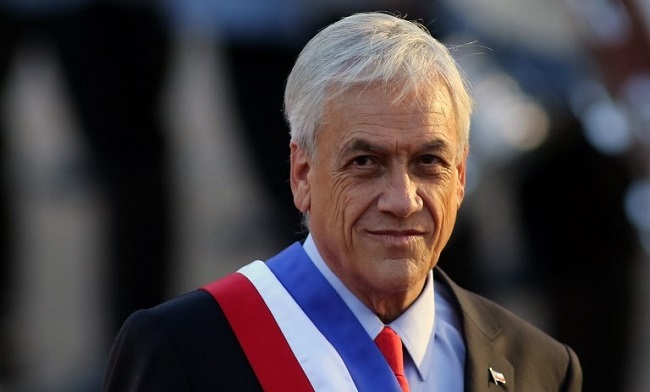
Chilean President, Sebastian Pinera. Photo credit: AFP / CLAUDIO REYES
Brazil was initially slated to host the talks, but far-right president-elect Jair Bolsonaro pushed the Brazilian government to withdraw its offer to host conference.
Under UN rules, next year is the turn of a Latin American or Caribbean country to host the event.
Chile and Costa Rica were the forerunners. Costa Rica withdrew because of the costs but offered to help Chile in the organisation of the so-called 25th session of the Conference of the Parties (COP25) to the UN Framework Convention on Climate Change (UNFCCC).
“We are delighted to tell you that for COP25, we will be working with Costa Rica,” Chile’s environment minister Carolina Schmidt told the conference in Katowice on Friday.