Home Blog Page 1735

Shell’s Bonga hits 800m barrels mark

0

In 13 years of deep-water exploration, the Bonga vessel of the Shell Nigeria Exploration and Production Company (SNEPCo) has produced over800 million barrels of crude oil, confirming the company as a pacesetter in offshore oil and gas production in the Gulf of Guinea.
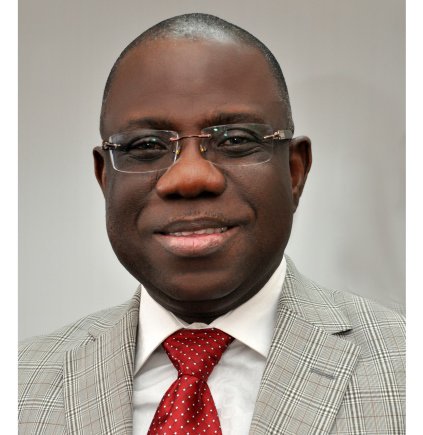
Bayo Ojulari
SNEPCo Managing Director, Bayo Ojulari

In its review of the performance of the Bonga Floating Production, Storage, and Offloading (FPSO) vessel for 2018, SNEPCo’s Managing Director, Bayo Ojulari, expressed satisfaction with the consistent availability and optimal performance of the vessel which began operation at the Bonga field in OML 118 in 2005 under a production sharing contract with the Nigeria National Petroleum Corporation (NNPC).

“We are relentless in our pursuit of excellence on all fronts, and this we have consistently demonstrated with the management of Bonga to the satisfaction of our government and co-venture partners,” Ojulari said in Lagos on Monday, December 17, 2018.

“We leverage the Shell group’s global expertise in technology and new advancements in the industry to continue to unlock Bonga’s huge potential, one such example was the completion and inauguration of the Bonga North West Cross Over module in 2014, a first in the history of Shell which launched the beginning of a new phase delivering the reservoirs proven volumes and maintaining production of the FPSO at full capacity,” the SNEPCo MD added.

According to Ojulari, SNEPCo, with the support of NNPC and the co-venture partners – Total E & P, Nigerian Agip Oil Company, and ExxonMobil – has also done so much for Nigeria and Nigerians in its years of operations in revenue and taxes accruable to the government, and social investments in education, sports and health across the country.

In the last three years, SNEPCo has spent over $3millionyearly in scholarships and other intervention in schools across Nigeria including the popular NNPC/SNEPCo Cradle-to-Career scholarships for the six years of secondary school for children from rural areas. The scholarships with over 375 beneficiaries since its commencement in 2014, cover tuition, boarding and maintenance allowances in leading schools in select Nigerian cities.

Ojulari said, “Our health and education programmes are aimed at improving healthcare; bridging the educational opportunity gap between urban and rural school populations; providing educational grants; improving ICT education; and supporting displaced persons.”

The Bonga Asset Operations Manager, Elohor Aiboni, described the FPSO as a jewel noting however that SNEPCo’s achievements did not come without their challenges. “We overcome our challenges with the ingenuity and integrated delivery approach of our staff who work together every day to deliver one of the best assets in the world. “I’m proud to say that over 95percent of SNEPCo’s staff are Nigerians and they have distinguished themselves as some of the best in the industry within and outside Nigeria.”

SNEPCo’s resounding performance, Aiboni said, had been delivered with zero fatality since first oil. “In 2016 the team also won the Shell CEO HSE Award for disciplined and focused safety culture.”

In recognition of its pioneering initiatives in Nigeria,SNEPCo was in early 2018 honoured as the best Nigerian oil and gas company in technology and innovation at the maiden edition of the  Nigerian International Petroleum Summit (NIPS) held in Abuja for pioneering in-country Subsea Tree Refurbishment, a remarkable feat in local capacity potential which resulted in significant savings. This was the first time in the Nigerian oil and gas industry that a Subsea Tree was fully stripped down and refurbished locally with all its original functionality restored.

The Bonga field increased Nigeria’s oil production by 10%when output began in 2005 and has since stimulated the growth of support industries in addition to helping to create the first generation of Nigerian oil and gas engineers with deep-water experience. The FPSO has potential to produce 225,000 barrels of crude oil and 210 million standard cubic feet of gasper day.

The FPSO vessel’s capacity was upgraded in recent years,allowing SNEPCo to expand the field with further drilling of wells in Bonga Phases 2 and 3 and through a subsea tie-back that unlocked the nearby Bonga North West field in August 2014.

Bonga North West can produce approximately 65,000 barrels of oil equivalent a day and was named Engineering Project of the Year 2015 at the prestigious Platts Global Energy Awards in New York.

1.5m Rwandese to get AfDB’s €115m water lifeline

0

The Board of the African Development Bank (AfDB) has approved additional funding support of €115 million to Rwanda’s Sustainable Water Supply and Sanitation Programme, enabling 1.5 million people to access improved, reliable and sustainable water supply services.

Wambui Gichuri
Wambui Gichuri, the AfDB’s Director for Water Development and Sanitation

The funding will cover strategic cities and address water and sanitation challenges in areas with a low access rate of 45% − a figure that is way below the national average of 85%.

The new financing is to scale up the country’s largest water and sanitation sector investment programme, which is co-financed by the European Investment Bank and the OPEC Fund for International Development.

In November 2017, the bank approved an initial $121 million loan and $50 million Africa Growing Together Fund (AGTF) loan to Rwanda under its Sustainable Water Supply and Sanitation Programme.

“The bank’s support to this programme further goes to deepen and consolidate the impact of its investments in enhancing resilience to climate change and inclusive growth,” said Wambui Gichuri, the AfDB’s Director for Water Development and Sanitation.

The Government of Rwanda is said to have shown consistent commitment to sector reforms and economic transformation in furtherance of its recently-approved National Strategy for Transformation − designed to propel Rwanda into an upper middle-income country by 2035. The programme is bolstered by the country’s new Vision 2050, which aims to ensure a high standard of living for all Rwandans.

Of the 1.5 million people to be provided water access under the additional funding, 700,000 live in peri-urban/rural areas.The AfDB is the main development partner in Rwanda’s water and sanitation sector which is reported to have seen a positive record of accomplishments. The additional financing will enable the government to undertake the programme. 

Buses in Cote d’Ivoire to be fueled with compressed natural gas

0

The Ivorian Minister of Transport, Mr Amadou Koné, and several government ministers have launched what has been described as a ground-breaking initiative that is in line with the country’s commitment to the Paris Climate Change Agreement.

Compressed natural gas fuel station

The Minister unveiled a fleet of buses commissioned by the Société des Transports Abidjanais (SOTRA), supplied by IVECO and fuelled by compressed natural gas. ENGIE and Tractebel collaborated to engineer, supply and install the first ever compressed natural gas (CNG) fuelling station in Abidjan.

The CNG fuelling station is located on SOTRA’s premises in Yopougon, Abidjan, and will facilitate the operation of the new range of compressed natural gas buses. When fully commissioned, the gas fuelling station will have a compression capacity of 1360 m³/h, and will be split into two units, each equipped with two hoses, enabling four buses to charge at any one time.

The Abidjan station is said to be the first stage in the Ivorian government and public transportation companies plan to increase the number of CNG buses and ensure that the region is working towards fulfilling its commitment to the COP 21 agreement. More importantly, it will lead the way for other African countries that are keen to further embrace clean technologies. Countries including Ghana, Togo, Benin and Cameroon are reportedly monitoring the success of the initiative with the intention of replicating the project.

As part of the deal between IVECO and the Société des Transports Abidjanais (SOTRA), 50 Crealis buses will run on compressed natural gas in Abidjan. The particle emission levels will be nearly zero, and their Nitrogen Oxide emissions will be reduced by 60 per cent. The buses will serve within Abidjan’s wider urban area, it was gathered.

Officials revealed that ENGIE and Tractebel have a unique level of expertise and a local presence that was vital to the success of the venture. They are regarded as specialists in delivering infrastructures which provide alternative fuels for green mobility solutions.

Praises, knocks greet COP24, outcome

0

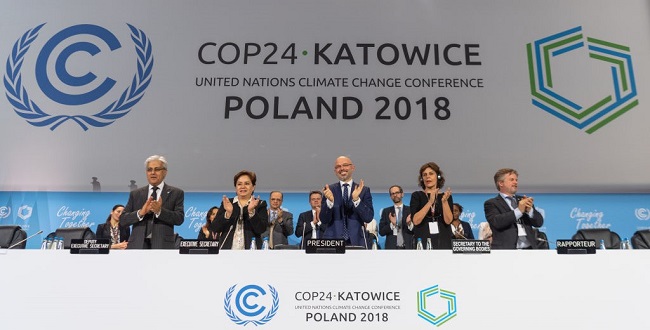
After two weeks of deliberations and negotiations, the 24th Session of the Conference of the Parties (COP24) to the United Nations Framework Convention on Climate Change (UNFCCC) ended on Saturday, December 15,2018 upon the approval of the Paris Agreement Work Programme, otherwise known as the “Katowice Climate Package”.

COP24 Conclusion
Michal Kurtyka (M), President of the UN Climate Change Conference COP24, and other participants of the climate summit are pleased and applaud the decision of the compromise at the world climate summit. The aim of the agreement is to limit global warming to well below two degrees. Photo credit: Monika Skolimowska /dpa-Zentralbild / Getty Images

The conclusion has however attracted a barrage of comments from stakeholders who have on one hand hailed it as a welcome development and,on the other hand, condemned it for being weak and lacking direction.

United Nations Secretary-General, António Guterres, was however full of praises for COP24, which he said has displayed the resilience of the Paris Agreement.

He said: “The approval of the Paris Agreement Work Programme is the basis for a transformative process which will require strengthened ambition from the international community. Science has clearly shown that we need enhanced ambition to defeat climate change.

“From now on, my five priorities will be: ambition, ambition, ambition, ambition and ambition.

“Ambition in mitigation. Ambition in adaptation. Ambition in finance. Ambition in technical cooperation and capacity building. Ambition in technological innovation.

“Ambition will be at the centre of the Climate Summit that I will convene in September 2019.

“And ambition must guide all Member States as they prepare their Nationally Determined Contributions (NDCs) for 2020 to reverse the present trend in which climate change is still running faster than us.

“It is our duty to reach for more and I count on all of you to raise ambitions so that we can beat back climate change.”

Johan Rockström, resilience scientist who as Director Designate is leading the Potsdam Institute for Climate Impact Research, spoke in a similar vein, describing the Katowice agreement as “a relief”.

His words: “Countries recognise the need for global collaboration to deal with the global climate crisis. The Paris Agreement is alive and kicking, despite a rise in populism and nationalism. With the rulebook now finally adopted, the Paris agreement can be implemented. Overall, the Katowice decisions provide enough momentum to move forward.”

But he frowned at the fact that the UN Summit failed to align ambitions with science, “in particular missing the necessity of making clear that global emissions from fossil fuels must be cut by half by 2030 to stay inline with the IPCC 1.5 C report.”

He said: “This is a real concern. We continue to follow a path that will take us to a very dangerous 3-4 degrees warmer world within this century. Extreme weather events hit people all across the planet already now,at only one-degree global warming. Especially the US is a hard-hit victim, a nation that played an unfortunate role at the climate summit, which already suffers and will suffer even more in the future from an increase of regional droughts and hurricanes.

“However, Katowice is only one step on the long and winding road to achieving sustainable prosperity within a fossil-fuel free future. All of us need to stop tip-toeing and speed up our steps. And Europe can and must be a forerunner.”

Ottmar Edenhofer, climate economist and acting Director at the Potsdam Institute for Climate Impact Research, also expressed cautious optimism on the issue, saying: “Once again, governments across the world have proven that they’re capable and willing to cooperate in order to protect their citizens from climate risks. Despite a growing number of populist governments, multilateralism succeeded.

“However, the world needs more than climate policy targets and processes – it needs concrete measures, and they must be taken now.  In this respect, climate change can no longer be simply regarded as the biggest market failure of all time – with the continued rise of global greenhouse gas emissions after years of negotiation, it has also become an unprecedented government failure.

“Through appropriate policy measures – like effective CO2pricing – governments have to build a new trust-relationship to citizens.Carbon pricing cannot solve everything, yet without it nothing can be solved.And governments can actually use carbon pricing to enhance social justice,because the generated income can and must be given back to the people, be it through electricity tax cuts, infrastructure investments, or Christmas cheques.”

Joseph Onoja, Director of Technical Programmes at the Nigerian Conservation Foundation (NCF), gave the summit a thumbs-up for eventually arriving at a decision, but likewise offered a word of caution and advice.

He said: “Suffice to say that it was a tensed gathering because a decision was not reached until the very closing minutes of the summit,the good thing is that the decision was made at the end. It is indeed a right step towards the right direction. However, it is time for action.

“Climate change is not waiting for humanity to act. We have negotiated for long. Now is the time to act. As for the content, it will not be completely water tight, but we have a good enough document to work with, which will be impactful if implemented.

“In terms of the commitments, countries were committed to their interests but, at the end, the global interest won and that is the beauty of negotiation. Now is the time to act.”

Environmentalist and renewable energy expert, Huzi Mshelia, opined that, going by the COP’s outcome, countries have shown commitment to the process to the extent that they acknowledged the climate change threat and are engaging.

“The adoption of the guidelines, even without conclusion on markets, is a good step in the right direction because it could have been tragic to come out of Katowice without anything,” he stated.

He went further: “For a start, the guidelines would prompt further action albeit not as urgently as the situation deserves. The development in Katowice has reinforced my earlier belief that we need to do more domestically, particularly the mobilisation of local financial resources to address our vulnerabilities. While the international climate regime isencouraged, domestic actions are, in my opinion, even more critical and urgent.

“For Nigeria, the economy is directly at risks of climate change and our response is to immediately build appropriate safeguards to climate-proof the economy; any other approach will show lack of understanding of the dynamics of this phenomenon.”

But environmental activists and Director, Health of Mother Earth Foundation (HOMEF), Nnimmo Bassey, faulted the basis of the summit as well as its outcome.

His words: “The Paris Agreement was not the best agreement that the world needed to tackle global warming. A Rulebook to implement a set of voluntary nationally determined commitments does not add up to change the climate trajectory, sadly. The Paris Rule Book does not address the key cause of global warming: continual extraction and burning of fossil fuels.

“The outcome of Katowice is essentially business as usual, a postponement of many issues yet to be decided and a broad weakening of the justice basis of the Climate Convention. It will essentially give a tiny nudge to act and that action will mostly be in the frame of false solutions based on market mechanisms and other carbon offset routes. COP24 was an arena for power play and left vulnerable nations, that were never part of creating the problem,with the burning end of the climate stick, unfortunately.“The world can and must do better. Polluters must be kept away from future climate conferences. Nations must agree to keep fossil fuels in the ground as required by science. Time to ensure that all concerns are based on the best interest of the people and the planet.”

Tons of antibiotics harmful to human health found in pork

0

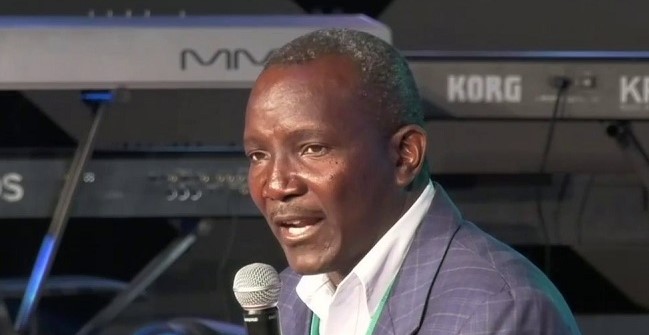
More than 12,000 tons of antibiotics that are harmful to human health has been found in pork in Kenya, an official with the World Animal Protection said.

Victor Yamo
Victor Yamo

Victor Yamo said that symptoms of the overuse of antibiotics in pig farming are now contributing to the superbug crisis.

“Traces of antibiotics have been traced in supermarkets where pork is sold to consumers,” Yamo told journalists during a media briefing in Nairobi, Kenya.

Yamo said that farmers and factories have been applying antibiotics in treating animals from being sick but do not know that they are contributing to the superbug crisis in animals.

He said that farms are becoming more industrialised to meet the global demand of animal protein but in the process, they end up using dangerous methods to meet the demand of consumers.

Yamo told consumers to buy safe and quality pork from established companies with labeled products adding that the increase of small-scale producers is likely to play a role in the current problem.

“There is need to clearly label pork products to avoid causing harm to unsuspecting consumers,” Yamo added.

He said that failure to take precaution could lead to superbugs to cause food poisoning, blood poisoning, urinary tract infections and even death.

The official urged supermarkets to improve the lives of pigs by only sourcing pork from high-welfare farms.

“Factory farm conditions for pigs cause them immense pain and stress, which involves a steady overuse of antibiotics,”he added.

He called on supermarkets to demand that their suppliers improve the welfare of pigs by keeping them in cleaner places.

Yamo said that the Kenya national action plan and national policy are set to address the problems once they become effective.

“We are working in collaboration with farmers to ensure that the pork produced are of good quality for human consumption,” he said.

The world animal protection did a global study that has exposed the use of antibiotics in pig farming.

The organisation said that with the current food insecurity particularly in Africa, there is need to ensure that the existing food chains are kept clean according to the regulations developed by the country’s policies.

By Duncan Mboyah

Katowice failed, produced ‘weak’ rulebook – CSE

0

“It is a weak Rulebook that we have got for implementation of the Paris Agreement. This Rulebook is completely insufficient to drive ambitious climate action,” said the Centre for Science and Environment (CSE), a New Delhi, India-based think tank which closely tracked the negotiations at the24th Session of the Conference of the Parties (COP24) to the UN Framework Convention of Climate Change (UNFCCC) that closed on Saturday, December 15,2018 in Katowice, Poland.

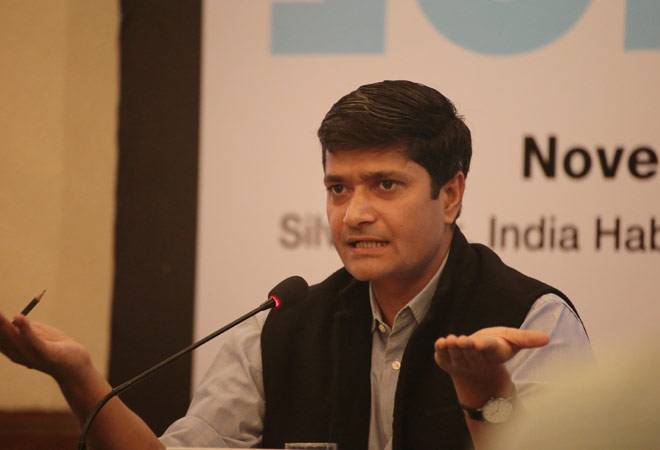
Chandra Bhushan
Chandra Bhushan, Deputy Director General, Centre for Science and Environment (CSE)

The global climate change summit, adds the group, also failed to increase ambition of countries to cut the emissions of greenhouse gases as per the findings of the IPCC’s Special Report on 1.5oC. It notes that the refusal of the COP to take the IPCC report seriously undermines the Paris Agreement.

“The Katowice COP will be remembered as an anti-science COP for its failure to consider the findings of the IPCC’s Special Report on 1.5oC. It will also be remembered for coming out with a Rulebook that dilutes an already weak Paris Agreement, thereby undermining the global effort to combat climate change,” said Chandra Bhushan, deputy director general, CSE.

The CSE enumerates points to back up what it claims is a “weak Rulebook”.

Provision of finance by developed countries

In the Paris Agreement, developed countries had agreed to a financial commitment of $100billion each year by 2020. Currently, only around half of this commitment is being met. The Rulebook had to define what all will constitute “finance”, and how it will be reported and reviewed.

But at Katowice, rules on financial contributions by developed countries have been diluted.

Firstly, developed countries have the choice to include all kinds of financial instruments, concessional and non-concessional loans, grants, aids etc, from various public and private sources, to meet their commitments. Secondly, the rules on ex-ante financial reporting and its review for adequacy has been significantly weakened. Put together, these two dilutions will make it very difficult to hold developed countries accountable.

“Developed countries now have the freedom to decide the amount and the kind of financial resources they want to give to the developing countries and do this without any strong mechanism of accountability. The idea of ‘new and additional’ financial support from developed to the developing countries to mitigate and adapt to climate change is now a mirage,” says Bhushan.

Loss and Damage

Loss and Damage has largely been excluded from the Paris Rulebook. It is conspicuously missing from the section on finance. The Warsaw International Mechanism, which must deal with averting, minimising and addressing loss and damage associated with the adverse effects of climate change, has no financial resources to support vulnerable countries.

“With no financial provisions, it clear that the countries are now left on their own to address the impacts of climate change,” said Vijeta Rattani, Programme Manager, Climate Change, CSE.

Global stocktake

Global stocktake (GST) was one of the top-down elements in the Paris Agreement to increase ambition of countries. It was supposed to measure global progress and identify the barriers to mitigation and adaptation, considering equity and science. However, the GST Rulebook has reportedly been watered down into a non-policy prescriptive process. That is, this process will neither give any recommendation to individual countries or a group of countries, nor will it give any prescriptive policy to everyone. The result is that a lot of technical information will be collected without any clear recommendation to increase ambition on mitigation or finance.

“Under the Paris Agreement, GST was the main mechanism to raise ambition. With the nature of GST outcome being non-prescriptive in the Rulebook, the purpose of GST has now been largely watered down. Also, equity has been mentioned in the text, but there is no mechanism to operationalise it,” said Rattani.

Reporting and transparency

The Paris Agreement is built around countries reporting their progress on Nationally Determined Contributions (NDCs). Under the Rulebook, a detailed requirement has been set for reporting on mitigation, adaptation, impacts and finance. A certain flexibility has been provided to the developing countries, which have lower capacity to collect and analyse information, to provide less rigorous information. Developing countries will have to provide “self-determined”time frames for improving the quality and quantity of reporting.

It is to be noted that emerging economies like India had already informed that they would not need flexibility and would report in a manner like those followed by the developed countries.

Carbon market is the king

The Katowice COP was extended for a day because countries had disagreements over the details of the carbon market mechanism. Market mechanism has emerged as the most important element of the Paris agreement.

Paris Agreement allows emissions trading markets between two or more countries (such as the EU Emissions Trading System), as well as a unified market for all countries (which succeeds the Kyoto Protocol’s Clean Development Mechanism). It also provides fora non-market mechanism to reduce emissions and enhance sinks in forests and land. There has virtually been no progress made on non-market mechanisms, while the negotiations on market mechanisms is now mired in technicalities.

The Clean Development Mechanism (CDM) of the Kyoto Protocol had major problems, including cheap carbon credits, outsourcing of emission credits, corruption and non-additional projects, which subsequently left the overall emission reductions of the mechanism to doubt. Under the Paris Agreement, these drawbacks were to be removed so that real emissions reductions could be achieved. However, the rules made so far indicate that many of the problems of CDM like Overall Mitigation of Global Emissions, is likely to remain in the Paris rulebook as well. Also,the rulebook has different rules for different markets, which is non-transparent and makes emissions reductions unverifiable. Trading is allowed for sectors which are not covered in a country’s emissions targets, which will dilute the overall mitigation effect.

Currently, many technical issues of the market mechanism have been shifted to 2019. But it is clear that under the Paris Agreement, carbon markets will be the main avenue through which countries are going to engage with each other.

Countries are on their own

The Paris Agreement had both bottom-up and top-down elements. Most of the top-down elements have been diluted in the rulebook. The Paris Agreement and its rulebook is now a totally “self-determined” process.

“Countries are now on their own to mitigate, to adapt, and to pay the cost of climate impacts. The UNFCCC is now a platform to collect and synthesise information and provide a forum to discuss and debate. It doesn’t have the tools to drive global collective action to combat climate change. In such a situation, one needs to seriously question the raison d’être of the UNFCCC,” concludes Bhushan.

COP24: ACT demands stronger climate action commitment

0

The just concluded UN climate talks in Kotawice, Poland confirms the vast disconnect between ambition, urgency for action on climate change, and the political will of key governments, the ACT Alliance has said.

Rudelmar Bueno de Faria
Rudelmar Bueno de Faria, ACT Alliance’s General Secretary

 The organisation, which made the submission in a statement made available to EnviroNews on Sunday, December 16, 2018, insists that the divide can and must be bridged.

“COP24 failed to deliver the best possible outcome to the most vulnerable people in the world,” said Rudelmar Bueno de Faria, General Secretary of the ACT Alliance. “We are pleased to see that loss and damage is included in the document to guide the implementation of the Paris Agreement. Including loss and damage helps to acknowledge the threat to vulnerable communities who are most affected by climate change. Climate finance needed a much more ambitious push to move the world beyond the commitments that have already been made and to help us to meet the goal of capping global temperature rise at1.5C.”

The IPCC report issued earlier this year lays out the likely effects of global temperature rise at different points, clearly demonstrating that increased ambition is required to keep global temperatures from rising more than 1.5C.

ACT Alliance’s study, which was released at COP24, concludes that without addressing climate change, it will be impossible for the world to achieve the Sustainable Development Goals and the 2030 Agenda.

“We are disappointed that the COP did not put more focus on the scientific findings of the IPCC, and that climate skeptics have moved the debate backwards, casting doubt on the scientific work of the IPCC, which makes it clear that we need to increase our ambition,” de Faria continued.

“We expected stronger provisions in the Paris Rulebook to protect human rights and gender equality,” said Joycia Thorat, co-chair of the ACT Alliance Global Advocacy Advisory Group. “We urge governments to ambitiously increase their climate commitments in the revision of the Nationally Determined Contributions (NDCs), making sure to include human rights and gender in the implementation of both mitigation and adaptation measures.”

ACT calls on churches, faith groups, civil society, and governments to continue to increase ambition to combat climate change, and to keep the needs of the most vulnerable at the forefront of the negotiations and action. But we must act now for climate justice.

“It is important not to lose hope and to continue the struggle for climate justice, for all people and for the planet. Together we can still reverse the course, and we can do it with justice for all,” concluded Thorat.

African farmers lack knowledge of GMOs, says foundation

0

The African Agricultural Technology Foundations (AATF) on Sunday, December 16, 2018 expressed displeasure over lack of knowledge of Genetically Modified Organism (GMO) among the African farmers.

GMOs
GMOs

The Foundation’s Regional Director, Dr Issouhou Abdurhamane, made the submission when he led a team to a News Agency of Nigeria (NAN) forum to sensitise Nigerians on Genetically Modified Organism (GMO).

GMO is any organism whose genetic material has been altered, using genetic engineering techniques to reproduce another organism.

AATF, a non-profit organisation based in Nairobi, Kenya, is designed to facilitate and promote public, private partnerships for access and delivery of appropriate agricultural technologies for use by resource-poor smallholder farmers in sub-Saharan Africa.

According Abdurhamane, African farmers are yet to apprehend the scientifically developed technology which can go a long way to boost agriculture in areas of livestock production, animal feeds, and food crops.

The AATF director said the scientific initiative of GMO application in agriculture was harmless, hence capable of boosting economy of any nation.

He said one of the major factors that drew agriculture backward was dwelling so much on the past farming system, adding that with the current environmental challenges, agriculture production was very low.

On this note, the AATF official assured that with the adoption of GMO in agricultural practices in Africa, there would be bountiful increase in the sector.

He, however, condemned the belief that GMO was harmful and capable of causing diseases including cancer.

“This is one of the problems because there are many people who don’t want to see biotechnology development in Africa, especially the use of GMOs.

“They have been putting a lot of lies on the internet,things we cannot back by facts and anything which is not back by facts is a lie.

“I use the term very strongly and I am able to support it.

“To say that GMO causes cancer, GMO causes disease, GMO causes these is a lie.

“If this is true, then no American should have been alive today because the major food crop in U.S. is maize; maize is all GMO in U.S., soya beans are all GMOs in the U.S.”

He said the GMO project was co-funded by Bill Gate Foundation, Open Forum on Agricultural Biotechnology (OFAB), and Agricultural Mechanisation Projects.

He added that all the efforts were geared toward creating awareness of GMOs in sub-Sahara Africa.

By Okon Okon

COMESA set to launch seed labels

0

The Common Market for Eastern and Southern Africa (COMESA) plans to launch seed labels for easier trade within the 21-member countries, an official has disclosed.

John Mukuka
John Mukuka

John Mukuka, the COMESA Regional Seed ProgrammeCoordinator, said that 4.5 million seed labels and 2,500 certificates have beenprinted and ready for issuance to seed companies in the region.

“The labels that will be launched in February 2019 will enable seed companies to sell their seeds in all the member countries without getting into trouble with custom officials,” Mukuka said during a workshop on harmonisation of seed policies and regulations within the COMESA region in Nairobi, Kenya.

Mukuka revealed that COMESA has developed an online variety catalogue that so far has 57 varieties of beans, groundnuts, Irish potatoes, maize, soybeans and wheat that can be traded in the 21 COMESA member states without being requested to be evaluated or tested by any member state.

He said that the regional trading bloc would support seed companies with varieties on the COMESA variety catalogue to trade using COMESA seed standards efficiently and effectively begins February 2019.

Mukuka observed that the establishment of border-less plant health inspections would begin operations soon after the training of customs staff and seed companies on the harmonised seed documentation.

Hamadi Boga, Kenya’s Principal Secretary for Agricultural Research, called for the involvement of farmers by providing useful and timely knowledge.

“We need to avail the right technologies to farmers to help improve food productivity in the region,” Boga added.

The PS said that there is need to ensure that the African farmer is not handicapped by lack of knowledge so that he can help reduce the food security gap.

Boga called for the development of regulations that could help save small scale farmers from the competition posed by farmers in the developed world.

Jonas Chianu, chief economist at Africa Development Bank (AfDB), said that the future of Africa’s food security depended on the use of modern technology in agriculture.

“The technologies such as high yielding, nutrient dense varieties and bio-fortified crops currently exist to feed Africa, if widely deployed,” he added.

Chianu said that through Technologies for African Agricultural Transformation (TAAT), AfDB plans to avail the best technologies for priority commodities into the hands of millions of farmers in the continent.

Chianu noted that agriculture in the continent would be developed as a business to create opportunities for rural farmers to drive inclusive growth and help reduce poverty and build wealth.

By Duncan Mboyah

Drug abuse threatens Africa’s security, health, rule of law

0

Drug abuse is a significant threat to security, health, rule of law and sustainable development in Africa, an African Union (AU) official has said.

Jane Marie Ongolo
Jane Marie Ongolo

Jane Marie Ongolo, head of the Social Welfare Division at the AU Commission, said that Africa is faced with many problems lately because it has become a major transit route in the global trade in narcotics.

“This trend is now resulting in complex and shifting networks of insurgency, local and regional politics and organised crime including corruption and terrorism,” she said at the International Conference on Drug Demand Reduction in Nairobi, Kenya.

Ongolo observed that even though consumption of psycho-active substances is an age-old practice in Africa for medical, ceremonial or recreational purposes, it has been complicated by recent role of as transit region for hard drugs.

She noted that treatment of the drug users is often a very costly affair that only exists in few existing private up market facilities adding current initiatives is far below the expectations.

“Only on in 18 drug users in Africa have access to treatment services compared to one in six global figures,” she said.

She said that inclusion of drug users as beneficiaries of national social protection programmes remain a gap continent wide.

Ongolo observed that experts from African states noticed substantial increase in illicit drugs use in Sub-Saharan Africa (SSA) after 2005.

“Cocaine use is high in West, Central and Southern Africa while heroin consumption is popular along the East African coast – Kenya, Mauritius, Seychelles and the United Republic of Tanzania,” she added.

She said that the East African region remains a significant entry point for heroin in Africa, both as destination and transit area from South, West and East Asia.

In this region, she said heroin is cheap and highly addictive, afflicts mainly the poor – an alarming trend of injecting heroin use.

The official revealed that the AU’s plan of action on drug control and crime prevention (2013-2017-2019), a comprehensive framework to guide drug policy development in the continent, intended for Member States to galvanise national, regional and international cooperation to counter the drug, is being reviewed.

She observed that the review is taking into consideration the United Nations General Assembly (UNGASS) outcome document, Sustainable Development Goals (SDGs), and the AU agenda 2063.

“There is increased political commitment by the AU member states to preventing an upsurge in illicit drug use and dependence-golden opportunity to pursue the correct way to do it,” she added.

She noted that by investing in drug treatment cuts crime, saves money, promotes better public health outcomes.

“The end result is to help individuals achieve stable, long-term recovery and become productive members of society, and to eliminate the public health, public safety, and economic consequences associated with addiction,” she added.By Duncan Mboayh