Home Blog Page 1733

Oil and gas sector generated $17.05bn in 2016, says NEITI

0

A recent report of the Nigeria Extractive Industries Transparency Initiative (NEITI) reveals that the total financial flows from Nigeria’s oil and gas sector slumped to $17.05 billion in 2016, a 31% decline on the $24.79 billion generated in 2015, and a 75% on the sector’s peak earnings of $68.44 billion generated in 2011. In addition, the 2016 figure is the lowest in 10 years and the fifth lowest in the 18 years covered by NEITI’s audit reports so far (1999 to 2016).

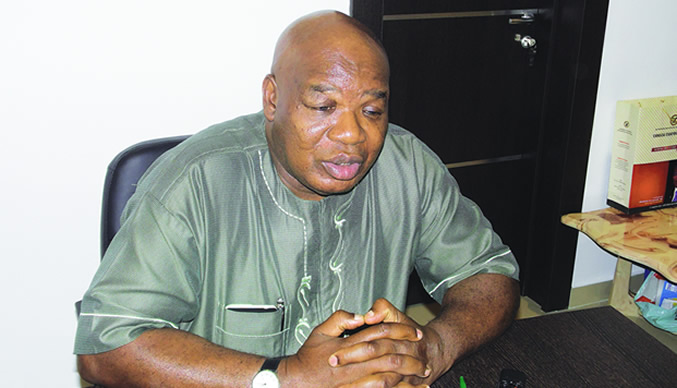
Waziri Adio
Executive Secretary of NEITI, Waziri Adio

According to the NEITI 2016 Oil and Gas Industry Audit Report, released to the press on Friday, December 21, 2018, the plunge in revenue in 2016 resulted from the double whammy of low oil prices in the global market and reduced oil production in Nigeria, which in turn was caused by disruption and vandalism of oil assets and spike in crude theft, among others.

Yearly average price of crude oil per barrel was $43.73 in 2016 as against $52.5 in 2015. Total oil production in 2016 was 659 million barrels as against 776 million barrels produced in 2015, a fall of 15%. Losses due to crude oil theft and sabotage rose from 27 million barrels in 2015 to 101 million barrels in 2016, an increase of 274%. This was aside losses due to deferment, which in 2016 was put at 144 million barrels which also went up by 65% when compared to the 87.5 million barrels in 2015.

“The bombing of the under-water 48-inch Forcados Oil Loading/Export Pipeline was one of many major occurrences that befell the industry in the year under review,” the NEITI report stated. “This incident occurred in February 2016 and the line remained in-operational for seven months. Shell Petroleum Development Company (SPDC) declared force majeure on lifting from Forcados on 21st February 2016. Companies injecting into the Forcados Terminal such as SEPLAT, PANOCEAN, MIDWESTERN, ENERGIA, PLATFORM, PILLAR, WALTERSMITH, and EXCEL shut down production for over 147 days.”

In addition, SPDC declared force majeure on the Bonny Terminal due to a leak in Nembe Creek Pipeline between May and July 2016 while NAOC declared force majeure on the Brass Terminal between July and August 2016.

Similarly, Mobil Producing Nigeria Unlimited declared Force Majeure twice between May/June and July/October 2016. This was due to a drilling process disruption and damage to the QIT loading system.

The NEITI report stated: “MPN’s total production within the four-month period was 4,616,825bbls, which is less than half of what was produced in each month previously as reflected in DPR reconciled sign-off records.”

After surviving the slump in the global oil market in 2008 and 2009, Nigeria’s oil sector rebounded in 2010 with a 49% increase in total financial flows to $44.94 billion, followed by the peak of $68.44 billion in 2011. However, flows from the sector have been trending downward since that peak year with $62.94 billion generated in 2012, $58.08 billion in 2013, $54.56 billion in 2014, and $24.79 billion in 2015. Similarly, oil production has been on steady decline with 866 million barrels produced in 2012, 800 million barrels in 2013, 798 million barrels in 2014, 776 million barrels in 2015 and 659 million barrels in 2016.

NEITI’s audit reports independently reconcile payments by companies against receipts by government agencies and cover key financial flows such as earnings from sale of Federation’s crude oil and gas, sector-specific taxes, fees and levies such as royalty, Petroleum Profit Tax (PPT), signature bonus, gas flared penalty, and other flows such as NDDC contribution, NCDMB levy, NESS fees, education tax and others. Breakdown of the payment shows that the major earnings for 2016 came from export and domestic sale of Federation crude oil and gas with $7.97 billion, PPT with $4.21 billion, and royalty oil with $1.57 billion.

A major highlight of 2016 was that for the first time in Nigeria’s history, crude oil produced from Production Sharing Contracts (PSCs) overtook output from the Joint Ventures (JVs). In 2016, PSCs accounted for 324 million barrels, while the JVs accounted for 289.1 million barrels, (as against the 320 million barrels for PSCs and 375.5 million barrels for JVs in 2015). PSCs, a production arrangement introduced in 1993, thus became the leading production arrangement in 2016. The PSCs are mostly offshore, thus insulated from vandalism and sabotage, and are not constrained by adequacy/availability of equity funding by the Federation. This change in production structure pushes to the fore the need to renegotiate the terms of the PSCs as stipulated in the Deep Offshore and Inland Basin Production Sharing Contracts Act of 1993 so as to increase government’s take.

The NEITI report also reveals that the total lifting for 2016 was 668.1 million barrels, as against the 780.4 million barrels lifted in 2015, a drop of 14.35%. Out of the total liftings for 2016, NNPC lifted 244.6 million barrels (36.61%) on behalf of the Federation while the companies lifted 423.5 million barrels (63.39%).

Other major highlights of the report are the following:

  • Contribution of the oil and gas sector to GDP dropped from 9.5% in 2015 to 8.3% in 2016.
  • Total gas produced in 2016 was 3,051,249 mmscf, out of which 288,209 mmscf was flared, representing 9.45% of production.
  • A total of 126 million barrels (valued at $5.48 billion or N1.37 trillion) was earmarked for domestic consumption, allocated as follows: 23 million barrels (18%) for refineries, 55.9 million barrels (45%) for Direct Sale Direct Purchase (DSDP), 36.6 million barrels (29%) for PPMC lifting and 10.4 million barrels (8%) for offshore processing.
  • From the money for domestic crude allocation (DCA), NNPC deducted the following upfront: N512 billion for JV cash call, N126.5 billion for pipeline repairs and maintenance, N99 billion for under-recovery and N20 billion for crude losses.
  • A total of 101 million barrels of crude oil was recorded as losses due to theft and sabotage, valued at $4.4 billion. Breakdown of this shows that SEPLAT and SPDC alone reported 81 million barrels of crude oil as losses due to sabotage while 20 entities reported 19.8 million barrels as losses due to theft.
  • NLNG dividend, loan and interest repayment for 2016 was $390.2 million, as against $1.07 billion of 2015, a decline of 63.5%.
  • $8.2 billion was budgeted for cash calls in 2016, $5.5 billion was released, and $4.9 billion was paid. Non-JV cash call expenses came to $874 million, representing 17.59% of cash call expenditure.

The 2016 NEITI report covered 84 entities, comprising the following: ten government agencies, seven power generating companies, 62 oil and gas companies, three refineries, and the NLNG and NGC.  The report is made public as part of NEITI’s statutory mandate under the NEITI Act 2007 and in compliance with the principles and standards of the global Extractive Industries Transparency Initiative (EITI), which Nigeria voluntarily subscribed to in 2003. The eighth report to be produced by NEITI on the oil and gas sector, the 2016 audit was conducted by Haruna Yahaya & Co., an indigenous accounting and auditing firm.
Organisation inaugurates project to support climate action

0

The Ambassadors of Dialogue, Climate and Reintegration, an NGO, says it has inaugurated environmental project “Chill the Climate” to support climate action in the country.

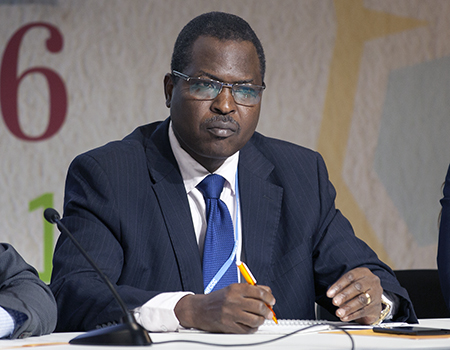
Dr Peter Tarfa
Dr Peter Tarfa, Director, Department of Climate Change (DCC) in the Federal Ministry of Environment

Executive Director of the organisation, Mr Richard Inyamkume, told the News Agency of Nigeria (NAN) in Abuja on Thursday, December 20, 2018 that the project was to train over 100,000 people to support climate action at the grassroots.

“The Chill the Climate project is a capacity building and awareness raising programme aimed at raising over 100,000 climate ambassadors across the federation by 2030 to support climate action at grassroots.

“The project is being implemented in five pilot states – Adamawa, Benue, Lagos, Rivers and Abia.

“It is hoped that through this project, we will increase public awareness about climate change, discourage degradation and encourage green conservation and resources preservation,’’ he said.

The executive director said that the organisation inaugurated 21 female climate ambassadors who were already working in schools and communities, setting up “Climate Care Clubs”.

He added that the ambassadors held first Adamawa Climate Change rally in Dec. 6.

“We are building capacity for 30 climate ambassadors in Benue state. These people will be inaugurated and inducted into the organisation’s ‘One Hundred Thousand Network’,’’ Inyamkume said.

He said that the organisation would hold a climate change rally in January 2019, expressing the organisation’s readiness to reach out to large number of people.

By Deji Abdulwahab

Kenya launches five-year plan to transform arid regions

0

Kenya on Friday, December 21, 2018 launched a five-year plan aimed at transforming Arid and Semi-Arid Lands (ASAL) into reliable economic hubs.

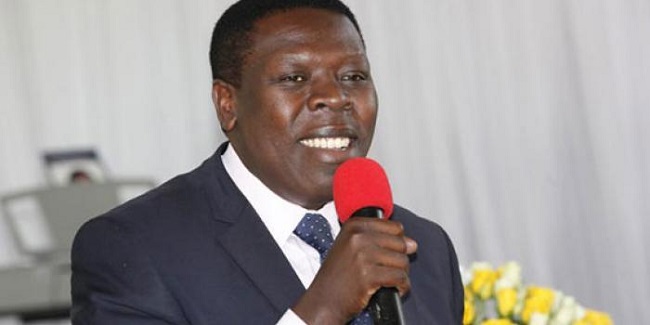
Eugene Wamalwa
Eugene Wamalwa

Mr Eugene Wamalwa, Cabinet Secretary of the Ministry of Devolution and ASALS, said that the 2018-2022 strategic plan targeted livestock, energy, tourism, agriculture, trade and minerals sectors which, he said, were underexploited.

“We want to address the inequalities and vulnerabilities that are currently being experienced in the ASALs in a coordinated manner,” Wamalwa said during the launch.

He said that though the regions faced extreme climatic conditions, leading to devastating effects on the environment and livelihood of communities with spiraling vulnerabilities, they had great potential for development and contributions to national economy.

Wamalwa noted that ASAL regions in Kenya cover 48 million hectares, which is slightly over 80 per cent of Kenya’s total land surface.

“Out of this land mass, 9.6 million hectares support marginal agriculture, 15 million are suitable for sedentary livestock production and 24 million hectares are dry and suitable for nomadic pastoralism,” he added.

Wamalwa said that the government was looking at finding long-term solutions to the problems in the regions by mainstreaming investments as way of finding a lasting sustainable development.

Lagos tasks V.I., Ikoyi residents on clean environment

0

The Lagos State Government has urged Victoria Island and Ikoyi residents to prioritise clean environment by being observant and protective of their immediate environment.

Babatunde Durosimi-Etti
The Lagos State Commissioner for Environment, Mr Babatunde Durosimi-Etti

Commissioner for the Environment, Mr Babatunde Durosinmi-Etti, said on Friday, December 21, 2018 in Lagos that the rate at which the highbrow areas were being defaced was alarming.

Durosinmi-Etti said the ugly development was illegal and capable of causing grave danger to the community.

He, therefore, urged strict adherence to Lagos State laws regarding waste management, noise pollution and the approved master plan of government for the area.

The commissioner said that the situation in which property owners in the area allowed indiscriminate conversion of the residential areas to commercial use was not acceptable.

He said that it had seriously contributed to increase in refuse generation in the area, as well as the attendant illegal dumping of refuse in unauthorised places.

Durosinmi-Etti said that government was commited to attain a clean, healthy and sustainable environment.

He frowned at the ugly development whereby some residents continued to patronise cart pushers and dump waste indiscriminately on the roads in spite several warnings on the environmental and health implications of such acts.

Durosinmi-Etti said that government had repeatedly warned against any abuse of its laws and all acts capable of compounding the challenge of waste management in the state.

He said that there had been proliferation of religious worship centres and Nite clubs in various residential areas in Victoria Island and Ikoyi metropolis and called for caution on the noise level to avoid rancour in the society.

“Any noise above the approved levels contravened the provisions of the National Environmental Noise Standard and Controls Regulations 2009, as well as the Lagos State Environmental Laws 2017,” Durosinmi-Etti said in a statement.

He called for the cooperation of religious centres and club owners on the maintenance of the acceptable noise levels for residential areas, which was 55 decibels during the day and 45 decibels at night.

The commissioner said that they were expected to operate in an enclosed and soundproof environment with regulated use of speakers.

He added that government would not rest on its oars in ensuring that Lagosians inculcate the habit of regular maintenance of their immediate environment, as doing so was a collective responsibility. 

By Florence Onuegbu

Expert advocates management of Ecological Fund by independent body

0

President, Nigerian Meteorological Society, Prof. Clement Akosile, on Friday, December 21, 2018 called on the Federal Government to allow an independent body to manage the Ecological Fund for greater efficiency.

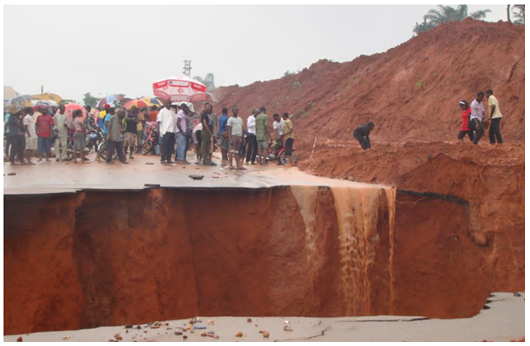
Gully erosion
Gully erosion in southeast Nigeria. The Ecological Fund is meant to be channeled to address such ecological challenges

Akosile said that professional management of the fund by an independent body would enable a more effective application of the fund in tackling ecological problems nationwide.

The professor made the call in an interview with the News Agency of Nigeria (NAN) in Lagos.

According to him, Ecological Fund given to some states was being used to solve problems not related to the environment.

He said that the independent body should work with states and local governments to identify their ecological needs and solve them.

Akosile noted that the country still suffered much environmental problems and, thus, required more effective utilisation of the fund.

He advised that the fund should not be used to solve problems not related to the environment.

“Proper management of the fund is good for the country now and in the future.

“Desert is fast encroaching on land areas in the north, deforestation is going on daily, erosions in some parts of the country are rapidly turning to gullies.

“Our sea shores are disappearing because of coastal erosion,’’ he said.

Akosile added that floods ravaged communities in rainy season and sometimes destroyed human lives and property.

He said that these environmental challenges would be tackled with effective utilisation of the Ecological Fund.

He called for more tree planting to check drought and its attendant drying of lakes, rivers and streams.

The Ecological Fund was established in 1984 for tackling ecological problems in any part of the federation.

Allocation to the fund has been reviewed from one per cent to three per cent of revenues accruing to the federation account.

By Chidinma Agu

Scientist says combating fall armyworm in Africa getting complicated

0

The effort to control the fall armyworm (FAW), a lethal pest that is ravaging food crops, through the application of insecticides is becoming complicated, a scientist warned on Friday, December 21, 2018.

Armyworm
Armyworm invasion

Sunday Ekesi, Director of Research and Partnership at the International Centre of Insect Physiology and Ecology (ICIPE), said the adult pest’s habit of being active at night complicates its management.

“It is strange that the pest’s infestation is only detected after damage has been caused to the crop,” Ekesi said.

Ekesi noted that, unlike other pests, FAW has a diverse range of alternative host plants that enables its populations to persist and spread.

He said that the larval stage of the FAW feeds on more than 80 plant species, including maize, sorghum, rice, wheat, sugarcane, as well as a variety of horticultural crops.

The worm had threatening food and nutritional security, trade, household incomes and overall economy.

The scientist noted that ongoing studies at the global insect research body indicate that FAW develops resistance to some insecticides.

“The performance of such chemicals is also hindered by limited knowledge and purchasing power of farmers, resulting into use of low-quality and often harmful products,” he added. 

Valuers recommend urban-regeneration scheme to boost housing delivery

0

The Nigerian Institution of Estate Surveyors and Valuers (NIESV) says Nigeria should adopt the urban-regeneration scheme to boost its housing delivery and overcome its housing deficit.

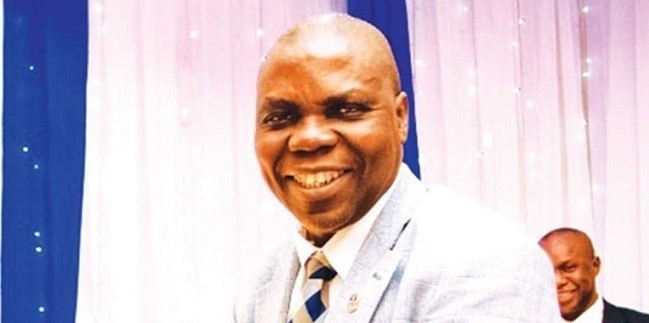
Dr Bolarinde Patunola-Ajayi

Its immediate past president, Dr Bolarinde Patunola-Ajayi, made the observation on Friday, December 21, 2018 while speaking with the News Agency of Nigeria (NAN) in Lagos.

Patunola-Ajayi said that urban regeneration would entail the removal and demolition of the small apartments, shanties, and bungalows that were scattered across the country.

They would have to be replaced with modern structures that would accommodate more people.

He said that this would also entail the complete upgrading of slums which he said formed 70 per cent of the environment.

“Urban regeneration can be in the form of demolishing the shanties to construct modern and high-rise structures that will accommodate more people.

“With urban regeneration scheme, the Public-Private Partnership (PPP) programme will be encouraged.

“The scheme will not completely be a government scheme, it will involve the private sector business ventures.

“All that government needs do is to acquire very large hectares of land and give it to the private sector to develop.

“The government will also be expected to provide the enabling environment and facilities for the private operators to have a smooth operation,” he said.

Patunola-Ajayi said that countries such as China and Singapore embraced the scheme to develop their countries and grow their housing sector.

He, however, said that the scarcity of land had been a major factor hindering the growth of housing development in the country.

According to him, urban regeneration will pave the way for maximum/optimal ultilisation of the limited land to construct the needed number of houses.

“With urban regeneration, land will be optimally ultilised to construct buildings that will accommodate more people because the shanties occupying spaces will be demolished,” he said.

By Lilian Okoro

EU ministers back 15% emissions cut for lorries, buses

0

EU environment ministers agreed on Thursday, December 20, 2018 to cut emissions from lorries and buses for the first time ever, by 15 per cent in 2025 and 30 per cent in 2030.

Svenja Schulze
German Environment Minister, Svenja Schulze

However, one wrinkle came from Germany, the only member state that opted to abstain from the otherwise unanimous vote.

Germany – an important automotive manufacturer – has been among the more reluctant member states to back deep emissions cuts.

German Environment Minister, Svenja Schulze, a Social Democrat, said after the vote that she “would have liked to sign on” to the deal, “but I could not make the case to the Chancellery.”

“Isolating yourself on such an important environmental issue is more than embarrassing,’’ she added.

EU member states must now negotiate these standards with the European Parliament before they take effect.

They are in line with a European Commission proposal made in May, but they are less ambitious than those of the European Parliament, which seeks a 35 per cent cut in 2030.

Whatever the outcome, the plan would mark the first time that the EU would place such restrictions on lorries and buses.

“This is part of our efforts to decarbonise the road transport sector and an important step towards achieving the goals we have agreed under the Paris Agreement,” said Austrian Environment Minister, Elisabeth Koestinger, whose country holds the rotating EU presidency.

The 2015 Paris Agreement calls for global warming to be kept to well below 2 degrees Celsius above pre-industrial levels and preferably to less than 1.5 degrees.

The bloc has also taken action on other types of vehicles.

Earlier this week, EU negotiators struck a deal to cut car emissions by 37.5 per cent by 2030, compared to a 2021 ceiling of 95 grams of CO2 per kilometre.

The targets are part of EU efforts to reduce CO2 emissions and limit global warming.

Vehicle exhaust fumes make up a large share of the emissions linked to climate change.

Still, resistance among manufacturers remains strong.

That is a mistake for market reasons, Schulze argued ahead of the talks on Thursday, adding that the incentives to sign on to emissions cuts are compelling.

“The market for heavy goods vehicles (HGVs) is completely different from that for cars,” she said.

“An HGV can only be sold if it is as efficient as possible and uses as little fuel as possible.”

Ivory sales ban becomes law in UK

0

What is widely considered one of the world’s toughest bans on ivory sales became law in the UK on Thursday, December 20 as the Ivory Bill gained Royal Assent to become the Ivory Act 2018.

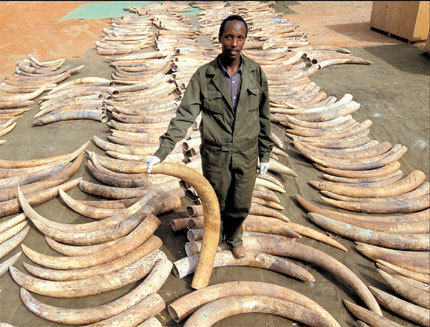
Ivory trafficking
Ivory trafficking. Photo credit: girlegirlarmy.com

African countries on the frontline of the elephant poaching crisis have welcomed the new Ivory Bill passed by the UK Parliament, which introduces tough new rules on the commercial trade of ivory in, from and to the UK, as “a significant moment for elephant conservation”.

In a signed declaration, senior representatives from 13 countries belonging to the Elephant Protection Initiative (EPI), an alliance of African states with common policies on elephant conservation, said: “We believe the UK’s new law will have an impact not only within its borders but will also support and encourage enforcement efforts and initiatives to reduce ivory trafficking in Africa, and around the world.”

The EPI includes Botswana, Gabon, Kenya and Tanzania, which have some of the largest remaining elephant populations in Africa. Other EPI countries which signed the declaration are Angola, Chad, the Republic of Congo, Ethiopia, Liberia, Malawi, Nigeria, Sierra Leone and South Sudan.

EPI countries, it was gathered, have already shut down their own domestic ivory markets, or are in the process of doing so, arguing that any legal ivory trade provides a cover for the illegal trade and sustains demand for poaching. Some 20,000 elephants are reportedly killed in Africa each year, mostly for ivory which is ultimately destined for Asia.

In their declaration, the EPI countries said, “Poaching is big business, run by ruthless networks that thrive on, and create, lawlessness. It is linked to the trafficking of weapons, drugs and the spread of terror. Hundreds of our wildlife rangers have been killed trying to defend elephants from well-armed poachers.”

The EPI countries hope others will now follow the UK’s example.

“We need global action to end the ivory trade for good,” the countries said in a statement made available to EnviroNews, “and we strongly urge other governments which have yet to adopt similarly tough measures to follow suit, particularly the EU and Japan, two of the principals remaining legal markets for ivory.”

Signatories

  • Angola: Paula Coelho, Minister for the Environment
  • Botswana: Tshekedi Khama, Minister of the Environment
  • Chad: Sidick Abdelkerim Haggar, Minister of the Environment
  • Republic of Congo: Rosalie Matondo, Minister of Forest Economy
  • Ethiopia: Prof. Fekadu Beyene, Commissioner of Environment, Forestry and Climate Change
  • Gabon: Prof Lee White, Director, Gabonese National Parks Service (ANPN)
  • Kenya: Najib Balala, Cabinet Secretary of the Ministry of Tourism and Wildlife
  • Liberia: Hon C. Mike Doryen, Managing Director of the Forestry Development Authority (FDA)
  • Malawi: Brighton Kumchedwa, Director, Malawi’s Department of National Parks and Wildlife (DWNP)
  • Nigeria: Ibrahim Usman Jibril, Minister of the Environment
  • Sierra Leone: Fatima Jabbie Maada Bio, First Lady
  • South Sudan: Jemma Nunu Kumba, Minister for Wildlife
  • Tanzania: Dr. Hamisi Kigwangalla, Minister for Natural Resources and Tourism.

The EPI is a coalition of 19 African Elephant Range States, with common policies on elephant conservation. Most of Africa’s surviving elephants are said to be in EPI countries.

GEF Council approves first work programme of new funding cycle

0

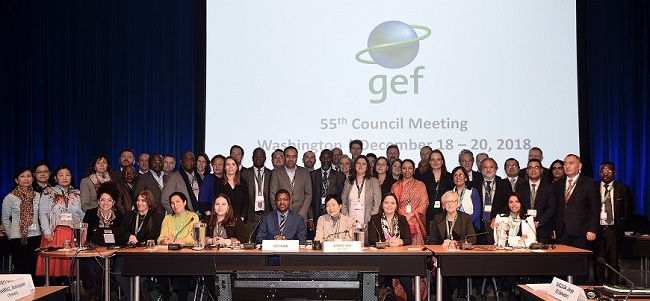
The 55th Global Environment Facility (GEF) Council meeting wrapped up on Thursday, December 20 2018 following the approval of its first work programme under its new, four-year investment cycle, known as GEF-7, and a series of decisions that will firm up its implementation policies and procedures.

GEF Council Meeting
Delegates at the 55th Global Environment Facility (GEF) Council meeting

The work programme, made up of 18 different projects benefiting 25 countries around the world, will require $157.8 million, and is expected to attract an indicative $819.7 million in financing from other sources.

Closing the meeting, Naoko Ishii, GEF CEO and Chairperson, thanked council members for the “extensive, rich and fruitful three days.” Repeating her call at the Council opening for “urgent action to get back on track”, she said much progress has been made, and “now GEF-7 can start!”

“We have reviewed different policies and modified them to provide a framework that will make the GEF work better,” said Abdul Bakarr Salim, Deputy Director of the Environment Protection Agency, Sierra Leone, and co-chairperson of the 55th GEF Council.

The three-day Council meeting, the first to be held since governments endorsed the new GEF-7 strategy and the accompanying $4.1 billion replenishment of its trust fund, approved various measures to further improve the GEF’s efficiency, accountability and transparency.

This includes new policy procedures to speed up the preparation, endorsement, implementation, and closure of projects, and, among other things, new policies to improve access to information, and an updated policy on environmental and social safeguards throughout the GEF project and programme cycle.

The Council received reports from the GEF’s Scientific and Technical Advisory PanelIndependent Evaluation Office, and held discussions on GEF’s relations with multilateral environmental agreements, the GEF-7 Non-Grant Instrument Programme, and options for responsible investment of funds in the GEF Trust Fund.

Following the well-received special session on gender at this year’s Civil Society (CSO) Forum, the Council decided that plastics management to avoid pollution would be the topic for the CSO consultation at the 56th GEF Council meeting in June 2019.

Immediately following the 55th GEF Council, a meeting of the 25th Least Developed Countries Fund (LDCF) / Special Climate Change Fund (SCCF) Council was held. The first work programme in GEF-7 for LDCF, consisting of six projects and requesting a total of $45.85 million, was approved.

In a demonstration of growing support for adaptation efforts by some of the most vulnerable countries to the impacts of climate change, the following pledges were announced by council members on behalf of their governments.  

For LDCF: Belgium, Walloon Region (€2.9 million), Denmark (Kr.150 million), Finland (€2 million), France (€20 million), and The Netherlands ($9.1 million). Switzerland announced a commitment of $13.25 million over four years to the LDCF and SCCF, with 75% going to the LDCF. Sweden highlighted its contribution of kr135 million to LDCF in 2018. Germany will finalise its contribution payments of €25 million before the end of the year.

Work Programme

Specific projects include: the long-term conservation and management of critical and threatened sites and species along the globally important East Asia-Australasian Flyway, by establishing a robust, resilient, and well-managed network of protected wetlands for endangered migratory water birds in China; transforming Sharm El Sheikh in Egypt into a sustainable tourism city by a whole host of measures including promoting low-carbon urban development, renewable energy generation, better waste management and recycling, and protecting the sea and coastal areas; and tackling substantial and alarming environmental degradation from pollution and overfishing in Africa’s Lake Victoria.

Two projects in Chile will support decarbonisation by fostering deployment of district energy systems which can cut emissions by 90 per cent and improve catching and management practices in fisheries over 1.7 million hectares of sea. Another two, in Turkey, will promote replacing persistent organic pollutants with environmentally sound alternatives in its extruded and expanded polystyrene foam industries and increasing the use of wood in buildings, thus reducing the embedded carbon content of construction materials.

Two more will tackle mercury pollution in Mexico and Argentina, while a regional project in Central Asia will assess and address the impact of climate change on glaciers in Kazakhstan, Turkmenistan and Tajikistan. The last project represents the first half of an allocation of $128 million under GEF-7 for the Small Grants Programme to provide grants to civil society and community-based organisations tackling global environmental issues in 107 countries.