Australia has just sweltered through its hottest summer on
record, the country’s Bureau of Meteorology (BoM) said on Friday, March 1, 2019.
Melbourne, Australia
“The starkest feature of this summer was the record warmth,”
the bureau said in a weather report.
The national average temperature from December to the end of
February was 2.14 degrees Celsius above average, easily beating the previous
record of 1.28 degrees Celsius above average in summer 2012 and 2013.
The long-term national average is 27.5 degrees Celsius,
which is a reference point used as a baseline for determining temperature
anomalies.
“For the country as a whole it is the warmest summer on
record for mean, maximum and minimum temperatures,” the BoM said.
January was the hottest month since records began, with mean
temperature across the country exceeding 30 degrees Celsius for the first time.
Australia saw its third-hottest year on record in 2018,
during which it experienced a massive drought.
The bureau said very low rainfall had accompanied the latest
summer’s record heat.
“At the national scale, each month was notably dry, and
total summer rainfall was 32 per cent below average, the lowest for summer
since 1982 and 1983,” the BoM added.
In “a summer of extremes,” Australia has experienced severe
weather including massive floods, damaging bush fires and worsening drought,
which is still ongoing in parts of the country.
The Green Climate Fund (GCF) has approved the Solar IPP Support
Programme for Nigeria, which is expected to benefit no less than one million
households in the country.
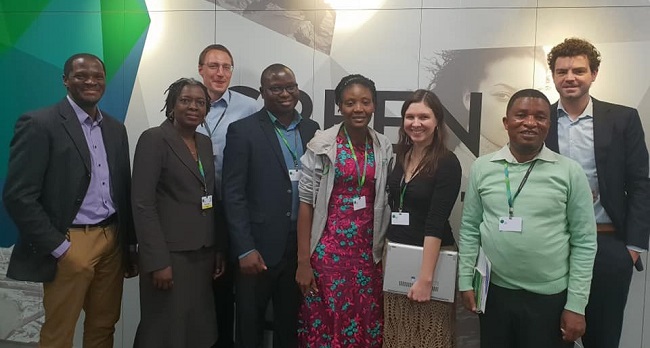
A group of delegates at the 22nd Meeting of the Green Climate Fund Board in Songdo, South Korea
The $100 million project forms part of the nine new climate
resilience and low emission projects totaling $440 million that were endorsed
at the 22nd meeting of the GCF Board that ended on Thursday, February 28, 2019 in
Songdo, South Korea.
According to sources, the Nigerian project will “reduce
or avoid 476,487t CO2 eq on an annual basis, and 9,529,739 t CO2 eq. over the
life of the programme”. The programme is also expected to reduce the perceived
risks of investing in the Nigerian renewable energy sector and catalyse private
sector investment in the area, through a commercial tranche, on a best effort
basis.
At the meeting that saw the selection
of Yannick Glemarec as its new Executive Director, the GCF took steps
to strengthen operations, reinforce standards and close policy gaps. The
meeting also approved the selection of nine new project partners to become
Accredited Entities to GCF.
Co-Chair, Nagmeldin Goutbi Elhassan Mahmoud, said: “We have
taken a series of positive decisions at this Board meeting that set us on a
path for a successful and ambitious replenishment of GCF, in particular the
selection of Yannick Glemarec as our new Executive Director.”
Co-Chair, Josceline Wheatley, stated: “The Board has worked
together in a positive spirit this week to expand our portfolio, improve our
governance, and strengthen GCF’s operations.”
Javier Manzanares, Executive Director ad interim, noted:
“GCF now has a $5 billion portfolio in 97 countries supporting low-emission,
climate-resilient development. With decisions to ensure better governance, new
project approvals, and a reinforced readiness programme, this Board meeting has
left us in great shape for our first replenishment.”
The nine new project approvals bring GCF’s portfolio to a
total of 102 projects and programmes, committing $5 billion of GCF resources
for climate action in 97 developing countries. Including co-financing, the
portfolio channels $17.7 billion in climate finance through its network of 84
Accredited Entities. The new approvals include the first REDD+ results-based
payments to be financed, relating to the Brazilian Amazon.
Providing readiness support to build the capacity of
developing countries is a key part of GCF’s activities. The Board took note of
the evaluation of the Readiness and Preparatory Support Programme by the Independent
Evaluation Unit and adopted a work programme and budget that builds upon the
evaluation findings and recommendations and provides $122.5 million for 2019
for a new phase of readiness support to developing countries.
Ahead of a pledging conference for the first replenishment
of GCF later this year, the Board meeting also moved to complete the policies
and standards that guide GCF’s climate activities. New investment criteria
indicators will strengthen the implementation of the investment framework,
whilst a policy on cancellation and restructuring of projects will further
reinforce the good management of its portfolio of projects.
The Board also welcomed recommendations from the Independent
Evaluation Unit on how to improve the Results Management Framework, as well as
a management response and action plan. The adoption of a policy on protection
from sexual exploitation, sexual abuse and sexual harassment, together with
guidelines and procedures for the Independent Redress Mechanism ensures that
GCF remains at the forefront of international efforts on safeguards and
standards.
The 22nd GCF Board meeting approved the following projects
and programmes:
FP100 – $96.5 million for REDD+ results-based payments for results achieved by Brazil in the Amazon biome in 2014 and 2015 with UNDP
FP101 – $8.0 million for Resilient Rural Belize (Be-Resilient) with IFAD
FP102 – $29.6 million for Mali solar rural electrification project with BOAD
FP103 – $18.8 million for Promotion of Climate-Friendly Cooking: Kenya and Senegal with GIZ
FP104 – $100 million for Nigeria Solar IPP Support Programme with AFC
FP105 – $69.6 million for BOAD Climate Finance Facility to Scale Up Solar Energy Investments in Francophone West Africa LDCs in Benin, Burkina Faso, Guinea-Bissau, Mali, the Niger, and Togo with BOAD
FP106 – $100 million for Embedded Generation Investment Programme (EGIP) in South Africa with DBSA
The following projects were also approved under the
Simplified Approval Process (SAP):
SAP005 – $9.0 million for Enhanced climate
resilience of rural communities in central and north Benin through the
implementation of ecosystem-based adaptation (EbA) in forest and agricultural
landscapes with UN Environment
SAP006 – $8.9 million for Building resilience of
communities living in landscapes threatened under climate change through an
ecosystems-based adaptation approach in Namibia with EIF
The GCF Board also approved the accreditation application of
the following entities:
Alternative Energy Promotion Centre (AEPC) based
in Nepal
Environmental Project Implementation Unit (EPIU)
of the Ministry of Nature Protection of the Republic of Armenia
Fondo Mexicano para la Conservación de la
Naturaleza A.C. (FMCN) based in Mexico
National Fund for Environment and Climate (FNEC)
of Benin
Pacific Community (SPC) based in New Caledonia
JS Bank Limited (JS Bank) based in Pakistan
Attijariwafa Bank (AWB) based in Morocco
Macquarie Alternative Assets Management Limited
(MAAML) based in Australia
Luxembourg Agency for Development Cooperation
(LuxDev) based in Luxembourg
The Nigerian Meteorological Agency (NiMet) has advised
farmers to ignore the current early rainfall across the country and not start
early planting.
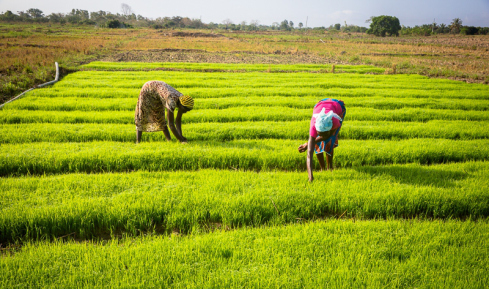
Women in engaged in dry season rice farming through irrigation
Mr Zakariyau Abdulrasheed, General Manager, NiMet’s Network
Services, gave the warning in an interview with the News Agency of Nigeria
(NAN) on Thursday, February 28, 2019 in Abuja.
Abdulrasheed said that the agency, in its 2019 Seasonal
Rainfall Prediction (SRP), had issued an early warning to farmers and others
who depended on rainfall for other uses, to be guided accordingly with the
early start of rains.
He said that the agency still stood by what it had
predicted, adding that NiMet would continue to monitor the climate and inform
the public on any new developments.
“In our seasonal rainfall prediction, we predicted that
there would be late on set of rains in many parts of the country.
“We still stand by that prediction and we are advising farmers
to adhere strictly to the early warning to avoid losses.
“The rain you are having now, especially around the North
central, is weather variations that occurs from time to time.
“It is the fluctuations of Inter-Tropical Discontinuity
(ITD) northwards.
“This is not an onset of growing season; therefore, farmers
are advised to be patient because we predicted that rainy season would commence
in April.
“If there is going to be any change, we will inform the
stakeholders and the general public about any new finding,” he said.
NiMet had predicted lower-than-normal rainfall over most
parts of Nigeria in 2019 with an expected late start of rains in the north.
It also predicted that the south-eastern zone and the
coastal areas would experience the normal onset of rains.
The Lusaka-based Zambia Alliance for Agroecology and Biodiversity
(ZAAB) is worried about some aspects of genetically-modified organism (GMO)
governance in the country, particularly those relating to importation of processed
GMO food products on one hand and, on the other, the ongoing policy amendments
to change the country position on production of live GMO crops. ZAAB lists
inherent grey areas and urges the authorities to act
GMOs
Importation of
processed GMO food products and the limitation to public participation
The NBA is working hard to ensure food products are regulated and go through the correct licensing processes.
The ability of the public to object to these imported
products, as per their legislated rights, is however extremely constrained. For
citizens to participate in the pubic consultation process and object to GMO
food imports, they must physically visit the NBA offices in Lusaka, and are
then allowed to view only the non-confidential elements of the application
dossier. The application details may not be copied electronically or
distributed to those not in the capital city. Objections based on scientific
analysis, submitted within the 30-day window, are then considered by the NBA
scientific advisory board.
The admired position and legacy of Late president Mwanawasa
was that all citizens, and the nation, have a right to be protected and fully
engage in GMO decision making processes. This was not limited to those
privileged and able to compile scientific objections. It also included
consumers concerned about social, economic, cultural and ethical issues. It
considered market gaps, or opportunities to instead protect Zambia’s market and
enhance value addition and support local livelihoods.
For importers to simply publish an advert in two newspapers
and submit an application dossier to the NBA offices – that is only accessible
to an elite minority in Lusaka – does not constitute public consultation. This
argument is backed up by the fact that the NBA has never received a
scientifically considered objection to an application. Given public opinion,
the lack of objections does not reflect the wishes of the Zambia public. It
instead reflects the inaccessibility and limitations of the public consultation
process.
Many citizens have recently been horrified to find out that
GMO processed products are entering Zambia and that the ACT facilitates this.
The public have a right to a broad and accessible consultation process, to effectively
engage in decision making on GMO products. If public consultation processes
cannot be duly filled, then perhaps the products should not be imported, and
Zambia’s non-GMO market protected, and local diversified production and processes
supported instead?
Ongoing policy review
processes and national concerns, that are unaddressed by the Ministry of Higher
Education and related authorities
In September 2017, the NBA/MoHE held an exclusive initial
consultation process on a new draft of the national biosafety policy, in
collaboration with COMESA and NEPAD. In December 2018, another exclusive
meeting was held, in collaboration with Gates funded ANBE, to develop
regulations for the release of LIVE GMOs in Zambia. I.E. the production of GMO
crops. ZAAB fully appreciates that ministries update policies from time to time
and that stakeholders have been promised national consultation on this matter.
However, if the Ministry of Higher Education and the NBA are
indeed neutral in their policy position, then why are they allowing pro-GMO
institutions to help craft Zambia’s new national policy and regulations – that
in draft are written to favour the promotion, of GMOs? The ABNE is funded by
the Gates foundation that has spent millions of dollars trying to develop GM
crops and smooth the regulatory environment for the introduction of GMOs across
Africa. The ABNE may be the advisory body to the Africa Union, of which Zambia
is a part, but this does not mean that as citizens we should just accept their
role in writing national policies that are meant to protect and uphold
sovereign interest.
The NBA has shot back at ZAAB and other CSOs for objecting
to the ABNE and Gates influence in national policy development, arguing that it
made economic sense to use experts available to it through the continental
body, despite their well-known pro-GMO position. We remain opposed to this
biased interference in national legislation drafting.
If the Ministry of Higher Education does not have the
financial resources to draw on local expertise to craft its policy documents,
then it does not have the financial resources to manage live production,
adequate nation-wide testing, control export and imports, or contamination of
seed and local food systems. It cannot deal with long term ecological, social
and health impacts; loss of biodiversity, further malnutrition and soil
infertility. It certainly does not have financial resources to compensate the
economic opportunity costs of changing Zambia’s advantageous NO-GMO position.
The primary element within the current National Biosafety Policy of 2003, is its basis on the precautionary principle, and directive for strong liability and redress. These are the two major aspects of the national legislation that will be weakened if amendments are approved.
Until then, GMO producers (biotech industry) will not apply
for license in Zambia, because they do not want to be held accountable for the
negative consequences or contamination arising from their technology. Industry
have made this clear and hence why they want policy changed.
The ABNE is a key service provider within the Programme for Biosafety Systems and the Agriculture Biosafety Support Project, launched by the United States to fight back against the strong precautionary stance taken by African countries in the development of the Cartagena Protocol (something that Zambia proudly stood by). These high-profile projects of the US aim to align African and Asian policy environments with the USA goals: the widespread adoption and acceptance of GM food from the US, enabling dumping of GM food onto local markets and control of African agriculture production. The International Services for the Acquisition of Agriculture-biotech Applications (ISAAA) recently quoted in media and known for their unsubstantiated statistics to boast of adoption of GMOs around the world, are part of this same US-backed project, funded also by private sector itself.
ZAAB wants policy makers to recall where Zambia’s GMO history comes from. As far as the people of Zambia are concerned, Zambia remains a No-GMO country. The NBA mentioned that this was the “old position”. For this position to change though, requires the citizens of Zambia to firstly, demand for this change. It is not for multinational seed and agrochemical companies or pro-GMO policy lobby bodies to enable this change.
ZAAB appreciates that the NBA are working hard to increase
public communication mechanisms despite minimal public funding. We recognise
that the MoHE has assured the public of consultation prior to policy changes;
and applaud decision makers working to ensure this happens in a genuine manner.
However, we remain with extremely concerned citizens who ask why given economic
constraints, the Ministry is going ahead with developing regulations that will
fundamentally change Zambia’s GMO position, and accepting support from pro-GMO
policy lobby groups in the policy re-drafting phases. It is well documented
that global GM crop production has primarily benefited transnational
corporations and the wealthy, rather than the poor and hungry of the world.
We again appeal to the Ministry of Higher Education, the NBA
and related decision makers to uphold the best interests of Zambia’s people, as
well as its economy; to implement commitments to diversify the agriculture
sector and enable the realisation human rights for all.
Parliamentary State Secretary at Germany’s Federal Ministry
for the Environment, Rita Schwarzelühr-Sutter, has honoured schools with
outstanding “student companies” for their commitment to
sustainability and climate protection.
Rita Schwarzelühr-Sutter
The award is part of the education project tagged: “StartGreen
@ School”, which supports the foundation of sustainable student companies. The
project is funded by the National Climate Initiative of the Federal Ministry
for the Environment with a sum of €940,000.
She recently handed over certificates to three successful schools
in Berlin, Hamburg and Frankfurt / Oder under the initiative.
Schwarzelühr-Sutter said: “The founding of a student
company demonstrates commitment and responsibility among the students and is a
valuable experience and preparation for their future working life. If
these student companies then also protect the climate and the environment,
there are only winners. The young people become important multipliers and
learn in practice how sustainability and successful business go together.”
The award and certificate handover took place on Wednesday,
February 27, 2019 at the 9th International Student Company Fair.
The following schools and projects were awarded:
The Johannes-Schule-Berlin, with the company
ArtisFeria, which offers break-time fairtrade products, snacks and coffee as
well as cocoa from Peruvian Fairtrade cooperatives
The district school Walddörfer in Hamburg with
the student company “The Green Collective”, which sold in a cooperating
nature school in the course drawn plants and produced their agricultural
products
The Konrad-Wachsmann-Oberstufenzentrum in
Frankfurt / Oder with the student company X-Mix, which offers smoothies and
soups as a break catering
According to the organisers, the student companies are not real business enterprises, but school projects that provide insights into professional life. The goal is that the students learn to plan and produce independently and to sell the created products at the same time or also to offer services.
The StartGreen @ School project, which was funded by the
national climate protection initiative, was honoured in 2017 by the Federal
Ministry of Education and Research and the German UNESCO Commission as an
“outstanding” educational initiative.
Through the services offered by StartGreen @ School, the participating teachers and pupils can experience how they can combine and realise innovative climate protection projects and start-up ideas, thereby helping to shape their immediate living environment in a participatory manner. Through concrete action they also experience a high degree of self-efficacy. They learn that they can contribute to the transformation of the economy and thus contribute to achieving the climate protection goals. Through networking, young people are motivated to start a sustainable business after school.
StartGreen @ School is a joint project in which the Borderstep Institute for Innovation and Sustainability, the Institute Futur of the FU Berlin and BildungsCent eV are involved in addition to UnternehmensGrün eV (joint management). It runs until September 30, 2019.
Two typhoon names – Mangosteen and Rumbia – have been
retired, due to the significant damage they caused in 2018, by a typhoon
committee.
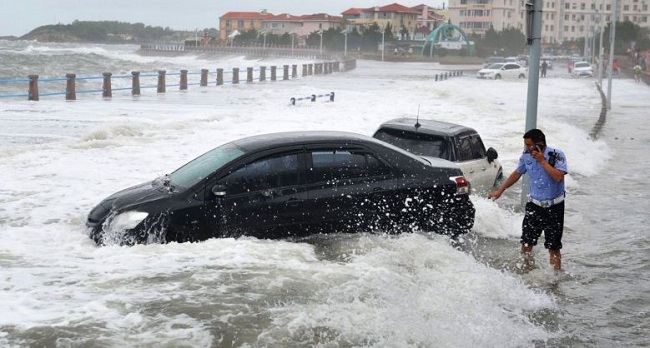
Typhoon Rumbia making a landfall
The Typhoon Committee, an intergovernmental body under the
Economic and Social Commission for Asia and Pacific (ESCAP) and the World
Meteorological Organisation (WMO), made the decision at the ongoing 51st
session on Thursday, February 28, 2019 in Guangzhou, the capital city of
southern China’s Guangdong province.
Mangosteen and Rumbia, the 22nd and 18th named storms,
caused extensive destruction in the Asia-Pacific region in 2018.
In China, coastal provinces, including Shandong suffered
from severe floods after Typhoon Rumbia.
At least 3.8 million people were affected, with six dead and
15 missing.
The committee started to name tropical cyclones in the
northwestern Pacific and the South China Sea since 2000.
Each of the 14 members of the committee, including Cambodia,
the Chinese mainland, Thailand, the Republic of Korea, the Democratic People’s
Republic of Korea, Hong Kong and Japan submitted 10 names.
Thailand and Malaysia who picked the names Mangosteen and
Rumbia are able to offer new typhoon names in the next session.
Three new names submitted by Japan and Hong Kong to replace
removed names in 2017 have been approved in the session.
The Typhoon Committee has removed 45 typhoon names within
the northwestern Pacific and the South China Sea.
Countries have been urged to protect vulnerable wetland
ecosystems as part of their climate strategies, and to learn from each other’s
experiences to sustainably manage them. Tropical peatlands are one of the main
carbon sinks in the planet, but are under threat from activities such as
agriculture, infrastructures and mining.
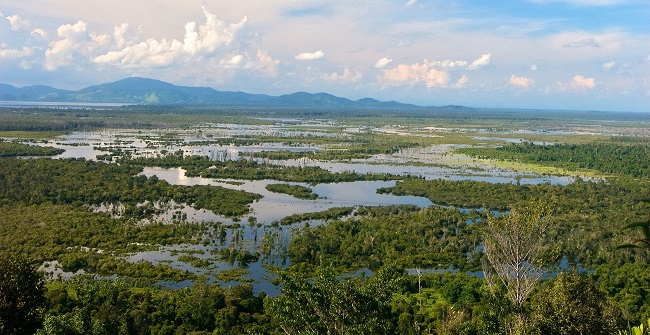
Peatlands
The message is forms the kernel of a research published in a
special issue of the Springer journal Mitigation
and Adaptation Strategies for Global Change. It presents nine
papers from Indonesia, the Congo basin and the Peruvian Amazon, offering
new insights to help policy-makers balance development, climate and
conservation goals.
Titled: “Tropical peatlands under siege: the need for
evidence-based policies and strategies”, the study was led by the Centre for
International Forestry Research (CIFOR) in collaboration with the US Forest
Service and with USAID’s support.
“Peatlands present us with a golden opportunity to confront
climate change, but we need policy-makers and scientists to work hand-in-hand
in the creation of sound strategies,” says Centre for International Forestry
Research principal scientist, Daniel Murdiyarso, on behalf of the other
Guest Editors Erik Lilleskovand Randy Kolka of the US Forest
Service.
“It is also vital that countries exchange knowledge to avoid
tripping over the same stone twice when it comes to peatland conservation and
management,” he adds.
Tropical peatlands in Southeast Asia continue to be
converted at an alarming rate – particularly in Indonesia, where peatland
development for oil palm and pulpwood took off in the 80’s. Peatlands in the
Amazon and Congo Basin are a lot less degraded, but they might follow the same
unsustainable pathway if they do not take action, warn researchers.
The document explores how lessons learned from Indonesia can
inform policies to protect relatively intact peatlands in Peru and the Republic
of Congo, noting that in these three regions alone peat swamp forests cover a
total of 50 million hectares and store up to 3,000 tons of carbon per hectare.
Scientists emphasize the need for strong policies that protect peatlands from
hydrocarbon mining and infrastructure development and call on countries to
exchange practical knowledge before it is too late.
The research has other policy implications. For
example, the papers identify drivers of conversion and can be used to refine
emission factors – essential to quantifying greenhouse gas emissions from the
degradation of peatlands. “The data reported in this special issue enriches
existing information, including the emission factors in the Wetland Supplement
of the IPCC guidelines,” notes the document.
Studies also unravel peatland hydrology – vital to restoring
drained ecosystems – and investigate better ways of modeling and remotely
monitoring water regimens. All this knowledge could be harnessed by national
bodies such as the Indonesian Peatland Restoration Agency, tasked with
restoring more than two million hectares of degraded peat swamp forests by
2020.
For authors, a deeper understanding of peatland
characteristics is important for countries to deliver on both national
priorities and global climate goals. For instance, through evidence-based REDD+
programmes and nationally appropriate mitigation actions (NAMAs).
“Policies that recognise peatlands as a unique and yet
vulnerable ecosystem type at the national level, alongside an appropriate
valuation of their ability to store carbon over long periods of time, could up
their chances of remaining carbon sinks rather than becoming major sources of
greenhouse gases,” conclude the authors of the synthesis of the nine papers
published in the issue.
The US Senate on Thursday, February 28, 2019 approved former
coal lobbyist Andrew Wheeler to head the Environmental Protection Agency by a
vote of 52 to 47, elevating a veteran of Washington political and industry
circles who has advanced President Trump’s push to rollback Obama-era
environmental regulations.
Wheeler, who began his career at EPA during the 1990s but spent years on Capitol Hill before heading to the private sector, has won praise from Republicans for his deregulatory agenda but criticism from Democrats for his refusal to act on climate change and several public health priorities.
He has been running the agency since Trump’s first administrator, Scott Pruitt, stepped down in July amid multiple scandals surrounding his management and spending practices. Trump said in November that he intended to nominate Wheeler for the top job, saying he had done a “fantastic job” in his interim role.
At his
confirmation hearing in January, Wheeler highlighted dozens of
significant rules that the EPA has begun to roll back during the past two
years, and he made clear to lawmakers that he intended to continue the Trump
administration’s reversal of environmental regulations.
“Through our deregulatory actions, the Trump administration
has proven that burdensome federal regulations are not necessary to drive
environmental progress,” Wheeler said at the time. “Certainty, and the
innovation that thrives in a climate of certainty, are key to progress.”
Despite the litany of rollbacks, the EPA under Wheeler also
has rolled out initiatives aimed at reducing lead exposures around the country
and providing oversight for a class of unregulated, long-lasting chemicals
known as perfluoroalkyl and polyfluoroalkyl compounds, or PFAS, that pose
serious health risks to millions of Americans. But the agency has yet to take
definitive regulatory action on those proposals.
One Republican, Sen. Susan Collins of Maine, voted against
Wheeler’s confirmation Thursday on the grounds that he had worked to water down
federal rules curbing greenhouse gas pollution from power plants, as well as
weaken fuel standards for the nation’s cars and pickup trucks.
“I believe that Mr. Wheeler, unlike Scott Pruitt, understands the mission of the EPA and acts in accordance with ethical standards; however, the policies he has supported as Acting Administrator are not in the best interest of our environment and public health, particularly given the threat of climate change to our nation,” Collins, who supported Wheeler’s confirmation as deputy EPA administrator last year, said in a statement.
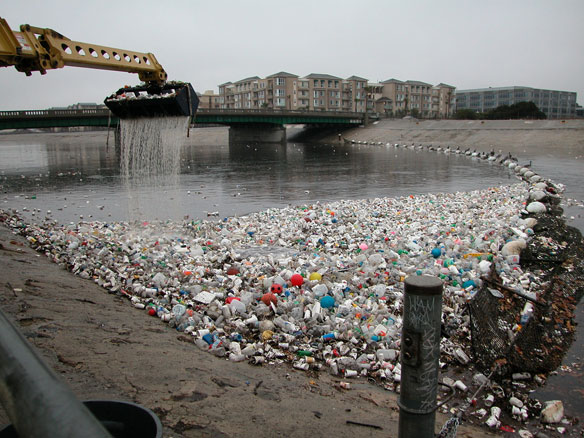
American scientists have developed what appears to be a more
effective and greener way to recycle the single-use plastics made from a common
polyester material.
Plastic pollution
The greener way to recycle could help protect oceans from
plastic waste by jumpstarting the recycled plastics market.
The researchers from the U.S. National Renewable Energy
Laboratory (NREL) combined reclaimed polyethylene terephthalate (PET) with
molecules derived from waste plant biomass to produce two types of
fiber-reinforced plastics.
The fiber-reinforced plastics are two to three times more
valuable than the original PET, according to the study published on Wednesday
in the journal Joule.
PET is a strong, light-weight and water-resistant material widely used in beverage bottles, clothing and carpet.
It is recyclable but tends to have a lower value than the
original and can only be reproduced once or twice.
“Standard PET recycling today is essentially ‘downcycling,’’
said the paper’s senior author Gregg Beckham with NREL.
The new process “upcycles” PET into long-lifetime, high-value composite materials that would be used in car parts, wind turbine blades or surfboards, said Beckham.
Although still in a lab stage, the researchers predicted
that the composite product would require 57 per cent less energy than the
current recycling process and would emit 40 per cent fewer greenhouse gases
than standard fiber-reinforced plastics production.
But the researchers still have to test the process for
scalability to determine how well it might fare in a manufacturing setting,
according to the study.
China plans to help control desertification along artery
roads in eight Central Asian and African countries, said Zhang Jianlong,
Director of the National Forestry and Grassland Administration.
Ibrahim Thiaw, Executive Director of the UNCCD
Jianlong said this at a UN Convention to Combat
Desertification (UNCCD) meeting held in Guiyang, capital of southwest China’s
Guizhou Province.
Discussions are underway as China expects the Secretariat of
the UNCCD to apply for the Chinese investment of about $2 million within the
country’s fund to support South-South cooperation, said Jianlong.
China is also compiling a list of desertification
technologies and demands for Belt and Road countries as part of its efforts to
promote international prevention and treatment of desertification, Jianlong
said.
China has achieved remarkable progress in desertification
control over the years by launching major ecological projects, including the
Three North Shelterbelt Project (or Sanbei Shelter-forest Project) and the
project of turning marginal farmland into forests.
A recent NASA research shows that China and India account
for one-third of the Earth’s greening during the past two decades, an area
equivalent to the Amazon rainforest.
“The economic loss due to land degradation is estimated at $1.3
billion a day.
“Every minute, 23 hectares of land are being degraded,” said
UNCCD’s Executive Secretary Ibrahim Thiaw.
Thiaw called for worldwide efforts to conquer the “cancer of the Earth” that is affecting more than 1.5 billion people worldwide.
Established in 1994, the UNCCD aims to improve the living conditions for people in dryland and achieve a land-degradation-neutral world consistent with the UN’s 2030 Agenda for Sustainable Development.