

African stakeholders, including ministers, senior officials, experts and experts and representatives of civil society, adopted the Addis Ababa Declaration entitled “Turning the Corner”, calling for urgent, coordinated and transformative action to accelerate the implementation of the Sustainable Development Agenda on the horizon 2030 and Agenda 2063.
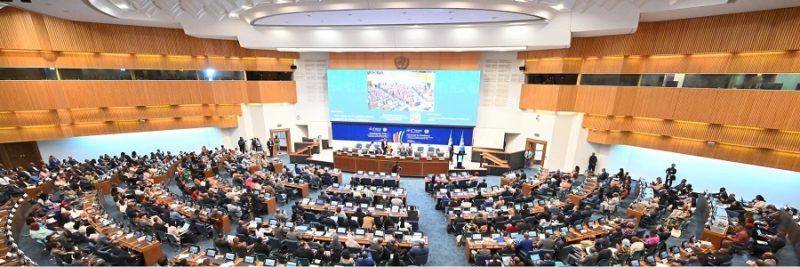
The Declaration was adopted at the end of the twelfth session of the African Regional Forum on Sustainable Development, held in Addis Ababa, from April 28 to 30, 2026, on the theme: “Turning the tide: transformative and coordinated actions for the 2030 Agenda and of Agenda 2063”.
The Forum brought together ministers, senior officials, parliamentarians, experts, representatives of the United Nations, the African Union Commission, the African Development Bank, regional organisations, civil society, academia, the private sector, youth, cultural institutions and religious communities.
The participants noted with deep concern that Africa is still far from achieving the Sustainable Development Goals (SDGs), with 12 of them making slow progress and five in decline. The Declaration highlights important gaps, including limited access to clean water and sanitation, energy poverty that affects approximately 600 million Africans, insufficient industrialisation, rapid urbanisation, rising debt and an annual financing gap for the SDGs estimated at between $670 billion and $848 billion.
Through this Declaration, African countries urged to intensify their efforts in five areas of the SDGs, currently under review in 2026: Clean Water and Sanitation; clean and affordable energy; industry, innovation and infrastructure; sustainable cities and communities; and partnerships for the achievement of the goals.
On water and sanitation, ministers called for strengthened political leadership, sustainable financing, and better water governance, protection of ecosystems, reduction of pollution, expansion of wastewater treatment and greater recognition of the strategic role of water as a driver of jobs, growth, resilience and peacebuilding.
On the energy front, the Declaration calls for accelerating investment in decentralised renewable energy, clean cooking solutions, regional energy pools, energy efficiency, digitalisation and financing models that can expand access to affordable and reliable energy for households, industry and services essential social issues.
On industry, innovation and infrastructure, the ministers urged countries to adopt strategies to forward-looking industry solutions that respond to megatrends such as Artificial Intelligence, green transition, digital connectivity, evolving supply chains, and demographic shifts. They also pleaded for increased investment in climate-resilient infrastructure, digital skills, science and technology, and regional value chains under the African Continental Free Trade Area (AfCFTA).
The Declaration also calls for cities to be considered as engines of inclusive growth and structural transformation. It calls for increased investment in affordable housing, slum upgrading, resilient urban infrastructure, land-use planning, clean income generation, public infrastructure and safer urban environments for vulnerable communities, including children.
On financing and partnerships, ministers called for reforms to the Global Financial Architecture, increased domestic resource mobilisation, local currency capital markets, blended finance development, debt solutions, investment-ready project portfolios and operationalisation the African Credit Rating Agency to help reduce borrowing costs and improve investor confidence.
Addis Ababa Declaration turned out to be Africa’s regional contribution to the 2026 High-Level Political Forum on sustainable development, the 2026 United Nations Water Conference, the World Water Forum and other major global processes. It also sets out Africa’s priorities for the follow-up to the Fourth International Conference on financing for development, the Second World Summit for Social Development and the thirtieth session of the Conference of the Parties to the United Nations Framework Convention on Climate Change.
The Declaration also welcomes the upcoming hosting of COP32 by Ethiopia, seeing it as an opportunity for Africa to deliver on its commitments, promote African solutions for adaptation and resilience, and ensure climate outcomes that meet the continent’s development priorities.
Looking ahead to the post-2030 period, the ministers urged African countries to actively and collectively engage in the development of the next global framework for sustainable development, ensuring that Africa’s priorities, experiences and lessons learned are fully taken into account. They called for any post-2030 framework to be aligned with the Agenda 2063, strengthens accountability, goes beyond Gross Domestic Product as an indicator of progress, and prioritises finance, technology transfer, trade, capacity building, and inclusion.
The Declaration focuses on youth, women and vulnerable communities, recognising them not only as beneficiaries, but also as co-creators, leaders and drivers of sustainable development. It calls for increased participation, targeted investment, better access to finance and technology, and skills development for young women and men.
The forum was organised by the Economic Commission for Africa, in collaboration with the African Union Commission, the African Development Bank and the entities of the United Nations system.