

The Federal Government says Nigeria loses about 24 million tonnes of topsoil annually due to erosion and land degradation, warning that the trend poses a serious threat to food security and climate resilience.
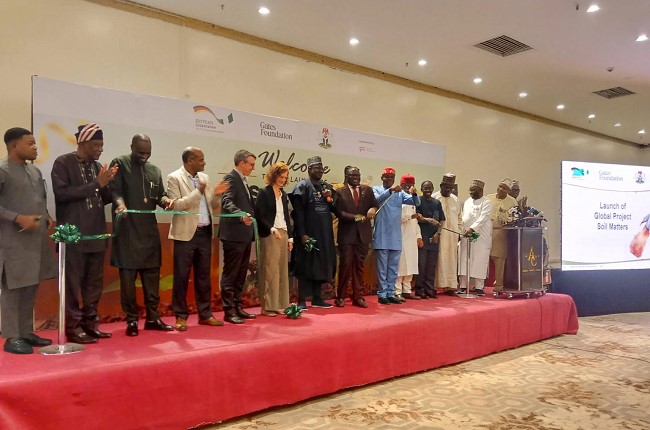
The Minister of State for Agriculture and Food Security, Sen. Aliyu Abdullahi, stated this on Wednesday, April 29, 2026, in Abuja at the unveiling of the Global Project – Soil Matters.
Abdullahi said healthy soil plays a critical role in water retention, drought resistance and carbon sequestration, stressing that restoring soil organic matter had become imperative amid rising climate shocks.
“Soil is not merely the dirt beneath our feet; it is the cornerstone of our food security, economy and climate resilience.
“Over 70 per cent of Nigerians depend on agriculture, yet the country continues to lose approximately 24 million tonnes of topsoil annually due to erosion and degradation.
“A nation that destroys its soil destroys itself. Nigeria will not be that nation,” he said.
He noted that under President Bola Tinubu’s Renewed Hope Agenda, the government aims to boost productivity, feed over 220 million Nigerians, create jobs and position Nigeria as a net food exporter.
According to him, these targets cannot be achieved without restoring soil health.
The minister recalled that the government, in collaboration with the International Institute for Tropical Agriculture (IITA), had earlier launched the Nigerian Soil Information System (NiSIS) and the Coalition of the Willing (CoW) to strengthen soil management.
He explained that NiSIS is a digital platform providing real-time data on soil properties, nutrient levels and management recommendations to farmers, researchers and fertiliser blenders.
“The goal is to address nutrient deficiencies and promote site-specific fertiliser application.
“The Coalition of the Willing brings together government, private sector actors, farmers and researchers to share knowledge and resources for improved soil health,” he said.
Abdullahi added that the Soil Matters – Innovations in Soil Health and Agroecology project, implemented by the German International Cooperation (GIZ), would promote sustainable business models for soil services, especially targeting youth and women.
He said the initiative would also support policy incentives, including tax reliefs and standards for soil restoration.
The minister urged state governments to domesticate the National Soil Policy and called on stakeholders to prioritise soil as a national asset.
“No soil, no food; no food, no peace,” he said.
In his remarks, the Permanent Secretary, Federal Ministry of Agriculture and Food Security, Dr Marcus Ogunbiyi, said agricultural transformation would remain elusive without sustained investment in soil management.
Ogunbiyi outlined the project as a platform to strengthen collaboration, drive innovation and promote farmer education on sustainable practices.
“It is an opportunity to mobilise action toward healthier soils and a more food-secure Nigeria,” he said.
Also speaking, Dr Erkossa Teklu, Project Manager, Global Project Soil Matters at GIZ, said the initiative was designed to establish a self-sustaining system for soil management in Nigeria.
“By 2028, the Coalition of the Willing and NiSIS platform are expected to operate independently under Nigerian leadership,” he said.
By Felicia Imohimi