

The Anambra and Enugu State Governments say they are doing everything possible to tackle erosion and other ecological problems in their states ahead of the rainy season.
The duo made the vow in separate interviews on efforts to mitigate ecological challenges especially erosion in their various states.
In Anambra, the Ministry of Environment disclosed that there were over 1,000 gully erosion sites across the state.
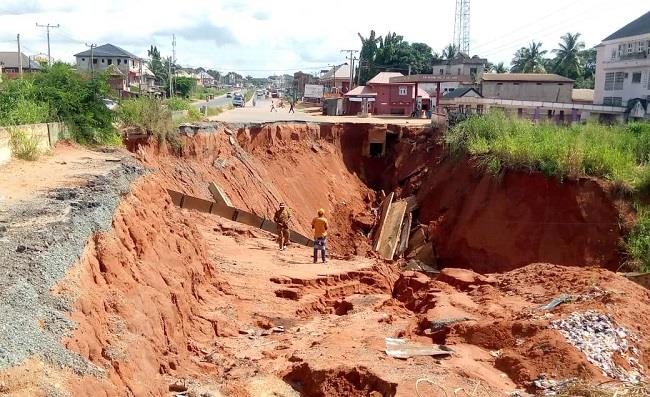
The Permanent Secretary in the ministry, Mr. Tochukwu Obodogha, disclosed that the state government was doing everything possible to tackle the issue with the financial resources available to it, as the menace required huge amount of money to control.
“Anambra has over 1,000 gully erosion sites and about 160 communities have been affected, out of the 179 communities in the state,” he said.
According to him, the state government is working hard to mitigate these ecological problems in our communities.
He noted that the state government had five priority development agenda, with environment as the fifth.
“This is the reason government is working very hard to mitigate the problem of erosion and heavy flooding before the next rain sets in,” he said.
The permanent secretary said that the state had concluded arrangements to deal with the issue of gully erosion and flooding together.
“Right now we are trying to clear our water ways before April 20 to help us control erosion and flooding in the state,” he said.
On the issue of ecological fund, Obodogha said that it was the Commissioner who was competent to speak on the issue.
He appealed for the Federal Government and international donors intervention as the menace of gully erosion required huge financial resources to combat.
The reelected Governor of the state, Prof. Chukwuma Soludo, has yet to form a new cabinet for his second term, after over three weeks of inauguration.
Also speaking, former Commissioner for Agriculture in the state, Dr Forster Ihejiofor, said a structured investment in bamboo and establishment of bamboo plantation clusters across the three senatorial zones in the state would reduce erosion impact across vulnerable communities.
According to him, Bamboo is “Anambra’s green gold”, with wide applications ranging from erosion control and land restoration.
“The opportunities in bamboo alone can reposition the state economically while addressing pressing environmental concerns,” he said.
On March 12, 2025, the Nigeria Climate Adaptation Erosion and Watershed Project through the European Investment Bank (NEWMAP-EIB) named the state as one of the beneficiaries of an intervention aimed at addressing erosion and land degradation challenges in Nigeria.
Mr. Anda Ayuba-Yalaks, National Project Coordinator, NEWMAP-EIB, made the disclosure when he led the Federal Project Management Unit of the project on an assessment tour of five erosion sites in the state last year.
Ayuba-Yalaks said that the intervention project would be carried out through EIB’s NEWMAP-EIB, following the payment of the state’s counterpart fund of N500 million by the state government.
According to NEWMAP, the delegation has conducted an on-the-spot assessment of uncompleted five selected erosion sites within the state, in collaboration with Anambra government.
They visited Ndi Agu, Ikenga Ogidi, Nkpor Flyover, Ugamuma Obosi and Abagana erosion sites.
“This project is to provide long-term sustainable land degradation control measures and to provide support to the state project management unit to accelerate the project implementation.
“We will further explore best practices and interventions to mitigate the challenges of erosion in Anambra.”
Efforts to reach the NEWMAP officials in the state to ascertain the extent of implementation failed due to some bureaucracies.
In Enugu State, Mr. Ifeanyi Nwodo, Head of the Ecology Department at the State Ministry of Environment, said the government had taken steps to address environmental challenges, particularly erosion and flooding.
According to Nwodo, the state works through the Nigeria Erosion and Watershed Management Project (NEWMAP), which handles erosion-related issues.
He explained that complaints from communities were forwarded to the agency for action.
“We have an agency responsible for erosion control, and interventions have already been carried out in areas such as Udi and other communities,” he said.
Nwodo also highlighted efforts by the ecology department to mitigate flooding across the state.
He noted that, in 2025, the government conducted extensive clearing and sorting of drainages within the state capital to ensure free flow of waterways and reduced flood risks.
“In the last two years, we have received thousands of petitions from residents regarding flooding and improper channeling of water into homes. We have addressed most of these concerns,” he added.
He further stated that the state operated its own ecological fund management structure through a dedicated unit based at the Government House, which oversees the application of ecological funds.
However, a human rights lawyer, Nnadume Offorkansi, criticized the current system, describing the ecological fund as lacking accountability.
“The ecological fund, like the security fund, is open to abuse. Governors spend it as they like without accountability,” Offorkansi alleged.
He questioned the visible impact of such funds in Enugu, pointing out that the only notable intervention he had observed was along the 9th Mile-Nsukka Old Road, which he claimed was handled by the federal government rather than the state.
“Erosion is ravaging many parts of the state, yet there is little evidence of state-funded intervention,” he argued.
Offorkansi also blamed both government and society for the lack of transparency, noting that the public was often unaware of how much governors received and how the funds were spent.
He advised that governors should engage more closely with local communities through town unions and their president-generals to better identify and address ecological challenges.
“Community leaders understand the real issues on the ground. If properly engaged, they can help prioritize ecological problems such as flooding and erosion,” he said.
He cited examples of flood-prone border communities between Enugu and Anambra State, as well as erosion-affected areas like Iwollo, Oghe, and other parts of Ezeagu council area, which he said, had received little attention.
Similarly, Mr. Ozor Ugonna, Executive Director of the Rural Engagement and Development Foundation, criticised what he described as widespread mismanagement and lack of public awareness surrounding the funds.
He said that many citizens and even some professionals were unaware that ecological funds were being disbursed to states for environmental and infrastructure-related challenges.
“The coordinated answer would be no,” he said, when asked whether the funds are being effectively utilised.
“There are no clearly designated funds that are transparently used for the purpose they were meant for.
“What we see instead is direct misappropriation. Ecological funds are intended to address pressing environmental issues such as erosion, flooding, and other natural disasters,” he said.
He argued that their impact was largely unfelt across communities.
Ugonna further criticized elected officials – including governors and members of legislative bodies, for failing to communicate with their constituents about funds secured and how they were spent.
The executive director highlighted a broader systemic issue, alleging that a lack of accountability mechanisms allowed funds to be siphoned without scrutiny.
“The citizenry are not aware, and when people demand accountability, no one is willing to listen,” he said.
“The system enables continuous embezzlement.”
He added that in spite of frequent reports of funds flowing from the federal level to states, there is little or no public disclosure on how the money was ultimately spent.
By Obinna Unaeze and Alex Enebeli