

Thirty-eight newly trained rangers on Friday, March 13, 2026, graduated from a six-week intensive training programme designed to strengthen the protection of Okomu National Park in Edo State.
Okomu National Park is one of Nigeria’s last remaining lowland rainforest ecosystems.
The rangers passed out during a ceremony organised by the Africa Nature Investors (ANI) Foundation in partnership with the National Park Service at the park.
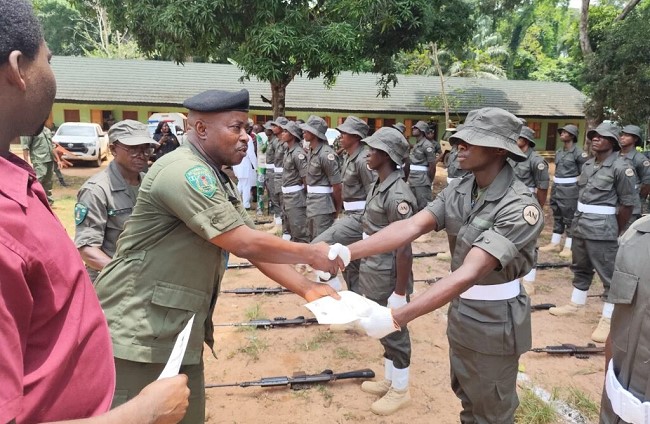
In his address, the Conservator-General of National Park Service, Ibrahim Goni, said the passing-out parade marked the beginning of a new responsibility for the rangers as frontline defenders of Nigeria’s natural heritage.
Goni, represented by the Conservator of Park at Okomu National Park, Lawrence Osaze, said the trainees underwent rigorous physical and professional training in wildlife law enforcement, patrol techniques, intelligence gathering, field survival and community engagement.
“Today’s ceremony represents not just the end of a training exercise but the beginning of a new responsibility for these dedicated rangers who are about to join the frontline of conservation,” he said.
He noted that the deployment of trained rangers had become increasingly important as protected areas face threats from poaching, illegal logging and encroachment.
“Okomu National Park remains one of Nigeria’s most valuable ecological assets.
“It conserves biodiversity, protects endangered species, regulates climate, is and supports research, tourism and sustainable livelihoods,” the conservator-general said.
He noted, however, that these critical ecosystems continued to face threats from poaching, illegal logging, encroachment, and other unsustainable human activities.
This reality, he said, underscored the importance of strengthening ranger capacity to ensure effective protection of the natural resources.
Goni acknowledged the contributions of development partners, supporting conservation activities in the Okomu landscape.
He appreciated the support of Africa Nature Investors (ANI) Foundation and other collaborating institutions, whose cooperation he said, continued to play a crucial role in safeguarding the protected areas.
The Executive Director of ANI Foundation, Tunde Morakinyo, represented by retired Brig.-Gen. Olajide Laleye, congratulated the new rangers and urged them to justify the investment made in their training.
“You must be dutiful and justify the resources that have been invested in you,” he told the recruits.
Speaking with journalists, ANI Foundation Country Manager, Nacha Geoffrey, said the organisation’s conservation model focuses on people-centred approaches that involve local communities in protecting natural resources.
“What makes our approach different is that we are not managing wildlife for wildlife alone. We are doing it for the people.
“Our approach is bottom-up. We ask how communities can see the economic benefit of living alongside wildlife and how conservation can make economic sense to them,” he said.
Geoffrey explained that all the newly trained rangers were recruited from surrounding communities as part of efforts to strengthen local participation in conservation.
In addition to ranger recruitment, he said the foundation supports community livelihood initiatives, including savings and loan groups, women empowerment programmes and youth conservation education.
A senior strategy adviser to ANI Foundation and former National Park Service official, Okeyoyin Agboola, described the training as essential for ensuring effective protection of the park’s flora and fauna.
He said the involvement of the foundation had significantly strengthened conservation efforts in the park.
“The coming of ANI is a game changer. Government alone cannot do this job. Their support has helped strengthen protection of the park,” he said.
Agboola added that improved conservation efforts had restored calm to the park, which previously faced frequent illegal activities.
“This is the last remaining rainforest ecosystem in the South-West region of Nigeria, and we must protect it for future generations,” he said.
Also speaking, the Chief Technical Adviser to the Global Environment Facility biodiversity project, Segun Oladoye, urged communities to support conservation initiatives.
“What we are doing here is not about any single organisation. It is about the community and the future of our children,” he said.
Out of 236 applicants who participated in the recruitment exercise, only 38 candidates were selected after multiple stages of screening.
By Usman Aliyu