

The Association for Environmental Impact Assessment of Nigeria (AEIAN) has called for the harmonisation and digitisation of the country’s Environmental Impact Assessment (EIA) system to support sustainable national development.
President of the association, Dr Abbas Suleiman, made the submission while addressing participants at its 2025 Annual National Conference (nineth edition) and Annual General Meeting on Wednesday, December 10, in Lagos.
The event had the theme: “Institutional Strengthening of Impact Assessment Policies and Regulations in Nigeria.”
Suleiman said Nigeria’s rapid expansion in infrastructure, industrial zones, energy, agribusiness and transport projects had increased pressure on ecosystems, making institutional reforms in EIA administration a national priority.
According to him, EIA remains the critical instrument that ensures development and does not compromise environmental integrity.
“For EIA to be effective, institutions must be strong, mandates must be clear, processes must be transparent, and professionals must be equipped,” he said.
He said that Nigeria had made progress with sectoral regulations, stronger agencies and improved public awareness, but still faced gaps that weakened environmental governance, 32 years after the enactment of the EIA Act.
He listed the lingering challenges as overlapping and conflicting mandates among regulators, bureaucratic delays, weak post-EIA monitoring, inadequate equipment and data systems.
Others, he said, were limited capacity in emerging areas such as climate risk assessment, cumulative impact assessment, Strategic Environmental Assessment, and biodiversity offsets.
Suleiman also listed poor community engagement, fragmented databases and inconsistent information flow between institutions as some of the challenges.
“These institutional challenges are not failures but opportunities for reform,” he said.
Suleiman outlined key reforms required to strengthen the national EIA system, as legislative updates to the EIA Act, policy harmonisation among regulators, a unified project screening system and clearer guidelines for inter-agency collaboration.
He said Nigeria must fully digitise its impact assessment process through a central online platform that would host project registration, public disclosures, review timelines, decision tracking, and compliance monitoring.
He added that professionalism in the sector needed to be enhanced through certification pathways, updated technical guidelines, national training modules and continuous professional development for practitioners.
“EIA approval should not be the end of the process. It is only the beginning.
“Stronger monitoring, better laboratories, drone and satellite-based surveillance and community-driven reporting must be prioritised,” he said.
He stressed the need to integrate climate change, public health, gender inclusion, human rights safeguards and nature-based solutions into modern environmental assessments.
He said AEIAN would continue to support government and partner with ministries, regulatory agencies, universities, development partners and the private sector to improve environmental governance in the country.
He urged regulators, consultants, academics, industry players, communities and government to work together to strengthen EIA implementation and ensure environmental safeguards remain central to Nigeria’s development priorities.
“Let us move from paper compliance to real environmental outcomes, and from fragmentation to institutional strength,” he said.
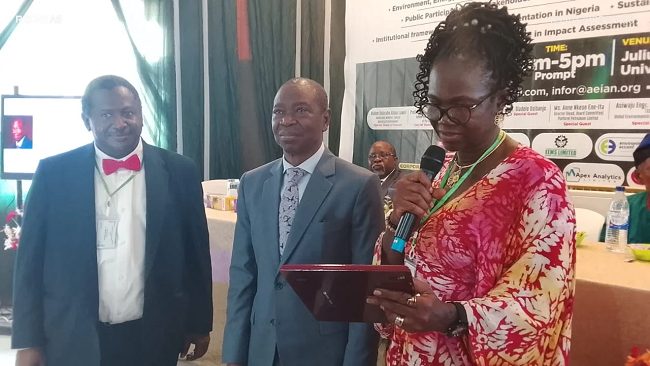
The conference also featured the inauguration of AEIAN’s Lifetime Achievement Awards to honour pioneers of EIA practice in Nigeria.
The recipients included Prof. Oladapo Afolabi, Ms Anne Ene-Ita, Emeritus Prof. Babatunde Alo, Prof. Oladele Osibanjo, and Asiwaju Anthony Ojeshina.
Other awards were presented to key contributors to AEIAN’s growth, including Prof. Bode Gbenle, Dr Banji Adekoya, Dr Ahmed Sanda, Prof. Ijeoma Vincent-Akpu, Dr John Alonge, Mrs. Bolanle Bolorunduro, and Mrs. Rofikat Odetoro, current Director of EIA at the Federal Ministry of Environment.
By Fabian Ekeruche