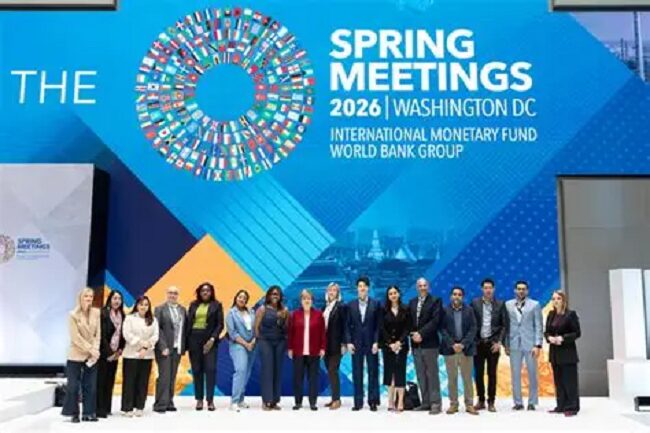
Civil society organisations from Africa and Latin America have expressed deep disappointment with the limited outcomes of the 2026 IMF and World Bank Spring Meetings, arguing that the institutions failed to deliver transformative solutions to the compounding debt, climate, food, energy and conflict crises facing the Global South.
The meetings, held in Washington DC from April 13 to 18, 2026, took place against a backdrop of renewed global instability, including the impacts of conflict in the Middle East that have driven up energy and food prices, exacerbating existing structural vulnerabilities in developing regions.
A Perfect Storm for the Global South
Daniela Berdeja, Debt Analyst and Manager of the LAC Vulnerability Atlas at the Latin American Network on Debt, Development and Rights (Latindadd), described the current situation as a “perfect storm” where multiple crises are compounding rather than occurring in isolation.
“Rising energy prices are driving up production costs and the need for subsidies. The food crisis is putting pressure on public budgets and increasing food insecurity. Trade disruptions are reducing export revenues, while the tightening of global financial conditions is making debt servicing prohibitively expensive due to high interest rates,” Berdeja said.
The result, she noted, is a deepening fiscal crisis in which every additional dollar spent on debt servicing means one less dollar available for healthcare, education, social protection or climate adaptation.
Berdeja challenged the IMF and World Bank’s view of the situation as temporary shocks, insisting instead that it represents a systemic crisis.
“This is not a temporary crisis as the IMF and World Bank see it; it’s a crisis of the system itself,” she emphasised.
Limited and Non-Transformative Responses
Civil society panellists observed that the Spring Meetings largely emphasised strengthening existing instruments – more loans, adjustments to financial facilities, and calls to improve resilience – while continuing to promote the G20 Common Framework as the primary solution to debt problems.
Berdeja criticised this approach as remaining “limited and not transformative.” She pointed out that debt sustainability continues to be measured primarily in terms of repayment capacity rather than from a human development and climate perspective.
“There remains a heavy reliance on fiscal adjustment frameworks which in practice end up reducing public spending in contexts where it should be increasing,” she added.
This leaves Global South countries trapped between rising debt burdens and persistent austerity pressures.
Rising Demand for IMF Programmes
A notable trend highlighted was the increasing number of countries turning to IMF programmes amid energy shocks and conflict spillovers.
While this underscores the IMF’s role as lender of last resort, critics argue it exacerbates power imbalances and imposes conditionalities on already vulnerable nations.
Berdeja highlighted a fundamental tension: countries are expected to invest in resilience, energy transition and social protection even as they are required to implement spending cuts under programme conditions.
Key Priorities for Debt Justice
Civil society proposed several urgent priorities, including:
– Significant scale debt relief and cancellation, rather than marginal measures.
– Far-reaching reforms to the international financial architecture, including fairer and more transparent debt restructuring mechanisms.
– Initiation of a UN Framework Convention on Sovereign Debt, as called for in the Common African Position and by various Global South countries ahead of the 4th Financing for Development Conference.
– More equitable issuance and reallocation of Special Drawing Rights (SDRs).
– Stronger mobilisation of domestic resources through combating tax evasion and illicit financial flows.
Without these structural changes, Berdeja warned, the international community will continue “kicking the can down the road.”
Feminist Perspectives on Austerity and Subsidies
Grace Namugambe, Economic Justice & Rights Officer at the African Women’s Development and Communication Network (FEMNET), raised concerns about the IMF’s push to shift from broad energy and food subsidies toward targeted social protection systems such as cash transfers.
In the current context of climate crisis and global conflicts driving fuel price increases, Namugambe argued that removing subsidies is not feasible and disproportionately harms women.
“Women often spend the bulk of their income on food. These price hikes mean they have fewer resources for healthcare or education,” she explained.
Higher fuel costs also increase women’s care burden, reducing time available for economic activities and further entrenching gender inequalities. FEMNET maintains that governments must continue providing subsidies and essential services rather than encouraging privatisation.
Namugambe also criticised the persistent emphasis on blended finance, noting that it often fails to deliver resources at the required scale or conditions for the Global South.
She called for the IMF and World Bank to move away from systemic deregulation and instead support a stronger role for the state in safeguarding public welfare.
“Gender is central to the conversation on climate, debt and development financing because women bear the brunt of both crises,” she stated.
Launch of the Borrowers’ Platform
Diana Mochoge, Policy Research & Advocacy Officer for Domestic Resource Mobilisation at the African Forum and Network on Debt and Development (AFRODAD), highlighted one concrete development: the launch of the Borrowers’ Platform by UNCTAD during the Spring Meetings.
This platform, part of commitments from the Sevilla Conference on Financing for Development, aims to bring borrowing countries together for peer-to-peer learning, knowledge sharing, and collective advocacy on debt issues.
“It gives Africa and the Global South a bigger voice in changing the rules of the global financial architecture,” Mochoge noted.
She added that countries are emphasising progressive domestic resource mobilisation that does not place additional burdens on citizens, alongside calls for “automatic debt suspension” during crises and reforms to credit rating agencies.
Questioning the Institutions’ Role
Stefano Prato, Managing Director of the Society for International Development (SID), offered a sharper critique, suggesting that the IMF and World Bank primarily serve powerful geopolitical interests and are unlikely to deliver genuine solutions for developing countries, particularly in Africa.
Calls for Structural Change
Across the contributions, civil society representatives stressed that the core question is not merely how to respond to the latest crises, but why the global system continues to perpetuate them.
They called for debt justice, democratisation of international financial governance, and structural reforms that place human needs, climate action and gender equality at the centre, rather than debt repayment.
The Spring Meetings have once again underscored the urgent need for bolder action beyond incremental adjustments to existing frameworks.
As countries across Africa and the broader Global South grapple with shrinking fiscal space and multiple overlapping shocks, the gap between rhetoric and meaningful reform remains wide.
Stakeholders now look toward the Financing for Development process and other global forums to push for the transformative changes demanded by civil society, including a UN Framework Convention on Sovereign Debt and more equitable financing mechanisms.
By Winston Mwale, AfricaBrief