The United Nations Children Education Fund (UNICEF) said it had identified 240,560 out-of-school children in three Local Government Areas (LGAs) of Zamfara State.
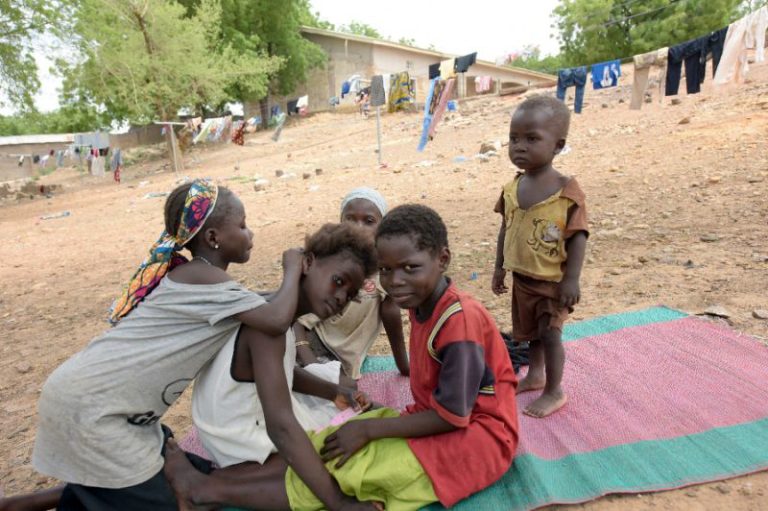
Displaced children in a camp in Nigeria. Photo credit: Yahoo News
The affected LGAs are Bukkuyum, Maradun and Zurmi
The Chief of UNICEF in charge of Sokoto Field office, Mohameden Fall, disclosed this on Friday, April 20, 2018 in Zurmi at the launching of cash transfer disbursement to parents of affected children under the UNICEF’s Educate A Child (EAC) project.
He said the number was derived from the household mapping and listing of out-of-school children conducted in 2016 through the state Universal Basic Education Board when the number of out-of-school children was identified in the three LGAs.
“In Bukkuyum, a total of 93,849 out-of-school children were identified with 41,134 males while 52,715 were females.
“In Maradun 63,943 were identified with 28,963 males and 34,980 females while Zurmi has a total of 82,768 children with 38,286 males and 82,768 females,” he said.
Fall also noted that the EAC project was bring funded by Qatar Foundation as personal initiative of Sheikh Nasser of Qatar and implemented by UNICEF in collaboration with Sokoto, Kebbi, Katsina and Zamfara state governments.
According to him, the overall aim of the EAC was to extend the access to quality of basic education for 501, 749 out-of-school children across the four states by 2020.
“We are targeting to reach out 10,347 in the first phase in Zamfara State, considering the alarming number of out-of-school children in the state.
“We are calling on the state government to extend this programme to other local government areas,” he said.
The project was initiated to assist households in sending their children and keeping them in school, in the benefiting communities who will receive an unconditional cash transfer of N8,000 per child that falls between six and 11 years for the period of two years.
“Cash transfer is one of the seven strategic interventions under the EAC to enable the government of the target states and UNICEF to reach more out-of-school children,” he said.
He thanked the state government for the recent award of N1billion contract for school renovation and the release of over N1 billion UBE counterpart funding on UNICEF intervention.
In his remark, the state Commissioner of Budget and Economic Planning, Alhaji Ibrahim Birnin-Magaji thanked the UNICEF and Qatar Foundation for initiating the project.
Birnin-Magaji said that the project was complementing the state government policy of promoting pupils enrollment and enhancement of basic education in the state.
He said the state government was ready to continue to partner with the UNICEF and other development partners to improve quality education in the state.
“The state government is committed to enhance teaching and learning in the state, from 2011 to date, we have renovated over 4,000 classrooms to reduce congestion of pupils.
“We trained over 8,000 teachers and established 50 ICT centers across the primary and junior secondary schools in the state.
“These efforts have increased our enrollment drive from 283,000 in 2012 to 600,000 as of now”, he said.
Birnin-Magaji said the plan was one the ways to recruit more teachers and implement N18,000 minimum wage for primary and junior secondary school teachers in the state.
Earlier, the state SUBEB Chairman, Murtala Jangebe, Commended the State Government and UNICEF for the project, saying that it would increase the pupils’ enrolment in the state.
Jangebe said 3,449 children have been selected from the 14 communities to benefit from the assistance of N8,000 under the project per term, per child.
“We are disbursing N27 million as first phase to beneficiaries from Alawa, Kadage, and Doka communities from the three LGAs of Bukkuyum, Maradun and Zurmi respectively.
”In each of the selected LGA, one community was chosen for the flag-off as first phase and we are going to continue with the remaining 11 communities,” he said.
In line with its new project focused on boosting the quantity and quality of environmental coverage in Asia and the Pacific region, the US-based Earth Journalism Network (EJN) is expanding into more areas across the territory.
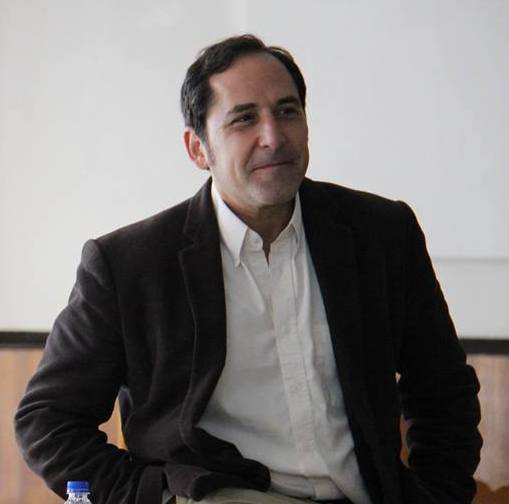
James Fahn, Executive Director of the Earth Journalism Network (EJN)
Supported by the Swedish International Development Cooperation Agency (SIDA), EJN is scaling up with the addition of five new staff members onto its team. They include:
Imelda V. Abaño (Content Coordinator for the Philippines and Pacific)
Stefano Wrobleski (GeoJournalism Consultant and a data journalist at InfoAmazonia)
Geoffrey Smith (Content Coordinator for Fiji and the Pacific)
Surachart (Tob) Somma (Information Officer)
Ben Kedoga (Content Coordinator for Papua New Guinea and the Pacific)
Similarly, the organisation has unveiled fresh grant opportunities in the bid to boost environment reporting.
For instance, the Bay of Bengal Organisational Grants are available to support the creation, growth, and capacity building of media and other development or educational organisations in the region, that aim to improve the quantity and quality of information about climate change, and access to this information by groups such as women and youth that are most vulnerable to its impacts.
Also, the EJN is inviting journalists to apply to report in 2018 from both the Global Climate Action Summit in San Francisco and the UN Climate Negotiations in Katowice, Poland in December. The body says that, due to ongoing technical issues with its registration form, application has been moved to an external server and extended the deadline May 4, 2018 at 5pm EDT.
The EJN Asia-Pacific project had earlier announced two competitive grant opportunities in the beginning of the year and received a total of 77 applications for media grants and 79 for story grants with good representation across the region. Selection of grantees has however been completed.
In March 2018, the EJN Asia-Pacific held its first Training of Trainers/Managers in the coastal region of Rayong, Thailand. The five-day training, discloses the EJN, brought together 24 leaders of environmental journalist networks in the region, journalists and project team members to discuss the needs and challenges faced by environmental journalists, the main environmental threats in different countries and sub-regions, and the priorities for the project.
James Fahn, Executive Director of EJN, says: “Sunday, April 22, 2018 is Earth day and, as we reflect on global challenges like climate change, the value of accurate, thoughtful, and local environmental coverage is clear. Internews’ Earth Journalism Network (EJN) works with thousands of journalists worldwide to support this kind of reporting.”
Global leaders from across the spheres of energy, foreign policy, trade, development and business have been announced as members of the newly formed Global Commission on the Geopolitics of Energy Transformation.
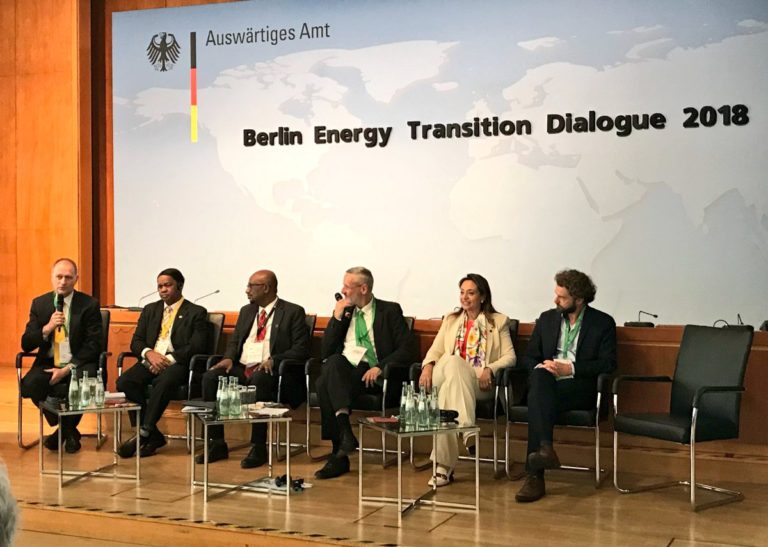
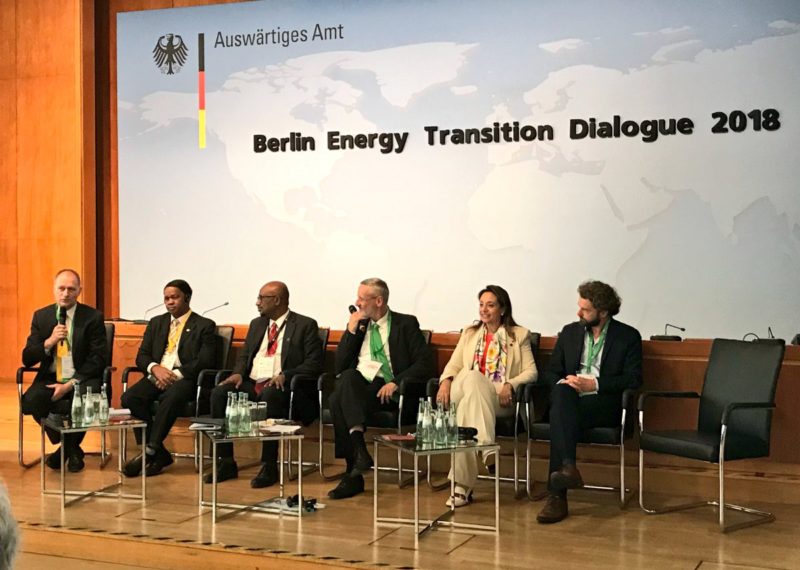
A panel discussion session at the Berlin Energy Transition Dialogue 2018
The Commission was launched in January 2018 during the Assembly of the International Renewable Energy Agency (IRENA) and its work is supported by the governments of Germany, Norway and the United Arab Emirates.
Leading the Commission as Chair is the former President of Iceland, Olafur Grimsson. Members of the Commission include prominent government and business leaders from the United States, Saudi Arabia, China, Germany, Brazil and Russia and other countries.
The line-up was announced on the second day of the annual Berlin Energy Transition Dialogue (BETD), hosted by the German Federal Foreign Ministry and the Ministry of Economy and Energy.
The Commission will meet for the first time during the BETD to establish a roadmap towards the development of an authoritative report to be released during IRENA’s next Assembly taking place in Abu Dhabi, in January.
“This Commission represents a truly formidable body of global leaders who will bring rigour, critical thinking, and a broad range of perspectives to the table as we analyse the potential effects of a renewables-based energy system on national and global politics,” said Commission Chair, Olafur Grimsson.
“As a result, this Commission’s work will be a robust assessment of the evolving geopolitics of energy as we move towards the post-carbon era.”
The Commissioners will bring professional perspectives from nations across the world and will reflect insights from traditional energy exporters, and net energy importers alike.
Countries at various stages of renewable energy exploration and development are also represented in the Commission’s membership. The Commission will be supported by an expert panel of renowned academics.
“The shift to renewable energy is proving to be one of the most positively transformational trends of our age. Renewables offer a cost-effective pathway to poverty reduction, increased energy access and economic growth whilst reducing energy-related emissions,” said Adnan Z. Amin.
“As we move towards a more decarbonised, decentralised and digitalised energy system, and scale-up renewables in line with the Paris Climate Agreement and Sustainable Development Goals, countries need to better understand the nature of the evolving geopolitical landscape, so as to ensure prosperity and peace,” he added.
Deputy Director-General for Energy and Climate Policy and Export Control at the German Federal Foreign office, Peter Fischer, described the commission as a development capable of accelerating the global energy transition.
Energiewende (Energy transition), according to Fischer, “will affect global politics as energy can be used as a means of power and coercion in international relations. This reinforces the need to build capacity and strengthen global systems through a framework such as this commission,” says Fischer.
Some of the members of the commission include Khalid M. Al-Sulaiman, former Vice President for Renewable Energy at King Abdullah City for Atomic & Renewable Energy, Saudi Arabia, Adnan Z. Amin, Director-General of IRENA, Anatoly Chubais, former Deputy Prime Minister of Russia, and Christiana Figueres, Former Executive Secretary of the UN Framework Convention on Climate Change.
Others include Joschka Fischer, former Vice Chancellor and Foreign Minister of Germany, Pascal Lamy, former Director-General of the World Trade Organization, Carlos Lopes, former Executive Secretary of the UN Economic Commission for Africa, Bill Richardson, Former US Secretary of Energy, Maria van der Hoeven, former Executive Director of the International Energy Agency, and Peter Fsicher, the Deputy Director-General for Energy and Climate Policy and Export Control at the German Federal Foreign office.
Only a land-based species could have called this planet Earth, since more than 70% of it is covered by sea. All life originated on the oceans and still depends on them. They regulate the climate, absorb much of the carbon that humanity emits, and produce the main source of protein for over three billion people. The ecosystem goods and services they provide are estimated to be worth $12 trillion.
GEF CEO and Chairperson, Naoko Ishii
Yet increasingly they are under threat. 90% of the world’s fisheries are either fully or over-exploited. Eight million tons of plastics enter the sea each year, reaching the most remote parts of the oceans and contaminating a quarter of all seafood. 80% of the wastewater collected worldwide is discharged without treatment, damaging health and biodiversity and creating “dead zones” in which animal life suffocates.
Toxic pollutants build up in the waters: toxic algal blooms flourish as a result of nutrient-rich waste. Carbon emissions melt sea ice and acidify seawater. Habitat loss takes a heavy toll. And the degradation has been getting worse.
“Recognising the critical need for global action to ensure the sustainability of our oceans, the GEF has provided tremendous support to ocean governance,” says Naoko Ishii, GEF CEO and Chairperson. “GEF initiatives have enhanced global and regional cooperation and led to improved ecosystem health, services and human wellbeing through stronger governance at regional, national and local levels. These projects apply an integrated cross sectoral approach while engaging the private sector, non-governmental organisations and multilateral institutions.”
The Global Environment Facility (GEF) has been working for decades to turn this tide of destruction. Now, with its support, 124 countries are working together to safeguard our coasts and oceans.
Fourteen of them, for example, work together in Partnerships in Environmental Management for the Seas of East Asia (PEMSEA), which this year celebrates its 25th Anniversary. It started as a GEF-funded project, but has since evolved into a regional intergovernmental mechanism, including all the countries of Southeast Asia, together with China, Japan and both North and South Korea, and encompassing some seven million square kilometres of shared sea, bordered by some 235,000 km of coastline. Eleven of them have signed up to a shared strategy – the Sustainable Development Strategy for the Seas of East Asia.
“PEMSEA’s mission is to foster and sustain health and resilience in oceans, coasts and economies throughout the seas of East Asia” says Ryan Whisnant, its Director of Strategic Initiatives. “It works very closely with the governments of the region, but the work really happens on the ground at local sites, in what is a set of integrated coastal management (ICM) sites across the region”
ICM, he explains, “recognises the fact that you can’t look at any one sector”, focusing, for example, just on pollution, sustainable fisheries or sustainable tourism – “but that there are relationships and interlinkages among all of them”. Similarly, he goes on, it involves all stakeholders – including local governments, businesses, community organisations and NGOs – working together to “build the capacity to manage healthy coastal areas”.
So far, he adds, “PEMSEA has been some part of securing that more than 17% of the entire region’s coastline managed under some form of ICM, making it highly likely that the contracting countries will reach the agreed target of 25% of the coast of the East Asian Region being under ICM by 2021”
Nancy Bermas, PEMSEA’s Senior Country Programme Manager, tells, for example, how it works with universities, the private sector and national and local government in the Philippines, in implementing the sustainable development of the province of Bataan, on Manila Bay as a long-term local ICM framework. Victor Ubaldo, the province’s ICM Programme Director, describes how its government, has co-operated with official national agencies, businesses and “peoples organisations” to replant mangroves.
Ronnie Baldera and Benito Villaneuva, mangrove caretakers, testify that this has reduced the impact of waves on the shore. And Jun Hernandez, a fishers’ community organiser, adds that restoring mangroves, together with building artificial reefs and implementing the ICM programme as a whole, has increased fish populations.
Much of it began, says Jose Enrique Garcia, a Congressman and former mayor of Balanga, the province’s capital, with a ‘coastal clean-up day’, which “jump-started our determination to come up with a feasible, practical, sustainable coastal programme for the city.” This resulted, for example, in an area that was going to be developed as a beach resort, instead being preserved as a wetland park rich in mangroves and birds.
He continues: “People now recognise Balanga as a place where sustainable industry, such as our dried fish processing, now thrives. If you look at the commercial side, we have grown by more than 100% over the past few years, but that is complemented by the growth also of our environmental protection activities.”
Meanwhile, “all the other municipalities in the province of Bataan have come up with their own programmes to help the environment, most especially in the clean-up of Manila Bay.”
In yet another development, the GEF was instrumental in setting up the pioneering Meloy Fund for Sustainable Community Fisheries, which provides debt and equity financing for businesses that have a positive impact on coastal fisheries in Indonesia and the Philippines.
Its first beneficiary is Meliomar, a sustainable Filipino seafood producer, which gets supplies from about 900 fishers in small-scale communities. With Meloy’s funds, says Christian Schmidradner, it’s General Manager, “we will be able to reach out to two thousand fishermen and improve their lives”.
Manuel Bueno Vera, Senior Director of Rare – the global conservation organisation that owns the Meloy Fund – says that Meliomar is important because it has “shown the way” to other companies that “you can build a good business” out of sustainable production. “It is helping to show how the private sector can be part of a solution that will essentially have a watershed impact on these coastal fisheries”.
The Fund, he adds, “seeks to generate financial returns for its investors and environmental and social returns as well.” and would not exist but for the GEF’s support. “Essentially the GEF was the first organisation to really believe in the concept of providing private sector financing to small scale fisheries, to step forward and really support the Meloy Fund. I think it has been particularly visionary, innovative and creative in its approach.”
On the world stage, meanwhile, the GEF last year endorsed a $2 million project – with UN Environment, Ocean Conservancy and the Ellen MacArthur Foundation – to build a global alliance across the entire plastic value chain.
The New Plastic Economy Initiative – which includes major companies that produce, process and use plastics, as well as governments – aims to “build momentum towards a plastics system that works”, including seeking out solutions to managing waste and setting up a joint investment fund in the Asia-Pacific Economic Cooperation region.
“The diversity of the GEF investment portfolio in the marine and ocean space is a testament to fact that transforming current ocean management practices will only be impactful if we pull on our collective strengths and vision to succeed,” says Christian Severin, GEF International Waters Focal Area Coordinator. “This unique mix of ingenuity from local entrepreneurs, coupled with national and regional policies and ministerial endorsed action-oriented frameworks, lays the foundation for the long-term processes needed for triggering sustainable management of the shared ocean and marine resources and ecosystem services”.
And the GEF will continue to promote the Blue Economy, which identifies the oceans as areas for sustainable development, including through tourism, fisheries and aquaculture, extractive industries, renewable energy production, coastal development and marine transport. It will fund collective management of coastal and marine systems, and implementation of the full range of integrated ocean policies, legal and institutional reforms.
The President of Nigerian Meteorological Society (NMetS), Prof. Clement Akosile, said on Thursday, April 19, 2018 that the country needed to aggressively address the desertification in the northern part of Nigeria.
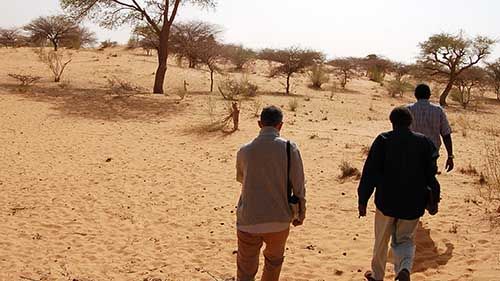
Desertification in Nigeria
Akosile made the call in an interview with the News Agency of Nigeria (NAN) in Lagos.
According to him, checking desertification will reduce the quest by cattle rearers to migrate southward in search of pastures and water for their cattle.
“To do this, it is good to encourage aggressive tree-planting by communities and individuals.
“Primary and secondary schools should also be involved in tree planting in designated areas.
“Tree planting campaign should also be taken to the grass roots level, and the people should ensure that suitable trees that can survive the harsh environment are planted,” he said.
Akosile said that irrigation should also be considered to help provide water in critical endangered areas for human and animal use.
He said that trees would change the environment and improve the soil surface for plants to survive.
The NMetS chief said that trees would provide vegetation canopy that would make life easy for human and animal survival in such arid areas.
Akosile said without such a step, desertification of the northern states would intensify, thus increasing the southward migration of humans and animals.
BudgIT, a non-governmental organisation (NGO), has advised the Federal Government to expedite action on gas flaring to stop environmental degradation posing hazards to human health and loss of revenue in the country.
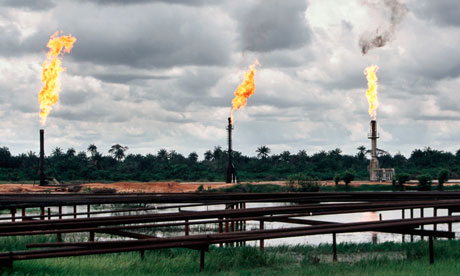
Gas flaring in Ogoniland, Nigeria. Photo credit: premiumtimesng.com
The group gave the advice in a statement signed by its Communication Lead, Mr Abiola Afolabi, on Thursday, April 19, 2018 in Lagos.
BudgIT, however, said that it observed some progress in the fight against routine gas flaring over the last 20 years.
Afolabi said analysis by the company’s extractive team revealed the volume of gas produced increased by 91.13 per cent.
The company also said the volume of gas flared reduced by only 38.06 per cent between 2001 and 2016.
“This implies that oil companies invested more money in gas production activities and are less concerned about sufficiently investing in technologies and infrastructure to control gas flaring.
“Research revealed that Nigeria has a potential for the consumption of un-flared gas.
“To this end, BudgIT urges all stakeholders to commit towards putting in place the supply-framework, infrastructure and market systems necessary for un-flared gas to reach its end users’ needs,” the statement noted.
BudgIT called on the government to explore existing technologies and strategies to reduce the amount of gas flared into the atmosphere.
It added that some oil companies were unwilling to make the investment necessary to deploy the right technologies and infrastructure in Nigeria.
“Also, the guiding legal framework for deterring gas flaring must be reviewed to prevent companies from taking advantage of inherent loopholes.’’
The organisation quoted the Finance Minister, Mrs Kemi Adeosun, as saying, “In current documents that cover the gas flaring penalty, the penalty was drafted as a charge.’’
“A charge is tax deductible; so when international oil companies flare the gas, they pay the charge on which they get tax relief.”
The statement said a BudgIT team visited communities in the Niger Delta in April 2017 and observed several cases of gas flare near residential neighbourhood, specifically Polaku and Ogu communities in Bayelsa and Rivers states respectively.
It also said the effects of gas flaring were not limited to deformity in children, lung damage, pneumonia, asthma, bronchitis, blood disorders and a host of other fatal health conditions.
Also, Mr Oluseun Onigbinde, BudgIT’s Lead Partner, called on the Federal Government to muster the political will necessary to execute the country’s gas master plan and to enforce regulations aimed at achieving Zero Routine Gas Flaring.
Onigbinde suggested that proceeds from gas flare penalties could be channelled toward funding health-related research in the Niger Delta region to protect the residents and improve their living conditions.
The Expert Review of the First Order Draft of the Intergovernmental Panel on Climate Change (IPCC) Special Report on the Ocean and Cryosphere in a Changing Climate (SROCC) will take place from May 4 until June 29, 2018.
Hans-Otto Pörtner, Co-Chair of IPCC Working Group II
The Expert Review of the First Order Draft is a key element of the IPCC assessment process. Experts from around the world will offer comments and suggestions to the author teams. The report authors address every comment received when they prepare the next draft, and the review process aims to include the broadest possible scientific perspective.
“The review process is essential for the quality of IPCC assessment reports. We expect a broad range of feedback from the natural and social science research communities and also encourage stakeholders with relevant expertise to participate,” said Hans-Otto Pörtner, Co-Chair of IPCC Working Group II.
Working Group II Co-Chair, Debra Roberts, added: “The author teams assess the current state of knowledge to inform policymakers at all levels and in all regions. Experts from all parts of the world are invited to review the draft based on their respective knowledge.”
All IPCC reports go through multiple stages of formal review. This first review will be followed by a second review when governments will also be invited to provide feedback.
Expert Reviewers can register with a self-declaration of expertise, says the IPCC, adding that all Expert Reviewers will be acknowledged in the final report, due to be finalised in September 2019.
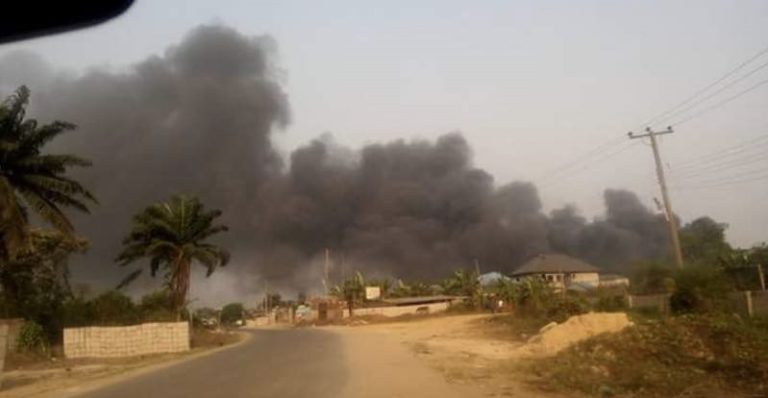
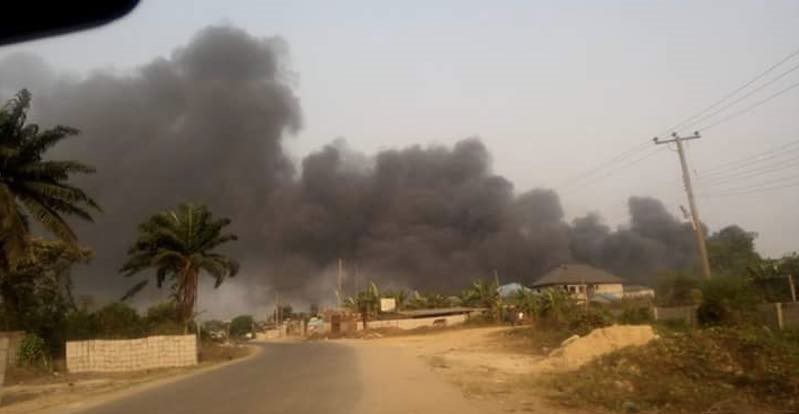
The Rivers State Government on Thursday, April 19, 2018 pledged its commitment to ensuring a safe environment for residents by tackling headlong the challenge of black soot within its confines.
Soot spreading over a neighbourhood in Port Harcourt, Rivers State
Deputy Governor, Mrs Ipalibo Banigo, gave the assurance while addressing a group of protesters at the Government House in Port Harcourt, the state capital.
Earlier, the group comprising of some civil society, environmentalists and some concerned residents had protested at the Government House to register displeasure on the prevailing soot ravaging Port Harcourt and its environs.
The group called for collaboration among government and stakeholders to end all unfriendly environmental activities like illegal oil bunkering burning of used tyres and operating sub-standard abattoirs.
Banigo admitted that environmental pollution was a collective problem that should not be politicised.
“Nobody has immunity to combat the negative impact of environmental pollution and that’s why, as a concerned government, we are going to ensure a safe environment.
“I also urge the Federal Government to take urgent steps toward addressing the issue of environmental pollution in the state,’’ she said.
Leader of the group, Tunde Bello, explained that the protest became necessary to stir the government and relevant bodies into addressing the challenge.
He said the move, tagged “Stop the Soot Now’’, was a wakeup call on possible dangers of black soot.
Bello disclosed that, for about 20 months, the state had been suffering from the negative impact of air pollution by black soot.
He said the menace had begun to affect the health and quality of lives of residents of the state, particularly those battling with respiratory conditions, pregnant women, infants and the elderly.
Bello urged the National Oil Spill Detection and Remediation Agency (NOSDRA) and other relevant environment agencies to ensure an end to the menace.
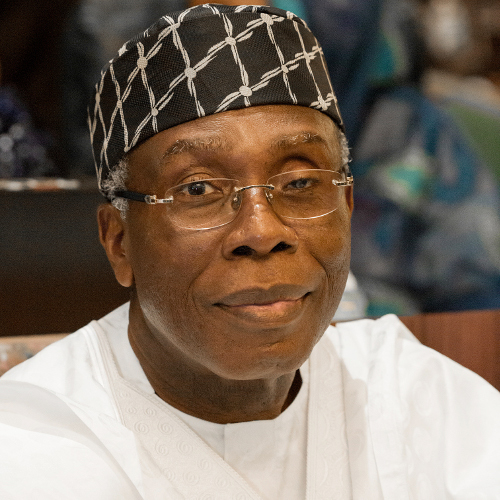
The Minister of Agriculture and Rural Development, Chief Audu Ogbeh, says the Federal Government is committed to checking deforestation across the country through the introduction of climate-smart agriculture.
Minister of Agriculture and Rural Development, Chief Audu Ogbeh
Ogbeh said this on Thursday, April 19, 2018 in Kano at the interactive session and inauguration of the Commodity Alliance Forum, organised by the International Fund for Agricultural Development (IFAD).
The minister, who was represented by his Senior Technical Adviser, Mr Auta Ape, said that the Federal Government would strengthen efforts to curtail deforestation in the country via the introduction of climate-smart agriculture.
He said that the newly introduced Climate Change Adaptation and Agribusiness Support Programme (CASP) was aimed at using technology, soil testing and appropriate inputs, such as fertiliser, to combat deforestation and reduce desertification.
Ogbeh said that the goals of CASP were food security as well as economic diversification to empower youths and women in entrepreneurship.
In his remarks, the IFAD Country Programme Officer, Mr Oussama Hassani, said that IFAD had been working in Nigeria for about 40 years in rural development projects which focused on poverty alleviation.
“The agency provides loans to farmers in the country through the Federal Government to implement the projects,’’ he said.
Hassani said that the CASP was currently working in some northern states, which included Borno, Yobe, Jigawa, Katsina, Kebbi, Sokoto and Zamfara states.
“Funding for the CASP totals $91 million, out of which IFAD is providing $70 million in loans and $15 million in grants.’’
Also speaking, Mr Muhammad Lawal, the National Programme Coordinator for IFAD, said that the programme was to improve food production, while taking climate change into consideration.
He said that the introduction of climate-smart agriculture in the country would enhance agricultural productivity, while boosting food security, economic growth and sustainable business growth.
“Thousands of youths will be empowered with starter-packs very soon, so as to enhance their productivity in seed production, general crop production and rice milling, among others,’’ Lawal said.
NAN reports that the Bank of Agriculture (BoA), agricultural commodity value-chain financiers and private sector organisations attended the event.
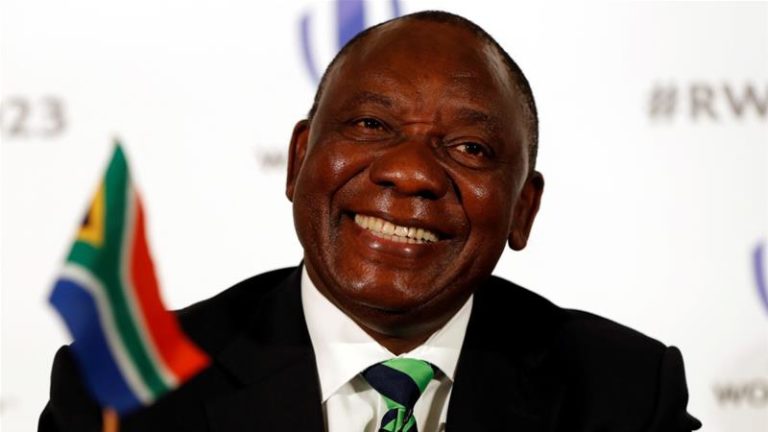
South African health authorities on Thursday, April 19, 2018 issued a malaria alert amid a rising risk of acquiring the disease both in and outside the country.
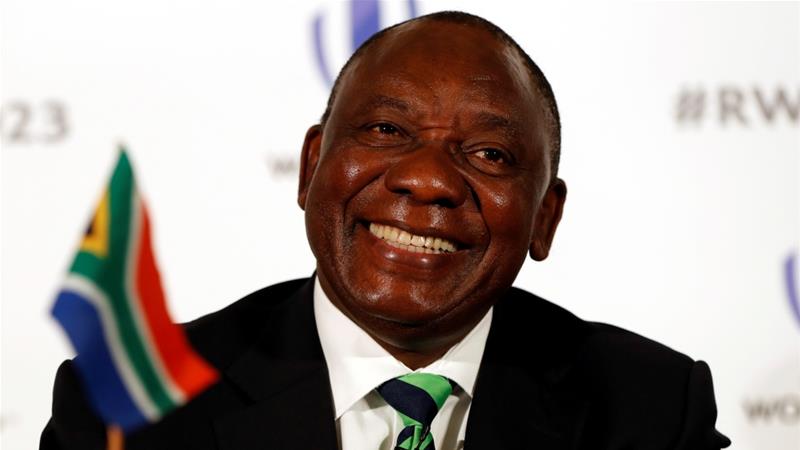
President Cyril Ramaphosa of South Africa
The National Institute for Communicable Diseases (NICD) said the total number of malaria cases has increased in three malaria-affected areas – north-eastern Limpopo, eastern Mpumalanga and northern KwaZulu-Natal.
NICD said some of the patients are likely to be travellers returning from neighbouring countries, particularly Mozambique.
The institute did not give the specific number of malaria cases.
The NICD said with the recent Easter holidays and an upcoming weekend, a substantial proportion of the South African population have returned or will shortly return from malaria-endemic destinations.
The institute said anyone who has been in a malaria risk area in the past 10 days to three weeks and who gets ill with flu-like symptoms should remember that malaria is a possibility and seek medical attention, which should include a malaria blood test, repeated if necessary.
Travellers should tell healthcare workers about travel and possible exposure, as they may forget to ask, the institute said.
Using anti-mosquito measures (nets, repellents etc.) and/or prophylactic medicines does not guarantee perfect protection from malaria, the institute cautioned.
The institute warned that delayed diagnosis of malaria often leads to more severe illness with the danger of serious complications or even death.
Symptoms of malaria include fever, chills, sweating, body pains, headache and extreme tiredness, which appear within 10 to 15 days after the ineffective mosquito bite.
This was the second malaria alert issued in South Africa since Dec. 14, 2017.
South Africa has pledged to eliminate malaria by 2018.
Malaria in the country is seasonal, with transmission occurring between September and May in geographical areas of Limpopo, KwaZulu-Natal and Mpumalanga provinces.