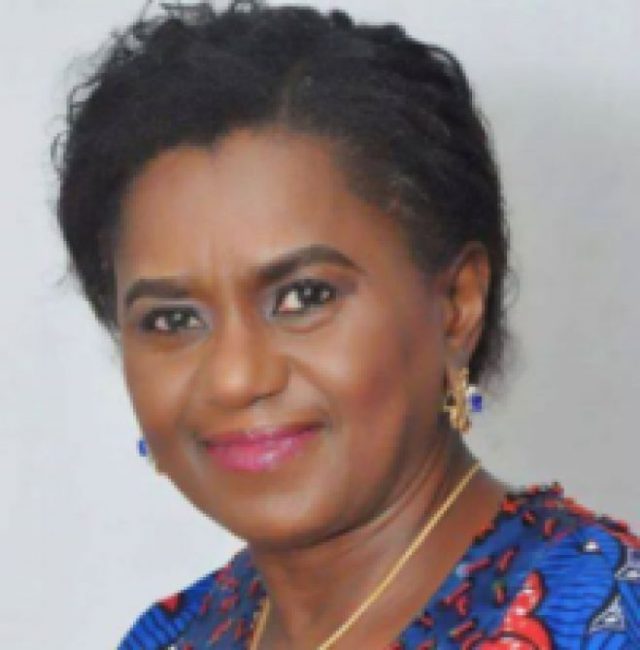
The Deputy Governor of Rivers State, Dr Ipalibo Banigo, on Wednesday, October 25, 2017 identified malnutrition as the cause of 53 per cent of deaths in women and children.
Deputy Governor of Rivers State, Dr Ipalibo Banigo
Banigo made this known in Port Harcourt at the opening ceremony of International Federation of Women Lawyers (FIDA) Nigeria Week/Annual General Meeting and Pre-convention meeting.
She spoke on “Economic Empowerment of Women under the Nigeria Economic Recovery and Growth Plan 2017/2010.”
The deputy governor said studies had shown that women were central to economic growth of any nation.
“Investment in women is economically important,” she said.
She decried the gender gap in employment (labour) circle, saying, “it can take about 70 years to close up the gender gap in the labour sector’’.
Banigo said that women had suffered from activities of pipeline vandalism and illegal refineries.
“Women should be given more political appointments to enable them to participate in decision-making and represent the interest of women,’’ she said.
The deputy governor said that educating a girl-child was one way of empowering a woman, while engagement in agriculture remained a way out of poverty and hunger.
In her remarks, the Vice-President of FIDA, Mrs Inima Aguma, said that the body considered education, intellectual and skills development as very important.
Aguma said that in line with this, the organisation had institutionalised the mandatory continuing legal education.
According to her, FIDA Nigeria engaged in training, workshops, lectures, seminars and discussions on topical issues, aimed at improving and developing the intellectual and professional capacity of its members.
Mr Rufus Godwin, the Head of Service in Rivers, said that FIDA had produced many prominent women, now occupying very strategic positions in the country.
The Federal Government has promised to collaborate with the stakeholders in Kogi State to give the necessary support to the state government in managing disaster.
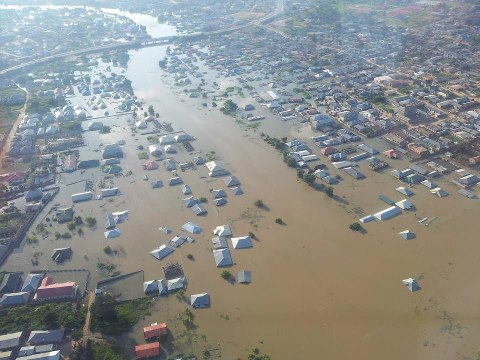
Flooded parts of Lokoja in Kogi State in 2012
Dr Oluwafemi Oke-Osanyintolu, team leader, Disaster Risk Management team, Office the Vice-President, made the promise while speaking with journalists on Wednesday, October 25, 2017 in Ibaji, Ibaji Local Government Area of the state.
He said that the team was in the state to carry out assessment of flood sites and disaster-prone areas in nine riverine local governments of the state.
Oke-Osanyintolu said: “We are here to do a holistic assessment, resource mappings, risk analysis and look at the overview of preparedness of Kogi State to manage any form of disaster.
“We are trying to mitigate the impacts of both man-made and natural disasters on the people of Kogi.
“We want to help reduce the rate of mortality and morbidity that is always associated with disaster.
“We have done a holistic assessment in areas worst hit by flood; we are satisfied with our assessments because Kogi government and other stakeholders are doing their best.
“We are going back to the drawing board to do a holistic planning; we will ensure that Kogi is well-prepared to effectively and efficiently respond to any form of emergency disaster.”
Oke-Osanyintolu, who is also Senior Technical Adviser on Disaster Risk Management, said the collaboration became necessary because of the realisation that the state government could not manage disaster alone.
The Deputy Governor, Mr Simon Achuba, who received the team, said that the state government had made provision in its 2017 Budget to equip the State Emergency Management Agency (SEMA).
He said the equipment include flying boat for rescue operation and other materials, to mitigate the effects of flooding.
“On 2017 flood, we took some steps ahead of time by doing monthly sanitation to clean our drainage system, flood sensitisation campaign and stakeholders meeting; if not, the situation would have been terrible just as in 2012.
“I come from a flood-prone environment; as I speak to you now the road leading to my local government in Ibaji is cut-off due to flood.
“We thank the Federal Government for coming to our aid,” he said.
Contributing, Mrs Rosemary Osikoya, the Commissioner for Environment and Natural Resources, expressed delight over the team’s visit to the state.
She said: “It is exciting and encouraging that the Federal Government is having more reawakening to our challenges in Kogi.
“It is an assurance that the people of Kogi have not been forgotten.”
Chairmen of Kogi/Kotonkarfe, Lokoja, Idah, Igalamela and Ibaji Local Government Areas, in their separate interviews with the News Agency of Nigeria (NAN), also commended the Federal Government for the exercise.
According to them, the gesture would go a long way in ameliorating the hardship facing victims of disaster in the state.
They also thanked the Vice-President, Prof. Yemi Osinbajo, for sending the team down to the communities for flood assessment and make some interventions.
The News Agency of Nigeria (NAN) reports that the exercise, which began on Monday ended on Wednesday with the team visiting some communities affected by flood in the state.
The team also paid courtesy visit to the Achandu Attah Igala, Dr Yusuf Ameadaji, who lauded the efforts of the federal and state governments, saying that idea behind the visit was to reduce the effects of flooding in his domain.
He, however, appealed to the Federal Government to provide the victims of the flood with succour, saying that the flood had destroyed their roads and farm lands.
“We are very grateful to the Federal Government for taking up these issues and for giving the needed support that our people deserve,” he said.
The Benue Team Lead, Synergos, Mr Michael Agon, has emphasised the organisation’s commitment in facilitating the continuous approach for the systems shift of agriculture in Nigeria and enlighten stakeholders on agricultural opportunities in Benue State.
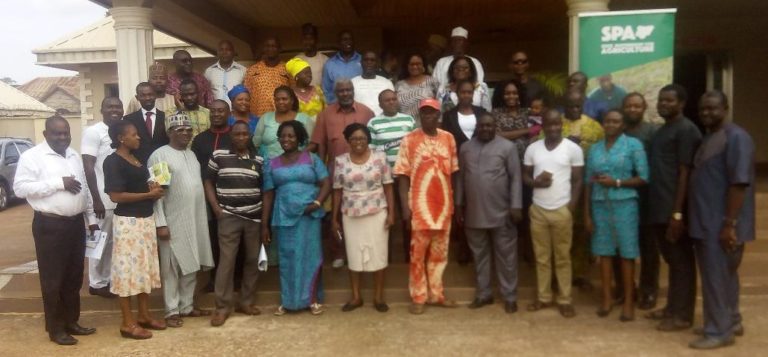
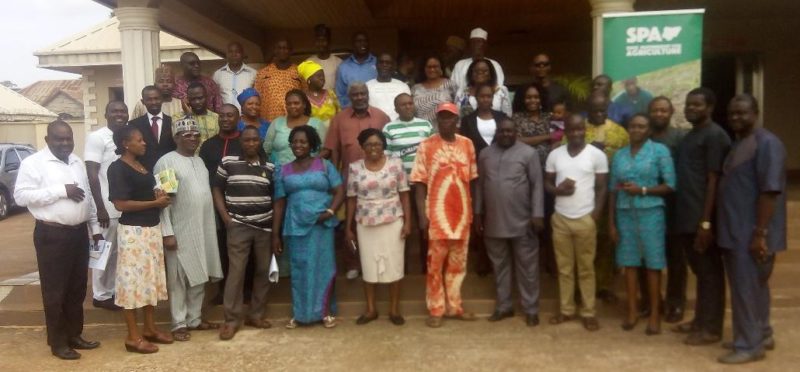
Group photograph of participants at the meeting
Making this known on Wednesday, October 25, 2017 at an Agricultural Visionary Group (AVG)/Agricultural Innovation Group (AIG) Stakeholders Meeting held in Makurdi, Benue State, he stated that they create a platform for exchange of ideas in order to enable stakeholders in agriculture make informed decisions.
He maintained that Synergos would continue to strengthen the agricultural system by establishing stakeholder working groups and building in the capacity of key public and private sector agricultural stakeholders to problem solve, mobilise resources, implement improvement initiatives in Benue State.
According to Mr Agon, as they try to find solutions to agriculture in the state, stakeholders need to look inwards and tap into many potentials in agriculture such as yam export trade which the state stands to gain big in the over $30 billion trade as Nigeria accounts for 75% of world yam produce, boasting of a spread of 60 varieties, with Benue having eight out of the lot.
Stressing further, the Team Lead stated that the Bill and Melinda Gates Foundation funded Synergos is poised to enhance agricultural opportunities in the country, hence, their training of aggregators in post-harvest farming to enhance crop handling processes among others.
Also speaking, a stakeholder and farmer cum Lecturer in the Faculty of Law, Benue State University, Makurdi, Mrs Mwuese Mnyim, stated that agriculture is a worthy venture and sustainable for livelihood.
Mrs Mnyim, who charged that Benue people must be at the heart of yam export in the country, added that they should cash in on the opportunity provided now with the commencement of export of the crop.
In his submission, Director, Agriculture Services, Benue State Ministry of Agriculture and Natural Resources, Mr Thomas Nongo, extolled the state governor for his effort in payment of counterpart funds for agricultural interventions which has developed agriculture in Benue.
According to Nongo, the state now has comparative advantage in agriculture in several crops, including citrus, yam etc and has actually reclaimed its food basket status.
Participants at an international conference on rivers and deltas in Africa on Wednesday, October 25, 2017 said the management and challenges of ecosystem could be better addressed through integrated and multi-sectoral framework.
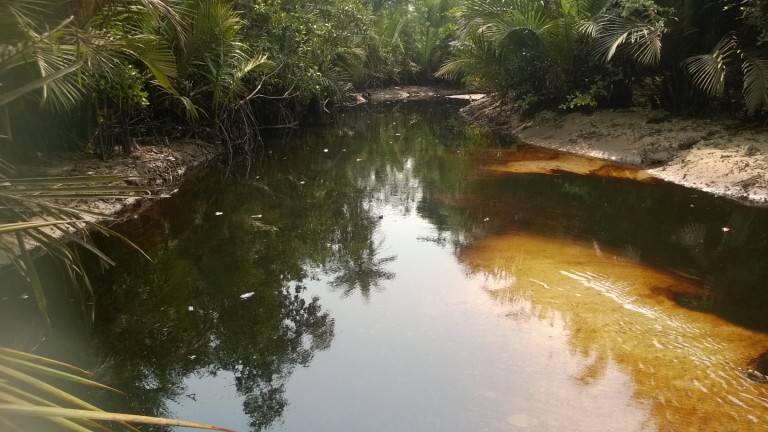
A polluted river in the Niger Delta region
The conference, with the theme, “Sustaining Ecosystem Services of Africa’s Rivers and Deltas”, was organised by a consortium of universities in the Niger Delta and hosted by the Niger Delta University, Wilberforce Island, Bayelsa State.
The stakeholders called on the government to encourage research in ecosystem services for sustainable development of the Niger Delta.
The participants, who were drawn from the academia, government, non-governmental organisations and community representatives, said there had not been sufficient investment in the ecosystem services in the region to complement revenue from oil and gas.
The universities include the University of Port Harcourt; Federal University, Otuoke; Rivers State University of Science and Technology, Port Harcourt; Federal University of Technology, Owerri; Delta State University, Abraka; University of Calabar; and University of Uyo.
Others are Ignatius Ajuru University of Education, Port Harcourt; University of Benin; and the Foundation for the Conservation of Nigerian Rivers.
The conference was the second in the series in response to a 10-year Global Delta Sustainable Initiative agreed upon by a network of international experts on rivers and deltas at a conference in Rotterdam, The Netherlands, in September 2013.
The stakeholders, in an eight-point communiqué, urged the International Oil Companies (IOCs) to collaborate with government, host communities, NGOs and other corporate bodies to chart a new course for sustainable development agenda for the Niger Delta.
They also called for a paradigm shift from the current flood control and crisis management approach to sustainable and integrated flood-risk management method in line with global best practices to address flood disasters in the region.
They further suggested that tertiary institutions in the Niger Delta need to strengthen research collaboration on sustainable development activities in the region.
The participants also advised that the IOCs, government and communities should emphasise and carry out modern environmental pollution control measures to save the rivers and deltas.
Unwashed hand is capable of transmitting infectious diseases and constitute threat to public health, a medical laboratory scientist, Mr Solomon Chollom, has said.
Handwashing
Chollom, who works with the National Veterinary Research Institute (NVRI) told the News Agency of Nigeria (NAN) on Wednesday, October 25, 2017 in Jos, Plateau State, that many people failed to imbibe handwashing culture in their daily life.
He described hand as an instrument of feeding and touching and as such, oral contact with unclean hand could lead to transmission of infectious diseases.
According to him, diseases spread when people involved in food preparation failed to wash their hands, especially after visiting the toilet.
“In the process of food preparation, infectious particles known as pathogens are transmitted to the food and ingest by unsuspecting persons,’’ Chollom said.
He said that dirty hands, most times, were contaminated and thus constitute threat to public health.
“Many times, people exchange handshakes immediately after leaving the restroom without washing their hands.
“In that process, infectious and communicable diseases are transmitted to another person’s hand and if the person fails to wash or sanitise his or her hand, such pathogens are further transmitted.
“Contaminated hands of a public caterer become grave public health challenge to the consumers of such food,’’ he said.
Chollom advised people to inculcate the habit of washing their hands daily, saying that such practice would drastically reduce the spread of infectious diseases.
Canadian High Commissioner to Nigeria, Dr Christopher Thorney, says the Government of Canada has earmarked $3.5 billion to advance the health of women and children in Nigeria.
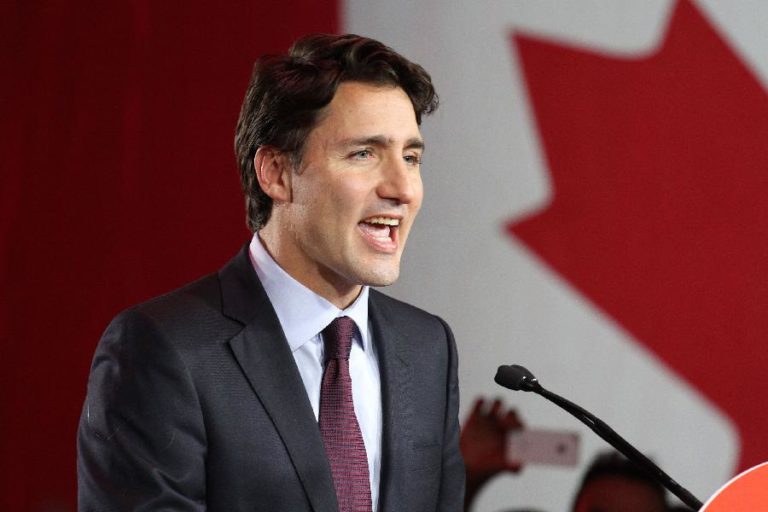
Justin Trudeau, Prime Minister of Canada
The High Commissioner made the disclosure during the Multi-Country Dissemination of the Rapid Access Expansion (RAcE) Project on Integrated Community Case Management of Childhood Illnesses (iCCM) in Abuja.
According to him, Canada has a long history of working to improve the health of women and children in Nigeria.
He said that other collaborative efforts were in the areas of polio eradication and other Maternal Newborn Child Health (MNCH) through Canada’s G8 initiative.
Thorney said that the initiative on MNCH was followed by the 2015-2020 commitment to invest $3.5 billion in related programmes over five years.
According to him, statistics on maternal and child deaths globally are troubling in spite of tremendous efforts already made.
“In 2016, 5.6 million children under the age of five died worldwide; to make that more understandable, that is about 15,000 child deaths per day.
“We also understand that three quarters of under-five mortality are also from leading causes such as diarrhoea, malaria and pneumonia.
“All of these can be prevented or treated with access to simple and affordable interventions when they are available but certainly they are not always available.’’
He said that although most of the effective interventions for these diseases were known, simple and affordable, they were, however, often inaccessible to families who could not reach health facilities on time, especially within the crucial 24 hours.
Thorney noted that progress in reducing child mortality worldwide had been gradual and in some cases stagnant or reversed.
He said, “Unless we tackle the barriers that are preventing access to life saving treatment, we will always be at risk of losing the momentum we have gained.
“This is why Canada is proud of its support which has promoted the scale of Integrated Community Case Management (iCCM) in Nigeria, Malawi, Mozambique, Niger and Democratic Republic of Congo,’’ Thorney said.
Also, Wondi Alemu, Country Representative, WHO Nigeria, said that that the organisation was very proud of the work executed in Nigeria, Niger, DRC, Mozambique, Malawi on the iCCM.
“As to Nigeria, iCCM is a successful programme; I say a programme because it is a project that will last after this financing from the government of Canada.
“I believe the government and states ministries of health will take it up and replicate the strategy in other states,’’ he said.
According to Alemu, over 700 health workers implementing the iCCM have been trained with the support of WHO, under the direct supervision of states ministry of health.
He said the trained personnel were providing important service to communities.
The News Agency of Nigeria (NAN) reports that Nigeria started the implementation of iCCM in 2012, which is meant to reduce the burden of under-five deaths due to malaria, diarrhea and pneumonia.
The programme targets under-served, hard-to-reach areas using Community Oriented Resource Persons.
The introduction of the intervention coincided with the re-positioning of Nigeria’s Child Health and Nutrition Agenda aimed at redeeming the unacceptable nutrition indices, and under-five mortality rate.
The Executive Secretary, Yobe Primary Healthcare Management Board, Dr Hauwa Goni, said over 1.1 million children under age five have been immunised against polio virus this year.
She disclosed this on Wednesday, October 25, 2017 at a press conference in Damaturu to mark the World Polio Day.
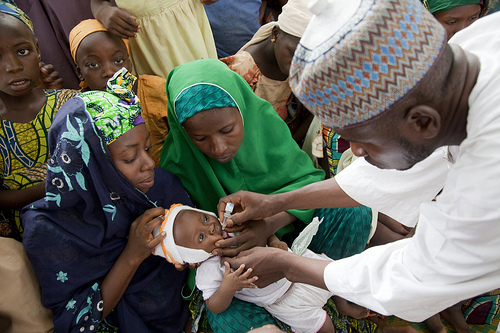
Polio immunisation in Nigeria. Photo credit: comminit.com
Goni said that the state recorded its last case of polio virus three years ago, stressing “precisely, since 14th April, 2014, no case was recorded in Yobe state”.
The scribe said the task force on polio immunisation under the leadership of the state Deputy Gov. Abubakar Aliyu, has sustained the campaign to ensure complete eradication of the virus across the state.
“The success recorded in polio eradication in Yobe state is due to sustained efforts and political commitments of Gov. Ibrahim Gaidam by providing the necessary resources for polio eradication at all levels,” she said.
Goni said the task force on polio eradication was collaborating with ministries of education and religious affairs, school authorities and traditional rulers to create more awareness on polio eradication.
She said the task force was also liaising with parents and all stakeholders to clear rumours on alleged strange injection on heads and abdomen of primary school pupils.
“There is no truth in the baseless rumour and not a single case of the strange injection has been established anywhere in the state.
“We have made parents to disregard this, take note of announcements on radio on the vaccination exercise and present their children for vaccination,” Goni said.
She advised residents to seek information and improve their health behaviour to prevent diseases.
An ecologist, Mr Richard Inyamkume, on Tuesday, October 24, 2017 urged relevant stakeholders in the environment sector to implement the nation’s strategic policies and plans of action on climate change.
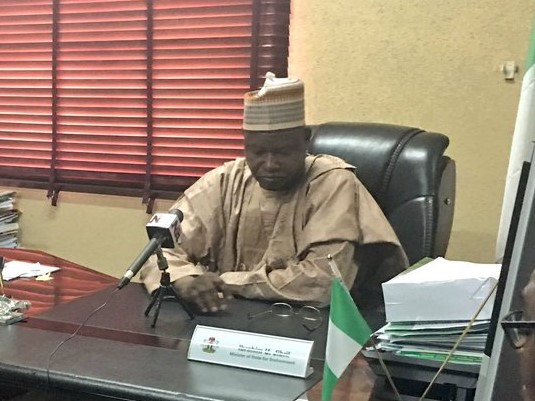
Ibrahim Usman Jibril, Minister of State for Environment
Inyamkume, who is also the Senior Programme Officer, Climate Change Mitigation and Adaptation Initiative, an NGO, gave the advice in an interview with the News Agency of Nigeria (NAN) in Abuja.
“The future of our nation is in our hands. We cannot fold our arms and wait for government to do everything for us.
“We need to act so as to reverse the negative trend of global warming in Nigeria.
“At least, government has demonstrated that it is ready to take the lead; it is now our part to see that climate change policies are implemented by the different tiers of government as they ought to be.
“At the moment, there have been national strategic policies and plans of action on climate change, which if carefully followed, can foster the development of low carbon growth initiatives,’’ he said.
According to him, it will also promote clean development mechanisms and earn carbon credits for the country.
Inyamkume lauded the Federal Government for initiating the “Great Green Wall Project”, saying that the project had made positive contributions toward improving the country’s climate through schemes such as tree planting.
“So far, Nigeria has demonstrated a lot of commitments to tackling climate change issues.
“I am happy with several green initiatives that were launched by the government in relation to climate change.
“I am aware that several eco-friendly projects have been launched at different levels within the country to improve Nigeria’s climate and green environment,’’ he said.
The ecologist, however, said that Nigeria should remain faithful to the Paris Agreement, which President Muhammadu Buhari signed in New York on Sept. 22, 2016.
He recalled that the Paris Agreement came into force on Nov. 4, 2016, with 197 parties, including Nigeria, signing it.
“Besides, President Buhari ratified the Agreement on March 28, 2017, making Nigeria the 146th member of the UN to have ratified the treaty.
“This is a global demonstration by Nigeria that she is faithful to international agreements,’’ he added.
The President of African Development Bank (AfDB), Dr Akinwumi Adesina, says Nigeria needs more investment in rural infrastructure to boost agricultural production in the country.
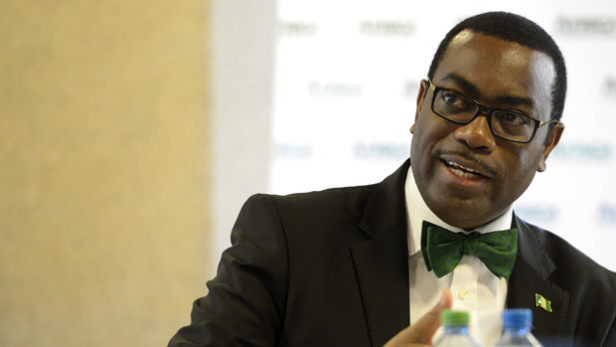
Akinwumi Adesina, President of the African Development Bank Group
Adesina made this known on Tuesday, October 24, 2017 in an interview with the News Agency of Nigeria (NAN) in Des Moines, USA.
He said that the country must continue to operate policies that would assist farmers in accessing seeds and fertilisers easily.
“We must continue to run public policies that get access to seeds and fertilizers for farmer at scale. When I mean scale, I mean at scale of millions and millions of farmers.
“And I think the use of the electronic wallet system, which we started when I was minister of agriculture, provides a very good platform to continue to do that because that same technology today is been used in other parts of the world.
“And I think it’s important to get access to technology to farmers at scale.
“Nigeria needs to invest a lot more in rural infrastructure; rural roads, storage facilities to help farmers. This is very important.
Adesina described the Nigerian Incentive-Base Risk Sharing System for Agricultural Lending (NIRSAL) as a game changer.
The CBN incorporated NIRSAL in 2013 as a dynamic, holistic 500 million dollars public-private initiative, to define measure, price and share agribusiness related credit risk with banks.
According to him, NIRSAL has made the banking industry to see the agricultural sector differently, adding that the amount of bank’s lending to farmers had increased since it advent.
“We also have to make sure that we are supporting a lot more of research and development of the sector.
“A lot more work needed to be done to support research institutions in Nigeria.
“But am delighted that Nigerian government is paying attention to agriculture as it should.’’
The Executive Secretary, Kaduna State Primary Health Care Development Agency (SPHCDA), Dr. Hadiza Balarabe, on Tuesday, October 24, 2017 said the state has not recorded any polio case since 2012.
Polio immunisation in Nigeria. Photo credit: comminit.com
The official said during a rally to mark World Polio Day in Kaduna that, in spite of the feat, the agency has sustained polio immunisation across all communities in the state.
The executive secretary, represented by a deputy director in the agency, Hamza Ikara, stressed that they would not relax in administering the oral polio vaccine to children under-five until the virus was totally eliminated in the country.
She enjoined parents to ensure that their children were not left out in the exercise.
“Tremendous achievements were recorded from December 2012 to date.
“Nigeria recorded only four reported cases of wild Polio Virus in Borno State in 2016 as against zero cases over the same period in 2015.
“Kaduna state in particular did not record any case of wild polio virus since November, 2012.”
The official said the celebration, which involves all development partners working in the state, was due to intensified efforts to ensure total eradication of polio in the state.
She said the event was an opportunity for all stakeholders to rub mind on the successes, challenges and way forward in making the state totally polio free.
NAN reports that participants at the rally included Journalists Initiative on Immunisation Against Polio, Polio Survivors of Nigeria, traders, UNICEF officials and other stakeholders.