The African Development Bank, (AfDB) says that no fewer than 650 million Africans currently live without electricity.
Dr Victor Oladokun, the AfDB Director, Communication and Media Relations, disclosed this on Wednesday, May 2, 2018 while welcoming African Journalists on a Media Tour to Saemaul Undong Model village project, in Yamoussoukro, Cote d’Ivoire.
“About 650 million people in Africa are currently without light and some communities till today have never seen electricity.
“We have a commitment to ensure universal electricity commitment and few other commitments,’’ he said
He said that Africa by 2050 would have a population of close to two billion people, a population of China and India put together.
He added that about 90 per cent of the people living in rural areas in Africa live in darkness.
“A state like Lagos in Nigeria has about 25 million population, five million commutes out of Lagos.
“Lagos, like Addis are likely to double its population to 40 to 45 million in the next 20 years, are we prepared? he asked.
He said that the continent needed to work hard to be able to manage the population with the basic needs.
He noted that the bank had five key areas of focus to ensure effective development of the region.
The five key areas, he said, include: Light up Africa, Feeding Africa, Integrating Africa, Industrializing Africa and Improve Quality of Life in Africa.
He said that the bank had continued to expand its operations to take business closer to consumers in the field.
According to him, the bank has established 40 offices in different countries in the region as against the 14 it used to have.
“As a bank, we need to be closer to the consumers and the private sector,’’ he said
He added that the bank had refocused its effort to ensure that rural areas were developed over urban centres to bring the desired result in the region
The World Health Organisation (WHO) has warned that records for extreme weather events are being broken at an unprecedented rate, and that there is a real risk for the world to lose its capacity to sustain human life if the Earth’s climate is further altered by adding ever more heat-trapping greenhouse gases.
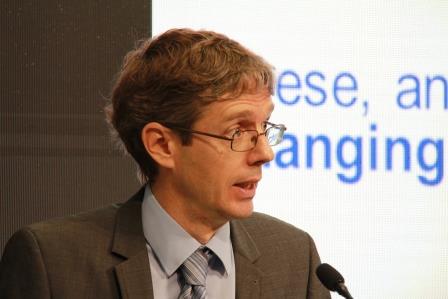
Dr Diarmid Campbell-Lendrum, lead scientist on climate change at WHO. Photo credit: graduateinstitute.ch
WHO officials expressed the warning whilst presenting new data at the 2018 UN Climate Change Conference in Bonn shows that nine out of 10 people breathe air containing high levels of pollutants and that around seven million people every year die from exposure to fine particles in polluted air.
This figure could be far surpassed by deaths caused by rising global temperatures and extreme weather if emissions, primarily caused by the burning of fossil fuels and deforestation, are allowed to rise at their present rate.
“We see the Paris Agreement as a fundamental public health agreement, potentially the most important public health agreement of the century. If we don’t meet the climate challenge, if we don’t bring down greenhouse gas emissions, then we are undermining the environmental determinates of health on which we depend: we undermine water supplies, we undermine our air, we undermine food security,” said Dr. Diarmid Campbell-Lendrum, WHO Team Lead on Climate Change and Health.
A main cause of the deaths mentioned in the new WHO report is indoor cooking with inefficient stoves.
Around three billion people – more than 40% of the world’s population – still do not have access to clean cooking fuels and technologies in their homes, the main source of household air pollution. Cooking with wood and coal is also main driver of deforestation, which in turn negatively affects the world’s climate.
Each year, close to four million people die prematurely from illness attributable to household air pollution from inefficient cooking practices using polluting stoves paired with dirty solid fuels and kerosene, emissions from which add to the growing climate challenge.
“We have a unique opportunity to get these two things, climate change and health, right if we get air pollution right. The health benefits of climate mitigation will pay for the costs of climate mitigation,” said Campbell-Lendrum.
The second main cause of the seven million annual deaths mentioned in the report is the burning of fossil fuels for power, heating and transport which leads to outdoor air pollution.
Fighting climate change by investing in energy-efficient power generation and renewables, planning greener cities with energy-efficient buildings, and providing universal access to clean, affordable energy technology are key ways in which regions can decrease ambient air pollutants, the report finds.
The good news is that countries are increasingly taking up the opportunity to fight climate change and air pollution at the same time. More than 4,300 cities in 108 countries are now included in WHO’s ambient air quality database, making this the world’s most comprehensive database on ambient air pollution.
The report points to Mexico City’s 2016 commitment to cleaner vehicle standards, including a move to soot-free buses and a ban on private diesel cars by 2025.
This year WHO will convene the first Global Conference on Air Pollution and Health (October 30 – November 1, 2018) to bring governments and partners together in a global effort to improve air quality and combat climate change.
Some environmentalists have called for concrete actions against the spate of micro-plastics pollution in the nation’s water bodies.
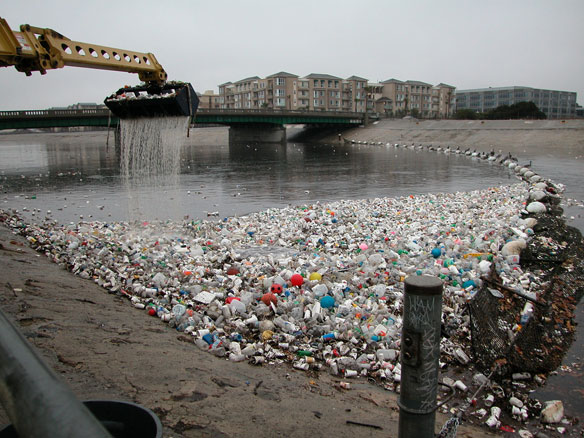
Plastic pollution
The environmentalists made the call in various interviews with the News Agency of Nigeria (NAN) in Lagos on Thursday, May 3, 2018.
Micro-plastics are broken-down plastic waste, synthetic fibres and beads found in personal hygiene products.
They also include larger plastics that have broken apart, resin pellets used for plastic manufacturing, and manufactured plastic beads used in health and beauty products.
They harm marine life, which mistake them for food and can be consumed by humans via seafood, tap water and salt.
The Co-founder of Cleanedge Initiatives, Mr Temitope Ogunweide, said that micro-plastics could be prevented from entering human bodies through effective waste management practice.
“Micro-plastic pollution is one of the most widespread and long lasting anthropogenic changes in the surface of the planet.
“The best way to reduce micro-plastics in our waters is by having an effective waste management system, which is why it is urgent to support the ocean clean-up exercises.
“Not cleaning up the ocean will result in the spread of more micro-plastics which is deposited in our food chain, table water and salt among others.
“It takes about 14 days for micro-plastics to digest in aquatic animals when compared to the normal digestion which just takes two days.
“Fish is the primary source of protein for humans. The micro-plastics ingested by the fish can be passed on to humans when consumed,” Ogunweide said.
On his part, Mr Olumide Coker, the Country Manager of Let’s Do It Nigeria, said Nigeria needed to adopt the use of eco-friendly materials to curb micro-plastic pollution.
“Some countries have identified the inherent dangers of micro-plastics both in the aquatic and human environment.
“These countries have resolved to use eco-friendly materials. They have a timeline to create awareness on the dangers of micro-plastics pollution and need to ban plastics.
“We are still far behind in this aspect in Nigeria. I think we should adopt their strategies to eliminate micro-plastics pollution in our country,” Coker added.
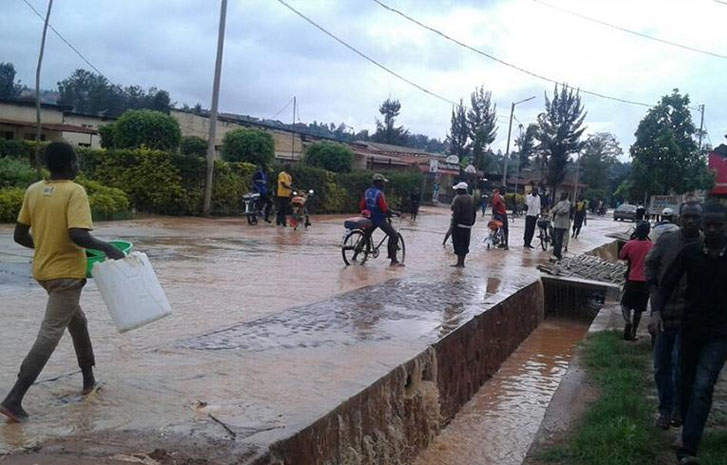
At least 183 people were killed and 215 others injured in Rwanda by heavy rains in the first four months of 2018, the Ministry of Disaster Management and Refugees of Rwanda said.
A flooded street in Rwanda
From January 1 to April 30, the disasters including floods and lightning also destroyed a total of 9,974 houses, leaving 706 people homeless, according to figures released by the ministry on Thursday, May 3.
Also destroyed were 2,450 hectares of plantations and 21 school structures, according to the figures.
The cabinet of Rwanda on Wednesday at a meeting expressed concern and sympathy to all Rwandans, especially families that had lost members and those impacted by the effects of the recent disasters.
The meeting also discussed strategies and mechanisms that would continue to support those affected by disasters and to fast-track repair of damaged properties.
Dr Abebe Menkir of International Institute of Tropical Agriculture (IITA), Ibadan, has commended the West African stakeholders of the Stress-Tolerant Maize for Africa (STMA) for boosting maize production in the African sub-region.
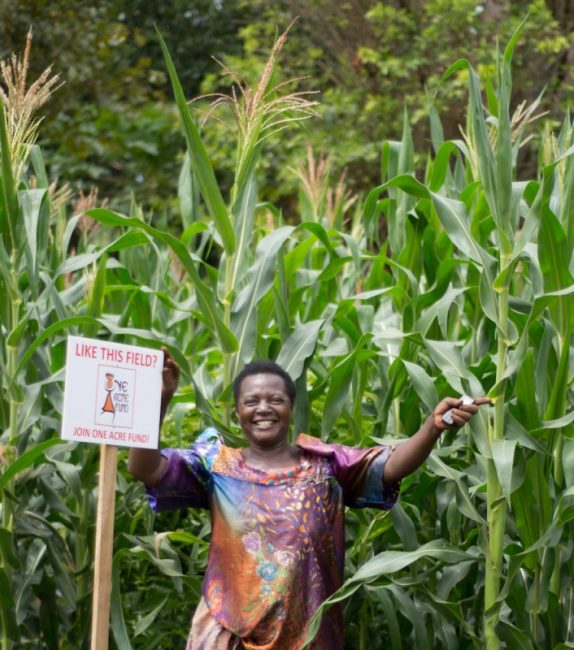
A maize farmer. Photo credit: Kelvin Owino
Menkir gave the commendation in a statement by Dr Godfrey Onagwa, Information and Communication, National Agricultural Extension Research and Liaisons Services (NAERLS), Zaria on Thursday, May 3, 2018.
It quoted Menkir, who is also the head of maize research programme, IITA, as saying that the project had yielded positive results.
The statement said the Stress-Tolerant Maize for Africa (STMA) Project held its West African Regional Planning and Review Meeting in IITA, Ibadan.
It added that the stakeholders gathered in IITA Ibadan to review the STMA’s tremendous roles at increasing maize productivity in the sub-region.
“The project has performed exceptionally well since its inception about two years ago.
“The project is involved in the development and promotion of maize OPVs (open-pollinated varieties) and hybrids that are drought-tolerant, striga-resistant, disease-resistant and those tolerant to low-nitrogen soils.
“The foremost maize scientist said this at the event of the West African Regional Planning and Review meeting of the Stress-Tolerant Maize for Africa (STMA) in IITA from May 1 to May 6, 2018,” it said.
Onagwa said the meeting, which is the forum for reviewing the project activities of 2017 and planning for those of 2018, had participants from four West African countries: Nigeria, Benin, Mali and Ghana.
The International Director of the STMA Project, Dr Cosmos Magorokosho, was also present at the meeting.
He noted that various countries reported increased activities in their variety development and dissemination across the region, disclosing that Nigeria released about two stress-tolerant varieties in 2017 alone.
It added that Nigerian partners include: Institute for Agricultural Research (IAR), Zaria, NAERLS, Zaria; University of Ilorin, Institute for Agricultural Research and Training (IAR&T), Ibadan.
Others include Premier Seeds, Maslaha Seeds, Tecni Seeds, National Centre for Genetic Resources and Biotechnology (NACGRAB) and National Agricultural Seeds Council (NASC).
The statement said Dr Muhydeen Oyekunle, a maize breeder and scientist at IAR, Ahmadu Bello University, Zaria, is the Nigeria country coordinator of the project.
The African Development Bank (AfDB) says it trained about 733 people in Nigeria on increased use of technology in agriculture in the country.
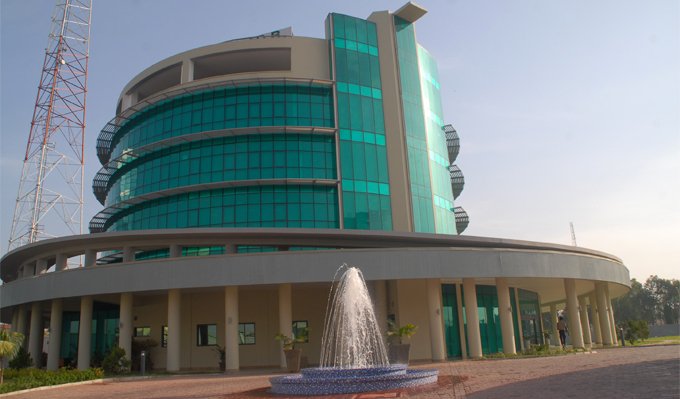
AfDB building in Abuja
The bank revealed this in its 2017 Annual Development Effectiveness Review on Thursday, May 3, 2018 in Abuja.
The AfDB said that the training was part of the Feed Africa project (2016 to 2025) under the high five priority projects of the bank.
According to the review, the bank interventions in agriculture over the last year have benefited 5.6 million people.
“Our feed Africa Strategy (2016 to 2025) is designed to eliminate extreme poverty, end hunger and malnutrition; make Africa a net food exporter.
“Also, it will move Africa to the top of certain agriculture based, export-oriented global value chains in areas in which it enjoys a comparative advantage.
It added that the bank met its target in assisting 597,900 people to increase their use of technology.
“In Nigeria, we trained 733 people and provided irrigation pumps and agro processing equipment.
“We built or rehabilitated 520km of feeder roads , provided farmers with access to 2300 tones of inputs and delivered increased access to finance,’’ the bank said
The report further noted that the bank supported improved water management practices on 37,600 hectares.
“In Gambia, we improved land and water management practices for over 68,400 people significantly reducing soil erosion, controlling salinity and increasing rice yields above our target,’’ the AfDB said
The bank added there was increase in yields of a wide range of crops through the assistance to agricultural research networks, training around 17,000 research and extension staff.
This, the bank said benefited an estimated 698,000 farmers.
The death toll in the deadly storm that hit India’s northern states of Rajasthan and Uttar Pradesh on Wednesday night has risen to around 80, with around 143 people injured, according to official sources.
Indian children swim in a pond during a dust storm in New Delhi on May 2, 2018. Photo credit: Chandan Khanna/AFP
The highest number of deaths was reported from Uttar Pradesh’s Agra city where around 36 people died in the disaster.
Nine people were killed in other parts of Uttar Pradesh, including in Bijnaur, Saharanpur and Bareilly.
The Rajasthan government confirmed 35 deaths in the state, mainly in the districts of Bharatpur, Alwar and Dhaulpur, Jhunjhunu.
Leading English daily The Times of India quoted sources from the meteorological department as saying that as much as 48.2 mm rainfall was reported in Agra district between 8.45 p.m. to 11.30 p.m. local time on Wednesday, with storm winds of around 145 km per hour.
The injured have been admitted to government hospitals.
Meanwhile, Uttar Pradesh Chief Minister Yogi Adityanath directed state officials to monitor relief work and provide medical aid to the affected.
Adityanath also announced a compensation of up to four lakhs Indian rupees (about $4,000) to the families of the deceased and 50,000 rupees (about $750) for each of the injured.
The Yobe State Government says it has placed a price tag of N1,000 on every tree planted in the state in its effort to promote afforestation, combat desertification and reclaim soil fertility.
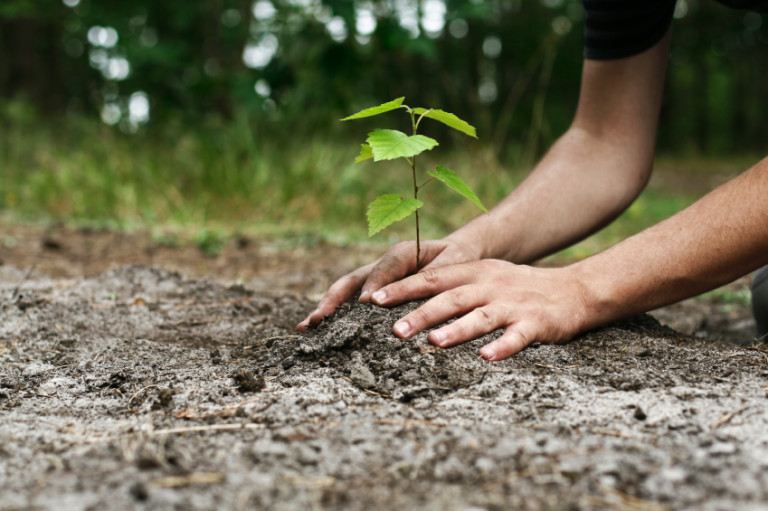
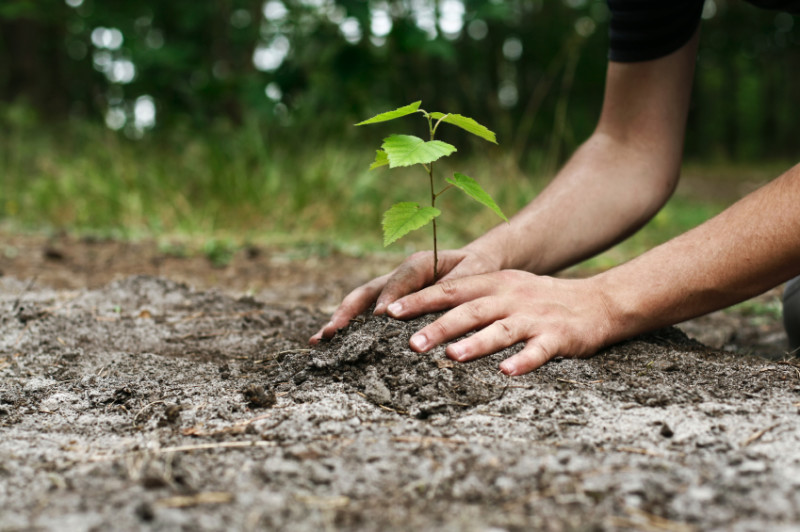
Tree planting
Alhaji Abubakar Aliyu, the state Deputy Governor and Chairman, Environmental Protection Committee, announced this on Wednesday, May 2, 2018 at the launching of special environmental protection programme at Gulani in Gulani Local Government Area.
The deputy governor also performed similar function at Gujba Local Government Area of the state.
Aliyu, who was represented by the Commissioner for Environment, Alhaji Jibrin Kortomi, said increased pressure on land for farming, indiscriminate felling of trees and illegal mining had impacted negatively on the environment.
“The sum of N1,000 is earmarked as price per tree stand, planted and nurtured for one year.
“Desert encroachment, land degradation and siltation of rivers had retarded agricultural activities with negative effect and promoting poverty in the communities.
“We have embarked on massive planting and nurturing of trees to protect the environment against wind storms, improve soil fertility and provide shelter for human and animals,” he said.
Aliyu directed local governments, traditional leaders and the communities to step up action on tree planting and other measures that would save the environment.
Alhaji Bunu Zanna, member representing Gulani constituency in the state House of Assembly, who spoke on behalf of his people, assured that trees would be planted massively to safeguard the environment.
“We will plant many economic trees to facilitate environmental and economic recovery as we emerge out of the Boko Haram insurgency,” he said.
Two developing countries will present their achievements and unique challenges in their actions to reduce greenhouse gas emissions, providing an update to previously presented actions.
A view of the atrium in the World Conference Centre Bonn (WCCB) in Germany, venue of the Bonn climate talks
In a fifth round of the so-called “facilitative sharing of views” (FSV) session, Chile and Singapore will present updates on the status of their greenhouse gas emissions, as well as on their updated actions to reduce emissions.
The facilitative sharing of views involves an inter-active exchange of information and views between those countries presenting updates and all other countries. Written questions to the presenting countries were submitted in advance. These will be addressed and taken up by the presenting countries during the FSV.
The FSV is one of the key processes for developing countries to demonstrate their achievements in climate actions, as well as to share good practice, challenges and capacity building needs.
Presentations during the FSV session often demonstrate that developing countries are committed to enhancing their climate actions in the context of implementing their climate action plans, called Nationally Determined Contributions (NDCs), with an aim to achieving low carbon growth.
Past rounds of the facilitative sharing of views have provided a wealth of information on mitigation actions in the developing countries and clearly demonstrated developing countries’ efforts and commitments to action. Successful examples of international cooperation to overcome barriers and challenges were provided by many.
They also showed that their measuring, reporting and verification system provides an excellent basis for solid data collection that could help inform policy decisions at the national level.
Countries also benefitted from the feedback received during previous FSV sessions, as it helped them to be better prepared for the implementation of the Paris Agreement. The positive experience gained from this process will lay a solid foundation for the new transparency framework under the Paris Agreement.
The Lagos State Commissioner for the Environment, Mr Babatunde Durosinmi-Etti, says 296 Waste Collection Operators (WCOs) have been re-certified and licensed to commence waste operations.
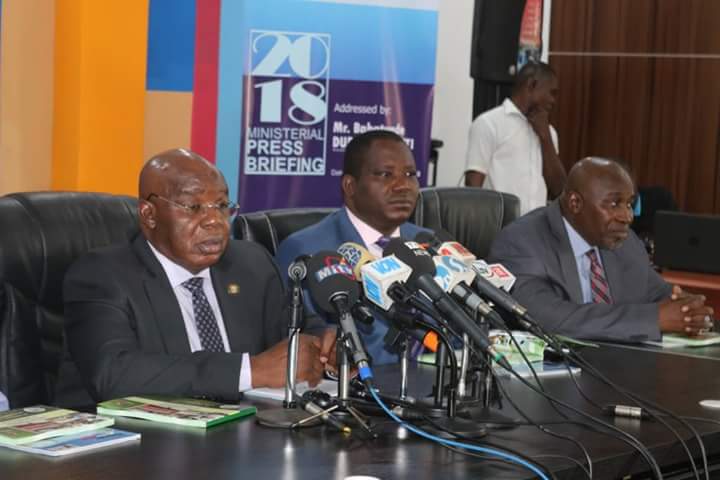
Lagos State Commissioner for the Environment, Mr Babatunde Durosinmi-Etti (left), during the briefing
Durosinmi-Etti announced this at the 2018 Ministerial Press Briefing to commemorate the third year in office of Gov. Akinwunmi Ambode on Wednesday, May 2, 2018 in Ikeja.
He said that said the evacuation of residential waste was in progress and refuse littering across the state would soon be a thing of the past.
According to him, the ministry has been relating with the PSP operators and there is no form of fractionalisation among them.
“The ministry has a process in place. Every PSP is registered; every truck is certified and registered in the ministry.
“The ministry has an obligation to deal with any PSP that is willing to work with it, in fulfilment of its mandate to keep Lagos clean.
“We should not play politics with the health of Lagosians, in keeping Lagos clean.
“No job is being taken from anybody, we went as far as creating access to capital, through the Employment Trust Fund for PSPs who are willing to work with us.
“My idea is not to work with cartels in dealing with the health and environment of Lagosians. The idea is to go through certification, have an open door policy; it is both a function of offer and acceptance and coming willingly to work,’’ he said.
The commissioner said that the problem of rapid urbanisation was a challenge, as it created more waste for the state.
He said that in keeping with His Excellency’s vision of changing the face of Lagos through reforms of the solid waste management sector, the Cleaner Lagos Initiative (CLI) officially took off in June 2017.
Durosinmi-Etti said that a major update of the CLI was that to aid the delivery of a safe and sustainable environment, community sweepers would henceforth be supervised by the ministry of the Environment.
He said that mechanised street sweeping would be managed by three private companies – Avatar, Wastecare and Corporate Solutions.
According to him, the ministry has entered a new dimension with the engagement so far of 13,958 community sanitation workers for the sweeping of inner streets in the 377 political wards of Lagos State.
“Likewise, the WCOs, otherwise known as the PSP operators, have been charged with the responsibility of managing residential and general waste collection.
“Visionscape Sanitation Solutions now has the mandate of implementing waste management infrastructure development across the state, in addition to intervening in public waste collection to cover any lapses that may occur.
“I wish to appreciate the patience and understanding of Lagosians thus far and restate government’s commitment to the realisation of a sustainable environment as the bedrock of prosperity and social and economic well-being.
“Let me assure Lagosians that the Cleaner Lagos Initiative remains the panacea for delivering efficient and effective solid waste management in Lagos with its attendant benefits, such as job creation, and a cleaner and healthy environment.
“I am therefore confident that with its positive outlook, the Cleaner Lagos Initiative will continue to yield good results and ultimately the current waste challenge being experienced will soon be a thing of the past,’’ he said.
Durosinmi-Etti said that it was important for Lagosians to cooperate with the government to ensure that CLI not only succeeded, but that it was sustained.
He said that Lagos was on the march towards joining some other parts of the world where waste was no longer a burden but wealth.
According to him, this is the direction of a new initiative in solid waste management to create wealth from waste, to utilise waste for many income generating potentials, and ultimately reduce waste.
“The environment is key to life. Therefore, the achievement of a functional and sustainable environment is everybody’s business.
“When we put the environment first, development endures, because we cannot lay claim to economic prosperity in the face of environmental insecurity.
“We must all strive to take good care of the environment, as God never created the environment to be distressed or degraded, it is human impacts that have put it in the current worrisome state,’’ he said.