The Democratic Republic of Congo (DRC) will start using an Ebola vaccine as early as Monday, August 6, 2018 to counter a new flare-up in the heavily populated eastern part of the Central African country, which emerged just as an earlier outbreak was being pronounced over.
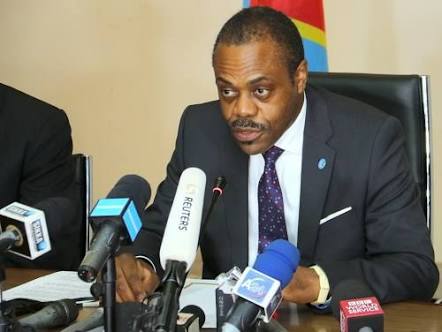
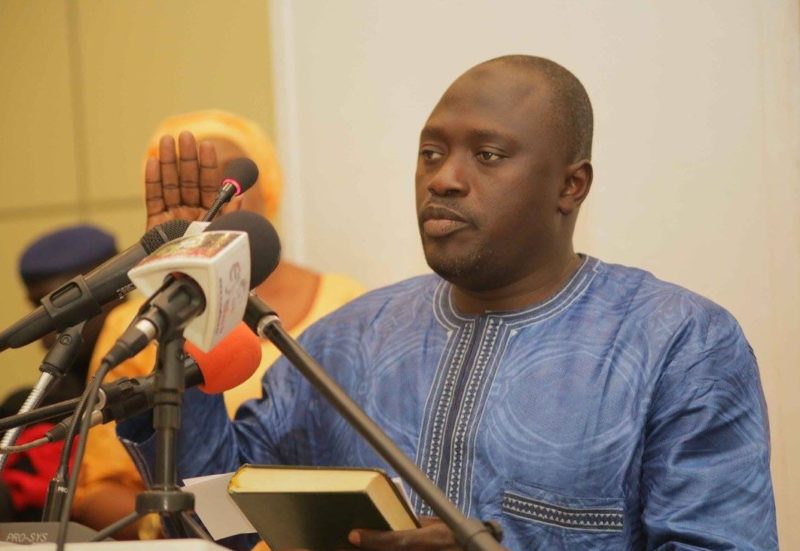
Oly Ilunga, the Congolese Minister of Health
Four people have tested positive for Ebola in and around Mangina, a town some 100 km (60 miles) from the Ugandan border, and 20 others have died of similar hemorrhagic fever symptoms without having been tested for the disease.
The World Health Organisation (WHO) says the new outbreak presents a high regional risk, given the proximity to neighboring countries.
It was discovered in July, just as health officials were declaring the end of another outbreak 2,500 km away in the western part of the country, which killed 33 people since it emerged in April.
The earlier outbreak was officially pronounced over last week. Officials have not yet been able to determine if the two outbreaks are linked.
Officials are already making steps to deploy a vaccine manufactured by Merck which has become the greatest weapon against the spread of the virulent Zaire strain of the virus and which helped contain the earlier outbreak.
“I think we can start using the vaccine as early as next week,” Health Minister, Oly Kalenga, told Reuters on Friday, August 3.
About 3,000 doses were stored in the capital Kinshasa after the last outbreak, he said. Another 300,000 doses could be supplied at short notice, the WHO has said.
“All teams on the way are being briefed and we are working on the cold chain,” he said, referring to the complex measures needed to keep the vaccine well below zero in a tropical climate without reliable power supplies.
“All this will be available very quickly.”
Ebola, which causes hemorrhagic fever, vomiting, diarrhea and frequently death in humans, finds a natural home in Congo’s dense equatorial forests where infected bats are suspected of transporting it long distances.
The latest outbreak is the tenth in Congo since the virus was discovered near the Ebola river in 1976.
An epidemic in West Africa between 2013 and 2016 killed more than 11,300 people.
Health officials have given new details about how the latest outbreak came to light.
One key event was the death and unsafe burial of a 65-year-old woman in Mangina in late July, the WHO said.
She had been admitted to hospital but then released after showing signs of recovery.
“On discharge (she) came down with a fever and other symptoms that were clinically consistent with Ebola,” WHO’s emergency response chief Peter Salama told reporters in Geneva.
“This is what really raised the alarm. She had fever, vomiting, bloody nose and bloody diarrhea as a final set of symptoms.”
He said seven of the woman’s immediate family later also died from Ebola-like symptoms, and health workers were now trying to track down potential contacts in 10 locations spread over tens of kilometers.
A health worker is believed to be among the dead, Salama said.
There were now suspected cases in the busy nearby town of Beni and the neighboring Ituri province.
WHO is working with Uganda and Rwanda in case the virus travels out of Congo with refugee flows. Uganda has set up Ebola screenings at its land and airport borders.
Salama said scientists were trying to determine whether the eastern Congo outbreak was related to the earlier one in the west.
“We cannot rule out that this is connected to the previous outbreak.
“What we can say is that there is no evidence to suggest there is a concrete link,” Salama said. Genetic sequencing results are expected on Tuesday.
Integrated engineering and construction solutions firm, ITB Nigeria Ltd, has reiterated its commitment to boost innovation in the engineering and construction industry by offering post-tensioning techniques; a unique solution in the global construction industry.
The Sapetro Towers on Victoria Island in Lagos
ITB disclosed in a statement that it has a fully functional post-tensioning division that offers shop drawings and stressing calculations, safe Installation procedure, supplies, and jack calibrations traceable to international standards.
Post-tensioning is a technique for reinforcing concrete, reducing the occurrence of shrinkage and cracking by strengthening concrete with high-strength steel strands or bars, called tendons.
The technique is said to be a form of pre-stressing where the stressing of the tendons is done after pouring and setting of the concrete, thus the name; post tensioning. It reportedly has numerous advantages over standard reinforcing steel as it allows construction that would otherwise be impossible, due to either site constraints or architectural requirements, to be achievable.
Speaking on the essence of using post-tensioning techniques, Mr. Ramzi Chidiac, Managing Director, ITB Nigeria Ltd, said: “At ITB, we constantly strive to improve the quality of our work, elevate levels of client satisfaction, and most importantly contribute significantly to the advancement of the Nigerian construction and engineering community. Our introduction and use of the post-tensioning techniques will guarantee premium quality structures, ensure flexibility of layout and servicing, lighter structure, and lesser construction time.”
Commenting further, Gabby Haddad, a post-tension expert and civil engineer with ITB, implored clients and potential homeowners to consider and opt for the technique.
He said: “If we are to grow the construction industry and build structures of world class standards, it is important that we innovate and adopt new technologies. We are glad to be the pioneers in Nigeria having deployed the technology since 2003 on the Sapetro Towers project on Victoria Island in Lagos, other landmark projects across the country and with further improvements in ongoing projects. Post-tensioned slabs tend to have longer life span, concretes are held more tightly, and cracks are eliminated.”
The twin 13-storey office/residential mixed development Sapetro Towers was completed in a supposed record time of 24 months.
It was neither a Saturday nor a Sunday. And it wasn’t in the evening. It was a weekday during school hours, at a time when their counterparts are learning. Scores of children were seen whooping jubilantly over a new bride at the El-Miskin centre camp – one of the several internally displaced persons (IDP) camps in Nigeria.
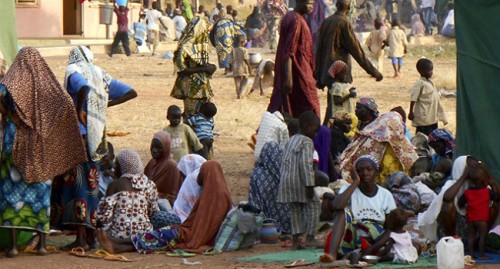
Women and children in a IDPs camp. The displacement was informed by the Boko Haram insurgency. Photo credit: channelstv.com
A petite girl of 14, bedaubed in a long red veil adorned with gold trimming, had just been ushered into matrimony. The children shouting ameriya (new bride) formed a local bridal train, accompanying her to her husband’s hut in the camp. It was gathered that this was the normal way of life in this camp, which is run unofficially by a Muslim philanthropist, at Jere local government area, Maiduguri in Borno State.
No school in the camp
Ali Hashir, the chairman of the camp said, “There is no school here. The children don’t go to school, because of that the girls marry early. There is nothing they are doing here, but to help their mothers (who teach them to become mothers too).”
Hashir, who is also the son of the philanthropist, pointed me in the direction of the bride’s father who was squatted on a mat, in company of some elders, counting the beads on his tasbih (a string of prayer beads). “Why should I keep the girl when she is ripe for marriage?” he answered through an interpreter, after which he continued his prayer recitation.
The bride wasn’t allowed to speak, but Ali Abubakar Yusuf, a millet farmer, who articulates properly in English, expressed fears about the future of these children.
“We are in critical condition in this camp. There is no school (western education) here,” he said counting his fingers as though about to enumerate the consequences.
According to him, the children play around the camp all day after attending sangaya (Quranic school for few hours). Some help their parents while the teenage girls are married off early.
“If you came here three days ago, we just married three of them (under 18 girls). We marry them among other IDPs in the camp.”
Hashir said that, around April 2017, some students from the University of Maiduguri arrived at the camp with the attempt of establishing a school there, but it failed. “We don’t know why they stopped.”
Yusuf, the millet farmer, added: “Education is the best. Someone who cannot read or write; his life is in danger,” he said, his face drawn as though in agony. “Please help us tell the government to come and help us. Let them help our children go to school. This Boko Haram problem is caused by lack of education, if we don’t send our children to school, their future is in danger.”
Hashir, however, did not admit that it was the lack of school in the camp that was fuelling such.
“It is our culture, normally. Not because of the camp.” But Yusuf believes that if there is a school to enlighten the mind and keep the children and teenagers busy, there will be less of such occurrences. “It is because of they have nothing to do. They (children) cannot be controlled,” Yusuf said with a deep sigh.
“We are in a critical condition here. The government has abandoned us,” Yusuf added, bringing out a green and white identification card issued by the National Emergency Management Agency (NEMA).
“NEMA only came here once, nine months ago, and gave us this card. Out of the 1,392 households in this camp, they only registered 450.
“We need assistance in the area of food too. The people giving us food monthly are the World Food Programme and Action Against Hunger.”
When contacted on why there is no semblance of formal education at this camp, the head of media and communication of the Presidential Initiative for the North-East (PCNI), Abdulkadir Alkassim, said the committee is trying its best with the little fund to coordinate all humanitarian support to meet the needs of the people.
“We are limited by funds. If you see UNICEF bringing schools to the camp, it is from the kind of work we do.” According to him, only N10 billion was released out of the N45 billion budgetary allocation made for the committee in 2017. He did not assure if the situation at this camp would improve soon, but he commended the philanthropist and several others who are supporting the government.
“The displacement problem is a huge one. Government cannot do it alone. We need support from NGOs and more philanthropists. Right now, we are working with Victims Support Fund and an Australian NGO that is taking care of orphans of Boko Haram. We are coordinating the activities, gradually,” he said.
Statistics from the Universal Basic Education Commission (UBEC), which is mandated to ensure that every Nigerian child has a right to education, show there are over one million children enrolled in Borno State in the academic session 2013/2014. As at March 2017, the commission transparently published on its website, www.ubeconline.com, that a total sum of about N9.3 billion was disbursed to Borno State as its matching grant between the year 2005 and 2016.
With this fund, about 1,700 children at this camp are not expected to grope in the darkness of the mind. Recently, the state governor, Kassim Shettima, claimed it will spend 65 percent of its budget on education, but all this is not felt in this camp.
Apart from the denial of the right to education, the Child Rights Act 2003, which is implemented in only 23 states of the federation, considers marriage before age 18 a violation of the rights of a child.
World food prices fell 3.7 per cent in July from the month before with declines seen across all crop types, the United Nations food agency said on Thursday, August 2, 2018.
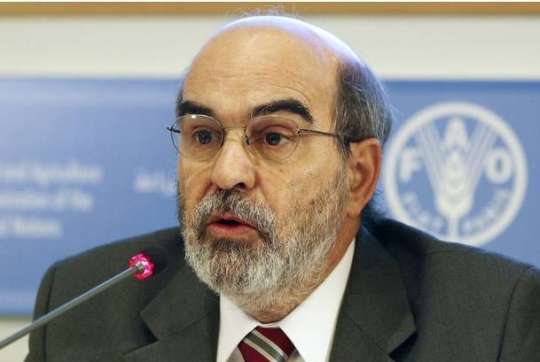
Jose Graziano da Silva, Director General of the FAO
The Food and Agriculture Organisation (FAO) said in Rome, where it is based, that the drop was the sharpest monthly drop since last December.
FAO’s food price index, which measures monthly changes for a basket of cereals, oilseeds, dairy products, meat and sugar averaged 168.8 points in July against an upwardly revised 175.3 in June.
“The decline in July was driven by weaker export quotations for wheat, maize and rice,” FAO said.
“International wheat prices were generally weaker during the first half of the month but concerns over production prospects in the EU and the Russian Federation started to push export values higher towards the end of the month,” it added.
The sharpest individual falls were registered in the dairy price index and the sugar price index.
FAO did not provide any new forecast for cereal output in 2018. The next new forecast will come on Sept. 6.
Flooding in India’s north eastern state of Assam has affected around 60,000 people and claimed no fewer than 38 lives, local government officials said on Thursday, August 2, 2018.
Flooding in India
According to the officials, over 10,000 people are taking shelter at 35 relief camps set up by the government.
Officials said that the fury of floods submerged 168 villages in five districts of Dhemaji, Lakhimpur, Golaghat, Sivasagar and Charaideo.
Sivsagar and Golaghat are the worst hit.
“Nearly 10,000 people are taking shelter at 35 relief camps in Sivsagar and Golaghat districts.
“The flood disrupted road movement at many places,’’ an official said.
On Wednesday night, 2,500 people were rescued by disaster response force and Police teams in Golaghat district.
“Water Resource and Agriculture Ministers, Keshab Mahanta and Atul Bora respectively, visited flood-affected areas at Golaghat district and met people at relief camps.
“Both ministers held a review meeting and told the district administration to step up relief and rehabilitation measures, besides setting up animal camps,’’ a local government spokesman said.
The authorities have issued directives to the field officials to make a proper assessment of damage to crops and property due to floods.
The officials said, so far, flooding has claimed 38 lives in Assam within the year.
Flooding is an annual occurrence in Assam during the monsoon season.
Governor Darius Ishaku of Taraba State on Thursday, August 2, 2018 urged the new Field Office of the National Environmental Standards and Regulations Enforcement Agency (NESREA) to initiate measures to address environmental challenges affecting the state.
Governor Darius Ishaku of Taraba State
Ishaku spoke in Jalingo, the state capital, when he inaugurated the field office of the agency.
Represented by Secretary to the State Government (SSG), Mr Anthony Jellason, the governor commended the Federal Government for establishing a NESREA office in Taraba where environmental issues were “massive”.
“Taraba is bedeviled with a lot of environmental issues, but I am optimistic that a collaboration between the State government and NESREA will tackle them,” he said.
Ishaku, who identified deforestation as a major environmental concern in Taraba, said efforts were being made to reduce logging of woods.
“Government will soon enact a law to check indiscriminate falling of trees in the state. We must save our natural habitat for future generations,” he said.
Earlier, Dr. Lawrence Anukam, the Director General of NESREA, had said that the inauguration of the field office was in fulfillment of a promise made to the governor after he promised to support the agency to set up an office in Taraba.
He promised that NESREA would work in collaboration with the state government to ensure a better environment and appealed to the state government to support the field office with operational vehicle to ease operations.
In his remarks, Chairman of the NESREA Governing Council, Mr Iyiola Oladokun, commended Ishaku for ensuring the establishment of NESREA office in Taraba State.
“The opening of NESREA field office in the state is to bring environmental governance to the grassroots.
“It will promote environmental education, awareness and advocacy as well as promote the creation of green jobs and ensure a cleaner and healthier environment for the citizenry,” he said.
Mrs. Rebecca Manasseh, the Commissioner for Environment, urged Taraba residents to cooperate with NESREA staff towards promoting a clean and safe environment for all.
She listed the state’s major environmental issues to include desertification, erosion, environmental pollution, among others.
Visionscape Sanitation Solutions (VSS) says it has closed two of its Transfer Loading Stations (TLS) in Lagos for upgrade to accelerate waste management in the state.
A transfer loading station in Lagos
The Chief Executive Officer of VSS, Mr John Irvine, said on Thursday, August 2, 2018 in Lagos that the closed stations were located around Murtala Muhammed Airport and Agege areas of the state.
A TLS is a building or processing site for the temporary storage of waste before taken to an engineered permanent site. It is an integral part of the waste management treatment infrastructure chain.
Irvine said that the company was aware of the recent complaints about the resurgence of waste across the state, especially in the Lagos West axis.
According to him, the acceleration of waste infrastructure has made it necessary to temporarily close two transfer loading stations in Lagos West axis for upgrade and refurbishment of the facilities.
“As a result, there is a backlog of waste, as Waste Collection Operators experience a high turn-around time.
“This underscores the importance of infrastructure to the waste management system and our role remains the provision of efficient facilities,” Irvine said in a statement.
He said that the company remained committed to working with all stakeholders in carrying out its respective roles and responsibilities.
The CEO said that Visionscape would continue to support the waste collection efforts through its monitoring and intervention team.
Egyptian authorities have referred a zookeeper in Cairo to a public prosecutor for interrogation over allegedly having painted stripes on a donkey to make it look like a zebra, an official said on Thursday, August 2, 2018.
Donkey painted to look like a zebra
Late last month, a visitor to the government-owned International Garden municipal park in the eastern Cairo district of Nasr City posted a picture on Facebook, showing a donkey with smudges on its face.
The animal also had long, pointed ears – unlike those of a zebra.
The picture soon caused a massive stir on social media, drawing an initial denial from authorities.
However, Mohammed Sultan, the head of Specialised Parks in Cairo, on Thursday accused the zoo keeper of having painted the donkey to look like a zebra, purportedly to deceive visitors.
“The keeper, who leases the place, has tarnished the reputation of the park. Faking a zebra is an unacceptable act,” Sultan said.
“The administration of the park has notified the prosecution of the incident.”
Sultan added that the zoo authorities had also decided to terminate the lease contract with the suspect whom he did not name.
Several patriots die unrewarded in Nigeria, as well as, in other countries. In some cases, no names or record are made public by the government to honour such folks. Park rangers fall right into this category.
Female park rangers
According to the Conservator-General of the National Parks Service, Ibrahim Goni, a total of 29 officers have died in active service across Nigeria’s seven National parks. With more unpleasant statistics unfolding, could it be possible that we are fast losing our rich biodiversity to poachers?
In 2017, the International Ranger Federation reported that 105 Rangers were killed worldwide. As at July 2018, another 128 rangers have been recorded to have lost their lives in active duties, with 63 of them in Africa, it does not seem we are winning.
The Convention on International Trade in Endangered Species of Wild Fauna and Flora (CITES) identified some species such as elephants, rhinos, pangolins, and rosewood among those that heighten the risks rangers face across the world. As more gory pictures of different wildlife species (like elephants) litter our timelines, and thousands of wildlife species (like pangolin) worth millions of dollars are seized, illegal killing of and illicit trafficking in wildlife is on the rise in Nigeria, even more than we can track.
While we all can’t carry guns and march onward to the borders of the national parks or other protected areas, there is a lot we can do to merge forces with relevant agencies like the National Park Service and our park rangers in ensuring poachers lose their dirty jobs.
The basic and simplest is to increase data-based, people-tailored education about Wildlife Conservation. There is a need for intentional conservation and for action-targetted conversations about the roles of individuals – especially young ones, and communities – with emphasis on rural communities. The precarious task of wildlife conservation must not be left solely on the shoulders of rangers – Park Rangers, else we all will wake to discover our once-rich wild places are completely empty.
The World Ranger Day is a day that annually commemorates rangers killed or injured in the line of duty and celebrates the critical work rangers do to protect the world’s natural and cultural treasures/biodiversity. July 31st, 2018 marks the 11th global anniversary of World Ranger Day, since the first was held in 2007 by the International Rangers Federation.
Gambian Minister of Environment, Climate Change and Natural Resources, Lamin Dibba, has called on the populace of the country to put up concerted efforts in curbing the negative impacts of pesticides and chemicals.
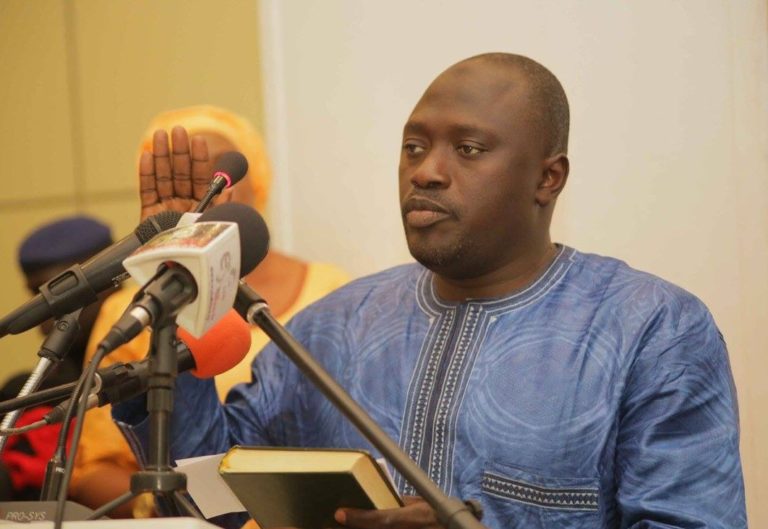
Minster of Environment, Climate Change and Natural Resources in Gambia, Lamin B. Dibba
He noted that his Ministry is aware of the health concerns resulting to local exposure to chemicals especially Persistent Organic Pollutants (POPs), and the impact upon women and, through them, upon future generations. He added that, considering a community with a low level of awareness, The Gambia has recognised the urgent need to take steps towards the development of an institutional framework for the sound management of chemicals to support a rapidly growing industrial and agricultural sector.
Dibba made these statements during the opening ceremony at the national inception workshop on the institutional capacity building for the implementation of the multi-lateral environment agreements in the Gambia held recently in Banjul. With participants drawn from all walks of life dealing with chemical, the daylong dialogue was designed to build the capacity of stakeholders on the dangers inherent in the utilisation of chemicals, most specially by farmers and women.
The Gambian government is partnering with development partners such as the United nations Environment Programme (UNEP) in implementing the project as part of the implementation of the Multilateral Environment Agreements such as the Stockholm Convention on Persistent Organic Pollutants (POPs), the Basel Convention on control of Trans-boundary movement of hazardous wastes and their disposal, the Rotterdam Convention on the Prior Informed Consent Procedure on International trade in Hazardous chemicals, the Minamata Convention on Mercury and the Strategic Approach to International Chemicals Management (SAICM).
All the Conventions, Dibba revealed, have a common objective of protection of human health and the environment. He reiterated that the Government of The Gambia attaches high priority to reducing chemicals pollutions and to promoting sound management of chemicals and associated wastes. He pointed out that The Gambia had been working closely with international partners on the implementation of the chemicals Conventions, which it considered crucial to further strengthening international commitment on the reduction of chemicals exposure.
To meet her obligations under the various Conventions, the minister disclosed that Gambia had developed strategies and plans that would outline the situation of chemicals in the country with the ultimate goal to protect human health and the environment from the risks posed by the unsound use, management and releases of chemicals.
He told the participants that, turning to the resources required to implement the MEAs, it is not possible to over-emphasise the importance of consolidating the resource base for assisting countries in the implementation of conventions and other activities to protect human health and the environment. He expressed confidence that the special programme to support institutional strengthening at the national level for implementation of the Basel Convention, the Rotterdam Convention on the Prior Informed Consent Procedure for Certain Hazardous Chemicals and Pesticides in International Trade, the Stockholm Convention, the Minamata Convention and the Strategic Approach to Chemicals Management established by the United Nations Environment Assembly at its first session would play an important role in that regard.
The objective of the Special Programme, he said, is to support country-driven institutional strengthening at the national level, in the context of an integrated approach to address the financing of the sound management of chemicals and wastes, considering the national development strategies, plans and priorities of each country, to increase sustainable public institutional capacity for the sound management of chemicals and wastes throughout their life cycle. Institutional strengthening under the Special Programme will facilitate and enable the implementation of the chemical convention to which The Gambia is a State Party.
The successful implementation of the Special Programme funded projects, he said, would derive a lot from civil society input, and therefore public participation is critical in addressing chemical issues and their health and environmental effects and in developing adequate responses which respond to their situation and circumstances, including opportunities for providing input at the national level regarding implementation of the Conventions.
“Recognising the importance of stakeholder participation, this National Inception Workshop is being held to map out strategies of implementation and to identify roles and responsibility for different stakeholders. Chemicals impacts on many sectors, including policy-making, law-making, environmental protection, agriculture, public health, industry and the private sector, the public and various interest groups. In order to make an effective and successful project, a wide range of stakeholders must be involved and engaged in the process,” Dibba pointed out.
Some of chemicals substances are pesticides, he said whilst many others are industrial chemicals or unwanted products of industrial processes or combustion which are toxic and adversely affect human health and the environment around the world. Because they can be transported by wind and water, most chemicals (POPs) generated in one country can and do affect people and wildlife far from where they are used and released. This therefore calls for the need to engage other countries in the crusade to mitigate negative impacts.
“I would also like to acknowledge the support of the Special Programme Secretariat and other partners in the spirit of cooperation and commitment for working with the Government of HE Adama Barrow in trying to meet our obligations towards Multilateral Environment Agreements. We should all understand that environmental protection thorough sound management of chemicals is not the government’s duty alone; but that all and sundry must demonstrate their commitments and take an active role,” he concluded.
In his welcoming remarks, the Executive Director of the National Environmental Agency (NEA), Momodou Jaama Suwareh, revealed that chemicals are important determinants for sustainable development, sound environmental health and quality of life, but noted that while the use of chemicals in all human activities (such as agriculture, health, energy production, manufacture, services and residential) contribute to improving the quality of life, it also raises concerns about its harmful effects on workers, consumers, the environment and society at large through exposure.
Suwareh further adduced that accidental releases from the distribution, consumption and disposal of chemicals may permanently damage soil, water and air.
He revealed that the Stockholm Convention is a legally binding international instrument, designed to lead to gradual decrease of the presence of persistent organic pollutants in the environment. He noted that the Gambia is a party to the Stockholm Convention. Persistent organic pollutants (POPs) are toxic chemicals that adversely affect human health and the environment around the world.
Because they can be transported by wind and water, Suwareh warned that most POPs generated in one country can and do affect people and wildlife far from where they are used and released, and they persist for long periods of time in the environment and can accumulate and pass from one species to the next through the food chain.
Registrar of Pesticides and Hazardous Chemicals at the NEA, Omar Bah, revealed that the objectives of the workshop are to sensitise stakeholders on the project and its activities, to encourage support, cooperation and commitment from the stakeholders for the implementation of the project, and to foster inter-institutional and bi-lateral collaborations in the implementation of the MEAs.
Bah listed the objectives to include: to capture the experiences, expertise, and concerns of the stakeholders/resource persons and factoring them into the project implementation; to come up with recommendations that will enhance the successful implementation of the project; and to enlighten the people living in The Gambia on sound chemical management.
Some of the expected outcomes, he added, are: to develop and monitor the implementation of national policies, strategies, programmes and legislation for the sound management of chemicals and wastes; promote the adoption, monitoring and enforcement of legislation and regulatory frameworks for the sound management of chemicals and wastes; and promote the mainstreaming of the sound management of chemicals and wastes into national development plans, national budgets, policies, legislation and implementation frameworks at all levels.
The dialogue was facilitated by Kei Ohno-Woodall, a programme officer at the Secretariat of the Basel, Rotterdam and Stockholm Conventions, who noted that the objective of the Rotterdam Convention is to promote shared responsibility and cooperative efforts among parties in the international trade of certain hazardous chemicals to protect human health and the environment from potential harm and to contribute to their environmentally sound use.