Home Blog Page 1810

Paris Agreement put at risk by Trump’s siren call

0

Negotiations on a rulebook for the Agreement lurch toward their final act despite developed countries refusing to engage on key issues like climate finance
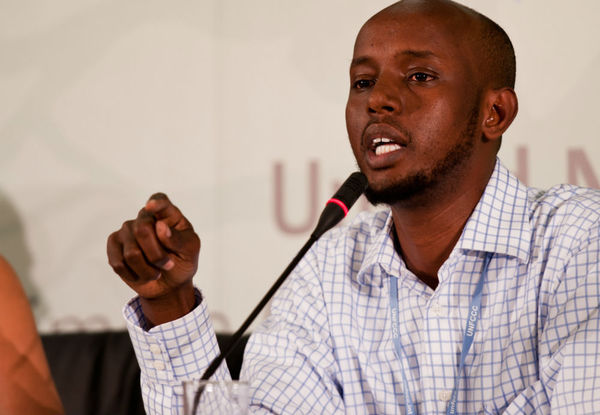
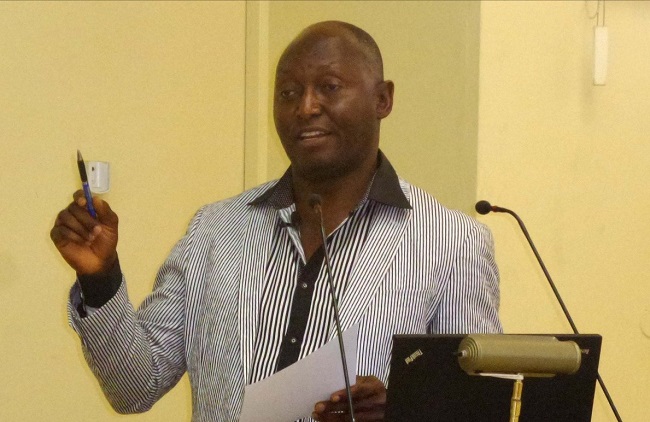
Mohamed Adow, Senior Climate Advisor at Christian Aid
Mohamed Adow, Senior Climate Advisor at Christian Aid. Photo credit: Scidev.net

Nearly 2 ½ years after opening, negotiations on the rulebook for the Paris Agreement enter their final stage as countries agreed a process to condense a 300-page draft into text that can be negotiated later this year in Katowice, Poland.

“We have fortunately avoided scuppering the ship,” said Mohamed Adow, Christian Aid’s International Climate Lead. “Governments have empowered the Co-Chairs to turn the progress made so far into a more solid basis for negotiations in Poland. It is now vital for the Co-Chairs to change the course of the negotiations away from diplomatic doldrums towards a win-win approach and craft middle ground options that the whole world can get on board with at COP24.”

The Co-Chairs will have to remain transparent in their process, ensure an even-handed treatment of the options on the table, and refrain from inserting new language in order to avoid a mutiny later this year. However, larger concerns remain over the role of one country – and one man in particular – in frustrating progress.

“Under Trump the U.S. has set about renegotiating the Paris Agreement to escape its historical responsibility and get better deal for the Big Polluters it serves” saidCorporate Accountability’s media director, Jesse Bragg. “Led by the U.S., developed countries are trying to strip equity from Paris and force false solutions into the heart of the Agreement. But this type of obstruction is nothing new – the U.S. has long watered-down multilateral agreements before walking away all together. If we’re to get what the world needs from Paris, we cannot allow Trump to hold this Agreement hostage.”

Particularly frustrating for developing countries and civil society alike was an apparent refusal by developed countries, led by the U.S., to engage constructively on key discussions about finance issues such as their communication of up-front information, the process to establish a new long-term finance goal, and the replenishment of the Green Climate Fund.

Lidy Nacpil, Coordinator at the Asian Peoples Movement on Debt and Development, warned, “the U.S.’ cancellation of $2 billion of its $3 billion pledge to the Green Climate Fund and obstruction of the Fund’s replenishment – these acts are not only denial of its responsibility for the climate crisis. These acts will bring further harm to our people and communities.”

“The U.S. has announced its withdrawal from the Paris Agreement but still negotiates as if it is a Party, weakening international cooperation by not contributing to finance and technology transfer to developing countries,” said Meena Raman, legal advisor at Third World Network.

“After contributing the most to cause the climate crisis, the U.S. now expects developing countries to clean up the mess with no help whatsoever. This Just Do It Yourself attitude risks infecting the entire process and will hinder the much-needed implementation of the Paris Agreement.”

Harjeet Singh, ActionAid’s Global Lead on Climate Change added, “The Paris Agreement is on the brink. Developed countries are going back on their word and refusing to agree clear rules governing climate finance. If they remain stuck in their positions and fail to loosen their purses, this treaty may collapse.

“We have a mountain to climb before the next climate summit this December. Finance ministers must now step in and deliver on the promises made in Paris.”

“The U.S.’ siren call appears to be working, big polluting countries are falling in behind.” said Rachel Kennerley, International Climate Campaigner at Friends of the Earth England, Wales, and Northern Ireland. “Now Australia is openly talking of scrapping its already weak climate plan and withdrawing from the Paris Agreement. And other low-ambition countries including the U.K. are hiding in the U.S.’ shadow even while claiming to be climate leaders.”

“To be a real climate leader the U.K. and other developed countries need to provide real climate finance and phase out fossil fuels as soon as possible.”
Why we Rise for Climate Justice – Bassey

0

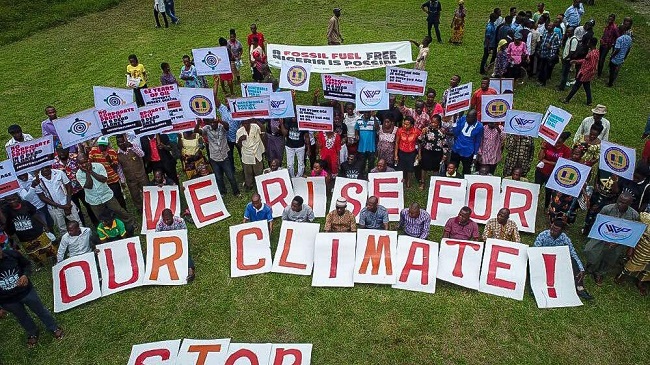
In a solidarity message delivered at the #RiseforClimate rally at the Ken Saro-Wiwa Peace Centre, Bori, Ogoni in Nigeria on Saturday, September 8, 2018, Director of the ecological think tank, Health of Mother Earth Foundation (HOMEF), Nnimmo Bassey, says its time to rise for climate, and stand for justice

Rise for Climate
The #RiseforClimate rally

The floods are coming. Our coastlines are receding. Our creeks, streams and rivers are polluted by oil spills, produced water, toxic wastes and an assortment of wastes including plastics. Deforestation continues. Desertification is not slowing down. No water to drink. No fish in our waters. Our farmlands are barren. Violent conflicts everywhere resulting from shrinking access to the gifts of nature. Our people are sick! Life has become a mist!

It is time to Rise for Climate. It is time to stand for justice.

Nigeria continues to allow routine gas flaring. Deadlines are set, and goal posts are shifted continually. Sixty-two years of unconscionable pumping of harmful elements into the atmosphere. Sixty-two years of pretending we do not know that the diseases we see around us are not strange but are manufactured by our lack of conscience and our refusal to stop the continuous poisoning of our peoples.

It is time to open our eyes, shake off the pretense and Rise for Climate! It is time to stand for justice.

Changed weather patterns. The climate crisis is here and now. Failing agriculture. Many tragic events underscore these realities, yet rather than act and, whereas we should stop digging for and burning crude oil, we give room for false solutions like carbon marketing and dream we can solve the problem with carbon capture and burial and even through geoengineering.

Together we Rise for Climate. Together we stand for climate justice.

As the Lagdo dam in Cameroon and the Kainji dam in Nigeria send huge quantities of water down stream, our agencies raise the alarm and do little else. In 2012 we lost over 300 persons and over 2 million persons were displaced. As we speak, the scenario is repeating itself. Already over sixty communities have been submerged and at least one death has been recorded.

It is time to wake up, see the horrors and Rise for Climate! It is time to stand for justice.

Ogoni remains polluted. Oil spills are going on across the Niger Delta. Soot hangs like a blanket over Port Harcourt. We cannot wait until we perish before we rise? We shall not wait until we cannot breathe before we speak up? We cannot be silent until all our lands disappear in the ocean or are covered by the desert? The labour of our hero’s past shall not be in vain? No!

Ken Saro-Wiwa said “to be silent is treason.” He also urged action, adding “We shall do this peacefully, and we shall win!” Today we pledge to take real Climate action wherever we are. Today we pledge to stand with our peoples and fight climate criminals. Today we rise for climate and demand action. Today we rise for climate and demand justice.

Feed Africa: Stakeholders zero in on partnerships for technology delivery

0

Key stakeholders in Africa’s agricultural sector today identified partnerships for sustainable agricultural technology delivery as a critical factor in Africa’s quest to feed Africa.

Mpoko Bokanga
Dr. Mpoko Bokanga, Head of the TAAT ClearingHouse

This came out strongly at a breakfast session that heralded the presidential summit of the 2018 African Agricultural Revolution Forum (AGRF) which ended on Saturday, September 8, 2018 in Kigali, Rwanda’s capital city.

Organised by the ClearingHouse of the Technologies for African Agricultural Transformation (TAAT), an initiative of the African Development Bank’s Feed Africa Strategy that aims to achieve major agricultural transformation in Africa, the session had in attendance, African agriculture ministers, scientists, representatives of multilateral development banks, donor partners and the private sector.

Mpoko Bokanga, Head of the TAAT ClearingHouse, in his opening statements traced the programme’s history to the October 2015 Dakar High Level Conference on Africa Agricultural Transformation Agenda which led to the adoption of four goals and 18 action points to transform African agriculture.

With a focused approach on integrated development of agricultural value chains, Dr. Bokanga highlighted the main objective of TAAT which is to “take proven agricultural technologies to scale in a commercially sustainable fashion through the establishment of a mechanism to facilitate partnerships.”

“These partnerships will not only provide access to expertise required to design, implement and monitor the progress of crop, animal and aquaculture, they will also contribute to ending extreme poverty by eliminating hunger and malnutrition; and making Africa a net exporter of agricultural commodities,” Dr. Bokanga said.


Innovative approach in partnerships

TAAT, according to Dr. Bokanga, isn’t an addition to Africa’s long list of agricultural initiatives but an innovative programme that serves as a clearing house for sustainable agricultural technology delivery.

Through its components, the programme will promote an enabling environment for technology adoption; establish a regional technology delivery infrastructure to accelerate delivery; and raise Africa’s agricultural productivity by deploying proven agricultural technologies at the agro-ecological and country levels in strengthened agricultural value chains.

The Togolese Minister for Agriculture, Livestock and Fisheries, Ouro-Koura Agadazi, was full of praises for the African Development Bank (AfDB) and the International Institute for Tropical Agriculture (IITA) for this well-thought-out programme, which according to him, “carries the prospects of transforming Africa’s agricultural landscape.”

“Togo has benefitted from several of IITA path-breaking agricultural solutions and it is our hope that TAAT will not be any different,” Agadazi added.

Joseph Mwanamvekha, Malawian Minister of Agriculture, Irrigation and Water Development, commended the partnership between IITA as the executing agency and the over 10 research institutes and centres driving the implement of the TAAT programme.

Also underscoring the imperatives of partnerships for sustainable agricultural technology at the breakfast session were representatives of International Fund for Agricultural Development (IFAD), Alliance for a Green Revolution in Africa (AGRA) and the IITA.


Technologies for Africa

Technologies for African Agricultural Transformation (TAAT) is a knowledge and innovation-based response to the recognised need to scaling up proven technologies across Africa.

Already being implemented in 31 low income Regional Member Countries of the AfDB, TAAT supports AfDB’s Feed Africa Strategy for the continent to eliminate the current massive importation of food and transform its economies by targeting agriculture as a major source of economic diversification and wealth, as well as a powerful engine for job creation.

The initiative will implement 655 carefully considered actions that should result in almost 513 million tons of additional food production and lift nearly 250 million Africans out of poverty by 2025.

Kogi sets up camps for Lokoja flood victims

0

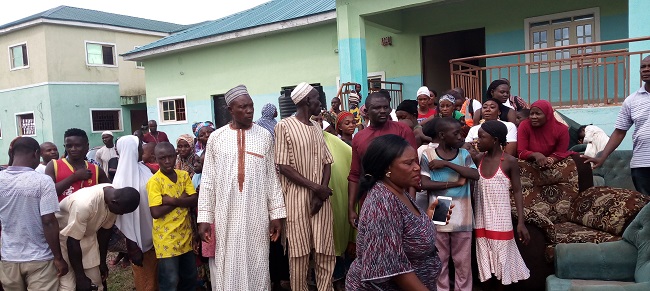
The Kogi State Government has set up temporary camps for victims of flood in Lokoja, as more houses get submerged in the confluence city.

Lokoja flood victims
Displaced Lokoja flood victims

According to Mr Sanusi Yahaya, the Commissioner for Environment and Natural Resources, camps have been opened in Wada Estate and Old Poly Quarters in the state’s capital city to accommodate the flood victims.

“We are already collaborating with all relevant stakeholders to ensure that relief materials and other essential facilities are provided in the camps.

“We had challenge of water supply yesterday (Saturday, September 8, 2018) because the borehole is not functioning, but we have been able to resolve that by providing alternative water supply sources.

“Light and clinic are also other challenges because the camp has not been connected to the grid, but since it is an emergency, we will solve the problems as they are being identified.

“The accommodation is adequate for the number of people currently displaced. We can still accommodate more people.

“Already, NEMA officials have visited the camps in Koton-karfe. As we speak, they are on their way to Lokoja with other teams sent by the federal government to assess the situation,” Yahaya said.

The commissioner advised residents of flood-prone communities to relocate to safer places to avoid loss of lives and property.

“All the indices that were in place before the 2012 flood are already here except for the Lagdo Dam in Cameroun that is not spilling water as yet.

“As at Saturday morning, the water level in River Niger was already 10.014 metres, compared to its 9.5 metres depth on Sept. 8, 2012; it is time to move away from water,” he said.

Mr James Ahmadu, Director of Relief and Rehabilitation, Kogi State Emergency Management Agency, who also spoke with newsmen, said that the flood victims had been trooping into the camps that were set up on Friday.

“Fifty-five households arrived the camp on Friday while additional 33 came on Saturday.

Mr Umar Zakari, the Camp Leader, told the News Agency of Nigeria (NAN) that victims from Adankolo Estate lost practically everything they had.

He commended the state government for the temporary accommodation and appealed to relevant stakeholders to assist the flood victims.

“We thank government for providing water, but we need food, mosquitoe nets, light and a clinic. Our children are getting sick,” Zakari said.

NAN recalls that the Kogi government set up five camps to accommodate 64 communities displaced by flood in Kotokarfe, last month.

By Stephen Adeleye

Ibeju-lekki residents lose valuables worth millions to flood

0

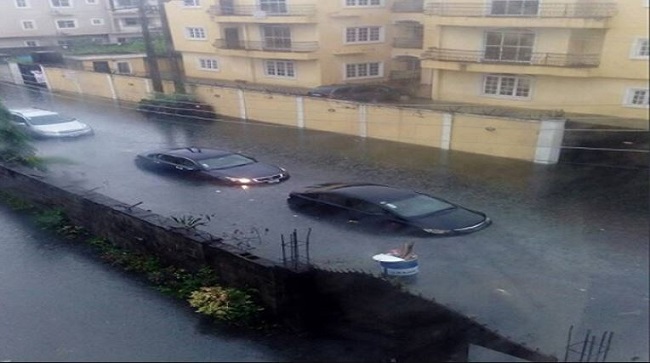
Some residents of Ibeju-Lekki in Lagos on Saturday, September 8, 2018 lamented their loss of valuables worth millions of Naira to flood from persistent rainfall since the early hours, coupled with the poor drainage facilities in the community.

Lekki-Flood
A flooded neighbourhood in the Lekki axis

Some of the residents, in interviews with News Agency of Nigeria (NAN), said the early morning downpour left several roads and homes in the area flooded.

Mr Luqman Balogun, a member of the Community Development Association (CDA), in Ibeju-Lekki, said that it had been a long time since the community witnessed such torrential rain.

“We can neither go to the office nor stay at home comfortably now as many of our valuables are already destroyed by flood.

“I never believed we could be sacked by flood because we live in a predominantly sandy environment, due to our proximity to the ocean.

“What I have observed now is that there are no working drainage channels in Ibeju-Lekki, as we have in other parts of Lagos State,’’ he said.

Balogun mentioned some of the areas affected by the flood included Kajola, Majek first-gate area, Lakowe, Eleko, Oribanwa and Awoyaya, among several others.

According to him, the flooding has affected commercial businesses in the community, including the hospitality sector.

“I am a hotel operator. We hotel owners are also complaining of low patronage due to bad roads, epileptic power supply, the absence of a functional drainage system and other issues.

“Despite all the challenges, government is still giving us estimated taxes and ridiculous bills.

“We have not been enjoying any infrastructure in this community, yet we pay our taxes and there is virtually no serious encouragement from government,’’ he said.

Also, Mr Seyi Bakare, a resident, decried the poor condition of the Ibeju-Lekki Expressway.

He noted that the major road in the area had started to develop several portholes, thereby causing some traffic bottlenecks on the expressway

Bakare added that the journey from the Ajah axis to Epe/Ibeju-Lekki which ought to take about 45 minutes now lasts about an hour-and-a-half.

Another resident, Mr Lanre Solution, appealed to the Lagos State government to fix the Lekki-Epe expressway, which he said, was the major road linking Ibeju-Lekki to Epe.

He said that adequate maintenance of the road would enhance business activities in the area.

Mrs Bola Fadahunsi, another resident, lamented that the bad roads and flooding were causing a lot of damage to the vehicles of residents, costing them much more money to maintain them.

By Idris Olukoya

Why we sacked 18 area managers, by Visionscape

0

Visionscape Sanitation Solutions (VSS) Ltd. on Saturday, September 8, 2018 attributed the termination of appointment of 18 area managers of the organisation on April 13, 2018, to business restructuring.

 John Irvine
Chief Executive Officer of Visionscape, Mr John Irvine

The Chief Executive Officer of VSS, Mr John Irvine, gave the clarification in a statement in Lagos, explaining that there was a cohesive change in the scope of the company’s contract, and in turn, its modus operandi.

Irvine said that the organisation had keen emphasis on performance and sustainability of the business, in the current operating environment.

He said that the waste management company evaluated every employee in all functions of the business, using individual performance assessments as a basis of decision-making.

According to him, this methodology highlights the core individuals that need to be retained, considering the resizing and right-sizing of the business.

“Unfortunately, in tandem, some employees were affected by the process. We reiterate that the decision to terminate the area managers’ employment was purely a business decision.

“This is as management reviewed the manpower requirements against the backdrop of the delivery of our current scope,” the chief executive officer said.

Irvine said that all salaries, entitlements and emoluments due to the 18 workers upon termination of employment had been paid in full.

By Florence Onuegbu

Flood washes away N25m fruits in Kebbi

0

The Kebbi State chapter of Nigerian Fruit Sellers Association says its members have lost N25 million worth of fruits due to recurring flood at its main market in Birnin Kebbi, the state capital.

Fruits
Fruits and vegetables

The association’s Chairman, Alhaji Aminu Abubakar, told the News Agency of Nigeria (NAN) in Birnin Kebbi on Saturday, September 8, 2018 that the absence of proper drainage had led to recurring flooding of the market annually.

‘‘We have no where else to go, it’s the only market we have, we just watch in agony as flood destroy our fruits and the loss has reached as much as N25 million.

‘‘You can see water all over the market yourself as if human beings are not living in the market,’’ he said.

Abubakar appealed to the state government to re-build the market to make it safer and conducive for business and earn more in revenue generation.

The chairman also urged the state government to provide support to members of the association to cushion their losses.

‘‘We are appealing to the government to support us with soft loan to boost our business.

‘‘Farmers, traders, and different types of business associations have been getting support from the state government, but we were never considered to benefit from such support,’’ he stressed.

According to Abubakar, the association has over 20,000 members in all the 21 Local Government Areas in the state.

‘‘We also employ over 3,000 unemployed youths who are helping to transport our goods and sell in major towns across the state.

‘‘Imagine the burden of the numbers of unemployed youths we can help government to reduce, if we have support and empowerment,’’ he said.

By Ibrahim Bello

Urbanisation affecting Nigeria’s dietary diversity

0

The Country Manager of HarvestPlus Nigeria, Mr Paul Ilona, said on Saturday that urbanisation was affecting the dietary diversity of Nigerians.

Paul Ilona
Country Manager of HarvestPlus Nigeria, Paul Ilona

HarvestPlus is part of the Consultative Group for International Agricultural Research (CGIAR) Programme on Agriculture for Nutrition and Health (A4NH).

Ilona told the News Agency of Nigeria (NAN) in Lagos that urbanisation had not been properly managed.

According to him, fruit trees have been overtaken by ornamental trees, affecting the country’s nutritional density, hence the need for bio-fortification.

NAN reports that bio-fortification is meant to increase the density of vitamins and minerals in the crop through plant-breeding or agronomy practices, so that when consumed regularly, such crops would generate the required vitamins and minerals for the body.

Ilona said: “Urbanisation is seriously affecting the dietary diversity of Nigerians, and there is need for more nutritious foods that will enhance our capacity.

“We have not done enough to add value to diversifying our foods; we have focused too much on urbanisation.

“In the olden days, on the way from school, you could climb any fruit tree; but we do not have that anymore because fruit trees have been replaced by ornamental trees.

“Ornamental trees are good, but will not add value to our nutritional requirements, which is why I say urbanisation is good, but we have not managed it well.”

The country manager said that it had become necessary to add value to the lives of Nigerians, thereby promoting wellness.

Ilona said that the current drive to promote bio-fortified foods was to fight against hidden hunger, which was taking a toll on children and pregnant women.

According to him, the country is over-concentrating on producing carbohydrate foods.

“It is not about how much food you have put into the system; it is the extent to which the food you have eaten meets the desires of the parts of the body.

“According to World Health Organisation (WHO) in 2015, 100 children under age five die; and 6 women of childbearing age die every hour in Nigeria, and this should be a concern to us.

“About 60 per cent of the reasons for their deaths have been attributed to malnutrition,” he said.

The HarvestPlus official described hidden hunger as a situation whereby one has eaten, but the body systems did not derive what they required from such food.

“Nigeria has come of age that we should not be hungry again. It is germane to ensure that Nigerians have access to nutritious food,” he said.

By Itohan Abara-Laserian

Group seeks more attention to climate change

0

The Global Initiative for Food Security and Ecosystem Preservation (GIFSEP), an NGO, has called on aspirants vying for political offices to include issues of climate change in their manifestoes.

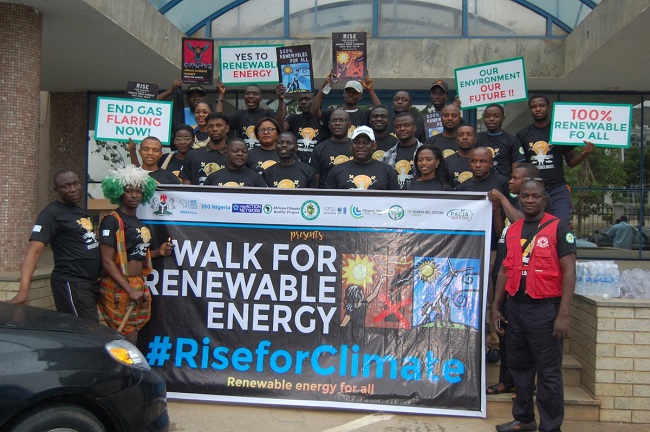
Abuja Rise for Climate Walk
The Abuja Rise for Climate Walk

The Executive Director of GIFSEP, Mr David Michael, made the call at the Abuja Climate Summit Walk in Abuja on Saturday, September 8, 2018.

GIFSEP, in partnership with 350 Africa, Global Environmental Facility (GEF) and other relevant NGOs, organised the walk to sensitise Nigerians on the need to protect the planet.

Michael said that his organisation had observed that many aspirants were yet to include the issues of climate change in their programmes.

‘‘This is something that affects our health and the food we are eating, as well as our existence as human beings.

‘‘That is why we are walking to sensitise Nigerians to know that climate change is a real threat to us and the future generations.

‘‘It is a problem that affects all of us without discrimination, although some people and places are more vulnerable to climate change than others.

‘‘That is why people need to drive actions against climate change and send a clear message to the government for it to respond to the will of the people,’’ he said.

Mrs Ibironke Olubamise, the National Coordinator, Global Environmental Facility Small Grant Programme (GEF-SGP), urged Nigerians to support ongoing efforts to address effects of climate change.

Olubamise, who said individual efforts were imperative in this regard, urged the people not to abuse food and water consumption.

“If you waste and throw away food, you are contributing to the climate change, and if you are wasting water endlessly, you are contributing to climate change because all these have negative effects on the climate,’’ she said.

By Deji Abdulwahab

Last stretch of Bangkok climate talks eyes progress, clarity on finance

0

Hundreds of thousands of people are demonstrating over the weekend against political inaction on climate change even as negotiations carry on laying the groundwork for COP24

Bangkok Climate Change Conference
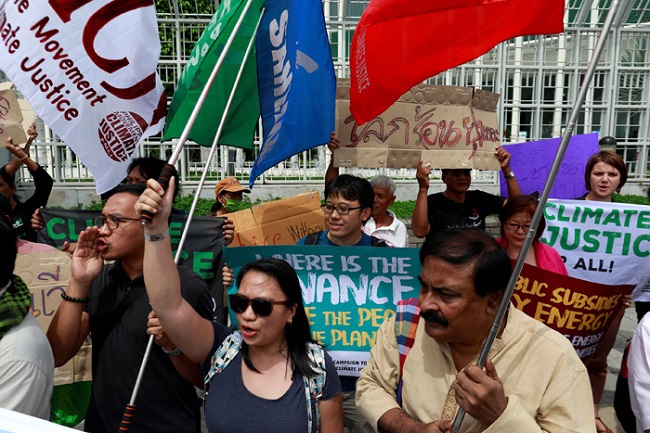
Environmental activists protest in front of the United Nations Conference Centre (UNCC) in Bangkok where the Bangkok Climate Change Conference is taking place

With a day to go until the Bangkok climate talks wrap up on Sunday, September 9, 2018, the glaring void of finance is staring the world in the face and threatens to erode trust in the negotiations. Some progress has been made on efforts to trim down the bulky rulebook text into a clear outline with options, but progress has been uneven.

The weekend more than 820 actions, involving hundreds and thousands of demonstrators, have been planned in 91 countries under the Rise for Climate movement even as discussions carry on in the negotiating rooms to lay the groundwork for COP24.

Committing to predictable, transparent and sustainable finance with real money for real action underpins trust in the Paris regime and is critical for averting a crisis in the months ahead. The European Union, Switzerland, Norway, Canada and Japan must step out from the shadow of the United States and match actions with words. Support to fully implement conditional aspects of the nationally determined contributions is an integral part of the Paris Agreement and the solution to strengthen overall ambition from all countries.

Discussions on the Global Stocktake, compliance and transparency made promising headways but developed countries must realise that without movement on finance success at COP24 will be at stake. Negotiators must feel the heat to untangle the technical issues in the next two days and provide clarity of options, so ministers can’t hide behind technical complexities when they arrive in Poland for final discussions. They must feel the pressure to come good on supporting common sense rules and processes that enable predictable, transparent and impactful finance.

Brandon Wu, ActionAid USA Director of Policy & Campaigns, said: “So far in Bangkok, it looks like rich countries are making a concerted effort to avoid any conversations that would ensure they live up to their existing obligations for providing climate finance. Of course, the US is setting a bad example, but what’s especially troubling is that other governments from the EU and Norway are hiding behind the US rather than providing any real leadership. Developed countries do not seem to be negotiating in good faith, which is jeopardizing the negotiations as a whole. This not only puts a huge question mark over the possibility of achieving the goal of the Paris Agreement, but also puts the lives and livelihoods of vulnerable communities around the world at risk.”

“There are two things needed for the Paris Agreement to prove effective, one is a robust rulebook to translate the accord’s pledges into action, the other is finance to help poor countries deliver their national emission reduction plans and adapt to a changed climate.  In Bangkok rich countries like the UK and Canada are trying to avoid the finance element which is in danger of paralysing negotiations. It’s vital that these nations stop dancing to the tune of Donald Trump which will only result in damage to the negotiations and tragedy for the world’s poorest people,” Mohamed Adow, Christian Aid’s International Climate Lead, said.

Civil society organisations have called on Polish Presidency to lead diplomatic efforts ahead of Katowice and work towards a comprehensive COP24 package that includes a strong rulebook and a meaningful outcome on the Talanoa Dialogue with stronger climate targets by 2020 that is informed by the IPCC 1.5C Report. The report, which is due in a month, will be a klaxon on the growing urgency of the climate crisis.