Home Blog Page 1806

Clean Power Plan replacement a dismantling of smart climate policy – Climate Reality

0

The US Environmental Protection Agency (EPA) on Tuesday, August 21, 2018 released a new proposal to replace the 2015 Clean Power Plan, a landmark climate policy aimed at reducing carbon emissions from coal-burning power plants by 32 percent (from 2005 levels) by 2030. The Clean Power Plan was a key component of US plans to meet commitments made under the Paris Agreement, an international pact that President Donald Trump announced his intention to withdraw from in June 2017. In a reaction, Ken Berlin, President and CEO of The Climate Reality Project, describes the new proposal as a complete dismantling of smart climate policy

Ken Berlin
Ken Berlin, President and CEO of The Climate Reality Project

Make no mistake: the EPA’s new proposal for coal-burning power plants is not a replacement for the Clean Power Plan. It’s a complete dismantling of smart climate policy. There will be nothing ‘clean’ about the soot and smog allowed to pollute the air and water of communities across the US. There will be nothing fair about how this pollution will hit marginalised communities already struggling with poverty the hardest.

At a time when relentless heatwaves and raging wildfires fill the headlines and make the stakes of the climate crisis crystal clear, the Trump Administration continues to defy logic and even basic common sense. Instead of actually confronting the crisis, the administration is attacking forward-thinking environmental protections like the Clean Power Plan that can help solve it – all to line the pockets of the failing fossil fuel industry. The American people clearly cannot count on this administration to protect their basic human rights to clean air, clean water, and an environment where they can safely live and raise their families.

The good news is that we are in the midst of an incredible clean energy revolution that cannot and will not be stopped, no matter how much this administration tries to put its finger on the scale. Solar, wind, and other forms of clean energy continue to get cheaper and put more Americans to work than many dirty fossil fuels. As more local, city, and state governments and private sector actors take substantive steps to reduce emissions, we will keep making progress. Now, it’s our job as citizens, activists, parents, friends, and neighbors to work even harder to accelerate the clean energy revolution – by organising, educating, and most importantly, voting up and down the ballot to support climate policies.
We’re committed to complying with RSPO principles – GAR

0

Indonesia’s largest palm oil company, Golden Agri-Resources (GAR), has said that, while focused on responsible palm oil production, it remains committed to complying with the Roundtable on Sustainable Palm Oil (RSPO) Principles and Criteria as well as the laws and regulations of the country.

Golden Agri-Resources
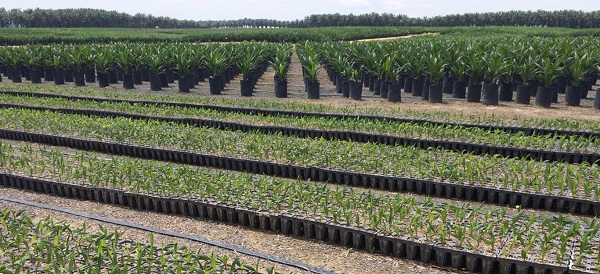
A Golden Agri-Resources oil palm plantation

The organisation made the submission in a statement on Monday, August 20, 2018, in an apparent reaction to claims by the the Forest Peoples Programme (FPP) stating, among others, that complaints were filed against GAR by a group of Indonesian, Liberian and International NGOs.

The GAR, which is said to be part of the huge Sinar Mas (Golden Rays) conglomerate run by the Widjaja family with interests ranging from palm oil and pulpwood to real estate and banking, was accused by the NGOs of failing to comply with RSPO’s standards.

Both GAR and its subsidiary in Liberia – Golden Veroleum Liberia (GVL) – reportedly angered NGOs when they withdrew GVL’s membership of the RSPO, and allegedly dodging a demand from RSPO that it should halt development of its palm oil mill on contested lands.

By the GAR has expressed “extreme” disappointment with the FPP claim that it had filed a new complaint against it. According to GAR, FPP chose not to share the details of its grievance with it (GAR) before releasing the “complaint.” GAR stated that, to date, it has received no official notification or communication from FPP regarding the new “complaint”.

GAR added: “This has given GAR no opportunity to understand or clarify any of the matters brought up by FPP and is hampering proper communications between the parties as well as a violation of the spirit of the RSPO process.

“From what we know of the FPP grievance, we note that it is referring and repeating various matters which have been previously resolved and addressed. Furthermore, it is still based on an erroneous understanding about our relationship with GVL, the nature of which we have recently clarified again with the RSPO Secretariat.

“We have updated these matters with FPP and RSPO through our regular reports to RSPO which are publicly accessible here: https://rspo.org/members/complaints/status-ofcomplaints/view/75. As for FPP’s claim concerning GAR and shadow companies, we absolutely refute this and affirm there is no basis for such allegations.

“In accordance with the GAR Social and Environmental Policy, we remain committed to complying with the RSPO Principles and Criteria and the laws and regulations of Indonesia.”

GAR is said to be one of the leading palm oil plantation companies with a total planted area of 500,481 hectares (including plasma smallholders) as at June 30, 2018, located in Indonesia. It has integrated operations focused on the production of palm-based edible oil and fat.

In Indonesia, its primary activities include cultivating and harvesting of oil palm trees; processing of fresh fruit bunch into crude palm oil (CPO) and palm kernel; refining CPO into value-added products such as cooking oil, margarine, shortening, biodiesel and oleo-chemicals; as well as merchandising palm products throughout the world.

Founded in 1996, GAR was listed on the Singapore Exchange in 1999 and has a market capitalisation of $2.8 billion as at June 30, 2018.

Malaysia makes significant Viet Nam-bound rhino horn seizure

0

Malaysian authorities on Monday, August 20, 2018 announced the discovery of 50 pieces of rhino horn at a postal aviation centre in the Kuala Lumpur International Airport in what is believed to be Southeast Asia’s largest single seizure of rhino horns.

rhino horn seizure
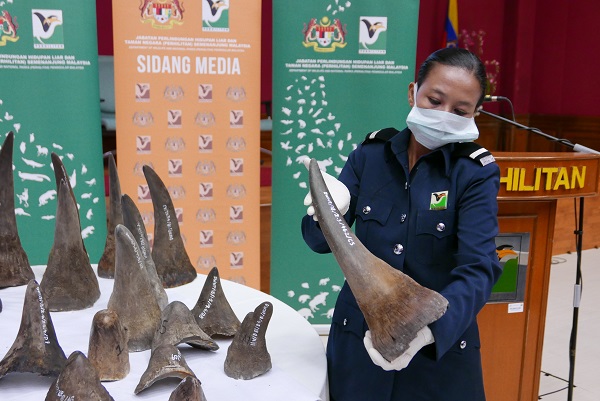
An airport official with one of the seized items

The horns were packed in boxes that also contained nine whole carnivore carcasses, and all were bound for Ha Noi, Viet Nam.

This incident follows several high-profile rhino horn seizures in Southeast Asia in 2017 and earlier this year. It includes a case of 46 rhino horns seized at Viet Nam’s Ha Noi’s Noi Bai International Airport in March 2017 that were smuggled in two suitcases on a flight from Kenya. A month later, Malaysian Customs seized 18 horns smuggled on a flight from Mozambique to Doha.

In February this year, Singapore jailed a Vietnamese for 15 months for attempting to smuggle eight pieces of cut horn and a bag of shavings. The man was flying from Dubai to Lao PDR via Singapore’s Changi Airport. Just last month, a Vietnamese man was stopped at Tan Son Nhat airport for illegally transporting 12 rhino horns from Angola.

The rhino horn seizure announced on Monday took place a week earlier on Monday, August 13 when officials of the export branch of Pos Aviation suspected something amiss with a consignment at the cargo terminal building in the airport’s Free Commercial Zone. They alerted the Royal Malaysian Customs who in turn called on the Department of Wildlife and National Parks Peninsular Malaysia (Perhilitan).

The agent who managed the consignment is under investigation, said Perhilitan Director-General, Dato’ Abdul Kadir Abu Hashim, who added that initial investigations showed false information had been used in the shipping document.

Pos Aviation is a ground services provider offering ground and cargo handling, inflight catering. aircraft maintenance and engineering services to inbound and outbound international commercial airlines in Malaysia. Last November, 337 kg of pangolin scales from Sabah and Sarawak in East Malaysia were discovered in Pos Aviation facilities.

Neither the source of the horns and the carcasses, nor the length of time they have been in storage, is known.

Perhilitan reported collecting DNA samples of all the seized items for analysis to identify all the species involved in the seizure. Kadir also said Perhilitan will work with Interpol on the case, which is being investigated under Malaysia’s International Trade in Endangered Species Act 2008 as an illegal export offence.

The case, according to the authorities, once again highlights illegal trade links between Malaysia and Viet Nam. At least 15 Vietnamese nationals have been held for wildlife related offences in Malaysia since 2016, having been caught with hundreds of wildlife parts and snares.

“This was a very unusual mix of wildlife parts found – rhino horns which were clearly not from Asia and carnivore carcasses which could have originated from the country,” said TRAFFIC’s Acting Southeast Asia Director, Kanitha Krishnasamy.

According to her, th discovery raises questions about how criminals are accumulating wildlife parts and using a multitude of routes and methods to traffic them onwards to destination countries.

“The situation calls for a closer look into KLIA and all its operators including agents, transportation and logistics companies,” said Krishnasamy.

In a separate case, Perhilitan has charged a local man for illegally keeping three juvenile orangutans. The man, who had offered the animals for sale online, was apprehended in July. He has been released on an MYR80,000 ($20,000) bail and has been ordered to surrender his passport while awaiting trial.

DNA tests have shown all three animals to be Sumatran Orangutans Pongo abelii and steps have already been taken to arrange for repatriation of the animals to Indonesia, said Kadir.

In a similar case in 2015, Perhilitan rescued two juvenile orangutans from the online pet trade. Both the animals were eventually returned to Sumatra.

Flooding concern as Cameroon releases water from Lagdo Dam

0

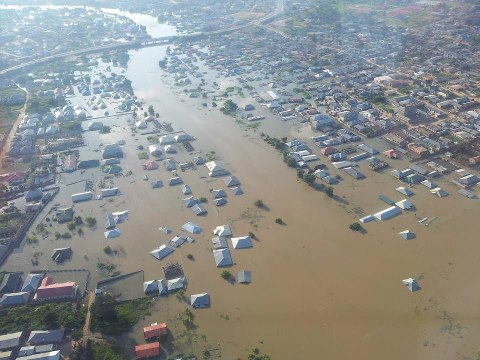
Governor Muhammad Bindow of Adamawa State on Monday, August 20, 2018 urged the residents to prepare for flooding following the release of water from Lagdo Dam by the Cameroonian authorities.

Lokoja
Flooded parts of Lokoja in Kogi State in 2012

Bindow gave the warning during an emergency meeting with key stakeholders in Yola, the state capital.

In 2012, the state, as well as some other parts of the country, experienced a catastrophic flood following the release of water from Lagdo dam.

The flood resulted in the deaths of many, destruction of hundreds of farms while many families were rendered homeless.

The governor told the audience that the state government received a report two days ago that the Cameroonian authorities had released a high volume of water from Lagdo Dam.

“And we have started feeling the wave of the water because some boarder communities and farms along the bank of River Benue have been submerged.

“It has become necessary to invite all of you to put our heads together and mitigate the effects of the flood,” Bindow said.

He said that it was the responsibility of the stakeholders to sensitise the people to the effects of flood and find lasting solution to it.

Mr Ahmad Sajoh, the Commissioner for Information, said that the state government could confirm that four persons had so far died as a result of the flood in the state.

He said that the flood had also destroyed many bridges and culverts, adding that nine local government areas of the state had been hit by the flood.

He said that Furore, Yola South, Yola North, Demsa, Shelleng, Guyuk, Numan, Lamurde and Girei local government areas had so far been overwhelmed by the flood.

Gully erosion severs Nkpor-Nnobi Road in Anambra

0

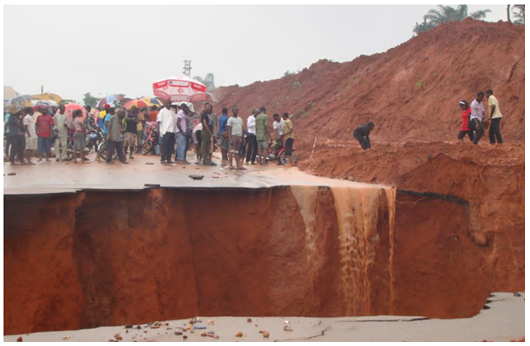
Gully erosion has severed the Nkpor-Nnobi Road, a major road which links Onitsha and environs with Nnobi, Nnewi and other parts of the southern part of Anambra State.

Gully erosion
Gully erosion in southeast Nigeria

The road was built during the Dr Chris Ngige administration.

NAN reports that the gully erosion is few metres from the Ideani junction end of the busy road on the Nnobi bound lane.

Following the development, motorists tend to queue from both directions to take their turn in what looks like a “walk on a precipice”.

One lane of the road has already collapsed while that existing is under serious erosion threat.

A motorist, Mr Joel Nnodum, who works for a popular transport company on that route, said the road had become a nightmare for motorists in the last two months.

Nnodum said vehicles usually ran into themselves, especially at night, noting that it was more dangerous for those who were not familiar with the road.

He said that the development was a dilemma because there were no alternative routes to easily access the area.

“My brother, it is a pity that this quality road which we have used for over 13 years have been destroyed by this massive erosion and the road has collapsed.

“This road connects the entire Onitsha and Idemili to Nnobi, Nnokwa, Nnewi, Aguata and most of Anambra south.

“It is a dangerous route to drive on now, you can see it is at a sharp bend and these glasses on the ground are from accidents, we pray the worst will not happen,” he said.

Another motorist, Greg Unadike, who described the site as a disaster, called on Anambra government to urgently take steps to salvage the road.

Unadike said the colossal damage could have been prevented if flooding was nipped in the bud.

“This is a clear case of poor maintenance, the environment and works ministries could have prevented this if they were proactive, now see the damage, it requires a huge sum of money to fix,” Unadike said.

Reacting to the development, Mr Marcel Ifejiofor, the Commissioner for Works, said the government was aware and that it was working on how to remedy the situation.

“We are working on it, the contractor will soon move to site,” he said.

By Chimezie Anaso

6,000 still stranded, over 1m in camps in flood-hit Indian state

0

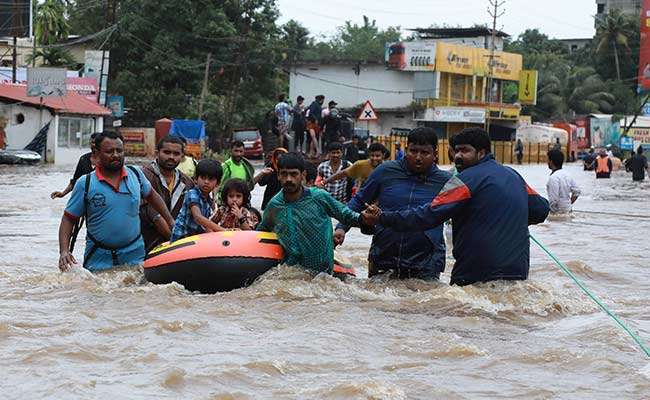
Authorities and military on Monday, August 20, 2018 stepped up rescue and relief efforts in the flood-ravaged India’s state of Kerala, where an estimated 6,000 people remained stranded in the worst-hit areas.

Kerala
Rescue operations in Kerala

Over a million people are being housed in relief camps.

Authorities opened a naval airbase for commercial flights in the state’s busiest city of Kochi to help with the operations, Civil Aviation Minister, Suresh Prabhu, said.

The main airport has been closed since last week due to flooding.

Other airbases in the region would also be opened to commercial traffic, officials added.

Around 380 people have been killed since the monsoon season began in Kerala in May with the second more devastating spell of flooding from Aug. 8 claiming 220 lives.

A disaster management official said 6,000 people were stranded, many of them trapped, including in worst-hit areas like Chengannur.

About 1.08 million people were in 3,646 relief camps on Monday, up from 850,000 on Sunday.

“Our priority is rescue operations which we aim to complete by today, 26 military helicopters as well as 1,200 large boats had been deployed for the effort,” he said.

“Relief efforts including air-dropping food packets and water are ongoing. “Rehabilitation and repairs of houses will be taken up in the third phase,” he said.

Floodwaters had started receding in some parts with the rains easing over the weekend, but bigger concerns remain over the lack of clean water and diseases in the aftermath of the inundation.

Kerala Chief Minister, Pinarayi Vijayan, said the floods are the worst seen by the state in a century and estimated the damages to infrastructure and property at nearly $3 billion.

Delta holds public hearing on urban renewal, regional planning bill

0

The Delta State House of Assembly Joint Committee on Urban Renewal, Lands, Survey and Urban Development on Monday, August 20, 2018 welcomed views from the general public at a hearing on a bill for urban renewal and regional planning in the state.

Asaba, Delta State
Asaba, capital of Delta State

The committee Chairman, Mr Oboro Preyor, said the bill would provide for the administration of urban and regional planning, urban development, urban renewal and building control activities, when passed.

Preyor said that the bill would also help to address the conflicts between local governments and the state Ministry of Lands, Survey and Urban Development, arising from the existing laws.

He said that the state government created the Ministry of Urban Renewal and the Delta State Capital Territory Development Agency to ensure clear-cut functions in the urban renewal and regional planning sectors.

He noted that the bill had passed the first and second readings hence the public hearing to enable the stakeholders to make input before it was passed.

Preyor thanked the stakeholders for their envisaged contributions and assured them that the house would do the needful for the speedy passage of the bill.

Also, Mr Peter Uviejitobor, a member of the committee, said that the bill was important for the development of the state.

According to him, the bill would facilitate urban renewal, town planning, building control activities and establishment of urban and regional planning board and local planning authority.

Uviejitobor urged the stakeholders to feel free to recommend amendments to any clause or section of the bill found necessary before its final passage.

In his contribution, the Commissioner for Justice, Mr Peter Mrakpor, said that the bill emanated from the state government through the Ministry of Justice.

Professional bodies, including the Nigerian Institute of Town Planners (NITP), Nigeria Institution of Estate Surveyors and Valuers (NIESV) and Nigerian Institution of Surveyors (NIS) attended the hearing.

Other stakeholders in attendance were the Association of Town Planners Consultants of Nigeria (ATOPCON) and the Nigerian Institute of Architects (NIA).

The participants recommended, among others, that the functions of the various tiers of government, especially in the area of town planning, should be well spelt out to eliminate conflicts.

By Mercy Obojeghren

ERA flays renewal of Shell mining license in Ogoniland

0

The Environmental Rights Action/Friends of the Earth Nigeria (ERA/FoEN) has condemned the Federal Government’s renewal of Shell Petroleum Development Company of Nigeria Limited (SPDC) Oil Mining License in Ogoniland which expires in 2019 despite the opposition of the Ogoni communities.

ERA-Ogoni-UNEP
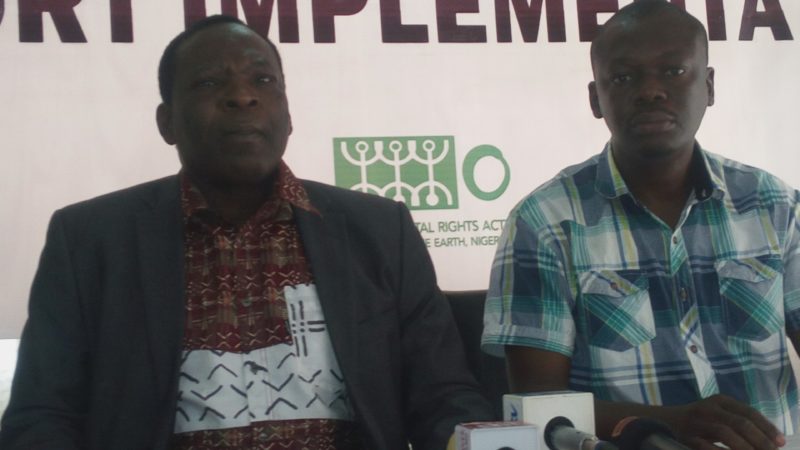
Executive Director of Environmental Rights Action/Friends of the Earth Nigeria (ERA/FoEN), Dr. Godwin Ojo (left); with the ERA/FoEN Head of Media, Philip Jakpor

In a statement issued by ERA/FoEN’s Head, Media & Campaigns in Lagos, Philip Jakpor, the group described the decision which comes seven years after the failed take-off of the Ogoni cleanup exercise as “a shameful betrayal of the people”.

According to him, the ERA/FoEN position echoes similar condemnation that has trailed the action by the Movement for Support of the Ogoni People (MOSOP) and other groups in the region.

ERA/FoEN Executive Director, Godwin Uyi Ojo, said: “This is a stab on the back of the Ogoni people and should be viewed as such by all believers of fairness and equity. The Federal Government has shown that it is only interested in profits over the people’s right to existence.”

Ojo explained that the renewal of the contentious oil mining license is a continuation of the shielding of Shell from the full weight of its atrocious extraction in the Ogoni communities which necessitated the United Nations Environmental Programme (UNEP) Assessment Report in 2011.

He stressed that despite the company’s claim at some point that it was not interested in returning to Ogoniland, “Shell had been covertly seeking the renewal of its lease, due to expire June 2019. The backdoor moves had attracted the attention of Ogoni people who feel it is insensitive on the part of the government to commence renewal of license even when no single drop of oil had been cleaned in the Ogoni environment”.

Ojo maintained that the Shell claim that the renewal of the lease for the Ogoni oilfields will enable it to contribute to the Federal Government’s revenue base “falls flat in the face of reality.”

“Our conviction that the cleanup flag-off and events subsequently have been mere whitewash is further reinforced by this action. We demand the immediate revocation of the oil mining license and removal of Shell from all the governing structures of the UNEP cleanup exercise which it has only used to stagnate the process. Anything short of this is intended to provoke the peaceful Ogoni people,” Ojo insisted.

Europe’s oldest gorilla, Fritz, put to sleep

0

Fritz the gorilla at 55, the oldest of his kind in Europe, was euthanised on Monday, August 20, 2018 after becoming increasingly weaker in the past few days, the Nuremberg Zoo in Germany has said.

Fritz the gorilla
Fritz the gorilla. Photo credit: Erich Heimann

Fritz, born in Cameroon in 1963, was given to the zoo in southern Germany in November 1970 and had been a real character, it added.

The zoo had decided to close the ape enclosure as Fritz became increasingly infirm since the weekend, giving the group of gorillas some privacy.

Simply because there was no chance of an improvement in his condition, the zoo said, the immobilised leader of the group was put to sleep.

Not even his favourite dish – quark, a kind of German curd cheese, with raspberry jam – could cheer him up, the zoo wrote.

Fritz was loaned out only to two other zoos in the 1980s one in Berlin and one in the present-day Czech Republic, the zoo said.

Fritz had fallen seriously ill about a year ago before recovering again.

Nigeria ratifies International Cocoa Agreement

0

President Muhammadu Buhari on Monday, August 20, 2018 in Abuja signed the Instrument of Accession to the International Cocoa Agreement, 2010.

Cocoa
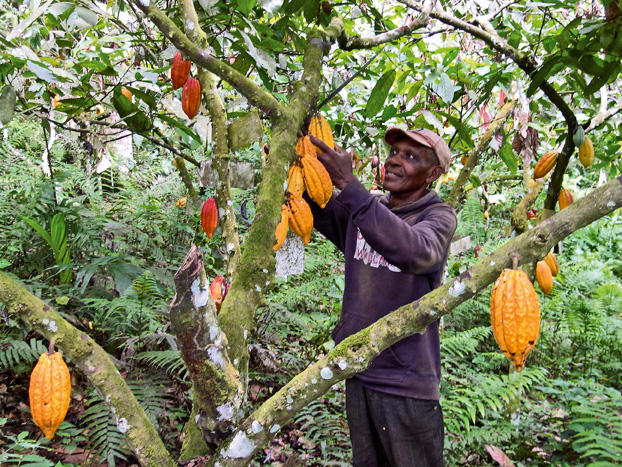
Harvesting cocoa

Malam Garba Shehu, the Senior Special Assistant to the President on Media and Publicity, who confirmed this in a statement in Abuja, said the signing of the Agreement followed its approval by the Federal Executive Council.

According to him, with the execution of the instrument of accession, Nigeria undertakes “faithfully to abide by all the stipulations therein contained” in the Agreement.

Shehu listed other benefits of the Agreement to include strengthening cooperation between exporting and importing member countries.

He said that the agreement was expected to improve their cocoa economies through active and better focused project development and strategies for capacity-building.

He said: “The 2010 Agreement is also expected to build on the successes of the 2001 Agreement by implementing measures leading to an increase in the income of cocoa farmers and by supporting cocoa producers in improving the functioning of their cocoa economies.

“It will also deliver cocoa of better quality, take effective account of food-safety issues and help establish social, economic and environmental sustainability, so that farmers are rewarded for producing cocoa that meets ethical and environmental considerations.’’

By Ismaila Chafe