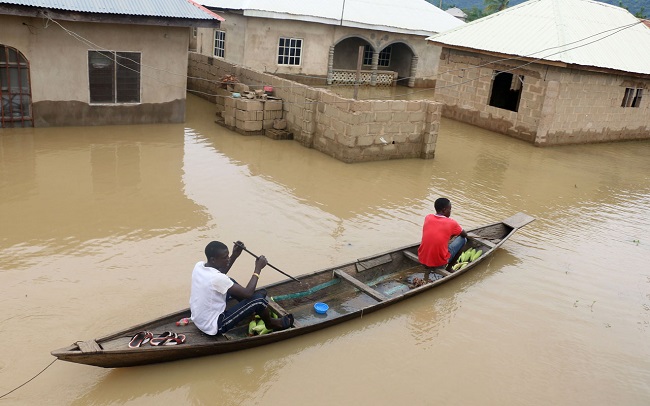
The Otuoke-Onuebum Road in Ogbia Local Government Area of Bayelsa State has been taken over by flood, as vehicles now pass through Elebele Road, a longer distance, the News Agency of Nigeria (NAN) reports.
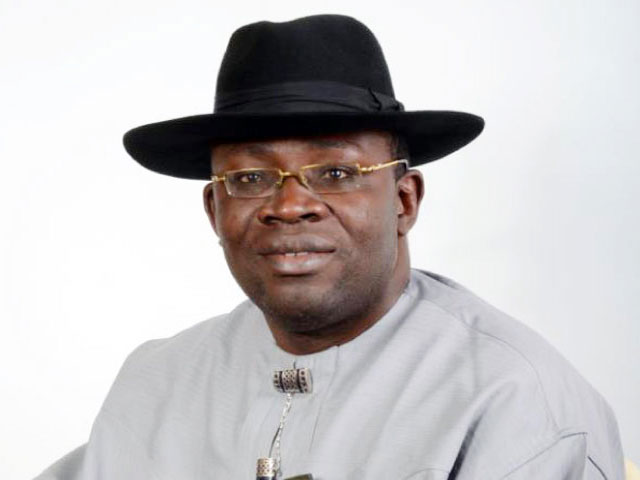
Seriake Henry Dickson, Governor of Bayelsa State
NAN reports that Otuoke is the home town of former president, Dr. Goodluck Jonathan.
A staff of the Federal University Otuoke (FUO), Mr Clever Ogbodi, told NAN in Otuoke on Friday, September 21, 2018 that passengers were paying N400 instead of N250 from Otuoke to Yenagoa, the state capital.
Ogbogi appealed to the Bayelsa government to come to the aid of the community for the sake of FUO students, who are directly affected.
“This was how it happened in October 2012 when flood took over the whole community; Up till now, there is no proper preventive measure put in place by government.
“We are expecting the government to come up with necessary measures to mitigate future occurrence, but it is a matter of regret that such measures are not in place.
“I am calling on all relevant authorities to look into the matter because we cannot be experiencing this terrible situation every year,” he said.
Also commenting, Mr Azibator Omonibo, a passenger, wondered why the situation remained the same even after the intervention fund that was given to the state in 2012 to tackle it.
Omonibo expressed concern over the suffering of the people and urged the government to live up to its responsibility of preventing flooding and rehabilitate the road.
A taxi driver plying the road, Mr Kalawole Adebutu, said that the road was already in a bad shape before the flooding.
He appealed to the Federal Government to assist the people of Bayelsa as the state government was unable to find a lasting solution to the problem.
Adebutu said that the youth in the community were the ones sandfilling the road, adding that commercial drivers were paying them from their little profit.
An agricultural expert, Mr Tunji Owoeye, on Friday, September 21, 2018 urged the government to provide an enabling environment to attract potential investors to invest in agricultural waste-to-wealth projects.
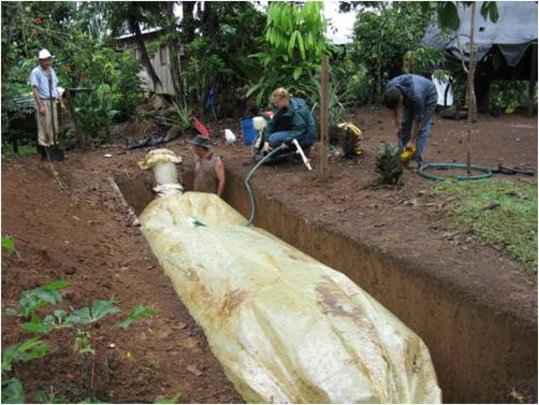
From farm waste to renewable energy
Owoeye, who is the Managing Director, Elephant Group Plc., made this call in an interview with News Agency of Nigeria (NAN) in Lagos.
He noted that a lot of agricultural waste could be converted into useful products via money-spinning ventures if potential investors were sure of getting good returns on their investment.
“Investors are looking for an enabling environment that could safeguard their investments in any sector.
“For investors to be attracted to invest in agricultural waste conversion projects, they want to be assured of the viability of their investment.
“For instance, waste generated from rice production can be used for so many things like generating electricity and producing rice oil, among others.
“Besides, a lot of things could be done with the waste generated from over 100 agricultural produce that we have but there has to be some protection and encouragement for any investment in those areas.
“Investors can come in once they are sure of getting value for their money in such ventures.
“If there are enlightenment activities on the opportunities existing in such ventures and the protectionist policies put in place, it will be easier to get more investors interested in the conversion of agricultural waste into wealth,’’ he said.
Owoeye said that the protectionist policies could be in the form of tax relief for pioneer companies, among others, adding that the policies would go a long way to encourage potential investors to set up agricultural waste conversion projects.
“This is because before taking critical decisions on investing in agricultural waste conversion projects, entrepreneurs would want to look at for the political environment as well as the stability and sustainability of the investment.
“If they harbour some doubts on the sustainability of the investment, it would be difficult for them to go on and invest in such ventures,’’ he said.
Owoeye said that agricultural waste recycling projects were currently undertaken at minor levels, adding, however, that the government should provide an environment that was conducive to the establishment of commercial waste conversion projects.
New diesel and petrol sales need to be stopped by 2030 to ensure that the Paris Agreement targets are met.
Electric vehicles will replace petrol and diesel cars
The UK announced in 2017 that it aima to ban all sales of new petrol and diesel cars by 2040. But a new report, commissioned by Greenpeace Belgium and conducted by German Aerospace Centre, has shown that this deadline needs to be brought forward if the EU wants to keep its commitment to the Paris Agreement.
Norway has set their target at 2025, and Ireland and the Netherlands have agreed to ban sales by 2030.
The Paris treaty set a carbon budget to limit the increase in mean global temperature to 1.5 degrees Celsius. Several countries have implemented measures to ensure this target is met; however, Australia and the U.S. are failing to implement sufficient climate policy.
Rosie Rogers, clean air campaigner at Greenpeace, said: “Road transport is one of the few EU sectors where CO2 emissions continue to grow. Phasing-out diesel and petrol cars will benefit the climate, help solve the air pollution crisis and improve quality of life for everyone. The speed of the transition is the crucial point. It’s clear most car makers and policy makers are still at least a decade short of meaningful action to clean up our roads.”
The European commission has proposed a 30 per cent cut in vehicle emissions but MEPs want this to increase to 45 per cent.
This news follows Frankfurt’s court-ordered diesel ban aimed at reducing pollution beyond the city limit.
The economic value of Nigeria’s bees was brought into sharp focus in August 2018, when the Federal Ministry of Agriculture and Rural Development announced that bees could outstrip oil for economic activity. Furthermore, the minister responsible declared that ApiExpo Africa 2018 would focus on sustainability amid this potential. Clearly, the vast resources in rural Nigeria have caught the attention of national authorities, bringing opportunities for both the economy and the ecosystem.
Bee pollination
In addition to this, the benefits of bee pollination has already been touted as a solution to famine across the continent. Respecting nature’s helpers and helping to flourish will therefore represent a symbiotic relationship for the country and its growers. What principles need to be observed, and what steps should be taken, to protect bees and responsibly grow the industry?
Enhancing local ecosystems and protecting them
Given the economic potential for honey and its emerging markets, its predictable that people are becoming more involved with beekeeping, from those seeking to farm honey by erecting their own builds to developing bee-positive gardens. However, simply erecting a hive isn’t enough to guarantee safe growth and protect the flying insects. Chemicals are commonly used in a wide range of applications and are dangerous to the bee – Greenpeace outline how 150 different chemicals, dubbed a “toxic cocktail” have been found in pollen residue. To its credit, the Nigerian government have instilled measures to proactively manage this problem; a ban on bee-killing compounds commenced in early September 2018. Taking this measure seriously and making other changes to the environment to benefit bees – the planting of bee-positive plants for example.
Harnessing economic growth in a responsible manner
While honey is a delicious and natural source of nutrition, the farming processes to create cheap, mass-manufactured honey are not always as friendly. In the USA, Harvard College found that the use of mass honey bee hives in areas where they do not naturally occur creates an ecological disaster, featuring species extinction and epidemic disease. Having naturally farmed and grown hives is crucial; over-farming and introduction of invasive species is demonstrably disastrous.
How honey can create social change
The headline for honey production is the money it creates. It will aid environmentalism, food shortages, and when done ethically, benefit the ecosystem and reduce reliance on artificial foods. What does it do for the community? According to a study conducted by the Federal University of Technology Owerri, a lot. Rural and impoverished beekeepers in Imo State obtained gains of N26,100 after the initial outlay, helping to alleviate poverty, establish businesses and help people to improve their quality of life.
Between the economic benefits honey can bring Nigeria, the proactive measures taken by the federal government and the activity of farmers, beekeeping may bring about a bright future for rural Nigeria. Going forward, it will be key to protect the environment by minimising the use of harmful pesticides. Crucially, all growth must be natural and without intensive farming methods.
The Nigerian Institution of Estate Surveyors and Valuers (NIESV) has urged operators in the real estate surveying industry to improve on their capacity development.
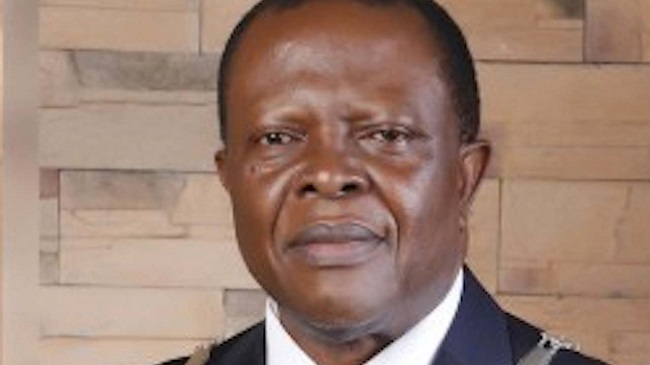
Rowland Abonta, President of the Nigerian Institution of Estate Surveyors and Valuers (NIESV)
Mr Joe Idudu, a former President of the institution, said at a seminar organised by the Faculty of Estate Agency and Marketing Business Division of NIESV in Lagos on Thursday, September 20, 2018, that it was to overcome the challenges of international competition.
The seminar was themed: “Prospect and Challenges of International Competition in the Business of a Real Estate.”
Idudu said that estate agency had became an “all comers affairs” where anybody could walk up overnight to begin operation, including the foreigners.
He said the only means the local estate surveyors could remain relevant and compete with the multinational firms was to improve on their capacity development/competence in the profession.
“Our institutions need to find a way to enhance the capacity of the local operators to create more values for the profession.
“Knowledge is key. And if we can acquire the needed knowledge, skills and competence if we must be ready to learn,” he said.
Contributing, Mr Emeka Eleh, a past President of NIESV, identified slow to change as the major challenge of the real estate agency profession and the Nigerian economy at large.
Speaking on the topic: “Leveraging on the Concept of Pseudonym for Mega Practice”, Eleh said that the local operators found it difficult to adapt to new changes that could facilitate growth of the industry and the economy.
According to him, the world changes by the day, saying that operators in the real estate industry need to move with the changing trend.
He said lots of efforts were being made by the multinational firms and foreign operators to invade and overtake the real estate industry.
“There is need for us to change our home mindset, strategise and be ready to compete with the international competitors.
“There are opportunities where we have challenges,” he said.
Also, Mr Victor Alonge, the Managing Partner, Nelson Thorpe Alonge company, called for partnership among the operators in the real estate industry.
Alonge said that partnership was the way the operators could collectively combat international competition in the profession.
According to him, international competition has come to stay, saying that the operators need to be prepared to and accept the competition.
“There is need to understand how the foreign businesses operate and the yardstick for its success.
“We will urge the government to enact law aimed at prohibiting operation of foreign operators in the industry.
“We need to come together, collaborate and pull resources together to grow and sustain the industry,” he said.
Earlier, Mr Sam Eboigbe, the Chairman, Faculty of Estate Agency and Marketing Business Division of NIESV, said that Nigeria had competent estate surveyors that could compete effectively with their foreign operators.
Eboigbe said it was financial capacity and government support that the foreign operators had over the local ones.
He urged the Federal Government to support and financially encourage the local operators to enable them to compete with their foreign counterparts.
Residents steer a dugout canoe past flooded houses following heavy rain in the Nigerian town of Lokoja, in Kogi State, on September 14, 2018. Photo credit: AFP / Sodiq Adelakun
The raging flood, which has affected at least 12 states across the country, remains worrisome not only to the victims but also the government, as Rivers Niger and Benue continue to rise in volume, according to National Emergency Management Agency (NEMA).
The current flood pattern, which experts say has shown indices of a similar natural disaster of 2012 in many parts of the country, has left hundreds of victims with tales of woes, with many others living in fear.
A survey by the News Agency of Nigeria (NAN) showed that some lives have been lost while farms, houses and livestock destroyed as floods ravage communities most parts of North-Central Nigeria, the region said to be most hit in this year flood.
NAN correspondents who visited some of the affected areas in the region report that many communities, especially those contiguous to Rivers Niger and Benue, have been submerged and in the process, victims have been relocated to camps opened by respective governments or seek refugee with relations.
The agency reports that worst hit states are: Kogi, Niger, Taraba, Benue and Plateau, with Kogi having Lokoja, Ibaji, Koton-Karfe, Bassa, Igalamela, Omala, Ajaokuta, Ofu and Idah councils so far affected.
Residents of the affected local government areas have been relocated to the Internally Displaced Persons (IDPs) camps or taking refugee with friends and relations house.
Parts of the Lokoja-Abuja road has also been threatened by the ever-increasing floods.
According to Alhaji Alhassan Aiyegba, Executive Secretary, Kogi State Emergency Management Agency (SEMA), 64 communities have been submerged by the flood.
“There are camps for the displaced persons, but the situation gets worse every minute,’’ Aiyegba said.
Mr Sanusi Yahaya, the Commissioner for Environment and Natutral Resources in the state, also told NAN that the situation was becoming much frightening as more communities were being submerged in Lokoja, the state capital.
“Government has set up a camp for the flood victims in Lokoja, the capital city. The worst hit areas are Wada Estate and the Old Poly Quarters,’’ he said.
He said that the state government was collaborating with relevant stakeholders to ensure that relief materials and the essential facilities were provided in the camp.
“We have had challenge of water supply, but that has been resolved.
“Light and a clinic are other challenges because the camp has not been connected to the national grid
“But since it is an emergency, we will be solving the problems as they are identified.
“Accommodation is still adequate for the number of people that are in the camp so far, and the camp can still accommodate more people.
“Officials of NEMA visited the IDP camps in Koton-karfe few days ago and on their way to Lokoja with other team sent by the Federal Government,” Yahaya said.
The commissioner advised residents of flood-prone communities to immediately relocate to safer places to avoid loss of lives and property.
Yahaya noted that all the indices in place before the 2012 flood occurred had manifested.
Mr James Ahmadu, Director of Relief and Rehabilitation of the Kogi State Emergency Management Agency, told NAN that the flood victims had been trooping into camps in Lokoja in their large number since it was set up.
Ahmadu said that the data of the victims were being accommodated as they arrived, adding that about 100 households had arrived the camp.
“Many victims are still coming with majority of them being women and children,” Ahmadu said.
Mr Umar Zakari, the Camp Leader, said that most of the victims were from Adankolo quarters where he said property, foodstuff and farms were totally destroyed by flood.
He commended the state government for the temporary accommodation provided for victims and urged relevant stakeholders to join with government to cushion the effect of the natural disaster.
“We thank government for providing water, but we need food, mosquito nets, light and clinic. Our children are getting sick,” Zakari said.
NAN reports that Kogi government had earlier set up five camps in Kotokarfe, where about 64 communities have been submerged by flood.
Among the submerged communities are highly populated settlements like Akpaku, Akpo, Ajara, Banda, Kpakpasu, Ozale, Opkakere, Agbawu and Adabode, among others.
Meanwhile, the Chief Judge of the state, Justice Nasir Ajanah, has disclosed that the High Court complex, in Koton-Karfe was among structures submerged by flood.
He said the court would be relocated “to ensure that the development does not affect the dispensation of justice.”
Ajanah, while assessing the extent of damage on the submerged complex, also said that the relocation became imperative to arrest the perennial breaks in the administration of criminal justice in the area.
“The busiest prison yard in the state is located is this town. So, it is important that we relocate the court from here to another location within the town.
“That is the most important thing to do now because this is a very busy place,” he said.
Ajanah said the cost of putting up a new complex for the High Court and the Chief Magistrate’s Court in Koton-Karfe would be included in the state supplementary budget.
He expressed optimism that the supplementary budget would be approved, and money released.
Meanwhile, as more displaced persons rush to IDPs camps in the state, the Nigerian Medical Association (NMA), Kogi chapter, has donated drugs to victims’ camps in Kogi and Kotonkarfe.
Dr Kabiru Zubair, the state Chairman of the association, handed over the drugs to local government officials at the camps in Ogbakwu and Edeha communities.
Zubair said: “We decided to visit the IDPs camps in Kotonkarfe to support and sympathise with them.
The visit is also to educate them on hygiene in order to maintain clean environment and avoid outbreak of communicable diseases.
“Today, we have donated drugs such as Vitamin C, anti-malaria, antibiotics to the camps’ to aid in the management of some common diseases likely to occur in this kind of situation.
“We have also sensitised them on health education in order to avoid outbreak of cholera and other communicable diseases, because prevention is better than cure.”
The chairman also said that the chapter was also collaborating with the state government to provide manpower in the clinics in the camps.
According to him, doctors will be on ground in all the camps throughout the period of the flood to ensure that patients are well managed.
“Those that have serious cases will be referred to the General Hospital, Kotonkarfe, Kogi Specialist Hospital, Lokoja or Federal Medical Centre (FMC), Lokoja.”
The situation appears the same in Taraba where hundreds of farmlands have already been submerged.
Our correspondent, who visited some of the areas in the state reports that the situation had been compounded by the release of water from Lagdo Dam in Cameroun with hit Local Governments being Gassol, Ibi, Lau and Karim Lamido.
In Gassol, flood has destroyed mass of farmlands while the council Chairman, Mr Yahuza Yau, confirming that two bridges had been damaged.
Yau said that the council has set up a committee to compile the list of villages affected while residents of villages along river Benue have been advised to relocate.
Benue, severely hit last year by flood, is also facing similar experience this year, though on a much smaller scale so far.
NAN investigation also revealed that Wadata, High Level, Wurkun, Guma, Otukpo, and Logo Local Governments, hit last year, had yet to suffer major flood damage this year.
However, to forestall colossal damage, the Benue State Government has dug drainage in most parts of Makurdi and constructed several canals where flooding was massive last year.
According to Emmamnuel Shior, Executive Secretary, Benue State Emergency Management Agency, major water channels have been opened to avoid floods.
He said people were being sensitised to take care of the environment and avoid building near river or blocking water ways.
NAN learnt that Makurdi International Market was being prepared for people that might be affected by floods.
At the city centre, NAN found that people in flood-prone areas had mobilised themselves to evacuate blocked drainage.
In Niger, NAN found a more devastating situation with Bosso Local Government with record of some deaths.
In Shiroro Local Government, the story was devastating with communities like Nungu, Ungwan Bagudu, Rafin Gora, Mashigi, Ungwar-Abok submerged by flood while the IDPs were sheltered at the Zungeru Primary School.
In Lapai Local Government Area, it was a picture of farms, houses and livestock destroyed but Gov Abubakar Sani, who visited the area promised to investigate ways to control the menace.
In Plateau, floods were being experienced in the traditional areas comprising Ungwan Rogo and other settlements along Bauchi road.
Alhaji Alhassan Barde, the Executive Secretary, Plateau State Emergency Management Agency, blamed the recurrent flood in the area on residents’ stubbornness.
“People get unnecessarily stubborn; they keep building houses along waterways and in water logged areas, year after year.
“Sometimes, they ignore advice to relocate in the face of imminent danger, until it is too late. This is sad,’’ he lamented.
The Commissioner of Environment, Abdullahi Abbas, however, told NAN that everything was being done to check the menace.
“The flood was devastating in the past, especially in 2012; we do not want a repeat.”
The probability of recurrence of earthquakes in the very near future is high in Nigeria.
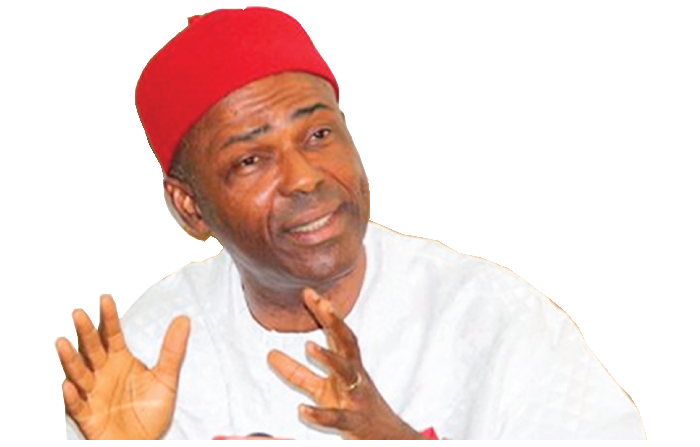
Dr. Ogbonnaya Onu, Minister of Science and Technology
This disclosure was made on Thursday, September 20, 2018 in Abuja by Prof. Seidu Muhammed, chairman, Technical Committee on Earth Tremor, while submitting a report on the recent tremor in the federal capital city to Dr Ogbonnaya Onu, the Minister of Science and Technology.
Prof. Muhammed stated that his submission is based on the results obtained using the probability of recurrence theory.
On Sept. 7, some residents of the Federal Capital Territory (FCT) were woken up by earth tremor that shook some parts of the city.
Muhammed said that more than one million earthquakes occurred daily but very few were either observed or recorded, adding that available seismic records from 1919 to 2018 showed that Nigeria has experienced seismicity (tremor) in the past.
According to him, Nigeria is now prone to seismic hazards following recent earthquake occurrence in Kwoi, Kaduna State (2016); Saki, Oyo State (2016); and Igbogene in Bayelsa State (2016).
“The latest occurred in Sept. 7 in Abuja with Mpape as epicentre. Though these earthquakes may have been of low-magnitudes, it is now certain that earthquake occurrence has become a potential hazard to the nation,” he said.
Muhammed listed the recommendations of the committee to include procurement of more seismometers, ground-based magnetometers and GPS sensors/equipment for the enlargement and networking of the Nigeria National Network of Seismographic Stations.
He added: “Further detailed seismotectonic study using state-of-art equipment of the area and by extension, the entire country is recommended.
“Also, detailed Seismic Hazard Assessment for the entire country is very necessary.
“An integrated study should be carried out to properly delineate the fault systems in the area while ensuring buildings should be constructed with the right engineering design and materials on approved sites.
“Infrared satellite technology space magnetic data for earthquake monitoring are showing more prospects. It is advised that this technology must be adopted and funded.
“Others are to monitor, identify and catalog earthquakes locations to improve on future forecasts in time, and releasing of Ecological Fund urgently for Earthquake Monitoring and Hazard Assessment in Nigeria.’’
According to him, the committee further recommended that there is need to regulate exploitation of ground water resources of Abuja via indiscriminate sinking of boreholes as it was the primary reason for recent Abuja tremor.
“Government should fund the training of geophysicists, geologists, engineers, technologies and researchers to participate in earth science research to improve understanding of Nigerian and West African geophysics and tectonics dynamism.
“The Federal Government should empower relevant research agencies mandated to carry out studies on the remote causes of the tremor and proffer solutions,” he added.
Speaking, Dr Onu said the Federal Government would advance research activities to mitigate any earthquake hazard in the country.
The minister said that research activities were crucial to societal value as evidence for readiness and mitigation of earthquake hazard.
“We will keep on carrying out researches to ensure our nation is secure by taking proper proactive and not reactive measures to address challenges that can hinder efficient forecasting, detection and monitoring of earthquake in Nigeria.
“There is urgent need to establish the Nigerian standard for the seismic building code which I think Nigerian Building and Road Research Institute (NIBRRI) should be able to handle for the nation,” he said.
Onu said that he would submit the technical report to the President Muhammadu Buhari immediately for appropriate and urgent actions.
Half of those living in poverty around the world are under 18 years of age, according to UN data released on Thursday, September 20, 2018.
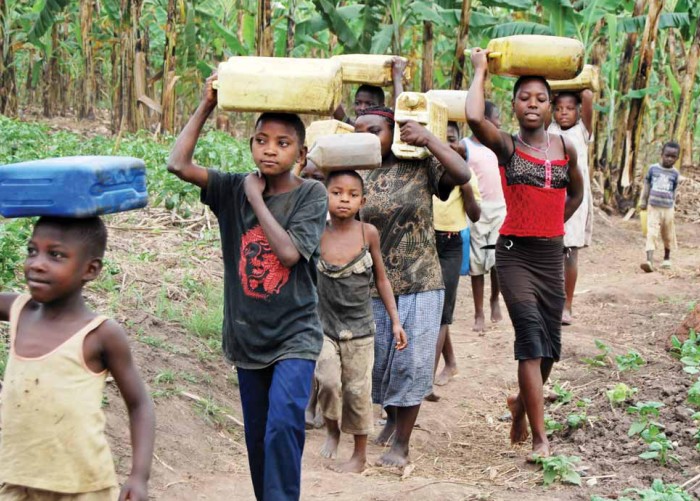
In Uganda and several other developing countries, children and women are the main collectors of domestic water. They often walk long distances to fetch water
The UN said that the data was based on a multidimensional poverty index compiled by the UN Development Programme (UNDP) and the Oxford Poverty and Human Development Initiative (OPHI).
It said that 1.3 billion people – almost a quarter of the population in the 104 countries considered in the study – were classified as poor of which 662 million were children.
The data considered health, education and living standards, noting that those living in poverty lacked access to necessities such as clean water, sanitation, electricity, adequate nutrition or primary education.
It further said that the vast majority of those considered poor – 1.1 billion – live in rural areas, where poverty rates are four times higher than those living in urban areas, according to the report.
It noted that government development initiatives were working to tackle poverty worldwide, such as in India, where 271 million people escaped poverty between the 2005-2006 and the 2015-2016 reporting years, said Achim Steiner, the head of UNDP.
“Although the level of poverty – particularly in children – is staggering, so is the progress that can be made in tackling it,” Steiner said.
The data aims to more accurately pinpoint where the most in-need people in the world are, as it considers broader criteria than the basic measure of poverty often used – anyone earning less than $1.90 a day.
The 104 countries considered in the report, which focused on primarily low and middle-income countries, make up almost three-quarters of the global population.
Lennart Båge and Paul Oquist, co-chairs of the Green Climate Fund (GCF) Board, are looking forward to the upcoming B.21 Board meeting, which holds from October 17 to 20, 2018 in Bahrain, saying that it is crucial to charting the organisation’s progress in meeting climate challenge. Decision on numerous funding proposals, a review of the Fund’s performance, and the selection of a new Executive Director are a few of the items on the agenda
Paul Oquist and Lennart Båge, co-chairs of the Green Climate Fund board
The Green Climate Fund (GCF) was created to channel and mobilise climate finance, supporting action in developing countries to help them reach their climate ambitions.
Recent years and months have shown that climate change is already having a devastating impact with an increase in droughts, flooding, heatwaves and extreme weather events. Meanwhile, greenhouse gas emissions are rising again, with 1.6 percent growth in 2017, after remaining flat over the previous three years.
This shows we need an unprecedented global effort to address this challenge. The GCF has a decisive role to play in the success of the Paris Agreement and the rapid implementation of the Agenda 2030 sustainable development goals.
Early results at the GCF have been quite remarkable. While the Fund has only been up and running for about three years, it has allocated more than $3.4 billion to 74 projects and programmes and mobilised another $9 billion in co-financing. These are expected to improve the living conditions for 217 million people while at the same time reducing 1.3 billion tons of CO2 emissions.
Yet achieving these results has not been without challenges. Even with such a noble and important cause as climate change, insufficient capacity at the Secretariat, which is still growing, as well as the current system of governance have set limitations. Due to a lack of a decision-making mechanism in the absence of consensus the Board oftentimes has found it difficult to reach agreement. The current Board is working to correct this.
Filling the remaining policy gaps is needed to provide clarity and predictability to developing countries on issues such as co-financing, incremental costs and eligibility criteria. Further work remains to be done also on areas such as gender, accreditation including direct access, and the simplified approval process. It’s not merely about having policies for the sake of policies but having the appropriate policies that are designed to enable the GCF to meet its objective of supporting developing countries in transitioning toward low-emission and climate-resilient development pathways.
The next Board meeting (B.21), which will take place from October 17 to 20 in Bahrain, is crucial. The Board is expected to decide on many funding proposals, with an indicative funding envelope of about $1 billion, as well as several accreditation proposals. The Board is also expected to initiate a review of the Fund and its performance during the Initial Resource Mobilisation Period (IRM). Furthermore, the Board will have to treat the selection of a new Executive Director as a matter of urgency. It also needs to launch the replenishment and agree on the arrangements to make it happen.
As Co-Chairs of the world’s largest climate-dedicated fund, we are highly conscious of the challenges ahead of us. Climate impacts are apparent everywhere, affecting both developing and developed countries. Entire countries, local communities and individuals are already feeling the impacts. With the growing threat of climate change, the role of the GCF will only become more important.
Whatever short-term challenges the Fund may currently face, developed and developing country Board members need to work together to respond to our rapidly changing climate.
Exxon Mobil, Chevron and Occidental Petroleum are joining a group of international oil and gas giants in an initiative aimed at curbing carbon emissions in the sector, two sources familiar with the matter said on Thursday, September 20, 2018.
Chevron Nigeria Office
The move marks a u-turn for the top two U.S. oil and gas producers which had resisted joining the Oil and Gas Climate Initiative (OGCI) after its launch in 2016.
The OGCI currently comprises 10 firms including BP, Royal Dutch Shell, France’s Total as well as national oil companies of China, Mexico, Brazil and Saudi Arabia, which together count for around 20 per cent of global oil and gas production.
The initiative last year created a $1 billion fund to develop technologies to reduce emissions of greenhouse gasses in the sector as the world aims to shift toward a low-carbon economy.
Exxon came under fire and has faced several lawsuits in recent years over its disclosures related to climate change.
Exxon, Chevron and Occidental could not be immediately reached for comment.