Greenpeace celebrates in November 2018 10 years of environmental activism on the African continent.
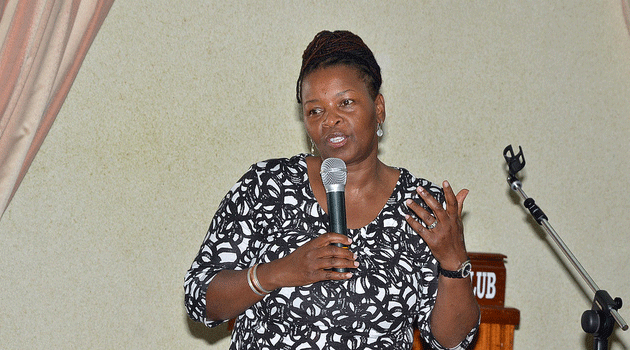
Greenpeace Africa Executive Director, Njeri Kabeberi
Partnering with artists, volunteers and other civil society organisations, the environmental watchdog is organising an open day to spark an environmental revolution. As part of commemorative activities in South Africa and Senegal, artwork will be used to encourage partners and Africans to celebrate their individual acts of courage towards the environment.
“Greenpeace Africa is using this occasion to highlight environmental concerns and calling on partners to share their memories of being part of this environmental movement over the years. The challenges facing the environment are enormous in Africa and it is impossible for Greenpeace Africa to address them without the goodwill of other stakeholders,” says Njeri Kabeberi, Greenpeace Africa’s Executive Director.
Greenpeace Africa currently runs campaigns on four key issues on the continent: to protect the Congo Basin from large-scale deforestation, stop overfishing in West Africa, promote ecological farming in the horn of Africa as well as demand a shift from fossil fuels to renewable energy sources in South Africa in order to reverse the impacts of climate change.
Over the past 10 years, Greenpeace Africa has exposed illegal fishing by Chinese companies in West Africa which led to the cancellation of over 29 fishing licenses in 2012 and pushed relevant ministries to seek help from Greenpeace Africa in finding solutions to the problem of Illegal, Unreported and Unregulated fishing in West Africa.
In the Congo Basin, the group says it investigated and exposed breaches on the moratorium and succeeded to push the government to cancel more than three illegal logging titles. Africa is said to be the organisation’s largest and most active volunteer base.
Greenpeace says the anniversary is an opportunity to appreciate and amplify the contribution of local and indigenous communities, volunteers, staff and donors who gave substance in its struggle to protect the environment. It adds that it is likewise celebrating a decade of “fruitful militant contribution towards protecting the planet and the amazing work of partners that resonate across the continent”.
“After 10 years of countless affirmative actions down the lane, the people remain central to Greenpeace Africa’s identity. Communities are at the heart of who we are and what is needed to create the green and peaceful Africa we crave for. Without the activists, volunteers, partners and local communities, Greenpeace Africa will just be a farce and we won’t be able to face environmental injustices with courage,” stated Njeri.
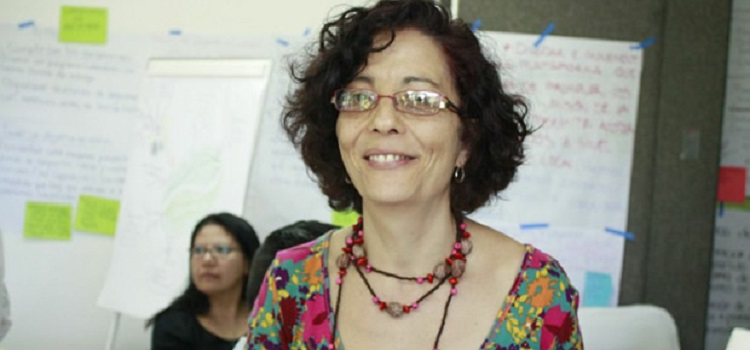
“We all value nature in very different and sometimes conflicting ways. Nature can be seen as a provider of food or water, as a regulator of climate, as part of our heritage or our identity, or as our home and that of life on earth. Assessing this diversity of values and how they are incorporated into decision making will contribute to addressing conflicts over nature and promoting more equitable decisions.”
These were the words on Tuesday, November 13, 2018 of Prof. Patricia Balvanera of the Institute for Ecosystem and Sustainability Research, National Autonomous University of Mexico while welcoming over 70 experts from 40 countries to Mexico City, for the first author meeting of a new expert assessment to improve decision-making at all levels.
Prof. Patricia Balvanera
Leading the new assessment, under the Intergovernmental Platform on Biodiversity and Ecosystem Services (IPBES), Dr. Balvanera was joined at the event by her three co-chairs: Brigitte Baptiste (General Director, Alexander von Humboldt Institute, Colombia); Prof. Unai Pascual (Ikerbasque Research Professor at the Basque Centre for Climate Change (BC3), Spain, and Associated Senior Research Scientist at the Centre for Development and Environment (CDE), (University of Bern, Switzerland); and Prof. Mike Christie (Director of Research, Institute of Business and Law, Aberystwyth Business School).
“This assessment will be a game-changer,” said Prof. Pascual, “It will provide evidence to help decision-makers see different types of values of nature, choose and design appropriate valuation methods, recognise the data gaps that exist and identify areas in which more capacity is needed – all to integrate plural valuation approaches into diverse decision-making contexts.”
An IPBES technical support unit, also led by Prof. Balvanera, will coordinate the production of the assessment and is based in Morelia, Mexico. It is hosted by the Institute for Research on Ecosystems and Sustainability (IIES-UNAM), the Secretariat of Institutional Development (SDI-UNAM), and the University Seminar on Society, Environment and Institutions (SUSMAI-UNAM) all within the National Autonomous University of Mexico (UNAM), and the Mexican Commission for Knowledge and Use of Biodiversity (CONABIO).
“One of the key elements of the assessment will be to empower individuals and groups whose voices are typically not heard in discussing values,” said Brigitte Baptiste. “This is why it has been so important to assemble an expert author team from a wide range of disciplinary and interdisciplinary backgrounds, ranging from the natural sciences to diverse social sciences, such as sociology, philosophy, economics, geography and many others.” The expert group is also quite gender balanced, comprising 53% women and 47% men.
In addition to the first author meeting this week, the experts are expected to meet again twice over the next two years. Drafts of the assessment report will be opened for two rounds of external review, by experts and governments, before the final report is presented for consideration to the 130-member States of IPBES – expected to be in 2021.
Speaking about the timing of the meeting, and the importance of the work, Prof. Christie said: “This week also sees the opening of global negotiations on a new biodiversity action framework for the world, at the UN Biodiversity Conference 2018 in Egypt. It is expected that this process will culminate in 2020. We believe that effective achievement of the post-2020 biodiversity targets will be greatly strengthened by the evidence we will present – helping to ensure that the many values of nature are considered.”
A new report by Greenpeace has found that Mondelēz International has destroyed over 25,000 hectares of orangutan habitat in Indonesia.
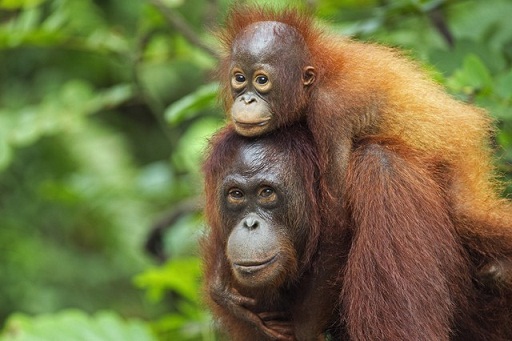
Orangutans
The company, responsible for Cadbury, Cadbury Roses and Oreo, is one of the biggest buyers of palm oil.
A Greenpeace-led investigation has found that, between 2015 and 2017, 22 of Mondelez palm oil suppliers cleared 70,000 hectares of rain forest.
This deforestation is having devastating effects on the orangutan population, every year it is estimated that 1,000 to 5,000 orangutans are killed in palm oil concessions.
Palm oil suppliers to Mondelēz have also been accused of child labour, exploitation of workers, illegal deforestation, forest fires and land grabbing.
Kiki Taufik, head of Greenpeace Southeast Asia’s Indonesia forests campaign, said: “It’s outrageous that despite promising to clean up its palm oil almost ten years ago, Mondelez is still trading with forest destroyers. Palm oil can be made without destroying forests, yet our investigation discovered that Mondelez suppliers are still trashing forests and wrecking orangutan habitat, pushing these beautiful and intelligent creatures to the brink of extinction. They’re literally dying for a biscuit.”
Mondelēz announced on Monday, November 12, 2018 that it is committing to 100 per cent sustainability and transparency across the palm oil industry.
Jonathan Horrell, Global Director of Sustainability at Mondelēz International, said: “Mondelēz International remains fully committed to driving change in the palm oil sector and today’s actions against 12 upstream suppliers reflect that commitment.”
This news follows Iceland’s Christmas TV advert being banned by Clear Cast for being ‘too political’. The advert explicitly showed how palm oil deforestation affected orangutan habitats, watch the advert here.
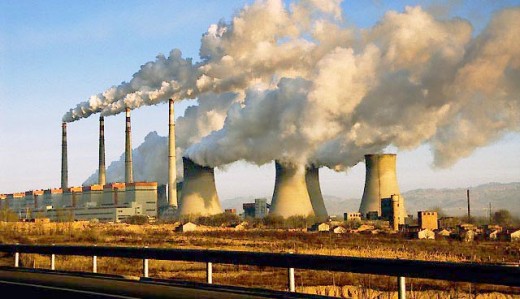
If electricity markets continue to depend on coal-fired power plants – which today account for a third of CO2 emissions – or gas-fired power plants, countries will not be able to meet the long-term climate objectives of the Paris Agreement, the International Energy Agency (IEA) was warned.
Coal-fired power plant in China
In a recent World Energy Outlook 2018 report, the IEA examines the impact of increased electrification in transport, buildings and industry. The analysis shows that increased electrification would lead to a peak in oil demand by 2030 and reduce harmful local air pollution. But electrification alone would have a negligible impact on carbon emissions without increased efforts to raise the share of renewable and low-carbon energy sources.
“We have reviewed all current and under-construction energy infrastructure around the world – such as power plants, refineries, cars and trucks, industrial boilers, and home heaters – and find they will account for some 95% of all emissions permitted under international climate targets in coming decades,” says Fatih Birol, Executive Director of the Paris-based institution. “This means that if the world is serious about meeting its climate targets then, as of today, there needs to be a systematic preference for investment in sustainable energy technologies.”
Countries around the world are rapidly increasing their share of solar photovoltaics and wind power, and the share of renewable energy in electricity production will rise to more than 40% in 2040, a positive trend for the environment, the Agency says. But the trend needs to be accelerated to achieve the central goal of the Paris Agreement, which is hold the global average temperature to as close as possible to 1.5 degrees Celsius.
Even the existing expansion of renewables brings major environmental benefits but also a new set of challenges that policy makers need to address quickly. With higher variability in supplies, power systems will need to make flexibility the cornerstone of future electricity markets.
The analysis, based on scenarios in the report, describes the different possible futures of the energy system for all fuels and technologies. It contrasts with different approaches, based on current and planned policies, and those that can achieve the long-term climate objectives of the Paris Agreement, reduce air pollution and ensure universal access to energy.
According to the IEA, natural gas is expected to overtake coal as the second largest energy source in the world after oil by 2030 due to a drive to cut air pollution and the rise of liquefied natural gas use.
In its “Sustainable Development Scenario”, the IEA projects global energy-related CO2 emissions to peak around 2020 and then decline sharply and sustainably, in line with the trajectory required to achieve the objectives of the Paris Agreement on Climate Change.
“It will be essential to develop the right policies and incentives to achieve our common objectives of security of energy supply, reducing carbon emissions, improving air quality in urban centres and expanding basic access to energy in Africa and elsewhere,” said Fatih Birol.
The problem: Most emissions linked to energy infrastructure are already essentially locked-in. In particular, coal-fired power plants, which account for one-third of energy-related CO2 emissions today, represent more than a third of cumulative locked-in emissions to 2040. The vast majority of these are related to projects in Asia, where average coal plants are just 11-years-old on average with decades left to operate, compared with 40 years on average age in the United States and Europe.
Energy demand is set to grow by more than 25% to 2040, requiring more than $2 trillion a year of investment in new energy supply.
“Our analysis shows that over 70% of global energy investments will be government-driven and as such the message is clear – the world’s energy destiny lies with government decisions,” adds Dr Birol.
The decisions will partly be shaped by the outcomes of the UN Climate Change Conference COP24 in December, where governments are set to on agree the implementation guidelines of the Paris Agreement and discuss next steps to increase climate ambition.
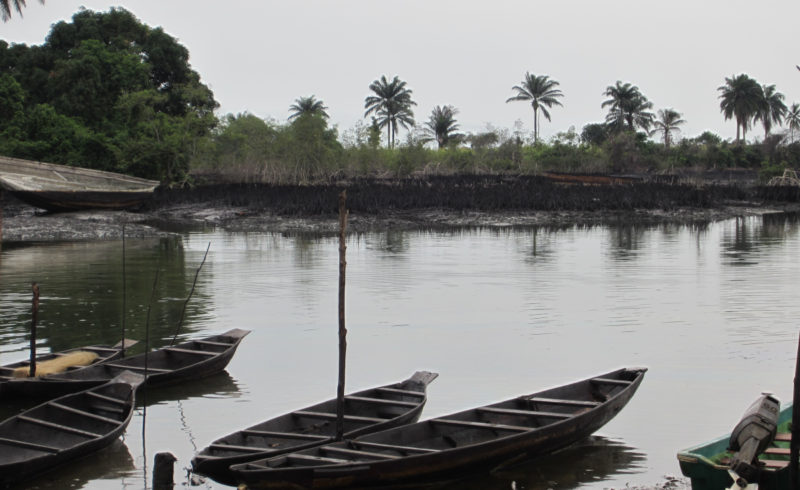
Artisanal fishermen in the Niger Delta, affected by the Dec. 2011 Bonga oil spill, have urged the Federal Government to compel Shell to pay the $3.6 billion fine for the spill.
A water body in the Niger Delta polluted by crude oil
Rev Samuel Ayadi, Coordinator, Niger Delta zone, Artisana Fishermen Association of Nigeria, made the call in an interview with the News Agency of Nigeria (NAN) in Yenagoa, Bayelsa State on Tuesday, November 13, 2018.
Justice Mojisola Olatoregun of a Lagos Federal High Court, on June 20, upheld the $3.6 billion fine imposed on Shell by the National Oil Spills Detection and Response Agency (NOSDRA), dismissing Shell’s appeal.
Ayadi lamented that Shell Nigeria Production and Exploration Company (SNEPCO) was yet to comply with the court order, saying that the judgment was a lifeline to the fishermen.
Following the Dec. 20, 2011 spill, NOSDRA in March 2015 imposed a $3.6 billion fine on Shell for discharging 40,000 barrels of crude into the Atlantic Ocean.
The fine comprised $1.8 billion as compensation for the damage to the natural resources and consequential loss of income by the affected shoreline communities as well as a punitive damage of $1.8 billion.
The Chairman of NOSDRA board, Sen. Ayo Akinyerule, had urged SNEPCO to pay the fine to enable the agency to compensate the impacted fishermen and communities.
Ayadi said that the fishermen thrown out of business by the incident had patiently waited for the litigation processes to end.
“The Bonga oil spill was a heavy blow to us artisanal fishermen. Ironically the spill from the oilfield named after the local fish specie, Bonga, was what led to the near extinction of the specie.
“We can no longer see Bonga fish in our dishes because the spill wiped out generations of the specie.
“The chemical dispersant spread to dissolve the leaked crude is very toxic to fish and other marine creatures.
“We were directed by NOSDRA to pull out of fishing to avoid catching contaminated fish that would jeopardise public health.
“The income loss is in addition to the damage done by the contamination of our fishing gear, outboard engines and nets.
“Since the three months appeal window has lapsed, we call on President Muhammadu Buhari to prevail on SNEPCO to comply with the court judgment and pay the fine so that NOSDRA can compensate the victims.
“We are counting on the fatherly disposition of President Buhari to prevail on Shell to comply with the court’s judgment so that we shall return to our traditional fishing occupation.
“Our return to sea will also guarantee that we play our own part in ensuring food security and reducing our dependence on imported fish,” Ayadi said.
On Dec. 20, 2011, during loading of crude at Bonga fields within OML 118 situated 120 kilometres off the Atlantic coastline, the export line ruptured and discharged crude into the sea.
The export line, according to a joint investigation report by NOSDRA and SNEPCO, spewed about 40,000 barrels (6.4 million litres) of crude oil into the sea.
Whenever agricultural related stakeholders, particularly farmers, are invited to a workshop or forum, they attend in great anticipation – to get answers to all kinds of problems plaguing their activities.
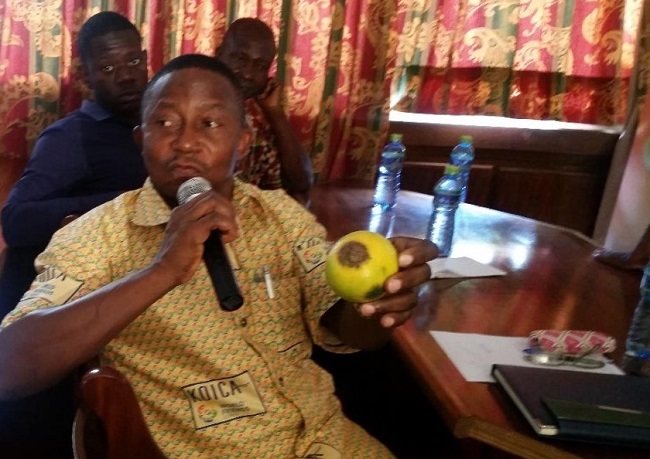
Gershon Wordzra, the Central Regional Director of Agriculture, with one of the diseased oranges, which he said farmers could avoid by maintaining their farms
So, at one such forums in Cape Coast organised by the Ghana Chapter of the Open Forum for Agricultural Biotechnology (OFAB) in Africa, one farmer came with the hope of finding solutions to what he described as “a strange disease” plaguing his orange orchard. But at the end of the meeting, the experts made it clear that “biotechnology cannot resolve every farming associated problem.”
The purpose of the forum was to sensitise the stakeholders on biotechnology as one of the options for addressing some crop production related challenges. So, in the course of the discussion, when Farmer Joseph Amoah showed participants several diseased oranges, it was obvious he was expecting answers from the technology being talked about.
As a young teacher posted to Asuansi in the Abura Asebu Kwamangkese District of the Central Region, Mr. Amoah established an orange orchard in 1973 and has been having good harvests and enjoying the proceeds for many years. However, his joy over the fruitfulness of the orchard fizzled off after the trees started bearing diseased fruits about five years ago.
And, for an answer, he got a gentle rebuke, which was a solution in disguise from Gershon Wordzra, the Central Regional Director of Agriculture. He made it clear to Farmer Amoah that the disease afflicting his oranges was a fungi disease, which occurs as result of an un-kept farm environment.
“We always tell you to manage your orange farms well and clear them of weeds, especially once they start fruiting or else this disease will become a problem for you,” Mr. Wordzra said.
Known as Anthracnose of orange, the disease, according to a Michigan State University brochure, is very fatal for farmers because “Anthracnose can reduce a beautiful harvest into rotted waste in just a few days.”
Therefore, Mr. Wordzra stressed that farms needed to be tended for farmers to make the make gains of their investments. “Farms are like humans, they also need care and hygiene, crops are like our bodies so nourish them, take good care of them and you will be very happy,” Mr. Wordzra stated.
He observed that farmers are often reluctant to spend money to maintain their farms and urged them to make the needed sacrifices in order to get the most of their farms. Mr. Wordzra also reminded farmers that, “in citrus cultivation, sanitation and regular pruning are very important.”
Other resource persons at the meeting including Country Coordinator of the Programme for Biosafety Systems (PBS), Daniel Osei Fosu, who explained that the need for one to keep his or her farm has nothing to do with biotechnology. Thereby, establishing the point that “whether cultivated crops were from genetically modified seeds or conventional breeding, maintenance of one’s farm, was of essence.”
In an interview, Mr. Fosu said, “Biotechnology cannot resolve issues of diseases from un-kept farms, the technology is applied to resolve specific crop productivity issues including drought and pests that undermine food security.” Thus, biotechnology, genetic modification or engineering should not in any way be the magic wand to maintain one’s farm, he added.
The scenario appears to be a clear pointer to how biotechnology has become the agricultural scapegoat. For instance, during an interaction organised by Alliance for Science, Ghana with officials of the National Biosafety Authority, one participant stated that, based on his personal experience, biotechnology crops can never do well in Ghana and therefore must not be encouraged.
According to him, a relation who lives in Canada came home recently and brought with him orange seeds, which they sowed, and it never germinated. In his view, “the seeds did not grow because they were genetically modified and cannot do well on our soils.” Dr. Richard Ampadu Ameyaw of the Science Technology Policy and Research Institute (STEPRI) of the Council for Scientific and Industrial Research (CSIR), who attended the meeting, responded that “so far oranges are not among the crops or plants that have been genetically modified across the world. What is available are improved varieties made possible through conventional breeding methods.”
Dr. Ameyaw explained that the “inability of the orange seeds to grow could be due to the unsuitability of the soil for that particular species of orange,” adding that, “some plants and crops tend to be endemic and once they are moved out of their native soils, can never do well in other soils and that could be case of those orange seeds.”
It is for this reason that improved crop varieties whether by conventional or through biotechnology methods are tested. In Ghana, the Biosafety Act, 2011 (Act 831) provides for intensive field trials to be conducted for genetically modified seeds. The essence is to ascertain the adaptability of a modified crop to the soil in terms of its ability to grow and manifest the traits for which it was engineered such as pest resistance or drought tolerant, and ultimately to produce good yields.
In Ghana, leading Ghanaian scientists are spearheading the process of field trials in genetically modified crops. They include Dr. Mumuni Abudulai of the Savannah Agricultural Research Institute of the CSIR. He is the Principal Investigator of the PBR Cowpea project in Ghana and attests that the PBR cowpea has successfully gone through all the various stages of field trials.
According to Dr. Abudulai, “the dossier for its final release are currently being analysed and what is good about this particular cowpea is that it offers an economically and ecologically sustainable way to combat pod bearers, for which they are no natural sources of resistance.”
He said the trial results demonstrates that the PBR cowpea “when adopted by farmers could reduce the frequency of insecticide sprays to two at the most for increased yields…result in important savings to the farmer from insecticide costs and … reduce the health hazards associated with insecticide sprays, resulting in improved health of farm families.”
From the Crop Research Institute of the CSIR, Dr. Maxwell Asante is leading trials of the NEWEST Rice (Nitrogen Use Efficient, Water Use Efficient and Salt Tolerant rice) Project in Ghana, for which field trials are still on-going. He says, “This rice has been modified to mitigate the effects of climate change on rice production among other things.”
Prof. (Mrs.) Marian D. Quain is a Principal Research Scientist of CSIR’s Crop Research Institute and leader of the Biotechnology Research Group at the Institute. She is of the view that while “the technology is not a panacea for all our agricultural problems,” it is desirable because it is geared towards “alleviating poverty, hunger and malnutrition in the sub-Saharan region and will ultimately improve food production, enhance nutritional contents of crops and contribute to economic growth.”
Dr. Quinn said a survey conducted not too long indicates that “majority of respondents are in favor of introducing genetically engineered crops in Ghana.” She attributed the main challenges to the process to “the very fast rate at which the technology advances,” and the need for Ghana “to secure substantial investment in cutting edge technologies and human resource development.”
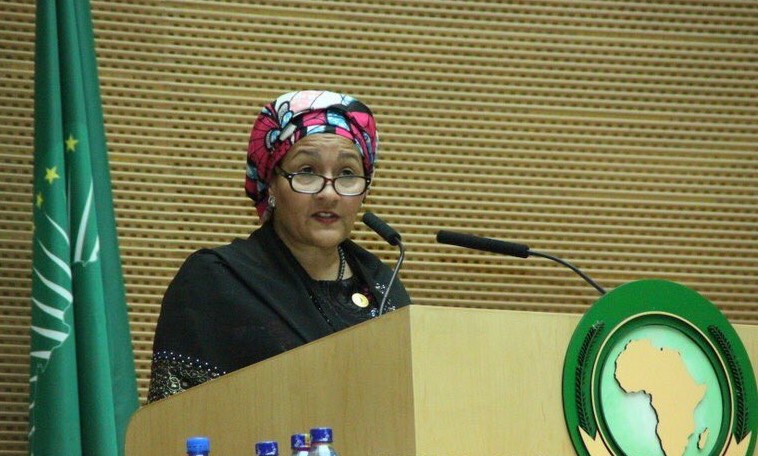
UN Deputy Secretary-General, Ms Amina Mohammed, says an estimated $157 billion is needed annually to implement the Sustainable Development Goals (SDGs) in the Sahel region.
Deputy Secretary-General, Amina Mohammed. Photo credit: African Union Commission
Mohammed stated this in her remarks to the Annual Session of the Peace building Commission with the theme: “Peace building and Sustaining Peace in the Sahel Region”.
The UN deputy chief said the Sahel offered enormous opportunities, adding that it is the most youthful region of the world.
Mohammed said: “It (Sahel) has abundant natural resources; it has great potential for renewable energy; and a rich cultural legacy.
“However, financial and human resources remain a challenge. The total needs to implement the SDGs for instance in the region are estimated at $140 billion this year, rising to $157 billion annually by 2022.
“It is therefore imperative that we increase our advocacy and resource mobilization efforts in a more joined-up manner.”
According to her, investment in this region is vital in order to prevent countries that are experiencing fragility today from becoming the failed states of tomorrow.
She said many of these countries were grappling with threats including terrorism and insecurity that originated beyond their borders, and with climate change that respects no borders.
The UN deputy scribe explained that she visited the Sahel earlier in the year with a joint UN-African Union delegation, joined by Sweden’s Foreign Minister, Margot Wallström.
Mohamed said: “We found the resilience of the Sahelian people not only inspiring but humbling.
“Their wish and hope for sustained peace and security was clear – as was the need to ensure women are meaningfully included in all initiatives and policies.
“We met women who had been terrorised by extremists and women who had been married off in childhood.
“We also spoke to women who were supporting extended families and helping to build community resilience, and women religious leaders working to end child marriage and prevent radicalisation and extremism.
“We met women peace builders and mediators, who were driving change and working for a more sustainable future.
“Their voices are essential in peace negotiations and decision-making processes. Their experience and their leadership are essential to building a new Sahel,” she said.
Mohammed said supporting transformative policies for stability and development in the Sahel was a matter of international solidarity and global security of a collective responsibility.
According o her, 41 million young people are in the Sahel, who are often portrayed either as victims, or as potential perpetrators of violence.
She, however, said that these stereotypes are completely wrong.
An agricultural firm, Value Seeds Ltd., has urged local farmers to cultivate Vitamin A fortified seeds to boost nutritious diet and food security in the country.
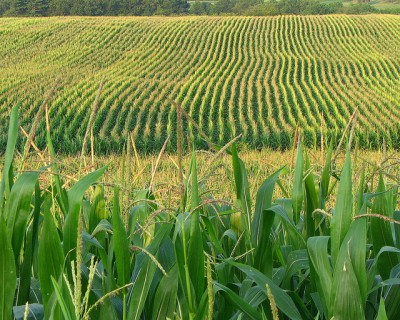
A corn field
Spokesperson for the firm, Ms Mercy Essien, made the call in an interview with the News Agency of Nigeria (NAN) on Tuesday, November 13, 2018 in Lagos.
Essien said that the cultivation of hybrid seeds would help boost food security as they could be cultivated under any weather condition.
“We encourage local farmers to cultivate more of Vitamin A maize because it is more nutritious than the regular maize seeds.
“The regular maize seed does not contain Vitamin-A nutrient like the hybrid Vitamin-A fortified maize seeds.
“Vitamin A maize is a macro-nutrient crop that is very good for children’s consumption, it is good for children’s eyes, reduces stunting and wasting and helps control or eradicate night blindness in children,” she said.
Essien said that her company’s goal was aimed at sensitising local farmers to cultivate hybrid and Vitamin A fortified maize for better nutrition.
“Our vision is centred on the multiplication, production and distribution of seeds, both field crops and vegetable crops,’’ he said.
“We produce and distribute rice, soybeans, millet, sorghum; we have our vegetable seed as okra, carrots, watermelon, cabbage etc.
“We multiply hybrid seeds because it is more beneficial to cultivate than the open-pollinated seeds.
“We encourage local farmers to plant more of hybrid seeds because of the changing environmental conditions in the country.
“Hybrid seeds have earlier maturity than the open pollinated seeds and may not need favourable weather conditions to grow well.
“We want to shift the idea of just cultivating open pollinated seeds to cultivating hybrid seeds.
“We are sensitising local farmers on the importance of cultivating these hybrid Vitamin A fortified maize seeds and some of them are already adopting it,” she said.
NAN reports that open-pollination of seeds occurs by insects, birds, wind, humans or other natural mechanism, while hybridisation is a controlled method of pollination in which the pollen of two different species or varieties is crossed by human intervention.
The Federal Government says it is committed to addressing the sanitation challenges including ending open defecation in the country and ensuring proper management of excreta.
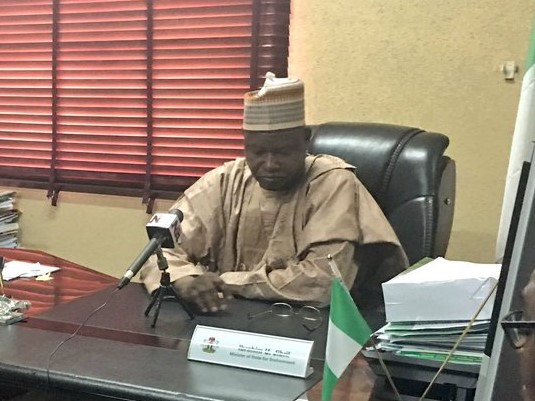
Ibrahim Usman Jibril, Minister of State for Environment
Alhaji Ibrahim Jibril, the Minister of State for Environment, said this at the 2018 World Toilet Day Ministerial Press Briefing on Tuesday, November 13, 2018 in Abuja.
The minister, who was represented by the Permanent Secretary, Mr Leon Aliboh, said that the commitment was demonstrated by the President Muhammadu Buhari’s recent declaration of state of emergency on water, sanitation and hygiene in the country.
He said that the celebration, with the theme: “When Nature Calls’,’ was quite apt as it drew attention to the fact that “you and I cannot avoid or ignore the call of nature and the environmental health challenges associated with poor management of toilet, faeces and sewage.’’
“It focuses on the reawakening of societal consciousness on the importance of having eco-friendly sanitary facilities in every household and ensuring proper management of sewage.
“This year’s commemoration focuses on toilet and nature, raising awareness and inspiring action to tackle global sanitation crisis.
“It also aims to promote access to toilets for everyone everywhere, end open defecation and ensure that toilet construction, operation, use and management are ecosystem friendly,’’ he said.
Jibril noted that access to sanitary facilities remained a mirage to a vast majority of Nigeria’s citizens.
“Today, 4.5 billion people in the world live without safe toilet and 892 million people still practice open defecation, as many people still use the bush and water bodies as their regular means for excreta disposal.
“Many institutions do not have sanitary facilities and where they exist, they are either not functioning well or are misused.’’
He said that one of the major consequences of poor excreta disposal was the high rate of diarrhea disease being the cause of the second highest rate of morbidity and mortality among children under the age of five.
“The persistent re-occurrence of annual incidences of cholera outbreak in some of our states and the occurrence and re-occurrence of other excreta related diseases are also manifestations of inadequate toilet facilities.
“Yet this could also be prevented through safe excreta disposal by every individual.
“I therefore challenge all stakeholders on environment, particularly sanitation at national, state and local government levels, to not only talk, but take practical steps and actions as agents of change to ensure everyone has access to eco-friendly sanitary facilities.’’
He said that the ministry in collaboration with other stakeholders had put together series of activities to mark the 2018 World Toilet Day.
“We have school pupils sensitisation (competition and education through game and artwork), sanitary inspection of Federal Government premises, community awareness campaign and sanitary inspection of markets and motor parks,’’ he said.
The theme of the World Toilet Day is: “When nature calls, please think healthy and safe environment’’.
Nov. 19 of every year is marked as World Toilet Day as declared by the United Nations General Assembly in 2013.
Dr Domnic Abonyi, the Registrar, Environmental Health Officers Registration Council of Nigeria (EHORECON), said safe toilet must follow some criteria.
“For toilet to be safe and sound, the criteria to solve the purpose of toilet must include, it should not be unsightly, should not have access to flies, fresh faeces should not be handled and should be devoid of odour.
“Individual should provide for themselves, family and community any type of toilet suitable to their finances provided that the ecstatic criteria are considered.
“The basic thing for those who cannot afford the most standard toilet can dig the site they want for the toilet, void the faecal matter and cover it.
“This should be done in a way that flies cannot get access to it, nobody will see it and you cannot remove or handle with your hand,’’ he said.
He said that emphasis was on individuals and families to get a toilet system they could operate and maintain.
“Basically, the need is for us to avoid seeing bigger matter like cholera that could be avoided,’’ he said.
The Federal Government on Tuesday, November 13, 2018 said the completion of all abandoned water projects in the country was paramount to the overall goal of improving access to potable water in the country.
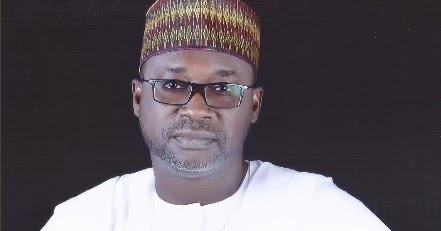
Suleiman Adamu Kazaure, Water Resources Minister
Mr Suleiman Adamu, the Minister of Water Resources, said this at the opening of the 2018 Media Week to highlight achievements of the administration in the last three years.
According to him, the ministry is focused on working in line with the National Water Resources Master Plan, which targets deriving optimum benefits for Nigerians.
He said that the ministry had in the last three years embarked on only two projects of Kazaure Water Supply Project and the Dukku Regional Water Supply project in Jigawa and Gombe states respectively.
“We are committed to completing all ongoing viable projects in the ministry to derive optimum benefits from government’s investments.
“It is instructive to note that since the inception of administration, my ministry has initiated only two projects, this underscores the emphasis on completion of the numerous ongoing abandoned projects inherited from past administration,” he said.
Adamu said that the ministry had initiated the National Irrigation Development programme to aid economic diversification, promote food security and employment creation.
He said that this programme would establish additional 100,000 hectares of irrigated farmland by 2020 and 500,000 hectares by 2030.
He noted that the ministry was working with private sector and state governments to complement governments’ efforts to deliver 41, 000 hectares of irrigated agriculture by 2019.
The minister added that the ministry was also implementing the Transforming Irrigation Management in Nigeria programme in partnership with the World Bank to the tune of $495 million.
“The project involves the rehabilitation and expansion of about 42,000 hectares of irrigation land under the first phase to be completed by 2022.”
He said that Bakolori, Hadeija, Kano River, Dadin Kowa, Middle Rima Irrigation projects were ongoing with the overall goal of poverty reduction and sustainable agriculture production.
The minister however lamented that only 1,930 megawatts out of the 12, 220 megawatts of hydro power potential was being developed at Kainji, Jebba and Shiroro Dams, noting that efforts were on to concession some of them to become more beneficial to the populace.
Earlier, Alhaji Aliyu Pategi, the Chairman, House Committee on Water Resources, commended the ministry on implementation of the Songhai model of agriculture, urging all river basins to adopt the same model to improve lives of Nigerians.
Pategi noted the challenges of poor capacity building of river basins needed to be corrected at the ongoing National Council of Water Resources meeting and pledged the commitment of the legislature to promote all programmes to reposition the water sector.