Home Blog Page 1738

Government declares Cross River councils open defecation free

0

The Federal Government has declared Ikom and Yala Local Government Areas (LGAs) of Cross River State open defecation free (ODF).
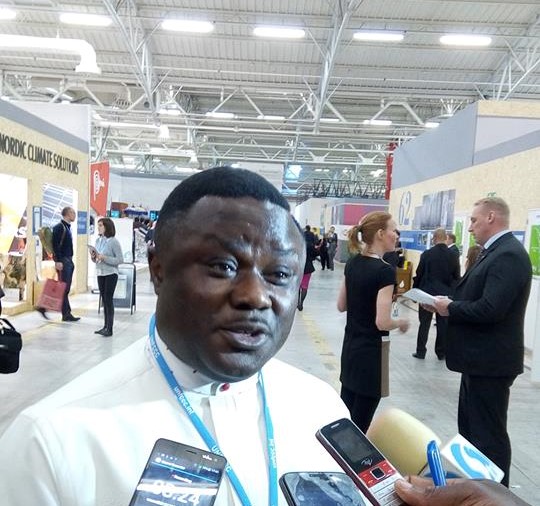
Gov Ben Ayade
Gov Ben Ayade of Cross River State

The declaration was made at a news conference held in Calabar, the state capital, on Thursday, December 13, 2018 by the state Ministry of Water Resources.

Speaking at the occasion, the Minister of Water Resources, Mr Suleiman Adamu, who was represented by Mr Emmanuel Awe, a Director in the ministry, commended the state government for the feat.

According to the minister, while Nigeria made significant progress in the provision of safe water supply in the past decade which had contributed to socio-economic development, the same could not be said of sanitisation and hygiene.

“Nigeria was reported to be the country with the highest number of people practising open defecation in Africa, with over 46 million people involved.

“To this end, the Ministry of Water Resources in collaboration with United Nations Children Education Fund (UNICEF) developed the strategic document -Making Nigeria Open Defecation Free,” he said.

The minister noted that, on Nov. 8, President Muhammadu Buhari also declared a state of emergency in the Water Sanitation and Hygiene (WASH) sector and launched the National Action Plan for the revitalisation of the sector.

“More recently, the ministry launched the Open Defecation Free Nigeria (Rural) 2025 campaign during the last National Water Resources Council meeting held in Abuja.

“These are geared to ensure that Nigeria meets the 2025 target of making the country open defecation free,” he said.

Similarly, the state’s Commissioner for Water Resources Mr Ntufam Gabe-Odu said all the communities in Ikom and Yala had satisfied the National Open Defecation Protocol.

He thanked the Community-led Health Improvement through Sanitisation and Hygiene Promotion in Nigeria (CHISHPIN) and all the other agencies that supported the initiative.

The commissioner also urged all hands to be on deck in order to make the state the first state to be declared ODF in the country.

Earlier, the traditional rulers of Ikom and Yala LGAs thanked the government for its efforts =and called for increase funding for such laudable initiatives to ensure sustainability.

“Sustainability is key to whatever we are doing; some communities operating this scheme in the states do not have boreholes and depend on streams which dry up in the dry season.

“We depend on what donors give to this state to survive and so if the state government increases its counterpart funding for projects like this, I think we will benefit more,” he said.

So far, five LGAs in the state – Obanliku, Bekwarra, Yakurr, Ikom and Yala – have been declared ODF.

By Christian Njoku
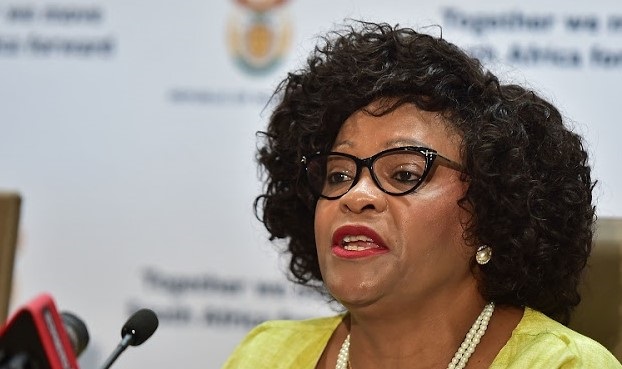
S. Africa dedicated to low-carbon economy in Africa, says minister

0

The South African government will advance the agenda of inclusive growth, a low-carbon and climate-resilient economy not only in the country but also on the African continent, an official said on Wednesday, December 12, 2018.

Nomvula Mokonyane
Nomvula Mokonyane

Minister of Environmental Affairs, Nomvula Mokonyane, said this when she announced the government’s plan to host the Partnership for Action on Green Economy (PAGE) Conference, scheduled for January 10-11, 2019 in Cape Town.

The PAGE Conference supports countries and regions to put sustainability at the heart of economic policies and practices to advance the 2030 Agenda for Sustainable Development.

“Hosting the PAGE Conference will advance the agenda of inclusive growth, and the adoption of a low-carbon and climate resilient economy, domestically and on the African continent,” said Mokonyane.

She said the PAGE programme aimed to further strengthen the cooperation, coordination and capabilities required to implement South Africa’s transition to a low-carbon, resource-efficient and pro-employment development path.

The 3rd PAGE Ministerial Conference, under the theme Advancing Inclusive and Sustainable Economies, follows two successful conferences, which were held in Dubai in 2014 and Berlin in 2017 respectively.

PAGE was launched in 2013 as a response to the call at Rio+20 to support those countries wishing to embark on greener and more inclusive growth trajectories.

The platform brings together five UN agencies: UN Environment, International Labour Organisation, UN Development Programme, UN Industrial Development Organisation, and UN Institute for Training and Research.

The platform, whose mandates, expertise and networks combined can offer integrated and holistic support to countries on inclusive green economy, ensuring coherence and avoiding duplication.

Mokonyane said the 3rd PAGE Ministerial Conference would provide an opportunity for member states to reinforce the commitment to transition to a green and sustainable economy.

He said it would also to demonstrate implementation of the tools and strategies to accelerate, scale up and sustain the momentum on deepening green economy principles in socio-economic and environmental planning frameworks.

The minister said South Africa had been working to adopt green economy strategies in line with its National Development Plan Vision 2030, which committed the country to an environmentally sustainable and equitable transition to a low-carbon economy.

The country, she said, was currently implementing programmes to promote energy efficiency, green transport, sustainable housing and climate resilient agriculture.

Similarly, the South African government on Wednesday welcomed the resumption of peace talks aimed at resolving the Western Sahara issue.

“South Africa welcomes the recently concluded first round of negotiations held on Dec. 5 to 6, in Geneva, Switzerland on the situation in Western Sahara,” Minister of International Relations and Cooperation, Lindiwe Sisulu, said.

The talks, held after six years of suspended negotiations, would be followed by a second round-table in the first quarter of 2019.

Sisulu said her country was pleased that Morocco and the Polisario Front had been able to meet to seek a political solution to the conflict.

South Africa is hopeful that this negotiations process, led by former Germen President, Horst Kohler, in his capacity as the Personal Envoy of UN Secretary-General Antonio Guterres will lead to a just, lasting, and mutually acceptable solution.

The negotiation will provide for the self-determination of the people of Western Sahara, Sisulu said in a statement.

“It is our hope that these negotiations are a step in the right direction towards reviving the long-stalled talks between the Polisario Front and Morocco,” she said.

The negotiations took place in accordance with UN Security Council Resolution 2440 adopted by the UN Security Council on Oct. 31, 2018.

The negotiations called on the parties to show “political will and work in an atmosphere propitious for dialogue.’’

Sisulu pledged that South Africa would utilise its upcoming term on the UN Security Council (UNSC) to call on the UN to continue to support the right to self determination of the people of Western Sahara.

South Africa will serve its 2019-2020 term as a non-permanent member of the UNSC.

Western Sahara was partitioned between Morocco and Mauritania at the end of Spain’s colonial rule in 1976.

When Mauritania, under pressure from Polisario guerrillas, abandoned all claims to its portion in August 1979, Morocco moved to occupy that sector and asserted administrative control over the whole territory.

Fighting then broke out between Morocco and the Polisario Front, which is fighting for the independence of Western Sahara.

A cease-fire was signed in 1991 and in that year, the UN mission, known by its French acronym as Minurso, was deployed to monitor the cease-fire.

It’ll will be ‘immoral, suicidal’ to fail to agree on climate change action – UN

0

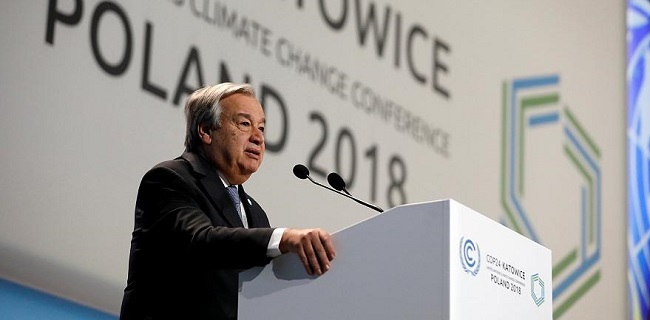
UN Secretary-General Antonio Guterres says it will “not only be immoral, but suicidal”, should the world body fail to agree on climate change action.

António Guterres
António Guterres

Guterres said this on Wednesday, December 12, 2018 at the ongoing 24th Conference of Parties (COP24) in Katowice, Poland.

He challenged the more than 100 government leaders gathered in Katowice to find consensus and “finish the job”, noting the roadblocks continuing at the (COP24) climate change conference over how to implement the historic 2015 Paris Agreement.

“In my opening statement to this conference one week ago. I warned that climate change is running faster than we are and that Katowice must – in no uncertain terms – be a success, as a necessary platform to reverse this trend,” Guterres said.

Since Dec. 2, the conference has brought together thousands of climate action decision-makers, advocates and activists, with one key objective – to adopt global guidelines for the 197 parties of the 2015 Paris Agreement.

The 197 parties of the 2015 Paris Agreement committed to limiting global warming to less than 2 degrees Centigrade – and as close as possible to 1.5 degrees Centigrade – above pre-industrial levels.

With only three days left at the conference for the negotiations, the UN chief regretted that “despite progress in the negotiating texts, much remains to be done”.

On Wednesday, given the complex state of discussions, the Polish Presidency of COP24 proposed a text to act as a “new basis for negotiations”.

“Key political issues remain unresolved. This is not surprising – we recognise the complexity of this work. But we are running out of time,” Guterres warned, referring to the alarmingspecial report on global warming issued in October by the Intergovernmental Panel on Climate Change (IPCC).

He told the delegations, which are locked in negotiations, that “over the last 10 days, many of you have worked long, hard hours and I want to acknowledge your efforts. But we need to accelerate those efforts to reach consensus if we want to follow-up on the commitments made in Paris.”

He called on negotiators to boost their ambition, with regards to “predictable and accessible financial flows for the economic transition towards a low-emission and climate-resilient world”.

Guterres reminded the audience that developed countries had a financial obligation to support the efforts of developing countries, as established by the UN Climate Change Convention (UNFCCC), under which the Paris Agreement falls, and which was signed in 1992.

“It’s very difficult to explain to those suffering from the effects of climate change that we have not managed to find predictable support for the actions that must be taken,” he remarked.

He hailed various financial announcements made since the beginning of COP24, including by the World Bank, multilateral development banks, and the private sector but urged developed nations to “scale up their contributions to jointly mobilise $100 billion annually by 2020”, as laid out in 2015 in Paris.

“Countries have different realities, different capacities and different circumstances,” he noted, explaining that “we must find a formula that balances the responsibilities of all countries” and that is “fair and effective for all”.

The UN chief said there was the know-how, as well as “incredible momentum from all segments of society” adding that “what we need, is the political will to move forward”.

“I understand that none of this is easy. I understand some of you will need to make some tough political decisions,” he said, adding “this is the time for consensus.

“This is the time for political compromises to be reached. This means sacrifices, but it will benefit us all collectively”, he challenged the conference to overcome national preferences and work together to “finish the job” with raised ambition “on all fronts”.

Guterres stressed: “To waste this opportunity in Katowice would compromise our last best chance to stop runaway climate change. It would not only be immoral, it would be suicidal.”

By Prudence Arobani

COP24 delegates seek scaled-up ambition, support on climate finance

0

Ongoing UN Climate talks in Katowice, Poland are at a critical stage, as negotiations on Wednesday, December 12, 2018 moved into bilateral talks between ministers and in the final days of the summit.

Observers are optimistic that the talks will deliver results.

Mattias Söderberg
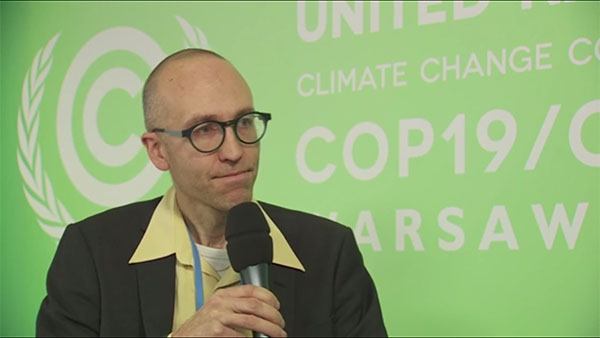
Mattias Söderberg of the ACT Alliance

“We are concerned about the slow progress and we call on all delegates to acknowledge the urgency and the need for scaled-up ambition,” said Mattias Söderberg, the head of the ACT Alliance delegation.  “This meeting is critical for billions of people around the world, and governments should not let them down.”

One issue that appears to have proven very difficult and on which parties stand far apart is climate finance.

Söderberg commented, “We should always remember that talks about climate finance are talks about climate action. With no support, poor and vulnerable countries will have difficulties to take the action needed.”

“All parties agree that there is a need to scale up the ambition, but this will only be possible if there also is a scale-up of support. Climate finance must, therefore, be new and additional,” he continued. “It seems like developed countries have difficulties in delivering the new and additional support they have promised. Therefore, they try to create flexible rules which make it possible to include a number of existing financial flows in their reporting.”

Current climate finance includes a large amount of loans, which have to be repaid with interest. “Loans may play an important role for many investments, but when we talk about climate finance it is worrying that developed countries want to include money which in fact will be repaid,” Söderberg said. “Repayment and interest may lead to a situation where developing countries end up with the bill, where climate finance flows which were agreed as a support to developing countries, turn into a backflow of funds to rich countries. That is not fair!”

COP24 is expected to deliver a rulebook, which will create a framework for the implementation of the Paris Agreement. Rules for how to report and account climate finance will be part of the rulebook.  According to Söderberg, “We need robust and fair rules, with an aim to promote concrete action on the ground, leading to support for poor and vulnerable communities. We should never forget that climate change already has critical effects on people around the world, and they are in urgent need of support.”

A recent analysis by DanChurchAid, a member of the ACT Alliance, shows how rules for climate finance may have a big effect on the amount of support developing countries will receive in the coming years.

Youth champions deliver Talanoa action call

0

At the closing of the Talanoa Dialogue on Wednesday, December 12, 2018, the Presidencies of this and last years’ UN Climate Change Conferences (COP24 and COP23) issued the Talanoa Call for Action.

Youth champions
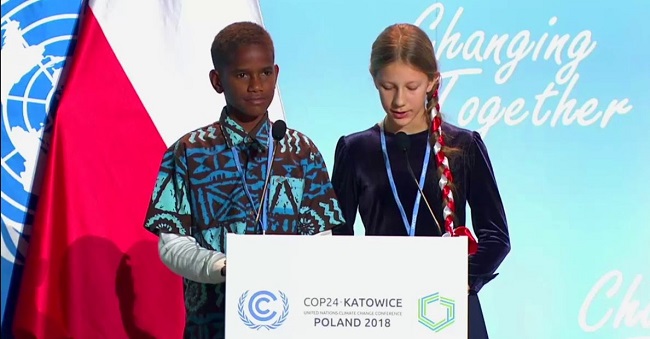
Youth champions Timoci Naulusala from Fiji and Hanna Wojdowska from Poland

The statement calls for the urgent and rapid mobilisation of all societal actors to step up their efforts with a view to meeting the global climate goals agreed in Paris in 2015. The calls to action were delivered by youth champions Timoci Naulusala from Fiji and Hanna Wojdowska from Poland.

The closing session concluded 21 ministerial roundtables – convened on the previous day at COP24, which runs to the end of the week in Katowice, Poland. The roundtables brought together nearly 100 ministers and over 40 non-Party stakeholders to chart a way forward for global climate action.

“It is with great joy and commitment that the Polish Presidency co-leads with Fiji the Talanoa Dialogue,” said COP 24 President, Michał Kurtyka. “The exchange of experiences and good practices, which is guided by the idea of Dialogue, is particularly important at this stage – the Dialogue’s discussion will focus on the question: how do we want to achieve the goal? A similar question constitutes the main issue of COP24, that is, the establishment of the Katowice Rules mapping out the viable paths that each country will follow in their efforts at intensifying actions for climate protection. The Talanoa Dialogue is therefore closely interwoven with the main task of COP24 – developing specific methods of combating climate change that are optimal for each Party.”

Afterwards, the Prime Minister of Fiji, Frank Bainimarama, President of COP23, said that the time for talking and listening – as important as that has been and will continue to be in the Talanoa process – must now also give way to action.

“The Talanoa Dialogue now must give way to the Talanoa Call for Action. Together, we must recognise the gravity of the challenge we face – the need to increase our collective nationally determined contributions fivefold – five times more ambition, five times more action – if we are to achieve the 1.5 degree target. Together, we must unreservedly accept the science and the advice that our present NDCs have us on target for warming of at least 3 degrees by century’s end. Together, we must commit to continue exchanging ideas and best practices to raise our NDCs and achieve net-zero emissions by 2050. Together, we can overcome the greatest threat humanity has ever faced – with the entire global community eventually emerging more prosperous and more resilient,” he said.

Overall, today’s “call for action” represents the outcome of a year-long process that has, for the first time in UN Climate Change’s history, brought together governments and thousands of actors from across the world in informal discussions on international climate policy that have seen virtually all segments of society have their say.

The call is issued against the backdrop of stark warnings in several recent UN reports – including the IPCC’s Special Report on 1.5 and UNEP’s Emissions Gap Report – which show that greenhouse gas emissions continue to grow and only rapid and far-reaching action on an unprecedented scale, together with adequate resources and technology, can prevent the worst climate impacts, and help transition economies to a just, clean future.

It therefore sends a critical political signal to governments as they embark on updating their national climate pledges and preparing long-term climate strategies, due by 2020.

In the spirit of the Talanoa Dialogue – which was inclusive of the inputs of all actors throughout 2018 – the statement captures a series of “calls” directed at governments, international agencies, non-Party stakeholders, civil society, spiritual leaders and youth, as a means of fostering greater political will and action. The Presidencies now invite all stakeholders – including the general public – to join the “Talanoa Call for Action” to amplify the message and spread support.

The Talanoa Dialogue – borrowing from the Fijian traditional way of holding conversations to tackle collective issues – was convened as part of the UN climate talks and gathered views on three guiding questions in relation to the climate crisis: Where we are? Where do we want to go? How do we get there?

Its purpose was to take stock of global efforts since the Paris Agreement was adopted and inform the preparation of nationally determined contributions. The response has been overwhelming, showing unprecedented levels of climate action by governments, businesses, civil society, citizens, and many others. Under the third question, the process identified myriad solutions and ways forward to meet the Paris goals.

It is noteworthy that in many cases the views gathered from non-Party stakeholders are those of coalitions of actors spanning many different countries and representing a sizeable share of the world population and world economy.

Virtually all contributions show alarm at the gap between current levels of ambition and action and what is required to achieve Paris Agreement goal and call for enhanced determination from all to create an enabling environment and remove barriers to unleash untapped potential.

Images: Nigeria faces, functions at COP24

0

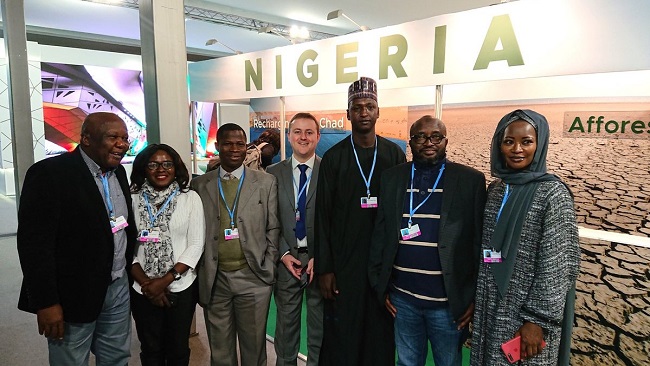
With a base at the lively country pavilion, members of the Nigerian delegation have been quite active at the UN Climate Change Conference (COP24) in Katowice, Poland.

They comprise civil society players, negotiators, business officials, government functionaries and media practitioners.

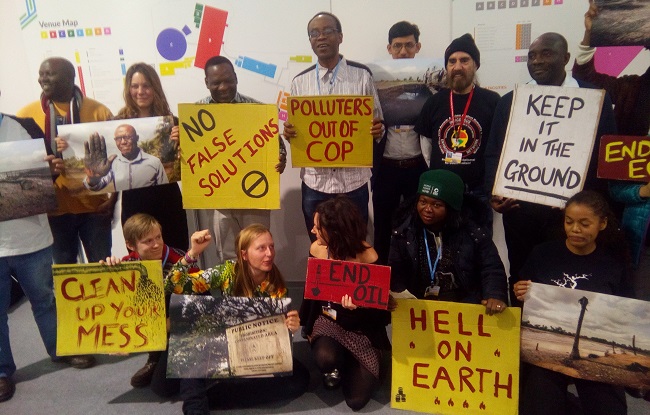
Shell action
The activists confronting Shell at the COP: Three Nigerians – Nnimmo Bassey, Gowin Ojo and Rita Uwaka are part of the action
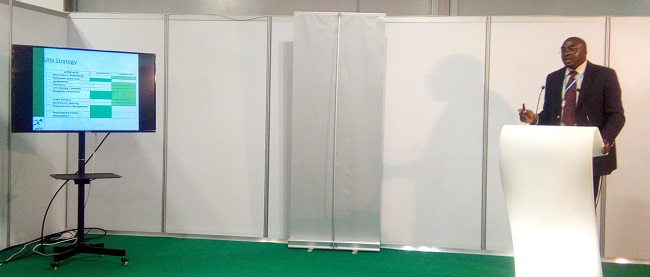
Dr Onoja Joseph
Dr Onoja Joseph of the Nigerian Conservation Foundation (NCF) making a presentation at the Nigeria Pavilion on Wednesday, December 12
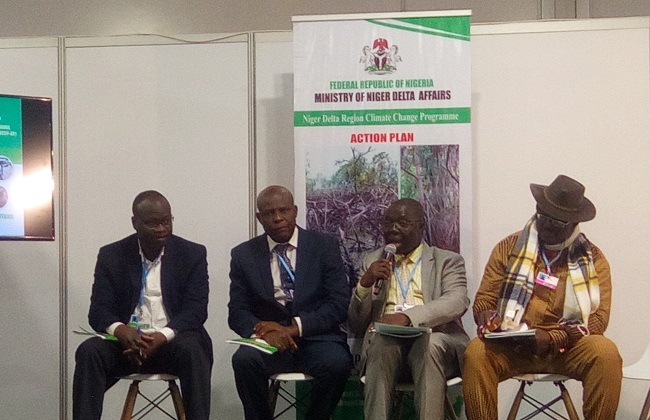
Niger Delta COP24
A panel discussion session during a side event organised by the Ministry of Niger Delta Affairs featuring, among others, Dr Samuel Adejuwon and Senator Foster Ogola
Niger Delta Climate Action Plan
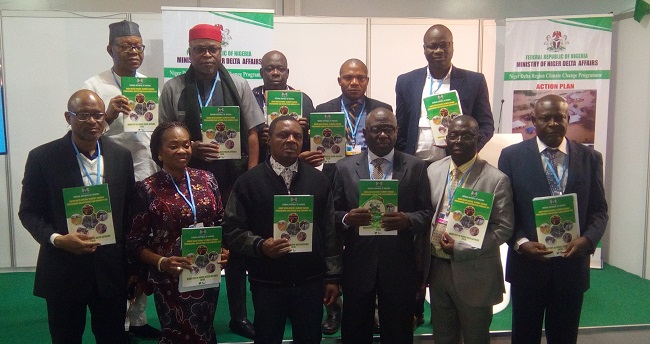
Formal presentation of the “Niger Delta Region Climate Change Programme and Action Plan (NDRCCP-AP) at COP24 on Wednesday, December 12
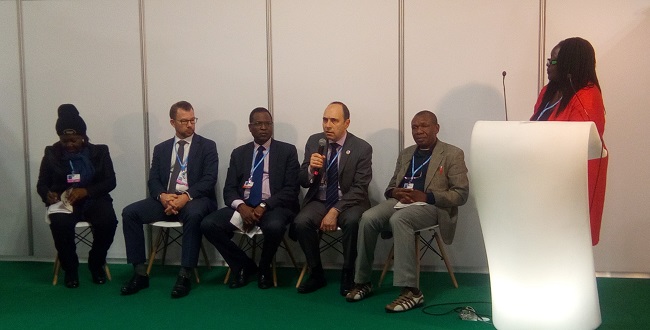
Nigeria REDD+ Programme
A panel discussion segment during a side event organised by the Nigeria REDD+ Programme
Nigeria REDD+ Programme
Participants at the close of the Nigeria REDD+ Programme side event
UK-Nigeria Climate Finance Accelerator
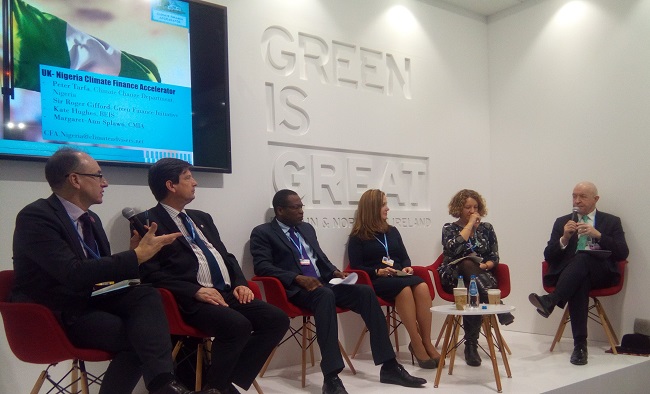
Dr Peter Tarfa as a panelist during a panel session on “UK-Nigeria Climate Finance Accelerator” on Tuesday, December 11


Huzi Mshelia
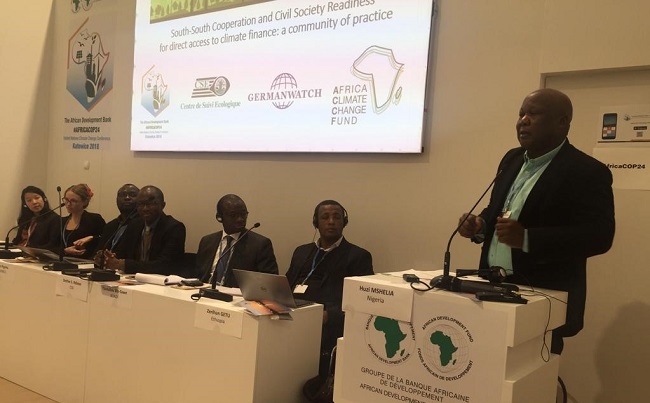
Huzi Mshelia making a presentation during a session organised by the African Development Bank (AfDB)

How pavilion impacted Nigeria’s performance at COP24

0

The Nigerian pavilion at COP24 has positively impacted Nigeria’s image and performance at the ongoing UN climate change summit in Katowice, Poland.

COP24 Pavilion
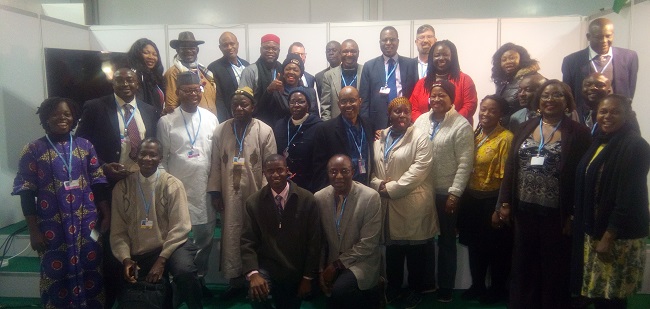
Some members of the Nigerian delegation beside the pavilion

Director, Department of Climate Change in the Federal Ministry of Environment, Dr Peter Tarfa, who made the submission on Wednesday, December 12, 2018, said the facility gave the nation the stage to show the world what it has been doing in terms of climate action.

“It has impacted our performance at the COP24 in Katowice very, very positively because it has given us a platform to come a showcase what we have been doing back home,” he said, adding that Mr President even visited the place and expressed his approval and commendation.

“There was never a time that any president of Nigeria since the start of the COPs ever visited the Nigerian pavilion. But President Muhammadu Buhari made history when he did so last week. He came here. He looked at all the signs here especially the ‘Deforestation’ sign and asked: ‘Do we still have forests?’ It shows how passionate he is towards issues related to the environment and climate change,” said Dr Tarfa.

The pavilion has in COP24 played host to several programmes organised by organisations such as the Federal Ministry of Environment (NEWMAP: Supporting Nigeria’s climate change response agenda and the Paris Agreement), Nigeria National Petroleum Corporation (Addressing climate change in the Nigerian oil & gas sector), Federal Ministry of Water Resources (Outcomes of international conference on Lake Chad), Anambra State Government (Mainstreaming climate disaster loss and damage solutions to sustainable development in Anambra State of Nigeria), Ministry of Niger Delta Affairs (Addressing the environmental and climate change impacts in the Niger Delta Region of Nigeria), National Green Campus Initiative, Climate and Clean Air Coalition(Nigeria national action to reduce short-lived climate pollutants: Delivering multiple benefits for clean air and climate), Women Environmental Programme (Using climate change capacity building to transform community people’s behavioral and adoption of climate smart practices), Green Bonds (Green Bonds: Making Articles 2 and 6 a reality), Kaduna State Government (Building resilience against climate-induced displacement) and the Nigeria Meteorological Agency (NiMet at a glance: Synopsis on climate change mitigation and adaptation strategies in Nigeria).

Others include Global Eco Strategies Limited (Blockchain technology financing for clean energy Nigeria), OSSAP-SDGs, United Nations Development Programme *Achieving the SDGs through climate action), National Assembly (Role of the Nigerian Parliament in the implementation of the Paris Agreement), Nigeria Incentive-Based Risk Sharing System for Agricultural Lending (De-risking and catalysing finance and investments across climate smart agricultural value chains), Federal Capital Territory Authority (Resilient infrastructure development in FCT: Key to enhancing Nigeria’s NDC implementation), Nigerian Conservation Foundation (Delivering national climate action and sustainable development goals through re-greening Nigeria), African Centre for Agriculture and Social Inclusion (Smallholder youths and gender action in climate change impact – Jigawa State of Nigeria in view), Nigeria REDD+ Programme (Developing a finance strategy for incentivising and implementing REDD+ activities, and opportunities for public-private partnerships), Infintum Global Projects (Catalysing carbon neutral and carbon negative through infrastructural development in developing nations), and Ecologistics Integrated Services Limited (National preparation for conference of parties for developing nations).

COP24: It’s within our grasp to finish job – Espinosa

0

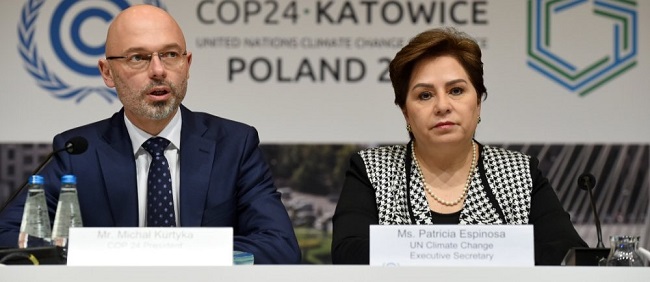
The second part of the high-level segment of the UN Climate Change Conference COP24 resumed on Tuesday, December 11, 2018 with the UN’s Climate Chief, Patricia Espinosa, and other top UN officials making passionate pleas to governments to finish the work they set for themselves and conclude the conference with a strong and effective outcome.

Patricia Espinosa
Patricia Espinosa, Executive Secretary of the UNFCCC (right), with Michał Kurtyka, President of COP24

The main objective of the conference is to finalise the implementation guidelines of the Paris Agreement.

With more than 100 ministers now in Katowice to provide political guidance, and with only a few days left to go, Ms. Espinosa said: “Many political divisions remain. Many issues still must be overcome. But I believe it’s within our grasp to finish the job. Let’s complete the Paris Agreement Work Programme and, by doing so, immediately unleash the power of the Paris Agreement itself.”

Ahead of COP24, the UN’s Intergovernmental Panel on Climate Change (IPCC) issued a special report on the achievability and implications of a 1.5°Celsius global average temperature rise compared to pre-industrial levels, the lower temperature goal of the Paris Agreement on Climate Change.

In Katowice, Hoesung Lee, Chair of the IPCC, reiterated the key findings of the report, namely that the temperature goal is achievable, but that this can only happen if there if governments take urgent and far-reaching action in all aspects of society, with many implications for policy-making.

“Every bit of warming matters. Every year matters. Every choice matters.  With this report, the scientific message is clear. It is now up to you, the governments, to act,” he said.

Mr. Petteri Taalas, Secretary-General of the World Meteorological Organisation, also addressed ministers and delegates. He warned that current levels of greenhouse gas emissions were unsustainable and were already leading to dramatic climate change impacts around the world, from the melting of Artic ice to many incidents of fires flooding this fear.

“We are expecting a 2 to 4 percent increase in global carbon dioxide emissions this year. If we are serious about the Paris Agreement, we need to see different numbers.”

He also pointed out that even if pollution of the atmosphere is stopped today, the current levels of CO2 would stay in the atmosphere for many years to come, locking in extreme weather.

At the end of her speech, Ms. Espinosa alluded to the words of Mae Jemison, the first black female astronaut in space, who spoke about traveling to space and exploring the unknown.

“What struck her most was looking back at Planet Earth and seeing not just the beauty of our planet, but the thinness and fragility of the atmosphere surrounding it—the thin blue line protecting all life on Earth. That’s what we’re fighting for. That’s what we’re here to protect: That thin blue line of life. That thin blue line of hope.”

COP24: WEP, Solidaridad, others unveil ‘smart’ initiatives

0

The Women Environmental Programme (WEP), Solidaridad Network Organisation, Alex Ekwueme Federal University Ndufu-Alike (AE-FUNAI) and Climate and Sustainable Development Network (CSDevNet) at the ongoing 24th Session of the Conference of Parties (COP24) to the United Nations Framework Convention on Climate Change (UNFCCC) holding in Katowice, Poland, presented smart projects and practices that can contribute towards achieving the Nationally Determined Contributions (NDCs) commitments and the Paris Agreement in West Africa.

WEP Solidaridad
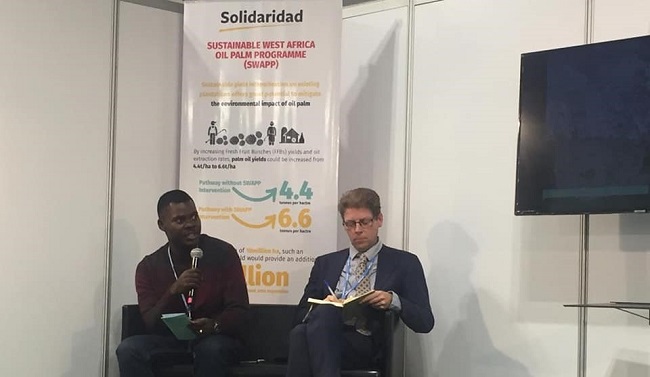
John Baaki of WEP (left) and Jan Maarten Dros of Solidaridad during the side event at Nigerian Pavilion at COP24

The smart projects and practices were presented at a side event the organisations collaboratively hosted at the Nigerian Pavilion at COP24 on December 6, 2018.

Welcoming participants to the event and declaring the event open, the Director, Department of Climate Change, Federal Ministry of Environment, Nigeria, Dr. Peter Tarfa, appreciated the collaboration of the organisations as he stated that this is needed to find a collective solution to climate change challenges.

Speaking on the collaboration, Atâyi Babs, National Network Coordinator of CSDevNet who moderated the event, described the COP24 side event as one of the quick wins recorded by the National Civil Society Framework on Paris Agreement and SDGs, recently launched by the network in Nigeria.

“The Framework which comprises a broad spectrum of Nigerian CSOs was established to enhance Nigerian Civil Society participation in post-Paris Agreement activities, amplify voices of vulnerable people and ensure that the recognised role of CSOs within the provisions of the Paris Agreement is at the centre-stage of the implementation in Nigeria and today’s event is a shining example in that regard,” Atâyi said.

The organisations took turns to present their smart projects and practices that they have implemented.

Mr John Baaki, WEP’s Programme Manager, presented the following projects and practices by the organisation:

  • Trees planting project involving 2,000 trees across the FCT as well as Benue, Kano and Katsina states with support from Trees for Cities. This project, WEP said, would help to remove greenhouse gases from the atmosphere, prevent land degradation and provide a source of income for communities where the project has been implemented.
  • Solar dryer tent: WEP also constructed a solar dryer tent for the farmers of Adogo, a community in Nigeria’s Mbaya district of Buruku Local Government, Benue State where sun drying was the only way to preserve produce as local women would lay fruits and vegetables on the ground to dehydrate them for future use. Sun-drying is unfortunately time-consuming and weather dependent and exposes food to contaminants like dust and insects. With the construction of solar dryer tent in the community, drying becomes faster, more hygienic and post-harvest losses would be reduced.
  • WEP also presented initiatives that advocate for the implementation of the Gender Action Plan of the UNFCCC in Nigeria as well as the initiative that trains women to upcycle waste plastic bags into shoes and other products.

Solidaridad on the other hand presented her “National Initiatives for Sustainable Climate-Smart Oil Palm Smallholders – NI-SCOPS” project, sharing experiences from Asia and Africa. Jan Maarten Dros, Climate Innovation Manager at Solidaridad, led the discussion on behalf of Solidaridad Network on effective approaches for implementing the project NI-SCOPS in Asia and Africa.

Dr. Samson Samuel Ogallah, who is the Senior Climate Specialist at Solidaridad, added that the NISCOPS project with the support from the Dutch Government focused on four countries in Asia and Africa. The countries include Ghana, Nigeria, Malaysia and Indonesia. Dr. Ogallah added that the project will contribute the countries’ efforts at addressing the impacts of climate change, achieving their NDC commitment under the Paris Agreement and the Sustainable Development Goals.

The Regional Director for Solidaridad West Africa, Isaac Gyamfi, during one of the COP24 events, also highlighted some of the milestone achieved so far in the region. These include supporting smallholder producers to increase their productivity and improved livelihood, facilitating market opportunities for farmers, credit and input access for small and medium scale enterprise farmers and stimulating public-private partnerships while ensuring continual improvement for sustainable climate smart production systems.

AE-FUNAI also shared experiences of her initiatives of greening the university through tree planting.

According to the organisers, the aim of sharing the smart projects and practices is so that they can be replicated by communities to address their climate challenges.

DBSA challenged to distance self from Thabametsi coal plant project

0

A group of activists from different organisations on Tuesday, December 11, 2018 took to the streets outside the Westin Hotel in Cape Town where the South African Energy Week is taking place to protest the DBSA’s plans to fund the Thabametsi coal plant in Lephalale.

Ahmed Mokgopo
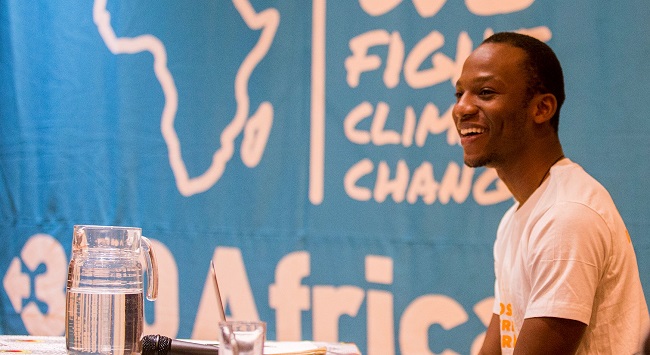
350Africa.org divestment campaigner, Ahmed Mokgopo. Photo credit: Jennifer Bruce/350Africa

Plans for the Thabametsi plant and for new coal development in South Africa are said to be inconsistent with the need to limit global temperature increase to below 1.5°C, as confirmed by the latest IPCC report. The study clarifies that limiting the rise in global temperatures to 1.5°C would be significantly better than breaching the 2°C threshold, supporting calls for a rapid decline in fossil fuel use and a rapid transition to energy systems based on 100% renewable energy.

350Africa.org divestment campaigner, Ahmed Mokgopo, said, “The DBSA has already recognised the opportunity for clean energy which holds true to just and sustainable development. However, their inconsistency in funding renewables and fossil fuels at the same time, overshadows what could see them as leaders in promoting clean energy development for the continent.

“With Energy Week South Africa taking place this week, we encourage the DBSA to commit to 100% renewable energy financing to avoid undermining their ambition to ‘Make Change Happen’. This presents an opportunity for the bank to truly live up to its mandate and align all of its energy lending with South Africa’s commitments to reduce greenhouse gases in accordance with the Paris climate agreement currently being discussed at COP24, in Poland.”

Last week, nine Multinational Development Banks announced a framework “reinforcing their commitment to combat climate change”, signaling a move by financial institutions globally to clean up their investments – an example the DBSA should follow, according to 350Africa.org. It adds that the DBSA has an opportunity to not take the Thabametsi project into consideration and, by doing so, make a clean break from coal.