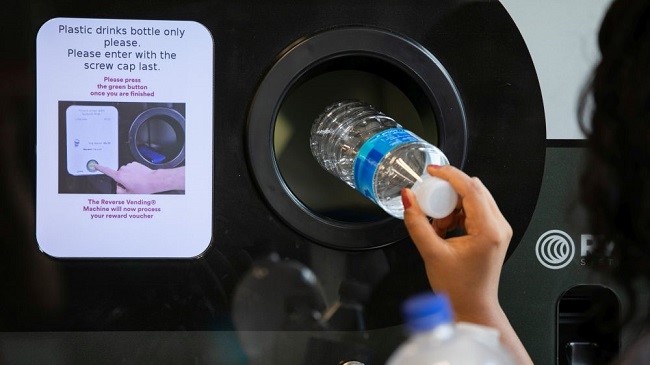
Reverse vending machines, placed in Iceland stores across
the UK, have earned shoppers over £30,000, research reveals.
A reverse vending machine. Photo credit: Greenpeace
The scheme, which awards a 10p voucher for every bottle
returned, has resulted in 311,500 plastic bottles being recycled so far. The
bottles must have been brought in an Iceland store and only bottles up to 3
litres were accepted.
Richard Walker, Iceland’s Managing Director, said: “Iceland
has continually led the way in the fight against the scourge of plastic since
making our announcement to eliminate plastic from our own-label product
packaging. It’s clear from the results that consumers want to tackle the
problem of plastic head on and would be in support of a nationwide scheme.”
Iceland will share the results of the scheme with the government
in an attempt to encourage more supermarkets to introduce reverse vending
machines in their stores.
Other supermarkets, including Tesco, have recently trialled
the machines in a bid to reduce the growing plastic pollution, but no results
have been published.
In March 2018, Michael Gove, Environment Secretary,
announced a consultation to introduce a bottle deposit scheme that will
increase recycling rates and slash the amount of waste polluting our last and
seas.
Presently, UK consumers go through an estimated 13 billion
plastic bottles a year, with more than 3 billion being incinerated, sent to landfill,
or left to pollute our streets, countryside and marine environment.
Will McCallum, Greenpeace UK head of oceans, said: “The
success of Iceland’s reverse vending machine trial demonstrates that deposit
return schemes to boost recycling and tackle plastic pollution are both popular
with consumers, and eminently doable. We hope that other retailers follow suit.
However, we can’t just rely on businesses to tackle the problem of throwaway
plastics; we also need leadership from Government. The Environment Secretary
Michael Gove must deliver on his promise to introduce a deposit return scheme
without delay and ensure that it covers containers of all sizes and
materials.”
This news follows the European Union agreeing on deal for a single-use plastic ban which is set to be put in place in 2019.
A not-for-profit outfit, the Developmental Association for
Renewable Energy (DARE), has began training youths on collecting waste plastics
in Kaduna metropolis, Kaduna State, for recycling.
Green interlocks made from plastic waste
The recycling is aimed at using them for interlocking tiles,
blocks, roofing tiles, and decorating houses, to protect the environment.
Chief Executive Officer of the organisation, Mr Yahaya
Ahmed, said this in an interview with newsmen in Kaduna on Sunday, January 6,
2019.
Ahmed, an engineer, explained that the technology was the
first of its kind in Nigeria and some parts of Africa.
“This tried-and-tested new technique of turning waste
plastic into interlocking tiles, blocks and roofing tiles is a low-cost method
that helps keep plastic wastes out of the environment completely.
“We have been working on the idea for a long time on how to
recycle the waste plastics that are polluting the environment every day.
“We are in contact with our partner organisations in Germany
and United Kingdom, but the real idea comes from Waste AID UK.
“We planned on having them in Nigeria for training our
people, but things are not ready at that time, so they did the training in
Cameroon and told us there are good people in Cameroon that can come to Nigeria
and train other interested persons which is better for us,” he said.
Ahmed pointed out that the waste plastic interlocking tiles
is stronger and everlasting than the normal interlocking blocks that are sold
in the market.
According to him, it will take hundreds of years to
decomposes because the interlocking tiles are constructed with only plastic
waste, adding that there is a market for the product.
He said the association wanted to train many Nigerians in
the new technology to reduce unemployment, fight poverty and reduce idleness
among the youth.
“This will create jobs, reduce street begging as many youths
will engage in it, making them to become self-employed in the future.
“We are targeting training 1,000 unemployed youths including
women and graduates from various institutions across the 36 states of Nigeria.
“We buy the plastics and measure it in kilos and pay in cash to waste collectors/scavengers.
“The waste plastics have detrimental impact on the
community, environment, human health and even on agricultural land hence the
need for our technology to recycle them and help Nigerians transform them into
money.
“We have started training many interested persons, and we
are hoping to see that those that receive the training will also train others
so as to spread the idea and save our environment,” he said.
He said their greatest challenge was how to get government
to be involved in the programme and sustain it.
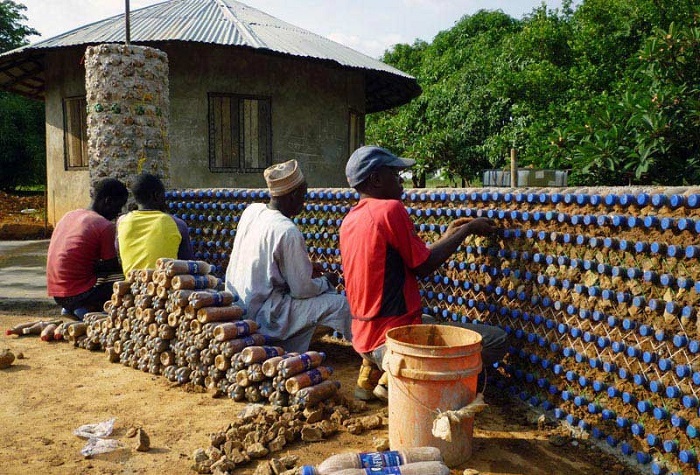
Plastic bottle house under construction in Nigeria
Ahmed was the engineer who constructed the first plastic
bottled house in Africa that could last for over 200 years. The house is
located at Yalwa Village, which is along the Kaduna-Zaria Road.
Responding, Mr Pierre Kamsouloum, the trainer and expert on
recycling plastic from Cameroon, said it was interesting coming to Nigeria to train
young people interested in learning the technology of transforming waste
plastics to something important in the society.
“This idea started 12 years ago in my country Cameroon, in
my town Garoua and, few years later, I joined other organisations to spread the
message which involves travelling from one country to another.
“We are here in Nigeria to teach youths how to collect waste
plastics from the trash centre, transform them into something that is useful
for the construction of houses and other interior decoration.
“I train them on how to collect the waste plastic, wash it
and dry-it before putting it into a big pot for melting while mixing it with
sand that is extracted from the Kaduna River,” he said.
Mallam Ahmed Dala, one of the youths receiving the training,
expressed gratitude and satisfaction with the organisers.
Meanwhile the Assistant Director, African Climate Reporters,
Dr Piman Hoffman, has applauded the efforts of the NGO and the International
Waste Plastic Trainer from Cameroon.
Hoffman said Recycling was important in today’s world if we
wanted to leave the planet for our generations.
“Recycling your waste makes you more responsible in the way
you use and dispose of it. It is evident from studies that people who do this
instinctively cut down on buying unwanted things from the supermarket.
” When we recycle, recyclable materials are reprocessed into
new products, and as a result the amount of rubbish sent for incineration
reduces,” he said.
He then called on Government, NGOs and CSOs to always support the spread of iniatives like this one.
Abuja Environmental Protection Board (AEPB) says it has put
measures in place to ensure dirt-free environment in 2019.
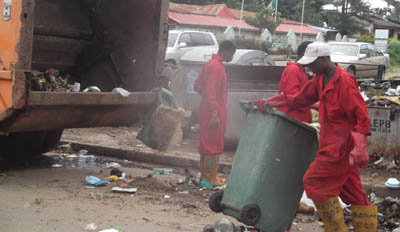
Officials of one of the AEPB waste evacuation contractors, on duty in Garki Area of Abuja
AEPB Head of Information and Outreach Unit, Mallam Muktar
Ibrahim, said this in an interview the News Agency of Nigeria (NAN) in Abuja on
Sunday, January 6, 2019.
Ibrahim said that the measures aimed at ensuring a clean,
hygienic and sustainable environment in the Federal Capital Territory (FCT).
“While wishing all residents of FCT a happy and prosperous
new year 2019, the AEPB is poised more than ever before to ensure a clean,
hygienic and sustainable environment in the FCT.
“To guarantee this, the board has put various measures in
place, including increased monitoring and enforcement activities by AEPB and
constant removal of all sundry nuisances across the city.
“In addition, the board is stepping up its intervention to
deal with any city cleaning contractors who is found wanting.
“This has achieved great results in the sense that they have
been put on their toes as any intervention carried out attracts deductions on
the erring contractor,’’ the information officer said.
He added that the board was working to expand its cleaning
contractors from 27 to 48 in the new contract.
“AEPB solicits the cooperation of residents to cultivate a
civilised attitude towards environmental cleanliness as the board will not
spare any one found to be working in cross purposes to AEPB mandates.
“We put strategies in place to ensure that the usual post
yuletide waste littered have been evacuated and reduced to the barest minimum.
“City cleaning contractors have been mobilised at short
notice to any area of perceived nuisances if there is a complaint from
concerned parties,’’ he said.
Ibrahim advised all residents to maintain environmental
cleanliness to achieve the FCTA’s vision of making Abuja one of the first-class
cities of the world.
According to him, AEPB advises all residents to ensure
proper disposal of waste through proper bagging.
“Residents should provide proper waste bins with lids for
waste collection and avoid throwing of waste out of vehicles.
“They should pay waste service charges to AEPB dedicated
revenue accounts displayed on the service bills and avoid any form of cash
payments which is recipe for fraud.
“They should also ensure proper connection of their properties
to AEPB managed central sewer lines and desist from patronising street
hawkers,’’ he said.
Ibrahim urged residents to report suspicious
persons/activities to the relevant agencies, including scavengers who have been
banned from operating within the city.
“They should fight against open defecation and avoid bush
burning to protect the environment.
“Residents are also advised to report all forms of
environmental pollution to the board for prompt attention.
`These include noise, air and water pollution from
loudspeakers, grinding machines which may result from using residential places
for commercial purposes,’’ Ibrahim said.
According to him, other forms of waste include burning of
hazardous materials that release poisonous fumes into the atmosphere.
He said that the board had rehabilitated several dilapidated
Roro bins to increase the number of available receptacles for waste collection
and minimise litter around waste collection points.
“In addition, AEPB has engaged an additional 300 enforcement
staff to boost its compliance mechanism.
`The FCT Administration has also regularised the employment
of 300 staff, cutting across the relevant departments of the board, especially
the Environmental Health and Safety.
“This will enhance the board’s capacity in inspecting
premises to check sundry nuisances,’’ he said.
A rainy spell early on Sunday, January 6, 2019 brought
better air to residents of New Delhi, giving them a brief respite from thick
grey smog that has shrouded the Indian capital for the last two months,
although air quality continued to be “very poor”.
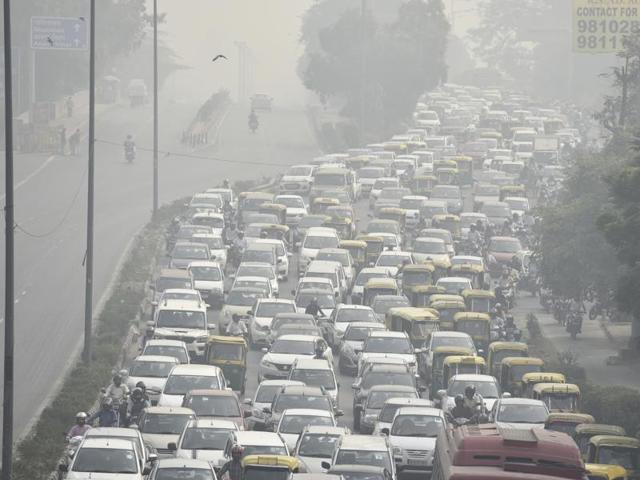
As Delhi’s pollution levels rise to severe, the EPCA has directed governments to impose all conditions under the Graded Response Action Plan under severe category
A measure of tiny, hazardous breathable particles known as
PM 2.5 reached an average of 182 by 12 p.m., the Central Pollution Control
Board said, its lowest since Nov. 4.
But pollution was still five times more than a U.S.
government recommended level of 35 to stand at “unhealthy” levels, according to
the U.S. embassy.
“Change in weather conditions by rain or higher wind speed
helps dissipate peak pollution, but we continue to need strong emergency
actions such as shutting power plants,” said Anumita Roychowdhury of the Centre
for Science and Environment think-tank.
The Federal Government air quality index rated Delhi’s air
quality “very poor” on Sunday and had a similar forecast for Monday.
It urged people with respiratory and cardiac problems to
avoid polluted areas and limit outdoor movement.
A sharp drop in temperatures and wind speed over the last
two weeks, combined with vehicle and industrial emissions, dust from building
sites and smoke from garbage burning has stoked pollution over much of north
India.
Levels of PM 2.5, or particles smaller than 2.5 microns in
diameter, hit their highest last year at 450 on Dec. 23, 2018.
Despite the pollution, there is little sign Delhi’s 20
million residents are taking steps to protect themselves.
Activists say the apparent lack of concern gives politicians
the cover they need for not tackling the issue adequately.
The world appears to have taken an important step on the
road to drastically reduce the production and consumption of powerful greenhouse
gasses (GHGs) known as hydrofluorocarbons (HFCs) and limit global warming, with
the Kigali Amendment to the Montreal Protocol on Substances that Deplete the
Ozone Layer coming into force on Tuesday, January 1, 2019.
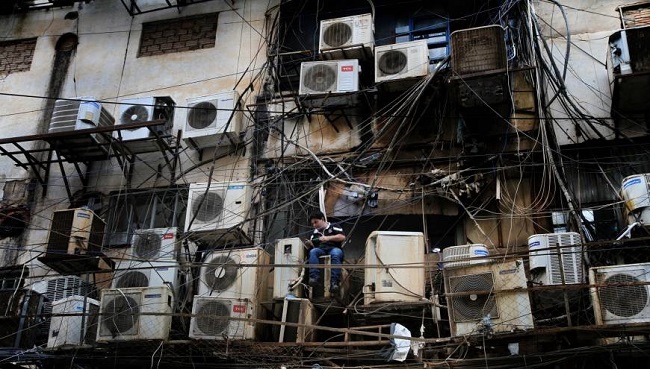
HFCs are described as the world’s fastest-growing climate pollutant and are used in air conditioners and refrigerators. Photo credit: Getty Images
If fully supported by governments, the private sector and
citizens, the Kigali Amendment will avoid up to 0.4°C of global warming this
century while continuing to protect the ozone layer, according to the UN Environment.
The body adds that the amendment will substantively contribute to the goals of
the Paris Agreement.
HFCs are organic compounds that contain fluorine and
hydrogen atoms, and are frequently used as refrigerants in air conditioners and
other devices as alternatives to ozone-depleting substances controlled under
the Montreal Protocol. While HFCs themselves do not deplete the ozone layer,
they are said to be extremely potent GHGs with global warming potentials that
can be many times higher than carbon dioxide.
The parties to the amendment have put in place practical
arrangements for its implementation, including agreements on technologies for
the destruction of HFCs and new data reporting requirements and tools. The
amendment comes with provisions for capacity-building for developing countries,
institutional strengthening and the development of national strategies to
reduce HFCs and replace them with alternatives. Phasing down HFCs under
the Kigali Amendment may also open a window to redesign cooling equipment that
is more energy efficient, further increasing the climate gains.
Implementation of new targets set out in the amendment will
be done in three phases, with a group of developed countries starting HFCs
phase-down from 2019. Developing countries will follow with a freeze of
HFCs consumption levels in 2024 and with a few countries freezing consumption
in 2028.
Ratified by 65 countries so far, the Kigali Amendment builds
on the historic legacy of the Montreal Protocol agreed in 1987. The Protocol
and its previous amendments, which require the phasing out of the production
and consumption of substances that cause ozone depletion, have been universally
ratified by 197 parties.
The broad support for and implementation of the Montreal
Protocol has led to the phase-out of more than 99 per cent of nearly 100
ozone-depleting chemicals and significantly contributed to climate change mitigation.
Evidence presented in the latest Scientific
Assessment of Ozone Depletion shows that the ozone layer in parts of
the stratosphere has recovered at a rate of 1-3% per decade since 2000. At
projected rates, Northern Hemisphere and mid-latitude ozone is scheduled to
heal completely by the 2030s followed by the Southern Hemisphere in the 2050s
and polar regions by 2060.
The United Nations High Commissioner for Refugees (UNHCR) on
Friday, January 4, 2019 said its first five solar-powered safe water systems at
Cox’s Bazar refugee settlements in Bangladesh are delivering at their full
capacity with the aim to supply all refugees this way.
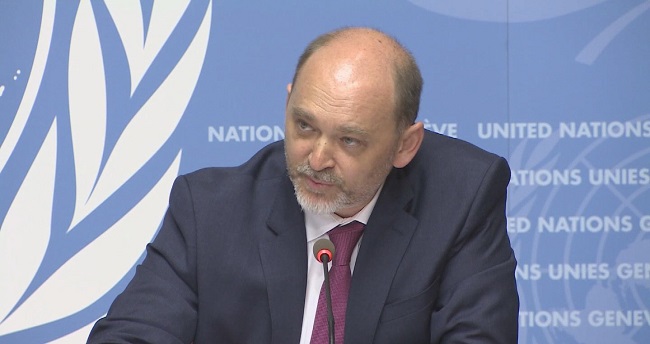
UNHCR spokesperson, Andrej Mahecic
“These new systems improve the daily supply of safe, clean
drinking water to Rohingya refugees living in crowded sites in Southeast
Bangladesh,’’ UNHCR spokesperson Andrej Mahecic said at a UN briefing.
The project, funded by the UN agency, is part of a broader
shift in the humanitarian response toward the expanded use of green and
non-polluting technologies.
“The new safe water systems run entirely on electricity
generated through solar panels,’’ the spokesperson said, adding that UNHCR aims
to provide 20 litres of safe and clean water to each refugee daily.
Report says over 900,000 Rohingya refugees live across 36
different locations in Cox’s Bazar area.
Using solar energy has allowed the humanitarian community to
reduce energy costs and emissions.
The five new water networks, jointly completed by UNHCR and
its partners, are currently providing safe water to no fewer than 40,000
refugees.
A further 55,000 refugees will benefit as UNHCR
and its partner agencies are hoping to install nine more solar-powered water
networks across Kutapalong refugee camp in the coming year, at the cost of $10
million.
The World Health Organisation (WHO) on Friday, January 4,
2019 said there are now more than 600 confirmed or probable cases of Ebola in
Congo.
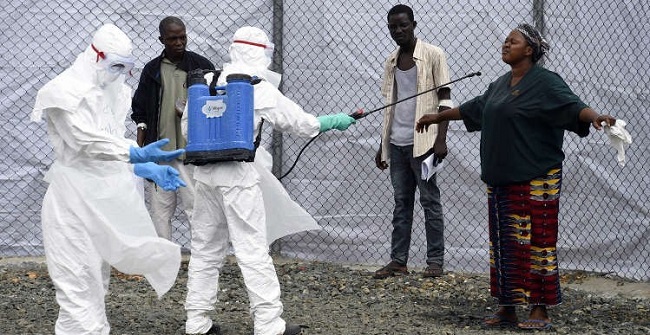
Health workers move to prevent Ebola spread
Most of the new cases occurred in cities and urban areas in
Eastern North Kivu province, where an Ebola outbreak was declared in August
2018.
Numerous militia groups are fighting for control over the
country’s rich natural resources in the province, hampering efforts to combat
the epidemic in the impoverished nation.
“Mass protests that erupted in recent days over a delay in
Congo’s presidential elections have also frustrated the work of aid officials.
“A hospital was attacked in city of Beni, for example, which
resulted in fewer Ebola vaccines being handed out,’’ the WHO said.
The health agency added that a further deterioration in
security would undermine the fight against the life-threatening haemorrhagic
fever.
“According to the latest figures, 560 cases of Ebola have
been confirmed and 48 other cases are considered likely.
“This Ebola outbreak is the second-worst ever recorded,’’
the WHO said.
An Ebola outbreak ravaging Eastern areas of the Democratic
Republic of Congo has claimed several hundred lives.
The Federal Government says it will reclaim all land lost to
gully erosion and assist flood-prone communities in the country.
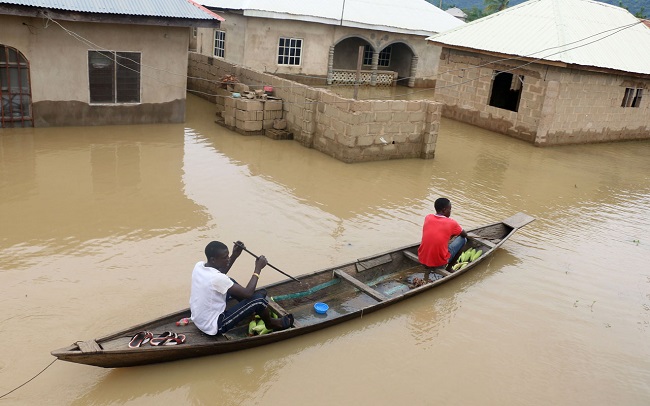
Residents steer a dugout canoe past flooded houses following heavy rain in the Nigerian town of Lokoja, in Kogi State, on September 14, 2018. Photo credit: AFP / Sodiq Adelakun
The information is in a statement issued by Mr AbdulGaniyu
Aminu, the Head of Public Relations, Federal Ministry of Science and Technology
(FMST).
Aminu stated that the Minister of Science and Technology, Dr
Obgonnaya Onu, made the disclosure at the launch of gully erosion control works
at Okwohia, Obowo/Ihitte Uboma Local Government Area of Imo on Thursday.
He quoted the minister as saying that the intervention of
Federal Government would usher a huge relief to the Okwohia community which had
for long been devastated by ecological challenges.
Onu said “the approval of the project is a clear testimony
to the present administration’s resolve to ensure that no part of the country will
be allowed to suffer any neglect due to geographical location.
“To further consolidate on the gains of this stride, the
Federal Government’s execution of projects across the country also demonstrates
the sincerity of purpose of APC-led administration toward promoting equity and
fair play to all and sundry.”
According to him, the project will improve the standard of
living of the community and its environs.
He added that the project would at the same time reduce the
danger posed to lives and property associated with erosion and persistent
flooding experienced in recent times.
He affirmed that Federal Government would continue to
implement genuine government policies, agreements and contracts at both
national and international levels that were aimed at laying solid foundation for
virile and prosperous nation.
The Permanent Secretary, Ecological fund Office, Dr Habiba
Lawal, said that the project was initiated through a request for an urgent
intervention forwarded to the Ecological Fund Office.
She explained that the request was forwarded by Sen.
Benjamin Uwajumobi representing the Imo North District at the upper chamber of
the National Assembly.
Lawal, who was represented by Mr Mathias Eluma, said that
the launch and hand over of the project to the benefiting community would enable
the people to take over and ensure its maintenance and sustainability.
The FADAMA III Project in Jigawa says it has given various farm inputs to no fewer than 15,000 farmers in the state in 2018.
Minister of Agriculture and Rural Development, Chief Audu Ogbeh
Alhaji Aminu Isa, the Project Coordinator in the state,
disclosed this to newsmen in Dutse, the capital city, on Friday, January 4,
2019.
He said the beneficiaries consisted of 14,287 males and 713
females that produced rice and sorghum.
“Some 232 production clusters were registered under the project
with 163 as rice production clusters and 397 sorghum production clusters.
“The clusters consisted of 1,500 production groups with
1,103 as rice production groups and 397 sorghum production groups.
“1,500 business plans, with 1,103 for rice production and
397 for sorghum production, were developed by 232 production clusters with 163
for rice production clusters and 69 for sorghum production clusters.
“Of the 1,500 business plans, 1,137 business plans representing
75.8 per cent were approved and fully implemented with 787 for rice and 350 for
sorghum,’’ Isa said.
He said that the farmers were supported with 38,500 kg of
rice seeds, 105,000 kg of sorghum seeds and 1,760,000 kg of assorted
fertilisers.
“68,670 litres of Agro-chemicals were given to both rice and
sorghum production groups; 3,655 water pumps and 3,393 sprayers were also
provided.
“680 tube wells and 6,466 wash bores were drilled,’’ the
project coordinator disclosed.
According to him, 44 rice milling machines were given to 16
production groups, 48 bags of paddy rice were distributed to women and youth
agro-processing groups as starter for operations.
Isa added that 19 tricycles, 17 power tillers were also
given to nine youth groups and 25 sorghum milling machines were given to
production groups, which comprised seven women and five youth groups.
According to Isa, 61 thrasher machines were given to 50
production clusters and six production groups, comprising four youth and two
women groups.
“548 smart farmers were used to train the beneficiaries on
improved agricultural practices.
“Also, 480 Personal Protective Equipment (PPE) were given to
125 rice production clusters, 68 sorghum production clusters and 47 processing
groups,’’ the coordinator said.
Isa said that when compared with the 2017 yields, the farm
input support led to a noticeable increase in yield level.
The war against malaria has been on for long, but still
seems far from ending as malaria remains endemic and life-threatening in
developing countries including Nigeria.
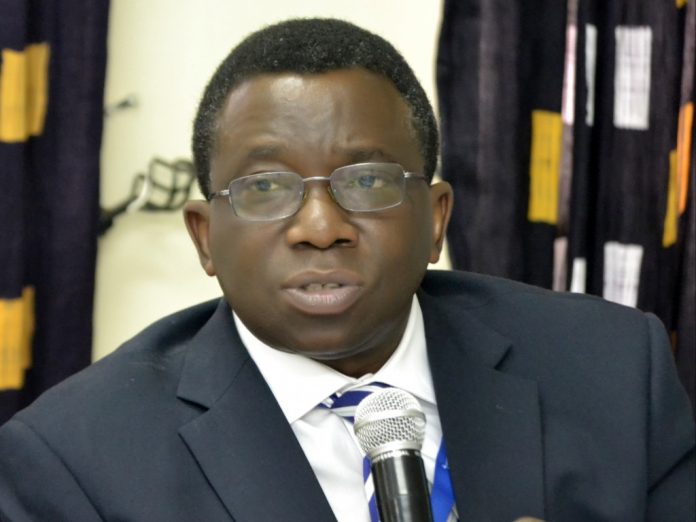
Minister of Health, Isaac Adewole
Medical experts blame malaria prevalence on several factors including inadequate funds, drug counterfeiting, malaria resistance to drugs, mosquito’s resistance to insecticides and global warming.
Analysts also identified dearth of research into malaria
cure, as a major factor.
Mr Chukwu Okoronkwo, Head, Advocacy, Communication and Social
Mobilisation, National Malaria Elimination Programme, Federal Ministry of
Health, is worried that although some donor-agencies have strongly supported
malaria elimination, Nigeria still has huge gaps.
“Quite a lot of donor-partners are supporting malaria elimination
in the country, but we still have huge gaps, which is why malaria is still
endemic in Nigeria.
“We are appealing to more donor-agencies to come in;
governments should also increase their funding for malaria elimination,’’
Okoronkwo says.
According to the World Malaria Report 2017, Nigeria
contributes 27 per cent of the global 216 million malaria cases and 24 per cent
of the 445,000 deaths due to malaria annually.
This means that about three of 10 persons suffering malaria
in the world live in Nigeria, while one of four deaths from malaria globally
occurs in Nigeria.
According to analysts, Nigeria’s annual record of over 54
million malaria cases in the last three years gives room for concern and the
need for wider research to find innovative ways to reduce the burden.
The 2015 National Malaria Indicator Survey shows that the
North West has 37 per cent prevalence rate, North Central 32 per cent, North
East 26 per cent, South South 19 per cent, South West 17 per cent, and South
East 14 per cent.
The World Health Organisation believes that advanced
research efforts, sustained financing and political will are among major
strategies that can be applied to win the war against malaria.
Dr Sam Awolola, Deputy Director and Head, Malaria Research
Programme, Nigeria Institute of Medical Research (NIMR), is of the opinion that
contributions of African governments to malaria research funding is low
compared with the burden of the disease.
“Today, Africa still harbours the burden of the disease.
Yet, funding for malaria research is donor-dependent.
“The statistics of funding malaria research by African
governments is precarious and the Nigerian situation is pathetic.
“An assessment of funding malaria at NIMR from 2007 to 2016
shows shocking statistics with above 80 per cent provided through external
support, while Nigerian Government through the Federal Ministry of Health
offered less than seven per cent.
“If we ignore the responsibilities of today, we cannot elude
the challenges of tomorrow,” he warns.
Awolola notes that despite the low funding, malaria has been
a topical issue for some Nigerian researchers, some of whom, he said have made
some impacts.
An epidemiologist from the University of Ibadan, Prof.
Ikeoluwapo Ajayi, who carried out a research in collaboration with two others
on “Improving Home and Community Management of Malaria: Providing the Evidence
Base,’’ says findings from the research show that non-medical people can handle
community and home management of malaria in children, if well selected and trained.
“We were able to get to the community and reach out to
mothers, the caregivers, who would usually do something when their children are
sick.
“We were able to understand their practices and perception
of illness.
“We were able to engage them in getting to know early
symptoms of malaria, what to do when a child has fever and the right drug and
dose to give to such a child.
“One unique thing is that we actually trained some members
of a community chosen by the community to take up the management of these
children whenever they fall ill with malaria fever,’’ he says.
Ajayi, a Public Health Consultant, carried out the research in
collaboration with Prof. Bidemi Yusuf, a Medical Statistician, and Prof.
Ayodele Jegede, Health Scientist, both also from the University of Ibadan.
He says engaging such non-medical people will reduce delay
in taking children to hospitals as well as reduce cases of severe malaria,
while those with uncomplicated malaria will get treated.
“The community medicine distributors we trained even went on
to diagnose malaria using the Rapid Diagnostic Test, which many people think
that lay people should not be allowed to use or may not be able to use.
“We have been able to prove that if lay people who are well
selected and trained are given the opportunity, they can actually perform this
role.’’
According to Ajayi, performing this function at the
community level does not mean that the selected and trained community members
are taking up the job of health workers.
“They are just complementing the work of the health
workforce for our children not to die at home as a result of delayed treatment
or not having money.
“This is because throughout the programme, the drugs were
given free or at a subsidised rate.
“The research was done in the South West, and we have handed
over our findings to the National Malaria Elimination Programme.
“We believe that they will make use of the findings to scale
up community and home management of malaria in children in Nigeria and reduce
morbidity and mortality from malaria,” Ajayi says.
Prof. Olugbenga Mokuolu of the University of Ilorin notes
that there is the need for better understanding of what is responsible for
malaria resistance to the currently recommended Artemisinin compounds.
Mokuolu conducted a research on “Multifaceted Efforts at
Malaria Control in Research: Management of Malaria of Various Grades and
Mapping Artemisinin Resistance’’.
He is optimistic that his submission made impressive
contributions in the area of management of severe malaria and monitoring of
molecular markers of Artemisinin resistance.
According to him, detection of molecular markers of
resistance to any chemotherapeutic drug provides the earliest evidence of
emerging resistance before manifestation of clinical failure.
The consultant paediatrician and malaria treatment expert is
convinced that the understanding is essential since efforts in malaria
treatment will be wasted if resistance is not curtailed.
“Though the current malaria statistics are scary, they have
reduced significantly from where we used to be.
“Therefore, we must not allow resistance to make us to lose
our previous gains; that is why it is important to have a mapping of
Artemisinin resistance that can help us to continue to curtail the spread and
reverse any adverse action stemming from that,’’ he says.
For Dr Chukwuma Agubata, a pharmacist and lecturer,
ineffective drug delivery is a major hindrance to malaria treatment.
Agubata, who teaches in the Faculty of Pharmaceutical
Sciences, University of Nigeria, Nsukka, developed novel lipid microparticles
for effective delivery of Artemether anti-malarial drug, using (ogbono) a
locally-sourced irvingia fat from the nuts of Irvingia gabonensis var excelsa
grown in Nigeria.
He conducted a research on ‘`Novel Lipid Microparticles for
Effective Delivery of Artemether Anti-Malaria Drug Using a Locally-Sourced
Irvingia Fat from Nuts of Irvingia
Gabonensis Var Excelsa (Ogbono).
Agubata believes his work demonstrates productive scientific
research by identifying the potency of the use of “ogbono” oil to ensure well
absorption of antimalaria drugs.
He says good absorption will lead to high blood levels which
in turn will increase cure rates and reduce the chances of resistance.
“Malaria is an endemic disease and a major cause of
morbidity and mortality; we also know that most malaria drugs are administered
by mouth – the Artemether Anti-Malaria drugs.
“But there is a major challenge which is the low water
solubility of the drug which limits it dissolution and absorption into the
blood stream; this affects the efficacy of the drug.
“What we have done in this research is to improve the
anti-malaria efficacy of Artemether drugs by formulating with Irvingia Fat
(Ogbono) which is locally-sourced so that there can be improved delivery and
efficacy.
“In our research, we got very good results, and this shows
that our local materials can actually improve the efficacy of some drugs that
already exist,’’ he argues.
The researcher explains that the Ogbono was formulated as
micro particles, where the fat from it was used to trap the drug so that it
becomes a carrier of the drug to the blood stream.
“So, if you take Ogbono soup while taking Artemether, there
should be an improvement as it will assist the drug to pass through all the
barriers to get to its destination in the body and start working properly.’’
Agubata calls for support from governments and private
organisations to take the research to the next level.
“We intend to take this research to the next level with the
support of corporate organisations and governments.
“We will be able to do local mobilisation and mass produce
the locally-sourced materials so that Nigerians will benefit.
“There is hope in reducing the burden of malaria with this
research,’’ he says.
Analysts urge scaling up of research into malaria cure to
get Nigeria to the next level in its fight against the scourge.