The Lagos State Government says it has approved transformation of the Obalende bus stop into a modern bus transport hub, sponsored by MTN as a Corporate Social Responsibility (CSR).
This is disclosed in a statement by the Commissioner for the Environment and Water Resources, Lagos State, Mr. Tokunbo Wahab.
He said the transformation would affect the Obalende loop, underbridge and adjoining lay-by, ensuring a fit into the Lagos state Mega-City.
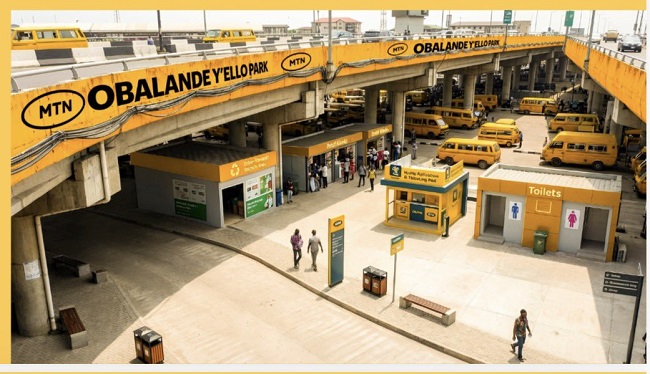
An impression of the Obalende Y’ELLO Bus Park
“Gov. Babajide Sanwo-Olu has approved transformation of the Obalende bus stop into a modern bus transport hub.
“This will transform the Obalende loop, underbridge and adjoining lay-by, ensuring a fit into the Lagos state Mega-City.
“The project will be fully sponsored by MTN as a CSR contribution to the development of Lagos State,” he said.
Wahab added that the proposed transformation on which work would soon start, will include organised and regulated bus operations as well as well-labelled location signage.
“The hub to be named Y’ELLO Bus Park will feature installation of solar panels to support long-term energy efficiency and reduce carbon footprint,” he said.
He added that the new transport hub would have provisions for a recyclables drop-off station to promote waste management and recycling.
“Tree planting is also planned to improve air quality and enhance the visual appeal of the environment.
“Also to be included are road camps for LAWMA Sweepers and Security Agencies including KAI and Neighbourhood Agency,” he said.
Wahab said features of the new transport hub also included Food and Beverage Kiosks for passengers, ticketing Booths and public toilets to eradicate open defecation.
He explained that the project is community-centred to improve the health, well-being, security and aesthetics of the Obalende area, ultimately helping to reduce the crime rate.
“The proposed hub will also contribute to protecting the integrity of the McGregor Canal, which often gets heavily silted and blocked, leading to frequent clean-up efforts by the State Ministry of the Environment and Water Resources” the commissioner explained.
Wahab said the space currently being used as the Obalende Bus Stop had grown to be one of the busiest transport hubs in Lagos.
He added that the place served as a major gateway connecting Ikoyi, Victoria Island and as a conduit to the Mainland through the Third Mainland Bridge.
“Over time, rapid urbanisation, population growth and informal economic activities have altered the area’s character with the prevalence of activities.
“Illegal activities such as illegal trading, improper waste management, unauthorised use by non-state actors, lack of greening and landscaping, open defecation, shanties and illegal structures, vagrants,” he said.
Sanwo-Olu visited the site on Feb. 18, 2024, confirming the sad reality of a deviation from the vision of Lagos as a megacity.
He also saw the deteriorating aesthetics of the area that was affecting security, public health, ease of movement and overall livability, especially as Obalende connected to strategic business districts in Lagos.
Following his visit, there had been several interventions to restore order to the area with the most recent enforcement and cleanup in December 2025 and January 2026 by the Ministry of Environment and Water Resources.
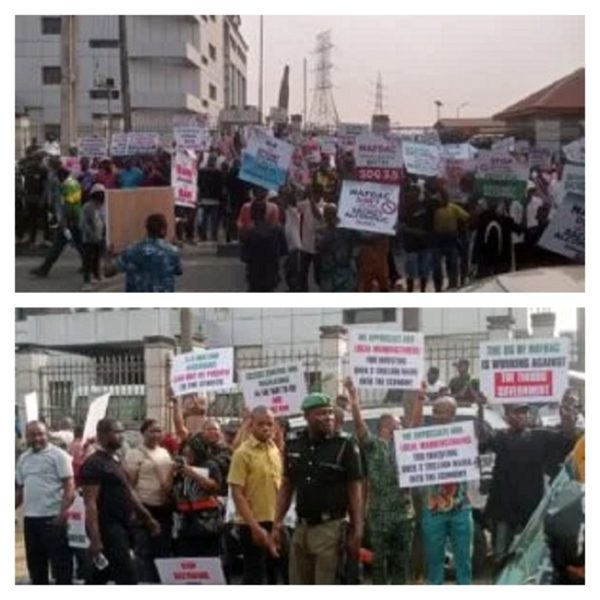
Protesters against the ban on alcohol in sachets and pet bottles and protesters in support of the ban on Tuesday, January 27, 2026, stormed the Lagos office of National Agency for Food and Drug Administration and Control (NAFDAC) at Isolo in lagos.
Both groups displayed various placards with contrasting messages in support of and against NAFDAC’s decision to stop manufacturers from producing alcoholic beverages in sachets and pet bottles below 200ml.
EnviroNews had earlier reported that NAFDAC’s Director-General, Prof. Mojisola Adeyeye, on Jan. 21, during a media parley, told newsmen that NAFDAC had started enforcing the ban on alcohol in sachets.
Protesters against the ban on alcohol in sachets and pet bottles and protesters in support of the ban on Tuesday in Lagos
Adeyeye stated that the enforcement would continue, stressing that only government legislation could halt the action.
Protesters in support of NAFDAC’s action carried placards urging the agency to maintain the ban.
Their messages included: “NAFDAC do the needful, our lives are precious”; “NAFDAC don’t let them kill us with sachet alcohol”; “Alcoholic sachet drinks, killing Nigerians”, among others
Protesters against the ban displayed placards with inscriptions “Director-General of NAFDAC of working against the administration of President Bola Tinubu”, “NAFDAC stop working for multi-nationals and protect indigenous manufacturers”, and others.
Mr. Babatunde Adeshina, who spoke on behalf of the group backing the NAFDAC decision, said the group was against the unchecked circulation of, and access to alcohol among young Nigerians.
Adeshina noted that the group’s agitation was driven by national interest and concern for Nigeria’s future.
He said:”As concerned Nigerians, we are not against alcohol consumption, all we are against is the production and sales of alcohol in sachets.
“These alcoholic beverages in small quantities have ruined the lives of many especially teenagers and youth and the impact on public health is visible for all to see.
“That is why we are here to support NAFDAC.”
He urged the agency to follow the enforcement to the end, adding that a lot of Nigerians were solidly behind them.
A coalition of consumer rights advocates led by Mr. Olufemi Lawson, had staged a protest on Monday at NAFDAC Lagos Office, describing the planned enforcement as “economically insensitive and not well thought out”.
Security men were on ground at the NAFDAC premises to prevent chaos and ensure safety of both groups.
The Nigeria Centre for Disease Control and Prevention (NCDC) has said that Nigeria is currently responding to multiple infectious disease outbreaks across all six geopolitical zones.
The diseases include diphtheria, cholera, Lassa fever, and measles.
Dr Jide Idris, Director-General, NCDC, made the disclosure on Tuesday, January 27, 2026, during a three-day Stakeholder Workshop on Preparedness and Response to Public Health Emergencies, organised by the agency, in collaboration with UNICEF and the WHO.
Idris noted that these outbreaks are compounded by climate-related and humanitarian emergencies, as well as broader structural factors such as population mobility, rapid urbanisation, pressure on health systems, and persistent inequities in access to essential services.
Director-General of NCDC, Dr Jide Idris
“Preparedness is not defined by the absence of outbreaks, but by the capacity to anticipate risk, detect threats early, coordinate effectively across sectors and levels of government, and respond in a timely, equitable, and evidence-driven manner,” he said.
The NCDC boss highlighted the centre’s role as Nigeria’s national public health institute, established by law in 2018, to provide technical leadership for the prevention, detection, and response to public health threats.
He emphasised that the centre works in close collaboration with the Federal Ministry of Health, state governments, sister agencies, and development partners to strengthen the country’s health security architecture.
“Over the years, Nigeria has made deliberate investments to enhance its emergency preparedness, including the implementation of the International Health Regulations (2005) Monitoring and Evaluation Framework, the adoption of the National Action Plan for Health Security 2.0, operationalisation of the Integrated Disease Surveillance and Response (IDSR) 3rd Edition, and the ongoing implementation of the 7-1-7 outbreak detection and response approach,” he said.
However, he acknowledged that persistent challenges remain, particularly in coordination across sectors, data integration, logistics, workforce readiness, sustainable financing, and alignment of partner support with nationally defined priorities.
The three-day workshop, according to him, is designed as a technical and policy-oriented platform to examine how Nigeria’s preparedness and response systems function, identify bottlenecks and enablers, and strengthen coherence across frameworks, institutions, and investments.
He urged participants to engage with intellectual honesty and technical depth, adding that the success of the meeting would be measured by its ability to produce an actionable, nationally owned roadmap to strengthen early detection, improve response coordination, and enhance resilience at both national and sub-national levels.
He commended partners for their collaboration and the government for its leadership in advancing health security.
Leading minigrid company CEOs operating across Africa on Tuesday, January 26, 2026, issued a 17-step action plan for funders, governments and industry to urgently align ambition with the scale, speed, and structure of capital mobilisation and regulatory reform required to meet Africa’s electrification targets.
The companies have endorsed a Mission 300 Industry Position Paper setting out 17 priority actions to ensure minigrids can catalyze electrification at the scale envisioned.
Mission 300, led by the World Bank and the African Development Bank, seeks to connect 300 million people to electricity by 2030. So far, the banks have signed Energy Compacts with 29 African governments.
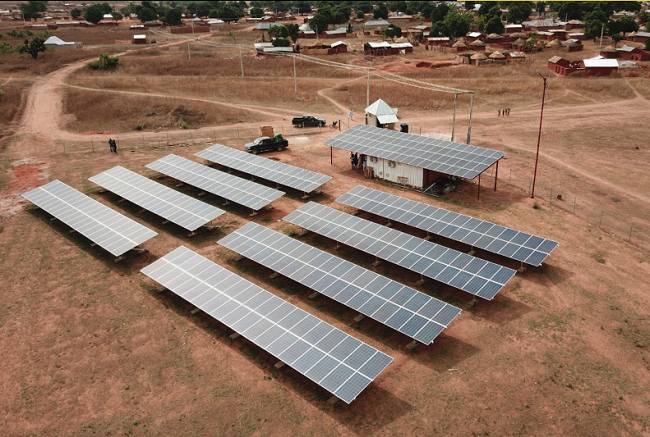
A solar mini-grid system
An analysis of the Compacts, released with the position paper for the first time, is said to demonstrate a strong desire by governments for the minigrid industry to play a central role. Governments expect to serve over 115 million people, equivalent to 23 million connections, by the end of the decade.
Core industry messages
Mission 300 is achievable, but only with a step change in delivery. Delivering 23 million minigrid connections in less than five years implies unprecedented scale and coordination. The sector is ready to deliver, but success depends on immediate action across capital deployment, regulation and institutional execution.
Minigrid companies must have access to both corporate equity and local currency debt to scale. Accelerating deployment will require ensuring that a combination of corporate equity and appropriately structured local currency debt is available to enable minigrid companies to scale operations within existing markets and expand into new countries. Achieving Mission 300 will require $28–46 billion in total capital, including over $10 billion in equity by 2028.
Mission 300 funders must publish a clear, time-bound capital plan. It is important that Mission 300 clearly state how much concessional and risk capital will be deployed, how this capital will mobilise private equity at scale, and how approval and deployment timelines will be accelerated to reflect the urgency of the target. Transparent capital mobilisation plans and measurable delivery milestones should form part of Mission 300 performance tracking.
Policy, regulatory and performance standardisation is essential for speed and scale. Governments and funders must support greater standardisation of policy frameworks, technical standards and industry Key Performance Indicators (KPIs) to reduce transaction costs, streamline approvals and build investor confidence across markets.
Minigrids must be allowed to earn appropriate commercial returns. Governments are urged to enable cost-reflective tariffs, remove import duties and taxes that add over 7% to equipment costs, and allow deployment in commercially viable peri-urban, interconnected and standalone urban settings. Without these conditions, private capital cannot scale at Mission 300 speed.
Mission 300 KPIs must reflect economic impact, not household connections alone. Perhaps most importantly, Mission 300 should count connections to small and medium enterprises (SMEs) and social institutions, not only households as currently stipulated. Including productive and institutional demand in KPIs will enable higher utilisation, stronger economics and more sustainable minigrid systems.
Endorsements
The companies endorsing the paper collectively operate 392 active minigrid sites, have invested over $300 million, and hold a development pipeline exceeding 1 GW, representing a capital requirement of up to $8.2 billion. The sector states that it is ready to deliver, provided the enabling environment moves at the pace Mission 300 demands.
Commenting on the paper, AMDA CEO, Olamide Niyi-Afuye, said: “Mission 300 has set an ambition that meaningfully confronts the scale and urgency of Africa’s electrification challenge. This paper is the industry’s response. It reflects a strong alignment among minigrid CEOs who are already delivering on the ground and ready to scale. The message is clear: the sector is ready. What is now needed is capital mobilisation with a clear, time-bound plan, and regulatory and institutional systems that move at the same speed as the ambition.”
Manoj Sinha, CEO & Founder of Husk Power, said: “M300 has enabled more predictable policies, reduced market risk and unlocked more capital. As a result, Husk Power has increased its ambition to 1GW of distributed energy projects in Africa by 2030. However, it is well known that high income, low energy countries do not exist. Governments have spoken on the need for minigrids to power economic growth beyond households. Now a step change in action is needed.”
CEO & Co-Founder of ANKA, Camille André-Bataille, said: “Mission 300 is not constrained by technology or demand, but by how capital is structured and deployed. Project-level financing remains essential to build minigrid infrastructure, but scaling delivery at the pace M300 requires will depend on increased corporate equity, alongside enabling national frameworks, to strengthen companies’ capacity to grow, execute, and manage portfolios efficiently. No strong companies means no successful projects.
“This Position Paper brings together practical insights from minigrid companies active across Africa and provides concrete recommendations to help align capital, regulation, and institutional frameworks with the realities of large-scale delivery. It is vital that we all move forward in the same direction.”
Olu Ajala, CEO of Ashipa Electric, added: “Mission 300 is no longer a question of ambition. It is a test of execution. Governments have made clear their expectation that minigrids will serve over 115 million people by 2030, and companies like ours are already delivering at scale. What will determine success now is whether capital, regulation, and institutional processes move fast enough to match that demand. With access to appropriately structured equity and local-currency debt, cost-reflective tariffs, and standardized performance frameworks, the minigrid sector can deliver reliable power at Mission 300 speed.”
Kenneth Gitonga, Market Development Facility Manager at Camco, said: “Camco has been committed to the minigrid sector for over a decade, and we’ve seen how it can deliver clean energy and inclusive economic growth. The 17‑Step Action Plan offers the clarity needed to turn early ambition into scalable, bankable projects. With the right enabling conditions, we are ready to deploy catalytic capital and support developers to help Mission 300 deliver sustainable impact for households, SMEs, and communities.”
According to the World Bank, over 600 million people in Africa still lack access to electricity. With less than five years to the 2030 deadline, industry leaders warn that incremental approaches will fall short.
The Position Paper concludes with a clear message: achieving 300 million new connections has massive implications for capital flows, regulatory alignment, and institutional delivery. The minigrid industry stands ready to play a central role, but success will depend on funders and governments matching ambition with execution.
Dangote Petroleum Refinery & Petrochemicals has reaffirmed its commitment to market stability and uninterrupted nationwide supply of Premium Motor Spirit (PMS).
During the recent festive period, the Refinery implemented a deliberate and temporary price support intervention to cushion Nigerians at a time of heightened household spending. This marked the second consecutive festive season in which the Refinery absorbed significant costs in the national interest, including logistics support in 2024 and a price reduction in 2025 to promote affordability and market calm.
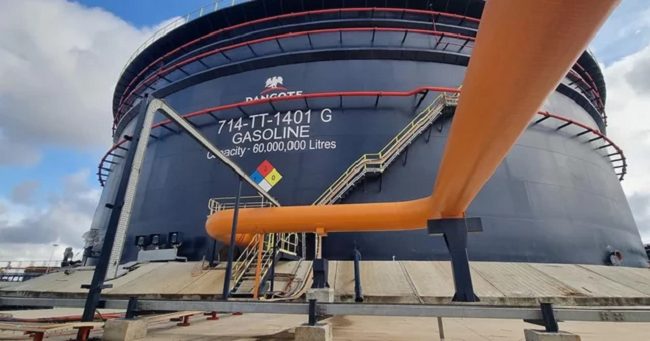
Dangote Refinery
Despite the price reduction, many filling stations failed to reflect the new price at the pump, thereby denying Nigerians the benefits of the reduction.
With the festive period concluded, PMS prices have been modestly realigned to sustainable levels to support long term market stability and affordability. Under the current alignment, the PMS gantry price is N799 per litre, while MRS retail outlets are selling at N839 per litre.
The Chief Executive Officer of Dangote Petroleum Refinery, David Bird, stated that the Refinery continues to supply the domestic market with approximately 50 million litres of PMS daily, with nationwide evacuation and distribution operating normally.
He noted that the Refinery’s design flexibility allows it to process a wide range of crude and intermediate feedstocks, enabling continued PMS supply during planned maintenance activities. According to him, this capability ensures that domestic supply remains stable and uninterrupted.
As a domestic producer, Dangote Petroleum Refinery continues to shield the Nigerian market from import related volatility and external supply disruptions, while remaining a stabilising force in the downstream petroleum sector.
Dangote Petroleum Refinery remains focused on delivering energy security, price stability, and long-term value for Nigerians.
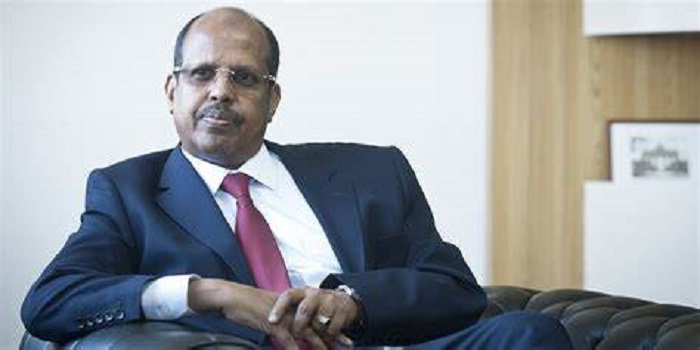
The African Union Commission (AUC) Chairperson, Mahmoud Youssouf, has decried Africa’s position at the frontlines of climate crisis it did not create.
Youssouf made this known during the virtual meeting of the Africa Adaptation and Development Emergency Leaders on Tuesday, January 27, 2026.
The meeting, chaired by Kenya President Williams Ruto, was attended by Heads of State and Government from Africa, partner countries, leaders of international financial institutions, and strategic partners.
Mr. Mahmoud Youssouf, Chairperson of African Union Commission (AUC)
According to him, Africa is on the frontlines of a climate crisis it did not create, saying droughts, floods and rising temperatures are eroding lives, economies, and ecosystems.
Also, shrinking climate finance threatened decades of hard-won development gains.
Youssouf said, “This is not only a climate emergency, it is a development, justice, and security emergency.
“Looking beyond COP30, one truth is clear: the world cannot meet its climate goals without Africa, the continent cannot unlock its full potential without predictable and equitable adaptation finance at scale.
“Africa brings solutions, youth-led innovation, climate-smart agriculture, renewable energy, resilient infrastructure and nature-based solutions, with the right finance and technology, Africa can lead global green growth.”
This, according to him, is possible through adaptation as a pathway to development, saying every road, school, hospital and farm must be climate-resilient.
He stressed the need for Africa to unlock large-scale adaptation finance, private investment, integrate resilience into development planning centred on people, especially women and youth through the inauguration of AAAP2.0 (2026–2030).
The AAAP2.0 (2026–2030) refers to the second phase of the Africa Adaptation Acceleration Programme announced by the AUC in January 2026, as a strategic initiative to scale-up climate adaptation efforts across the continent.
The phase focuses on implementing climate-resilient development from 2026 to 2030, in the bid to bridge the climate finance gap and foster green growth.
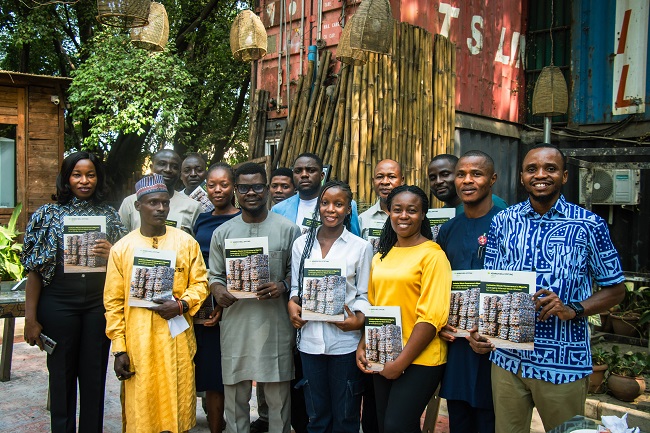
The NGA Green Academy Fellows, an initiative of the Heinrich Böll Foundation, have unveiled what appears to be a groundbreaking research report titled “Inclusive Waste Governance in Nigeria: Leveraging Informal Waste Workers for a Circular Economy.” The report spotlights the invaluable contributions of informal waste workers to Nigeria’s waste management and recycling systems, while urging policymakers to formally recognise and protect this vital sector.
According to the report, informal waste workers are responsible for an estimated 60–90 per cent of waste collection and the recovery of recyclable materials within Nigeria’s circular economy value chain. Despite their crucial role, these workers continue to face significant challenges, including occupational and health risks, harassment, poverty, and social stigma. The report calls for inclusive governance strategies that integrate informal workers into policy development, planning, and implementation.
NGA Green Academy Fellows
The launch event convened a diverse group of stakeholders in Abuja, including informal waste workers, formal waste management and recycling companies, civil society organisations, media, international bodies, and government representatives. The discussion focused on strengthening environmental sustainability and advancing circular economy practices in Nigeria’s capital.
Co-Lead Researcher, Eugene Yakubu Shichet, described informal waste workers as “unsung heroes” whose efforts keep Nigerian cities clean, sustain the recycling industry, and contribute significantly to national economic growth. He noted that the event sought to amplify the voices and lived experiences of these workers. In tandem, a photo exhibition showcased portraits and stories of informal waste workers, bringing their challenges and positive environmental impact to the forefront.
Ms. Sophie von Knebel, Country Director of the Heinrich Böll Foundation, emphasised the importance of people-centred, inclusive approaches to waste governance. She stressed that achieving a cleaner, more sustainable society requires meaningful involvement and recognition of informal waste workers, as well as the upholding of their human dignity.
Representing the government, Hajiya Hannatu Ibrahim, Head of the Environmental Department at the Abuja Municipal Area Council (AMAC), called for closer collaboration between government, NGOs, and recyclers to improve waste management. Noting that the publication’s alarming findings on the severe exposure of informal waste workers to hazardous and chemical waste underscores the urgent need for the government to implement policies that ensure these workers have access to comprehensive health services at subsidised rates.
Lead Researcher, Aniebiet Obot, provided context on Nigeria’s mounting waste crisis, noting the effects of rapid urbanisation and rural-urban migration, with urban centres generating an estimated 40,000-60,000 tonnes of waste annually. He advocated a transition from linear waste systems to a circular economy, recognising the pivotal role informal waste workers play in last-mile waste collection and in supplying materials for recycling. Aniebiet also identified existing structural gaps and the lack of a harmonised waste governance framework as barriers to effective waste management, while commending AMAC’s steps toward recognising informal workers in its new waste policy.
Panel discussions delved into the realities faced by informal waste workers and explored practical strategies for integrating the informal sector into formal waste governance and recycling systems. Stakeholders reaffirmed that inclusive policies that recognise, protect, and partner with informal waste workers are essential to building a sustainable, circular waste economy in Nigeria.
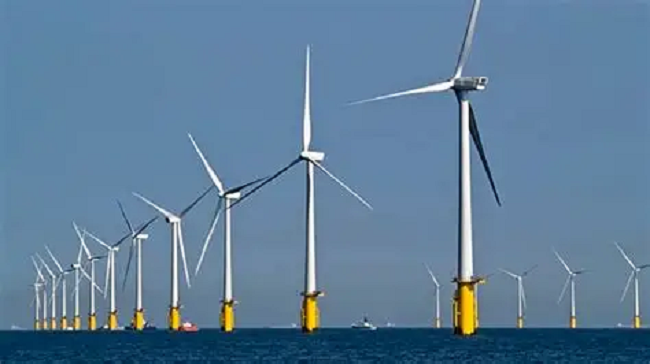
As the world observes the International Clean Energy Day on Monday, January 26, 2026, 10 European countries have committed to building an interconnected offshore wind power grid in the North Sea that is expected to provide 100GW of renewable electricity, enough to power 143 million homes.
The agreement, which involves building windfarms that connect directly to multiple nations through high-voltage subsea cables, is to be signed on Monday, September 26, in Hamburg by energy ministers from the UK, Belgium, Denmark, France, Germany, Iceland, Ireland, Luxembourg, the Netherlands and Norway.
Offshore wind power farm
It was reached less than a week after US President Donald Trump criticised European wind power at the World Economic Forum in Davos, calling windmills “losers” and claiming countries with more wind power are doing “worse.”
Last year, wind and solar energy reportedly overtook fossil fuels in the EU’s power generation mix.
While lauding the commitment of 10 European countries, environmental campaign group, 350.org, however emphasised that to clearly demonstrate climate leadership, moves to scale renewable energy for energy security and independence must be matched by an end to fossil fuel financing.
Clémence Dubois, 350.org Global Campaign Manager, said: “The Trump administration may be doing everything it can to keep the fossil fuel ‘rollercoaster’ going, but people are no longer buying tickets. Some European political leaders are beginning to recognise that energy security and economic stability won’t come from oil and gas, but rather, a renewable energy system that can lower electricity bills and can’t be switched off by dictators or disrupted by global conflicts.
“This isn’t just about switching energy sources – it’s about ending a rigged system where fossil fuel companies pocket the profits and the public picks up the bill through higher energy costs, climate disasters, and government handouts.
“Historically, oil and gas extraction in the North Sea has done a lot to fuel global heating, accounting for over nine percent of total global greenhouse gas pollution. Transforming the North Sea into a renewable energy hub would not erase that damage, but it could begin to correct it – especially if this is matched by an end to public finance for fossil fuel everywhere, and if fossil fuel companies are made accountable for the harm they’ve caused.
“Done right, it can be a powerful model of regional climate cooperation that addresses urgent economic and security concerns today, without exporting climate risk and costs to future generations and the Global South.”
Nigeria’s gas ambitions will not be delivered by policy declarations alone. They will be delivered by speed, precision and engineering ingenuity. The Agbada-67 intervention in OML 17 offers a compelling case study of how brownfield innovation can unlock stranded capacity, boost domestic gas supply and stabilise power generation, without drilling a single new well.
Re-engineering Gas Assets Accelerates Power Delivery
Nigeria has positioned gas as its transition fuel, but the challenge is delivering results. The nation lacks neither reserves nor strategies, only speed of execution. Bridging the gap between gas resources and reliable power depends less on new drilling and more on innovatively re-engineering existing assets.
Despite Africa’s largest proven gas reserves, the country still faces power shortages, industrial disruptions, and gas flaring, gaps that cannot be closed by policy intent or capital-intensive megaprojects. It requires practical, scalable engineering solutions that unlock value from existing assets, quickly, safely, and affordably.
In 2025, a rigless gas well intervention at Agbada-67 in OML 17 demonstrated what is possible when innovation meets constraint.
Through a carefully executed brownfield recompletion, the well was restarted with a gas output of approximately 45 million standard cubic feet per day (MMscf/d), contributing to a broader rise in OML 17 gas production from about 50 MMscf/d to a peak of 135 MMscf/d.
The impact was immediate: aggregate power generation across plants supplied from the eastern network increased from roughly 100 MW to over 325 MW on average, with peak generation reaching about 455 MW.
Why brownfields now matter more than ever
Nigeria’s upstream sector is undergoing a structural transition. With many international oil companies exiting, assets once developed under capital-intensive expansion models are now operated by indigenous firms facing tighter capital but greater pressure to boost production.
Historically, wells were drilled to target larger, deeper reservoirs, often bypassing shallower hydrocarbon-bearing zones. Over many decades, this approach has created a vast portfolio of completed and suspended wells, running across untapped or underutilised reservoirs. In the onshore Niger Delta alone, over 3,200 wells have been drilled, with more than 2,300 now completed or suspended.
This history presents a challenge and an opportunity, as while mature assets face declining production, targeted brownfield interventions offer a high-value, low-cost alternative to new developments.
The Agbada-67 technical approach
Agbada-67 was originally completed in a deeper gas reservoir and began experiencing water breakthrough in line with reservoir prognosis. Conventional responses would have involved drilling a new gas well at an estimated cost of about $25 million, or a full workover costing roughly $10 million.
Instead, the technical team pursued a third path: a two-stage, through-tubing recompletion – an approach that had not previously been executed in this combination on the asset.
The first stage involved a chemical water shut-off of the existing completion to enable access to a shallower reservoir. The second stage focused on recompleting the well through existing tubing, avoiding the need for a rig.
This included through-tubing perforation, reservoir stimulation using micro-emulsion breaker chemicals, isolation of the annulus from the surface with a cement packer, and the deployment of a bespoke ceramic sand screen 60 feet long, installed inside a 4½-inch tubing string at a depth of approximately 8,300 feet.
The entire operation was completed safely within 51 days.
The result was a recompleted gas well that delivered nearly double its initial production forecast, at strong reservoir pressures, and without expanding the field’s surface footprint.
Impact beyond the wellhead
For millions of Nigerians, this is not about infrastructure statistics; it is about lights staying on, hospital equipment functioning, and small businesses being able to operate without diesel generators.
This is why the significance of Agbada-67 lies not only in production numbers, but in its system-level impact.
In 2025, increased gas availability from OML 17 more than doubled supply into the eastern domestic gas network. Power plants dependent on this gas were able to ramp up generation, improving grid stability for households, hospitals, businesses, and industrial users. This is what gas monetisation looks like when it works, not as an abstract policy goal, but as electricity delivered.
Financially, the project also underscores the efficiency of brownfield innovation. The intervention cost approximately $3.5 million, around 35% of the conventional workover, and about 15% the cost of a new well. The payout period was roughly 22 days, with revenues of about $14 million generated within the first 90 days of production.
Replicability across Nigeria’s brownfields
Agbada-67 is the proof point.
Similar conditions exist across Nigeria’s mature fields, wells with existing infrastructure, declining reservoirs, and bypassed zones that can be accessed through creative recompletion strategies. The same approach is already being evaluated for nearby wells, including Agbada-68, which is expected to experience water breakthrough in the coming months.
More broadly, the lesson is clear: Nigeria does not need to wait for large greenfield projects to grow its gas supply. With the right technical mindset, regulatory support, and disciplined execution, brownfields can deliver meaningful volumes quickly and sustainably.
Aligning innovation with national priorities
Gas has been clearly identified as Nigeria’s transition fuel. Increasing domestic gas supply supports power generation, industrialisation, and emissions reduction by converting routine flares into productive use. However, delivering on this vision requires solutions that play out Nigeria’s current realities; solutions that are cost-effective, fast to deploy, and grounded in local engineering capability.
The success at Agbada-67 reflects what is possible when indigenous technical teams, working in partnership with NNPC and NUIMS, focus on practical problem-solving rather than textbook development models.
As Nigeria navigates the next phase of its energy transition, brownfield innovation should move from the margins to the mainstream of development planning. Regulators, operators, and investors all have a role to play in enabling these approaches through flexible frameworks, data transparency, and continued collaboration.
Agbada-67 shows that with the right tools and mindset, existing assets can deliver new value. The challenge now is to scale. If Nigeria is to meet its domestic gas ambitions, the future will not be built only on what we drill next, but on how intelligently we re-engineer what we already have.
Debo Adebajo is Vice President, Technical, Heirs Energies
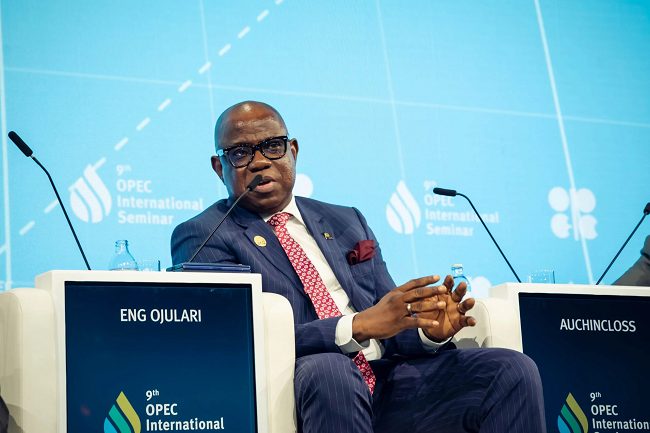
The Group Chief Executive Officer of NNPC Limited, Mr. Bashir Bayo Ojulari, will take centre stage at the 9th Edition of the Nigeria International Energy Summit (NIES) 2026, headlining a high-level, investor-focused fireside chat that underscores Nigeria’s strategic commitment to energy security, market reform, and the attraction of long-term global capital.
The session, titled “Securing Nigeria’s Energy Future,” will be held at the International Conference Centre (ICC), Abuja, as part of NIES 2026, convened under the theme “Energy for Peace and Prosperity: Securing Our Shared Future.”
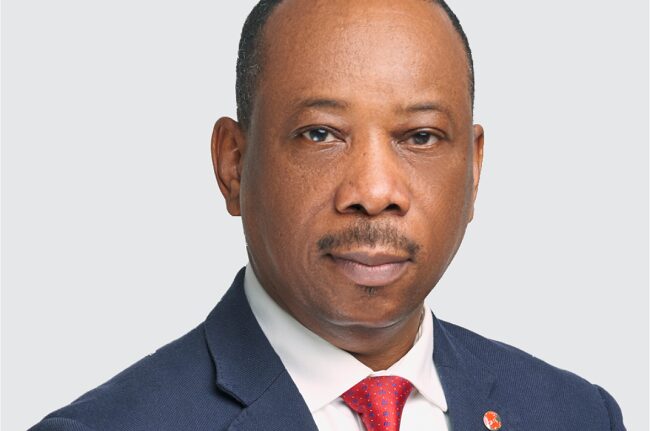
Bayo Ojulari, GCEO, National Petroleum Company (NNPC) Limited
It will be moderated by renowned energy and investment broadcast journalist, Ms. Vimbai Mutinhiri-Ekpenyong, and attended by a distinguished audience of chief executives, institutional investors, financial leaders, regulators, and energy service providers from across Africa and international markets.
“This fireside chat reflects our commitment to positioning Nigeria as a credible, reform-driven energy market where global capital, policy leadership, and commercial performance align,” said James Shindi, Chief Executive, Brevity Anderson, organisers of NIES 2026.
Positioned as one of the Summit’s flagship engagements, the fireside chat is expected to provide a candid and forward-looking examination of Nigeria’s evolving energy strategy amid global market volatility, intensifying energy transition expectations, and heightened investor scrutiny around governance, transparency, and capital discipline within national oil companies.
The conversation will frame Nigeria’s role at the heart of Africa’s energy economy and explore the strategic pressures shaping national revenue performance, energy security, and investor confidence. It will also spotlight how NNPC Limited is navigating production disruptions, refining constraints, gas supply dynamics, and asset transitions, while advancing a commercially driven transformation agenda aligned with global best practices and long-term national development goals.
Discussions are expected to span the stability and security of Nigeria’s production environment, the repositioning of refining and supply systems to strengthen market confidence and reduce import dependency, and the balancing of domestic gas needs with export commitments to support power generation and industrial growth.
The session will also examine how NNPC is supporting indigenous operators amid international oil company divestments, the policy and fiscal signals required to attract sustained investment in a transitioning global energy market, and the company’s progress in strengthening governance, capital discipline, and value delivery under the weight of national and market expectations.
“Bringing NNPC’s leadership into direct dialogue with international investors and industry leaders is central to advancing confidence, transparency, and long-term partnerships across Africa’s energy value chain,” said Kunle Odusola-Steveson, the Conference Producer.
The session will conclude with an interactive question-and-answer segment, offering investors, partners, and industry leaders the opportunity to engage directly with NNPC’s leadership on Nigeria’s energy outlook, reform priorities, and long-term investment landscape.
The Nigeria International Energy Summit is a premier global platform that convenes policymakers, industry leaders, investors, and innovators to advance dialogue, partnerships, and policy-driven solutions shaping Africa’s energy future.